You Know, If Yahoo Could Actually Focus, They’d Be a Helluva Lifestreaming Service

Yahoo announced its latest effort around making itself more social.  And unlike previous efforts (Mash, Yahoo 360), this one has potential.

Yahoo beta released the “Universal Profile”. To be honest, the initial release is underwhelming. Here’s what mine looks like:

The profile includes the picture + bio + interests that we’ve come to expect. What else?

  • Status Update = Facebook status, Twitter
  • Guestbook = Facebook Wall
  • Connections = any social network
  • Updates = Facebook news feed, FriendFeed

A Compleat Social Profile. Well not really. But it has potential.

Interestingly, the Status Update is a 140-character field. Not 125 characters, not 150 characters. 140, like Twitter. That probably says something about future Twitter integration.

Lets focus on that Updates box there. Because that’s where maybe, maybe Yahoo can finally integrate its disparate Web 2.0 properties.

Facebook, FriendFeed Have Been Enjoying Yahoo’s Sites

FriendFeed nailed the idea of pulling updates from different services. 43 of them currently, including three Yahoo properties. Check ’em out on FriendFeed:

Facebook, seeing the possibilities in lifestreaming, added feeds into the news feed. So now friends can see your activities on external sites as well, including Del.icio.us and Upcoming.

Currently, Yahoo’s beta release doesn’t include updates from those services. What is included? Yahoo 360, Yahoo Buzz, Yahoo Avatars (huh?), Yahoo Shine. I tested the update timing. Yahoo Buzz updated quickly onto my profile. I created blogs on Yahoo 360 and Yahoo Shine (yes, the women’s site). Neither blog post ever showed up on my profile.

So the initial profile is a bit underwhelming, the sites that feed into the profile are limited and activities don’t update from the sites that are available. Wow.

OK, not the biggest endorsement so far, but read on…

The Yahoo Advantage

Yahoo has three distinct advantages in the lifestreaming race:

  1. Traffic
  2. A set of sites that lend themselves well to lifestreaming
  3. Email/IM social graphs

Traffic

Yahoo draws the second highest traffic in the United States. For reference, here are traffic stats for Yahoo, Facebook and FriendFeed:

Critical to these lifetreaming social networks is having a sufficient number of users. Twitter has maintained its dominance in microblogging despite the emergence of competitors. Biggest reason? Everybody’s already there.

Yahoo ‘s lifestreaming starts with a critical mass of potential users.

Lifestreaming-Oriented Services

Yahoo has a number of sites that lend themselves well to lifestreaming, as mentioned above. The users of these sites are already putting things into the public domain, a psychological hurdle for many people in terms of social networks. While these sites aren’t available yet, Dan Farber reports that they will be soon.

Two services merit particular call-out here: Yahoo Buzz and Twitter.

Yahoo Buzz is Yahoo’s answer to Digg, Reddit, Mixx and other social news sites. Users submit stories, and other users can vote them up or down. Apparently, Yahoo Buzz delivers huge traffic. TechCrunch reported its single highest traffic day ever thanks to a link on Yahoo Buzz. And ReadWriteWeb reported that Yahoo Buzz had overtaken Digg in terms of visitors.

What I like about the integration of Yahoo Buzz into the Yahoo Universal Profile is that it becomes quite easy to see what users are interested in. It also becomes a great way to find stories via your social network.

Twitter is the best-known microblogging service, and competes quite well with Facebook’s status updates. Twitter is enjoying network effects allowing it to pull away from its competition. The 140-character Yahoo Universal Profile status updates are now available. I’d like to see how Yahoo either integrates Twitter into its experience, or creates a distinct microblogging experience built on Universal Profile status updates.

Email/IM Social Graphs

In the Yahoo Universal Profile, you are provided with a list of 10 connection recommendations. How are these recommendations generated? Check out what Yahoo says:

Now in a lot of ways, this is no different from uploading your email contacts to a social network and inviting people. The difference here is that these contacts are already using Yahoo. And Yahoo has the advantage of exposing lifestreaming via the email and IM that people use. Not as some third party social netowrk where a lot of people won’t bother to show up.

This goes back to the existing user base of Yahoo. If Yahoo can figure out how to put lifestreaming in-the-flow of its users’ daily interactions with the site’s properties, it’s got huge upside potential with this idea.

But Yahoo Is Always So Distracted

The latest distraction is the news that Yahoo will be laying off a lot of people. This follows the Microsoft acquisition attempt drama. And Yahoo has a history of acquiring sites, but not doing much with them. And many people question just what Yahoo is doing with this Universal Profile:

Don’t really see a point in setting up a profile on Yahoo!. I mean, I see the company’s goals here, but I do not see any user benefits. After all it’s just another Facebook, however tied to a dying Search Engine.

There is justifiable skepticism that Yahoo can actually pull off creating a vibrant, useful lifestreaming service. If Yahoo could pull it off, here’s what it gains:

  • Higher page views
  • Longer page views
  • Exposure and growth of its many sites via the lifestreams of a user’s social graph
  • A clear and distinct advantage over Google and Microsoft
  • An ability to lead the technology conversation again

I’m rooting for Yahoo from this corner. I would love to see Yahoo bring lifestreaming and social networks to the mainstream.

*****

See this post on FriendFeed: http://friendfeed.com/search?q=%22You+Know%2C+If+Yahoo+Could+Actually+Focus%2C+They%E2%80%99d+Be+a+Helluva+Lifestreaming+Service%22&who=everyone

Entrepreneurship as Signal: Quitting Facebook to Tackle Enterprise 2.0

In a recent post, Fred Wilson had this to say about Enterprise 2.0:

This is one of the reasons we’ve struggled so hard to invest in “enterprise 2.0” at Union Square Ventures. We have tried pretty hard to find companies that we can invest in that bring the new web technologies to the enterprise, but often we’ve found what happens is that consumers (ie employees) bring the web technologies they use every day to work and they prefer that.

I understand the sentiment, but I’m not really agreeing with Fred on this one. Corporate employees don’t use their Gmail and Yahoo Mail in lieu of their company’s Microsoft Outlook application. It’s really a matter of making an application that solves some key issues and has an appropriate experience for what it needs to accomplish.

But Fred’s opinion is interesting in the context of Friday’s news that two key Facebook executives are leaving the company “to build an extensible enterprise productivity suite”. They plan to leverage many of the conventions of Facebook for this new company.

Enterprise 2.0? Are they crazy?

Enterprise Software Is So Boring

Robert Scoble set off a firestorm last December when he wrote Why enterprise software isn’t sexy. In that post, he observed a couple things:

  1. “Business software like that from Oracle, SAP, Microsoft etc makes a TON of money.”
  2. “I know that when I talk about enterprise software the numbers of viewers just don’t show up. So, tech bloggers quickly learn that if they talk about enterprise software they aren’t going to get many advertising impressions.”

Michael Arrington of Techcrunch said the same thing in this tweet in April:

“@dahowlett enterprise is boring. no way around it. people just don’t care.”

Nick O’Neill wrote this about the Facebook execs’ departure:

“Apparently Rosenstein and Moskovitz are leaving to create an enterprise level productivity software package. Sounds thrilling doesn’t it?”

Rosenstein and Moskovitz are deeply ingrained at Facebook. They’ve been there for a while, and have seen it blossom as the go-to social network. They’ve were there for the heady valuation of $15 billion. The pre-IPO company still has work in front of it, but surely it’s pretty interesting.

So what do they do? They quit to go start a BORING enterprise software company.

What could this possibly tell us?

Entrepreneurship As Signal

Here’s one clue for why the Facebook guys would quit to start their own Enterprise 2.0 company:

Via ReadWriteWeb

Via ReadWriteWeb

Social networking inside the enterprise is expected to dominate spending in the category. And what is Facebook? The most successful consumer social network.

The Enterprise 2.0 market is still quite nascent and fragmented. Combine that industry profile with projected spending in the category, and suddenly you understand why these guys are striking out on their own.

It’s not an easy market to crack, and working inside the enterprise is much different from working out on the Web. Looking forward to watching their progress.

*****

See this post on FriendFeed: http://friendfeed.com/search?q=%22Entrepreneurship+as+Signal%3A+Quitting+Facebook+to+Tackle+Enterprise+2.0%22&who=everyone

Facebook Is Starting to Get My Attention Again

Facebook recently made its new design permanent, despite the protests of many vocal users. Where the old focus was on a slow newsfeed, ornamenting your profile and interacting through thrird party apps, the new design puts content and conversations at the center of the user experience.

I think Michael Arrington still has one of the best perspectives on it when he wrote The Friendfeedization Of Facebook back in July.  As he said there:

But it’s also clear that they like what they see at Friendfeed, which expertly combined the idea of an activity stream that was first popularized by Facebook with the microblogging trend introduced by Twitter. Users constantly add content that their friends read and comment on, which creates yet new content. The virtuous page-view creating cycle continues.

The attraction of FriendFeed for me is the ability to discover new things via the variety of feeds, and to engage others in conversations about a wide range of topics. I had stopped using Facebook because of the inane apps and the funky secret algorithm that controlled what went into the news feed. Movie trivia games and sheep throwing with old school friends just wasn’t that fulfilling.

Interactions from My Facebook Network Are Increasing

But recently, I’ve noticed activity in my Facebook network picking up. I generally don’t post anything in Facebook – tweets are my status updates, FriendFeed is my activity stream. In the past few days, I’ve had more interactions via those tweets than I’ve had in a while. Here’s an example.

Tweet: “Alternative theory…Palin’s interview with Couric was just to set the bar incredibly low for her upcoming debate with Biden.”

Responses from my network…

High school friend: “If so, she’s a genius.”

College friend: “Brilliant tactic IMO.”

Cousin: “I can hardly wait. It will be so cringe-worthy!”

Former co-worker: “hmmm, I have my fingers crossed. Sadly, Biden has the tendency to put his foot in his mouth too……”

As a point of comparison, here’s the response this tweet got on Twitter:

N/A: no one replied.

Now it’s not like I’m the most active Twitterer. But I’ve been more active there than on Facebook. Facebook had more interaction in this case.

And as one more point of comparison…here’s the response on FriendFeed:

5 Likes, no comments

Likes are great, they are the currency of FriendFeed. No conversations though in this case.

Facebook: The Value of Context and Better Interaction Hooks

Actively engaging in FriendFeed and (somewhat) Twitter, I’ve built up some context with my networks on those sites. And there are plenty of good conversations there. FriendFeed is still my favorite haunt.

What interests me with the Facebook experience is the variety of people from my life – classmates, family, colleagues – that commented on that tweet. I really haven’t maintained a strong interaction with those folks. But there’s an existing reserve of “context” from my past interactions that is the basis for interacting.

And Facebook really did take a page from FriendFeed, with commenting on various activities. I’ve been impressed with how non-FriendFeeding, non-Twittering people in my network have started using the new commenting functionality.

I don’t know if it will last, but early results are promising.

*****

See this post on FriendFeed: http://friendfeed.com/search?q=%22Facebook+Is+Starting+to+Get+My+Attention+Again%22&who=everyone

Microsoft Is Getting Much More from Its Investment in Facebook

When Microsoft invested $240 million in Facebook at a $15 billion valuation, the general reaction was one of disbelief. The valuation is too high to justify. But some people at the time felt like the dollar amount was well within the comfort zone of a giant like Microsoft. Here’s how commenter Prashant put it on TechCrunch:

I don’t think that MSFT expects to make money on the $250MM at a $15B valuation. Internally for them it is a $250MM investment to get an exclusive advertisement deal over the next 4 years. The 2% stake is only icing on the cake. Had they announced that they have given $250MM to Facebook for a 4 year exclusive ad deal, no one would have flinched, this is cheaper than the Google/MySpace deal.

Over the past few days, I’ve read a couple other blog posts that make me think Microsoft may be getting much more from its investment. Here’s a quick list of what what Microsoft seems to be getting:

  1. Exclusivity on a huge number of page views, and experience with social context advertising
  2. Insight into an emerging competitor to its operating system and productivity apps hegemony
  3. Model for bringing social networking into the enterprise

Let’s look at #2 and #3.

Operating System and Productivity Apps

Dan Kimerling wrote a great piece on TechCrunch about how Generation Y looks to the new wave of social media apps for functionality previously provided by Microsoft’s desktop and web offerings. As Dan notes:

Facebook succeeds because it is the killer web application for communications and personal information management

These are in-the-flow tools. Facebook users don’t leave Facebook, open email and send a separate message. They do it all, right there. The level of functionality is just right for their usage.

The original Microsoft email and productivity apps were pretty simple, but they did just what people needed, and with skillful marketing tie-ups, Microsoft became the standard for millions of us. Over time, Microsoft has added new features to each release, because that’s how they grew their revenues. You had to get the latest. But what happened was we got to feature bloat.

Via Kathy Sierra, Creating Passionate Users Blog, 2005

Via Kathy Sierra, Creating Passionate Users Blog, 2005

I think Kathy Sierra’s graphic is spot-on for general mainstream users. Personally, I probably use only 5% of the functionality available with the applications.

I’ve talked previously about the Innovator’s Dilemma here. As market incumbents grow, they tend to move up-market in terms of functionality in their offerings. What this does is open the door for competitors with new functions that are simpler to use. These new competitors target a niche, and grow slowly upward from there.

Facebook’s niche is still heavily Gen Y. But they’re gaining a foothold. Microsoft’s investment gives them a ringside seat for what’s happening there.

Social Networking Inside the Enterprise

I was reading a blog post by Doug Cornelius where he reported out notes from a session at the Real World SharePoint Experiences conference. A Microsoft Solution Specialist was describing the roadmap for SharePoint. If you don’t know, SharePoint is Microsoft’s enterprise collaboration software, where teams can build out individual sites to shhare and work on documents and to communicate. Each employee has a MySite, which includes their corporate directory information as well as the the list of groups and documents that are theirs.

Here’s a quote from Doug’s post:

Social networking. Mysite will be the hub of the social network. There will likely be Knowledge Network integration. They are looking to take some lessons from their investment in Facebook.

The Enterprise 2.0 space is hot, and social networking is a big focus for companies and vendors. Through its investment in Facebook, Microsoft can learn a lot of what drives interactions, how people connect and watch the mistakes the young company makes. As Dave Ferguson put it:

Good judgment comes from experience. Experience comes from bad judgment. The corollary is that the bad judgment doesn’t have to be yours.

Microsoft continues to evolve its SharePoint offering, and I look forward to SuperPoking my colleagues one day.

Wrapping Up

At first, the only purpose for the Facebook investment appeared to be advertising related. I’m sure that’s still primary, because of the huge dollars involved.

But Microsoft is also gaining an information advantage for the new wave of social computing that is finding its way into both consumer and business experiences. Given the vast reach of the company’s product lines, that’s pretty valuable as well.

*****

See this post on FriendFeed: http://friendfeed.com/search?q=%22Microsoft+Is+Getting+Much+More+from+Its+Investment+in+Facebook%22&who=everyone

“What’s the Difference Between IM and Yammer?”

It’s been a couple weeks since Yammer launched at TechCrunch50, and I assume Yammer is getting a road test out there in the workplace. One thing I saw after the launch was people wondering if Yammer was really just a copy of instant messaging. Here’s a representative tweet:

What’s cool about it? What’s the difference between IM and yammer?

Let’s hold off from noting the irony of posting that question on Twitter…

It is a fair question, because of their high similarity: short messages to a group of subscribers. But there’s so much more to the story.

Comparing IM and Yammer

The table below describes similarities and differences between instant messaging and microblogging (e.g. Yammer):

The table is pretty self-explanatory. Let me add a little more context from two blog posts related to this.

Sam Lawrence of Jive Software has a nice post, 18th Century Twitter. A quote from his post:

Everyday thousands of employees miss the opportunity to find people who can make what they’re doing less redundant or more valuable. What’s the ROI of a fully networked, 100% connected workforce? What’s the value of having all those connections saved for others to profit from?

And John Tropea writes about 140 characters to knowledge share. He makes several points about how Twitter inside the enterprise (e.g. Yammer) is a powerful basis for surfacing knowledge. In this quote, he comes at microblogging from a blogging perspective, not an IM perspective:

Twitters value contribution to the knowledge flow-spontaneous, unpolished, work in progress, thinking out loud-lends itself to this type or quality of participation due to its brief, immediate, and intimate publishing format…let’s hope internal blogs generate the same calibre of tacit value without being hindered by their format.

The fact that John looked at services like Yammer from a blogging perspective as opposed to an instant messaging perspective illuminates a key difference between IM and Yammer.

When you know what you write is visible to everyone, trackable and does not have the burden of being “on point” to recipients, you’re somewhere between instant messaging and blogging. I think Sam’s post does a nice job of summarizing the value of that.

I’m @bhc3 on Twitter.


Business Week Launches Info Sharing Social Network – Will It Float?

Business Week Magazine has entered the social networking world with Business Exchange. Business Exchange is built around the sharing of information and discussing it with others. Here’s how Editor-in-Chief Stephen J. Adler described it:

“Business Exchange, a free online information hub, is a new initiative of BusinessWeek.com. It enhances the ongoing reporting and analysis of Business Week writers and editors in print and online by aggregating other sources of news and analysis (including other media brands, blogs, videos, and research reports). Readers can use it to track business trends, with hundreds of topics available at launch, or create a specific topic that’s not currently on the Exchange.

The best part is the social underpinning of this platform. Users (including our journalists and editors) can share their own knowledge about a subject to enrich each topic far beyond what any single person or search engine can accomplish.

Business Exchange is a mix of:

  • Social bookmarking
  • Forums
  • Social network

Business Exchange vs. FriendFeed

FriendFeed actually has a similar mission to that described by Business Week’s editor-in-chief. So I put together a quick comparison of the two sites:

FriendFeed feels like a hotbed of activity, the kind of site where you’re compelled to hit the F5 refresh button. Business Exchange is more staid, partly because it doesn’t yet have an active user base, partly due to its design. The key design points from the table above that make a difference are:

  • Bounce to the top – Adding a comment or a save doesn’t move an item to the top of the Business Exchange page for a given topic, losing that feeling of “what’s hot”.
  • Forced segregation of content – For a given topic in Business Exchange, you can look at News or Blogs or References. But you can’t take them all in at once.
  • View Saves by user – In the list of entries on Business Exchange, you can’t see how many times an item has been Saved. This information is available for an individual item. But it’s not an easy experience to see what others found valuable.

As seen in this discussion, community, conversations, variety and outstanding design are making a difference for FriendFeed.

That being said, Business Exchange is new and it’s beta. Let’s see what they are doing.

Business Exchange’s Features

Content is both streamed and added. Being streamed into Business Exchange seems like a nice bonus for a media site or blogger. Check out the difference below in the way these two items made it into Business Exchange:

The MyDebates post was “published” into the topic. The Soul of the Enterprise post was “added” to the topic. From what I can tell, designated media sites and blogs are automatically added based on either key words or tags.

Full Profile. You get a full profile page on Business Exchange. Work, education, picture and up to four links to other sites. It also shows your recent activity, which is nice.

Building a social network. You can’t search for other users. So you find them when they’re displayed as “Active Users” on the site, via the items they Save or Comments they make. It makes it a bit challenging to build out your list of subscriptions. Your subscriptions are simply a list, and you can click an individual to see their activity. There is not currently a way to see the aggregated activities only of your subscriptions.

Focus on Most Active. At different points on the site, Business Exchange gives a list of what’s most active. The home page tells you the most active Topics, and gives a list of Active Users. Each topic includes a list of Most Active, which does aggregate from News, Blogs and References.

The definition of Most Active inside a topic is probably based on the number of Views, Saves and Comments. You can see all of those stats for an item when you go to make a Comment. I like seeing those stats.

If You’re Business Minded, Check It Out

It’s early in the life of Business Exchange. Getting more users will, of course, make it a more interesting place to hang out. It doesn’t hurt that it hangs off the businessweek.com site, and that it can get periodic boosts from the print magazine.

I’m still learning the site, and maybe the Most Active tab for each Topic is the place to be.

My profile on Business Exchange is here. If you sign up, add me, and I’ll add you back.

*****

See this post on FriendFeed: http://friendfeed.com/search?q=%22Business+Week+Launches+Info+Sharing+Social+Network+-+Will+It+Float%3F%22&public=1

Delicious and Diigo: Differ in What It Means to Be “Social”

Andy Brudtkuhlhas has a nice post, 6 Reasons Diigo is Better Than Delicious. In the post, one of the reasons he cites for Diigo’s being better is its social aspects:

Diigo has an extra level of social networking that Delicious does not provide – at least not in a usable manner. You can connect with people that have similar interests based on what you tag.

I’ve been playing with them a bit. Here’s an initial impression I have of how “social” works in the two bookmarking services:

  • Diigo uses content to find people
  • Delicious uses people to find content

Delicious, an original web 2.0 company, still has “user-generated” as its core raison d’être. Diigo has the later-stage web 2.0 philosophy of being a “social network”.

Diigo: Social Is as Social Does

Diigo has been built to find people based on common bookmark and tag interests. It has social network features throughout:

  1. Finding people on Diigo is much easier than on Delicious
  2. Diigo generates user matches based on tag and bookmark compatibility
  3. User profiles
  4. You can see who has visited your profile page
  5. You can comment on the bookmarks of others
  6. You can share bookmarks with specific users

Networking on Diigo Is Easier

A basic function – finding other users – is much easier on Diigo than on Delicious. The graphic below shows the results of a search for my name:

On Delicious, you have to know someone’s Delicious handle. On Diigo, you can use a person’s regular name. Diigo’s approach is more like that of today’s various social networks:

Social networks make finding users easy. So does Diigo. Delicious doesn’t.

Diigo Social Recommendations

Diigo attempts to match you to others based on common bookmarks and tags. As the graphic below shows, it’s not exactly Toluu-like in its matching.

Levels of compatibility at 2% and 3% don’t quite inspire clicks for further investigation. Social recommendations are a work-in-progress at Diigo. Delicious doesn’t do recommendations.

Diigo User Profiles

For each link, Diigo provides a user profile of everyone who bookmarked the link:

So when you check out others who bookmarked something you like, you can quickly determine if they are someone to whom you want to subscribe. Delicious also lets you look at someone’s activity, but you have to click on their handle to see their page. There’s no profile provided on the list of users who bookmarked a link.

Diigo Visitors Info, Commenting, Bookmark Sharing

I’ll skip the screen shots for these Diigo functions. But here’s how they foster social networking:

  • Who visited my profile? Potential matches. Also lets you know when your social network paid your bookmarks a visit.
  • Commenting. Commenting enables discussion with others. Socializing.
  • Bookmark sharing. You can call out specific users with whom to share a bookmark. Very social.

Delicious Has More of a Crowdsource Feel

Where Diigo is social, Delicious emphasizes the interests of all users. What are people finding interesting. That’s not to say it doesn’t have social network aspects. On Delicious, you can:

  • Add users to your network
  • View your network’s bookmarks
  • Become a ‘fan’ of someone

But Delicious pretty much stops there on the social aspects. The rest of Delicious is centered around bringing order to the huge volume of crowdsourced bookmarks.

Delicious: Who Bookmarked That Link When?

The new Delicious has a really cool timeline that shows who bookmarked a given link when:

That timeline is a thing of beauty. Users, dates, tags, notes. Where Diigo wants to get you socializing around a bookmark, Delicious wants to provide you with information about how a link fared with the public at large.

As mentioned above in the Diigo user profile section, Delicious doesn’t provide user profiles in this listing.

Wrapping It Up

The new Delicious continues its mission of organizing a massive number of user-generated bookmarks and tags. It looks cleaner, and I like the way information is presented. Information organized by an army of user librarians. “Social” in this context means your bookmarks and tags are exposed to others, and you can find related content based on what others are bookmarking and tagging. People are the basis for discovering content.

Diigo wants people to interact via common interests in content. It has a lot of social network hooks. “Social” in this context means establishing and building relationships with others. Content is the basis for finding people.

I’d love to hear your thoughts on the different approaches of Delicious and Diigo. And you can find me on both services:

*****

See this post on FriendFeed: http://friendfeed.com/search?q=%22Delicious+and+Diigo%3A+Differ+in+What+It+Means+to+Be+%E2%80%9CSocial%E2%80%9D%22&public=1

I’ve Joined Connectbeam, and Social Media Got Me the Job

On Wednesday August 13, I start my new job as Senior Product Manager for Connectbeam. Connectbeam provides social bookmarking and networking to the enterprise. The goal is to foster better information management and discovery, and to connect colleagues around projects and common interests.

Going a bit further, here is a note from privately-held Connectbeam’s about page:

Connectbeam’s architecture and core application (Spotlight) were designed to help people in any role, across the enterprise, connect with both the growing pool of information and colleagues with the expertise and experience to help them get their jobs done more intelligently and more quickly. We enable this by aggregating the social metadata that is generated naturally by using the web into a single repository that everyone in the company can access and use.

Current customers include: Procter & Gamble, CSC, Bristol-Myers Squibb, Honeywell, 3M, Intel, Pfizer and Booz Allen Hamilton.

Why Connectbeam?

The problem Connectbeam is tackling greatly interests me. How to manage information to make individuals smarter, help people find information and determine the ways in which common interests establish and build relationships. There are many posts on this blog along those lines. Here are six of them:

  1. FriendFeed ‘Likes’ Compatibility Index
  2. Hey Yahoo! Forget MSFT, GOOG. Change the Search Rules.
  3. Who Is Your Information Filter?
  4. Knowledge & Innovation: The Journey Is as Valuable as the Destination
  5. Tag Recommendations for Content: Ready to Filter Noise?
  6. Social Media Consumption: You Want Signal or Discovery?

I also like Connectbeam’s delivery model. I am a fan of cloud computing, and in my experiences at eFinance and Pay By Touch, customers got comfortable. But I also ran into companies that only wanted applications behind their firewall, which is what we sold at BEA Systems. Security, control and reliability are still important, and recent outages at Amazon S3 and Gmail highlight those concerns. Connectbeam runs as an appliance behind companies’ firewalls.

Connectbeam delivers its model as an integration with existing search engines and other applications. For instance, Connectbeam now has an integration with Microsoft’s SharePoint, the most pervasive collaboration software out there. The Microsoft SharePoint Senior Technical PM even tweeted about it.

I’m a big believer in the ability of enterprises to improve the ways that information is created, disseminated and managed by employees. Those that get this right will be better-positioned in our information-centric economy.

FriendFeed Has Opened My Eyes

I joined BEA Systems to do product marketing for enterprise 2.0. Prior to that, I had done a little tweeting and had a Facebook profile. But not a whole lot of social media. I started blogging in February to eat my own dog food when I was marketing web 2.0 to companies. I needed to immerse myself in the world to really understand it.

Well, blogging has become quite important for me. FriendFeed has become just as important.

FriendFeed opened my eyes to the possibilities of knowledge as the basis of relationships. The ways in which content from a variety of sources is a powerful, addictive basis for learning, conversations and collaboration. How activity streams are compelling reads. I’ve been active on FriendFeed since March, and it shocks me how much I know about web 2.0 and technology in general versus last year. I’ve still got much to learn, and FriendFeed will continue to be a good source for that.

So why can’t companies get better around that too? Having eaten my own dog food on FriendFeed, I’m ready to work with employees and companies to improve the ways in which information is created, tracked and shared.

How Social Media Got Me the Job

You’ve probably seen more than a few posts saying that today’s resume is your Google search results. Your social network sites, content, updates, what others say about you…all of it is searchable.

Like me, Connectbeam CEO Puneet Gupta subscribes to Google Alerts for “enterprise 2.0”. Well one of my blog posts was listed in an alert. It caught Puneet’s attention, so he read the blog a bit more. Liking what he saw, he then investigated my name out on the web. Among the sites he found was one where I was a recommended blogger to follow (thanks Daryl, Franklin, Louis, Mark, Mike, Rob, Steven). Those recommendations were in part made due to the wonderful effects FriendFeed has for bloggers.

It didn’t hurt that I had been involved with enterprise 2.0 at BEA Systems. So after doing some due diligence, he left this comment on my blog:

Hutch:
Would love to connect with you and discuss some ideas.

I reached out to him, did some interviews, and the rest is history.

Looking Ahead

The new job will give me a more structured basis for looking at the ways in which information is managed. I plan to look more deeply at some of the consumer social bookmarking sites.I’m a product manager for Connectbeam, but a lot of my job will involve product marketing too.

I expect working in this area will influence my blogging subjects some. But I’ll blog about other fun stuff along the way as well.

Gotta go – my commute is from San Francisco to Mountain View. Need to battle the 101 traffic.

*****

If you want an easy way to stay on top of Enterprise 2.0, I invite you to join the Enterprise 2.0 Room on FriendFeed. The room takes feeds for Enterprise 2.0-related items on Twitter, Del.icio.us and SlideShare. To see this room, click here: http://friendfeed.com/rooms/enterprise-2-0

*****

See this post on FriendFeed: http://friendfeed.com/search?q=%22I%E2%80%99ve+Joined+Connectbeam%2C+and+Social+Media+Got+Me+the+Job%22&public=1

The New Facebook Newsfeed: Slow. Over-engineered. I Like It.

Facebook recently rolled out several changes related to activity streams and commenting. As TechCrunch’s Michael Arrington noted, these changes represent the “Friendfeedization” of Facebook. The changes include the ability to import activities from other services (e.g. Twitter, blogs, Last.fm, etc.).

Before looking at these changes, let’s take a moment to understand Facebook’s market position. Recent numbers indicate that Facebook continues its tremendous growth. Mashable’s Adam Ostrow reported that Facebook had a terrific June in the United States:

According to Nielsen Online, Facebook swelled to 29.2M unique visitors in the US, up more than 10 percent from May.

It’s clear the site continues to do well with larger numbers of mainstream users. But among the tech cognoscenti, there is a different view of Facebook. Dave Winer wrote this on FriendFeed:

Am I the only one who doesn’t give a flying fcuk about Facebook?

There were a number of concurring comments. And that’s fair. I really haven’t been on Facebook much in the last several months.

But Facebook is definitely working to improve the experience on its site. Now one might argue that with mainstream users’ growth, what do they need to do? From my perspective, they need to make the site more interactive.

So we have the new changes. Let’s look at them.

Services Import = More You, More Activity

Definitely a component of the FriendFeedization. Having been on FriendFeed for several months, I’ve gained a healthy appreciation for others’ content: Flickr photos, Last.fm music, blogs, tweets, direct posts of cool and funny stuff. It really is like people are TV channels on FriendFeed.

Bringing these into Facebook is a great complement to the usual apps and group joining that seems to dominate the newsfeed. It will be nice to see more of the things my friends like.

Hopefully it will help the level of activity on the site. Compared to FriendFeed’s Mississippi River of content, Facebook is a quiet brook.

Newsfeed Rules Make the Activity Stream Pretty Quiet

Facebook has rules that govern what content makes it into the newsfeed of members. This is a difference to the wide open flow of Friendfeed. In FriendFeed, users control the noise. In Facebook, the site controls the noise. And according to TechCrunch, those noise control rules will be updated. It will be harder for many apps’ activity to make it into the newsfeed.

Great for managing those annoying app updates. But not so good for fostering increased interaction around users’ activities, as only a fraction of them will get through. A half-commitment to lifestreaming.

Maybe it’s just me, but my newsfeed is dominated by Facebook photos. Keep those in there, but I’d like to see a greater variety of entries show up.

Commenting = Great Addition, Wish It Was More “In the Flow”

This is the most direct FriendFeedization feature: commenting on the activities of friends. I really love this feature. Previously, it was see something in the newsfeed, then go post a message to the person. Nice that it’s all bundled together now. Conversation around activities.

I already received some benefit from the feature. I now know of a website that will tell me where iPhones are available. How’d that happen? I commented on an item on my Facebook newsfeed:

My friend Amy isn’t on FriendFeed. But her status update, my question, and her response, are exactly the kinds of interactions that regularly occur on FriendFeed.

One observation about the commenting. After someone responds to a comment on their entry, the ‘comment’ button disappears. No chance to follow-up commenting in the main newsfeed. You can see this in the graphic above. There’s no ‘comment’ button to click.

You can go to the user’s profile page and post a follow-up comment. So it is possible to continue the conversation, but Facebook takes it out of the newsfeed flow.

One other point versus FriendFeed. In Facebook, you get notifications of comments on an item. This contrasts with FriendFeed’s “bounce to the top” approach of seeing new comments. Notifications are just fine for me.

Facebook Is Still a Little Strange to this FriendFeed Addict

FriendFeed is very good with presenting content and letting users make quick interactions around it. Facebook isn’t quite that. Consider this exchange. My sister had an update in the Facebook newsfeed from one of her apps. Here’s how that conversation went:

My sister’s update: Helen has updated the Cities I’ve Visited map, by TripAdvisor.

Me: Which city?

My sister: Which city, what? 😉

So I’d have to add the TripAdvisor app to my profile, then navigate over to my sister’s profile, and figure out what my sister updated. Painful.

Facebook Is Slow and Heavy

Facebook is very slow. Every page takes forever to load. Facebook’s slowness is a restrictor plate on interactions there.

Robert Scoble talked with Facebook founder Mark Zuckerberg about this, and posted this comment on FriendFeed:

Mark Zuckerberg and I talked about FriendFeed today. He says he likes the search engine here. Explained that Facebook’s scale is slowing them down. Says that 90 million users make things go slow.

In that FriendFeed thread, Duncan Riley points out that Google Search is lightning fast with billions of users. But to be fair, Google Search doesn’t need to access everyone’s individual rules, settings and apps loaded specifically to everyone’s page. Doesn’t make the slowness any better though.

Facebook Status Updates Are the Best Comment Fodder

The status updates are great because they provide a natural basis for conversation. The things people do are those things which they’re most likely going to talk about. As the experience with my sister’s TripAdvisor app shows, commenting on actvities with apps is a little more painful.

One of my friends did include a blog post about Pandora and the iPhone in her newsfeed. I clicked on that, read the post, and came back to the newsfeed to make a comment. Felt very FriendFeed-ish.

I ‘Like’ the New Facebook Newsfeed

All that being said, I do like the new newsfeed.I have a whole circle ofd friends who do not hang out on FriendFeed. And the stuff that makes up their streams is different from those I follow on FriendFeed.

It’s a slower pace over on Facebook, but that’s OK for what it is. I use FriendFeed to learn information and points of view. I use Facebook to keep track of all those other little life details.

*****

See this post on FriendFeed: http://friendfeed.com/search?q=%22The+New+Facebook+Newsfeed%3A+Slow.+Over-engineered.+I+Like+It.%22&public=1

Email’s Changing Role in Social Media: Digital Archive, Centralized Identity

Alex Iskold wrote a great post recently, Is Email in Danger? This quote lays out the premise of the post:

From the 20th century mail was a fundamental form of communication. The invention of electronic mail (email) changed two things. It became cheap to send mail, and delivery was instant. Email became favored for both corporate and personal communication. But email faces increasing competition. Chat, text messages, Twitter, social networks and even lifestreaming tools are chipping away at email usage.

When it comes to email, there are some parallels to what happened to snail mail with the spread of the Internet and email. The biggest thing is this:

Snail mail found an unexpected opportunity for growth with the rise of the Web.

Email will lose out on some of its uses, but there are some interesting possibilities that will emerge.

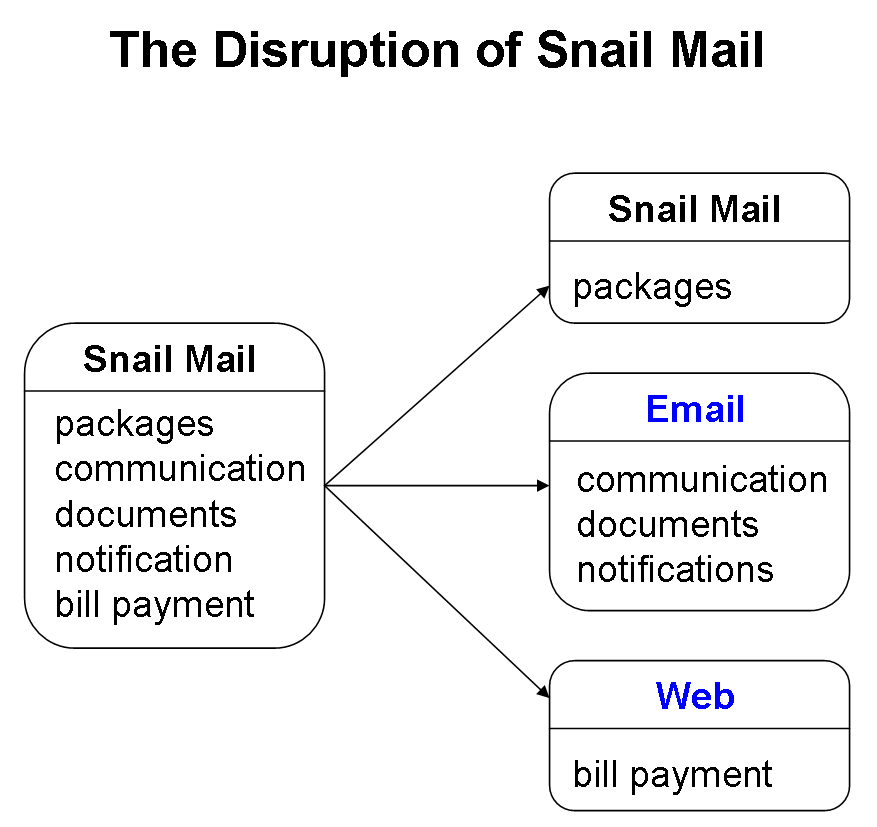
The Disruption of Snail Mail

The diagram below depicts the disruption that occurred to snail mail.

I’ve kept the disruption focused on the effects of the Internet. In other words, no fax machine or FedEx in here.

Back in the day, the mail system was the way you got a variety of important communications to other people. Our grandparents wrote letters. L.L. Bean mailed us the stuff we ordered via their catalogs. All our bills came through the mail. We were notified of things like jury service.

With the arrival of the Net, a good portion of snail mail’s portfolio was assumed by other technologies. And it’s had an effect. Here’s a quote from a 2001 General Accounting Office report on the future of the U.S. Postal Service:

Although it is difficult to predict the timing and magnitude of further mail volume diversion to electronic alternatives and the potential financial consequence, the Service’s baseline forecast calls for total First-Class Mail volume to decline at an average annual rate of 3.6 percent from fiscal years 2004 through 2008.

Pretty bad, eh? Electronic alternatives were evaporating the revenues of the post office.

But something else was out there which would help offset these losses in first-class mail: e-commerce. With the growth of the Internet, people got more comfortable shopping online instead of going to their local mall.

Those packages had to get to shoppers somehow. That’s where the U.S. Post Office shined. It already had the infrastructure to get things from a centralized place to multiple individual residences. What got disrupted were the trucking companies who moved merchandise from manufacturers to retailers.

Sure enough, the U.S. Postal Service saw a rebound thanks to online purchases, according to Web Designs Now:

In 2005, revenue from first-class mail like cards and letters, which still made up more than half the Postal Service’s total sales of $66.6 billion, dropped nearly 1% from 2004. But revenue from packages helped make up for much of that drop, rising 2.8%, to $8.6 billion, last year, as it handled nearly three billion packages.

And the dark mood at the U.S. Postal Service headquarters brightened quite a bit:

“Six years ago, people were pointing at the Web as the doom and gloom of the Postal Service, and in essence what we’ve found is the Web has ended up being the channel that drives business for us,” said James Cochrane, manager of package services at the Postal Service.

There is a lesson here for email.

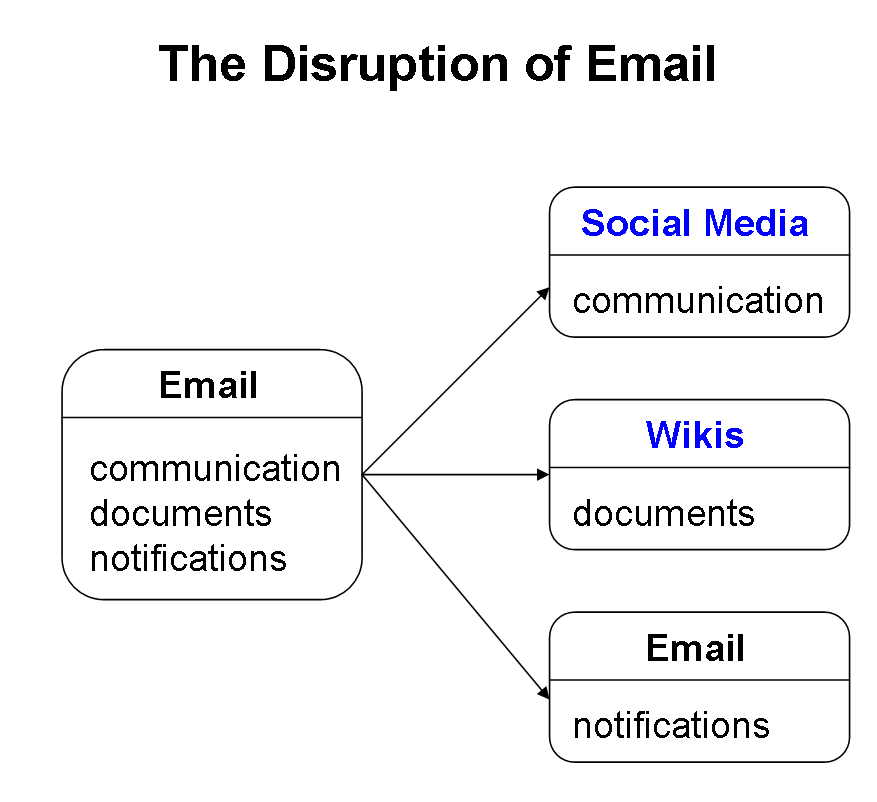
The Disruption of Email

Email is undergoing its own disruption:

Again, similar to the previous diagram, I’m focusing on the web here. No mobile texting as an email disruptor, even though it is.

As Alex outlined in his post, the easy messaging of social media is supplanting the email messages that used to be sent. I haven’t seen any surveys that show the decline in person-to-person communications because of email. But my own experience reflects the migration of communications to the various social media.

  • LinkedIn messages
  • Facebook messages
  • Twitter
  • FriendFeed comments

As Zoli Erdos pointed out in his blog post Email is Not in Danger, Thank You, wikis are growing as the basis for sharing documents. They provide better capabilities than does email: wider visibility, versioning and searchability.

But it’s in notifications where email’s future is bright. Many of us are members of social media sites. As we go through our day, it’s hard to stay on top of activity in each one: new messages, new subscribers, new friend requests, etc.

Where is the central clearinghouse of my multiple social media identities? Email.

Email is the permanent record of what’s happening across various sites. This is actually a very valuable position in which to be. Here are two examples where email helped me:

  • After I wrote a post about nudity on FriendFeed, I lost some FriendFeed subscribers. I know this because my number of followers went down. There was one person in particular I wanted to check. This person wasn’t on my list of followers, and I thought, “maybe wasn’t subscribed to me in the first place?” Checked email, and I did indeed have a follow notification from this person a few weeks earlier. So I knew I’d been dropped.
  • I inadvertently deleted a comment to this blog. On wordpress.com, once deleted, the comment is not recoverable. I was in a bind. But then I realized I get whole copies of comments to this blog emailed to me. So I went to Gmail and found the comment notification. I was able to add the comment back by copying it from my email.

As snail mail had to adjust to the rise of email, so too will email adjust to the rise of social media:

As the number of social media sites and participation in them expands, email will find new growth and value in being the centralized notifications location.

Email = Centralized Identity Management

Much has been written about email being the ultimate social network. The basis for this is your address book and the emails you trade with others. But might there be another opportunity for email?

If email has all these subscription and message notifications, doesn’t it potentially have a role in helping you manage your centralized identity? Gmail could map out my connections across various sites. Find those that are common across the sites. Gauge the level of interaction with others.

Even add APIs from the various sites and let me send out communications from email. Suddenly, email’s back in the communication game as well.

I’m just scratching the surface of what might be possible here.

What Do You Think?

Email’s primary role as a communication medium is diminishing. Many of us are enjoying the easy, contextual basis of communicating via the various social media sites.

But like snail mail before it, email has interesting possibilities for what it will do for us in the future.

What do you think?

*****

See this post on FriendFeed: http://friendfeed.com/search?q=%22Email%E2%80%99s+Changing+Role+in+Social+Media%3A+Digital+Archive%2C+Centralized+Identity%22&public=1

What Interactions Do You Want from Social Media?

Mapping the different social media interactions to human anatomy:

Now…where to go to get those interactions? An incomplete list follows.

Ideas, opinion, information:

  • FriendFeed
  • Twitter

Share photos, videos

  • Flickr
  • SmugMug
  • Zoomr
  • YouTube
  • Facebook
  • FriendFeed

Music you like:

  • Last.fm

Chit chat

  • Twitter

What are you feeling?

  • Facebook
  • Twitter

What are you doing?

  • Twitter
  • Facebook
  • FriendFeed
  • Upcoming

What are you eating?

  • Twitter

Where are you?

  • Brightkite
  • Twitter

Personally, my interest is in ideas, opinions and information. But some photos and chit chat are also nice.

How about you?

I’m @bhc3 on Twitter.


Knowledge & Innovation: The Journey Is as Valuable as the Destination

I don’t know about you, but I’ve had a pretty traditional background in terms of product management. I was an assistant buyer for a retail chain, I marketed as an investment banker, and I’ve had over seven years in the software world. From that work, I’ve gotten a good feel for the process that occurs in producing an end result.

  1. Start with the idea
  2. Bounce it off your boss and peers
  3. Write it up
  4. Email it around
  5. Sit down with people
  6. Re-work the idea
  7. Produce the final version (PRD, white paper, pitch deck, etc.)

For most of us, step 7 is the prize, the definition of what’s valuable. All else is a pain in the ass.

But having spent some time on FriendFeed, I’m starting to recognize the value of steps 2 – 6. The conversations and debates to get from Point A to Point B are actually incredibly valuable.

The problem isn’t the work of getting from Point A to Point B. The problem is the methods we typically have inside the workplace. I suspect few corporate cultures are set up to make the journey as rewarding as the end result.

What do I mean exactly? Well, take the iteration process for a given initiative. You send an email, get single replies back from several folks. You sit in a meeting, and there’s this vague group meeting dynamic where someone with the most passion (right or wrong) ends up controlling the meeting vibe. Maybe you do a series of one-on-ones.

The problem with these methods is that the conversations are limited. Debates take the form of comparing the feedback of different people. I know this. I’ve lived it. You ever try to coordinate the Outlook Calendars of various people? In a series of meetings? It’s a nightmare.

So what has FriendFeed taught me? That there is a way to improve this process. That the journey to  Point B can actually be fun and engaging. And that it has value. Companies should take heed.

Here’s what I would love to see. Companies adopt ways to enable asynchronous conversations around ideas that are searchable, engaging and radiate greater benefits than just producing a final result. Wikis are good, but they too often have an emphasis on maintaining versions of documents. They lack the vital conversations that go into the various versions of a document.

What are the benefits of companies than can figure this out? Plenty! Here are three that come to mind:

  • Context for the end product
  • Other ideas come out of the process
  • Deeper understanding of others’ views and knowledge

Let me break these down a bit more.

Context for the End Product

When consuming the content after it is completed, all someone knows is what they read. Not that there’s anything wrong with that. The document says that System A will do Action 3 after receiving Data #. It’s a straightforward recitation of what people are supposed to know.

But if you have context for why things are spelled out the way they are, I argue you’ve got much more informed workers.

I’m personally not satisfied with only reading something. I always want to know why something ended up the way it did. Especially when you’re reading something new, that background is vital context.

But too often, all workers have is the end product. Which means they end up with half the story, and not enough background to really grok the content.

Other Ideas Come Out of the Process

A rich conversation and debate around ideas and projects can become an innovation jam. As people jump in the fray to discuss something, inevitably other tangential ideas come flying out.

In an earlier post FriendFeed ‘Likes’ Compatibility Index, good discussion erupted out on FriendFeed (here, here). If that post was Point A, I’ve already written about Point B, which was an app built by felix to automatically calculate your likes compatibility index.

But there was another idea thrown off from the discussions: how well represented are women on FriendFeed and social media? Mark Trapp wrote Friendfeed Like Factor and the Gender Divide which put some numbers and thoughts to this question. Which got its own discussion going.

I’m quite sure an energetic conversation by engaged employees has the same effect – unplanned ideas come out of them.

Spread some innovation jam.

Deeper Understanding of Others’ Views and Knowledge

It’s funny to say, but I feel like I have a better read on some folks through FriendFeed than I did on people with whom I actually worked.

Why? Because work in some companies is fairly isolated. You may trade some emails, do some calls and attend status meetings. But the fertile soil of engagement is lacking. Aside from missing the benefits described above, employees miss the opportunity to learn more about one another.

Why does this matter? The better you understand your colleagues, the easier your job becomes. People develop instinctive ways of working, and a shorthand language built from prior interactions emerges. Long time employees do this, but it takes while. And new employees have to pick up the signals as best they can.

What I like about this approach is that employee social networks just emerge naturally via the interactions. A more formal social network approach isn’t needed.

Gimme Some FriendFeed Inside the Enterprise

If I could get a FriendFeed-like experience inside a company, I’d be thrilled. For all the reasons stated above. Plus it would just be fun.

I’ve said before that FriendFeed is a social network built around ideas. And the typical work for a lot of folks is also around ideas. Seems like there’s potential.

There would need to be some new features to make it the experience more pertinent to work versus play. But that’s a follow-up post.

Final Thoughts

As stated earlier, I’d like to see companies adopt ways to enable asynchronous conversations around ideas that are searchable, engaging and radiate greater benefits. Things like wikis are a good start as collaboration vehicles, but they lack the interaction aspect that has emerged as the killer feature of social media.

The nice thing is that new start-ups are popping up all the time. I look forward to seeing the ones that take in the next wave of innovation.

I’m @bhc3 on Twitter.