How Would Social Media Help You in Your Job?

I’m having a ball with social media out in the consumer web. Blogging, FriendFeed, Twitter, Facebook. I’m learning so much about technology, new companies and people’s attitudes regarding Web 2.0. Along the way, some collaboration and a new job actually happened out of all this fun.

Now why can’t we see some of these same effects in the place where most of us spend a third of our day? We’re seeing live implementations of social media inside organizations (aka Enterprise 2.0). It’s a good sign.

I’m now in a job where I’m thinking about this a lot. And I figured I’d start with myself. Where would social media have made a difference in my two previous Big Corporate jobs:

Both companies were examples of today’s modern company, with a heavy information orientation. It’s been years since I worked at either, but here is how social media could have helped me in my jobs.

May Department Stores

The buying office of a retailer is responsible for picking the merchandise you see on the floor. Buyers also plan and execute promotions, set prices and ensure optimum amount of inventory on the floor and in the warehouse. We also had to communicate with the department managers of dozens of stores.

Here are the social media that would have helped me (if we had the Web back in 1990-1994):

  • Twitter: Yup, I would have loved Twitter. An easy way to fire off updates out to the field of department managers. And they would have sent back news of things they were seeing. Would have been a huge help during the crazy Christmas season.
  • Blog: I would have blogged about the weekly promotions. There’s a fair amount of work that went into them (promo prices, signage, focus of the ads), and documenting all that would have been useful. New products that we bought would have been good to discuss as well.
  • Bookmarking and notetaking: Assuming we had the world wide web back then, I would have bookmarked and noted a number of things for the job: competitor ads and pricing, product promotions I liked, new products I’d seen elsewhere.

Bank of America

At BofA, my group raised debt for corporations. Deals could run anywhere from $25 million to $6 billion. It was an information-intensive job.

The work consisted of three primary activities: (1) win the deal; (2) sell the deal; (3) close the deal via documentation. You had to stay on top of comparable deals, industry trends, capital market trends and general market chatter. Our group was divided into Structurers (me), who worked with clients to win and structure deals; and Distribution, who sold the deal to the market. Distribution always had the best information.

Social media I would have wanted:

  • Twitter: Again! I really would have wanted to see the ongoing chatter of the Distribution guys. They picked up all sorts of incredibly valuable market intelligence during the day. They used to IM. Now I’d want them to tweet.
  • Wiki: Every deal should have had a wiki space, with its “win the mandate” phase, its “sell it to the market” phase and the documentation phase. Wikis would have been good for handling the whole deal cycle.
  • Feed Reader: There were market data publications to which BofA subscribed. Getting a feed of deal information would have been a huge help. We were chasing information down in paper publications.
  • Bookmarking and notetaking: When deal, market or industry news came through, I needed a place to save it. I was always going back to find stuff I’d seen earlier. Bookmarking would have helped a lot. Note taking too – capture some information or thoughts, tag it and come back to it later.
  • Blog: My group wouldn’t have had much use for a blog amongst ourselves. But a blog that updated the rest of the bank as to what was happening in our particular capital market (syndicated loans) would have been perfect. We had other groups asking us often about market conditions.

I’d Love to Hear About You

Maybe you’re already using social media inside your company. Or perhaps you’ve been thinking, “my company really needs…”

If you’ve got any ideas to share, I’d love to hear them.

*****

If you want an easy way to stay on top of Enterprise 2.0, I invite you to join the Enterprise 2.0 Room on FriendFeed. The room takes feeds for Enterprise 2.0-related items on Twitter, Del.icio.us and SlideShare. To see this room, click here: http://friendfeed.com/rooms/enterprise-2-0

*****

See this post on FriendFeed: http://friendfeed.com/search?q=%22How+Would+Social+Media+Help+You+in+Your+Job%3F%22&public=1

Applying Circuit Breakers to a Social Media Mob Mentality

Cyndy Aleo-Carreira has a good post out today, When FriendFeed Creates a Mob. The post describes the activity on FriendFeed related to a Thomas Hawk post regarding the director of visitor relations at the San Francisco Museum of Modern Art. In case you’ve missed it, here’s a quick summary:

  1. Thomas Hawk was shooting pictures at the SFMOMA
  2. The director of visitor relationships told him to leave
  3. After pleading his case, Thomas was kicked out of the SFMOMA
  4. Thomas blogged about it, asking people to Digg the story to get it maximum attention
  5. Many people on FriendFeed dugg it, and currently the post has 3,780 diggs

In her post, Cyndy points out that we’re only hearing one side of the story: Thomas Hawk’s. I can’t blame Thomas for that. He was only blogging the incident from his point of view. That’s what blogging is about. But she and Jeremiah Owyang both argue that the use of the guy’s name and calling him a “jerk” (it was originally “asshole”) meant that the post transcended a normal beef, like Comcast not handling someone’s moving well. It was personal, not a slam against a faceless organization.

Was it a mob mentality that took hold?

For the record, I did participate in this:

I trust Thomas Hawk’s point of view, so I was comfortable with the Digg and the Like. Noting the Digg count was probably a bit much. Generally, I thought of it as an authentic telling of an event by Thomas, and wanted to show my support. But I pretty much left it there. I’m not a photographer nor have I had any problems at the SFMOMA.

Also, if the SFMOMA director came out with his own explanation of events, I’d Like that, digg it, share it. I’m not out to tar and feather the guy. Rather, there is a greater issue of individual liberties versus the protection of artists’ rights and individuals’ privacy here. A worthy area for discussion and examination, as Steven Hodson points out. I’m glad that Thomas wrote up his experience, and that it got attention. It should.

But Cyndy’s post does cause me to wonder how one would stop a mob mentality taking hold on FriendFeed, or any social media site.

When Mob Mentality Overwhelms Our Information Filters

In a recent post, I wrote about the emergence of a new role in social media: Information Filters. Particularly on FriendFeed, but on other social media sites as well, we rely on others to surface content that is interesting to us. They do this through their Google Reader shares, Diggs, direct posts, Likes, comments, etc. Some people have a natural talent for this, and they become powerful information filters for others.

I’d say that Information Filters are the primary line of defense against any mob mentality taking hold. Through the various ways they share or don’t share, Information Filters hold strong sway over the agenda of what is discussed.

What would a mob mentality look like?

  1. Our Information Filters buy-in to a “get this guy” mentality and start spreading the word as rapidly as possible
  2. The sheer volume of links, Likes and comments overwhelms the more thoughtful discourse that typically marks FriendFeed

#2 above in particular is where things get dicey. You’re no longer relying on your usual Information Filters. The frequency with which you’re seeing an issue show up becomes the measure of its importance, not the trusted referrals of your Information Filters.

Three Options for Applying Circuit Breakers to a Mob Mentality

Off the top of my head, I can come up with three ways to slow down a mob.

  1. Automatic restrictions: Like the New York Stock Exchange’s trading curbs, FriendFeed would automatically apply the brakes to a URL that gets to much play on the site. New shares of the site link stop bouncing to the top of FriendFeed. New comments and Likes no longer cause the link to bounce to the top. This, of course, would be terrible. Really good posts would have a tough time going viral.
  2. FriendFeed staffers intervene: Similar to the automatic restrictions, except it’s done manually on an ad hoc basis. This is better because truly egregious cases could be addressed, not just an “hot” story. But it puts the FriendFeed folks in a really bad position. As soon as they put the kibosh on a story, the howls of censorship would begin and the vibe of FriendFeed would tank.
  3. Our information filters exercise judgment: This is the right call. We rely on our Information Filters to find content that is interesting, sharp and correct if facts are used.

Information Filters = Circuit Breakers

As noted earlier, Information Filters are people adept at finding interesting content and sharing it. Interestingly, Mona N is exactly on of these people. She finds all sorts of unusual things that people love. I know I do. So her pumping up Thomas Hawk’s SFMOMA blog post was a case of an Information Filter saying “Hey, this is really important information for you to know and act on!”

By virtue of their role, information filters can also act as the brakes should things ever get out of control. Why?

  • They tend to have a large number of followers
  • Many of their followers are frequently reading what they share
  • The ongoing conversation they have with others establishes their “cred” when it comes to discussing new ideas, opinions and news

People who are Information Filters can simply not share whatever it is everyone else is talking about. The lack of their participation reduces some of the heat that can surround an issue. They can also more actively put a stop to an overly emotional mob that forms. With posts, comments, blog shares, etc. People will listen to them. Their participation this way can allow cooler heads to prevail.

It Is Social Media After All

On FriendFeed, Derick Valadao left a great comment on Cyndy’s post:

To those who would say behaviour like that stated in the article isn’t group think I have to disagree. We voice our opinions here on popular entries because we think it will be the right thing to say. We want to affirm the sentiments of the post (for the most part). I have yet to see a social network that can combat against this phenomenon. When we reward opinions with popularity or regard we inevitably create this phenomenon. That of why I appreciate small voices in the crowd who are willing to go against popular opinions. Now we should ask ourselves how we can build that into a social structure if we ever intend ok bringing credible interesting stories to our community.

I look to our Information Filters to play an important role in Derick’s call for a social structure. Having users, particularly those who have been “voted” as our information filters, dampen the creation of any mob tendencies fits well with the idea of social media. It is all about the users. We really should sort these things out ourselves.

It does put the onus on those who enjoy positions as information brokers to elevate their game, and to think hard about the effect they have on the people and organizations they shine a light on. Jeremiah Owyang has a new post out Tracking the Toronto Explosion on Twitter: Opportunities and Risk. I’ll close with a quote from his post:

The community (myself included) must be mindful of what’s real and what’s not, over hyping or spreading false information [that] could impact lives.

*****

See this post on FriendFeed: http://friendfeed.com/search?q=%22Applying+Circuit+Breakers+to+a+Social+Media+Mob+Mentality%22

What’s the Story of Your Life?

In the recent post Who Is Your Information Filter?, I noted that individuals are emerging as leaders in the distribution of information. These Information Filters have good judgment as to what their subscribers like.

But there is certainly more to the being a good filter. Here’s an example of what I mean. Dare Obasanjo wrote a post titled Giving Sh*t Away is not a Business Strategy. Eric Rice and I both shared the post on July 12. Check out the results on FriendFeed:

The Likes and comments on Eric’s share included some folks who are subscribed to me.

This is the sort of thing that I love to explore. What makes people respond to the sharing of identical content from one person, but not another?

Interactions and relationships are an important part. Robert Scoble made this point in a comment on FriendFeed.

There’s an additional factor as well. Here’s one way to describe it:

  1. Experience and passions make up your narrative, the story of your life.
  2. A narrative gives context.
  3. Context loads the information you share with meaning.
  4. Meaning draws interest by others.

This takes a little explaining.

A Lesson in Mark Rothko’s Paintings

Mark Rothko was an abstract painter, famous for paintings of rectangles (multiforms) with different colors. His life shared the drama that seems to mark many great artists. He was Jewish, and saw the persecution of Jews in Czarist Russia. His family emigrated to the United states. He was highly intelligent, rapidly advancing through school and receiving a scholarship to Yale. He divorced twice. He drank heavily. He ultimately committed suicide.

And yet he was pivotal in the abstract movement of the mid-1900s. He hated being called an “abstract artist”, but he was leader in the genre. His is a rich history of art, intellect and  experimentation.

Growing up, I’d see art like his and think, “I could paint that. What’s so special about that painting?” Typical punk kid.

But to that point, I went ahead and tried my hand at painting in the Rothko style. Below are a painting by Mark Rothko, and one by my own hand:

This was my first painting effort since middle school. Please pardon the brush strokes.

With practice, I could get the hang of the brush strokes. With time, I bet I could replicate Mark Rothko’s style pretty well.

Which would make me a hell of an abstract painter, right?

Obviously, the answer is no. Even if I could duplicate the style, no one would care. Why? I don’t have a narrative to back it up. I didn’t come up with the style, I wasn’t a participant in the abstract movement, I’m not a student of art or of Rothko, I’m not a painter.

The silly adolescent that I was didn’t want to understand that. And yet understanding the importance of Rothko’s narrative imbues his paintings so much meaning.

There is a lesson here in terms of people who shine as Information Filters.

The Information You Share Fits a Larger Narrative

The context surrounding a piece of content is an important, underestimated component of what makes it valuable to an audience. If Thomas Hawk and I were to favorite the same photo on Zooomr, I suspect Thomas’s favorite would garner more Likes and comments on FriendFeed than would mine. Which makes all the sense in the world.

Thomas is a professional photographer, shooting photos for magazines and other media. He regularly blogs about issues affecting photography. He’s the CEO of a photo sharing site. When he shares a photo, you know he “gets” a wide range of attributes for that photo:

  • Lighting
  • Subject matter
  • Angle
  • Lens
  • Dimensions
  • Etc.

Me? I’m just a dude who likes a picture. The pictures I share lack a larger narrative.

Curious about this, I took a look at my Google Reader shares on FriendFeed. Here are five that received the most attention (excluding my own blog post shares), and five with no Likes or comments:

My online narrative is really defined by this blog. So the lists above don’t surprise me. The five that fit my narrative are consistent with blogging, information consumption and distribution, and enterprise 2.0. The five that don’t fit my narrative reflect themes I generally don’t hit on here: online advertising, acquisitions, SAAS and the environment.

Does that mean I should stop sharing them? Hell no! But it does show that the people who subscribe to me have particular interests, consistent with my narrative.

Attention Paid to A-Listers: It’s Not Just Hero Worship

I do think there’s an important point to be made. Sometimes people get exasperated that something they’ve blogged about or posted didn’t get a lot of traction, while an A-Lister talks about the same thing and everyone falls over themselves to Like, comment, share the content, etc. This is generally ascribed to an overly worshipful flock. I’m sure there’s a bit of truth in that.

However, I think an overlooked element is that a lot of the well-known figures out on the web have a strong narrative.

When they share something, it’s really part of the larger narrative they’ve been sharing with a lot of people over time.

What’s Your Story?

I bring up A-Listers because its a familiar meme. But there are regular people who have a particularly strong narrative in a subject area. You see people reacting to the content they share, because it fits what they’re about.

Strong narratives make people strong Information Filters.

How about you? What’s the story of your life?

I’m @bhc3 on Twitter.

Who Is Your Information Filter?

This comment by Michael C. Harris on FriendFeed the other day caught my eye:

Heaps of fantastic shares from unknowns get almost completely ignored and yet Scoble shares “Scoble” and gets 50 comments

Michael is hitting on something very important. In FriendFeed, not all shared items are created equal. I’ve noticed some people are really good at getting people to click through on a shared item and start a conversation.

I think of these people as the new Information Filters. They have a knack for getting their subscribers to check out stuff they find interesting. More so than your average social media user.

Over time, a logical outcome would be this: as the Information Filters share information with their subscribers, click-throughs and comments occur on that content. Which attracts new people into the discussion. Who then subscribe to the Information Filter. Which increases the click-throughs and comments. Repeat…

Good Information Filters can find themselves with a lot of power to direct traffic, and subtly influence what others take in when it comes to information. This isn’t without precedent. Television and the web are prior examples of this.

Migration of News Consumption Habits

Both television and the web have seen changes in the way people get their news. In both TV and the web, the changes are based on the strength of someone’s personality and judgment as to what the audience wants:

In 2004, CNN reported a Pew Research Center survey of news viewing habits. The survey found that 21% of people aged 18 – 29 got their news on the presidential election from Jon Stewart and Saturday Night Live. A follow-up report “Where Americans Go for News” by Pew also noted:

During these late night hours, many young people are tuning into comedy shows such as David Letterman and Jay Leno. Those under age 30 are among the most likely to watch these types of shows 17% watch Leno or Letterman regularly, compared with 8% of 30-49 year-olds and 12% of those age 50 and older.

What do Jon Stewart, David Letterman and Jay Leno offer that the traditional news broadcasts don’t? Humor, obviously. They also get to pick the most interesting news items for their shows. NBC News anchor Brian Williams noted the obligation of professional news organizations to offer news that likely doesn’t interest most audiences:

Some people call it ‘eat your peas’ journalism because it has to include everything that’s good for you to know to be a good citizen of the world. We put it out there.

In this comment, you see the larger societal obligation felt by the mainstream news media. They cover everything, even the stuff you don’t care for. There’s a tension between ensuring people get a full range of information about our multi-faceted world, and what people are willing to pay attention to.

The web has undergone a similar change in reading habits. Matt Drudge’s Drudge Report has eclipsed traditional news outlets in terms of influence. From The Telegraph’s article Matt Drudge: world’s most powerful journalist:

So much internet traffic can be directed to an item linked to by Drudge that unprepared websites have been known to collapse under the strain.

For politicians, the effect is akin to a needle injecting information into the media bloodstream. A positive story can give a shot of adrenaline to a flagging campaign. More commonly, negative information can be like a dose of poison being administered.

Drudge rose to prominence when he famously put the Monica Lewinsky story in play. Since then, his traffic has grown enormously. It’s not just about that one scoop. Drudge has a good sense about what is newsworthy. From the Washington Post blog The Fix:

The second major reason for Drudge’s influence, according to the Fix’s informal poll of Drudge-ologists is his ability to sniff out a potentially big story when others — including reporters — miss it at first glance.

“He can identify what’s a big deal even when the reporters who actually cover and report on an event don’t realize what they have,” said one GOP strategist granted anonymity to speak candidly. “He scoops reporters’ scoops.”

What do Jon Stewart, David Letterman, Jay Leno and Matt Drudge have in common?

  • They don’t actually find and report news (for the most part)
  • They only present what they find interesting
  • They have shrewd judgment as to what audiences will like
  • Their personalities are part of their effectiveness as news filters – people trust them

Each of these guys have emerged as a key Information Filter.  New social media platforms, such as FriendFeed, are starting to see the emergence of their own Information Filters.

You Are Who You Follow

This is something Robert Scoble emphasizes: you define yourself by who you follow. Early FriendFeed employee Kevin Fox described the general role of your friends on FriendFeed:

The nature of FriendFeed is that you start to think that the world is like you, because your friends shape your FF world. I think the FF world is full of Obama supporters, and other people thing it’s full of Twitterers. Pick your friends wisely because they define your FF.

In an equal world, information shared by any of your friends will merit click-throughs and discussion. But the practical reality is that some people will be more “equal” than others in terms of driving the discussion agenda. There are two highly correlated components to that:

  • Number of subscribers
  • Reputation for identifying what is interesting

The sheer number of subscribers make some people Information Filters. The big power users on Twitter: Leo Laporte, Dave Winer, Robert Scoble, Jason Calacanis, etc. These guys really drive discussions around ideas, opinions and news. If you subscribe, you can’t help but be overwhelmed by the discussions they can kick off.

The reputation for finding interesting stuff is a little harder. Like Matt Drudge and Jon Stewart, you need to have a sense for what people want to know and find interesting. Some people are naturals at this, but I think anyone can learn how to identify interesting stuff.

Louis Gray is a really good Information Filter. Out of curiosity, I took at look at the last 30 Google Reader shares he put into FriendFeed. And I compared them to my last 30. I wanted to analyze the interaction around them: Likes, comments.

The chart to the right graphs the total Likes and comments for the 30 Google Reader shares of each of us. Louis is clearly good at putting things out there and having people discuss them. You’ll see the Likes and comments on his shares are double mine.

I consider Louis to be one of my Information Filters. He’s great at identifying the good stuff. And he takes this role seriously. He wrote a post Roll Your Own Blog Leaderboard with Google Reader Trends, in which he identifies the blogs he’s sharing most often.

The Effects of Our Information Filters

NBC News’ Brian Williams had this to say in response to the increasing application of personal filters to news:

Do you have a problem with people personalizing the news vs. you saying ‘these are the top stories’? Is there a danger in that if you give people too much personalization?

Williams: That’s for others to decide. I will say that if you’re using a filter, if you wake up in the morning and you have loaded up your computer, in other words to say, ‘Foreign news totally bums me out, this Iraq thing, it just ruins my day. Keep it away from me.’ Is that what [James] Madison had in mind, do you think? Is that what [John] Adams and [Ben] Franklin and [Thomas] Jefferson had in mind? Did they expect a little more informed electorate, to quote Mr. Jefferson? Did they expect a little more from us as citizens? I can’t judge people.

Democracy, on the other hand, looking at the argument, it’s their right [to filter]. I’m a lover of news and information, I’m a lover of American history, it’s my hobby. So if I had my druthers… Some people call it ‘eat your peas’ journalism because it has to include everything that’s good for you to know to be a good citizen of the world. We put it out there.

I can’t start programming the ‘NBC Nightly News’ with just the news that doesn’t bum people out. Just the news they want to see and hear. But I can’t stop someone from using filters, from using pay-as-you-go technology to get what they want. I will probably have my own opinion in a couple years about what we’ve become as a society as a result of if we stop getting the news that’s at all negative.

There’s a similar concern about over-reliance on our Information Filters in social media. That it becomes too easy to rely on what they find, and put in front of us. Robert Scoble asked a question that touched on this recently:

Hmm, how come you all like commenting on Google Reader Shared Items here in FriendFeed but you all do so little Google Reader reading yourselves?

Check it out for a good discussion around the merits of using FriendFeed exclusively for reading new blog posts.

Choose Your Information Filters Carefully

Brian Williams alluded to the “eat your peas” element of being an informed citizen. That is, take in information even when it doesn’t interest you. But that’s really fighting against human nature. We’re time-constrained, and social media has made it easier than ever to perpetuate our natural tendency to rely on the advice of friends for what is interesting.

So really, the best thing to do is to choose your Information Filters wisely.

What do you think? How do you select your Information Filters?

*****

See this post on FriendFeed: http://friendfeed.com/search?q=%22Who+Is+Your+Information+Filter%3F%22&public=1

Unclear on the Concept: People Complaining about Comcast Monitoring Social Media

The New York Times has an article today about Comcast using social media to respond to customer complaints. Comcast is definitely at the forefront of this move to engage customers out in the wild. Comcast’s efforts have previously been documented on ReadWriteWeb. New York Times coverage helps move the concept, and Twitter, closer to mainstream adoption.

What caught my eye in the NYT article is that some people are concerned about Comcast doing this. They feel like Comcast is acting like Big Brother. According to the article, 20 year-old Brandon Dilbeck blogged about his dislike of ads on Comcast’s programming guide. A Comcast representative found the post (Google blog alert perhaps?), and responded to him via email.

Hey dude! Your blog had some impact! Isn’t that cool?

Well, no. The blogger apparently thought it was weird:

Mr. Dilbeck found it all a bit creepy. “The rest of his e-mail may as well have read, ‘Big Brother is watching you,’ ” he said.

Here’s what I don’t get. Blogs are publicly available. Anyone can find a blog and comment on it. Sometimes, your blog posts result in actions you wouldn’t have expected. This is the power of Web 2.0.

If you’re going to write publicly, how on earth can you be concerned about Big Brother? Sure, if Comcast had monitored his email or phone conversations, that’d be Big Brother (and illegal).

But to air your concerns publicly and have someone from the company read it? If you’re concerned someone would actually read your post, then don’t blog. I’m actually surprised this 20 year old was concerned. The Gen Y folks are supposed to be pretty open about everything in their lives. Maybe Mel McBride is right when she made this comment on FriendFeed with regard to Facebook:

I’m just getting tired of dopes buying into the surveillance of their personal history, daily activities and personal associations as a “convenience” – wake up people.

Social media: If you write it, do it or video it, people can find it. That’s the great opportunity for all of us.

*****

See this post on FriendFeed: http://friendfeed.com/search?q=%22Unclear+on+the+Concept%3A+People+Complaining+about+Comcast+Monitoring+Social+Media%22&public=1

Email’s Changing Role in Social Media: Digital Archive, Centralized Identity

Alex Iskold wrote a great post recently, Is Email in Danger? This quote lays out the premise of the post:

From the 20th century mail was a fundamental form of communication. The invention of electronic mail (email) changed two things. It became cheap to send mail, and delivery was instant. Email became favored for both corporate and personal communication. But email faces increasing competition. Chat, text messages, Twitter, social networks and even lifestreaming tools are chipping away at email usage.

When it comes to email, there are some parallels to what happened to snail mail with the spread of the Internet and email. The biggest thing is this:

Snail mail found an unexpected opportunity for growth with the rise of the Web.

Email will lose out on some of its uses, but there are some interesting possibilities that will emerge.

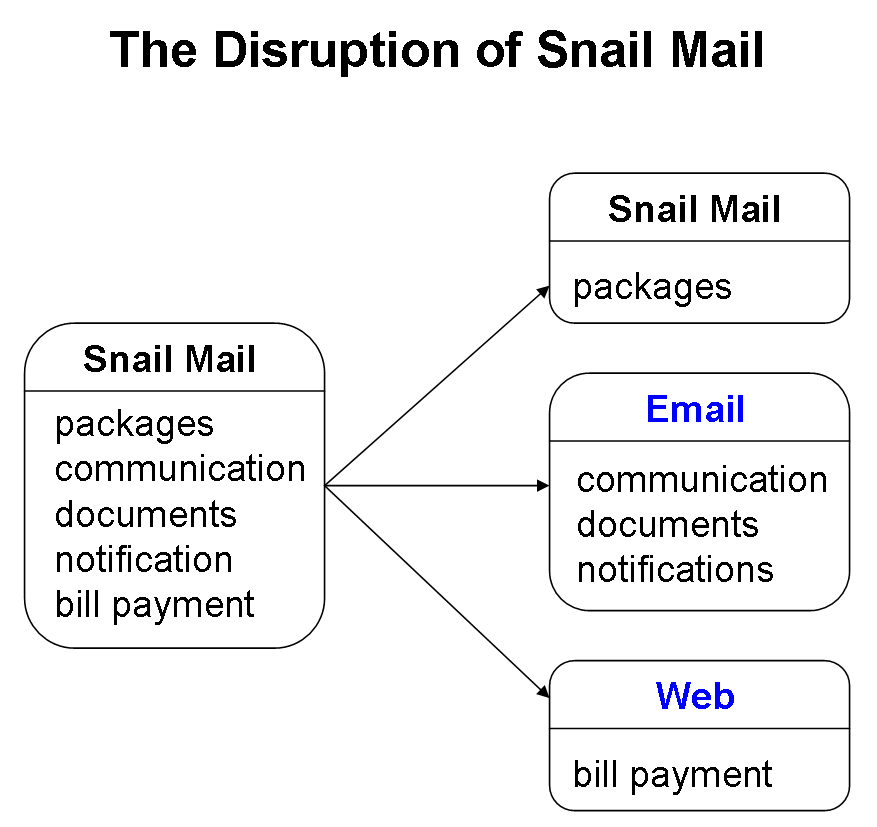
The Disruption of Snail Mail

The diagram below depicts the disruption that occurred to snail mail.

I’ve kept the disruption focused on the effects of the Internet. In other words, no fax machine or FedEx in here.

Back in the day, the mail system was the way you got a variety of important communications to other people. Our grandparents wrote letters. L.L. Bean mailed us the stuff we ordered via their catalogs. All our bills came through the mail. We were notified of things like jury service.

With the arrival of the Net, a good portion of snail mail’s portfolio was assumed by other technologies. And it’s had an effect. Here’s a quote from a 2001 General Accounting Office report on the future of the U.S. Postal Service:

Although it is difficult to predict the timing and magnitude of further mail volume diversion to electronic alternatives and the potential financial consequence, the Service’s baseline forecast calls for total First-Class Mail volume to decline at an average annual rate of 3.6 percent from fiscal years 2004 through 2008.

Pretty bad, eh? Electronic alternatives were evaporating the revenues of the post office.

But something else was out there which would help offset these losses in first-class mail: e-commerce. With the growth of the Internet, people got more comfortable shopping online instead of going to their local mall.

Those packages had to get to shoppers somehow. That’s where the U.S. Post Office shined. It already had the infrastructure to get things from a centralized place to multiple individual residences. What got disrupted were the trucking companies who moved merchandise from manufacturers to retailers.

Sure enough, the U.S. Postal Service saw a rebound thanks to online purchases, according to Web Designs Now:

In 2005, revenue from first-class mail like cards and letters, which still made up more than half the Postal Service’s total sales of $66.6 billion, dropped nearly 1% from 2004. But revenue from packages helped make up for much of that drop, rising 2.8%, to $8.6 billion, last year, as it handled nearly three billion packages.

And the dark mood at the U.S. Postal Service headquarters brightened quite a bit:

“Six years ago, people were pointing at the Web as the doom and gloom of the Postal Service, and in essence what we’ve found is the Web has ended up being the channel that drives business for us,” said James Cochrane, manager of package services at the Postal Service.

There is a lesson here for email.

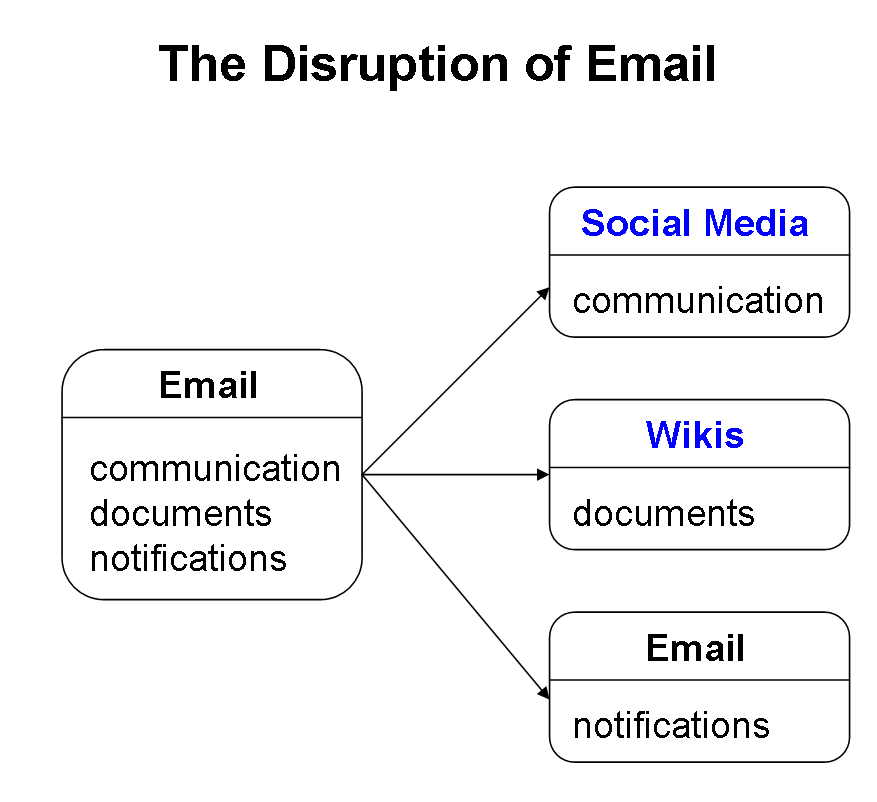
The Disruption of Email

Email is undergoing its own disruption:

Again, similar to the previous diagram, I’m focusing on the web here. No mobile texting as an email disruptor, even though it is.

As Alex outlined in his post, the easy messaging of social media is supplanting the email messages that used to be sent. I haven’t seen any surveys that show the decline in person-to-person communications because of email. But my own experience reflects the migration of communications to the various social media.

  • LinkedIn messages
  • Facebook messages
  • Twitter
  • FriendFeed comments

As Zoli Erdos pointed out in his blog post Email is Not in Danger, Thank You, wikis are growing as the basis for sharing documents. They provide better capabilities than does email: wider visibility, versioning and searchability.

But it’s in notifications where email’s future is bright. Many of us are members of social media sites. As we go through our day, it’s hard to stay on top of activity in each one: new messages, new subscribers, new friend requests, etc.

Where is the central clearinghouse of my multiple social media identities? Email.

Email is the permanent record of what’s happening across various sites. This is actually a very valuable position in which to be. Here are two examples where email helped me:

  • After I wrote a post about nudity on FriendFeed, I lost some FriendFeed subscribers. I know this because my number of followers went down. There was one person in particular I wanted to check. This person wasn’t on my list of followers, and I thought, “maybe wasn’t subscribed to me in the first place?” Checked email, and I did indeed have a follow notification from this person a few weeks earlier. So I knew I’d been dropped.
  • I inadvertently deleted a comment to this blog. On wordpress.com, once deleted, the comment is not recoverable. I was in a bind. But then I realized I get whole copies of comments to this blog emailed to me. So I went to Gmail and found the comment notification. I was able to add the comment back by copying it from my email.

As snail mail had to adjust to the rise of email, so too will email adjust to the rise of social media:

As the number of social media sites and participation in them expands, email will find new growth and value in being the centralized notifications location.

Email = Centralized Identity Management

Much has been written about email being the ultimate social network. The basis for this is your address book and the emails you trade with others. But might there be another opportunity for email?

If email has all these subscription and message notifications, doesn’t it potentially have a role in helping you manage your centralized identity? Gmail could map out my connections across various sites. Find those that are common across the sites. Gauge the level of interaction with others.

Even add APIs from the various sites and let me send out communications from email. Suddenly, email’s back in the communication game as well.

I’m just scratching the surface of what might be possible here.

What Do You Think?

Email’s primary role as a communication medium is diminishing. Many of us are enjoying the easy, contextual basis of communicating via the various social media sites.

But like snail mail before it, email has interesting possibilities for what it will do for us in the future.

What do you think?

*****

See this post on FriendFeed: http://friendfeed.com/search?q=%22Email%E2%80%99s+Changing+Role+in+Social+Media%3A+Digital+Archive%2C+Centralized+Identity%22&public=1

What Interactions Do You Want from Social Media?

Mapping the different social media interactions to human anatomy:

Now…where to go to get those interactions? An incomplete list follows.

Ideas, opinion, information:

  • FriendFeed
  • Twitter

Share photos, videos

  • Flickr
  • SmugMug
  • Zoomr
  • YouTube
  • Facebook
  • FriendFeed

Music you like:

  • Last.fm

Chit chat

  • Twitter

What are you feeling?

  • Facebook
  • Twitter

What are you doing?

  • Twitter
  • Facebook
  • FriendFeed
  • Upcoming

What are you eating?

  • Twitter

Where are you?

  • Brightkite
  • Twitter

Personally, my interest is in ideas, opinions and information. But some photos and chit chat are also nice.

How about you?

I’m @bhc3 on Twitter.


Smart Workers Will Figure This Out: Social Media = Career Advancement

Do you think you’ve got more to contribute to your organization than you’ve had a chance to show? I’ll bet you do too.

There have been a fair number of posts about the adoption rate of web 2.0 inside companies. In my previous work doing enterprise 2.0 product marketing for BEA Systems, I can confirm a growing interest out in the corporate world.

But interest from the higher-ups is one thing. What makes the employees actually want to wiki/blog/tag/comment/tweet?

I came across this comment on an old Nick Carr post, Web 2.0’s Numbskull Factor:

Successful adoption [of web 2.0 inside companies] is likely to be driven by the usual three support cycles involved in effective change: achieving personal benefits from using them, seeing peers achieving the same benefits and continuous management support over the 24-36 months required to embed them in business as usual.

Graham Hill, PriceWaterhouseCoopers

Graham’s three elements are spot on. In this post, I want to discuss the first two cycles he discusses. The third cycle is for another post.

Personal Benefits Come in Two Flavors

In a company setting, personal benefits mean one thing:

How will it improve my career?

I know that’s a bit crass. But I think it speaks to what energizes us to work. You want recognition that you can “bring it”.

Two ways such an outcome occurs with social media/web 2.0:

  1. Makes me better at my job and strengthens relationships with colleagues
  2. Others with the power to advance my career start to form a good impression of me

In terms of improving your work, web 2.0 apps offer a variety of benefits. That’s actually going to be future post.

The second benefit is one of reputation. I think all us who work in big companies know that reputations are vital to career advancement. You form impressions of others, which frames your view of their work. And most assuredly, others form impressions of you.

In the typical work environment, you interact with others via email, phone, team meeting. Contributions are made, but not recorded. Knowledge of your effort is silo’d and much of the good stuff we do is invisible.

Social media changes the game. As projects run through wikis, a permanent record of your contributions is created. Your comments are visible and searchable, greatly increasing their value relative to verbal contributions or email. A blog post with a good idea is accessible everywhere, at any time. It also can be shown as the spark for that killer product the company introduced. Your tagging of internal data is like Louis Gray sharing posts from Google Reader. People love your tags.

You also get to step outside of your assigned duties, and weigh in on the big issues facing the company. Always felt like you’ve got a good bead on areas the company needs to address? But your manager and peers aren’t really interested? Blog about it. Tweet about it. Comment about it. Establish your cred. If your thinking pans out, you’ve got a basis for demonstrating your contributions.

The other thing is this. Your contributions via social media need to help others. As you offer insight, decisions and ideas, others will find value in your contributions. Well beyond the normal four walls of that cubicle you’re sitting in. You can build relationships with geographies, business units and departments that are not normally in your work sphere.

To recap the benefits of social media for you:

  • Work better
  • Get beyond relying only on the annual review, create an electronic trail of your work
  • Show you can contribute to larger issues affecting the company
  • Establish relationships with people outside your daily social circle
  • Build – better yet, control – your internal reputation

Peers Getting the Benefits

This one is pretty basic. You know those mass internal emails calling out an individual or team for doing something really outstanding? Don’t you love those?

Well, social media will have some of that. You’ll be on the company portal or wiki, and you’ll see a complimentary message for someone’s work on it. If it’s anything like what I see on FriendFeed or Twitter, there will be several of these messages. A great way to give the “atta boy” or “atta girl” to someone’s work.

And everyone else seeing these complimentary messages will start to get the hint. My colleagues are starting to have an impact. I’d better participate.

Final Thoughts

Workers already have a host of channels with which to establish their reputation: project teams, emails, meetings, water cooler. For some, adding web 2.0 apps is just another thing they have to worry about.

Smart employees are going to see things differently. These tools offer the chance to better contribute, to get a better read on the pulse of the company and to better control one’s reputation. A chance to change the rules for career advancement.

*****

If you want an easy way to stay on top of Enterprise 2.0, I invite you to join the Enterprise 2.0 Room on FriendFeed. The room takes feeds for Enterprise 2.0-related items on Twitter, Del.icio.us and SlideShare. To see this room, click here: http://friendfeed.com/rooms/enterprise-2-0

*****

See this item on FriendFeed: http://friendfeed.com/search?q=%22Smart+Workers+Will+Figure+This+Out%3A+Social+Media+%3D+Career+Advancement%22&public=1

Social Media Effect: Improve Customer Service Before It Hits Twitter

Customer service is the new marketing and you have to Engage and Respect your customers.

Joseph Rodgers, Filter 2 Evangelist, Joseph Rodgers’ Internet Marketing Blog

The above quote actually has two meanings in my mind. The first meaning is to find customers who are having problems with your product or service, and engage them out in social media. Smart companies are doing it more and more, with great examples from Louis Gray, Colin Walker and Sarah Perez.

The second meaning for me is this:

Social media puts more power in consumers’ hands than ever before, and companies need to recognize that the messages their customers post will in time become as valuable as TV commercials, online ads, and magazine and newspaper ads.

Customers should not have to make a complaint on Twitter, FriendFeed, Facebook or other social media. Rather, companies need to become more aware that the way they treat their customers is going to be broadcast, with positive or negative effects on their brands.

In my previous jobs, I know that customer service tended to be that backoffice operation.  Some guy somewhere worked on that. Not something into which many in the organization invested a lot of thought. The function is not considered strategic, and many companies figured they could outsources the work.  A 2006 article from Business 2.0 pointed out the problems with outsourced customer service.

A 2005 Gartner study predicts that 60 percent of organizations that outsource customer-facing processes will see significant numbers of frustrated customers switching to competitors.

And that was before the rise of social media. Now a customer that is dissatisfied isn’t just switching to a competitor. They’re going to tell their social networks about it.

What this means is that companies need to realize that their operational cost-center approach to customer service needs to change. A couple examples tell the tale.

Adobe Customer Service

Adobe makes some killer products. The Adobe PDF is everywhere. Photoshop continues to be quite popular. Adobe is keeping the photo processing at the leading edge. Adobe Air is the new technology for rich Internet applications. All good stuff, and clearly Adobe is maintaining its market leadership position.

Which makes it such a shame that its customer service is so weak. Here are the most recent six tweets on Summize.com for “adobe customer service“:

Now when you’re producing kick-ass products, perhaps you can get away with bad customer service. But if viable competitors gain traction and deliver comparable products, what people say about your company will make a difference. Who wants publicity like that above? And those 5 different users have 637 followers on Twitter.

Let’s look at a company that has more favorable than unfavorable publicity.

Amazon Customer Service

Amazon seems to have a particularly good (not perfect) focus on customer service. Here are the most recent six tweets from Summize.com for “amazon customer service“:

Amazon.com does this as a matter of course, and has seen the benefits. The New York Times’ Joe Nocera related his personal experience with Amazon’s customer service in January 2008. Money quote:

There is simply no question that Mr. Bezos’s obsession with his customers — and the long term — has paid off, even if he had to take some hits to the stock price along the way. Surely, it was worth it. As for me, the $500 favor the company did for me this Christmas will surely rebound in additional business down the line. Why would I ever shop anywhere else online? Then again, there may be another reason good customer service makes sense. “Jeff used to say that if you did something good for one customer, they would tell 100 customers,” Mr. Kotha said.

Final Thoughts

Customer service has not traditionally been sexy. It reflects imperfections in the product, service or in the explanations for how to use it. Who wants to deal with that?

But as companies start to see their customers talking about them in various social media, it will become apparent that all customer touch points are chanves to burnish or tarnish their brands.

Customer service groups…please step into the spotlight.

*****

See this item on FriendFeed: http://friendfeed.com/search?q=%22Social+Media+Effect%3A+Improve+Customer+Service+Before+It+Hits+Twitter%22

Knowledge & Innovation: The Journey Is as Valuable as the Destination

I don’t know about you, but I’ve had a pretty traditional background in terms of product management. I was an assistant buyer for a retail chain, I marketed as an investment banker, and I’ve had over seven years in the software world. From that work, I’ve gotten a good feel for the process that occurs in producing an end result.

  1. Start with the idea
  2. Bounce it off your boss and peers
  3. Write it up
  4. Email it around
  5. Sit down with people
  6. Re-work the idea
  7. Produce the final version (PRD, white paper, pitch deck, etc.)

For most of us, step 7 is the prize, the definition of what’s valuable. All else is a pain in the ass.

But having spent some time on FriendFeed, I’m starting to recognize the value of steps 2 – 6. The conversations and debates to get from Point A to Point B are actually incredibly valuable.

The problem isn’t the work of getting from Point A to Point B. The problem is the methods we typically have inside the workplace. I suspect few corporate cultures are set up to make the journey as rewarding as the end result.

What do I mean exactly? Well, take the iteration process for a given initiative. You send an email, get single replies back from several folks. You sit in a meeting, and there’s this vague group meeting dynamic where someone with the most passion (right or wrong) ends up controlling the meeting vibe. Maybe you do a series of one-on-ones.

The problem with these methods is that the conversations are limited. Debates take the form of comparing the feedback of different people. I know this. I’ve lived it. You ever try to coordinate the Outlook Calendars of various people? In a series of meetings? It’s a nightmare.

So what has FriendFeed taught me? That there is a way to improve this process. That the journey to  Point B can actually be fun and engaging. And that it has value. Companies should take heed.

Here’s what I would love to see. Companies adopt ways to enable asynchronous conversations around ideas that are searchable, engaging and radiate greater benefits than just producing a final result. Wikis are good, but they too often have an emphasis on maintaining versions of documents. They lack the vital conversations that go into the various versions of a document.

What are the benefits of companies than can figure this out? Plenty! Here are three that come to mind:

  • Context for the end product
  • Other ideas come out of the process
  • Deeper understanding of others’ views and knowledge

Let me break these down a bit more.

Context for the End Product

When consuming the content after it is completed, all someone knows is what they read. Not that there’s anything wrong with that. The document says that System A will do Action 3 after receiving Data #. It’s a straightforward recitation of what people are supposed to know.

But if you have context for why things are spelled out the way they are, I argue you’ve got much more informed workers.

I’m personally not satisfied with only reading something. I always want to know why something ended up the way it did. Especially when you’re reading something new, that background is vital context.

But too often, all workers have is the end product. Which means they end up with half the story, and not enough background to really grok the content.

Other Ideas Come Out of the Process

A rich conversation and debate around ideas and projects can become an innovation jam. As people jump in the fray to discuss something, inevitably other tangential ideas come flying out.

In an earlier post FriendFeed ‘Likes’ Compatibility Index, good discussion erupted out on FriendFeed (here, here). If that post was Point A, I’ve already written about Point B, which was an app built by felix to automatically calculate your likes compatibility index.

But there was another idea thrown off from the discussions: how well represented are women on FriendFeed and social media? Mark Trapp wrote Friendfeed Like Factor and the Gender Divide which put some numbers and thoughts to this question. Which got its own discussion going.

I’m quite sure an energetic conversation by engaged employees has the same effect – unplanned ideas come out of them.

Spread some innovation jam.

Deeper Understanding of Others’ Views and Knowledge

It’s funny to say, but I feel like I have a better read on some folks through FriendFeed than I did on people with whom I actually worked.

Why? Because work in some companies is fairly isolated. You may trade some emails, do some calls and attend status meetings. But the fertile soil of engagement is lacking. Aside from missing the benefits described above, employees miss the opportunity to learn more about one another.

Why does this matter? The better you understand your colleagues, the easier your job becomes. People develop instinctive ways of working, and a shorthand language built from prior interactions emerges. Long time employees do this, but it takes while. And new employees have to pick up the signals as best they can.

What I like about this approach is that employee social networks just emerge naturally via the interactions. A more formal social network approach isn’t needed.

Gimme Some FriendFeed Inside the Enterprise

If I could get a FriendFeed-like experience inside a company, I’d be thrilled. For all the reasons stated above. Plus it would just be fun.

I’ve said before that FriendFeed is a social network built around ideas. And the typical work for a lot of folks is also around ideas. Seems like there’s potential.

There would need to be some new features to make it the experience more pertinent to work versus play. But that’s a follow-up post.

Final Thoughts

As stated earlier, I’d like to see companies adopt ways to enable asynchronous conversations around ideas that are searchable, engaging and radiate greater benefits. Things like wikis are a good start as collaboration vehicles, but they lack the interaction aspect that has emerged as the killer feature of social media.

The nice thing is that new start-ups are popping up all the time. I look forward to seeing the ones that take in the next wave of innovation.

I’m @bhc3 on Twitter.

Weekly Recap 061308: Social Media Exposure

Social media means exposure…exposure of your life…exposure to people interested in and knowledgeable about subjects you like…exposure to things that might offend you…exposure for your company

*****

Had fun this week with my post Nudity on FriendFeed: What Are Some Sensible Rules?…I wrote it for two reasons…(1) to get a temperature check from FriendFeed members as to where they stand with regard to nudity in their streams…(2) to point out that users have some control over their exposure to such things…

Michael Hocter, whose Flickr Favorites entry prompted me to write the post, reports that he gained a lot of new FriendFeed subscribers…and he’s sticking with the nudes (NSFW)…

I also learned that showing a topless model in your blog post will drive site visits better than anything…usually, my posts have a greater number of subscription views than site views, but this post was the opposite…a lot of click-throughs to the blog…

One concern…the word nudity in the post will get me some unwanted attention from odd spammers…thank goodness for Akismet

*****

Interesting development…FriendFeed now has a ‘block’ feature…as I write this, the FriendFeed guys haven’t posted anything about it yet to their blog…but here’s what the text says when you use the ‘block’ feature:

After blocking this user, you won’t see any of their posts or comments on FriendFeed, and they won’t see anything you post. If they’re subscribed to you, that subscription will be removed.

Here’s how Bret Taylor describes the philosophy of the feature: “Blocking is not a filtering mechanism, but an abuse prevention tool.”…this is going to come in handy…

****

NBC News’s Tim Russert passed away today, from a heart attack…I enjoy following politics, and when I lived in Washington D.C., I couldn’t get enough of it…Tim Russert served up outstanding questions, a respectful demeanor and a tenacious pursuit for answers to his questions…I also enjoyed his book Wisdom of Our Fathers: Lessons and Letters from Daughters and Sons

Amazing array of items related to Tim Russert on FriendFeed…blogs, direct posts, news articles, tweets, photos, videos…

*****

Jeremiah Owyang asks Does the President need to know how to use a Computer/Web?…NO!…there are so many things that go beyond our technology world, why would we stress this?…give me an authentic leader, who can surround himself with a talented team, who has positions with which I agree, and who can drive an agenda at home and abroad…computer user is pretty low on my list of requirements…

*****

How FriendFeed has altered one of my behaviors…I often share only three items at once in Google Reader…three is the maximum number of shares that display with titles in FriendFeed…do more than that, and you get two blog titles visible, all others relegated to the dreaded “[N] more” link…

*****

Caleb Elston released new features this week for his company Toluu…those are great, but I thought an equally cool story was how Caleb leveraged his blogger relations and presence on FriendFeed and Twitter to spread the word…

I added up the Technorati Authority of the eight blogs that covered the new features…the combined Authority of 872 is the equivalent of getting a Top 5000 blogger to write about you, but even better…those eight different posts were bouncing to the top of FriendFeed over and over for each blogger’s set of subscribers, meaning the exposure was not dependent on one blog post getting traction…something to think about for future marketing…

*****

If you haven’t yet, make sure you check out Louis Gray’s post this week about The Five Stages Of Early Adopter Behavior…my favorite is Stage #4 “Sense of Entitlement, Nitpicking and Reduced Use”…I’m not an early adopter type (I still have a mini-brick Sprint cell phone), but I’ll have to watch myself for these stages…

*****

See this item on FriendFeed: http://friendfeed.com/search?q=%22Weekly+Recap+061308%3A+Social+Media+Exposure%22&public=1

Smart Social Media Marketing: Caleb Elston and Toluu

Interacting with bloggers called vital for business

Brice Wallace, Deseret News, June 7, 2008

Toluu released several new features on Wednesday. The features are cool, and are covered in another post on this blog. Which leads to the point of this post…

Caleb Elston did a masterful job of getting coverage for his fledging company Toluu. By himself, with no PR firm. How?

Caleb is a participant in social media. He’s established relationships and credibility with bloggers, and with others on FriendFeed and Twitter.

In a recent post, I asked Will Brands Figure Out FriendFeed? The idea is that rather than rely only on standard press releases and marketing campaigns, companies should look at engaging customers out in various social media, with a focus on FriendFeed. Establishing these deeper relationships pays dividends:

  • Reliable audience for updates
  • Viral distribution of company information
  • Customer advocates
  • Feedback from the market, with the ability to follow-up on questions/comments

Caleb has all of these advantages through his efforts in social media. How involved is he? On FriendFeed, he subscribes to 278 people, has 248 Comments and 244 Likes. On Twitter, he’s following 479  people and has 734 updates. In other words, he’s involved. Which is actually pretty amazing considering he has a day job on top of building out Toluu.

Yesterday, his involvement paid dividends. He reached out to bloggers the day before to let them know of an upcoming release for Toluu, and asked us if we wanted to cover it. Well, since I know him already, saying ‘yes’ was easy. He got eight different bloggers to write about the new release:

The combined Technorati Authority of those eight blogs is 872, which is like getting a top 5,000 blog to write about you. Many of the bloggers are active on FriendFeed, which combined with their existing subscribers, meant that a lot of people saw the news about the new features.

Caleb describes the payoff:

All I can say is wow. Yesterday was an amazing day for Toluu, you helped us shatter every metric we track. We had a record number of pageviews, visitors, signups, new feeds, connections made, invites requested, and time spent on the site. All I can say is thank you.

He even picked up technology celebrity Leo Laporte as a user. Said Leo, “I’m in dire need of a feed reset!”

Admittedly, as a small start-up with limited resources, this is all he could really do. He can’t crank up the PR, marketing and advertising machine.

But that doesn’t devalue the accomplishment. Caleb managed to get people interested in his company thanks to his active involvement in social media.

Big companies…are you listening?

*****

See this item on FriendFeed: http://friendfeed.com/search?q=%22Smart+Social+Media+Marketing%3A+Caleb+Elston+and+Toluu%22&public=1