My Ten Favorite Tweets – Week Ending 071709

From the home office in the U.S. Senate in Washington, D.C.

#1: Reading: Your Idea Sucks, Now Go Do It Anyway http://bit.ly/10Dwi0 Most important thing is to get started, not be right #innovation

#2: Love this quote: “Disruptive innovation has been held up as the Olympics of innovation sport.” http://bit.ly/15ypw6

#3: Google and Apple “are accidental competitors. They just don’t seem to know it yet.” http://bit.ly/4xjXCJ

#4: Reading: Adoption stories http://bit.ly/6hNJr by @panklam on The AppGap #e20 #e2adoption

#5: Social Computing Journal picks up my post – Enterprise 2.0: Culture Is as Culture Does http://bit.ly/eTA43 #e20

#6: P&G’s @JoeSchueller has a nice comment on Google Wave’s potential in the enterprise on Socialtext’s blog: http://bit.ly/xRkGj

#7: I like @fredwilson‘s take on customers. Active transactors vs. active users. http://bit.ly/WrHQ2

#8: RT @markivey Why BusinessWeek Matters (from a former BW writer) http://bit.ly/fe9GC Really GREAT post, why we *need* our news institutions

#9: An entrepreneur who has built companies in both Silicon Valley and NYC describes the issues w/NYC for startups: http://bit.ly/G2Hss

#10: I ♥ wikis

Google and Microsoft now driving SaaS’s disruptive innovation

Google Chrome OS and Microsoft Office 2010As incumbent companies go through their own versions of Clayton Christensen’s disruptive innovation, I imagine early observations about the changes-to-come are similar to these seen last week with Google’s Chrome OS announcement

Item #1:

But while I’m sure Chrome OS will pick up some fans, I have a hard time seeing this as the way of the future for computing.

Nick Mediati, PC World, Is Chrome OS The Future Of Computing? I Hope Not.

Item #2:

It’s certainly interesting and ambitious to state that the entire application platform will consist of web apps. If anyone was going to build such an OS, it’d be Google. Much of the initial commentary regarding Chrome OS has been wholly positive, but one common note of skepticism has been with regard to the “web apps are the only apps” aspect, with the frequent point of comparison being to the 1.0 release of the iPhone OS.

John Gruber, Daring Fireball, Putting What Little We Actually Know About Chrome OS Into Context

Item #3:

Netbooks may be important, but they remain a tiny part of the world’s PC sales. Google’s bet is predicated on strong demand for weak computers.

Google is counting on users of small computers not being tied to specific applications and being willing to accept low cost and, perhaps, ease of use over a more familiar and more powerful environment.

Nick Coursey, PC World, Five Reasons Google Chrome OS Will Fail

The quotes above reflect a rationale perspective on the fate of netbooks and an-all SaaS computing experience. After all, no one does that today. Most people haven’t even looked at the web-only alternatives out there. Microsoft Office is a client app. Adobe is a client app. File directories are client apps for files on your hard drive.

Why does anyone need a web-app only experience? Well, note Microsoft’s announcement of its web-based Office 2010. Something is afoot. Both Google and Microsoft are pushing forward significant initiatives that will increase the percentage of computing done via SaaS. What does Clayton Christensen’s theory say about this?

Disruptive Innovation

A disruptive innovation is one that upends the existing structure of an industry, often sending incumbents into niche positions, and niche players into incumbent positions. Three qualities define it:

  • New technologies start out less functional than existing technology
  • New technologies find their niche markets
  • At the outset, it’s really hard to believe the new technology will ever displace the incumbents

Pretty much sums up the idea of all web-based computing.

Check out the chart below, which diagrams sustaining and innovation over time and performance:

Disruptive Innovation Graph

Probably the single most important thing to note about this graph is that the incumbent companies (blue line)  continually add features to their products. This effort expands their addressable markets, as more and more niche segments are covered. It’s a rationale, smart way to grow.

But at some point, the incumbents’ innovations overshoot what mainstream users need. As Christensen notes, performance exceeds what customers can utilize. This is what happens as companies expand into niche markets.

Which brings us to the PCs of today. They are marvels, providing a slick experience for users and able to accommodate a host of new applications. But if I were a betting man, I’d say the most common activities people do with their computers are:

  • Surf the web, engage in social media
  • Email
  • Write documents
  • Build spreadsheets
  • Create presentations
  • Consume and work with media (video, music, graphics)
  • Use web-based business apps

Among those activities, what’s the magic of client-based computing? The media-related activities perhaps require the horsepower of a client app. But even those are getting better with web apps.

Web-based apps fulfill the first bullet of early disruptive innovation above – they’re not as full-featured.

Second bullet is the initial niche that wants to use the less powerful alternative to incumbents. For web-based computing, I can see two markets:

  1. Small businesses – lower cost, less hassle than installed apps
  2. Students – more comfortable with third parties holding data, low cost, activities are mostly writing and web access

Those are the initial toeholds into the operating system market. Getting significant share in a couple segments is critical to getting the attention of application developers.

The Web Apps Are Coming Along

Let’s start with the apps most commonly used in work contexts: documents, spreadsheets and presentations. Zoho has been at it for a while now, and provides a very functional set of apps. Google Docs continue to evolve toward better functionality. And of course Microsoft has joined the SaaS movement. The TechCrunch article about Microsoft Office 2010 notes:

Most certainly a direct challenge to Google Apps, Microsoft is rolling out lightweight, FREE, Web browser versions of Word, PowerPoint, Excel and OneNote. All based in the cloud, the web-based versions of these products have less features than their desktop cousins but still let users that users basic tools to edit and change documents.

Already inside the enterprise, wikis are quite functional. As alternatives to writing up documents and emailing them around, they are quite powerful. Atlassian Confluence, Socialtext, JSPwiki and others are highly functional. They offer a formatting experience similar to the most commonly used functions of document applications.

And for graphics, a new company Aviary got a great review in NetworkWorld:

It’s true that there are a number of graphics editors online, but most fail to come anywhere close to the functionality of Adobe’s iconic software. Until now.

The ecosystem to provide online apps with functionality comparable to client apps is growing.

My Personal Evolution to SaaS

I’m a former banker, then I did product management at eFinance and Pay By Touch. In those jobs, I never bothered with hosted apps. I certainly never thought about wikis. I did my writing in Microsoft Word. At Pay By Touch, I was introduced to the Confluence wiki. I used it because engineering wanted me to, but only as a centralized document repository. I’d rather have emailed the documents around.

It was at Connectbeam that I started to really *get* wikis. The ease of writing on them. The value of a common place to find and share documents. I found the core rich text editing functions of a wiki to be quite sufficient for what I need.

Now you can’t get me off the wiki.

When I was noodling on a business idea 18 months ago, I wrote everything up on Google Docs. It was an easy way to share the documents while updating them as often as I needed to.

More recently, the client applications TweetDeck and Seesmic have been getting a lot of attention. I’ve resisted them, because I just can’t see downloading and running these apps. They take their toll on your PC, as Louis Gray wrote:

For those Web-addicted souls who spend a good deal of their day buried in Twitter, seeing their friends updates and exchanging conversations, most software options have required the installation of Adobe AIR software, which to date has whirred your CPU to life, turning on laptop fans, and chewing through memory. The work to throttle down load on RAM and CPU is a constant battle, which both Loic’s team and Iain Dodsworth of TweetDeck have been working on since their products debuted.

In contrast, logging into the new Web version of Seesmic doesn’t feel like you’ve sacrificed your computer power to get your Twitter fix, and you don’t give up features either.

In short, whenever I can make a move to web-based apps, I’m doing it. I’ve come a long way from my Bank of America days.

Google Chrome OS and Microsoft Office 2010 – Forever Changing the Game

Certainly the idea of PCs as basic on-ramps for doing work via the web has been around for a long time. In 1996, Larry Ellison believed that network computers would outsell conventional PCs by 2000. Well, we see how that turned out.

In 2009, things have changed remarkably. First, usage of SaaS for applications has grown significantly, although it’s still small as a percentage overall. Second, people’s comfort with web-based computing has grown tremendously. Most enterprise software is now delivered as a web application. Salesforce has been a tremendous trailblazer here. And Facebook is fostering a greater comfort with sensitive data held by a third party.

Finally, Google is a titan. Oracle was (and still is), but in 1996 it was the database company. No one knew what to make of its network computers. Google is an entirely different animal. It has established credibility with its Google Apps. And presumably, any web app will work well on the Google Chrome OS. Including Microsoft’s new cloud Office offering.

This doesn’t stop Microsoft from coming out with its own web-based OS. Expect that if the Chrome OS seriously threatens. A lower cost OS for low-cost PCs to use low-cost web apps.

Microsoft’s announcement is huge because the Office suite is a brand used and trusted by millions of people. With their marketing heft, this is a significant boost in the credibility of SaaS computing. Microsoft also is a student of history, and clearly doesn’t want to risk the marginalization seen in Clayton Christensen’s studies of disruptive innovation.

The past two weeks have seen two significant milestones on the SaaS front.

This brings me to my final point. Market transitions don’t happen that quickly. The Google and Microsoft offerings won’t be ready for a while. And existing hardware, software and habits are going to change overnight. We will still have client-based applications for quite a while.

But let’s see how the small business and student markets take to these efforts.

My Ten Favorite Tweets – Week Ending 070309

From the home office in Wasilla, Alaska…

#1: This tweet about some guy that didn’t get picked for some winery’s social media job is getting a lot of Digg interest: http://bit.ly/1vhvWM

#2: “#1 factor preventing full adoption of social media is the lack of executive trust in employees” http://bit.ly/2FbMQY by @CarolineDangson

#3: New Spigit blog post: Is Enterprise 2.0 Just for Knowledge Workers? http://bit.ly/3pwQVF #e20

#4: Reading: Are You Encouraging Innovation? http://bit.ly/Hh5U5 by EMC’s @LenDevanna #innovation

#5: “Generating great ideas to the wrong challenge is worse than mediocre ideas for the right challenge”. Arthur VanGundy #innovation

#6: Understand the job your product was hired to do, says Clay Christensen. Good example by OfficeMax: http://bit.ly/ff4c6 #innovation

#7: Nice post about harnessing community brainpower to solve problems, and Spigit http://bit.ly/12etu5 by Sun Micro’s @drapeau

#8: Bing is starting to serve up the latest tweets for people when you search their name + “twitter”. Nicely done. http://bit.ly/Qmym3

#9: RT @gialyons Famous speeches delivered via Twitter: http://bit.ly/10rY2c

#10: Funny discussion by @peterkim and @markstevens20 about the need to give your kids unique names in a social media world http://bit.ly/Ua3Lz

My Ten Favorite Tweets – Week Ending 062609

From the home office in Buenos Aires…

#1: Early criticism of veracity of MJ story was that it came from TMZ. Does TMZ misreport or lie? Or do people just not like what they cover?

#2: Reading – How to approach open innovation: With lessons from P&G http://bit.ly/EjcSp by @lindegaard #innovation

#3: “As strongly as you & a few like-minded people feel the impacts of info overload, a lot more people just don’t care.” http://bit.ly/9OnX4

#4: CLEAR, the service that used biometrics to fast-track you thru airport security, is no more http://bit.ly/cAxSY Another biometrics firm dies

#5: Reading these Dachis posts today http://bit.ly/13RFri I get the sense the firm is consultancy, not technology @peterkim @armano @jevon

#6: RT @VMaryAbraham McAfee/Lockheed: Top-down mandate needs to be done carefully. Otherwise it can hamper e20 rollout. #e2conf {How?}

#7: Reading: The secret sauce to successful Enterprise 2.0 adoption http://bit.ly/7oLP5 by @oscarberg

#8: Self-spam? Colleague CC’d himself on an Outlook email. Outlook put his email into its spam folder.

#9: Blind? :-p RT @hottweeters @bhc3 Are your legs tired? Cuz you’ve been running through someone’s mind at http://www.hottweeters.com/bhc3

#10: My 5 y.o. son asks: Is there infinite of anything. My answer? No, everything is finite. Right?

Google Gets Serious about Innovation

Yeah, that’s funny to say, isn’t it? Google is getting serious about innovating. “Serious” as in determined not to miss out out good opportunities. From the Wall Street Journal last week:

Google has recently started internal “innovation reviews,” formal meetings where executives present product ideas bubbling up through their divisions to Eric Schmidt, Larry Page, Sergey Brin and other top executives.

“We were concerned that some of the biggest ideas were getting squashed,” said Schmidt.

Google Searches for Ways to Keep Big Ideas at Home, Wall Street Journal, June 18, 2009

BW 2009 Top 3 innovative companiesGoogle is renowned for its innovation chops. The company consistently ranks among the Top 2 most innovative companies in Business Week’s annual survey. It’s not surprising. The ability of engineers to devote 20% of their work time to any side project of their choosing is one of the strongest statements about the importance of innovation in the world (the new United States CTO recently praised it). Google has instilled innovation into its corporate DNA.

So when the company says it’s missing out on good ideas, this is both surprising, and perhaps somewhat expected. Surprising, because how does a company consistently ranked at the top of innovation surveys miss good ideas? Expected, because Google now employs 20,000. With that many people, how does a company stay on top of all those ideas?

What I’m seeing is a company that is is progressively systematizing its innovation practice. Google is following the path of its large enterprise brethren, adapting its internal processes to account for its size and its need to grow across multiple fronts. It really has to. It’s no longer the small company where ideas get tossed around on a white board, and everyone knows what’s going on. I mean, there are 20,000 people employed there.

Google is getting serious about innovation.

A Google’s Innovation Management Scorecard

The scorecard below is a simple one, which I’ll freely confess is based on what I’ve read about Google’s innovation. I don’t work there, but the assessment feels about right. See if you agree:

Google innovation scorecard

These are five elements of an innovation program, highly focused on the front end of innovation.

Strategic innovation focus areas: I rated the “strategic innovation focus areas” as average, because it’s not clear exactly what Google’s focus areas are. Google employees might dispute that assertion. But it’s also true that Googlers treasure the ability to work on off-topic, seemingly stupid ideas.

Employee ideas encouraged: Well, yeah! 20% time.

Visibility into ideas generated: I also rated “visibility into ideas generated” as average. Really, this rating is based on the Wall Street Journal article. It sounds like executives weren’t able to see all the good ideas they wanted to. I will note, that this Googler said:

In order for 20% time to work, anyone must be able to see what is out there

I’ll characterize “must be able to see it” as a wiki-like philosophy of easy accessibility. It also may have a local orientation, where you tell your colleagues to go look at your code. Making it easy to see the ideas and let the best one surface is a different issue. This becomes harder as companies get bigger. Eric Schmidt and Hal Varian wrote about the challenges growth brings:

A final issue is making sure that as Google grows, communication procedures keep pace with our increasing scale. The Friday meetings are great for the Mountain View team, but Google is now a global organization.

Select the best ideas: Go back to Eric Schmidt’s statement in the WSJ article. The biggest ideas were getting “squashed”. It may also be hard to define what exactly “the best” means. With a broad mandate to organize the world’s information, presumingly any idea could be considered among the best.

Google’s challenge of coming up with big ideas is something Om Malik wrote about a few months ago. Personally, I’m not insistent that innovation is only for game-changing ideas. But perhaps Om’s post can be an angle on the ability to identify the best ideas.

Operationalize ideas: Google is quite good at operationalizing its ideas. Search, AdWords, Gmail, Google Reader, Android, etc. It’s got the resources, market presence and experience to turn an idea into an innovation.

Prediction: Google Starts to Focus Employees’ Innovation Efforts

Google’s innovation strength draws from its employees’  willingness to spend 20% of time of new ideas. It is distinct among global companies with this regard. 20% time as a method of producing an immense number of ideas.

Which means these innovation reviews by top executives will be interesting. Already, Google Wave is the result of these. And a nice answer to whether Google can come up with big ideas.

It wouldn’t surprise me if these innovation reviews, and the projects that are selected, become a signaling effect to the troops. When they see what the top brass green-light and give resource priority to, it will likely have an impact on what they put their 20% time toward. Sure, some entrepreneurial types will do their own thing. And if they don’t get priority treatment, they’ll start their own companies. But I’d wager the majority would likely orient their research and creativity in the preferred areas.

Google’s growth is slowing, although much of that is due to the general economic climate. Still, expect for Eric Schmidt and team to look at areas where they want to see growth. And to let the troops know what those areas are.

Imagine that. All those 3.9 GPA-toting, know-why-a-manhole-cover-is-round brains putting their focus on specific growth areas. As Scott Anthony wrote about Google’s new discipline around innovation:

It doesn’t seem like Google is walking away from its ideals. Rather, it’s trying to couple its world-class approach to the “front end” of the innovation process with the world-class discipline exhibited by companies like Procter & Gamble. It might yet struggle to bring these two approaches together. But success could allow the company to create an innovation capability that actually lives up to the hype.

And hopefully the “stupid ideas” still get attention.

My Ten Favorite Tweets – Week Ending 061909

From the home office in Tehran…

#1: RT @Brioneja The Future of Energy: A Realist’s Roadmap to 2050. Which technology will finally free us from oil? http://bit.ly/FXg7A

#2: People’s interest in the real-time web is as much a social thing as it is a need to stay on top of events as they happen.

#3: In case you didn’t know…Atlassian’s new release of Confluence 3.0 includes status updates: http://bit.ly/yNZn4

#4: RT @rhappe the tight engagement you build with a small group will go viral… a big group with a lot of ‘extras’ won’t have the same

#5: RT @prwpmp Very insightful article in today’s WSJ about the power of daydreaming! http://bit.ly/2hJZMs {Daydreaming = AHA! moments}

#6: Which are most likely to survive in social media-driven news world? The mega global media (e.g. NYT), regional newspapers or local papers?

#7: New Spigit blog post: Kaiser Permanente Crosses the O-Gap in Innovation http://bit.ly/PNcom #innovation

#8: What is the magic number where the size of a group outstrips its ability to stay on top of everyone’s ideas? 25? 50? 100? #innovation

#9: Is there such a thing as the “avg distance” between a firm’s employees & its customers? SMBs’ avg distance < enterprises’ avg?

#10: ABC7 prediction market: Will the Dow Jones Industrial Average end 2009 below 2008’s year end close? http://bit.ly/1rjAt My vote = NO

Does Self-Censorship Help Innovation? The Enterprise 2.0 Approach

Credit: gerriet

Credit: gerriet

Came across this interesting perspective on the blog of Mark Turrell, CEO of idea management software company Imaginatik, in his post Myth #3: “We need lots of ideas”:

The next time someone tells you that you need lots of ideas, stop, think and work out the outcomes you want before you go collecting thousands, and thousands, and potentially more thousands of fluffy, non-relevant ideas that go nowhere.

The next time someone tells you that you need lots of ideas, stop, think and work out the outcomes you want before you go collecting thousands, and thousands, and potentially more thousands of fluffy, non-relevant ideas that go nowhere.

The gist of Mark’s post is that encouraging the contribution of ideas from all quarters is actually counterproductive. He prescribes the concept of an “appropriate” number of ideas.

Wow. Really?

The post makes some good points, but I’m not in agreement with its overall tone. As I read the post, it struck me that there are really only two ways to reduce the number of ideas:

  • Limit who gets to contribute ideas
  • Have everyone self-censor ideas that they “know” will be noise

This perspective is quite different from the tenets that are driving the Enterprise 2.0 movement. There are three elements of Enterprise 2.0 that are relevant here:

  1. Emergence
  2. Filters
  3. Culture

One disclaimer. My company is Spigit, which provides an enterprise innovation platform. We integrate social software heavily into our application, so naturally my take on Mark’s post will differ. But readers of this blog know I’ve been part of the Enterprise 2.0 field for a while. Perhaps my perspective isn’t so surprising.

On to it then!

Emergence

Credit: Dion Hinchcliffe

Credit: Dion Hinchcliffe

Are ideas the province of a privileged few?

Emergence is a cornerstone of Enterprise 2.0. The principle says that ideas and knowledge are found throughout an organization, not just in the executive suite. In the daily rhythms of their work, employees everywhere build up an immense trove of experience and learnings. They encounter the “why don’t we?” questions every day. It’s tapping these ideas and knowledge that drives the value proposition of Enterprise 2.0, and is reshaping the corporate workplace.

In the graphic to the right, Dion Hinchcliffe provides a basis for considering traditional software versus social software. There is, obviously, a need for both inside companies. For instance, financial accounting is not an emergent activity. The SEC and FASB have very specific standards for companies to follow. Auditors have a series of criteria they use to confirm the integrity of a company’s financial statements. Centralized control and access are important here.

Innovation, on the other hand, does not have similar constraints. There are really two limits for business innovation:

  1. Do ideas meet the strategic direction of the company?
  2. Does the company have the resources to turn an idea into an innovation?

The nature of innovation – what’s next? – means that tapping the full power of an organization is important. That doesn’t mean that everyone is constantly ideating. Things do need to be done. But as Stefan Lindegaard writes in his post Should everyone work with innovation?

On the other hand, every employee should be given the opportunity to work with innovation even at a certain radical level through a variety of initiatives setup by your innovation leaders. This could be idea generating campaigns, internal business plan competitions and innovation camps.

That strikes me as the right answer. No limits on employees’ opportunities to contribute ideas.

Filters

“It’s not information overload. It’s filter failure.” Clay Shirky, Web 2.0 Expo.

The issue of how to handle an avalanche of contributions – ideas, requests, information – has emerged as an acute issue with the proliferation of online media. You’ll find people discussing issues of noise vs. signal, “email bankruptcy” and the need to pare down their social networks.

Clay Shirky gets it right in his philosophical positioning. The capacity of every individual to generate contributions is significant. That’s not going away, and as we’ve seen with the use of Twitter in the Iranian election protests, it shouldn’t.

Rather, the focus needs to be in refining the ways people manage information. Instinctively, you know when a piece of information is valuable. Have you stopped to consider why it was valuable? What were the contextual variables that made it so?

The application of filters is an ongoing effort by the industry, made more pertinent by the “roll-your-own” approach of many social media sites. But think about this: Google has been employing filters for a decade. The Google PageRank is an important filter for displaying search results. PageRank is a form of authority, based on a website’s inbound links.

Here in 2009, an array of tools are available for filtering contributions. A key tool is leveraging what a community finds valuable. Distributing the work of defining value to thousands of different people is proving to be a powerful way to identify signal. Take for example, the My Starbucks Idea site, there are currently 9,500 ideas there. Sure, it’s a lot. But the community has done a tremendous job of filtering those ideas. You can see that when you compare the top 20 to the bottom 20.

What are some other filters? For idea management, here are just a few:

  • Minimum community approval level
  • Tags and key words
  • Latest ideas
  • Ideas within specific categories
  • Ideas with minimum number of votes
  • Ideas with minimum number of views
  • Ideas with minimum number of comments
  • Ideas in a specified stage of evaluation

You get the gist of this. Social software is evolving to provide better and better ways to filter through contributions.

One other issue with following a hard-coded view of what’s signal and what’s noise: Your noise might be my signal. It depends on what you’re working on. As the graphic below shows, it’s really about stuff you’re seeking. And even the stuff you’re not seeking can be classified as discovery, fuel for innovation.

a-definition-of-noise

This is the value of a rich quantity of ideas. Signal and discovery can come from anywhere.

Culture

If you treat everyone like sheep, you’ll end up with employees who are sheep.

My view here is informed by working in several different companies, both large and small. I’ve been exposed to cultures where employees are assumed and expected to contribute fully and meaningfully, and to cultures where the attitude is “when I want your opinion, I’ll give it to you.”

Changing the latter mindset is what Enterprise 2.0 is about. It taps a rich vein of contributions that have value in their own right. It also creates a work environment that most employee surveys show is highly desired and sought after.

Talk of there being an “appropriate” amount of ideas, and that most employee contributions constitute “noise” is antithetical to the direction companies are heading. For example, AT&T published a white paper several months ago, The Business Aspects of Social Networking. The paper looks at the opportunities that the rise of social networks is bringing, both externally with customers and internally with employees. Included in that paper is this table:

AT&T white paper - leadership styles

AT&T has 300,000 employees and a long history in the United States. The fact that they’re talking this way is a good indicator that the market is moving towards a more collaborative, participatory environment, away from the same old controls that have marked work for centuries.

If employees are expected to self-censor their noisy ideas, that will have a chilling effect on participation. After all, you might risk embarrassing yourself, and incurring the wrath of people who monitor for noise. Why bother?

Bring the Noise

Innovation is built on the contributions of many people, and many experiences. This is something stressed in both Scott Berkun’s Myths of Innovation and William Duggan’s Strategic Intuition. Incorporating these three elements of Enterprise 2.0 – emergence, filters, culture – are powerful drivers of innovation for companies.

So let a thousand ideas bloom!

My Take on Crowdsourcing Published on Business Week’s Website

Business Week’s Editor for Innovation and Design, Helen Walters, recently asked the crowd for their opinions on crowdsourcing, via Twitter:

thoughts on crowdsourcing? @jtwinsor has written a bw op-ed but we want to publish the crowd’s take, too. (pls RT!)

I replied with a couple tweets, which I then coalesced into a single thought via email. Business Week recently published ten of these opinions. Here’s mine:

BusinessWeek quote on crowdsourcingYou can see all of the opinions, and the a link to John Winsor’s op-ed here. Another contributor, Braden Kelley, also wrote up his Business Week crowdsourcing comment on his blog Blogging Innovation.

My Ten Favorite Tweets – Week Ending 061209

From the home office in Palo Alto, CA…

#1: RT @palafo Facebook URL rush should have been hashtagged #nerdolympics. “Just sayin’. ”

#2: Enjoyed the Building43 launch at TechCrunch’s offices tonight. Knock ’em dead @scobleizer Looking forward to following and participating.

#3: Reading: Why SaaS Has Better Functionality than Enterprise Software http://bit.ly/ZPLlF

#4: Left comment on New York Times post, The Stalled Promise of Innovation http://bit.ly/BlgNT Really, it’s not bleak, we’re doing fine.

#5: New Spigit blog post: Medplus Built Its Innovation Program with 12 Moose-on-the-Table Questions http://bit.ly/11UOMZ #innovation

#6: RT @innovate Knowledge Management is more about “How do I?” while Innovation is more about “Why don’t we?” – #yam #innochat

#7: Participating in an ABC7 prediction mkt: Will Dianne Feinstein run for governor of California in 2010? http://bit.ly/1bJL1w I’m betting ‘no’

#8: RT @Hammarstrand Top 30 Failed Technology Predictions. http://is.gd/W7Uc #innovation #tech #future

#9: TV news story here in SF about the CA education budget cuts, shows a teacher out of a job as “layed off”. Guess the cuts are hurting already

#10: Kinda sad…took down the crib tonight. Our 2 1/2 y.o. is sleeping in her own big girl bed, our 5 y.o. long ago left the crib.

My Ten Favorite Tweets – Week Ending 060509

From the home office in Cairo, Egypt…

#1: Could Google Wave be the holy grail for internal integration of enterprise apps, with two-way real-time updating?

#2: @calmo Yes, that’s a great way to frame it! Yes, Google Wave as an enterprise collaboration SOA protocol.

#3: The enterprise implications of Google Wave http://bit.ly/53tvI by @dhinchcliffe #e20

#4: ReadWriteWeb: Drinking From The Firehose With InnovationSpigit 2.0 http://bit.ly/103rZX #innovation

#5: The Atlantic magazine: Mitt Romney Should Run GM http://bit.ly/BkagH

#6: @jmcdermott2 A pared-down GM, that can cut the cord with its past legacy of dominance, would be an interesting opportunity for a CEO.

#7: BusinessWeek bloggers are being evaluated by how many comments they elicit: http://bit.ly/ee5UU

#8: RT @futurescape The Essential DNA of a Chief Marketing Officer http://tinyurl.com/dzeucu

#9: Just executed my first-ever “reply-DM” to an auto-DM from someone I just followed. As I said I would: http://bit.ly/d6Tn1

#10: Getting ready to head down to Maker Faire with my 5 y.o. boy. http://bit.ly/110Pwc An HP CTO, @philmckinney is speaking there.

U.S. Innovation Is Failing, or It’s Never Been Better

BusinessWeek TimeTwo stories came out this week from Business Week and Time, with polar opposite views of what’s happening with U.S. innovation. Here’s the glass-is-half-empty version from Business Week, The Failed Promise of Innovation in the U.S.:

“We live in an era of rapid innovation.” I’m sure you’ve heard that phrase, or some variant, over and over again. The evidence appears to be all around us: Google (GOOG), Facebook, Twitter, smartphones, flat-screen televisions, the Internet itself.

But what if the conventional wisdom is wrong? What if outside of a few high-profile areas, the past decade has seen far too few commercial innovations that can transform lives and move the economy forward? What if, rather than being an era of rapid innovation, this has been an era of innovation interrupted? And if that’s true, is there any reason to expect the next decade to be any better?

There’s no government-constructed “innovation index” that would allow us to conclude unambiguously that we’ve been experiencing an innovation shortfall. Still, plenty of clues point in that direction. Start with the stock market. If an innovation boom were truly happening, it would likely push up stock prices for companies in such leading-edge sectors as pharmaceuticals and information technology.

—-

Instead, the stock index that tracks the pharmaceutical, biotech, and life sciences companies in the Standard & Poor’s (MHP) 500-stock index dropped 32% from the end of 1998 to the end of 2007, after adjusting for inflation. The information technology index fell 29%. To pick out two major companies: The stock price of Merck declined 35% between the end of 1998 and the end of 2007, after adjusting for inflation, while the stock price of Cisco Systems (CSCO) was down 9%.

Consider another indicator of commercially important innovation: the trade balance in advanced technology products. The Census Bureau tracks imports and exports of goods in 10 high-tech areas, including life sciences, biotech, advanced materials, and aerospace. In 1998 the U.S. had a $30 billion trade surplus in these advanced technology products; by 2007 that had flipped to a $53 billion deficit. Surprisingly, the U.S. was running a trade deficit in life sciences, an area where it is supposed to be a leader.

A more indirect indication of the lack of innovation lies in the wages of college-educated workers. These are the people we would expect to prosper in growing, innovative industries that need smart, creative employees. But the numbers tell a different story. From 1998 to 2007, earnings for a U.S. worker with a bachelor’s degree rose only 0.4%, adjusted for inflation. And young college graduates—who should be able to take advantage of opportunities in hot new industries—were hit by a 2.8% real decline in wages.

The final clue: the agonizingly slow improvement in death rates by age, despite all the money thrown into health-care research. Yes, advances in health care can affect the quality of life, but one would expect any big innovation in medical care to result in a faster decline in the death rate as well.

Now here’s what Time Magazine says in How Twitter Will Change the Way We Live:

When we talk about innovation and global competitiveness, we tend to fall back on the easy metric of patents and Ph.D.s. It turns out the U.S. share of both has been in steady decline since peaking in the early ’70s. (In 1970, more than 50% of the world’s graduate degrees in science and engineering were issued by U.S. universities.) Since the mid-’80s, a long progression of doomsayers have warned that our declining market share in the patents-and-Ph.D.s business augurs dark times for American innovation. The specific threats have changed. It was the Japanese who would destroy us in the ’80s; now it’s China and India.

But what actually happened to American innovation during that period? We came up with America Online, Netscape, Amazon, Google, Blogger, Wikipedia, Craigslist, TiVo, Netflix, eBay, the iPod and iPhone, Xbox, Facebook and Twitter itself. Sure, we didn’t build the Prius or the Wii, but if you measure global innovation in terms of actual lifestyle-changing hit products and not just grad students, the U.S. has been lapping the field for the past 20 years.

How could the forecasts have been so wrong? The answer is that we’ve been tracking only part of the innovation story. If I go to grad school and invent a better mousetrap, I’ve created value, which I can protect with a patent and capitalize on by selling my invention to consumers. But if someone else figures out a way to use my mousetrap to replace his much more expensive washing machine, he’s created value as well. We tend to put the emphasis on the first kind of value creation because there are a small number of inventors who earn giant paydays from their mousetraps and thus become celebrities. But there are hundreds of millions of consumers and small businesses that find value in these innovations by figuring out new ways to put them to use.

There are several varieties of this kind of innovation, and they go by different technical names. MIT professor Eric von Hippel calls one “end-user innovation,” in which consumers actively modify a product to adapt it to their needs. In its short life, Twitter has been a hothouse of end-user innovation: the hashtag; searching; its 11,000 third-party applications; all those creative new uses of Twitter — some of them banal, some of them spam and some of them sublime. Think about the community invention of the @ reply. It took a service that was essentially a series of isolated microbroadcasts, each individual tweet an island, and turned Twitter into a truly conversational medium. All of these adoptions create new kinds of value in the wider economy, and none of them actually originated at Twitter HQ. You don’t need patents or Ph.D.s to build on this kind of platform.

Hogwash

My own opinion is that Time is right, Business Week is off here.  Business Week’s article makes a tough-to-sell argument based on the stock market and stagnating wages. It looks at trade deficits, and death rates. These macro factors certainly reflect innovations, but they’re affected by too many factors to lay it all at innovation’s feet.

While I don’t have a decade-by-decade list of innovations to back up my view, I in no way think we’re living in a period of failing innovation.

We, as people, are just as creative as we’ve always been. There’s been no mass mutation of our genetics to cause a decline there. The same spirit that compelled our great-grandparents is alive and well inside us. If there was a drop in innovation, it would need an identifiable systemic cause. Business Week doesn’t provide that.

We’re living in an era where entrepreneurship has never been more accessible. Capital, outside of dips in the economic cycle, is readily accessible. Technology is cheaper than ever. The ability to leverage the web for marketing and information is unprecedented.

The Time article gets it right. The innovations continue apace, many of which are more distributed than before. I saw this firsthand at Maker Faire, where average folks are turning out all sorts of cool things.

When you distribute the innovatin’ to the people, it’s only a matter of time before a wave of new ideas will emerge for all of us to enjoy.

What factors do SMBs think are most important for innovation?

Thinking

Credit: Holly Marie Photography

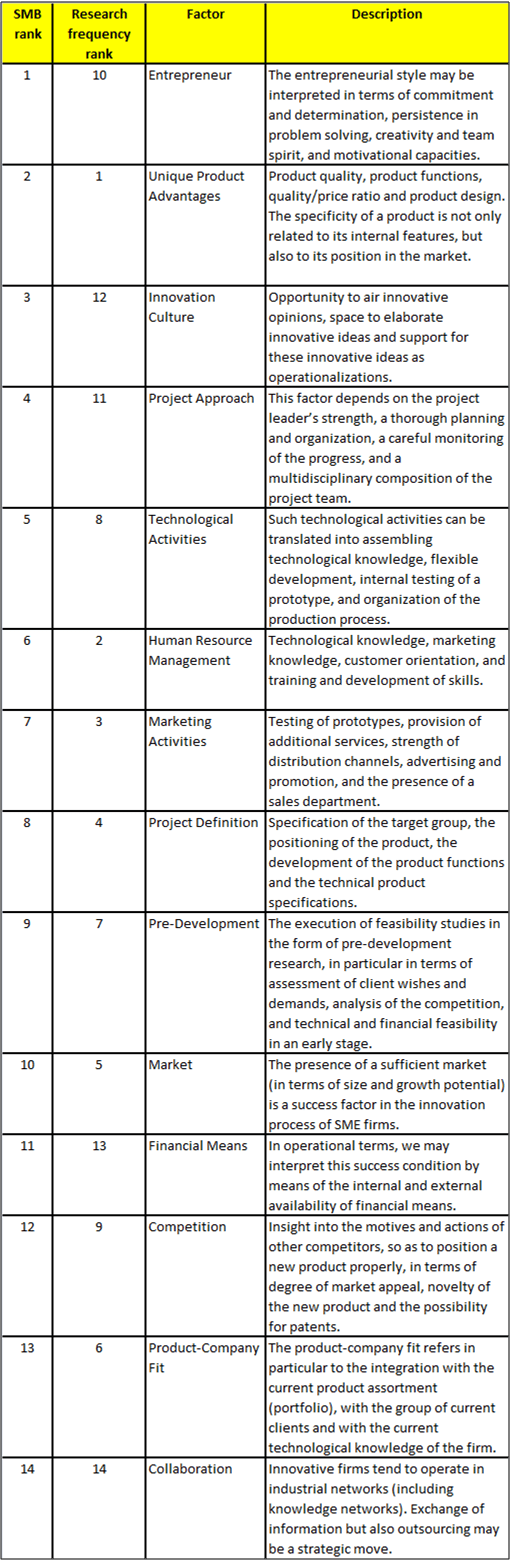
I came across an nice 2003 study by Dutch academics titled, SME innovation and the crucial role of the entrepreneur. The study’s purpose was to ask small and midsize enterprises (SMEs) what they viewed the most important factors in innovation to be. In this study, SMEs consist of 100 employees or less.

Rather than have the businesses come up with their own factors, the academics conducted an extensive survey into the prevailing studies on the matter. From this survey, they culled to the 14 most commonly mentioned bases for innovation. The 14 factors

They then asked 167 firms to answer 50 different questions, which resolved to the 14 factors. From these responses, they generated a statistically valid ranking of the what small businesses consider to be the most important drivers of innovation.

Before discussing these ranked factors, it’s interesting to note the academics’ take on this. They came up with a really rough ordering of the most important innovation factors, based on their frequency in research studies. They then compared the research studies to what the businesses themselves identified. It’s of interest to see the discrepancies.

The chart below shows how business ranked the 14 factors, along with their approximate frequency in research work.

SMBs 14 factors for innovation

The findings are useful, and perhaps not surprising. In a firm with under 100 employees, the entrepreneurial zeal of a founder certainly is a key driver of innovation. Unique product advantages make sense as the #2 factor – although perhaps that’s a bit confusing in that innovation produces the unique product advantages.

Innovation culture comes in for #3. This is important, and my guess is that if you were to survey growing sizes of firms, this factor would rise in the rankings.

Check out the full paper for details.