Weekly Recap 071108: iPhone’s Big Gulp of Humility

Today was Apple’s big day, the release of its new 3G iPhone…geeks lined up days beforehand…stores were full of new iPhones…money was burning holes in pockets…the doors opened…customers rushed in to be the first ones to have the shiny new gadget…they claim their iPhones and go to activate in-store, an Apple requirement…and…the activation FAILS

Damn, that sucked

Apple is a company that has been on a hot streak for a while…here’s a quote about them from a recent Fortune article:

Apple requires a special kind of workforce. The place is divided by product but also by function along what COO Tim Cook calls “very faint lines.” Collaboration is key. So is a degree of perfectionism. Apple hires people who are never satisfied.

Today’s activation flub has got to be eating them up sumthin’ fierce…Apple has worked hard to achieve and maintain its air of excellence and coolness…

Fake Steve Jobs recently retired from his blogging…but surely this is too delicious to not write one more post…

All that said, Robert Scoble gives the new iPhone a thumbs up

*****

Loren Feldman is currently following only 3 people on his Twitter account…he unsubscribed from everyone he was following…wow…he does say that he will be on FriendFeed going forward

I’m not comfortable damning this guy, as I’ve never heard of him outside of recent events…he seems pretty tightly wound and people describe him as funny…he messed up with TechNigga…I’m willing to watch what he does going forward…and was this really Wayne Sutton commenting on Loren’s blog?

Thanks for the official statement, continue to create videos and I hope everyone from this situation has learned something and does not stop the future of sponsorship from other national outlets with the online video blogging community. I’m looking forward to your next project.

If that’s Wayne, wow…

*****

I’ve never said meatspace….

*****

Lots of discussions this week about the fast growth of subscribers for big name people on FriendFeed…Allen Stern does a nice job of breaking it down in this video…the issue is that same people tend to show up in two key places on FriendFeed…(1) the first 12 subscriptions listed on users’ Me page…and (2) the same 9 people are often displayed on the recommended page…shaking things up on those listings would be nice…

For my part, I was really surprised at the number of subscriptions (~100) that occurred because of Mike Fruchter’s post about ten people to follow on FriendFeed…thanks for the shout-out Mike…

*****

Two young women keeping it real out there on FriendFeed…Mona N and Michelle Miller

Mona is a geeky gal who also attracts attention from the fellas…Hao Chen declared:

Ahh…Mona just overtook Robert Scoble as my #1 person you find interesting.

Michelle is irreverent, keeping folks entertained with updates about her dates with The UPS Guy…her blog post describing their first date was What Brown Did for Me

*****

On Twitter, there are two ways to broadcast a blog post:

  1. Tweet a link to your own blog post, usually including something like “blog post” so people have a heads up its your own post.
  2. Tweet the word “reading” and the name of the blog post with a URL. This lets people know that you’re reading someone else’s blog post, and you like it enough to tell others about it.

Jason Calacanis tweets “reading” for his own blog posts. Huh? Reading? He wrote it! Here’s one example:

Reading: “Official announcement regarding my retirement from blogging.” (http://tinyurl.com/5zae7s)

Don’t hate the playa, hate the game, I guess…

*****

Digg founder Kevin Rose provided a great example of changing the name of blog post during its submission to Digg…

Here’s Allen Stern’s post, referenced earlier, about the ways in which A-listers quickly accumulate followers:

  • “FriendFeed Follower Patterns Exposed: How Jason, Mike, Loic & Robert Get So Many Followers So Quickly (video)”

Here’s how Kevin Rose submitted Allen’s post to Digg:

  • “The politics of Friend Feed”

Call it social media attention optimization….

*****

See this post on FriendFeed: http://friendfeed.com/search?q=%22Weekly+Recap+071108%3A+iPhone%E2%80%99s+Big+Gulp+of+Humility%22&public=1
Email’s Changing Role in Social Media: Digital Archive, Centralized Identity

Alex Iskold wrote a great post recently, Is Email in Danger? This quote lays out the premise of the post:

From the 20th century mail was a fundamental form of communication. The invention of electronic mail (email) changed two things. It became cheap to send mail, and delivery was instant. Email became favored for both corporate and personal communication. But email faces increasing competition. Chat, text messages, Twitter, social networks and even lifestreaming tools are chipping away at email usage.

When it comes to email, there are some parallels to what happened to snail mail with the spread of the Internet and email. The biggest thing is this:

Snail mail found an unexpected opportunity for growth with the rise of the Web.

Email will lose out on some of its uses, but there are some interesting possibilities that will emerge.

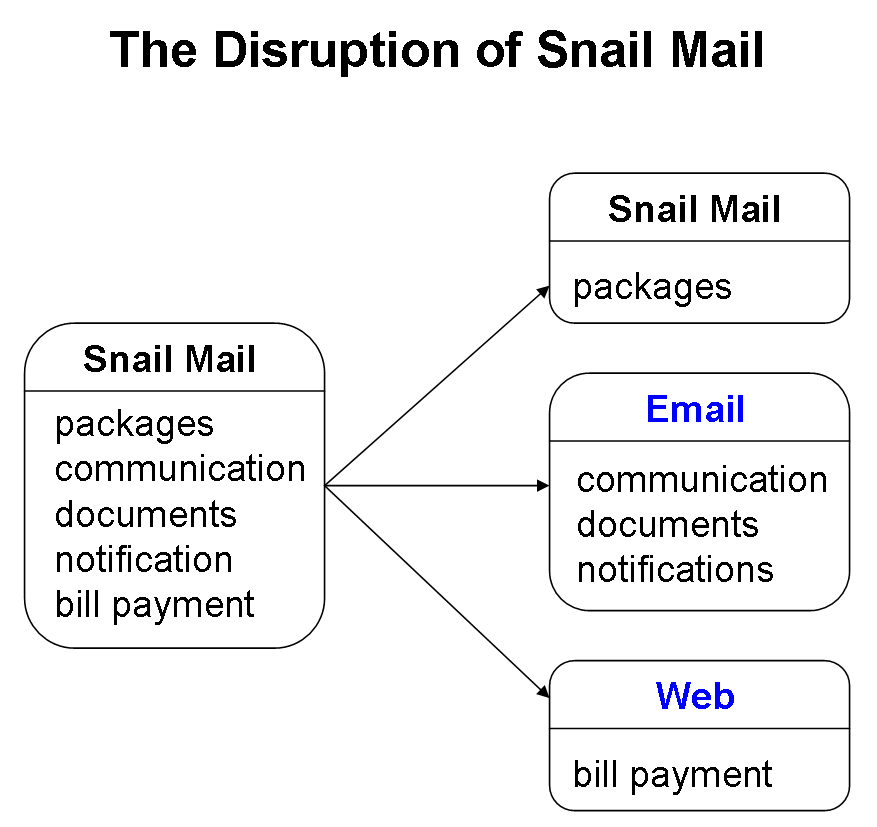
The Disruption of Snail Mail

The diagram below depicts the disruption that occurred to snail mail.

I’ve kept the disruption focused on the effects of the Internet. In other words, no fax machine or FedEx in here.

Back in the day, the mail system was the way you got a variety of important communications to other people. Our grandparents wrote letters. L.L. Bean mailed us the stuff we ordered via their catalogs. All our bills came through the mail. We were notified of things like jury service.

With the arrival of the Net, a good portion of snail mail’s portfolio was assumed by other technologies. And it’s had an effect. Here’s a quote from a 2001 General Accounting Office report on the future of the U.S. Postal Service:

Although it is difficult to predict the timing and magnitude of further mail volume diversion to electronic alternatives and the potential financial consequence, the Service’s baseline forecast calls for total First-Class Mail volume to decline at an average annual rate of 3.6 percent from fiscal years 2004 through 2008.

Pretty bad, eh? Electronic alternatives were evaporating the revenues of the post office.

But something else was out there which would help offset these losses in first-class mail: e-commerce. With the growth of the Internet, people got more comfortable shopping online instead of going to their local mall.

Those packages had to get to shoppers somehow. That’s where the U.S. Post Office shined. It already had the infrastructure to get things from a centralized place to multiple individual residences. What got disrupted were the trucking companies who moved merchandise from manufacturers to retailers.

Sure enough, the U.S. Postal Service saw a rebound thanks to online purchases, according to Web Designs Now:

In 2005, revenue from first-class mail like cards and letters, which still made up more than half the Postal Service’s total sales of $66.6 billion, dropped nearly 1% from 2004. But revenue from packages helped make up for much of that drop, rising 2.8%, to $8.6 billion, last year, as it handled nearly three billion packages.

And the dark mood at the U.S. Postal Service headquarters brightened quite a bit:

“Six years ago, people were pointing at the Web as the doom and gloom of the Postal Service, and in essence what we’ve found is the Web has ended up being the channel that drives business for us,” said James Cochrane, manager of package services at the Postal Service.

There is a lesson here for email.

The Disruption of Email

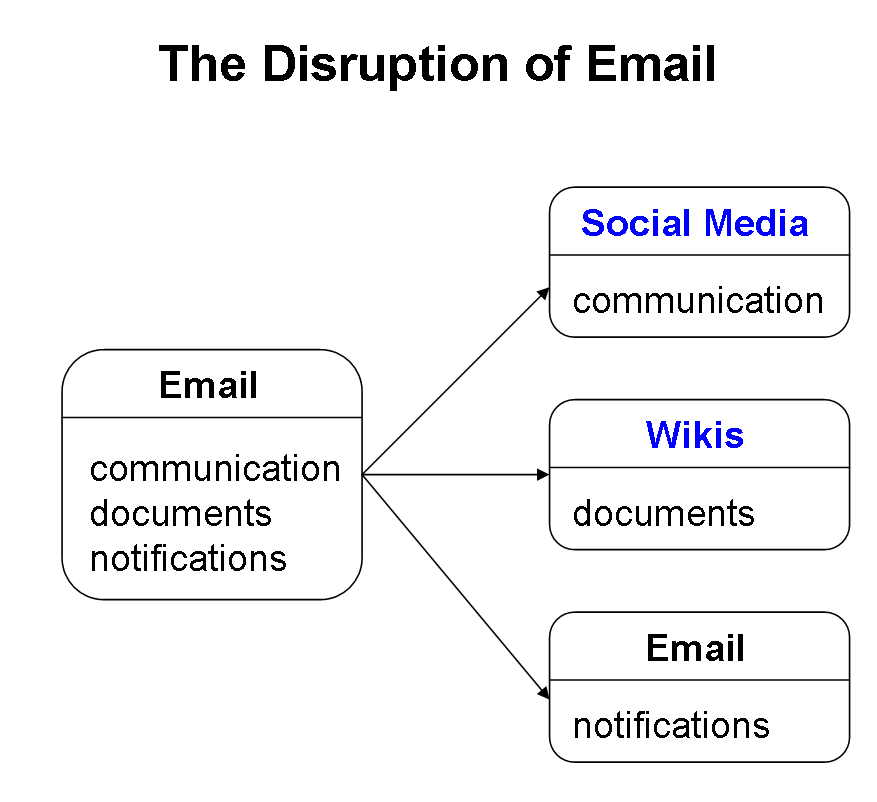
Email is undergoing its own disruption:

Again, similar to the previous diagram, I’m focusing on the web here. No mobile texting as an email disruptor, even though it is.

As Alex outlined in his post, the easy messaging of social media is supplanting the email messages that used to be sent. I haven’t seen any surveys that show the decline in person-to-person communications because of email. But my own experience reflects the migration of communications to the various social media.

  • LinkedIn messages
  • Facebook messages
  • Twitter
  • FriendFeed comments

As Zoli Erdos pointed out in his blog post Email is Not in Danger, Thank You, wikis are growing as the basis for sharing documents. They provide better capabilities than does email: wider visibility, versioning and searchability.

But it’s in notifications where email’s future is bright. Many of us are members of social media sites. As we go through our day, it’s hard to stay on top of activity in each one: new messages, new subscribers, new friend requests, etc.

Where is the central clearinghouse of my multiple social media identities? Email.

Email is the permanent record of what’s happening across various sites. This is actually a very valuable position in which to be. Here are two examples where email helped me:

  • After I wrote a post about nudity on FriendFeed, I lost some FriendFeed subscribers. I know this because my number of followers went down. There was one person in particular I wanted to check. This person wasn’t on my list of followers, and I thought, “maybe wasn’t subscribed to me in the first place?” Checked email, and I did indeed have a follow notification from this person a few weeks earlier. So I knew I’d been dropped.
  • I inadvertently deleted a comment to this blog. On wordpress.com, once deleted, the comment is not recoverable. I was in a bind. But then I realized I get whole copies of comments to this blog emailed to me. So I went to Gmail and found the comment notification. I was able to add the comment back by copying it from my email.

As snail mail had to adjust to the rise of email, so too will email adjust to the rise of social media:

As the number of social media sites and participation in them expands, email will find new growth and value in being the centralized notifications location.

Email = Centralized Identity Management

Much has been written about email being the ultimate social network. The basis for this is your address book and the emails you trade with others. But might there be another opportunity for email?

If email has all these subscription and message notifications, doesn’t it potentially have a role in helping you manage your centralized identity? Gmail could map out my connections across various sites. Find those that are common across the sites. Gauge the level of interaction with others.

Even add APIs from the various sites and let me send out communications from email. Suddenly, email’s back in the communication game as well.

I’m just scratching the surface of what might be possible here.

What Do You Think?

Email’s primary role as a communication medium is diminishing. Many of us are enjoying the easy, contextual basis of communicating via the various social media sites.

But like snail mail before it, email has interesting possibilities for what it will do for us in the future.

What do you think?

*****

See this post on FriendFeed: http://friendfeed.com/search?q=%22Email%E2%80%99s+Changing+Role+in+Social+Media%3A+Digital+Archive%2C+Centralized+Identity%22&public=1

What Interactions Do You Want from Social Media?

Mapping the different social media interactions to human anatomy:

Now…where to go to get those interactions? An incomplete list follows.

Ideas, opinion, information:

  • FriendFeed
  • Twitter

Share photos, videos

  • Flickr
  • SmugMug
  • Zoomr
  • YouTube
  • Facebook
  • FriendFeed

Music you like:

  • Last.fm

Chit chat

  • Twitter

What are you feeling?

  • Facebook
  • Twitter

What are you doing?

  • Twitter
  • Facebook
  • FriendFeed
  • Upcoming

What are you eating?

  • Twitter

Where are you?

  • Brightkite
  • Twitter

Personally, my interest is in ideas, opinions and information. But some photos and chit chat are also nice.

How about you?

I’m @bhc3 on Twitter.


Do FriendFeed Comments Hurt Bloggers’ Ad Revenue?

Allen Stern at CenterNetworks recently wrote a post arguing that FriendFeed was hurting bloggers by taking away page views. I’d paraphrase his position as this:

Once people comment on the actual blog post, they tend to return many times to see the comments that follow theirs.

I mean, they reload the blog post…MANY, MANY times…

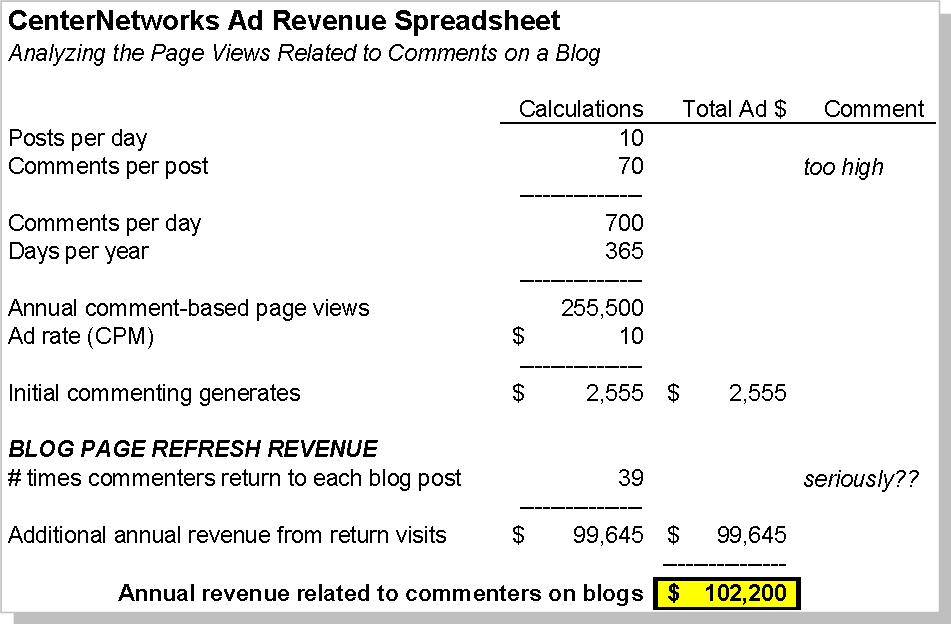
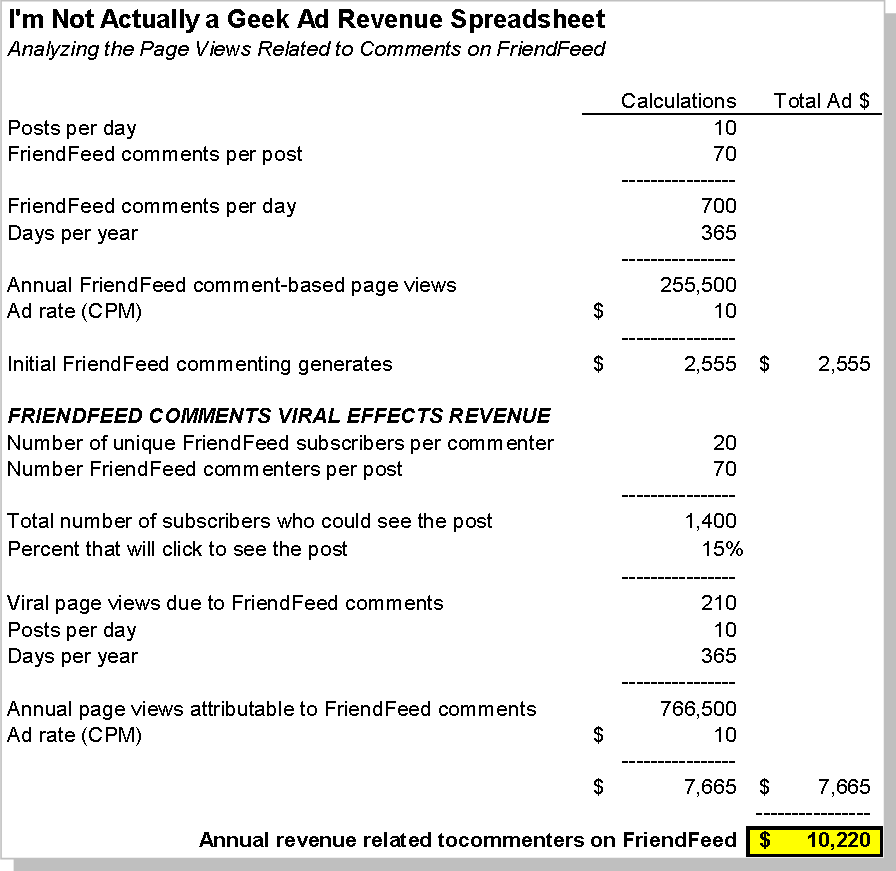
The numbers sounded aggressive to me, so I wanted to give some consideration to Allen’s calculations. I also created a separate spreadsheet that estimates the ad revenue generated from comments on FriendFeed. The tables are presented below.

One note. Allen’s CenterNetworks worksheet for blog-based comments shows ad revenue that crushes the revenue I show for FriendFeed-based comment ad revenue. But here’s the catch – there’s an uber-aggressive assumption about repeat visitors to blogs in Allen’s calculations. Right-size that assumption, and I think FriendFeed ends up looking better.

If you leave this post with one thought, it’s this:

FriendFeed will help the vast majority of ad-based blogs to increase their revenue by driving higher page views.

OK, on to the calculations.

CenterNetworks Blog Comment Ad Revenues

Allen wrote most the calculations below in his blog post. I did have to make some assumptions to hit the $100,000 annual revenue level he associated to commenter page views.

As Allen says in explaining the $100,000 in comment-related revenue:

Last step in the equation – how many people visiting the blog will reload the page a number of times to view and/or interact with the comments – on sites with major trollage, this number can be astronomical. Using our numbers above, I estimate that this could be a minimum of $25,000-75,000 per year. Again this is most likely a bare minimum and for large blogs with controversial content, this dollar figure could be way higher.

At the end of the day, a large blog could easily be generating more than $100,000 a year in commenting revenue alone.

Allen does say the number of reloads is astronomical. As the table above shows, to hit his $100,000 in comment-related revenue, commenters must hit reload 39 times. For all 10 posts. Every day. All year long. All commenters.

And presumably they’re doing this for all the big blogs: TechCrunch, BoingBoing, ReadWriteWeb, Mashable, Engadget, Gizmodo, Huffington Post…and do these blogs actually average 70 comments per post?

Anyway, I’m sure there are those who actually refresh 39 times per post on all these blogs. But are there enough to generate $100,000?

FriendFeed Comment Ad Revenues

The crux of my analysis is not page views driven by reloads. It’s based on unique visitors clicking to the blog because of the viral attention features of FriendFeed. Specifically the tendency of comments to bounce a blog post to the top of people’s FriendFeed. Comments in general will advertise the content, and comments by someone you trust will increase the odds of clicking.

As you see, I set the revenue as 10% of what Allen has in his, but I’d argue it’s based on a more realistic assumption about page views. Remember this spreadsheet focuses only on the comments effects, not the Likes or the multiple times a blog post shows up in FriendFeed: Google Reader Shares, bookmarks, Stumbles, etc.

A problem with my spreadsheet is that I carry over the aggressive assumption about comments (70 per FriendFeed entry). But I want to make the comparison to Allen’s spreadsheet apples-to-apples.

Analyzing TechCrunch’s Comment Activity

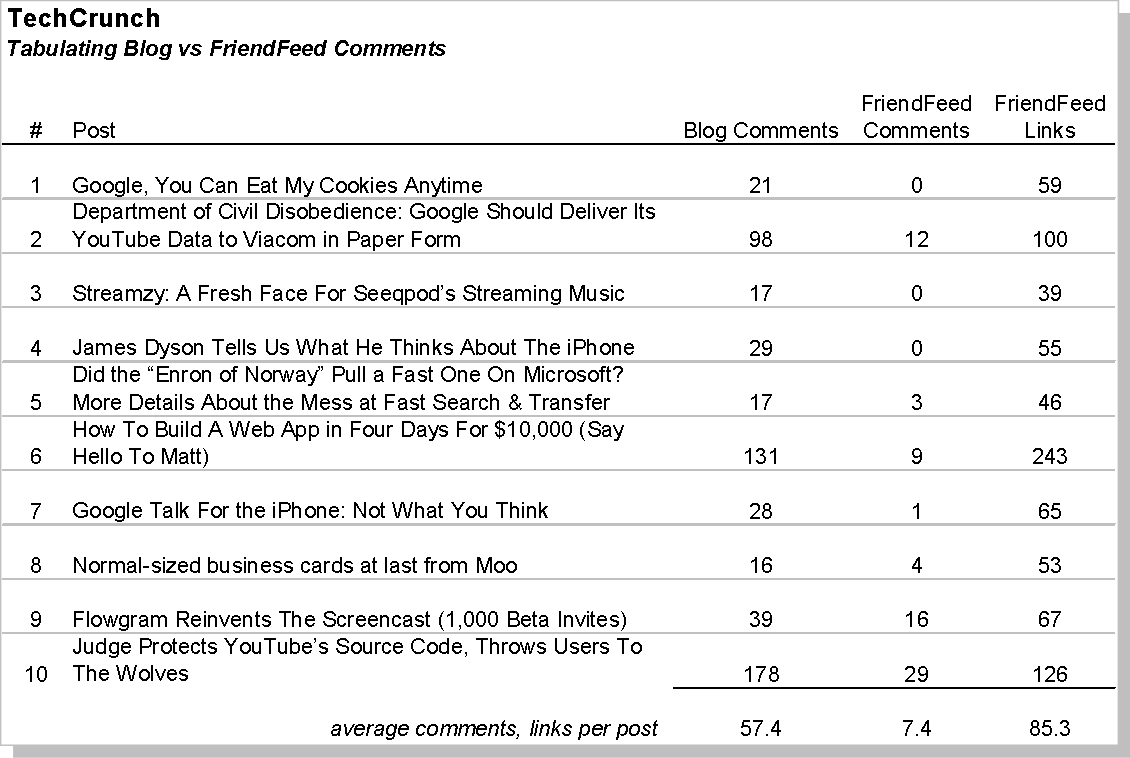
To get a sense of FriendFeed’s impact thus far, I looked at ten TechCrunch posts from the July 3 period. I counted the number of comments the posts received directly on TechCrunch, and how many they received on FriendFeed. For FriendFeed, I found all instances of the link – TechCrunch’s RSS feed, Google Reader shares, del.icio.us bookmarks, Stumbles, etc.

I excluded notes included with Google Reader shares or del.icio.us bookmarks from the FriendFeed comment count.

Looking at the table a couple things stand out:

  • FriendFeed does not appear to have stolen too many comments from TechCrunch
  • FriendFeeders have put the link out into their individual networks an average of 85 times – that’s the kind of visibility most blogs would kill for

I want to call your attention to post #10 in the above table, “Judge Protects YouTube’s Source Code”. 29 comments on FriendFeed. 14 of those comments came on a direct post of the TechCrunch article by Jason Calacanis. Jason has 29,000 followers on Twitter, and many of those have come over to FriendFeed. So when posts a question, he can get a lot of comments. But more importantly, the people commenting on his post are in all likelihood doing it because it’s Jason Calacanis.

My guess is that most of those commenting would not comment on the TechCrunch post. They’re more interested in what Jason is discussing.

Some Conclusions

I’m sure Allen is right about the TechCrunch “regulars” who post and reload multiple times. I’ve seen the reload behavior in myself when it comes to FriendFeed. However, I suspect his estimated number of reloads is way overstated. If you were to look at the 70 commenters in his scenario, you’d be lucky to get an average reload of 3 times, not 39 times. Sure, some commenters will hit double digits in their reloads. But many commenters won’t return at all.

The other consideration is that FriendFeed will take away some of those diehard reloaders. But I’d be willing to bet most of the die-hards will stay on the blog itself. Why? These guys’ relationship is with the blog and if you’re really reloading 39 times, you won’t stop commenting on the blog itself. I’ll bet there are a bunch of TechCrunch-heads who know one another via posting there. The TechCrunch site is their social network.

For most blogs that don’t generate 70 comments per post, the viral attention features of FriendFeed hold greater benefit than comments on the blog itself. Look at the ratio of FriendFeed links-to-comments for TechCrunch:

11.5 times more links for a post than comments (85.3/7.4)

As a blogger, I’ll take that trade-off. All those links are added visibility. FriendFeed is just as much about discovery as it is about conversations. That shouldn’t be overlooked.

Even Allen’s post about this was visible 24 separate times on FriendFeed.

Finally, in an interesting development, check out how ReadWriteWeb is integrating FriendFeed comments into each blog post. That’s one of the top 11 blogs worldwide embracing FriendFeed comments.

*****

See this post on FriendFeed: http://friendfeed.com/search?q=%22Do+FriendFeed+Comments+Hurt+Bloggers%E2%80%99+Ad+Revenue%3F%22&public=1

Darwin and FriendFeed’s “Bounce to the Top” Algorithm

I really enjoy seeing the flow of new content come through FriendFeed. And the best feature is that people’s interactions make content resurface at the top of your FriendFeed page. Human filtering to make the most interesting stuff bounce to the top.

We all enjoy the Likes and Comments that make the most interesting content in our social networks pop back up to the top. And it seems to be pretty simple, right?

{Like} or {Comment} = Content Bounces to the Top

Well, it’s actually a bit more complex than that. The FriendFeed “bounce to the top” algorithm has some interesting behind-the-scenes rules. There is a certain amount of Darwinism to it.

Having noticed that the “bounce to the top” function is not as straightforward as simple Likes and Comments, I posted this comment on FriendFeed:

Sometimes I don’t understand the FriendFeed “bounce to the top” logic. I just added my Like to Corvida’s blog post about email (http://friendfeed.com/e/68e566…), but I didn’t see it pop back up to the top of my FriendFeed screen. What drives the logic?

In typical FriendFeed fashion, there was a really interesting conversation that followed. Mark Trapp, who has really impressed me with knowing stuff, had this to say:

I’ve been tracking the bump logic for a month or so now, and this is what I’ve found out: likes will stop bumping a story after a certain amount of time, and comments will always bump to the top if either a) it’s your story, b) it’s someone you’re subscribed to’s story, or c) it’s a FoaF AND a friend of yours comments on the story AND it’s the first time your friend commented on the story. Everyone else’s comments won’t bump it. For scenario c, Paul had mentioned to me that a fix for it was in the works.

From Mark’s response, one can see a few design principles behind FriendFeed.

1. Comments Are More Valuable than Likes

Comments always bounce something back to the top. Likes stop doing that after a period of time. This makes sense. Likes are easy. They are quite valuable as signals for the “interestingness” of content.

But Comments are King in the FriendFeed system. Comments mean someone has taken the trouble to express themselves. And that engagement draws the content creator and others into the conversation.

As reviewed in an earlier post here, Comments don’t necessarily mean the content has information that’s good to know. Some bloggers are just really good at stirring things up.

But the supremacy of Comments in the “bounce to the top” algorithm clues you in to the FriendFeed founders’ orientation. Conversations are ranked higher than good content discovery.

I Like that.

2. The Value of Likes Decreases with Time

In my comment, I referenced that my Like of Corvida’s blog post failed to bounce her entry back up to the top of my FriendFeed. I believe the FriendFeed entry of her blog post was only an hour old at the time.

My initial thought for this is…why? Doesn’t a Like mean others should check out the content, even if it is older?

Good content doesn’t have an expiration date.

But there are other ways content resurfaces in the FriendFeed system. Google Reader shares. Tweets. Direct posts. Bookmarks. Unlike comments, which only become visible when the entry to which they’re attached bounces to the top again.

So the multiple ways content can resurface reduces the need for Liked content to bounce to the top again after a while.

Wonder how long Likes have an effect on the “bounce to the top” algorithm?

3. Comments = More Reputational Skin in the Game

This is the conclusion I draw. Likes are easy, and have multiple purposes, as described by Mike Fruchter. If someone were to call you out for an errant Like, you could always say, “I was just using the Like to bookmark the entry to my personal feed.”

But comments are more visible, and you are much more accountable for them. When people post comments, they are adding to or withdrawing from their reputation account. And in social networks, reputation is huge.

So the emphasis on comments makes sense. The threshold for adding those is higher, and its effect should be greater.

Survival of the Fittest

Only the strongest content seems to survive in the FriendFeed Galapagos Islands. An initial rush of Likes puts the content into the stream of many, many users. Strong content will get this initial rush.

Then the content has to evolve. If it’s going to get that ongoing attention, Likes are no longer going to cut it. The content has to attract Comments. These Comments sustain the content in a sea of new, competing content.

Of course, just like Darwin’s animals, eventually even the well-adapted content will perish. Fossils for our future searches.

*****

See this post on FriendFeed: http://friendfeed.com/search?q=%22Darwin+and+FriendFeed%E2%80%99s+Bounce+to+the+Top+Algorithm%22&public=1

Made the Switch: FriendFeed Now My Homepage

In recent weeks, I’ve noticed my behavior has changed when I fire up the PC in the morning. My Yahoo has been my home page forever. I love the portal approach, with everything I like easily visible and accessible with a click.

But as soon as My Yahoo loaded, I quickly clicked over to FriendFeed. I really didn’t read much of what was displayed on My Yahoo.

I can be pretty loyal to apps and companies I like. I was doing this with Yahoo, despite the change in my behavior. Finally though, I realized that staying loyal and delivering a page view to Yahoo wasn’t really getting me anything.

I switched to FriendFeed.

My Top 5 Reasons for Making the Switch:

  1. Content that is filtered by my network on FriendFeed has more value to me than what I see on My Yahoo
  2. My interest in all the content I see on My Yahoo is only fleeting, but a portal demands that it’s always there (e.g. stock quotes)
  3. Hitting Refresh on My Yahoo only brings up the same stories. FriendFeed has the most amazing river of new stuff.
  4. My Yahoo doesn’t provide some of the content I find most interesting = tweets, blog posts, articles directly posted, comments, Flickr Favorites by people I trust (note the Flickr irony…)
  5. My Yahoo takes too long to load

I know I can control the portal experience by adding/deleting content. But that’s a pretty heavy process to me. And it doesn’t really come close to the constant stream of interesting new content that FriendFeed delivers.

I don’t mind the ads so much, but that big fat Classmates.com ad sure does take up a lot of real estate. I expect when Friendfeed includes ads, they’ll be more subtle like Google AdWords.

Biggest concern? I’ll fail to check my Yahoo Mail without the link I have on the My Yahoo page. A number of people still use that email to stay in touch.

If Yahoo can get clever and revive itself, I might make it my home page again. But for now, it’s FriendFeed.

*****

See this post on FriendFeed: http://friendfeed.com/search?q=%22Made+the+Switch%3A+FriendFeed+Now+My+Homepage%22&public=1

Why Bloggers Should Want Comments on FriendFeed

Blog comments aren’t dead, but FriendFeed comments have emerged as equally valuable. Robert Scoble has a post up now in which he states:

My Tesla post gathered two comments here.

13 comments and 12 “Likes” over on FriendFeed.

Let’s just stick a fork in it. Comments are dead.

I don’t think they’re dead, but I do think he raises a good point. The interaction that occurs on FriendFeed is so much easier and freewheeling than it is on blogs.

Blogs that don’t have a lot of comments can feel like museums (“look, but don’t touch”). It feels like it takes an extra effort to put a comment there, because you can’t really feed off others’ participation.

FriendFeed’s got four things that make it really, really good for commenting:

  1. Wide open nature – anyone can jump in
  2. More lively subscription base – RSS subscribers are great for views, but not for comments. FriendFeed’s interaction nature stokes conversations in a much better way
  3. The barrier to commenting is lower – I commented on Robert’s post about this, and got a message saying my comment was “awaiting moderation”. Not on FriendFeed – where I just typed and clicked “Post”.
  4. FriendFeed’s viral attention features – Likes/Comments cause content to bounce to the top of the screen and friend-of-friend interactions cause people outside your subscription base to see your blog post, generating more views and comments

Keep the blog comments coming, but I’m quite happy to have you comment on FriendFeed too.

*****

See this post on FriendFeed: http://friendfeed.com/search?q=%22Why+Bloggers+Should+Want+Comments+on+FriendFeed%22&public=1

Breaking the Rules and Still Winning: Twitter’s Je Ne Sais Quoi

When I was in grad school our professor gave us an assignment. Our papers had to be within a set word count. Nearly all of us diligently stayed within that rule, constraining our analysis as best we could. But not one classmate. He blew right through the word count restriction. When the professor discussed our papers the next day, he called out this student’s paper as the best of the lot. We all learned two things that day:

  1. Ignore this professor’s word count restrictions in the future
  2. Rules don’t matter if you create something people love

Twitter is going through its toughest stretch ever right now. Here’s a FriendFeed search on the phrase “twitter is dead to me“. And here’s Steve Isaacs’ thoughts on the current Twitter:

I expect Twitter to be 1) reliable = epic fail. 2) Something more than a simple one way alerting medium = fail 3) to grow and mature like all great web services = also a fail. Am I being too hard, I think not.

Pretty grim, eh?

Well, not so bad. Several big names have recently stated their new interest in FriendFeed in lieu of Twitter. But read these comments closely, and tell me that these guys have really given up on Twitter:

The beautiful thing about Twitter is that spontaneous, diverse conversations erupt that are almost synchronous, or chat like – Michael Arrington, in post praising FriendFeed over Twitter

I’m steering people to FriendFeed, can’t help it. My discussions are happening there. And bonus: It pisses off Steve Gillmor. 🙂 – Dave Winer

Really tired of Replies being broken here. Spending more time in FF, but still subscribing only to close friends over there. – Shel Israel

There are others. These are people who are practically being dragged away from their favorite social media app.

Their words say FriendFeed, but their hearts say Twitter.

And this is what I mean. Let’s look at the rules Twitter has broken.

Rule #1: Build a scalable platform

Well, this is the crux of the current problem, so clearly they messed this one up. Google didn’t mess this one up. Amazon.com didn’t. eBay didn’t. Yahoo didn’t.

Twitter did.

Rule #2: Communicate with your users

For the most part over the last several months, communication has been via the Fail Whale. Not a lot of feedback to the loyal users about the problems. And when features are removed, it doesn’t seem to be communicated correctly.

Dave Winer noted that Twitter’s own employees are not among the power users of Twitter. The shoemaker’s children go barefoot.

Rule #3: Web 2.0 companies actively add features

A hallmark of hosted web 2.0 services is they constantly roll out new features as they get feedback from users.

Not Twitter. They rely on a robust ecosystem of developers to take care of that. Twitter users relied on a member of that ecosystem, Summize.com, while they took down the Replies tab this past week.

Rule #4: Web companies need realistic paths toward profitability

And that generally means advertising. But not Twitter, at least not yet. Profitability shmofitability. But to be fair, when you see YouTube picked up by Google without revenue, and Powerset purchased by Microsoft without revenue, you realize this is a rule that is getting relaxed more and more.

.

But Twitter’s Got that Je Ne Sais Quoi

Dave Winer appears to be twittering about as much as he always has. He has also started to engage folks on FriendFeed as well, as a look at his comments there shows. But Twitter got its Replies feature back Saturday, causing Dave to wonder:

Now that Replies are back, we get to find out if our fling with FF is the real thing, or just a summer love.

And here’s a sampling of FriendFeed comments on his tweet:

  • “Twitter is the Cliff Notes of Friendfeed. Quick and easy & you get the gist.”
  • “For me, it’s like friends with benefits and evaporates when my true love returns.”
  • “Twitter is my Best Friend… Friend Feed is my Book Club… there’s more ‘deep conversation’ over here – but I don’t always want every conversation to either be non-existent or terribly deep. Sometimes I just want to twitter like a little bird.”
  • “I like FF – I love Twitter – FF needs to be organized differently, I think – it doesn’t have the right logical setup for me.”
  • “I’m sure people will complain about twitter when it fails to work, but when they manage to kick themselves and make it work, people will flock back”

This comment from Arrington’s FriendFeed-favorable TechCrunch post captures it for me:

I will stick with Twitter for now, because even though about half of my tweets are @ replies, I don’t really use it for _conversation_ per se – more like spontaneous short IM chats that end in ❤ tweets and involve 2-3 people. Don’t need an entirely different website to “manage” that.

Twitter’s got that new funding including Jeff Bezos, they’ve got heavyweights rooting for them (e.g. Arrington’s “Twitter!” post) and loyal users who are sticking with them despite the limited functionality.

Twitter also has going for it the same asset that helped AOL through its downtime crisis in the late 1990s. If you were on AOL, you had all your email connections there. Switching costs were high. Same thing applies to Twitter. Social network switching costs are high, a point recently made by Corvida.

Here’s what I predict will happen. The new architecture is built. New features will be added (threading tweets, Seesmic-like video conversations, etc). There will be an avalanche of positive coverage: “Twitter’s Back!” And it will continue its growth trajectory after a 9-month rocky road.

Twitter…breaking all the rules and living to tell about it.

*****

See this post on FriendFeed: http://friendfeed.com/search?q=%22Breaking+the+Rules+and+Still+Winning%3A+Twitter%E2%80%99s+Je+Ne+Sais+Quoi%22

Weekly Recap 062708: The FriendFeed Immigration Continues

Twitter’s replies tab has been disabled most of this week, causing a fair amount of consternation…without Replies, it’s hard to maintain asynchronous conversations, or even synchronous ones if you’re conversing with 10,000+ people…

So a few more of the bigger technorati are discovering the merits of FriendFeed…

Michael Arrington: “Friendfeed for most users was just a place to bookmarks all their activities on other social networks. Now, more and more, it’s a place that people start conversations. The early adopters got that a while ago. Now, the not so early adopters are using it as a Twitter replacement, too.”

Dave Winer: “I’m steering people to FriendFeed, can’t help it. My discussions are happening there. And bonus: It pisses off Steve Gillmor. :-)”

Shel Israel: “Really tired of Replies being broken here. Spending more time in FF, but still subscribing only to close friends over there.”

Steve Gillmor: “friendfeed is getting very close to being usable”

Chris Saad: “So is the idea we use friendfeed instead of Twitter? Does that actually work?”

Not bad at all…but we’ll see how long it lasts…collectively, the last four (excluding Arrington) have 18,670 followers, which is hard to match any time soon on FriendFeed…as Corvida noted:

when you get out of one relationship that you’ve put so much time and effort into, do you really feel like going out there, just to find a replacement to try to rebuild what you had with someone else?

Once Twitter rights its ship (in several months), we’ll see how many of the Twitter refugees stick around on FriendFeed…

*****

Have you heard of the Persian Cam Room on FriendFeed? Join it! Amazing pictures can be found there.

.

Amazing pictures can be found there.

*****

I often see complaints on FriendFeed about too much FriendFeed talk…to which I say, that’s why they provide the Hide function…

*****

Facebook has added FriendFeed-like functionality, allowing comments on the activity streams of your friends…I’m trying it out a bit, here are a few initial impressions:

  • It’s hard to comment on someone adding the “Hug Me” application
  • Status updates are easier content on which to comments
  • You really get used to the speed with which commenting and accessing new content occurs. Facebook is so painfully slow in comparison
  • I was pleased with the comments I got back after I did my first round of comments. Will continue to play with it.

*****

Finally, I wanted to note the moves of several solo bloggers into the “big time”

Interestingly enough, Frederic had just the prior week written a post in which he noted:

It’s close to impossible for a solo blogger to make a living in the tech blogosphere.

Now he’s part of the big time…congrats to all!

*****

See this item on FriendFeed: http://friendfeed.com/search?q=%22Weekly+Recap+062708%3A+The+FriendFeed+Immigration+Continues%22&public=1

What’s Your Blogging Style? Use FriendFeed Likes/Comments Ratio to Find Out

Julian Baldwin asked a question today on FriendFeed: “Roughly speaking, what is your comment to like ratio here on FriendFeed?” Based on the responses, a  lot of folks are doing more commenting than liking, but I suspect the responses aren’t totally representative. Still you can see a lot of emphasis on commenting.

Which made me wonder about turning this around a bit. Instead of looking at each person’s ratio of Likes to Comments, what could be gleaned from figuring that ratio out for a blog?

I selected several blogs, and totaled the number of Likes and the number of Comments for the last 30 posts of each blog. I then calculated the ratio of Likes to Comments, and mapped the bloggers to roughly one of four blogging styles:

  • Stir it up
  • Can we talk?
  • Observing the scene
  • Stuff you want to know

There are some adjustments and limitations related to this; they follow below. But first, the map of bloggers to blogging styles. To reiterate, the ratios you see below are calculated this way:

# Likes / # Comments = blogging style

So for instance, Dave Winer’s ratio is actually below 1.0. He gets more Comments than Likes. Here’s the map:

As I put this together, the analysis does seem to ring true from my perspective.

Here are the adjustments and limitations:

  • Some bloggers are really active at responding to comments on FriendFeed. This tended to drive their number of Comments up. For instance, Alexander van Elsas could put on a clinic in terms of engaging commenters on FriendFeed. I should be so good. So I gave the number of Comments a haircut for several bloggers.
    • Alexander van Elsas – 33% haircut
    • Myself – 25%
    • Mark Dykeman – 25%
    • J. Phil – 25%
    • Colin Walker – 25%
  • The analysis only applies to the main blog for each person (listed below)
    • No Toluu activity updates
    • No Qik videos
    • No side blogs that augment the main one
    • Etc.
  • Only the blogger’s own feed was used in this analysis. This is imperfect, as it does not include Likes and Comments for other ways thr blog post gets into FriendFeed:Google Reader shares, tweets, direct posts, del.icio.us, etc.
  • Some great new bloggers aren’t here, as they build out their blogs with posts.
  • The 30 blog posts per author only included entries with at least 1 Like or Comment.

And quickly, here are the links to the blogs used in the analysis:

What do you think? Does the Likes/Comments Ratio make sense as a blog style indicator?

*****

See this item on FriendFeed: http://friendfeed.com/search?q=%22What%E2%80%99s+Your+Blogging+Style%3F+Use+FriendFeed+Likes%2FComments+Ratio+to+Find+Out%22&public=1

Using FriendFeed Rooms for Work: What’s Needed?

I believe that Participation is the killer app.

Whether it is end user participation in content driven conversations on blogs and wikis, or end user developed applications, mash-ups and widgets, I think that it is participation that key difference between Enterprise 2.0 and Enterprise 1.0.

Rod Boothby, Participation Is the Killer App, Innovation Creators

Making work more interesting and more engaging would have benefits for companies and workers. To that end, I’ve suggested that FriendFeed has aspects applicable inside the enterprise. Steven Hodson took it a step further, suggesting engineers could use FriendFeed rooms to manage their software development.

The idea of using rooms for work purposes has been broached by other as well:

  • possible248: “Companies already have blogs and wikis, is there going to be something like a FriendFeed room that they can host on their own server?”
  • Jigar Mehta: “How would it be, if FriendFeed allows users to attach documents (doc, docx, ppt, pdf, txt, rtf) and discuss over them!!”

Personally, I think there’s a lot of merit to this idea. I’ve seen so many good discussions around ideas on FriendFeed. And for many of us, work is the creation, advocacy and execution of ideas – projects, presentations, campaigns, financings, etc.

The land of wikis is well developed, but most of them suffer from only emphasizing multiple user changes to documents and revision tracking. They lack the interactive participation that makes FriendFeed so compelling.

With that in mind, I wanted to come up with a list of features that would provide very basic wiki functionality in FriendFeed rooms. Wikis can have all sorts of advanced features. What would be the minimum feature set to make rooms function as lightweight wikis?

To be clear about the objective…I’ll set the wiki bar low. A room would only exist to manage the production of a smaller project or document. No large-scale stuff here. And that’s probably a good approach in business anyway.

Rooms already have three key elements for making them into wikis:

  • Ability to manage who the room members are
  • Room-specific search
  • RSS directly into rooms

Here are my four features for wikifying FriendFeed rooms:

  1. Better handling of RSS feeds for document changes
  2. Sticky setting for entries
  3. Timestamp comments
  4. New comments and entries notification

Better Handling of RSS Feeds for Document Changes

In Jigar Mehta’s entry, Nick Lothian commented:

Doesn’t GDocs have a RSS feed for changes? Hook that up and then you can have discussion about the changes to documents

That makes a lot of sense to me. FriendFeed doesn’t need to upload the document and maintain revisions. It can leverage that functionality in another app, like Google Docs. And this use case is exactly how FriendFeed works: users read blog entries and then come back to FriendFeed to Like and Comment.

I set up a public document on Google Docs, and had the document changes feed into a specific room: Rooms Wiki Experiment. If you go there, you’ll see my original entry, “Politics 2008 – Google Docs”. I commented a couple times. Then you’ll see another entry called “Restricted”. If you had access to the source document, you’d see information about revisions. I, of course, do have access. And that link only takes you to Revision #3. I made 15 revisions, but those changes didn’t stream into the room.

So that needs to work better, either from Google Docs or within FriendFeed.

Sticky Setting for Entries

Brad McCrorey posted a good question on FriendFeed:

Would having a “sticky” setting that keeps an item at the top of the room be too “forum like”? I think I’d get some use out of it.

I like this idea. In terms of advancing a project or document, this feature would let key decisions remain visible to everyone in the room.

Timestamp Comments

This is a recurring request. And it makes sense in terms of the wiki. Projects and documentsd evolve, and the timestamp helps one understand whether a comment was made before a change or after it. Or before a decision, or after it.

Timestamps give an extra bit of context to the interactions that occur around the project.

New Comments and Entries Notification

Inside a company, you are busy with multiple tasks. You’re not likely to keep the FriendFeed room up all the time (although that may be possible).

But it’s important to know when new entries have been posted. These entries would be:

  • New changes to a document
  • New direct posts of someone with an idea or question
  • New document added to the room

Notification provides the visibility needed to ensure interactive participation and timely decision-making.

Final Thoughts

The comment at the top of this post reflects my position regarding the future of work. More open, more interactive, broader participation, more engaging. FriendFeed, and Twitter as well, have created terrific interactive models not seen in most Enterprise 2.0 apps today.

I’m sure the FriendFeed guys aren’t worried about this now. But somewhere along the line, companies may see the potential in FriendFeed and begin asking for this type of functionality.

*****

See this item on FriendFeed: http://friendfeed.com/search?q=%22Using+FriendFeed+Rooms+for+Work%3A+What%E2%80%99s+Needed%22&public=1

Weekly Recap 062008: Baby I’m-a Want You

Babies sure can take a long time to arrive, can’t they? I don’t want to see an update from Louis until at least an hour after their birth, even longer…first things first…

*****

Benjamin Golub, creator of RSSmeme, received an email from an irate blogger this week…a couple of her posts had been shared via Google Reader, and ended up on RSSmeme. She wanted them taken down…

I was surprised, as I had only seen links and partial feeds for blogs on RSSmeme…turns out, there was a full feed option…

RSSmeme does run Google ads, but Benjamin’s not getting rich off them…they offset the server costs…

Still, it did set up an issue where the full content of a blog was accessible on a different site, and the site was earning money on the content via ads…

Duncan Riley came out pretty strong in favor of the blogger…partial feeds are fine, as the reader must visit the actual blog to read the whole thing…but full feeds crossed the line…I find myself agreeing with Duncan on this one…

The cool thing about RSSmeme is that it indicates how popular an item was by the number of shares…it also tells you who did the sharing…so if someone’s interested in the full blog post based on (i) its subject; (ii) the number of Reader shares; and (iii) who did the sharing, they will click the link to read the post on the actual blog…full feeds on RSSmeme aren’t needed…

*****

TechCrunch posts are published under two separate users on FriendFeed, Michael Arrington and Erick Schonfeld…but the action always seems to be around Arrington’s user ID…

Looking at the past ten TechCrunch posts, Arrington’s FriendFeed has 22 Likes and Comments, Schonfeld has 2…

Why such a disparity?…Arrington is the public face of TechCrunch, so people will gravitate toward his feed even if he hasn’t written the post…Arrington follows 1,329 people on FriendFeed, Schonfeld follows 79…Arrington’s FriendFeed handle is techcrunch while Schonfeld’s is erick…so if you looking for the TechCrunch feed on FriendFeed, you’re naturally going to find Arrington first…

*****

Finally applied the FriendFeed Block function to a user…it wasn’t that he was hassling me, but he has a tendency to spam FriendFeed entries with unrelated things and links…he added one right after I posted a comment on one entry, which disrupted the vibe of the entry…so I finally pulled the trigger…

I actually feel bad about doing it…

*****

With the recent post about nudity on FriendFeed, the search term nudity is starting to show up a regular referral to my blog…not quite was I was looking for, but traffic is traffic…

Which makes me wonder what kind of search term hits Ginger Makela will get for her recent post Now That I’ve Got Your Attention with BOOBS, a Word from Our Sponsor…Ginger did ad sales for Google, so she knows a thing or two about SEO

*****

I did experience a few users unsubscribing from me on FriendFeed the past week or so…you write about nudity, gay marriage and Like Flickr pix with nudity, that will happen…

*****

Some couples on FriendFeed that I enjoy…Lindsay Donaghe and Tad DonagheThomas Hawk and Mrs Hawk

*****

And thanks go out to Steven Hodson for putting this humble little blog up on pedestal…if you’re not subscribing to his blog WinExtra, you should…click here to add it to your reader…

*****

See this item on FriendFeed: http://friendfeed.com/search?q=%22weekly+recap+062008%22&public=1