U.S. Innovation Is Failing, or It’s Never Been Better

BusinessWeek TimeTwo stories came out this week from Business Week and Time, with polar opposite views of what’s happening with U.S. innovation. Here’s the glass-is-half-empty version from Business Week, The Failed Promise of Innovation in the U.S.:

“We live in an era of rapid innovation.” I’m sure you’ve heard that phrase, or some variant, over and over again. The evidence appears to be all around us: Google (GOOG), Facebook, Twitter, smartphones, flat-screen televisions, the Internet itself.

But what if the conventional wisdom is wrong? What if outside of a few high-profile areas, the past decade has seen far too few commercial innovations that can transform lives and move the economy forward? What if, rather than being an era of rapid innovation, this has been an era of innovation interrupted? And if that’s true, is there any reason to expect the next decade to be any better?

There’s no government-constructed “innovation index” that would allow us to conclude unambiguously that we’ve been experiencing an innovation shortfall. Still, plenty of clues point in that direction. Start with the stock market. If an innovation boom were truly happening, it would likely push up stock prices for companies in such leading-edge sectors as pharmaceuticals and information technology.

—-

Instead, the stock index that tracks the pharmaceutical, biotech, and life sciences companies in the Standard & Poor’s (MHP) 500-stock index dropped 32% from the end of 1998 to the end of 2007, after adjusting for inflation. The information technology index fell 29%. To pick out two major companies: The stock price of Merck declined 35% between the end of 1998 and the end of 2007, after adjusting for inflation, while the stock price of Cisco Systems (CSCO) was down 9%.

Consider another indicator of commercially important innovation: the trade balance in advanced technology products. The Census Bureau tracks imports and exports of goods in 10 high-tech areas, including life sciences, biotech, advanced materials, and aerospace. In 1998 the U.S. had a $30 billion trade surplus in these advanced technology products; by 2007 that had flipped to a $53 billion deficit. Surprisingly, the U.S. was running a trade deficit in life sciences, an area where it is supposed to be a leader.

A more indirect indication of the lack of innovation lies in the wages of college-educated workers. These are the people we would expect to prosper in growing, innovative industries that need smart, creative employees. But the numbers tell a different story. From 1998 to 2007, earnings for a U.S. worker with a bachelor’s degree rose only 0.4%, adjusted for inflation. And young college graduates—who should be able to take advantage of opportunities in hot new industries—were hit by a 2.8% real decline in wages.

The final clue: the agonizingly slow improvement in death rates by age, despite all the money thrown into health-care research. Yes, advances in health care can affect the quality of life, but one would expect any big innovation in medical care to result in a faster decline in the death rate as well.

Now here’s what Time Magazine says in How Twitter Will Change the Way We Live:

When we talk about innovation and global competitiveness, we tend to fall back on the easy metric of patents and Ph.D.s. It turns out the U.S. share of both has been in steady decline since peaking in the early ’70s. (In 1970, more than 50% of the world’s graduate degrees in science and engineering were issued by U.S. universities.) Since the mid-’80s, a long progression of doomsayers have warned that our declining market share in the patents-and-Ph.D.s business augurs dark times for American innovation. The specific threats have changed. It was the Japanese who would destroy us in the ’80s; now it’s China and India.

But what actually happened to American innovation during that period? We came up with America Online, Netscape, Amazon, Google, Blogger, Wikipedia, Craigslist, TiVo, Netflix, eBay, the iPod and iPhone, Xbox, Facebook and Twitter itself. Sure, we didn’t build the Prius or the Wii, but if you measure global innovation in terms of actual lifestyle-changing hit products and not just grad students, the U.S. has been lapping the field for the past 20 years.

How could the forecasts have been so wrong? The answer is that we’ve been tracking only part of the innovation story. If I go to grad school and invent a better mousetrap, I’ve created value, which I can protect with a patent and capitalize on by selling my invention to consumers. But if someone else figures out a way to use my mousetrap to replace his much more expensive washing machine, he’s created value as well. We tend to put the emphasis on the first kind of value creation because there are a small number of inventors who earn giant paydays from their mousetraps and thus become celebrities. But there are hundreds of millions of consumers and small businesses that find value in these innovations by figuring out new ways to put them to use.

There are several varieties of this kind of innovation, and they go by different technical names. MIT professor Eric von Hippel calls one “end-user innovation,” in which consumers actively modify a product to adapt it to their needs. In its short life, Twitter has been a hothouse of end-user innovation: the hashtag; searching; its 11,000 third-party applications; all those creative new uses of Twitter — some of them banal, some of them spam and some of them sublime. Think about the community invention of the @ reply. It took a service that was essentially a series of isolated microbroadcasts, each individual tweet an island, and turned Twitter into a truly conversational medium. All of these adoptions create new kinds of value in the wider economy, and none of them actually originated at Twitter HQ. You don’t need patents or Ph.D.s to build on this kind of platform.

Hogwash

My own opinion is that Time is right, Business Week is off here.  Business Week’s article makes a tough-to-sell argument based on the stock market and stagnating wages. It looks at trade deficits, and death rates. These macro factors certainly reflect innovations, but they’re affected by too many factors to lay it all at innovation’s feet.

While I don’t have a decade-by-decade list of innovations to back up my view, I in no way think we’re living in a period of failing innovation.

We, as people, are just as creative as we’ve always been. There’s been no mass mutation of our genetics to cause a decline there. The same spirit that compelled our great-grandparents is alive and well inside us. If there was a drop in innovation, it would need an identifiable systemic cause. Business Week doesn’t provide that.

We’re living in an era where entrepreneurship has never been more accessible. Capital, outside of dips in the economic cycle, is readily accessible. Technology is cheaper than ever. The ability to leverage the web for marketing and information is unprecedented.

The Time article gets it right. The innovations continue apace, many of which are more distributed than before. I saw this firsthand at Maker Faire, where average folks are turning out all sorts of cool things.

When you distribute the innovatin’ to the people, it’s only a matter of time before a wave of new ideas will emerge for all of us to enjoy.

What factors do SMBs think are most important for innovation?

Thinking

Credit: Holly Marie Photography

I came across an nice 2003 study by Dutch academics titled, SME innovation and the crucial role of the entrepreneur. The study’s purpose was to ask small and midsize enterprises (SMEs) what they viewed the most important factors in innovation to be. In this study, SMEs consist of 100 employees or less.

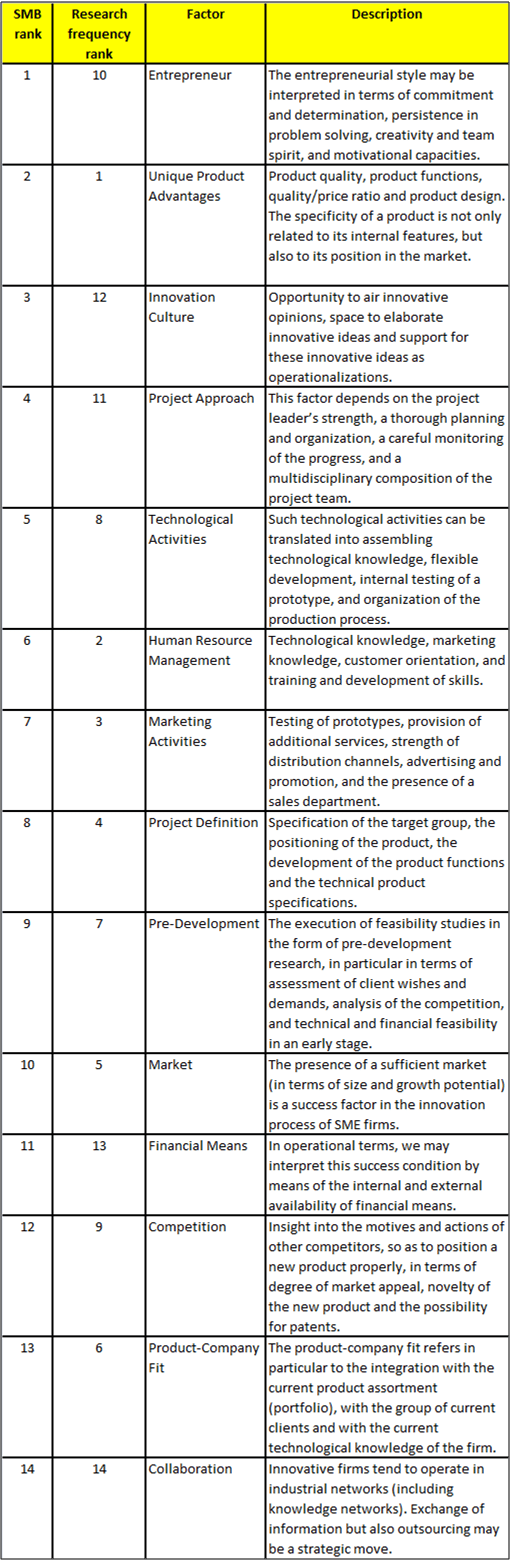
Rather than have the businesses come up with their own factors, the academics conducted an extensive survey into the prevailing studies on the matter. From this survey, they culled to the 14 most commonly mentioned bases for innovation. The 14 factors

They then asked 167 firms to answer 50 different questions, which resolved to the 14 factors. From these responses, they generated a statistically valid ranking of the what small businesses consider to be the most important drivers of innovation.

Before discussing these ranked factors, it’s interesting to note the academics’ take on this. They came up with a really rough ordering of the most important innovation factors, based on their frequency in research studies. They then compared the research studies to what the businesses themselves identified. It’s of interest to see the discrepancies.

The chart below shows how business ranked the 14 factors, along with their approximate frequency in research work.

SMBs 14 factors for innovation

The findings are useful, and perhaps not surprising. In a firm with under 100 employees, the entrepreneurial zeal of a founder certainly is a key driver of innovation. Unique product advantages make sense as the #2 factor – although perhaps that’s a bit confusing in that innovation produces the unique product advantages.

Innovation culture comes in for #3. This is important, and my guess is that if you were to survey growing sizes of firms, this factor would rise in the rankings.

Check out the full paper for details.

What is Innovation Management?

Innovation “Management” as a term, doesn’t sit well w/ me. Just like Knowledge “Mgmt”. KM failed in part b/c of the inherent controls

Sameer Patel, April 22, 2009

I thought this was a good comment by Sameer, as it reflects a couple things:

  • Nascent field of technology tools that specifically facilitate and improve corporate innovation is just becoming understood
  • Concern that the unpredictable and rough-edged aspects of idea generation will be smothered by ham-handed managerial controls

Seeing what’s happening with customers at Spigit, I can safely say that the field of innovation management is much richer and collaborative than the term might connote. It’s not so much “control” management as it is “optimization” management. It’s a recognition that companies have significant margin for improvement in their innovation processes and outcomes.

[tweetmeme source =”bhc3″]

With that in mind, I wanted to put forth eight elements that help describe “innovation management”. This list is by no means exhaustive, but it should give you a feel for what the field is about today.

#1: Innovation benefits from a range of perspectives

For most of our industrial history, innovation has been the province of an internal R&D team. Those smart geeky types who labored to create the next generation of products for big concerns. Fast forward to where we are today. With the rise of the Information Age, more people have a knowledge-based relationship with their employers.

Contributing what you know has become the dominant part of work in Fortune 2000 companies. Leveraging this trend into the innovation realm is a natural extension of employees’ work. And indeed, once done, it becomes apparent that so-called “line workers” have a lot of valuable knowledge, experience and ideas as well. You don’t need an advanced degree to understand a glaring customer issue or a better way to manage field operations.

Studies show that exposing ideas to a wider range of perspectives significantly improves them. In terms of management, the change for companies is elevating the importance of sourcing ideas from throughout the enterprise, as well as outside of it. One example: in this video on how it approaches innovation, Pfizer notes that “Ideas aren’t just sitting at headquarters. There are fantastic ideas all over the company.”

#2: Four of the most damaging words an employee can say: “Aww, forget about it”

What If I Fail cartoonIdeas come in various forms: disruptive, product and operational. And they hit employees at varying times as they do their work. Sure, a lot of these ideas won’t be feasible. But a lot will.

The problem for companies is that employees self-censor, either because (i) culturally they’re not encouraged to post ideas, even potentially bad ones; or (ii) there’s no way to easily capture these.

The recognition that there is valuable intellectual capital in the ideas that emerge from employees’ knowledge and activities is core to improving corporate innovation. Changing organizational focus to foster more ideas from all quarters, and providing the resources to capture these are core to what innovation management means.

#3: Create a culture of constant choices

Jim Collins spoke recently at the Front End of Innovation conference. A key theme from his speech was that great companies enable constant choices. By this, he means that external markets are constantly changing. Companies that are maintaining a good velocity of ideas are the ones that succeed long-term in industries.

This is actually a pretty significant cultural dynamic. Companies can be quite adept at execution, and throwing choices in front of everyone can disrupt that strength. So figuring out “their way” to create a culture of constant choices is really the hard work.

This is part of what is meant by innovation management.

#4: Looking at innovation as a discipline

Innovation is a Top 3 priority for companies, reports Boston Consulting Group. Indeed, BCG notes that innovation leaders generate 430 basis points more in shareholder returns than do average companies. So how does a company systematically address innovation as a discipline?

Companies apply resources and attention to a number of other disciplines: sales, customer relationship management, supply chain management, managerial accounting, etc. Looking at innovation from a similar perspective is emerging as an important strategy.

A number of large corporates have established internal innovation-focused executives. These aren’t employees who are supposed to dream up all the ideas. Their work is on establishing innovation as a discipline. Their charge is wide-ranging, including HR, executive attention, focus areas for innovation, internal communication, processes and selection of technology to facilitate. While I wasn’t around in the rise of the CRM era, presumably there was similar work by earlier generations of employees.

The work of making innovation a discipline is part of innovation management.

#5: Focus employees’ innovation priorities

Each of us knows a lot. From a variety of activities and interests. Work. Hobbies. Family. Locale. Life. I’ll bet you come up with ideas and encounter problems to be solved for a wide variety of things.

For corporations, this wealth of experience is an asset, but it does require some tuning. For ideas, you never know when someone’s personal church activities might have relevance to a product idea for the company. You want that variety of perspectives to inform and improve ideas.

At the same time, there needs to be a channeling of where employees’ ideas are focused. If executives don’t lay down directional areas for innovation, employees’ time on innovation will not be as valuable as it could be. Of course they’re going to have a range of ideas. But which ones are most pertinent to the company’s success in the market?

Channeling employees’ innovation focus is part of innovation management.

#6: Recognizing innovation as a funnel with valuable leaks

When one views innovation as not just game-changing disruptive ideas, but including incremental ideas, it becomes clear that innovation is fundamentally a funnel. Start with a large, ongoing quantity of ideas drawn from employees, customers and partners. As discussed in #2 above, you really want to get as many of these ideas as you can.

Ideas must then go through a winnowing process. Some will get stronger, and advance to projects. Some will fall away as not feasible.

And from all this intellectual activity around ideas, new ideas will emerge. It’s natural. Once employees are in the mode of generating and assessing ideas, it nwill be natural for new ones to emerge. Really, this arguably is the case for a lot activities that foster interaction among employees. But in this case, the social object around which they’re interacting is an idea. In terms of instilling a culture of constant choices, interaction around ideas promises to be a key part of achieving that.

Managing the funnel is part of innovation management.

#7: Establishing a common platform for innovation is a revolutionary step forward

Consider how employees innovate today. You have an idea, what are you going to do with it? Certainly you’ll sound it out with peers, which is illustrative of the fact that innovation is a social activity. Then what? Tell your boss. Email it. Enter it into a customer service database. Put it in a PowerPoint. Try to schdule meetings.

When you consider what employees must do today to move an idea forward, it’s really pretty daunting. Under this system, corporate innovation requires phenomenal acts of heroism to get anything done. Ad hoc, siloed applications make companies the poorer for the ideas they’re missing. Existing idea management processes don’t allow cross-enterprise visibility, which means collaboration among interested parties is limited. An unfortunate outcome is that the pace of innovation falters as ideas lose share of mind.

Creating the common community space for innovation is a dramatic leap forward in how companies foster innovation. The same mechanisms of departmental outreach and email are certainly still available. But now, ideas can get an audience of thousands, allowing them tap different reservoirs of experience and perspective. Senior executives csn see ideas that previously would languish in lower levels of the organization.

Creating this common platform is part of innovation management.

#8: Innovation must be more than  purely emergent, disorganized and viral

Innovation management today draws heavily from the themes of Enterprise 2.0. Key to the power of social computing is letting employees’ activities and knowledge apply itself naturally where it’s needed throughout an organization. For purists, this means get rid of oversight and managerial prerogatives.

To create ongoing, sustainable innovation, there needs to be a programmatic approach. Riding the pure emergent form of Enterprise 2.0, or continuing the current ad hoc, siloed approaches to idea management, is insufficient. Employees will be busy with projects and tasks they need to execute. Perhaps culturally, innovation hasn’t been a focus. There will need to be a push to raise the awareness of innovation. And some organization to channel it where it’s needed.

There will also be ideas that are valuable, but which may not resonate with a broader section of the employee base. Leaving the emergence of these ideas purely to viral dissemination means leaving some of them buried at the departmental level. Companies need ways to ensure valuable ideas are caught and surfaced systematically.

Combining bottom-up emergence with top-down priorities and organization is part of innovation management.

Wrap-Up

As I said above, innovation is a multi-faceted activity, with many moving parts and ways of approaching it. What I’ve listed here represent my way of clarifying what the field of “innovation management” is about. If you think I’m off or missed something, let me know in the comments below.

Thanks.

[tweetmeme source =”bhc3″]

Under this system, corporate innovation requires phenomenal acts of heroism to get anything done

Tapping Communities to Accelerate Corporate Innovation

Jim Collins related a story back in 1999 that well-describes the problems with and opportunities for innovation inside organizations. In a Harvard Business Review article, he wrote about Phil Archuleta, a materials manager at a U.S Marines recruiting depot in San Diego.

The Marines would issue new enlistees a uniform on their first day in the service. After two weeks of intensive training, these recruits needed a new uniform because the initial ones no longer fit. Marine policy was that the recruits original uniforms were to be destroyed. That’s right, thrown away.

Archuleta thought that policy was daft, and that the uniforms could simply be washed and used for the next class of recruits. He asked his superior, and was told, “No. It’s against regulations. Forget about it.” Eventually, Archuleta got a new supervisor who thought he had a good idea, and promoted it up the military chain. The idea was well-received at the higher levels, and implemented across the Marines. It resulted in annual cost savings of half a million dollars.

How many ideas by the likes of a Phil Archuleta are buried inside organizations?

Tapping Communities to Accelerate Corporate Innovation

The presentation below is one that I gave for recent webinar with Oliver Young of Forrester. The webinar focused on deriving ideas from organizations’ communities: employees, customers, partners.

The presentation is built around four themes:

  1. Strategic importance of innovation
  2. Email <> community
  3. Corporate innovation is more than a popularity contest
  4. You can’t manage what you can’t measure

Strategic value of innovation

Certainly this qualifies as an obvious notion. Innovation is important to companies. It’s the source of organic growth. But in many ways, companies are not treating it as important as other processes, such as supply chain management and cost accounting. Thus, it is important to reiterate the obvious.

Boston Consulting Group analyzed the shareholder returns for companies in its Top 50 innovators list. It compared these returns to markets averages, and found that best-in-class innovators generated 430 basis points more in returns than did the market. Aberdeen Group surveyed 280 manufacturers, and characterized their innovation capabilities as best-in-class, average and laggard. Best-in-class innovators, who far more consistently hit new product revenue targets and launch dates, were 4.7 times more likely to create specific processes for idea generation.

No surprise then that senior executives rank innovation as a top 3 priority.  Accenture well-describes the goals and aspirations of companies: create repeatable and ongoing improvements in business performance.

Key, of course, is to consider innovation among the disciplines in which a company should excel. And create a program for it accordingly.

Email <> community

I’ve worked for large companies. I know how it goes when you have an idea. Jot it down somewhere. Talk it out with someone. Then email someone else about it. If you’re lucky, someone in that email will pick it up. Maybe.

More often than not, interesting ideas just sort of lie there, buried in the minutiae of the daily grind or not catching the interest of a particular individual. Which is what happened to Phil Arhuleta’s idea about the Marines’ uniforms.

Rather than rely on ad hoc, siloed forms of communicating ideas (like email), social networks provide a new way to tap communities. The diagram below shows the process by which innovation is fostered with a social innovation platform:

Ideas are the social objects for community interaction

Ideas are the social objects for community interaction

On the top left, it’s important that companies understand: ideas can come at any time, in any form. They’re rarely subject to scheduling. Once you have an idea, there’s needs to be an easily accessible, and easily usable,  site for the posting of those ideas. No more silos!

Creating a common site is critical aspect #1 of creating an innovation program. Employees, customers and partners should have a single place where each community can go to post the ideas that occur to them.

Critical aspect #2 is the ability of the community to provide feedback on an idea. Separating the good from the bad, and refining ideas to help them take shape are the heavy lifting of emergent, social systems.

In the upper right, the refinement of good ideas takes shape. This includes the feedback from the community, as well as offline activities around the idea, such as design work, marketing plans and financial analysis. Finally, in the lower right, the company selects an idea based on community feedback and refinement.

Aside from the benefit of actually knowing about a lot more valuable ideas, there’s another benefit to community-driven innovation management: ideas get better when they’re subject to diverse points of view and knowledge. See the earlier post What Enterprise Social Networks Do Well: Produce Higher Quality Ideas to understand that effect.

Finally, the graphic below describes the community innovation cycle:

Bottom-up innovation requires top-down support

Bottom-up innovation requires top-down support

I think the concepts of expand community and pipeline of ideas are relatively self-explanatory. And I just discussed the engage, access, refine, select part of the cycle. The other two are the top-down support needed to ensure the community feels their efforts matter.

Keep in mind that when people suggest ideas to companies, these aren’t just conversation starters with their fellow community members. People want to know that companies listen to good ideas and take action. That’s quite clear to a community when its ideas are actually implemented, and there is a reward and recognitions for its members.

Executives go a long way, particularly with employees, when they make the company innovation program a focus point. Employees will take their priorities from senior management, and executive sponsorship is an important factor for creating an ongoing, sustainable innovation program.

Corporate innovation is more than a popularity contest

The most common notion of community innovation is the principle of: one person = one vote. An idea that receives a lot of votes clearly is more useful and valuable than an idea receiving fewer votes. This “rule” works well with products that exhibit these characteristics:

  • End buyer requests
  • Lower complexity features
  • No concentration of buying power

That last bullet needs a little explaining. Dispersed buying power means that basically you can consider each vote to be the equivalent of one product purchase. If you have a few customers that generate a significant amount of your sales, their votes should carry more weight.

There are going to be plenty of ideas that require stronger stuff than basic popularity. I like the way Microsoft’s Haddow Wilson put it:

There are times when the collective wisdom is what we need. But what about those times when we need to make a strategic decision and only a few in the crowd have the necessary background and insight to help? How do we separate the knowledge from the noise? How do we know to whom to listen? How do we find them?

Innovation communities need a way to identify those whose opinions should carry greater weight. They essentially need reputation systems to identify members with greater standing among the community. This stature can be assigned or earned.

You can’t manage what you can’t measure

The ethos and value of Enterprise 2.0 focuses on the emergent, authentic nature of employee contributions. It’s historically been hard for employees to apply knowledge in a timely fashion. In this culture, “management” is often a loaded word, with connotations of over-processing and controlling the ways in which employees collaborate.

But that should not stand in the way of measurement. You can have measurement of outcomes, and inputs, and use that to guide the community generally in the direction you’d want to take an innovation program. On the flip side, if a community continues to generate ideas that aren’t squaring with the company’s vision of where it wants to go, it’s porbably wise to listen to them.

Either way, measurement provides a view into the health of the community (posts, comments, views, etc.), the sources of the ideas (groups, categories, product lines, etc.) and the traction that ideas put on the platform are getting (stages, implementations).

Measurement is also the basis for analytics used to surface the best ideas from the rest. One other thing measurement does is this: it positively affects the culture of companies.

Performance and Culture

Breed performance, change culture

The transparency that measurement on an innovation management platform provides is healthy. Everyone can see the bases by which ideas advance. Everyone knows how their own ideas are faring, and can do something about it. This happens because of measurement.

It’s about creating ongoing, sustainable innovation

Companies will benefit greatly once they establish an ongoing program of innovation. It’s too often takes phenomenal acts of heroism to get an idea through the ad hoc channels and processes that dominate corporate innovation today.

Time to treat innovation as a discipline worthy of its own resources and focus.

When Being Rational Kills Your Business – Clayton Christensen

Clayton ChristensenLast week, I attended the World Innovation Forum on behalf of my company, Spigit. One of the speakers was Clayton Christensen, Harvard professor most famous for his book The Innovator’s Dilemma. His talk was one I really looked forward to, and he didn’t disappoint.

The theme of his talk was Disruptive Innovation as a Platform for Growth. A good all-purpose title, but one that really didn’t do justice to the range of topics. Clayton delivered a lot of good knowledge and analysis. I tweeted most of his talk, and I wanted to pull it together in a blog post here. So let’s get to it.

Big Steel vs. Mini Mills

He opened with a discussion that one can find in The Innovator’s Dilemma. It’s the tale of how big traditional integrated steel mills lost market share to upstart mini mills over the course of several decades. To the point where the integrated steel mills have for the most part been shuttered.

Key to the story is this: The steel market could be segmented into different segments, from low-grade to high-grade steel. And profit margins improved as you sold into the higher grade markets. The big integrated mills produced all grades of steel, which meant the profit margins for the different segments averaged out.

Cue the disruptive technology, mini mills in this case. The mini mills initially were too small to utilize the then-current technology to produce high grade steel. But they could produce low-grade quite well, and at a much lower cost. This meant they could easily underprice the big integrated steel mills, and they gained market share in the lower end of the steel market.

Ultimately ceding the low-end seemed OK to the big mills. It meant dropping the lowest profit business, which made margins look better, as the graphic below demonstrates:

Improve Margins by Exiting Low-Margin Businesses

In the short term, this strategy was quite beneficial to the integrated mills. The next part of the story is where the disruption really kicks in. The low grade mini mills’ technology got better, so that they could produce increasingly higher grade steel at lower costs. This forced the big integrated mills to retreat to ever higher margin segments, until there was no place left to hide.

Disruptive technology. Steel in this case, but it happens everywhere.

Why Do Companies Allow this to Happen? They’re Being Rational

This is a wide open question, and it’s one that cannot be answered completely here. But Christensen provided some valuable points.

In pursuing the higher margin business and jettisoning the lower segments, companies are being eminently rational. Fighting it out over low-margin business is generally not considered a good application of corporate capital. Why? Here’s my personal take on Christensen’s disruption model:

  • Existing customers are not clamoring for your low-margin business
  • Current manufacturing and installed base do not support lower cost production or delivery
  • Return on capital for protecting the low-margin business is poor
  • Low-margin business is not strategic to customers, and does not fit long term company goals

Indeed, all of the above are rational and generally the right approach to the problem. Spending large dollars pursuing low-margin commodity businesses is something most of us would view as folly. Christensen, in describing the big integrated steel mills’ management, noted that he never uses the word “stupid”. They’re actually being rational.

In being rational, companies encounter a significant problem when it comes to innovation:

A business model hijacks an idea and forces it to change to conform.

The existing business model rides on a set of processes and principles. Anything new must work with that “innovation infrastructure” to get anywhere internally. But often, this requires changing an idea so fundamentally that it no longer works like it’s originator thought it would. Innovation takes a hit.

Who’s Next for Disruption? Oracle and Toyota

Christensen mentioned some specific companies at risk for disruption.

Oracle, the ever growing enterprise software behemoth, is at risk for disruption from Salesforce.com. I get that. Salesforce clearly has lower cost applications that can target Oracle. In databases, Oracle seems to have prevented disruption by MySQL by acquiring it.

Toyota was a surprise pick for disruption…by the likes of Kia and Hyundai. As Christensen explained it, Toyota has been putting resources into higher margin luxury cars and pick-up trucks. Meaning they’re vulnerable at the lower end.

That’s one thing with these disruptive technologies. It’s really hard to believe it before it happens.

Key Strategies for Addressing Market Insurgents

Christensen offered three pieces of advice to companies in dealing with market disruption:

  1. Create separate units to deal with insurgents
  2. Frame the problem correctly
  3. Understand the job your product was hired to do

Separate business units. This advice is in his book, but it still makes sense. Essentially, the best way to handle disruptive technologies is to tackle them in a separate division outside the main corporate focus. Keys to this division:

  • Separate sales force
  • Leverage new technologies for cost-advantage, performance benefits
  • Be willing to cannibalize existing sales

Most companies do not do this. In the computer industry, Christensen cited IBM as the only company to successfully navigate disruptive technologies: Mainframe -> Mini computers -> PCs. Of course, they’ve jettisoned the PC business. I wonder if the next wave will be the mobile platforms emerging, like the iPhone.

Frame the problem correctly. Christensen believes the root cause for the inability to innovate is not framing the problem correctly. Companies do not understand what is happening with their customers as they use new technologies:

Expensive failure always results when disruption is framed as technological rather than business model terms.

There’s a tendency to view market competition through a technology lens, not a business one. A company will see a new technology, and note its obvious inferiority to what current leaders offer. It then becomes easy to dismiss it.

That’s the mistake.

Companies should think in terms of the business context for changes in their industry.Best way to do this?

Customers hire your product for a job. This was an intriguing way to put things. Christensen advises thinking in terms of “the job your product has been hired to do”. I heard this, and my initial instinct was…huh? But it really is a powerful way to understand how your customers use your products and services.

The crux of his point is that segmenting the market on demographics – e.g. urban hipsters, suburban soccer moms, etc. – is a way of performing marketing. But it’s not useful as context for product roadmaps or assessing new competition for your customers’ wallets.

Christensen referenced a Peter Drucker quote to bring this home:

The customer rarely buys what the company thinks it is selling him.

There’s an enormous amount to be learned when you consider your company’s product in the hands of a customer. In understanding the uses of the product, the  job of the product, you increase the likelihood of framing diruptioon in business terms, not technology. One example he gave is Ikea. Ikea’s not a low-priced furniture store. It’s integrated to get a job done – to get your place furnished fast.

The Disruptive Potential of Green Tech

Green technology has emerged as an important driver of our future economy. There’s a lot of investment in the sector. Here’s where Christensen put forth an interesting observation.

He traveled to Mongolia to see his kid who was on a mission there. While walking through a market, he came across some cheap solar-powered TVs. They were miniature, and the solar panels were low-cost materials. The quality wasn’t great, but they functioned well enough for that part of the world.

He compared these little cheap solar devices to the larger green initiatives underway today. And in his view, disruption of the traditional power industry is more likely to come from things like cheap solar TVs than from big heavy investments.

Those TVs are closer to the job people are hiring for.

Electric cars are often in the news today. The biggest challenge for them is that currently technology requires a heavy battery onboard. This causes them to be slow, and they don’t go very far on a charge. So who might be interested in “hiring” heavy, slow cars that can’t go too far? Parents of teenagers.

The Power of Employee Ideas

I’ll close out this post with this note. Christensen was engaged by Intel to talk to its employees about disruptive innovation, and framing the problem correctly. Led by then-CEO Andy Grove, the company held a series of employee meetings to discuss new ideas for their markets.

Last year, ideas coming from those employee ideas amounted to $18 billion for Intel. Not bad, not bad at all.

I’m Heading to the World Innovation Forum

world-innovation-forum-logo

I’m heading out to the World Innovation Forum in New York on Monday, May 4. I’m really looking forward to this conference. It has a lot of wattage and great attendees.

Spigit will be there to take in the discussions and meet folks.If you’re going to be there, shoot me a DM or @reply on Twitter. I’d love to catch up. On Twitter, the hash tag for the event is #wif09.

Here’s the speaker list for the World Innovation Forum:

  • Clayton Christensen – Disruptive Innovation as a Platform for Growth
  • Vijay Govindarajan – Strategic Innovators: From Ideas to Execution
  • Fred Krupp – Untangling the Future: Why Innovations Never Follow a Straight Line (eco focus)
  • Dan Ariely – Changing Focus: Why Human Behavior is the Hunting Ground for Insight & Innovation
  • CK Prahalad – The New Age of Innovation
  • Paul Saffo – How Today’s Technology is Defining Tomorrow’s Creator Economy
  • Padmasree Warrior – Cisco CTO

There will case studies discussed as well. Media partners are the Wall Street Journal and Business Week. Dozens of large corporations will be there too.

There will be a number of specially designated people blogging and tweeting about the vent. Some details about this were put together by EMC’s Stuart Miniman in this presentation:

What Enterprise Social Networks Do Well: Produce Higher Quality Ideas

Idea generation at some point involves someone moving knowledge from this group to that, or combining bits of knowledge across groups. Where brokerage is social capital, there should be evidence of brokerage associated with good ideas, and vice versa.

Professor Ronald Burt, University of Chicago, Structural Holes and Good Ideas

Allow me to note a top-down benefit for companies that excel at innovation. Boston Consulting Group (pdf) calculated that leading innovators generate 430 basis points more in shareholder return than do average companies. Put another webinar-051309-registrationway, if an average company were to return 7.7% on your investment, leading innovators would return 12.0%. As an investor, that’s pretty attractive.

And  as an employee, being part of an innovation culture must be immensely satisfying.

On Wednesday, May 13, Oliver Young of Forrester Research and I will host a one-hour webinar, Tapping Communities to Accelerate Corporate Innovation. The session will cover strategies, practices and findings with regard to what leading companies are doing today to accelerate innovation. You can register by clicking the graphic to the right.

A topic we will address is the role and value of communities in increasing the number of good ideas generated for companies.

Which brings me back to Professor Burt, whom I quoted above. In his article, he discusses in-depth research he conducted on the Supply Chain Group for a major American electronics company. The results are eye-opening, and are compelling evidence for creating a common way for employees across a company to share ideas, knowledge and perspectives with one another.

Before discussing his findings, let’s go right to one of Professor Burt’s conclusions:

Thus, value accumulates as an idea moves through the social structure, each transmission from one group to another having the potential to add value. In this light, there is an incentive to define work situations such that people are forced to engage diverse ideas.

Brokerage Across Structural Holes

Professor Burt speaks in terms of “brokerage” and “structural holes”. The sociogram below depicts a typical social network structure:

burt-sociogram

There are essentially three nodes in this social network: A, B, C (+D). The structural holes exist between A and B, B and C & A and C. Notice the two actors. James is relatively “network constrained”. His social world really revolves around a tight core that all know one another. Robert is not constrained. He has ties into different groups, allowing him to tap non-redundant sources of information. Reaching across these social nodes is known as brokerage.

Professor Burt describes for levels of brokerage for which a person could create (increasing) value:

  1. Make each side aware of the other’s interests and difficulties
  2. Transfer best practices
  3. Draw analogies between groups ostensibly irrelevant to one another
  4. Synthesize beliefs and behaviors that combine elements of both groups

From simple to complex brokerage, there is value in making connections. Specifically, value in terms of the quality of ideas produced.

The High Correlation Between Idea Quality and Brokerage

The study of the supply chain group involved 673 managers. Professor Burt was given detailed access to the employees’ backgrounds, job titles, salaries, and performance reviews. He constructed the sociogram for the workers through online surveys, giving him information on which workers were network constrained, and which ones spanned structural holes.  Basically, he had a wealth of variables to test.

And what did he test? The quality of the ideas submitted by these 673 workers. He asked each of them to answer this question:

From your perspective, what is the one thing that you would change to improve [the company’s] supply chain management?

Let each employee provide their idea for how things could be approved. These ideas were then evaluated by two senior-level executives who had gained prominence for running the respective supply chains of their business units.

These rated ideas were then statistically analyzed against all those variables. What Professor Burt found was that there were general patterns to idea quality:

  • More senior managers provided better ideas
  • More educated managers provided better ideas
  • Managers in urban centers had better ideas

Yet within these variables that correlated to idea value, there was an overall trend that held true across the board. Those managers who were network constrained consistently scored lower in the idea evaluations. So even though the more educated employees had better ideas on average, within their ranks, there was clear difference between those who span the structural holes, and those who do not.

Bottom line: Connecting with those outside one’s closed network results in higher average quality of ideas.

Wrapping Up

I wrote earlier about the revenue advantage accruing to employees with more diverse internal social connections. That study looked at the revenue per employee generated, and was fundamentally a productivity measurement. This field research by Professor Burt introduces a new benefit for creating an enterprise-wide view of ideas proposed by employees. The ability for others to know about an idea, and to see the value and the application of that idea in their own realm.

By enabling communities to post, critique, collaborate on and refine ideas, companies are certain to reap the benefits of accelerated innovation. As Professor Burt puts it:

People connected to groups beyond their own can expect to find themselves delivering valuable ideas, seeming to be gifted with creativity. This is not creativity born of genius. It is creativity as an import-export business. An idea mundane in one group can be valuable insight in another.

There’s a lot more where that came from. Oliver Young and I look forward to seeing you at the webinar (registration link) on May 13 at 1:00 pm Eastern.

I’m @bhc3 on Twitter.

Enterprise 2.0 and the Trough of Disillusionment

There is currently a business and marketing fashion wave for collaboration as the miracle cure for all that ails business which isn’t helpful in differentiating good from bad ideas.

Oliver Marks, ZDNet, When Internal Collaboration Is Bad for Your Company…

It feels like I’m seeing more posts describing the challenges that Enterprise 2.0 faces. I’m not alone, Dion Hinchcliffe noted a similar trend yesterday as well on ZDNet. Of course, these concerns have always been there, as they are for any technology innovations (just look Twitter coverage in 2007). But I’ve been impressed with the frequency of critiques recently.

All of which is right on schedule.

Are you familiar with something called the “hype cycle”? It’s a fascinating framework used by the analyst firm Gartner. It describes five phases that technologies go through on their to becoming mainstream and beneficial to companies:

1. “Technology Trigger”
The first phase of a Hype Cycle is the “technology trigger” or breakthrough, product launch or other event that generates significant press and interest.

2. “Peak of Inflated Expectations”
In the next phase, a frenzy of publicity typically generates over-enthusiasm and unrealistic expectations. There may be some successful applications of a technology, but there are typically more failures.

3. “Trough of Disillusionment”
Technologies enter the “trough of disillusionment” because they fail to meet expectations and quickly become unfashionable. Consequently, the press usually abandons the topic and the technology.

4. “Slope of Enlightenment”
Although the press may have stopped covering the technology, some businesses continue through the “slope of enlightenment” and experiment to understand the benefits and practical application of the technology.

5. “Plateau of Productivity”
A technology reaches the “plateau of productivity” as the benefits of it become widely demonstrated and accepted. The technology becomes increasingly stable and evolves in second and third generations. The final height of the plateau varies according to whether the technology is broadly applicable or benefits only a niche market.

The hype cycle is a useful framework, providing a reasonable explanation of the business phases of technology. Let’s look at how Gartner specifically characterized Enterprise 2.0 in its recent hype cycle report.

Enterprise 2.0: Staring into the Abyss

In August 2008, Gartner released Hype Cycle for Emerging Technologies, 2008. The report analyzed the different stages of 27 different emerging technologies. Included in the report were technologies related to Enterprise 2.0:

gartner-2008-hype-cycle

See Social Computing Platforms in the chart above, of which Gartner notes the following: “Following the phenomenal success of consumer-oriented social networking sites, such as MySpace and Facebook, companies are examining the role that these sites, or their enterprise-grade equivalents, will play in future collaboration environments.”

Future collaboration environments. What did Oliver Marks say? That Enterprise 2.0 has experienced a “fashion wave for collaboration as the miracle cure for all that ails business”.

So in his statement, Marks both describes unrealistic expectations of Enterprise 2.0, and his view that the hype about its potential needs to be taken down several notches. Last August, Gartner had put social computing platforms right at the cusp of falling into the Trough of Disillusionment. Eight months later, we’re seeing the first signs that Enterprise 2.0 may be falling into that trough.

To which I say…good. Let’s get on with it.

Collaboration is a Means, Not an End

One thing I find odd is that collaboration is touted as a benefit of social software. Collaboration is an activity. There is no ROI in collaboration itself. What enhanced collaboration produces is the benefit.

And that’s where it’s been tough in the enterprise 2.0 world. A lot of vendors offer tools with wide open use cases. They can be used for any purpose inside an organization, with an eye toward better collaboration. It makes sense, and yet it is challenging  to identify specific ROI-grounded use cases.

Here’s what I mean. Say you offer an application that let’s people easily share what they’re working on. They can send public messages to one another. They have spaces where you can upload, share and work together on docs. Free form spaces where employees share their thoughts. RSS feeds of activities.

Now I’m a believer in these tools, and I personally benefit from their utility every single day. But the challenge is specify what those tools will deliver to organizations’ bottom lines. Is it…

  • An increase in paying customers?
  • A reduction in customer churn?
  • The ability to stop paying for another more costly application?
  • Increased average unit sales for new products?
  • Hiring of new employees who have higher average ratings and lower rates of quitting?
  • A reduction in supply chain costs?

I could go on, but you see the point. What pain point inside companies does an enterprise app, social or otherwise, address? An answer of “any pain point” is unfortunately too broad, and makes it tough for executives to visualize exactly how the software helps. As Dion Hinchcliffe writes in Determining the ROI of Enterprise 2.0:

However, a key aspect of the ROI issue is that the strategic capabilities represented by Enterprise 2.0 are primarily emergent in nature, instead of carefully aimed at and unleashed at specific problems.

This isn’t to say that companies aren’t buying social software. Apparently, roughly a third of companies have some form of Enterprise 2.0 tools. But the actual usage and impact doesn’t match that adoption statistic.

So what happens to an industry when it enters the Trough of Disillusionment?

Less Attention, Fewer Competitors, Focused Solutions

Keep in mind what the overall Hype Cycle measures – level of attention on an industry. It doesn’t say the fundamental value of the technology changed.

It’s more like a hangover after the inflated expectations.

But of course, the hangover and reduced attention does have some effects. More skeptical articles appear. VCs rationalize the field. Enterprises no longer feel rushed to adopt the technology.

Sounds pretty rough, eh?

So what comes out of the Trough is a gritty determination to see it through. Companies persist in developing their products and marketing to customers. Indeed, a focus on what works becomes more important than ever.

For the Enterprise 2.0 industry, the Trough means this: focus on solving specific problems with social software. If you can talk pain points of enterprises, you will win. They’re not talking about failures to collaborate enough. Here are some examples of what I mean.

My own company Spigit is seeing some strong enterprise sales. Strongest I’ve seen in my 14 months of being the sector. I attribute much of that success to its singular focus on using social software to better collect, assess and select employees’ ideas. Product functionality goes toward helping companies build their innovation pipeline.

Helpstream is another Enterprise 2.0 company with a specific focus. It combines a well-covered field – customer service – with a unique integration of customer communities. Helpstream isn’t about better search, or replacing companies’ intranets. The company’s philosophy is nicely summed up in a blog post:

You have to deliver specific product functionality to specific business functions in order to extract all the value from Social Media in business. Most Social Software for Business makes claims of value for specific business functions, but nowhere can you find actual software modules targeted at those functions.

Even Jive Software, which recently released its wide-ranging Social Business Software 3.0, has started talking about specific solutions: Employee Engagement, Marketing & Sales, Innovation, Customer Support.

Fewer, leaner companies with products targeting specific problems. That’s what the Trough looks like.

Remember, Enlightenment Is Around the Corner

Photo credit: Jake Keup

Photo credit: Jake Keup

Keep in mind that the Hype Cycle is just that…a cycle. The rush of jubilation followed by the disappointment that a technology cannot, in fact, change all that needs improvement. But that doesn’t mean the technology doesn’t have value. It just means the hard work of addressing more specific tangible problems becomes the focus.

What gives me comfort is that the Hype Cycle provides a fairly well-known model for how technology ultimately becomes core to the way businesses do work. So let the analysis show that Enterprise 2.0 cannot, in fact, solve every problem that companies have.

That’s just a sign that things are progressing nicely.

Think Companies Can Do More with Ideas? Me Too – I’m Joining Spigit

spigitlogo

I start a new job today, and I’m quite excited about it. I’ve joined Spigit as  the Director of Marketing and Online Communications.

Now it’s possible you might be saying…”Spigit? Never heard of them.” Well, let me help you there.

Spigit provides idea management software for the enterprise in three modules:

Anyone is free to add any idea that occurs to them, and others can view, rate, and suggest changes to an idea. Ideas are categorized. The platform includes blogs and discussion forums to refine and clarify ideas.

The Spigit platform incorporates game theory into the process of identifying promising ideas and individuals who are good at seeing them. People can “invest” in ideas they believe in. If the company picks up the idea, everyone who invested in the idea earns incentive rewards.

As one finds with enterprise requirements, it includes role-based stages through which an idea must be approved. This process of graduation allows the top ideas by category to emerge.

A recent write-up on TechCrunchIT noted that  Spigit has lined up a number of significant customers, including IBM, Sun Microsystems, Intel, WebEx, Walmart, Sam’s Club, and Southwest Airlines.

Market’s View

Gartner: This past December, Gartner’s Anthony Bradley wrote up his thoughts about Spigit. He noted five key points:

  1. Spigit is a great example of the evolution of the social software market from best of breed tools to social software suites to technologies addressing horizontal business needs (idea management and prediction markets in Spigit’s case).
  2. Spigit exemplifies the need for some technology structure to enable community emergence. Spigit is rich with functionality (e.g. structure)  specifically targeted at mining the community for innovative ideas and then empowering that community to advance those ideas.
  3. It is clear when examining Spigit that significant effort has gone into designing an experience tailored to idea management. It is quite detailed in the intricacies of facilitating an idea marketplace. This is not something the usual enterprise could or would want to build into a general purpose suite.
  4. Spigit heavily employs gaming theory to make the experience fun. I see more and more gaming theory applied to enterprise 2.0 implementations to enhance community participation. All enterprises implementing E2.0 should strive to make a participants experience as fun as possible.
  5. A focus on analytics is also a critical capability. Growing, nurturing, and guiding the productivity of a community is no trivial exercise and it is important to have the tools to know how the community is functioning and where it needs help.

BearingPoint: Nate Nash of consulting firm BearingPoint has written about Spigit. Nash noted that his “consulting tires have really been rotated by one of the sponsors, Spigit.” Here’s the one-sentence version of his view of Spigit

Simply put, Spigit allows you to tune the impending barrage of systematized social interactions toward the vetting and implementation of innovative ideas.

TechWeb: On its Internet Evolution site, TechWeb recently wrote a great article Can Enterprise Social Networking Pay Off? The post included this customer’s quote about Spigit:

Another [Spigit] event for store managers focused on cutting costs and improving customer service. One idea from that event will save the company $8 million. “IT and senior VPs ask how we measure ROI for Spigit,” the director says. With numbers like that, the answer is easy.

A Few Personal Thoughts

Everyone has ideas. Everyone. The hardest part for employees is finding an engaged venue to air those ideas, get feedback and see them catch on if they have merit. Think about your own work. How easy is it to float ideas and get discussions going on them? Providing a defined location where ideas are expected to be added, found and advanced strikes me as a great use of social software. Spigit starts with a clearly defined use case and value proposition.

Another thing I like about Spigit is that anyone can participate in this social software initiative. My previous work at BEA Systems and Connectbeam focused on the knowledge worker, which is a consistent theme in the industry. Note how Dion Hinchcliffe describes Enterprise 2.0 in a recent article:

The Enterprise 2.0 story is primarily aimed at knowledge workers engaged in complex, collaborative projects which have had few effective software tools until recently, in other words strategic business activities.

But with idea management, anybody can have flashes of insight or creative solutions to everyday problems. The R&D group. Field consultants. The facilities manager. An hourly employee working the floor.

I really like that the addressable market for Spigit includes not just knowledge workers, but employees from throughout the company.

I’m also finding that Spigit is relatively unknown in the Enterprise 2.0 world at large. Indeed, Spigit doesn’t really go up against IBM, Microsoft SharePoint, Jive Software, SocialText and other more well-known collaboration vendors. Instead, you’ll find it mentioned alongside Salesforce Ideas, Imaginatik and Brightidea. This informs some of my work ahead.

Commute

If you’re not familiar with the Bay Area, Pleasanton is a bit of a haul from my home in San Francisco. Here’s a map that shows the commute:

bart-map

The nice thing is that  I’ll be able to take BART to work. And I will use that hour-long commute to get things done. Now if only BART would hurry up with installing wifi throughout the system. In the meantime, I’ll look at an EVDO card or the iPhone 3G tether.

Feel free to reach out to me if you’re interested in hearing more about Spigit.

Microblogging Will Marginalize Corporate Email

In case you missed it last week, Google CEO Eric Schmidt had this to say about the microblogging service Twitter:

Speaking as a computer scientist, I view all of these as sort of poor man’s email systems. In other words, they have aspects of an email system, but they don’t have a full offering. To me, the question about companies like Twitter is: Do they fundamentally evolve as sort of a note phenomenon, or do they fundamentally evolve to have storage, revocation, identity, and all the other aspects that traditional email systems have? Or do email systems themselves broaden what they do to take on some of that characteristic?

At first blush, this seemed like an example of Google not ‘getting it’ when it comes to Twitter (see the comments to the linked blog post above). But I think he’s actually on to something. It is a new way of posting notes about what you’re doing, but it also has a lot of communications usage via @replies and direct messages (DMs).

Reflecting both on Schmidt’s statement, and my own use of Yammer at my company, I’m seeing that microblogging is slowly replacing a lot of my email activity.

As more companies take up microblogging with services like Yammer, Socialcast, Present.ly and SocialText Signals, employee communications amongst employees will both increase and divert away from email. Something like this:

microblogging-marginalizes-email

Socialcast’s Tim Young said this about email:

Email is dead. If your company is relying on email for communication and collaboration, your company is walking dead in this new economy.

Being the CEO of Socialcast, that’s not a surprising statement. But I think he’s more right than wrong.

The shift I describe applies regardless of the microblogging application used. Since I’m actually familiar with Yammer as a user, I’ll talk about its features in the context of this shift.

Yammer Follows the Innovator’s Dilemma Path

A useful context for thinking about Yammer versus corporate email is Clayton Christensen’s Innovator’s Dilemma. Generally, the premise is that incumbent companies need to grow and increase the functionality of their products. This increases the products’ complexity and cost, but also increases margins. But as the incumbents are doing this, it opens an opportunity at the lower end of functionality for new companies to come in and attack the incumbents’ base. From Wikipedia, here’s a graphic that demonstrates the concept:

innovators-dilemma-disruption-graph

A useful way to think about the Innovator’s Dilemma in the enterprise software space comes from this blog post, Enterprise Software Innovator’s Dilemma. Existing vendors expand the functionality of their products, heavily relying on the requests of large customers. Over time, this has the effect of creating a robust, highly functional and more expensive offering. This trend is what opens the door for new vendors to come in.

Let’s consider Yammer in this context. Simple microblogging runs along the “low quality use” in some ways. At least in terms of the feature set. But it certainly takes “use case share” away from email.

If all you could do was make public notes, that’s the end of the story. Microblogging does not replace email. But these guys are advancing their product, and are rising up the performance axis.

Here is what Yammer now offers:

  • Behind the firewall installation
  • Public notes
  • @replies
  • DMs
  • Groups
  • Private groups
  • File attachments
  • Favorites (a form of bookmarking)
  • Tagging
  • Conversation threading
  • Unlimited character length (i.e. not limited to 140 characters)
  • Search

Look at that list. When you think about your own internal email usage, what ‘s missing? Folders or the Gmail equivalent of tags seem to be something for the down the road. I’m not an IT manager, so I’m sure there are some heavy duty infrastructure aspects of Microsoft Exchange/Outlook and Lotus Notes that are not there. Thus, Yammer still has the insurgent, disruptor profile relative to corporate email.

But don’t underestimate that. There’s what IT knows is needed behind the scenes. and then there’s what the users actually do when given the different applications.

Expanding Communications, Marginalizing Email

Microblogging’s premise is that public proclamations of what you’re doing and information that you find are a new activity for people, and they have value. Information is shared much more easily and in-the-flow of what we’re all doing anyway. In an office setting, I continue to find the way Dave Winer describes it quite useful: narrating your work.

This use case is what promises to dramatically increase communications among employees. As we’re seeing with Twitter’s explosive growth, it takes time for people to grok why they should microblog. But once they “get it”, it takes off.

So services like Yammer have your attention as you post updates and read what others post. In reaction to what someone posts, you hit the Reply button. You’re having a conversation that others can see, and join in if they want. You decide to have separate conversation with someone in this context. Do you open up your email? Or just click “Private Message” to someone? I’m willing to bet you’ll do the latter.

Which starts the marginalization of corporate email. Why? Because a lot of what’s going to generate interactions is occurring right on that microblogging app you’re looking at. It’s the most natural thing to act in-the-flow and use that application in lieu of email. Well-designed microblogging applications are also quite seductive in terms of ease-of-use.

As I’ve written before, email’s role changes in this scenario. The logical end use cases are:

  • Notifications
  • External communications

This isn’t something that’s imminent. Email is quite entrenched in daily workflow, older generations aren’t likely to stop using it and internal microblogging is still nascent.

But no one said the Innovator’s Dilemma plays out over the course of a couple years. It will take time. But watch the trends.

I’m @bhc3 on Twitter.

How I Address the Question of Enterprise 2.0 ROI

Photo credit: cambodia4kidsorg

Photo credit: cambodia4kidsorg

Establishing a solid ROI for enterprise social software is an ongoing discussion for the sector. It is generally a requirement for most technology decisions made by companies. At a high level, there are two sides to this argument:

  1. Measuring Enterprise 2.0 ROI is like trying to measure the ROI of email, it can’t be done
  2. Inability to measure ROI is a cop-out or evidence of the lack of value for social software

Martin Koser has a really thoughtful piece along these lines.  It is something that I’ve met head-on in my work at Connectbeam. We have several large, blue chip enterprises with whom we’re engaging. And the need for some sort of ROI justification is a recurring request.

I want to share how I’m approaching this request. Before that, I want to describe my experience in providing ROI for enterprise software, of the non-social kind. It’s useful as a point of comparison.

The ROI of Re-engineering the Credit Approval Process

I worked for a company named eFinance from 2000  – 2005. eFinance provided a hosted application that let enterprises run automatic credit evaluations on their commercial customers. This is an activity in most large corporations badly in need of improvement. I had the privilege of designing the scorecards for Hertz Equipment Rental Corp., using basic statistical analysis of actual customer payments and defaults.

For purposes of understanding what’s important in the world of back-office credit, here’s all you need to know:

  • Businesses have credit records with D&B and Experian, which enterprises access for credit applicants
  • New credit applications are manually reviewed by a remote credit office
  • Initial credit decisions = Approved, Further Review, Declined
  • Further Reviews can be either Approved or Declined

Turns out, there are some inefficiencies in the process. Inefficiencies which enterprise credit software can solve. The table below shows them.

efinance-improvements-to-credit-process

For the “R” part of ROI, the benefits are clear. The data costs were reduced with our credit system. Easy to apply the cost differential against the number of credit reports to arrive at a dollar savings. The credit reviews were another easy area for which to calculate the benefits. Each Further Review takes an average amount of time, which for a given volume means you needed N people. Reduce the percentage of Further Reviews, and fewer people are needed for a given volume of credit applications. Meaning headcount reductions.

The third benefit was faster response time to contractors seeking to rent equipment. While they didn’t have stats for lost business due to delays in responding to customers, feedback from the field was that this was an issue.Indeed, this third benefit was considered the most valuable.

From the eFinance work with Hertz, what characteristics are of relevance in considering Enterprise 2.0 ROI?

  • Ability to measure ROI was directly related to the ability to measure the underlying activity
  • The tangible dollar savings justified the project costs, while the intangible benefit of customer response time was the most exciting
  • The software was applied to a very specific activity

With that in mind, let’s turn to the question of ROI for social software.

The ROI of Enterprise 2.0

The challenge with social software is that it addresses unpredictable, unmeasurable activities. And Enterprise 2.0 addresses a range of activities, not just a single process inside companies.

The graphic below is part of my ROI presentation for Connectbeam:

bases-of-roi-connectbeam

My X axis measures the predictability of the benefit. “Predictability” in this instance referring to the ability to know ahead of time how the benefits will manifest themselves. Reflect on this measure for the eFinance work for Hertz. Predictability was high for:

  • Usage of cheaper D&B data reports with less data
  • Reduction in FTE hours for processing Further Review applications

My Y axis measures the amount of value for the different benefits. “Value” defined in terms of revenue impact and dollar savings. In the eFinance example, the benefit of faster response time to customers, while not readily calculable based on existing data, was perceived to be a strong value proposition.

For Connectbeam, I put the benefits into three buckets:

  1. Time savings (see this IBM article for how much)
  2. Increased connections between need & knowledge (see this Connectbeam blog post for an example)
  3. Stronger more diverse employee social graphs (see my earlier post for an empirical study of this)

I plotted them as having increasing value, but decreasing predictability. I won’t go into detail on how I describe these buckets, but the links above touch on it.

Essentially, the time savings are real, but are the lowest return to the enterprise. I look at those as the easiest to predict, with defined dollar benefits. In the ROI presentation, I can show how these alone offer payback on Connectbeam.

It’s the higher-value benefits where the ROI story is harder to present. After considering my previous success in identifying and articulating an ROI story for non-social enterprise software,

The ability to have predictable ROI for software is directly correlated to the predictability of the underlying activity that uses the software

Think about that. With the credit software, there was a standard process with known unit volumes. Each step in the process could be measured in time. Frederick Winslow Taylor would have loved it for its predictability, standardization and amenity to quantification.

What underlying activities does social software address?

  • Collaboration
  • Better decisions through improved access to relevant knowledge and content
  • Tapping the little bits of knowledge employees have en masse to provide better direction
  • More agile enterprise through improved connections and ambient awareness

All of those activities include elements of being unplanned, ad hoc, and creative. In short, they’re unpredictable and unmeasurable. The benefits also apply across a wide range of activities within the organization. Maybe Finance as a better handle on a new accounting issue that’s cropping up. Sales is up-to-speed on a customer’s hot buttons faster. R&D connects with the right field person to talk through a new innovation.

Like the feeling that faster response time to customers will result in higher sales and more satisfied customers in the eFinance example, the activities and problems addressed by Enterprise 2.0 are known to anyone inside a company. But no existing measures for the problems associated to these activities exist. Nor is there a good way to systematically measure their improvement.

That’s why anecdotes from the front line are so important. They show that improvements are happening with social software, even though you couldn’t pinpoint where at the start of the project.

Dennis Howlett is one my personal favorites out there in the world of enterprise software. He has an accounting background, so he’s pretty hard on soft, fuzzy feelings about the value of Enterprise 2.0. I did find it interesting  that this was his perspective on where ROI comes from:

In my argument, breakthrough ROI comes from seeing these technology through the lens of collaboration, which in turn implies process and context. I am mindful that huge amounts of value continue to be locked up in supply chains. AMR quoted a number of $3 trillion in 2005. Has that materially changed? Simply being able to communicate across supply chains in a meaningful manner could do wonders to lubricate those rusty wheels.

Note what he’s saying there:

  • Apply social software to a specific area (supply chain management)
  • Lack of communication among various parties is causing enterprises to tie up too much cost, capital in the supply chain
  • Even here, the benefit is one step removed from a hard, tangible ROI. Improved communication begets the benfit, although how it does so is on the intangible side of things.

To wrap it up, my approach is to push forward with the ways in which Enterprise 2.0 delivers ROI. We cannot escape this duty in the industry. But I also am working to set expectations for how predictable this ROI will be going in to a project. After all…

Software ROI is only as predictable as the activity for which it is used

*****

See this post on FriendFeed: http://friendfeed.com/search?required=q&q=%22How+I+Address+the+Question+of+Enterprise+2.0+ROI%22

The 10/20/30 Presentation Approach Fails in Social Media

Photo credit: Presentaiton Helper

Photo credit: Presentation Helper

Guy Kawasaki has a well known blog post from 2005, The 10/20/30 Rule of PowerPoint, in which he articulates why less-is-more when it comes to presentations. This post is really good for in-person presentations, and continues to be well-received as seen by the blog links to the post and Google search results.

The tenets of Guy’s post include:

  • Only 10 slides, because the audience will only be able to follow that many
  • Target 20 minutes of talking
  • Font size no smaller than 30 point

The post is part of a larger canon regarding presentations. For maximum effect, keep each slide simple, with few words and no bullet points. Graphics are a better way to present concepts, with the presenter narrating heavily. These principles have vastly improved presentations in-person or on a conference call.

But they’re terrible when it comes to social media. At best, they force readers of the presentation to guess what the presentation is saying. At worst, they cause people to come away with the wrong impression of what is being said. This week saw an example of that.

Fred Wilson and Twitter’s Search Plans

Fred Wilson, the Union Square Ventures venture capitalist behind Twitter, gave a presentation titled Startup culture, the Internet, and Television. Included in that presentation was this slide:

fred-wilson-slide-twitter-search

Now Twitter is the subject of much speculation. And this slide seems to show something about their future. Search + matching users + featured user. Of course, all we have to go on is this slide. This comment on Fred’s blog foreshadows what would happen next:

Good example of the Great Deck Paradox. Given a great deck should provide context and visual cues rather than the contents of the talk itself, a great deck by itself is pretty unintelligible without the talk. Still, the key point came across: guidelines for success in TV = guidelines for success on the net.

Fred’s slide was picked up in a post by Eric Berlin on Louis Gray’s blog.

A Case of Misunderstanding

In the post, Eric does a nice job of breaking down the implications of what’s seen in the screenshot from that slide. There were no notes that accompanied the slide on SlideShare. The slides were an aid to the true content of the presentation, Fred’s talk. Unfortunately, there was no audio included. So without notes or audio, the slide has to stand on its own in venues like SlideShare.

It turns out the analysis that Eric did ob the slide was wrong. Not so much on the analysis itself – that was top-notch. But on the premise behind the analysis. Namely, that the slide was showing the future direction of Twitter.

In a follow-up post, Fred wrote that bloggers were getting the wrong impression of the slide, which was some alpha version floating around Twitter. Here’s what he said about Eric’s post:

But it gets even more nutty. Today I saw a story on louisgray.com that assumes the title of slide 22 “Where We Are Going” implies that the search results page I showed was about where Twitter is going. And then it goes on to evaluate the business model implications of the page I showed. Well the post is pretty interesting, but it’s based on a false assumption. The “We” in “Where We Are Going” means TV users and the TV business, not Twitter.

Let’s trace this:

Incomplete information on slide -> Blog post based on incorrect assumption -> Fred Wilson refuting posts

Could Fred have added some content on the slide or a note to mitigate the possibility of misunderstanding? Yeah, probably.

Recognize Two Separate Audiences for Your Presentations

In How to Integrate Social Media in Product Marketing, I noted this issue about presentations put up on services like SlideShare and Scribd:

When people are viewing your PowerPoint, they will not have the advantage of your voiceover. You can’t provide a spare slide with just a picture and hope everyone gets what you’re saying. In the webinar, you’ll have a nice narration for the slide. In SlideShare and Scribd, each slide has to stand on its own.

In terms of product marketing, this is important for making sure you effectively get your point across. Here’s an example of what I mean, from the presentation How to Double the Value of Your Social Software:

example-of-self-explanatory-slide

The left graphic is a good visual aid. My voiceover is shown on the right. If you want to combine in-person slides with social media-ready slides, the little talk bubble on the right can be a custom animation that doesn’t appear during your narration of the slide until the end. You get the minimalist approach during the presentation, readers get the context afterwards.

That’s from a product marketing perspective. But as this incident with Fred Wilson shows, it’s a lesson that applies to any presentation you put up on social media sites. Perhaps Guy will update his 10/20/30 Rule to reflect the ways in which people consume information in 2009.

I’m @bhc3 on Twitter.