The Drudge Report Meets Twitter: The TCOT Report

tcot-report

The Republican revolution will be tweeted…

I’m guessing you’ve not heard about the TCOT Report. I hadn’t until yesterday. It just started this month. But it got my attention, because it’s a really innovative use of Twitter for grass roots idea generation and discussions. Social media skeptics rail against the echo chamber of geeks talking to one another about how grand social media is. So when non-geeks start leveraging social media’s best characteristics to improve things, it warrants attention.

OK, so what is TCOT?

Top Conservatives on Twitter

At its core, TCOT is a site that tracks the top conservatives on Twitter. As TCOT founder Michael Leahy describes it:

This list was first placed on the web on November 28, 2008. In the short time since then, it has become a bit of a rallying point for conservatives on Twitter. I think all of us who are on the list can conceive of many additional ways to improve the list to strengthen and grow the conservative community on Twitter.

You must primarily tweet on conservative themes and cannot be merely a “campaign profile” “political office holder profile” or a “radio or television program or publication promotional profile” to be on this list. New participants are welcome. Just nominate someone you follow or yourself and show that you are primarily on Twitter as a conservative.

Hats off to Leahy on this. It appears anyone, not just those with authority, can be included in the list, so long as you talk conservative themes. Here are the top ten conservatives on Twitter right now:

tcot-top-ten

The list itself is a resource for other conservatives looking to find like-minded people on Twitter.

What I found interesting was the TCOT Report.

TCOT Report: Crowdsourced Drudge Report

Leahy has set up the TCOT Report to track the news, opinion and discussion around conservative principles and politics. The real-time element of the TCOT Report is a continuous stream of tweets based on the hashtag #TCOT. Anyone can join in, as they are using the Twitter search function for this. To confirm this, I did a #TCOT tweet. Sure enough, it showed up:

tcot-feedAnd I even got a reply from someone in the TCOT community. The site also includes links to various news articles, opinion pieces and blogs.

To really understand the import of this initiative, consider the Rush Limbaugh ditto-heads.

Grass Roots Conservatism

Rush Limbaugh has millions of listeners to his daily radio show. People who are interesting in the news, and have opinions about it. The “social media” experience of this was to listen to your radio at the same time as everyone else.

When it comes time for communicating with others, there are two online formats for that: email and forums. Both have their place. Email is a great way to direct an action campaign. Forums, such as lucianne.com,  are great for longer discussion threads where all comments are displayed. Twitter appears to occupy a third spot, with some overlap with those other two.

Twitter lets folks express major or minor points easily, without guilt or worrying about whether a forum thread will grow. The hash tag identifies both the message and the person. And Twitter lets everyone weigh in on the events of the day, establishing their own brand of conservatism through their series of tweets.

At its best, politics is a world based on ideas. The ability to put forth an idea and argue persuasively is a the basis for the presidential caucuses that Barack Obama did so well with.

Once the election is over, what’s a person to do with all these ideas and enthusiasm? Channel them into engaging your fellow philosophical travelers. And right now, the Republican Party is thinking hard about its next moves. Given the grassroots orientation of the party, use of social media to discuss and spread ideas seems like a terrific idea.

Michelle Malkin, the conservative commentator and Fox News personality, is a fan of TCOT:

And if you haven’t opened a Twitter account (or haven’t figured it out yet), make sure to join TCOT.

And so is former House Majority Leader Dick Armey:

#TCOT @michaelpleahy Great to see so many conservatives on Twitter. It’s clear why everyone at @FreedomWorks wants me to use this more.

Not bad for a site that’s been up for a few weeks so far.

The Live Real-Time Web Version of the Drudge Report

I imagine some readers of this blog don’t agree with the Republican Party. That’s not my point in writing about TCOT. What interests me is the way some basic social media tools are being used for potentially great effect.

Twitter? Never be mainstream. Hashtags? People can’t be bothered. Twitter search? Why would I want to read the garbage people write?

What TCOT is doing is showing the potential in these tools. It’s too early to tell how this initiative will turn out, but a quick scan of the #TCOT tweets shows a lot of interest in this. I suspect the Obama administration and Democratic Congress will give a lot of energy to the TCOT Report. No one will displace the Drudge Report, but adding the instant reaction, and multiple points of view on myriad subjects in real-time is something that has proven addictive elsewhere.

If nothing else, I’m glad to see the continuing experimentation with social media outside the geeksphere.

*****

See this post on FriendFeed: http://friendfeed.com/search?q=%22The+Drudge+Report+Meets+Twitter%3A+The+TCOT+Report%22&who=everyone

My Ten Favorite Tweets – Week Ending 122608

From the home office in the North Pole…

#1: Guy tweeting after the plane crash was amazing (http://bit.ly/w6d6). Instant news. My non-twittering wife’s reaction? Eye-roll, “why?”

#2: Are you a long form twitterer? I often hit 140+ characters in my tweets, and spend time cutting them back.

#3: @mediaphyter You’re right about Twitter making us more succinct. You know where I’m seeing it most? In my emails, of all things.

#4: Enterprise 2.0 question: How important is it that things go viral inside a company?

#5: Gartner Hype Cycle for Social Software Aug 2008 – full 50-page report: http://bit.ly/ZVf6 (pdf)

#6: Some really great pix of…parents throwing their kids in the air (http://bit.ly/N5ul). This is something I do w/ my 2 y.o. girl, need pix!

#7: Listening to 7 y.o. piano prodigy on NPR, Ethan Bortnick http://bit.ly/80LW Funny to hear accomplished piano w/ a little boy’s personality.

#8: TwitterCounter has a revenue model. You pay to be a featured user on their home page/twitter user stats pages. $130/week http://bit.ly/Ve6N

#9: Hey…conservative commentator/Fox personality Michelle Malkin is now tweeting. http://twitter.com/michellemal… And the bus keeps rollin’

#10: I now await my kids’ going to sleep, so my Santa duties can get underway. I’ve got a doll house and a race track to assemble.

*****

See this post on FriendFeed: http://friendfeed.com/search?q=%22My+Ten+Favorite+Tweets+-+Week+Ending+122608%22&who=everyone

2009 Prediction: As Social Connections Reduce, Keyword Tracking Increases

Via Army.mil on Flickr

Via Army.mil on Flickr

Let me ask you this:

How are you tracking keywords in various social media right now?

I’ll bet the most common answer is Google Alerts. Not bad, I subscribe to them too. But you’re missing so much in terms of content and people that will be of interest.

Let’s examine why keyword tracking will become more important in 2009.

Social Network Contraction

Peter Kim has a terrific post in which 14 luminaries in social media offer their predicitons for what will happen in 2009. Read the comments below for a common theme:

Peter Blackshaw: Some of us will join the Social Media equivalent of Weight Watchers, eager to trim the excess and rediscover a modicum of “don’t follow everything” discipline.

Chris Brogan: We’ll still have Facebook and Twitter, but the real interest will be in making targeted networks that aren’t “come one, come all.”

Charlene Li: Having thousands of friends becomes “so 2008” and defriending becomes the hot new trend, driven by overwhelming rivers of newsfeeds.

Greg Verdino: Many consumers will scale back on both the number of accounts they maintain AND their number of so-called “friends” and “followers.”

Several predictions that people will dial back their personal social networks. I’m not sure which people have “thousands of friends”…seems like a peculiar Social Media Whale problem. But I think the sentiment is right. The experimentation of “hey, lets all be friends!” gives way to time management and strengthening relationships with fewer connections.

I’ve written about this before in Who Is Your Information Filter? There are those you follow for their acumen in finding useful information, and with whom you can bounce ideas and questions off.

But there is an issue with this as well…

Seek Out Non-Redundant Information

One risk of tightening up a social network is that diversity of information sources decreases. I love how these researchers from MIT, BU and NYU describe the value of diverse social networks:

Actors with structurally diverse social networks (networks rich in structural holes that link them to unconnected network neighborhoods) derive ‘information benefits’ from network structure because they are more likely to receive non-redundant information through network contacts.

Now if people are going to contract their social networks, what is the logical outcome for network diversity going to be? It’s going to reduce.

So here we have the tension of superior ‘information benefits’ from diverse social connections, and a desire to bring one’s social contacts down to Dunbar’s Number.

How to get the best of both? Keyword tracking.

Here’s what keyword tracking gives the back-to-basics social networker:

  1. Ability to leverage people outside one’s social network as sources of information on subjects you care about
  2. What topics have people buzzing
  3. New people to add, in a limited way, to one’s social network

Keyword tracking is a great way to get non-redundant information while staying in touch with the closest social connections you have. If you only receive information from the same old-same old, you will probably consume a lot of redundant information (aka the “echo chamber”).

I look forward to more movement on the notifications front. For instance, TechCrunch recently covered BackType’s keyword notifications functionality. Following an RSS feed of Twitter searches on topics will become a vital part of people’s information consumption. Personally, I’ve been loving the feed of tweets and Del.icio.us content related to social software in the Enterprise 2.0 Room on FriendFeed. Robert Scoble just set up his own ego tracking room on FriendFeed.

I wrote a post that described this phenomenon a few weeks ago, Follow Everything by a Select Few, Select Content by Everyone. The post included a poll asking people whether they will start using keyword notifications for tracking the world at large. 9 of 11 people said ‘yes’, they would. Let’s see how this plays out in 2009.

*****

See this post on FriendFeed: http://friendfeed.com/search?q=%222009+Prediction%3A+As+Social+Connections+Reduce%2C+Keyword+Tracking+Increases%22&who=everyone

My Ten Favorite Tweets – Week Ending 121908

From the home office in Short Pump, VA…

#1: “Each year there is more information created on the Web than in all the previous years combined. ” Jim Breyer of Accel http://bit.ly/12nH3

#2: Per a Yahoo product rep, the average search session lasts 15 minutes http://bit.ly/eSrr

#3: What a lovely bitchmeme we have this weekend…and in case you’re curious, here’s Dave Winer’s definition of a bitchmeme: http://bit.ly/MYJm

#4: It takes 6-9 months for a blog to get fully ramped up in terms of readership per @duncanriley http://bit.ly/W0LO

#5: Great story of a Best Buy meeting where a raging Twitter conversation happened while the room was respectfully quiet http://bit.ly/FkKM

#6: 60% of e2.0 vendors will be bought or go under in 2009, according to Gartner http://bit.ly/Acyg >> Oy!

#7: Today is my one-year anniversary of Twitter. First tweet? “Trying to get warm-n-fuzzy about Twitter…” http://bit.ly/fss2 Accomplished!

#8: Office 2007 – really, really confusing if you’re used to Office 2003 or prior versions.

#9: FriendFeed got a spammer attack, the team quickly took care of it. One thing I wonder: why do these spammers always have such bad grammar?

#10: My sister just earned her PhD in linguistics this morning from Georgetown. Way to go Helen!

*****

See this post on FriendFeed: http://friendfeed.com/search?q=%22My+Ten+Favorite+Tweets+-+Week+Ending+121908%22&who=everyone

The Top 10 Enterprise 2.0 Stories of 2008

The enterprise 2.0 space saw good action this year. I’ve had a chance to see it up close, starting the year with BEA Systems (now Oracle) and closing out the year with Connectbeam. I think it’s fair to say that in 2007, social software was still something of a missionary sale. In 2008, company inquiries increased a lot. The burden still falls on the vendors to articulate business benefits, adoption strategies and use cases. But enterprise customers are now partners in this work.

So let’s get to it. Here are my top ten stories for the year:

1. Activity Streams

Facebook really got this going with its newsfeed, and FriendFeed took it to an art form with its lifestreaming service. In 2008, many vendors added activity streams to their applications: Connectbeam, BEA Systems, Atlassian, SocialText, Jive Software and others.  Activity streams are great for improving awareness of colleagues’ activities, and adding a new searchable object: actions.

2. Forrester’s $4.6 Billion Forecast

Forrester Research made a splash with its forecast that Enterprise 2.0 will be a $4.6 billion market by 2013. The ReadWriteWeb story about it has been bookmarked to Del.icio.us 386 times and counting. Forrester’s projections provided a solid analytical framework for the different tools, used internally and externally. According to the analysis, social networking will be the most popular tool for companies. Whether you buy the forecast or not, they remain the best-known, most visible numbers to date.

3. Oracle Beehive

Larry Ellison is fond of essentially dismissing SaaS. He does not have Oracle invest much in the trend. But Oracle did seem to embrace Enterprise 2.0 in a big way this year with Beehive, which is an “integrated set of collaboration services.”  The New York Times quotes Oracle EVP  Chuck Rozwat: “It is a product we built from scratch over the last three years.” Now since Oracle is a huge enterprise software company, there’s plenty of skepticism about the capabilities and innovation of Beehive. But there’s no denying that Oracle has the ear of the enterprise, and picks up a lot of market intelligence through its customer base. While Beehive itself may or may not succeed, the idea that Oracle came out with Beehive was a big story.

4. AIIM/McKinsey Surveys

Research and consulting firms AIIM and McKinsey each came out with surveys of corporate interest in enterprise 2.0. The AIIM survey looked at levels of awareness and interest among different Enterprise 2.0 technologies. AIIM also took a fairly expansive view of social software. The top 3 “Enterprise 2.0” technologies in terms of corporate awareness? Email, instant messaging, search. That’s actually a funny list, yet there are lessons there for vendors and consultants in the social software industry. If those are entrenched, can you play nicely with them? One other quote I like from the report:

This study of 441 end users found that a majority of organizations recognize Enterprise 2.0 as critical to the success of their business goals and objectives, but that most do not have a clear understanding of what Enterprise 2.0 is.

McKinsey’s survey of enterprises looked at the interest in various tools as well. It also asked respondents what the leading barriers were for success of social software initiatives. Top three were: (1) Lack of understanding for their financial return; (2) Company culture; (3) Insufficient incentives to adopt or experiment with the tools.

5. Facebook Co-Founder Leaves to Start an Enterprise 2.0 Company

Facebook co-founder Dustin Moskovitz and colleague Justin Rosenstein announced they were leaving the hot consumer social network to start a new company. The new company will “build an extensible enterprise productivity suite,” with the goal of “making companies themselves run better.” Why would these young guys, sitting on top of the leader in consumer social networking, choose to exit? As I wrote at the time:

The Enterprise 2.0 market is still quite nascent and fragmented. Combine that industry profile with projected spending in the category, and suddenly you understand why these guys are striking out on their own.

Assuming they’ll be able to tap the mother ship for help, I think this was a fairly important story this year.

6. Microblogging Enters the Enterprise

Joining wikis, blogs, social bookmarking and other incumbent tools this year was microblogging . Given the way Twitter is used by Enterprise 2.0 aficionados, and is enjoying skyrocketing popularity, it’s no surprise we started seeing microblogging emerge for internal use. At the mostly consumer-focused TechCrunch50, enterprise microblogging start-up Yammer won the top prize. Other start-ups in the category include SocialCast and Present.ly. SocialText added microblogging with its release of Signals.

7. Gartner Narrows its Criteria for Social Software

Gartner came out with its Social Software Magic Quadrant in October. As SageCircle notes:

Gartner’s Magic Quadrant is probably the iconic piece of analyst research. With its visibility and status, it also has enormous influence on vendor sales opportunities, especially when it comes time for IT buyers to draw up the all-important vendor short lists.

So it was with great interest when I read that Gartner had narrowed the criteria for whom it puts in the Magic Quadrant:

Added blogs and wikis to the functionality requirements

The effect of that is to establish those two tools as the de facto standard for enterprise social software inside the enterprise. To the extent corporate buyers are listening to Gartner for signals about the market, this will make it a bit more challenging for start-ups with interesting offerings that address other parts of the social software market. Yammer, for instance, won’t make it into their Magic Quadrant.

8. Enterprise RSS Fails to Take Off

RSS is one of those technologies that you know has huge value, and yet continues to struggle for awareness and adoption. Google tracks the leading “what is” searches. The fifth most popular on its list? “What is RSS?” Take that as both good and bad. Good that people want to know, bad that awareness continues to be a struggle.

Forrester analyst Oliver Young has a sharp write-up that shows enterprise RSS did not expand inside companies as many had thought it would this year. As he notes:

Of the three enterprise RSS vendors selling into this space at the start of 2008: KnowNow went out of business completely; NewsGator shifted focus and now leads with its Social Sites for SharePoint offering, while its Enterprise Server catches much less attention; and Attensa has been very quiet this year.

RSS is a great way to distribute content inside companies, but its ongoing limited adoption was a big non-story for the year.

9. IBM and Intel Issue Employee Social Media Guidelines

IBM and Intel each established guidelines for their employees who participate in social media. As I wrote, this essentially was a deputization of employees as brand managers out on the web. These market leaders were essentially saying, “have at it out there on blogs, social networks, Twitter, etc. But make sure you know the company’s expectations.” These guidelines represent a milestone in large enterprises’ comfort with social media. I expect we’ll see more of this in 2009.

10. The Recession

This affects all industries, globally, of course. And Enterprise 2.0 is no exception. Jive Software made news with its layoffs, but the effect was industry-wide. And of course, corporate buyers aren’t immune either.

Those are my ten. Did I miss a big story for 2008? Add your thoughts in the comments.

If you’re interested in tracking what happens in 2009, I encourage you to join the Enterprise 2.0 Room on FriendFeed. It is a centralized location for tweets and Del.icio.us bookmarks that specifically relate to Enterprise 2.0.

*****

See this post on FriendFeed: http://friendfeed.com/search?q=%22The+Top+10+Enterprise+2.0+Stories+of+2008%22&who=everyone

If You Had to Choose One Form of Digital Communication, What Would It Be?

tin-can-phone

Via Mark Hillary on Flickr

That’s a funny question isn’t it? It is something of a parlour game question. Yet it’s a marvelous way to analyze the features of different communication modes, and to think about what we really need from our communications.

The inspiration for this blog post was a discussion with Chris White and others over on FriendFeed. The discussion centered around the merits of email, Twitter and other forms of communication. In the middle of the discussion, Chris asked:

If you had to choose one medium of digital communication, which one would you choose?

Well that, of course, got a good round of arguments. And it’s a good question.

Here are some modes that come to mind. I’m going to hold off on including mobile phones in the discussion. We’ll take voice as a given.

  • Email
  • Instant messaging
  • SMS text
  • Twitter
  • Social networks (i.e. Facebook)
  • FriendFeed

The table below covers several considerations for these different communication modes:

digital-comm-modes-summary-of-characteristics

The characteristics listed above are those that came to mind in considering digital communications. They’re not tech-geek stuff (like bandwidth, architectural factors, etc.). More a list of things that lay people would experience.

A few notes about the table before I pick my communication mode:

Email is both persistent and searchable. Those are valuable characteristics, as Joelle Nebbe notes during the FriendFeed discussion. But they have to be in your in-box to be accessible, because they are private.

IM and SMS text are pretty similar. One happens on a phone, the other happens on PC client. Or both happen on the phone, I suppose. LOL kthxbai!

Twitter can be both private (DMs) and public (default). The 140 character limit is genius to some people, frustrating to others.

Social Networks are private? Doesn’t that fly in the face of all the media about embarrassing pix on Facebook? I know information can leak out, but that’s not the default setting. For instance, see if you can find the most recent blog post I wrote on Facebook Notes about my kids. Unless you’re my friend there, you can’t access it. It’s private.

Social Networks are private in terms of their in-site messaging. Like Twitter DMs.

FriendFeed is public or private. Privacy can be a setting for all of your stream, or you may live in a Room with restricted access. It’s one-to-many only. No way to reach out talk to a specific user directly.

My Own Selection

As I wrote in the discussion on FriendFeed, if pressed I’d have to select Twitter. Why?

  • DM allows private one-to-one conversations (unless you’re Robert Scoble)
  • @reply acts as an in-box for public tweets
  • Searchability is very important and valuable
  • Public tweets are a different form of communication, one that I’m increasingly valuing as a way to cast a larger net for information and feedback

On the FriendFeed discussion, Chris White noted that email supports file attachments, while Twitter doesn’t. But as I wrote in yesterday’s post about the Atlassian Confluence wiki, I could live with my documents being in a centralized web space. I’d just tweet (Yammer?) a link to the document. It’s not perfect. There are times you need to get a document to someone who may not have access to a private web space. That would be a pain. But the other advantages of Twitter are enough for me to live with the pain.

A word about FriendFeed. If they ever decide to support direct messaging and something similar to the @reply tab of Twitter, then they would become my communication mode of choice. There is so much more that can be done there via different media types, along with Rooms and Lists.

Those are my thoughts. How about you? Email has survived this long, and has a lot of well-designed features. Maybe that would be yours? Did I miss some key points about the various modes? Gloss over a deficiency too easily? Maybe there’s another form of digital communication I missed?

Take a second and say which communication mode you would choose in the poll below (RSS reader – click over quickly to select one).

*****

See this post on FriendFeed: http://friendfeed.com/search?q=%22If+You+Had+to+Choose+One+Form+of+Digital+Communication%2C+What+Would+It+Be%3F%22&who=everyone

Atlassian’s Confluence Wiki Gets Social: Embed Your Favorite Social Media

Zoli Erdos has a nice write-up of enterprise software company Atlassian, titled Business Models and Right-brained Geeks. In it, he notes the culture of Atlassian is different from many enterprise software companies:

Atlassian is a “different” company in so many ways… no wonder they are still hiring while the rest of the world is busy downsizing.  But one thing I’ve not realized until now is they have a backup business plan. They could quit Technology tomorrow and become a Creative Agency overnight.smile_wink Need proof?

We use Atlassian’s Confluence wiki in our office, and I’ll bet a lot of you do as well. It’s easy to use, and I’ve become a big fan of it versus using Microsoft Word.

So it’s no surprise that the latest release, Confluence 2.10 has a really cool feature: the Widget Connector. Uh…come again?

The Widget Connector. It is a lightweight way to embed content from 16 different social media sites:

atlassian-confluence-connector-widget-supported-sites

I have to say, that’s pretty cool. The ability to embed media created elsewhere is a wonderful feature for any site. I’ve embedded my recent SlideShare on the About Page for this blog. And the ability to embed Vimeo videos was great for a recent post where I talked with MADtv’s Chris Kula.

LinkedIn recently started doing this as well. You can add content and applications from 10 different sites to your profile. It’s a smart play for companies. By letting you bring content from elsewhere, these sites become valuable platforms for getting business done.

Considering the Widget Connector in a Business Context

The interesting thing here is that these sites are indeed social. So the content that will be included is likely to be that which is OK for public viewing. Which means some sensitive internal content won’t be found on these sites. I know many of these sites allow private, restricted access content. It’s unclear whether restricted access content can be embedded though.

But a lot of what businesses do is perfectly fine for public consumption. Well, make sure you embed it in the wiki! Conference presentations, product demos, marketing media, product pictures, etc. In fact, the bias should be to have this content public and findable unless there is a real concern about loss of confidential information. Being a presence in the industry means getting out there with information and ideas that you share. Of course, not everything should be accessible. For instance, a webinar should be public, while a customer presentation will stay internal.

The reality is that companies are expanding their presence on social media sites, even if it is happening in a halting fashion. Turns out consumers are starting to expect it. As use of these various social media sites expands, having a central place to view and track the content on them makes a lot of sense.

Another use I see for this is collecting information from various services and users to build out research on:

  • New product or service initiatives
  • Competitors
  • Customers
  • Regulatory and standards development

Consider Atlassian’s release of Confluence 2.10 another step forward in expanding the use and value of social media for business purposes.

*****

See this post on FriendFeed: http://friendfeed.com/search?q=%22Atlassian%E2%80%99s+Confluence+Wiki+Gets+Social%3A+Embed+Your+Favorite+Social+Media%22&who=everyone

Why Professionals Should Continue to Blog in the Era of Twitter

I’ll bet you’re smart.

I mean, you’re likely college educated. Maybe even grad school. You can probably remember some killer instances where you nailed some assignment. That clever C++ hack. The time you delivered an insightful analysis of Vonnegut. Navigated your way through a thorny financial analysis. Came up with an elegant solution  in the chemistry lab.

You’re good. You’ve got knowledge in your field, you’ve got a track record of accomplishments in your job. And you’ve got solid points of view about your field and its future.

And all you want to do is tweet?

A number of people have blogged about the uncertain future of…uh…blogging. I understand where they’re coming from. Here’s how Jevon MacDonald put it:

I don’t know what the fate of blogging is, but as I think about it I wonder if it can survive without changing. Just in the last 2 years we have seen massive uptake in the creation of content by users, but most of it is now outside of the blogosphere. Status Updates on Facebook, Twitter, new levels of photo sharing and geolocation based services and networks are all becoming the centerpiece of attention.

His point is that with the ease of Twitter and Tumblr, the relevancy of and desire to blog is diminishing. He’s not alone, it’s a theme that’s been popping up in the last several months.

To which I say:

If you’re a professional who’s just going to twitter, you are missing a golden opportunity to help yourself via blogging.

This post is geared towards those who have day jobs, and for whom blogging and tweeting is an extension of their professional lives.

OK, smart reader, let’s talk about this.

A Blog Is Your Stake in the Ground

Twitter is wonderful. I’ve been tweeting it up the past few months myself. I’ve gained a whole new appreciation for the power of Twitter. As I said in a recent post:

Twitter has established lightweight messaging as valuable and addictive. From the simple roots of “What are you doing?”, people have morphed Twitter into a range of use cases. Open channel chats. News updates. Sharing articles and blog posts found useful. Polls. Research. Updates peers on activities and travels.

It’s great for what it is. And an important part of your professional persona and career development.

But blogs are the professional’s curriculum vitae. They are a standing record of strong thin king about a subject. When you devote the time to put together a blog post covering your field, you’re likely doing this:

  • Research
  • Analysis
  • Linking to others
  • Establishing your voice
  • Influencing the thinking of others
  • Showing the ability to pull together longer form thinking, a requirement in professional work

My own experience is that if you blog, every so often you pop out a signature piece. The kind of post that resonates with others and establishes your position in your field. These blog posts receive a lot of views, get linked to and turn up in Google searches. When you get one of these, congratulations! You have successfully put your flag in the ground for your field.

Tweets don’t do that. Tweets create a tapestry of someone, they foster ambient awareness. This has value in its own right. But they’re not vehicles for heavier thinking. They don’t demonstrate your capacity to size up an issue or idea and bring it home.

Keep in mind that LinkedIn now lets you add blogs to your professional profile. What’s going to be more valuable to you when people are running searches? Tweets or well-thought blog posts?

There’s a Flow to This

I know this is definitely early adopter stuff. The number of professionals spending time tweeting and blogging is still limited. But I suspect this is going to happen:

Those who can work blogging and some twittering into their regular activities are going to earn more money and get promoted faster.

I can’t wait until some academic study comes out about this.

Here’s how I see the way Twitter and blogging mix:

professionals-social-media-flow

Tweets engage you in a flow of information, they let you pick up signals and connect with others in your field. From all that, you gain a healthy perspective on what’s happening in your industry. Once you write a post, you’ll find yourself energized to engage once again via Twitter. And on goes the cycle.

The mere act of writing out research, analysis and opinion is amazingly valuable. No burdens for how that memo plays with your boss, or keeping your thoughts on-topic for the upcoming meeting. Just you and your blog, working through what interests you.

Could You Really Tweet These?

As an example, I’ve selected three posts from this blog. They were some that really worked out there. And I’ve tried to convert them into a tweet. Take a look:

blog-posts-with-tweet-alternatives

There’s no replacing the permanence or deeper thinking that blogs provide.

So What Are You Waiting For?

That’s my view on why you should keep on blogging even as you tweet. Let’s take this one out with quotes from three bloggers:

Bill Ives:

TwiTip recently had a post on Ten People All Twitter Beginners Should be Following by Mark Hayward. I will let you guess who is on it and then go to the post. It is no surprise that a number of top bloggers are one the list.

With the continuing evolution of tools, blogging is becoming more focused on what it does well – moving beyond sound bytes and providing a permanent accessible record of thought.

Eric Berlin:

Here’s my new thinking: probably the best and most successful bloggers will also tend to be the best blogger/microblogger hybrids, and vice versa.

Steven Hodson:

For us this means less competition and less noise for us to fight our way through in order to get through to the readers. This of course is my first reason why bloggers should be thankful for services like Twitter and FriendFeed – they help clear out the noise makers.

*****

See this post on FriendFeed: http://friendfeed.com/search?q=%22Why+Professionals+Should+Continue+to+Blog+in+the+Era+of+Twitter%22&who=everyone

My Ten Favorite Tweets – Week Ending 120508

From the home office in Truth or Consequences, NM…

#1: Love this post by Atlassian’s @barconati Connectbeam Connects | Confluence Customers Beam http://bit.ly/5VhY >> why E2.0 integrati …

#2: Noticing that my tweets that hit 140 characters are having text cut off well before 140. Anyone else?

#3: @twitter A bug. Char. < and > are stored as 4 char. in ur DB, not 1. Means each use cuts max char. of tweet by 3. This tweet’s max=134

#4: One effect of BackType – I am more conscientious than ever about commenting. Comments have the effect of Google Reader shares.

#5: Lump by Presidents of the USA comes on radio. Says 20-something, “Oh that’s the classic rock station.” Lump is classic rock? Ouch!

#6: One thing vacations with little kids ain’t…restful.

#7: RT @timoreilly Derived intelligence from large data sets is a kind of interest or “float” on data. Analogy of Web 2.0 data to capital.

#8: The H-P Social Computing Lab is doing some really interesting research http://bit.ly/k7dI

#9: RT @jbordeaux re: enterprise 2.0 “And like pornography: they’ll pay too much, get over-excited after tiny results, but soon regret it.”

#10: But at least I’ve got a Sam Adams.

Twitter Bug: Truncates 140-Character Tweets (UPDATED for why it happens)

Thought I’d snap off a quick blog post. I’ve been seeing a problem on Twitter where my longer tweets were being truncated at 130 characters. For example, this 140-character tweet got cut off mid-word.

Love this post by Atlassian’s @barconati Connectbeam Connects | Confluence Customers Beam http://bit.ly/5VhY >> why E2.0 integrati …

I did a bit of QA on-the-fly on Twitter. I found that tweets of 137 and 139 characters were just fine. It was only the exactly 140-character tweets that were being truncated.

A couple fellow tweeters participated in the QA. Nathan Bobbin (@nbobbin) got the same problem. But Jacqueline (@laikas) was just fine with her 140-character tweets.

So you may not be seeing this bug. But if you are, a simple solution is to limit tweets to 139 characters. A bit of forced brevity, eh?

*****

UPDATE: There is an answer for this problem, courtesy of GetSatisfaction user Eridanus. Apparently special characters are stored by Twitter as more than one character. So you think you’re righting 140 characters, but it’s actually longer as far as Twitter is concerned. In the tweet above, I used the characters: >>. Here’s what Eridanus had to say:

Tweet No. 1:
Reading: Confluence 2.10 – Just in time for the Holidays http://bit.ly/L45rs >> Cool widget connectors (Flickr, SlideShare, YouTub ……

Tweet No. 2:
Love this post by Atlassian’s @barconati Connectbeam Connects | Confluence Customers Beam http://bit.ly/5VhY >> why E2.0 integrati ……

In both cases, the > is the special character, which is represented as a so-called HTML entity:

> is represented internally as & gt ;
< is represented internally as & lt ; (but without the spaces)

(I had to include spaces in the entities to prevent Get satisfaction “obligingly” converting them into the characters).

So >> looks like 2 characters, but actually requires as much space as 8 normal ones (i.e. 6 more characters than you’d expect).

And then Twitter wastes a few characters for the ellipses …..! – making up the usual 140.

Crowdsourced answer. Awesome.

*****

See this post on FriendFeed: http://friendfeed.com/search?q=%22Twitter+Bug%3A+Truncates+140-Character+Tweets%22&who=everyone

Twitter’s Valuation – More Like AdultFriendFinder or YouTube?

After the recent news that Twitter turned down a $500 million acquisition offer from Facebook, I threw this tweet out there:

Twitter for $500 million..gut says that’s too low. Twitter is the defining platform for lightweight interactions. $1 billion +…

A nice discussion followed on FriendFeed about this notion. A couple counterpoints were made:

“I disagree: their model is no longer unique. Moreover, they don’t offer any particular feature that separates them from other similar models. The best they have to offer is the user base, and the right name-brand shiny shiny with a few choice features would take most of them away.”

“It’s a glorified IM network, only less functional because it’s a centralized platform with an absurd character limit that only the most ADD among us can find usable.”

My gut feeling is based on three factors:

  1. Platform
  2. Growth
  3. Comparable transactions

Here’s where I’m coming from.

Platform

Twitter has established lightweight messaging as valuable and addictive. From the simple roots of “What are you doing?”, people have morphed Twitter into a range of use cases. Open channel chats. News updates. Sharing articles and blog posts found useful. Polls. Research. Updates peers on activities and travels.

Based on tweets, companies find out how they’re doing out in the market. Twitter search yields a treasure of information about subjects. Find like-minded individuals with whom to connect.

The platform aspect is not one to be undervalued. This is a key point – platforms are worth more than any single app. Tim O’Reilly penned a thoughtful piece in this regard. With regard to Twitter as platform, he writes:

Rather than loading itself down with features, it lets others extend its reach. There are dozens of powerful third-party interface programs; there are hundreds of add-on sites and tools. Twitter even lets competitors (like FriendFeed or Facebook) slurp its content into their services. But instead of strengthening them, it seems to strengthen Twitter. It’s the new version of embrace and extend: inject and take over.

Microsharing, as Laura Fitton calls it, certainly requires some change in people’s behavior. There’s no doubt about that. But the concept of microsharing, or as it also known as, microblogging, is powerful. It’s highly flexible and has a variety of use cases.

It’s not just early adopter/social media types that are taking notice of this microsharing trend. Click here to see how often the New York Times has written about Twitter. An article on cnn.com about the Mumbai terrorists included this:

Neha Viswanathan, a former regional editor for Southeast Asia and a volunteer at Global Voices, told CNN, “Even before I actually heard of it on the news I saw stuff about this on Twitter.”

Twitter is transforming in terms of social, accessible and findable updates. True platform companies with reach and highly flexible uses don’t come along very often. Twitter is one of those platform companies.

Growth

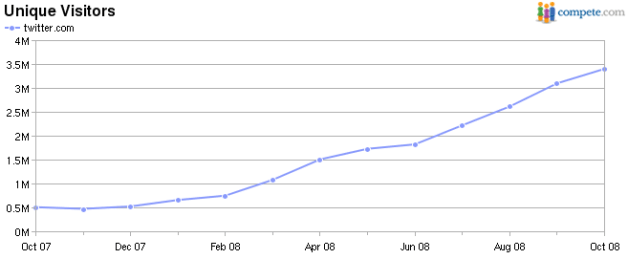
Twitter’s early period was marked by some uneven growth. But around March 2008, the service really took off. And it hasn’t looked back:

twitter-compete-graph-oct-2008

It’s fair to say that the network effects are getting stronger and stronger for Twitter. The more people that join, as seen in the graph above, the more valuable the service becomes. Search grows more and more in importance. So more people join, meaning it’s more valuable others to join, and so on…

Don’t dismiss Twitter’s growth either. This post on the Ignite Social Media blog, which shows traffic for 37 different social websites, illustrates how challenging it is for most social networks to maintain growth these days.

Twitter’s got huge momentum right now. That’s valuable.

Comparable Transactions

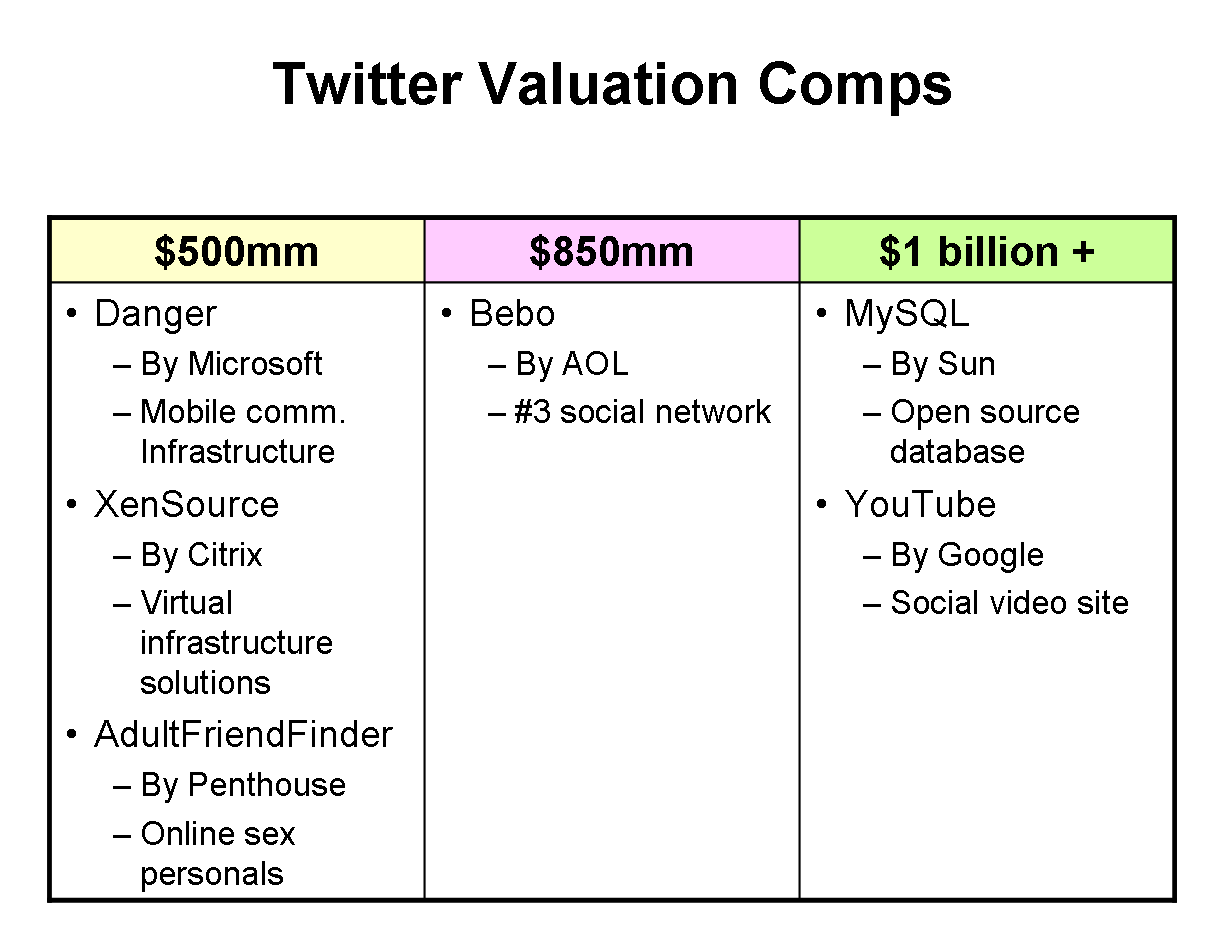
I researched purchase prices for technology companies in recent years. The table below shows acquisition prices for what I’ll call “market comparables”.

twitter-valuation-comps

Valuations are more art than science. Personally, I’m a big fan of triangulating on a value by looking at what other companies have gone for.

My point with the above table is to put some context around Twitter. Danger and XenSource were important niche plays. AdultFriendFinder was valued at $500 million. Given Twitter’s role in the emerging realm of microsharing, should it have the same valuation as AdultFriendFinder?

I know that there currently is no revenue for Twitter. It’s not like they’ve tried and failed. They haven’t even tried. But my guess is Twitter’s revenue path lies beyond punching up some ads on Twitter profiles or in Twitter streams. Those may be there, but like any platform, there will be other ways to monetize.

And let us not forget YouTube’s (non existent) revenue model when Google purchased them for $1.65 billion.

What Do You Think?

I’ve laid out my thinking here. Twitter is a rare platform play that’s hit a strong growth curve. Previous acquisitions say that Twitter should be able to take advantage of those factors for any valuation.

How about you? Weigh in on the comments below, or just answer this quick poll (RSS readers – click out to take the poll!).

*****

See this post on FriendFeed: http://friendfeed.com/search?q=%22Twitter%E2%80%99s+Valuation+-+More+Like+AdultFriendFinder+or+YouTube%3F%22&who=everyone

My Ten Favorite Tweets – Week Ending 112808

From the home office in Lake Tahoe, California…

#1: Better than spam? Chris Baskind reports a spammer on Twitter has a 21.5% return follow rate: http://bit.ly/EzHm

#2: If you don’t ask, you don’t get. And…you never get everything you ask for.

#3: Just added BackType to my FriendFeed. An interesting competitor to Disqus and Intense Debate.

#4: I love this saying about parenting: “The days are long, the years are short.” >> So very, very true.

#5: Why is Papa Bear such the dufus in the Berenstein Bears books? Giving us Dads a bad name…

#6: Doing a keyword search in my GReader, seeing some great posts for blogs to which I don’t subscribe. Power of subscribing to others’ shares.

#7: Editing/adding content on my blog’s About Me page. That page receives a good number of hits, and I thought…”What Would @chrisbrogan Do?”

#8: Reading: “Resumes are Dead. Social Media is Your New Resume.” http://bit.ly/yqUQ

#9: Twitter for $500 million..gut says that’s too low. Twitter is the defining platform for lightweight interactions. $1 billion +…

#10: Thanksgiving morning. We’ve got Christmas music playing on the radio (96.5). Kids are jumping on the bed. Heading to Gramma’s house later.