Nudity on FriendFeed: What Are Some Sensible Rules?

An interesting issue cropped up on FriendFeed. Nudity. Specifically, some of the Flickr pictures that come through on FriendFeed contain topless or fully nude models. It’s an interesting tension between user generated content and community norms.

This is an issue that has been raised numerous times in the United States, where community norms are more conservative. Europe seems to have been celebrating the human body since the Renaissance.

On FriendFeed, there’s a good discussion around a (not safe for work) set of Flickr favorites by Michael Hocter. The set includes pictures of topless and nude models.

There were several people applying ‘Likes’ to the set, including me. Hey, I liked the pictures, what can I say? They are artistic and beautiful.

The way FriendFeed works is what has caused some discomfort. If you subscribe to Michael Hocter, you’ll see his photos come through your feed. If you don’t subscribe, you won’t see his pictures initially…

Until someone to whom you subscribe Likes or Comments on them. Then they hit your FriendFeed stream via the friend-of-friend feature. As Michael Hocter himself says:

I photograph nudes, so I tend to favorite nudes on Flickr. A lot of them don’t show up here because most of us nude photographers mark our photos Moderate or Restricted. But sometimes when the photographer doesn’t do that, they end up here. I’m sure the majority of people who subscribe to my feed are aware of it and don’t mind, but the friend-of-a-friend feature is problematic.

This problem is somewhat unique to FriendFeed. You can publish photos on Facebook, but only people who are your friends will see them.

One female FriendFeeder who is subscribed to me, edythe, had this comment with regard to the photos:

yeah, i have some mixed feelings about the topless women. we had a discussion a couple of weeks ago about nudity appearing in flickr favorites. no one liked it when it was male nudity. I don’t object to this. i just have mixed feelings about it. (yes, i know i can hide it. 😉 )

Being an adult means you get to see things that you wouldn’t have when you were a child. I don’t want Victorian winds blowing through the feeds on FriendFeed. But I also recognize that there are sensible guidelines that govern the type of pictures that are appropriate.

A Few of My Own Guidelines

So I propose a few guidelines for nudity on FriendFeed:

I know it when I see it. As U.S. Supreme Court Justice Potter Stewart famously said about hard-core pornography, “I know it when I see it.” Both content submitters and those who Like or Comment need to use some common sense as to what constitutes porn. It’s particularly incumbent on those who Like and Comment to be reasonable.

Artistic vs. exploitive. This is one that probably varies by person, and really good arguments can be made on both sides. Here’s one way of thinking about it. Michael Hocter photos = artistic. Penthouse photos = exploitive. Playboy pictures = in the eye of the beholder. Want a better description of artistic? Here’s female photographer Dawn M. Armfield:

I don’t photograph nudes (obvious to anyone who follows my photography), but I really appreciate great nude photography, male or female. The contours of the human body are just as beautiful as any other shapes we photograph.

Sexual acts. Nope, don’t go there. Over the line.

Gender. Male or female models.

Anatomy. All normally visible parts of the human body (e.g. no goatse).

Frequency. Oh, this is a good one. If you’re an originator of content (e.g. Flickr favorites), I don’t think there should be any restrictions on how often you add content. Fire away as much as you want. If you’re a Liker or Commenter, use common sense in your frequency. Your subscribers probably aren’t looking for a high volume of nudity. If they want that, they can subscribe to the originator.

Don’t Be Afraid to Like or Comment. One of the great things about FriendFeed is you can give feedback to content submitters. I just said that Likes and Comments shouldn’t be overly frequent. But don’t stop giving feedback altogether…that would be another form of censorship.

Use the Hide function. Those who are offended by nudity should make good use of the Hide function. Assuming folks follow some of the guidelines above, the initial view of the pictures hopefully won’t cause cardiac arrest. After the initial shock, click that Hide link. No more of the offending pictures.

Final Thoughts

The hell if I know whether these make sense to others. I’m not a First Amendment public policy expert. I’m not a professional photographer. I’m not a woman who might feel excluded or offended by interaction around these pictures. But they make sense to me, a regular dude.

What do you think?

I’m @bhc3 on Twitter.

Will Brands Figure Out FriendFeed?

No one wants a relationship with their mustard.

NeoAtOgilvy COO Greg Smith, via Kara Swisher at Boomtown

Two posts caught my attention. Kara Swisher has a nice post titled Social Ads Not Cutting the Mustard? In the post, she breaks down the issues that brands have in being part of the social media world. And Jeremiah Owyang hypothesizes about How Brands Will Use FriendFeed.

The two pieces do a good job of highlighting the challenge of social media for companies. Social media is authentic, it emerges from everyday people, it’s governed by its own community rules, it’s random and it’s an ongoing conversation. How do profit-oriented companies requiring measurable results and consistent formats deal with this?

The general thrust of companies’ social media efforts is to create enthusiasts who will turn around and do viral marketing on behalf of the company. Word of mouth (WOM) marketing. It is a big deal, and it would be wrong to suggest it doesn’t exist. It’s quite powerful when it happens.

But a problem with most WOM marketing is that it’s too dependent on big hits that catch the imagination of people. The fantastic YouTube video. The funny widget for Facebook and MySpace. The imaginative web page.

Those types of mega-hits are incredibly important, and are a requirement for every marketer’s toolkit. The problem is when a company’s social media strategy only relies on the big hits.

Jeremiah talks about how companies should engage users on FriendFeed:

The one caveat is that brands will need to be part of the discussion that happens among these social tools, as what’s really important is the people that are talking, debating, and discussing what your company is announcing. For those that get it wrong, no one will subscribe, no one will talk about it, no one will ‘like’ it and spread it to their network. So be active in the comments, conversations, and an open manner.

He lays out a good philosophy that companies should follow. Don’t simply rely on the big hits. Get out there and engage people. Become part of the community.

I’m wondering what exactly does a company’s participation on FriendFeed look like? Jeremiah points to Ford Motors as a company with one version of social media press releases. So how would Ford use FriendFeed?

To Do’s for Brands on FriendFeed

Create a Ford Motors room: Every company should have a destinaiton on FriendFeed. As an individual, my presence on FriendFeed is defined by subscribing – both by me and to me. A company should have a more permanent home than just being in a list of subscribers.

Find your initial audience: The everyone search is a good start. Start with people who are talking about your company, good or bad. Search on ‘mustang‘. Search on ‘F150‘. Search on ‘Ford Verve‘. Subscribe to these people.

Like and Comment: If Ford comes across someone’s interesting content, throw a Like their way. Jump in with some comments. Here are a couple examples.

First, there’s this Tweet:

Going to test drive F150 tonight. We must be crazy. Prius won’t pull horse trailer though.

Great opportunity for Ford here. In this case, someone from Ford could add a comment like, “Yeah, we made the F150 pretty powerful for those big jobs. I can get you set up with a special visit at your local dealership if you want.”

I’d also avoid laying the smack down on the Prius, tempting as it is for Ford. Criticism based purely on a profit motive is a fast way to undermine authenticity.

Next, here are some Flickr pictures of a ’67 Mustang:

Ford occupies a unique place in Americana, and this picture taps into that. Ford would definitely want to Like these Flckr photos. Add a comment too: “Those 67’s were classic cars. Takes you back to a different time, doesn’t it? We have several of them here in the Ford museum. One thing we’re realizing here is that people still love that style, and look for the new 2009 model to reflect a lot of what made that car great.”

See? Ford has engaged a person. The interaction caused the pictures to pop into others’ streams. And Ford got to plant a seed for what’s coming out later in the year.

Engage on topics that fall outside pure product: Establish a presence beyond just talking about specific products. It will help the company’s social media ‘cred’, and make it more interesting for people to follow. The downside? Your critics will find you, and you can get stuck in a nasty throwdown. So choose your topics carefully. Rising gas prices are a recurring topic on FriendFeed and other social media. A lot of people would want to know what Ford is doing in terms of gas-powered fuel efficiency, as well as in gas alternatives, such a hybrids.

This is a chance for Ford to blow it, or to shine.

Here’s what blowing it looks like: “We continue to believe that California’s efforts to enact higher gas mileage requirements are wrong.” Say that, and you’re just itching for a fight. People will no longer focus on Ford the car company. They’ll focus on Ford the antagonist.

Here’s what shining on FriendFeed looks like. “We see the market segmented into those for whom gas mileage is important, and those for whom capacity and power are important. And our view is that the fuel efficiency segment is growing fast, and we are responding to that.”

Stick with it: This type on engagement is a long term play, with benefits that will be realized over years rather than a quarter. There will be direct benefits as consumers learn more about companies. And companies will get a lot of publicity for their efforts until it becomes mainstream and everyone is doing it.

Final Thoughts

I’m no brand expert, but these are my thoughts on how companies could use FriendFeed, and other social media as well. Done right, this type of marketing could emerge as an important part of  companies’ engagement with the market.

What do you think?

*****

See this item on FriendFeed: http://friendfeed.com/search?q=%22will+brands+figure+out+friendfeed%22&public=1

Three Big Questions Facing FriendFeed

I write about FriendFeed. A lot. Someone told me they wondered if I was employed there. Nope, just really enjoying the service.

Then I see a couple of bigger names in the online world, Robert Seidman and Steve Rubel, expressing their view that FriendFeed feels like it’s going to be the next big thing.

And I realize I’m not the only one with great enthusiasm. It’s growing.

As FriendFeed continues to acquire new users, innovate and roll out new features, it’s inevitable that some big decisions will need to be made. I want to discuss three of them here. Shall we?

1. How Will FriendFeed Balance Signal, Discovery and Noise?

This question really hits on two fundamental elements of the social media experience:

  • Distribution of information
  • Consumption of information

Managing information is a BIG deal. It’s hard to get the balance right – when do users really need a piece of info, when are they in the mood for a bit of discovery and at what point do they tune out because of information overload?

Google’s success was in recognizing the need for better information access, a process they continue to refine and improve. The thing with Google is that you search when you have a defined need. User intent is known. It’s what makes Google’s advertising so successful.

FriendFeed has a bigger challenge. Intentions vary by person. By hour. There’s time the river of content needs to deliver a hard dose of signal. Other times, you need a break from some work you’re doing, and you want a bit of discovery. But above all, please recognize what I consider to be noise!

So FriendFeed has to figure out the user intention, a burden that Google doesn’t have.

They’re off to a great start with these:

  • You choose the people to whom you subscribe, providing the first cut on topics you’ll see
  • Excellent Hide function
  • Rooms to isolate discussions around topics
  • Ability to view top content by likes, comments and other signals

This will be an ongoing war for FriendFeed, particularly as the service grows beyond its information junkie user base.

2. How Much of a Social Network Does FriendFeed Want to Be?

FriendFeed states their mission as follows:

FriendFeed enables you to keep up-to-date on the web pages, photos, videos and music that your friends and family are sharing. It offers a unique way to discover and discuss information among friends.

A simple goal. And yet, early users of FriendFeed are finding the social network aspects of FriendFeed to be compelling. I personally have established a completely different network of people on FriendFeed from what I have on Facebook or LinkedIn. I didn’t just port over my friends from those services, I established new connections.

When I was training for my first marathon back in 2003, I regularly participated over on Runner’s World message board. A group of us were running the California International Marathon in Sacramento, and an online bond formed. We conversed on the message board, and decided to meet up in Sacramento. How’d we do it? One guy posted his disguised email address, and we all emailed him. We then did the email thing to coordinate.

FriendFeed is above that level of social networking right now, but not by a whole lot.

FriendFeed has the potential to be a very powerful social network, one rivaling Facebook and LinkedIn. Why? Facebook is your network from school. LinkedIn is your network from work. FriendFeed is your network based on stuff that interests you. That’s what makes it so powerful.

Remember the interest in felix’s FriendFeed Likes Compatibility Calculator? People were really curious about who they match up with based on shared interests.

A few things come to mind as “best of” elements of social networks:

  • Direct messaging (Facebook, LinkedIn, Twitter all provide this)
  • Profile page – express yourself, complements your content, Likes and Comments
  • Status – for those times when you’re just not around or you need to get personal

Want to take it further? I can see FriendFeed becoming a more robust professional network than LinkedIn. You like all those comments and content? Maybe you’d look at that person as a potential hire. How about calendaring? Coordinate events, and it’d be a real nice complement to the Rooms.

How far does FriendFeed want to go in social networking?

3. How Will FriendFeed Make Money?

Ah, the money question. It’s inevitable and ultimately must be addressed to justify the venture capital.

I can see two possibilities for making money at this very early stage in the company’s history:

  • Advertising (duh…)
  • Business uses

Social media advertising has potential, but is not without its issues.

FriendFeed has a a few things to address and going for it when it comes to advertising. Users’ affection for the Refresh function means a lot of page views, but how much time will they spend on the ads. There’s a field of white space off the right, so real estate for ads won’t be a problem.

But FriendFeed does have two good weapons in its arsenal when it comes to advertising:

  1. A search function with a ton of potential (and search is the killer advertising feature)
  2. A mountain of data about what users’ interests are

As for business uses, my first thought when I saw the Rooms feature was that it could be a great thing for companies to use. Employees can trade thoughts on ideas and projects via Rooms. In fact, that’s how the FriendFeed guys use Rooms:

It started when we wanted a better way to share feature ideas and product plans with each other here at FriendFeed

I can also see media companies adding Rooms functionality to their sites. A much richer way to let readers discuss content than the current commenting systems.

Final Thoughts

I’ve written plenty about FriendFeed, and I’ll probably write more in the future. Partly because it’s such a compelling site for me. As a full participant, I can see a lot of stuff going on. And it doesn’t hurt that the site is getting hot in the blogosphere.

But there’s something deeper here as well. In FriendFeed, you can see some of the bigger issues that all social media have to deal with. For instance, I’d written a series of posts about the noise issue on FriendFeed. My most recent post stepped away from being FriendFeed-specific, and took a look at the broader issue of signal vs discovery in social media. Marshall Kirkpatrick of ReadWriteWeb took it a step further with a great post Why Online “Noise” Is Good for You, pulling in scientific studies on the value of noise and discovery.

FriendFeed is tackling some meaty issues, as described above. Since they’ve got traction, a talented team, an innovative spirit and an attentive audience, their efforts to address the big questions will be a terrific study of the larger social media realm.

*****

See this item on FriendFeed: http://friendfeed.com/search?q=%22three+big+questions+facing+friendfeed%22&public=1

Weekly Recap 060608: Ferris Bueller Was Right

The week that was…

*****

“Life moves pretty fast. If you don’t stop and look around once in a while, you could miss it.”

Ferris Beuller, Ferris Bueller’s Day Off

Consider that line in the context of the recurring demand for more signal

*****

FriendFeed rolled out a new feature to let you see the content that has risen above the noise…Personalized recommendations let you see the stuff that has the most likes and comments, but only for content provided by your network…actually, upon closer inspection, there’s one other component to the ranking…from the blog post: “based on your friends’ comments and ‘likes’ and other signals”…other signals?…hmmm…wonder what those are…

It’s a very cool feature, with some real potential…early benefit seems to be finding the good stuff missed during extended time away from FriendFeed (like more than 2 hours)…it also gives you a personal meme as well…

Robert Seidman has a good post describing potential pitfalls…

What winds up happening is that people are finding “best of” items so easily that they naturally are and adding more “likes” and comments to them which causes them to jump to the top of my regular FriendFeed stream (even outside of “show best of”). I don’t love this.

I noticed this too…older posts with lots of likes/comments suddenly were showing up in my stream again…because people using the “best of” feature were liking and commenting…let’s see how the dust settles once people get used to it…

*****

Robert Scoble, on the value of noise

If you don’t have noise, how can you tell what is signal?

Stop and think about that for a little while…

*****

I’ve been harping on the noise and filter issue for a while…I was really stoked to see ReadWriteWeb’s Marshall Kirkpatrick pick up the issue with a beautiful blog post Why Online “Noise” is Good For You…a few good points Marshall brings up…

  • Scanning quickly over large quantities of roughly relevant information can turn up invaluable resources, opportunities, context and contacts.
  • The ability to recall passively collected information that was gathered purposelessly in the past and put it to use in the future is a particularly powerful form of intelligence.
  • Some people worry that being exposed to too much information will lead to not remembering very much of it. Scientists say that’s not necessarily the case, though.

There’s a lot more there, you’ll kick yourself later if you don’t read it…

*****

Plurkkarma“…gonna wait on this one…

*****

Had a chance to visit the FriendFeed office this week during their open house…if you’ve seen Robert Scoble’s Qik video, you’ve got a good sense of their office space…big, spacious, plenty of room to grow…they actually share the space with another company…

Paul, Bret, Kevin, Casey, Ross, Dan, Ana (bios here) were all just as nice as can be…I’ve actually never gone to one of these start-up open houses before, is this some sort of Valley tradition?…one thing I got from talking with Paul was his interest in the distribution and consumption of information, which is what FriendFeed is all about…

Got to meet a few folks I’ve seen online…Ginger Makela, Adam Lasnik, Adam KazwellLouis Gray was there, and he had this awesome shirt that has his blog graphic on it…it actually made it easier to identify him if you’ve never met him before…as Chris Brogan’s been writing, you need to establish your online brand (even in offline meetings)…

*****

See this item on FriendFeed: http://friendfeed.com/search?q=%22Weekly+Recap+060608+Ferris+Bueller+Was+Right%22&public=1

Social Media Consumption: You Want Signal or Discovery?

In yesterday’s post A Definition of Noise, I talked about two types of social media consumers. Those who have a strong desire to receive only signal (signalists) and those who are looking for stuff outside their own interests (discoverers).

I thought it would be interesting to explore this a little further. Shall we break it down a little more?

Where are you on this table?

*****

See this item on FriendFeed: http://friendfeed.com/search?q=%22social+media+consumption+you+want+signal+or+discovery%22&public=1

On FriendFeed, We’re All TV Channels

Husband: Hey honey, what’s on TV tonight?

Wife: Just seeing what’s new on Do you KNOW Clarence?

Husband: Cool. Any tech updates on Scobleizer?

Wife: Always! But I just want to chill tonight. Let’s see what’s up with Hawaii over at Roxanne.

Husband:Nice. Let me get a quick NBA update over on Odenized.

Wife: Give me that remote. No sports tonight!

Husband:I know what we need. Glasses of wine and some Thomas Hawk photos.

Wife: That’s it! Perfect!

When you watch TV, you have channels and shows that fit your interests. When you surf the Web, you have sites that you enjoy. All are forms of media, of programming, of content. That pretty well describes FriendFeed.

We’re all TV channels on FriendFeed.

You choose to follow people on FriendFeed because they stream content, comments and likes that fit your interests. Isn’t this like TV? ESPN gives you sports. Comedy Central gives you humor. MSNBC gives you prison lockdown stories…

Imagine if you tuned into ESPN and saw shows recounting the battles of World War II? Or if the Oxygen network was showing a hockey game? You’d be confused. And annoyed!

Which is an interesting take on the signal vs noise meme. One person’s signal is another person’s noise.

Select Your Channels Wisely

This is a theme which I’ve stressed before. If you subscribe to people who are not giving you programming you like, you’re going to run into the ‘noise’ issue.

Personally, I wouldn’t watch the Oxygen network. It just doesn’t interest me. It would be noise to me. But there are millions of women who do enjoy it. It’s signal to them.

Which is why I don’t follow any sort of auto-subscribe philosophy, in FriendFeed or Twitter. If someone subscribes to me, I may not subscribe back. Their programming just doesn’t fit my interests. It’s a very egalitarian thing to automatically subscribe back, but you’re bringing noise into your information stream.

Programming Changes

My FriendFeed mostly consists of social media stuff. I also enjoy the world of track and competitive running. If I suddenly switched programming, and fed a lot of running things through the stream, my existing network would look at that as noise. Just like if ESPN started running sci-fi movies. Not what people were expecting.

Louis Gray had another example of this in a recent blog post. Tony Chung switched his programming from Apple and next gen technologies, to covering the arts.

Final Thoughts

Mia Dand and Steven Hodson have nice blog posts on how content forms the relationship between a blog and its readers. They are good examinations of social media as programming.

FriendFeed is even larger than blogs. We get someone’s interests beyond just their blog. Heck, you don’t even need to blog in order to become a FriendFeed channel.

If you value having subscribers and developing a network of like-minded individuals, think about what your Friendfeed streams mean in terms of your programming. Even the simple ‘Like’ function brings content into others’ streams. I’d hate to be too careful about what I ‘like’ or comment on! Just recognize what it’s doing to your subscribers.

And with that…back to our regularly scheduled programming.

*****

See this item on FriendFeed: http://friendfeed.com/e/64843b5f-f950-c815-72ad-bb7931540ff9

Do Companies Need Social Media Managers?

There are few institutions in the modern world that are not being transformed today by social media.

Shel Israel, Global Neighborhoods, 5 New Social Media Turn-ons for me.

Encouraging use and engagement with [social] tools is an area that all organizations find they have a need for at some point and time. Use of these tools and engagement by people in an organization often does not happen easily. Why? Normally, most of the people in the organization do not have a conceptual framework for what the tools do and the value the individuals will derive.

Thomas Vander Wal, vanderwal.net, Enterprise Social Tools: Components for Success

Social media is taps into a deep well of user knowledge and innovation that previously had been limited to people’s close offline contacts. FriendFeed, Twitter, Facebook, Flickr, del.icio.us and others have not so much invented new ways of thinking as they have created new ways to surface intellectual energy and creativity, and significantly expanded the conversations one has.

How does this translate into the workplace? Thomas Vander Wal’s quote above hits on one of the biggest hindrances. Just throwing tools at people and saying “have at it!” will be a colossal failure. For many people, social media requires a slow romance before they become wed to it. Want to see how much romancing is needed? Read this guy’s comment about Twitter on TechCrunch.

The thing about social media is that once people get it, they really get excited about it. Facebook has experienced terrific growth. Twitter is edging more closely to early mainstream. FriendFeed is rapidly growing. But all of these companies had a chance to incubate and grow an enthusiastic set of early adopters, which leads to broader usage.

There are two issues for companies to address in the adoption of social media:

  • Slow internal adoption can cause the initiative to die from lack of focus and budget.
  • The real benefit of social media comes when many people participate. Slow adoption means companies won’t see good benefit for a while.

How can companies accelerate adoption of social media inside by employees? An enthusiastic group of innovators is always a requirement. In addition to that, how about creating a new position? The social media manager.

The Social Media Manager?

I know such a suggestion will get eye-rolls by some. Fair enough. But hear me out.

I mentioned this idea of an employee emerging as a social media manager to someone the other day. His response was that it sounded like another version of the head of knowledge management inside a company. That was interesting take. The role of the Chief Knowledge Officer seems to include a role for social media adoption, at least as I read the definition of the role on wikipedia (here).

I’m not nearly literate enough in the field of knowledge management to know what works and doesn’t work. But I suspect there’s a big difference between a knowledge manager and a social media manager:

The social media manager is a personality-driven role

Getting people out of their shells to participate in social media will take more than a handbook and a set of best practices. The successful social media manager will be someone who can engage a wide variety of personality types. Who can handle a variety of viewpoints. Who has a thick skin, because…

The social media manager should have some skin in the game

By that, I mean the person should have some opinion about what’s best for the company. Not an absolute, draconian opinion. But a confident feeling for what makes sense for the company relative to its customers, markets, competitors and products and services. And that confidence extends to entertaining differing positions from her own. A social media manager should exemplify F. Scott Fitzgerald’s famous quote:

The test of a first-rate intelligence is the ability to hold two opposed ideas in the mind at the same time, and still retain the ability to function.

After reading this, I realize that it makes the social media manager seem like some sort of uber-participant, eclipsing all others. If that happens, then we have social media FAIL. Rather, a good social media manager will have the ability to stir up enough interest in subjects to get people participating amongst themselves.

Work of the Social Media Manager

There are three basic functions of the social media manager:

  1. Initiate discussions
  2. Participate in discussions
  3. Report on discussions

Initiation is particularly important in the early stages of the social media rollout. People need a jump start to participate, and someone willing to show how it’s done is important.

Participation keeps the social media manager relevant and build connections with others. In a large organization, no one will know everybody. So participation – the crux of social media – is a requirement.

Reporting is a way to show the benefit of participating. The social media manager can report out all sorts of things to foster interest and participation:

  • Good discussions
  • Tag buzz – hottest tags right now
  • Interesting activity streams (e.g. sales closed)
  • Rising wikis
  • Etc.

Reporting occurs via RSS and that reliable corporate communication method…email. Why report? Make sure people are aware of good stuff. And ensure good participants are recognized. This latter point is important, as it speaks to the motivation of employees. Employees are ambitious and want to succeed. Burnishing reputations via social media is a strong motivation.

It turns out this motivation dovetails with the goals of the company as well. Good social media usage benefits companies in a number of ways.

Final Thoughts

Ideally, the social media manager likely emerges organically from early users. Someone who’s a natural. If needed, someone can be appointed to the position. I’d also expect the position to change hands over time.

Note that there are those out there on the web who serve these de facto positions for a lot of us.

The thing about social media out on the world wide web is that it attracts a large number of people from all over the place, all around the world. It just takes a relatively small percentage of people to get social media going. Inside companies, more motivation is required to get things moving because there is a much more limited pool of users from which to draw adoption.

What do you think?

[UPDATE – this article mentions someone who has exactly this role: http://tinyurl.com/5zehew]

*****

See this item on FriendFeed: http://friendfeed.com/search?q=%22Do+Companies+Need+Social+Media+Managers%3F%22&public=1

Weekly Recap 050908: LouisGrayCrunched, BitchFeed

The week that was…

“Awesomesauce” “Apple sauce?” “Awesomesauce”…Corvida of SheGeeks.net coined this term, applying it to things she really likes. It’s gaining traction. I saw Alex Williams write it on FriendFeed. Robert Seidman’s thoughts on this? “would not say ‘awsome@^%$!’…speaking of Corvida, congrats on that ReadWriteWeb gig

Louis Gray runs something of a debutante ball for emerging bloggers. Three separate times, he’s run a post that calls out five bloggers to watch (here, here, here). When you get called out, you experience this rush of hits and an increase in blog subscribers. It’s really wild…Colin Walker’s blog was called out. His reaction? “We had the Digg Effect, then the Scobleizer effect but now it’s the Louis Gray effect :)”…Alexander van Elsas blog was called out as well. His reaction? “Thx Louis, its great to hear that there is actually someone reading the stuff ;-)”…I used the term LouisGrayCrunched when this blog got its Louis Gray spotlight. You really can’t believe how his mention changes a blog. I can’t wait to see his June list…if Louis Gray raises a blog like that, I can only imagine what a Scoble callout does…

This exchange is a little dated, but I thought it was funny. Emily Chang is something of a luminary in the web world. I guess she was growing tired of Techmeme. She tweeted this: “techmeme sort of reminds me of a gay bath house”…Did Techmeme Gabe Rivera get pissed? Nah. Tweeted back: “Thanks @emilychang …was getting terribly bored with the ‘echo chamber’ cliché”…

Have you seen people “retweet” on Twitter? It’s a little odd. There’s a couple variations. One is a person reposting something they tweeted earlier. The second is when you pick up someone’s tweet, and broadcast it to your followers…People do wonder about this practice. Shel Israel asks: “Would someone please explain retweeting? Do people retweet when no one responds? I seriously don’t get it.”…

Give credit to Guy Kawasaki, Alltop becomes a badge of honor…the aforementioned Corvida made it on there, as she noted in her blog…Sarah Perez was inducted, also noted on her blog…and Mark Dykeman was added…congrats to all, the recognition is well-deserved…please pass along updates on traffic referrals from Alltop as time goes along, will ya?…

Yahoo…boy oh boy…One thing I admire is that Jerry Yang stuck to his guns through a flurry of criticism. There are good arguments on both sides of the MSFT-YHOO acquisition saga…At business school, they drilled into me the importance of equity holders above all. On that score, Jerry and team really need to come up with a strong plan to get Yahoo moving forard again. Is Yahoo only a couple moves away from getting to $37 per share?…

One thing I did this week was add a FriendFeed link to a blog post…Hey, there was a good discussion going on at FriendFeed! I didn’t want my blog readers to miss it…

Speaking of which, there was a revisit of the dispersed comments issue this week. Quick recap: some bloggers don’t like that comments related to their blog posts are not actually being added to the blog itself. The comments end up on places like FriendFeed. For a recap of the previous flare-up of this issue, see here…The difference this time? The debate didn’t erupt over on Techmeme. It stayed on FriendFeed here…Instead of a Bitchmeme, perhaps we should start talking about a BitchFeed

Alert. Alert. Alert. Robert Scoble is building out his subscriber base in FriendFeed. He issued an open call for new people to whom he should subscribe. Get in now before you hit his limit….Can’t wait to see how this experiment unfolds…

*****

See this item on FriendFeed: http://friendfeed.com/e/b814ceb3-4359-1cfe-78c7-878e9b72618b

Social Media Identity: Personal vs. Professional

I recently had to engage social media not using my personal identity, but under my professional identity. A bit clueless how to proceed, I sent this out on Twitter:

Facing an interesting decision about mixing my personal and professional online personas. I think I need to establish a “professional” ID.

Brian McCartney brought up a great point in response:

A “professional” ID is a good idea but there are things on my personal ID that I might want to share with the professional world…

Which got me wondering about social media identity. By that, I really mean these three things:

  • What subjects do you cover
  • What “voice” do you use
  • How does your social network perceive you

When it comes to developing professional identity in social media, a key consideration is the size of your company.

Company Size and Social Media Identities

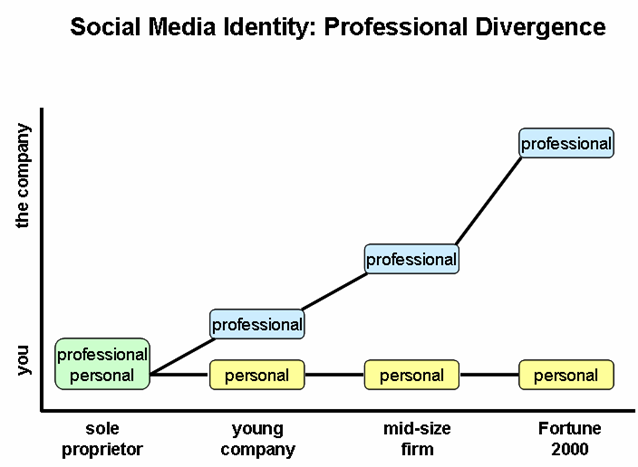
The graph below depicts where the professional and personal identities diverge.

The idea in the above chart is that the smaller the company, the more closely your personal and professional identities are tied. As the company size increases, the more separate your identities become.

Where can these identities come into play?

  • Blogging
  • Posting on blogs
  • Twittering
  • FriendFeed
  • Etc.

Entrepreneurs and Small Companies

For entrepreneurs, your social media interactions are your marketing. How you think. What you care about. What insights you can deliver. And employees of small companies are the company. So their identities are very closely tied to the company.

Sam Lawrence, CMO of Jive Software, is a good example of someone blurring professional and personal identities. Here are his social media identities:

  • Twitter: Sam mixes a heavy dose of Jive-related tweets with interesting tweets on other subjects. He ain’t afraid to keep it real out on Twitter.
  • Go Big Always: This is his personal blog, covering the social and enterprise software market. Jive gets plenty of attention, but it’s not the focus of every post.
  • JiveTalks: The official company blog. Sam can be found here, and the posts are product-related.

Here’s what Sam said about his multiple social media identities:

Up until now, I’ve been blogging on JiveTalks. But a corporate blog is just that – a corporate blog. I wanted to have a place where I could more freely voice wider observations and thoughts beyond Social Productivity and Jive’s business.

That being said, you get Sam, you get Jive Software.

Big Corporates

Employees working for larger companies will tend to have separate professional and personal social media identities. It’s tempting to say there’s the the “authentic” you and the “corporate” you. I think that oversimplifies things. The work you do is part of your authentic identity – if it wasn’t, presumably you’d quit the job.

But there are important differences when it comes to your professional identity. Here are a few that apply when using social media on behalf of a large corporate:

  • You write about things that are part of your identity only while you work for the company
  • You have to err on the side of “corporatism”, with language consistent with that of your company
  • Your company’s stuff is great, all competition sucks (of course, this applies for entrepreneurs as well!)
  • You’re likely in “sell” mode

The separation between personal identity and professional identity is the greatest for employees of large corporates. Whereas Sam Lawrence’s social media identity is very much a personal and professional combination, I decided to create a second identity for engaging social media professionally. My handle became Hutch@[company name]. You see that, you know I’m doing things on behalf of my company.

Final Thoughts

There’s a notion that someday all of our social media identities will be blurred. “Your personal identity is your professional identity in Web 2.0.” If we’re talking “professional” in terms of your career and talents you can bring to a company, then yes, that statement is true regardless of where you work.

However, if “professional” is the identity you assume on behalf of your company, then that statement really only applies to employees of small companies. For employees of big corporates, managing your social media identities is more complex than that.

I’m @bhc3 on Twitter.

Innovation Requires Conversations, Gestation, Pruning

The day-in, day-out work of employees is tough on innovation. You have to get done what your managers, and the company needs today. Now there’s nothing intrinsically wrong with getting the near0term stuff done. Companies would be chaos if everyone did their own thing. But the typical work day is not conducive to maximizing innovations.

Which is where employee blogs come in. Enterprise 2.0, if you will.

Current Workplace Environment

Several things limit the amount of innovation coming out of larger companies.

General Busyness. Andrew McAfee has a nice post on this one. We’re all very busy. It feels that way, doesn’t it? And it’s not just any busyness. Your hours must have an immediate, measurable outcome. That leaves little time for the longer term, R&D-oriented type of thinking that can result in breakthrough ideas. Google’s 20% of time for personal interests stands out as an example of a company fighting this dynamic.

Existing Processes Are Hard to Change. The current products, internal practices, meetings, sales efforts, etc. are all geared to what is going on today. Much of this infrastructure is decreed from the top. New ideas which require these same corporate resources get a tough reception. It’s like you’re adding new work to everyone’s day.

Proximity Drives Relationships. We tend to share our thoughts with those we work with regularly. It’s natural. These form our relationships. So if you have a new idea, you’ll naturally bounce off these folks. But it’s crap shoot as whether you’ll get far this way. Your colleagues may not be interested or are too busy. A good idea can suffer a premature death.

Ideas Go to the Email Inbox to Die. Email is a tough medium for idea exchange. You can send your idea to someone else. If the recipient doesn’t have an immediate response, the email just sits there. And sits there. And sits there. Before long, your email is six feet under. Never to be read again. Email also suffers from limited distribution, unless you spam the corporation with your idea.

Now it’s not like innovation is failing to occur. But do companies’ internal pendulums swing so far toward busyness that they’re not maximizing their vital innovations?

Conversations, Gestation, Pruning

You ever have an idea that you really thought had legs? Well, if you just keep it to yourself, it won’t go far. Your butterfly wing flap needs to be picked up by others. The process of talking out your idea is important for validating it, refining it, seeing if it has potential.

These conversations are hard to have based on the usual workplace dynamics described above. Sure, some will happen. In a company of 10,000 people working 40 hours a week, 50 weeks a year, there are 20 million hours annually. Out of these 20 million hours, some innovation conversations will happen. But enough?

New ideas also challenge the status quo. They need time to sink in. Colleagues know the existing processes, products and services well. How does your idea affect that? How will it improve it? It’s hard to rush people to grok your idea.

This gestation also lets the idea play out more fully. It can be refined, altered, researched. Others pick up the idea and discuss it. It gets socialized. Others can become advocates, including those with a say on corporate resources.

As a result of these conversations and gestation time, some ideas will emerge as real opportunities. Many won’t. In fact, most probably won’t. But that’s OK. Real innovation is hard to achieve; if it wasn’t, we’d all be enjoying our start-up IPOs, right? This pruning is healthy and necessary.

Blogging Is a Natural Channel for Employee Innovation

In my brief blogging experience, my eyes have opened to the power of blogging. You put an idea out there, and see what others think. You make connections. You read other blogs for different perspectives.

A lot of this makes sense for addressing the hurdles to employee innovation:

  • General busyness: Blog posts need not take a lot of time. Ideas can be entered in 10 minutes.
  • Existing processes are hard to change: A blogged idea does not put someone in the awkward position of considering how it will increase their workload and change their routine.
  • Proximity drives relationships: Blogs are location neutral. Anyone can find them. Forget the guy in the cubicle next to you. The employee in Asia might grok your idea.
  • Ideas go to the email inbox to die: Blog posts live on. They’re RSS-able. They’re shareable. They’re searchable. They’re taggable. And they can be accessed by everyone.

Blogs let the conversation continue in an asynchronous fashion. You can comment on a post. Share it with a colleague. Link to it. You can build on someone else’s post. Recruit others to your cause.

All of these factors contribute to the gestation period needed for the new idea to take hold. And they help prune ideas so the ones with the most potential survive.

And a Couple Nice Benefits Also Happen

An interesting thing occurs from this: new employee social networks emerge as connections among bloggers. There are the people you work close to. Those whom you collaborate on projects. And now new connections are made based on knowledge and innovation. Those last ones may be the strongest of all.

Employees can also raise their profile and reputation with their blogging. Here’s a nice example. EMC is deploying web 2.0 technologies inside the enterprise, an effort that is being blogged by Chuck Hollis, EMC VP Technology Alliances. In a recent post, he describes how several internal employee bloggers are “graduating” to be external bloggers. That’s right – they now will engage the market on behalf of EMC.

All in all, blogging holds tremendous benefit for companies. While many employees won’t do it, those that do can become real drivers of innovation.

*****

See this item on FriendFeed: http://friendfeed.com/e/5303300f-3e4c-e5d9-b1ed-96c6d94988cf