Do Not Kill Off Marketing During a Recession

It is a mystery to me why some companies (often the ones who find themselves eventually dying away) will react to a downturn by cutting marketing expenses. Cutting expenses is a super smart thing to do, but you should NOT cut back on your marketing.

David Risley, The Single Biggest Mistake in an Economic Downturn Is…

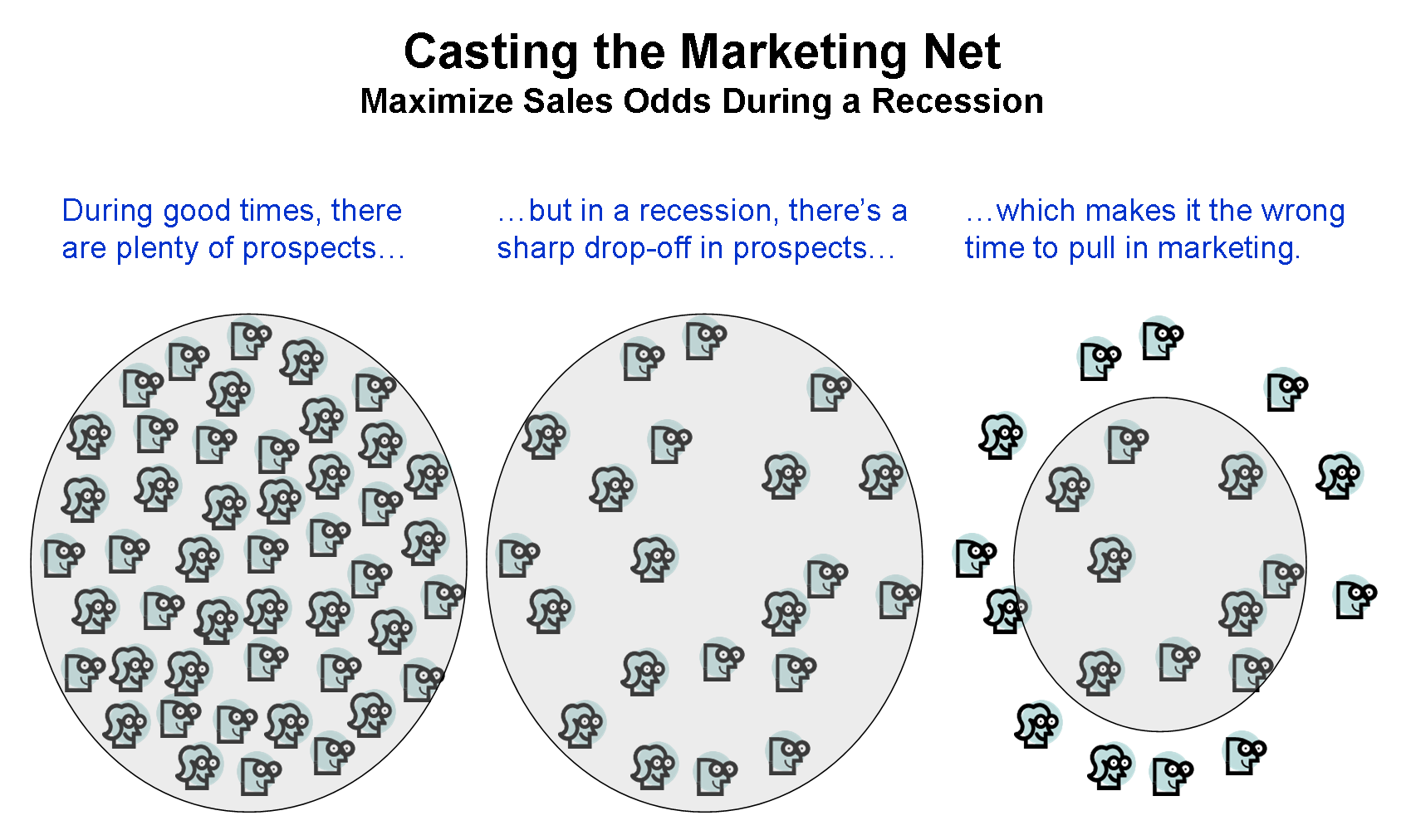
I like David’s sentiment, and I put together this graphic to complement it:marketing-radar

In the world of business sales, you cannot predict which prospects will become sales.  But, you know that you need touchpoints with companies. Which prospects will turn into customers? Hard to predict that.

One reaction to the reduced sales that accompany a recession is to cut back on marketing. Unfortunately, that’s just doubling down on your problems. There are fewer bona fide prospects out there during a recession as companies cut back. Which increases the value of each remaining prospect.

Thus, if you reduce the span/frequency of your marketing efforts, you’re going to miss some of the remaining prospects in the market. If you reduce the number of prospects with whom you engage, you can predict the effect on your sales.

That being said, there are wonderful opportunities to do more with less in terms of marketing, thanks to the rise of social media. Jeremiah Owyang and Chris Brogan can tell you more about how to do that.

*****

See this post on FriendFeed: http://friendfeed.com/search?q=%22Do+Not+Kill+Off+Marketing+During+a+Recession%22&who=everyone

Defrag 2008 Notes – Picasso, Information Day Trading, Stowe “The Flow” Boyd

defrag-logo

One of the most consistently provocative conferences I attended last year — my own Money:Tech 2008 aside, of course — was Eric Norlin’s Defrag conference. Oodles of interesting people, lots of great conversation and all of it aimed at one of my favorite subjects: How we cope with the information tsunami.

Paul Kedrosky, Defrag 2008 Conference

I spent two days out in Denver earlier this week at Defrag 2008 with Connectbeam. As Kedrosky notes above, the conference is dedicated to managing the increasing amount of information we’re all exposed to. Now my conference experience is limited. I’ve been to five of them, all in 2008: Gartner Portals, BEA Participate, TechCrunch50, KMWorld, Defrag.

Defrag was my favorite by far. Both for the subject matter discussed and the attendees. The conference has an intimate feel to it, but a high wattage set of attendees.

In true information overflow style, I wanted to jot down some notes from the conference.

Professor William Duggan: He’s a professor at Columbia Business School. He gave the opening keynote: “Strategic Intuition”, which is the name of his book.  Duggan talked about how studies of the brain showed that we can over-attribute people’s actions as being left-brained or right-brained. Scientists are seeing that both sides of the brain are used in tackling problems.

He then got into the meat of his session – that people innovate by assembling unrelated data from their past experience. For example, he talked about how Picasso’s style emerged. Picasso’s original paintings were not like those for which he became famous. The spark? First, meeting with Henri Matisse, and admiring his style. In that meeting, Picasso happened to become fascinated with a piece of African sculpture. In one of those “aha!” moments, Picasso combined the styles of Matisse and African folk art to create his own distinctive style. He combined two unrelated influences to create his own style.

Duggan also described how all innovation is fundamentally someone “stealing” ideas from others. In “stealing”, he means that people assemble parts of what they’re exposed to. This is opposed to imitating, which to copy something in whole. That’s not innovation.

Re-imagining the metaphors behind collaborative tools: This session examined whether we need need ways of thinking about collaboration inside the enterprise. The premise here is that we need to come up with new metaphors that drive use cases and technology design. I’ll hold off on describing most of what was said. My favorite moment was when Jay Simons of Atlassian rebutted the whole notion of re-imagining the metaphors. He said the ones we have now are fine, e.g. “the water cooler”. What we need is to stop chasing new metaphors, and execute on the ones we have.

Rich Hoeg, Honeywell: Rich is a manager in Honeywell’s corporate IT group (and a Connectbeam customer). He talked about the adoption path of social software inside Honeywell, going from a departmental implementation to much wider implementation, and how his own career path mirrored that transition. He’s also a BarCamp guy. Cool to hear an honest-to-goodness geek making changes in the enterprise world.

Yatman Lai, Cisco: Yatman discussed Cisco’s initiatives around collaboration and tying together their various enterprise 2.0 apps. I think this is something we’ll see more of as time goes along. Companies are putting in place different social software apps, but they’re still siloed. Connecting these social computing apps will become more important in the future.

Stowe “The Flow”: Stowe Boyd apparently gave quite the interesting talk. I didn’t attend it, because Connectbeam had a presentation opposite his. But from what I gather, the most memorable claim Stowe made was that there’s no such thing as attention overload. That we all can be trained to watch a constant flow of information and activities go by, and get our work done. I think there will be a segment of the population that does indeed do this. If you can swing it, you’re going to be well-positioned to be in-the-know about the latest happenings and act on them.

But in talking with various people after the presentation, there was a sense that Stowe was overestimating the general population’s ability and desire to train their minds to handle both the work they need to do for their employers, and to take in the cascade of information flowing by (e.g. Twitter, FriendFeed). Realistically, we’ll asynchronously take in information, not in constant real-time.

We’re Becoming Day Traders in Information: I heard this quote a few times, not sure who said it (maybe someone from Sxipper or Workstreamr). It’s an intriguing idea. Each unit of information has value, and that value varies by person and circumstances. Things like Twitter are the trading platform. Of course, the problem with this analogy is that actual day traders work with stocks, cattle futures, options, etc. Someone has to actually produce something. If all we do is trade in information and conversations, who’s making stuff?

Mark Koenig: Mark is an analyst with Saugatuck Technology. He gave the closing keynote for Day 1, Social Computing and the Enterprise: Closing the Gaps. What are the gaps?

  1. Social network integration
  2. Information relevance
  3. Integration with enterprise applications
  4. The culture shift

Mark also believes in the enterprise market,  externally focused social computing will grow more than internally focused. Why? Easier ROI, more of a sales orientation.

Charlene Li: Former Forrester analyst Charlene Li led off Day 2 with her presentation, Harnessing the Implicit Valkue of the Social Graph. Now running her own strategic consulting firm, Altimeter Group, Charlene focused on how future application will weave “social” into everything they do. It will be a part of the experience, not a distinct, standalone social network thing. As she says, “social networks will be like air”. She ran the gamut of technologies in this presentation. You can see some tweets from the presentation here.

One thing she said was to “prepare for the demise of the org chart”. When I see things like that, I do laugh a bit. The org chart isn’t going anywhere. Enterprises will continue to have reporting structures for the next hundred years and beyond. What will change is the siloed way in which people only work with people within their reporting structures. Tearing down those walls will be an ongoing theme inside companies.

Neeraj Mathur, Sun Micro: Neeraj talked about Sun’s internal initiatives around social computing in his session, “Building Social Capital in an Enterprise”. Sun is pretty advanced in its internal efforts. One particular element stuck with me. It the rating that each employee receives based on their participation in the Sun social software. Called Community Equity, the personal rating is built on these elements (thanks for Lawrence Liu for tweeting them):

Contribution Q + Skills Q + Participation Q + Role Q = Personal Q

Sun’s approach is an implementation of an idea that Harvard Professor Andrew McAfee put out there, Should Knowledge Workers Have Enterprise 2.0 Ratings? It’s an interesting idea – companies can gain a lot of value from social computing, why not recognize those that do it well? Of course, it’s also got potential for unintended consequences, so it needs to be monitored.

Laura “Pistachio” Fitton: Twitter-ologist Laura Fitton led a panel called “Finding Serendipitous Content Through Context”. The session covered the value of serendipity, and the ways in which it happens. The panel included executives from Aggregate Knowledge and Zemanta, as well as Carla Thompson from Guidewire.

What interested me was the notions of what serendipity really is. For example, Zemanta does text matching on your blog post to find other blog posts that are related. So there’s an element of structured search to bring related articles.

So I asked this question: Does persistent keyword search, delivered as RSS or email, count as “serendipity”? Carla’s response was , no it doesn’t. Serendipity is based on randomness. It’s an interesting topic worth a future blog post potentially.

And of course, Laura encouraged people to tweet during the session, using the hash tag #serendip. The audience tweets are a good read.

Daniela Barbosa, Dow Jones, DataPortability.org: Daniela works for Dow Jones, with coverage of their Synaptica offering. She’s also an ardent supporter of data portability, serving as Chairperson of DataPortability.org. Her session was titled Pulling the Threads on User Data. She’s a librarian by training, but she kicks butt in leading edge thinking about data portability and organization. In her presentation, she says she’s just like you. She then pops up this picture of her computer at work:

daniela-barbosa-laptop-screen

Wow – now that’s some flow. Stowe Boyd would be proud.

Wrapping up: Those are some notes from what I heard there. I couldn’t get to everything, as I had booth duties for Connectbeam. Did plenty of demos for people. And got to meet many people in real life that I have followed and talked with online. Looking forward to Defrag 2009.

*****

See this post on FriendFeed: http://friendfeed.com/search?q=%22Defrag+2008+Notes+-+Picasso%2C+Information+Day+Trading%2C+Stowe+%E2%80%9CThe+Flow%E2%80%9D+Boyd%22&who=everyone
Greed, Competition, Investor Expectations: Some Things Social Media Will Never Change

Courtesy Bryan Maleszyk on Flickr

Courtesy Bryan Maleszyk on Flickr

In my previous post, I wrote about the Paul Kedrosky session at Defrag 2008, Around the Horn. It was a free form session in which he queried several panelists on a range of subjects. Lots of good discussions from that.

One topic that got some extended discussion both on the panel and in audience questions was this:

Could social media and better information awareness tools have prevented the financial meltdown?

The basis of the question, in the Defrag context, was that there were signs and data that pointed to the implosion. The argument on the table was that there was a failure of information systems, and of social media, to alert the world to what was happening. And the follow-up: how can we improve this?

You can’t. Don’t even bother.

Because the problem isn’t one of not seeing the warning signs. See Morgan Stanley analyst Mary Meeker’s slides about the various financial ratios at the time of the financial collapse. We were clearly running things in the red zone when you see that data. And the data was there to see.

The problem is that people will never change. They will ignore any system telling them that things might be getting out of hand. Why? Tragedy of the commons.

Financial Meltdown = Tragedy of the Commons

In economics and game theory, there is the notion of the commons dilemma. This is the idea that when there is a common good, people will act upon their own interests in consuming that common good:

  • Person 1: consumes proportional share of large resource
  • Person 2: takes an outsized portion of resource, which by itself doesn’t destroy the resource
  • Person 3: sees Person 2 take larger share, matches that or even increases amount consumed
  • And on and on…

The problem is that as people do this, they are not acting as stewards of the common good. The result is that the common good ends up entirely consumed as each person acted in their own self-interest.

With regard to the financial crisis, what was the common good that was over consumed? Home ownership. The grpahic below is from Mary Meeker’s presentation:

morgan-stanley-home-ownership-timeline

Consider the dotted line on the above graph to be the normal consumption rate for home ownership. From 2000 onward, an increasing number of people purchased their own homes. Turns out, this put a mighty strain on the financial system. A lot of people purchased homes who shouldn’t have.

Now I don’t blame people for wanting homes. But the effect was to drive the prices up incredibly, which caused more desire for home ownership. Home ownership is sustained by a number of factors: steady incomes, mortgage tax breaks, personal financial management, a robust collateralized mortgage market, mortgage insurance, etc. All of those are part of the common resources. They were undermined by too many people partaking in home ownership.

The Banker’s Life

So in the case of home ownership, mortgage bankers ended up destroying the various shared resources that make up the market for home ownership. Each banker acted independently to get as much as he could from the system: loosened lending rules overall, finance build-n-flip construction, push home ownership into markets with lower financial means (a.k.a. sub-prime).

I understand the mentality. Once upon a time, I was an investment banker with Bank of America, in the syndicated loan group. Syndicated loans are like bonds, with the risk spread across many lenders. Here are two examples of how things work in banking.

First, I was part of a deal team trying to win a mandate with HMO company Humana. We were trying to unseat Humana’s incumbent bank, Chase Manhattan. We went in aggressively, with some pretty cut-rate financing terms. Chase did want to lose the deal, and so they went even more aggressively. In the syndicated loan market, you need a bunch of lenders to participate. Which means you need realistic pricing to sell the deal, just like in the bond or stock markets. Turns out, in its effort to keep Humana, Chase went too low in its pricing. They couldn’t syndicate the deal. Chase got caught up in the competition to keep Humana.

Second, at a dinner with the head of our group, the subject of minding the bank’s credit position came up. As in, what was the role of the syndicated loans group in being stewards of the bank’s balance sheet? Should we use our superior market knowledge to alert the credit underwriters about risks we’re seeing, and deals from which we should walk? I was a brash young guy, and provocatively opined that we were all about winning and syndicating deals. We shouldn’t focus on the credit risks, as that was the job elsewhere in the bank. To which the head of the group replied to me, “For the sake of your career, I’m going to pretend I didn’t hear that.” He was right – we really did have a responsibility. But I was reflecting the behaviors I’d seen out there in the market.

I bring up these examples to give you a sense of what it can be like inside banking. There is money splashing around everywhere, and when everything is up-up-up, you really can’t turn off the motivations of people.

Social Media Will Never Change This

What was happening in the mortgage industry was that the motivations were all one way: make the deal! You see your colleague cranking on getting deals done, and getting recognition internally. Your compensation is based on how many mortgages you get done. Competitor banks were reporting higher revenues and earnings. If you don’t match the growth of your peers, Wall Street dings your stock. The real estate market just kept going up, up, up.

Social software wasn’t going to change these dynamics. The current financial crisis is just the latest in a string of such events. And there will be more. It’s just human nature.

Professor Andrew McAfee tweeted a musing about Enterprise 2.0 and the financial collapse. I responded with my own thoughts:

amcafee: Could E2.0 have saved Lehman and Merrill? No. 🙂

bhc3: @amcafee – I used to work in banking. E2.0 would have made the banks better at achieving their growth goals. But those goals hurt the banks.

Social software is a powerful tool for organizations to get better in terms of innovation, productivity and responsiveness. But companies are still run by humans, and we’ll never be rid of that, for both the good and the bad.

*****

See this post on FriendFeed: http://friendfeed.com/search?q=%22Greed%2C+Competition%2C+Investor+Expectations%3A+Some+Things+Social+Media+Will+Never+Change%22&who=everyone

Enterprise 2.0 Vendors – An Implementation Lifecycle Model

On a phone call with a Connectbeam customer, I heard what seemed like a good description of the way in which Enterprise 2.0 – and perhaps other enterprise software – achieves enterprise-wide adoption. This particular customer started with an internal advocate who started with a departmental implementation, and is now rolling it out to thousands in the organization.

Now anyone following the space knows there are many, many factors in the process of gaining adoption. What I’m going to describe is a slice of those factors, but I think it’s a juicy slice.

The graphic below depicts the model:

Four stages in this simple model. Let’s break ’em down a bit.

Implement

This is the initial toehold in the organization.  Where will the app makes the most sense? For many vendors, the place where it makes the most sense is the department where the most enthusiastic advocate resides.

Clearly, the vendor needs to consider where its app will have the highest impact, and where an office culture will be receptive to a new way to working.

Implement also includes any integration with other apps. Don’t underestimate this. It takes a bit of time to set things up, and often at the departmental level, employees aren’t as familiar with corporate apps.

But really, the Implement process revolves around the manager who has the most passion for your app.

Try It

Next, employees need to actually use your application. This is important (obviously). If you’re going to show ROI for your app, it starts with people actually using your app.

Measure usage stats. These are the early markers of whether the app will be successful inside the company.

The internal advocate needs to recruit fellow passionates into this process. Try out the service. Put some real live near-term projects and tasks up on the service, be it a wiki, microblogging, blogs, social bookmarking, RSS, etc.

The internal advocate and his/her fellow travellers should celebrate when other employees use the product. Give them a shout-out for their usage, recognize the useful stuff they create.

The Try It stage needs to run for a few weeks or even months. The app really needs to prove its utility in this stage.

Anecdotes

After sustained usage by a group for a while, there will be interesting Anecdotes that emerge. Let’s be clear on the value of these…

Anecdotes drive company-wide adoption

Dry stats such as entries per day, clicks per user, etc. are the stuff you need to measure whether people are Trying It. Anecdotes are what sell the app to other departments and locations inside the organization.

Anecdotes are tangible examples of value. Other employees can hear these examples, and imagine the app being used in their daily work.

Anecdotes that put real dollars behind the use of the app are incredibly value. “So-and-so did this with app, and ended up saving $XX,XXX” types of stories. Those get the attention of senior management, make heros of the internal passionates, and put the social software app on an equal footing with other apps inside the company.

The internal advocate is best-positioned to hear and solicit these Anecdotes. They are the key to company-wide rollout.

Adoption

Welcome to the world of big-time software. Once you break through the departmental and geographic barriers, you’re going to get a lot of feedback on your app. More use cases will emerge than you knew. And more feature requests will come in.

But, attention will still need to be paid to the Try It stage. These other departments may not have a dedicated passionate. The key here will be recurring communication about Anecdotes. The group of internal advocates from the original pilot will become ambassadors and trainers on the best ways to use the app. This continues their role as internal heros and stewards of the app, and leverages their energy and experience.

Wrapping Up

This is a simple model, with a few observations provided. If you’ve got others to share, feel free to weigh in with a comment below.

I’m @bhc3 on Twitter.

Enterprise 2.0: Considering the Effect of Information Usage on Companies’ Market Cap

I want to tackle the issue of Enterprise 2.0 and its ROI for companies from a different angle today.  I want to consider the effect of individual “information units” on a company’s growth, and hence its market cap.

“Information units”? Yup. In the information economy, success is guided by superior generation and use of data, with manufacturing as a commodity output of that information. In the manufacturing economy, companies’ success was predicated on their production lines, access to raw materials, and superior distribution channels. I don’t to overstate the case of information, as these manufacturing-based factors are still critical. But they have become commoditized, with easy global outsourcing and markets.

The differentiator for today’s companies is their ability to source and use information more effectively than competitors. And we now we return to what I mentioned before…”information units”. An information unit is a discrete piece of information. There are billions of these units inside companies. Examples of information units include:

  • A customer reporting a problem with a product
  • The contract for ordering office supplies
  • How many days’ supply of inventory
  • The agenda for an upcoming conference
  • A project dependency and its risk of missing deadline
  • Etc…

I’m taking the view that in the information economy, a company’s value is intrinsically wrapped in its ability to use the high value information generated everywhere in the enterprise. With a bit of mathematical license, here’s a simple equation for what I mean:

Let me break down the two parts of that equation.

Value of Information: Information Units Are Like Shares of Stock

Companies have billions of information units. The value of any single information unit varies, not unlike an individual stock. The variation is based on where a company is currently with regard to its markets, financial performance and product or service offerings. These factors change constantly for companies. What’s unimportant today rises in importance tomorrow, and vice versa.

This dynamic flows all the way down to the information unit level. There is no absolute value for any information unit. Rather, its value derives from how it helps companies at any given point in time in dynamic markets and circumstances.

I think this well describes a huge challenge for companies. There’s no shortage of information, of data. The question is figuring out what data is most relevant.

And this is a battlefield issue, not one that can be managed from army headquarters. The employees doing the daily work are the ones who have to execute on their part of the overall company objectives. They need to create and find the relevant information for where the company is right now.

There’s too much information, too many actions needed and markets are too dynamic to wait for senior  executives to decide which information is important. Employees are tasked with this responsibility.

A problem for companies is flowing information (I’m using Stowe Boyd’s formulation of data flow). It doesn’t really happen. As new information affecting a company and its market is learned, most corporate information channels are poorly designed to get this out to everyone. Thus, the employees, those soldiers on the information battlefield, are not well-equipped to identify information that is rising or declining in value.

Email? Portal? There is too much new, dynamic information that can affect employee perspectives on the value of information units to be presented well in those channels. In other words, the value of existing information (tacit or recorded) is affected by external information coming in to the company.

In the mathematical equation above, the goal is to have employees better identify the value of information. If this is accomplished, much of the declining value information is ignored, raising the average value of a company’s production information units.

Propensity To Be Accessed at the Right Time

Here’s the thing about information units. Their value can increase in response to external events. But that value is never realized if no one ever finds them.

Every company has these. Valuable information that would have been great to know previously. It’s just that the information was inaccessible. It was trapped in someone’s inbox under an avalanche of emails. Or it was in an application that is accessible across the organization, but no one thought to check there. Or someone checks on of these apps, but the rising value information unit is buried in a sea of search results.

The basis to improving an information unit’s propensity to be accessed at the right time will be a mix of technology and people factors.

Technology: I’ll go back to Stowe Boyd’s flow as one element. Improving the way employees can consume an ongoing flow of breaking news, information from the front line and activities of colleagues. The goal here is not to memorize everything, but to develop an ambient awareness of what’s happening inside and outside the company.

The second technology component is making information units more accessible everywhere. If an information unit is rising in value as company circumstances change, it needs to be located. Cracking open apps with limited usage becomes more important. Oliver Marks has a piece up today on ZDNet in which he notes:

It’s not a stretch to see that the ‘aerobic fitness’ of free information flow though a company to its employees, partners and in some case customers makes them stronger and a healthier place to be. (Ever worked somewhere managerially opaque and secretive and tried to build momentum?)

We are entering a game changing era with applications…which provide technology bridges to other applications and systems.

People: The people is aspect is equally important. Companies can have thousands of employees, each producing plenty of information units. Information accessibility is the first step, but that unleashes a lot more information on employees. How to filter through it to find the important information?

There will be the wisdom of crowds approach, in which useful information is highly rated, clicked, saved. This will be a common basis for finding out what’s valuable. But that can be somewhat dated information, and cannot sniff out the nuggets that apply to specific situations.

Individuals become important filters. We naturally develop trust relationships with colleagues based on their past performance as curators of useful information. This isn’t an Enterprise 2.0 phenomenon, it’s a reality of our daily work. Hopefully your manager is one of these people, but there are always colleagues laterally in the organization to whom you turn for information and opinions.

With enterprise 2.0, use of these personal information filters is accelerated. It’s what others wrote in the wiki. Or their own blogs. Or tweet. Or tag. Or the documents they upload to the portal.

Improving the ability to track what others generate and find valuable is an critical component to improving the propensity to access information at the right time. Because it means you’re not on own to figure this out.

Wrapping Up

The takeway here is that Enterprise 2.0 touches on a couple levers for maximizing the value of information. First, recognize that there is no way for senior management to be there for every decision an employee makes. In fact, they shouldn’t be, as that would limit the flow of new information and ideas. But it does put the onus on employees to judge what information unit is valuable in the context of a company’s circumstances at that moment in time. The goal is improve the overall average judgment of what’s important right now for a company.

The second point is that accessing the rising value information – and its corollary, ignoring the declining value information – is just as important as recognizing the value of an information unit. After all, if you can’t find the piece of information, it’s pretty hard to assess its value to the company.

Maximize the value of information, and you increase the market cap of a company.

*****

See this post on FriendFeed: http://friendfeed.com/search?q=%22Enterprise+2.0%3A+Considering+the+Effect+of+Information+Usage+on+Companies%E2%80%99+Market+Cap%22&who=everyone

Enterprises Don’t Care about Network Effects

Tim O’Reilly penned a great thought piece over the weekend, Web 2.0 and Cloud Computing. In the post, he examines cloud computing and its ramifications for software vendors:

I believe strongly that open source and open internet standards are doing the same to traditional software. And value is migrating to a new kind of layer, which we now call Web 2.0, which consists of applications driven not just by software but by network-effects databases driven by explicit or implicit user contribution.

So when Larry Ellison says that cloud computing and open source won’t produce many hugely profitable companies, he’s right, but only if you look at the pure software layer. This is a lot like saying that the PC wouldn’t produce many hugely profitable companies, and looking only at hardware vendors! First Microsoft, and now Google give the lie to Ellison’s analysis. The big winners are those who best grasp the rules of the new platform.

Two things stuck with me in the post. First, Tim does a great job delineating the different types of cloud computing. I put them together in a graph, rising in order of specialization and (generally) value-add.

And here’s a quick summary of Tim’s descriptions:

  • Utility Computing: this is pure computing plumbing stuff – “virtual machine instances, storage, and computation”
  • Platform as a Service: APIs are provided for the platform, such as on Google AppEngine and Salesforce’s force.com
  • Cloud-Based End-User Applications: web services are cloud-based, but people make a distinction between Google Search, and Google Docs. Same server farms, same cloud-based delivery. The difference is that Search doesn’t hold personal information, Docs does. So the holding of personal or company information is an important distinction here.

It’s that third, top level where Tim makes an interesting point. Larry Ellison holds that cloud computing is an interesting approach to delivering software, but not one that returns a lot of value to vendors. Tim argues that Ellison is right about the Utility Computing layer, but that he’s missing the bigger story with the Cloud-Based End-User Applications.

I’m not so sure Ellison is wrong.

Enterprises Thrive on Proprietary Advantage

The principle of Web 2.0 is powerful: “the user’s data becomes more valuable because it is in the same space as other users’ data.”It’s powerful, and continues to be a sea-change in thinking for Web applications (the idea itself isn’t new – it’s the whole premise of any market).

But here’s how Tim describes the opportunity that Oracle is overlooking:

If Oracle isn’t playing that game, they will one day be doomed to irrelevance. Perhaps, like hardware giants of the past – Compaq, say – they will be absorbed by a bigger company. Or perhaps, like Unisys, they will linger on in specialized markets, too big to go away but no longer on the cutting edge of anything. Or they will understand that it’s not the database software that matters, but the data that it holds, and the services that can be built against that data.

Oracle sells its software to big enterprises. The information in Oracle’s databases is a core strategic asset and basis of operations for companies. You don’t get to mess with that. At least not lightly.

Putting the database software in-the-cloud and enabling external network effects to occur against that data will be a hard sell for any vendor. I can think of two reasons off the top of my head.

Third party access to data: First, it requires that external parties have some level of access to a company’s data. Right there, the typical response from the CIO will be…why? Why would I let someone anywhere near my data? There is no way you’ll convince a company that parking its data in a cloud will increase its value because other companies’ data is also there.

There is an ecosystem argument that if many companies do park their data ijn the cloud, they’ll get the benefit of better third party apps who can leverage that cross-company data to deliver better applications. Which brings me to a second thought.

Ecosystem already exists: For a large installed base of software, like Oracle, a robust ecosystem already exists. Companies recieve plenty of pitches from vendors for add-ons to their Oracle, Microsoft, SAP, etc. software. Strictly speaking, having to go from company to company, looking at the installed software, does not address the “live web” potential of network effect advantage. I mean, you’re privy to usage stats and data content during the install, then you have no visibility as a third party software vendor.

But the experience of going company to company provides some knowledge to these ecosystem players, and the next dot release will incorporate some of the learnings. I don’t enterprises are suffering from a lack of new ideas with regard to their installed software.

Because the Network Effects Only Help the Competition

In the enterprise world, it’s so very dog-eat-dog. And here’s the problem with network effects, especially for large companies: Large companies see much more of what’s happening in the market than do smaller competitors. Their installed proprietary databases are gold.

If they put that in a database cloud, who really benefits? Smaller competitors who also participate in that cloud, and an ecosystem of software vendors. But the enterprises don’t gain nearly as much as the smaller players. Which from their perspective, actually makes the enterprise worse off.

I think Tim is onto something for the consumer and the small business markets. Cloud computing will give them access to information and an ecosystem that they currently do not enjoy. We see this all the time with Web 2.0 sites – eBay, Google Search, Facebook, etc.

But in the enterprise market, I’ll disagree with Tim, and his view on the faultiness of Oracle’s current position. Oracle’s dominant market position and corporations’ own motivations, proprietary knowledge and data sensitivities diminish the value of network effects for the enterprise market.

*****

See this post on FriendFeed: http://friendfeed.com/search?q=%22Enterprises+Don%E2%80%99t+Care+about+Network+Effects%22&who=everyone

Today’s Social Media A-Listers: The Archetype of Tomorrow’s Company Leaders

Dennis Howlett had a post yesterday on Chris Brogan’s blog, Web 2.0- Was It Ever Alive? In the post, he takes the postion that much of the value of “social” is overstated, and will suffer from low internal adoption. He also believes the Gen Y/millennial fascination with social media will pass as workplace realities creep in.

Another post I read a couple days ago was on the New York Times Bits blog, Will Microblogging at Work Make You More Productive? This post and Dennis’s are nearly diametrically opposed. Included in the comments to the post was a very pro-social media point of view from a 22-year old named Emma.

Taking the two viewpoints together, I came up with this chart:

This certainly parallels the recurring generational differences on things like war, helping the poor, music and many other aspects of our lives. Use of social software in the workplace is actually one of those things that I believe will survive the inevitable changes in life perspective that will occur for Emma.

The ME in Social Media

Social media is a diverse pool of interests, motivations and relationships. It’s quite flexible for the uses you want.

Emma is very much in the learning mode. She’s engaging others on Twitter to diversify her knowledge network (see The Revenue Impact of Enterprise 2.0 to understand the value of this). There is no reason for her to discontinue this behavior, and indeed, she’s helping her career via social software.

Now as Emma progresses through her career, she’ll build up an external and internal network that provides sources of information, opinion and perspectives. These will be immensely valuable to her.

She also start to lead others. Inside her company, there will be applications that integrate collaboration and social networks natively with the apps where she does her work. Emma, and other talented young executives, will emerge as key players inside their companies by playing a couple roles:

Content producers and information filters. And this is where the A-Listers of today provide the examples.

Enterprise A-Listers

What does Robert Scoble do? Louis Gray? Chris Brogan? Brian Solis? Even Dennis Howlett? They are influencers, they have the power to bring high visibility to what they talk about and what they share.

What makes a company run? Employees with the judgment to see what’s needed and the ability to influence the organizational allocation of resources.

Currently, this influence is built only on the in-person encounters that occur in meetings and common project work. This won’t go away, but it is a very serendipitous sort ecology inside the organization.

The next generation of employee leaders will skillfully use social software inside their companies to influence the direction of the company and to build out highly visible profiles that will aid their career advancement. Over on the Connectbeam blog, I wrote a post called Five Moves of Power Users in Enterprise 2.0. The post examines how proficient users of social software would operate inside companies. Here are the five moves I described:

  1. SEO your social profile
  2. Build a good-sized social network base
  3. Comment, engage, discuss
  4. Celebrate and communicate the workstreams of others
  5. Share information with a vengeance

Of course, the power in all this only happens if the employee happens to be talented and have good judgment about the company and her peers. Mediocre people will be pretty quickly exposed if they attempt this.

But the point still stands – companies will benefit by having better collaboration and dissemination of colleagues’ perspectives and ideas, and employees will benefit from a higher awareness of the things that make the company. And the social software power users will emerge in prominent roles inside companies.

I’m curious what you think. Please take a second to vote on the future of social software in the workplace:

*****

See this post on FriendFeed: http://friendfeed.com/search?q=%22Today%E2%80%99s+Social+Media+A-Listers%3A+The+Archetype+of+Tomorrow%E2%80%99s+Company+Leaders%22&who=everyone

The Revenue Impact of Enterprise 2.0

I recently read a great study that looked at the impact of social networks inside companies. Information, Technology and Information Worker Productivity was written by academics at MIT, NYU and BU. The authors analyzed the social graph of employees for a 14-office midsize executive recruiting firm.

The firm didn’t actually have a social networking application in-house. It was all email. But what the authors did is look at the email connections of workers to extrapolate their social graphs. And what they found was enlightening.

I encourage you to read the study itself, as it has a wealth of good information in it. I’ll call out my favorite observations from the report:

A one standard deviation increase in betweenness centrality in the email network is associated with approximately $76,000 greater revenue output per year controlling for human capital, demographic variables and use of the ESS system.

A one standard deviation increase in network diversity is associated with approximately $83,000 greater annual revenue output.

Betweenness centrality: What’s the probability that an individual will fall on the shortest path between any two other individuals? This attribute measures the strength of an individual’s connections to other employees. Sort of a probability-based LinkedIn.

Network diversity: Measures the degree to which an individual’s contacts are connected to each other. If your social network consists of people who all know each other well, your network diversity is low. If your social network has a lot of connections that don’t know one another, your diversity is high.

Here’s what the network diversity impact looks like graphically:

The folks with the best access to a diverse set of opinions, knowledge and perspectives outperformed their peers.

How Do You Make These Findings Actionable Across the Organization

The author’s looked at the connections people had built on their own, and those who had the best, most diverse networks outperformed everyone else. What Enterprise 2.0 does is take these characteristics of the top performers and exposes them for everyone else in the organization.

If you force your employees to create these networks on their own with the existing offline relationships and siloed data, you’re not going to create opportunities for network improvements across the board. By making employees perspectives and work visible and searchable, you put every employee a step ahead of where they are now

I’ve got a fuller write-up over on the Connectbeam company blog. Check it out if you’re interested in developing an ROI of enterprise social software.

*****

See this post on FriendFeed: http://friendfeed.com/search?q=%22The+Revenue+Impact+of+Enterprise+2.0%22&who=everyone

Notes on Presenting to Gartner…and That Magic Quadrant Thing

I had the opportunity to create and lead a presentation to Gartner last week, on behalf of my company Connectbeam. Now if you don’t about Gartner, the one thing to know is that Gartner’s analyses are used by organizations as decision criteria for purchases. Gartner affects how a lot of IT money gets spent.

So naturally, enterprise vendors are quite interested in how they are viewed by the respective Gartner analysts covering their sector. In fact, here’s how analyst relations strategy firm SageCircle describes it:

Gartner’s Magic Quadrant is probably the iconic piece of analyst research. With its visibility and status, it also has enormous influence on vendor sales opportunities, especially when it comes time for IT buyers to draw up the all-important vendor short lists.

For an amazing review of the whole Gartner Magic Quadrant (MQ) phenomenon, make sure you read SageCircle’s 7-part series about the MQ.

And here’s what a Magic Quadrant looks like:

The MQ focuses on two dimensions. Here’s a description of them from CMS Wire:

  • Ability to execute: This criteria measures an organization’s success at selling and supporting both its products and services from a global perspective
  • Completeness of vision: This criteria deals with a company’s potential and helps to separate the vendors who are focused solely on the short-term from the vendors who have a more long-term view of their market

Yes, it’s a simple graph. But so much magic occurs to determine where companies fall on the X and Y axes of the MQ. For reference, Forrester Research has its own version of this, called the Wave.

Presenting Connectbeam to Gartner

In my previous jobs in technology, I’d only been exposed to one major analyst briefing. I had the good fortune to sit in on BEA Systems briefing to Forrester about our portals and enterprise 2.0 offerings. That particular session, which lasted several hours, was led by the head of marketing for the Business Interaction Division, Jay Simons. Jay did a wonderful job leading the Forrester guys through the BEA product and roadmap.

But now for Connectbeam, it was on me. What should we present to Gartner? I hadn’t read any good information on the specifics of what points to make to Gartner. But I did remember some points from the BEA presentation several months back.

After the usual iterations, dead ends and inspirations that characterize presentation building, I settled on three core points:

  1. Our latest release. Connectbeam recently GA’d Spotlight 3.0. Pretty important to talk about that.
  2. Our roadmap and vision. I didn’t think about the MQ as I did this, it just seemed a natural for talking with industry thought leaders. Where are we heading?
  3. Our customers. The idea here is that Gartner needs to know how you’re tracking. It turns out this was some of the most engaged conversation during our hour-long presentation.

The presentation seemed to go well. I personally enjoyed the chance to talk with these guys, because they’re smart and focused on the enterprise 2.0 sector. They just know stuff. Thanks to analyst Jeffrey Mann for tweeting about the meeting.

We originally anticipated two analysts from Gartner, ended up with four. It’s only now that I realize that the next enterprise social software Magic Quadrant is targeted for a 4th quarter release. Perhaps that’s why we had a larger attendance, but I’m not expecting Connectbeam to be in this MQ. We’re really just starting to maintain a dialogue with Gartner.

I know this is an area of focus for a lot of companies. Thought I’d share this experience, in case others are talking with Gartner or other firms. If you’re interested in talking more about it, feel free to connect with me through Twitter or LinkedIn (links are also on the right side of this blog).

*****

See this post on FriendFeed: http://friendfeed.com/search?q=%22Notes+on+Presenting+to+Gartner%E2%80%A6and+That+Magic+Quadrant+Thing%22&who=everyone

Would You Apply a ‘Dislike’ to Your Co-Workers’ Content?

On Digg, you can apply the “bury” rating to stories. On Amazon.com, you can apply a single star to rate something negatively.

Would you ever do that to the work of your colleagues?

I’m not talking the annual HR exercise of 360 reviews. I’m talking Enterprise 2.0 apps, which incorporate the features we see out in Web 2.0. The ability of people to rate the content they see.

A few social media sites have taken a binary approach to ratings: (1) positive rating, or (2) abstain:

While some others are incorporating the notion of negative ratings:

Out on the Web, where you’re interacting on platforms with thousands of anonymous or unknown people, negative ratings make sense and help bring some order to the scrum of content and products.

See Louis Gray’s post for a good perspective on this whole rating thing in social media.

Inside companies, things are a little different. There’s a vetting of other Enterprise 2.0 users, in the form of the hiring and annual review process. This automatically raises the average quality of contributions.

And there’s this….Enterprise 2.0 apps are used by people you know and work with. People you’re going to see in meetings, on projects and who have common connections. A negative rating to someone’s Yammer or wiki entry or social bookmark is a big deal. You’re essentially saying:

“Dude, this is bad. I mean really bad. So bad that I had to ‘dis you and let the rest of the organization know how bad it is.”

Personally, I’d have a hard time with this. In the most egregious cases, I’d apply the negative rating. But I’d strongly prefer to “work it out” in the comments to the original content.

My concern is that a negative rating turns into a basis for internal feuding and chills open discussion about ideas, information and observations. But in a large organization with a heavy flow of content, maybe the negative rating is the most efficient way to handle the value if information.

Perhaps I’m in the minority here. How about you? Would you give a thumbs down to your co-workers’ content via Enterprise 2.0 apps?

*****

See this post on DFriendFeed: http://friendfeed.com/search?q=%22Would+You+Apply+a+%E2%80%98Dislike%E2%80%99+to+Your+Co-Workers%E2%80%99+Content%3F%22&who=everyone

Entrepreneurship as Signal: Quitting Facebook to Tackle Enterprise 2.0

In a recent post, Fred Wilson had this to say about Enterprise 2.0:

This is one of the reasons we’ve struggled so hard to invest in “enterprise 2.0” at Union Square Ventures. We have tried pretty hard to find companies that we can invest in that bring the new web technologies to the enterprise, but often we’ve found what happens is that consumers (ie employees) bring the web technologies they use every day to work and they prefer that.

I understand the sentiment, but I’m not really agreeing with Fred on this one. Corporate employees don’t use their Gmail and Yahoo Mail in lieu of their company’s Microsoft Outlook application. It’s really a matter of making an application that solves some key issues and has an appropriate experience for what it needs to accomplish.

But Fred’s opinion is interesting in the context of Friday’s news that two key Facebook executives are leaving the company “to build an extensible enterprise productivity suite”. They plan to leverage many of the conventions of Facebook for this new company.

Enterprise 2.0? Are they crazy?

Enterprise Software Is So Boring

Robert Scoble set off a firestorm last December when he wrote Why enterprise software isn’t sexy. In that post, he observed a couple things:

  1. “Business software like that from Oracle, SAP, Microsoft etc makes a TON of money.”
  2. “I know that when I talk about enterprise software the numbers of viewers just don’t show up. So, tech bloggers quickly learn that if they talk about enterprise software they aren’t going to get many advertising impressions.”

Michael Arrington of Techcrunch said the same thing in this tweet in April:

“@dahowlett enterprise is boring. no way around it. people just don’t care.”

Nick O’Neill wrote this about the Facebook execs’ departure:

“Apparently Rosenstein and Moskovitz are leaving to create an enterprise level productivity software package. Sounds thrilling doesn’t it?”

Rosenstein and Moskovitz are deeply ingrained at Facebook. They’ve been there for a while, and have seen it blossom as the go-to social network. They’ve were there for the heady valuation of $15 billion. The pre-IPO company still has work in front of it, but surely it’s pretty interesting.

So what do they do? They quit to go start a BORING enterprise software company.

What could this possibly tell us?

Entrepreneurship As Signal

Here’s one clue for why the Facebook guys would quit to start their own Enterprise 2.0 company:

Via ReadWriteWeb

Via ReadWriteWeb

Social networking inside the enterprise is expected to dominate spending in the category. And what is Facebook? The most successful consumer social network.

The Enterprise 2.0 market is still quite nascent and fragmented. Combine that industry profile with projected spending in the category, and suddenly you understand why these guys are striking out on their own.

It’s not an easy market to crack, and working inside the enterprise is much different from working out on the Web. Looking forward to watching their progress.

*****

See this post on FriendFeed: http://friendfeed.com/search?q=%22Entrepreneurship+as+Signal%3A+Quitting+Facebook+to+Tackle+Enterprise+2.0%22&who=everyone

Don’t Be Boring, Don’t Sweat Page Views: Ten Company Blogs Analyzed

Courtesy of user 'twob' on Flickr

Courtesy of user twob on Flickr

I read an amusing and insightful post by B.L. Ochman, 10 Reasons Your Company Shouldn’t Blog. Several reasons don’t argue against blogging (e.g. “A blog is not a quick fix”), but a few are worth considering. Here are a couple that I liked:

1. The blogs most companies want to create are guaranteed to join the 900,999 out of every million blogs with no readers. Why? They’re boring.

2. A blog has to have a personal voice. If you sound like a corporate drone, nobody will read your blog.

In a similar vein, Wall Street Journal blogger Ben Worthen reported on a  study by Forrester Research. Forrester reviewed 90 B2B blogs, and came away decidedly unimpressed: most corporate blogs are “dull, drab, and don’t stimulate discussion.”

I’ve just started to blog for my company Connectbeam. I’ve got a couple posts under my belt, and I’m curious as to what other companies are doing. I decided to take a look at 10 companies’ blogs. I looked at 10 posts each for the 10 companies, and scored each post on 10 content attributes. This “10 cubed” analysis is presented below.

Ten Companies’ Blogs Compared

The table below shows counts for each company on the different content attributes.

Links to the ten companies’ blogs: Adaptive Path, Amazon Web Services, Boeing, Emerson Process, LinkedIn, Marriott, Pitney Bowes, Petro-Canada, Southwest Airlines, Starbucks. Hat tip to SocialText for maintaining a list of corporate blogs.

The table is sorted by the number of instances for the different types of content. And the content types? Made ’em up myself. They are the kinds of things I’m thinking about with regard to Connectbeam’s blog.

What About Those Different Types of Content

Explain Company’s Actions. The idea here is that the blog enables more freedom to give details behind the things a company does. I imagine for public companies, there are limits on how open they can be. But certainly there is opportunity for more than the canned quotes we often see in press releases.

Petro-Canada is currently very big in this category. I don’t know the company, but from reading its blog, it appears they’re having trouble getting gas to western Canada stations. One of their refineries is down. So they’re using their blog to keep people updated on progress.

This is a good use of a company blog.

Warmed Over Press Releases. That sounds harsh, doesn’t it? And it can be if that’s all a blog is. But there is a role for the press release type of information on blogs. After all, a press release tells a company’s latest activity, which fits a blog’s purpose. Another aspect is that a lot of blog entries are essentially mini-press releases. They have the quality and informational value of press release, but for a minor event that wouldn’t normally warrant a full press release.

Amazon Web Services leads this category. But that makes a lot of sense to me. AWS is hot. They’re getting traction in the cloud computing arena. Right now, they probably are best served dishing out updates to current and prospective customers. They are in a good position to lead industry thinking around cloud computing.

Company Events. Companies are having, and participating in, events all the time. They are good opportunities for blog write-ups, usually because of interesting things learned when people come together. Events may also relate to things outside the companies control, but which affect them nonetheless.

Boeing blogged about events related to the strike against it by the IAM union. Marriott blogged about the bombings outside one of its hotels in Pakistan.

Wax philosophical. This is one of my favorites. Companies are deep into the machinations of an industry, and of their markets. They see a lot, and are working hard to understand customers’ pain points and the future of their industries. This gives them both information and motivation to put forth interesting thinking. Admittedly, the thinking will slant toward what benefits the company. But I like different points of view.

Starbucks does this a bit on its blog. One entry discusses efforts in Costa Rica to establish sustainable coffee farming. Adaptive Path is really good about this. This post describes the merits of simple presentation styles using hand-drawn graphics. Reminds me of Common Craft.

Link to another blog. Linking to another blog establishes a company blog as being part of a great conversation. It says that the company is following activity in its industry, and finds value in things outside what its own employees do. It also gives a sense for the areas that a company is looking at.

Adaptive Path does this a lot. Their blog includes a lot of linking to other blogs, which makes their posts an interesting place to find more information. LinkedIn also links to other blogs, generally those that include something related to LinkedIn.

Discuss industry issues. As participants in their industries, companies can illuminate issues that affect them. Customers and suppliers will have an interest in these type of blog posts, because they want to know what’s affecting the market. Companies can also apply some influence on industry standards, legislation and developments through their words and analysis.

Emerson Process covers issues that affect its industry. In The Value of Inherent Safety?, there’s a discussion about the need to incorporate incident avoidance into the financial analysis of projects. Seems like a smart idea.

Link to another company. Linking to another company is a Profile In Courage. OK, that’s overstating it, but linking to another company is probably a little worrisome. Will I lose my reader when they click a link? Am I confusing a reader by mentioning a different company? I like when companies do this, because it’s an acknowledgment that there are other entities in the universe.

LinkedIn does this fairly often. For them, the links are to companies that have had some success on the professional networking site. Adaptive Path links to fellow panelists from a conference it attended.

Unrelated to core operations. This is a funny content category. Blog posts about things that don’t relate to company operations or industry issues. I guess it’s a way to attract readers who usually don’t read the company’s blog.

The Pitney Bowes blog is an example of this. Or perhaps it’s better to describe it as Pitney Bowes CEO Mike Critelli’s blog. He doesn’t really cover his company. Rather, he takes aim at wasteful spending and regulaiton by the government.

Describe product use cases. Blogs are great homes for product use cases. There really isn’t a place for these in a press release. You can put some on the company website. But blogs are conversational and open to all types of content. And use cases help customers see the possibilities for a product.

LinkedIn goes after this type of content hard. Their posts name names, tell how the social networking site was used and quantify the outcomes. They’re well-done.

Silliness. A bit of  irreverence can lighten a company blog. Put some fun in reading it.

Southwest Airlines’ blog incorporates plenty of good wholesome silliness and fun. Not surprising, considering the company’s personality. I like this one about this summer’s earworm, Kid Rock’s All Summer Long song.

Special bonus points to the Emerson Process blog for including a link in one its posts to a FriendFeed discussion.

What conclusions to draw from the above table?

  1. Explaining corporate actions is a key use of company blogs
  2. I was pleased to see that “waxing philosophical” is a recurring theme for blogs – this gives context to companies’ actions and product releases
  3. Describing product use cases seems like a great idea, but perhaps is not the right approach for the companies whose blogs I analyzed

One last thought…

Companies Aren’t Blogging for Page Views

Implicit in the “boring” analysis of blogs is the idea that the poor companies are suffering anemic page views.  Of course, high page views are something everyone would love. Google’s blog is daily reading for a lot of people.

But many companies will get value from blogging to a smaller audience. I think this is particularly true for companies in the B2B space. It’s the old quality vs. quantity situation. Earning the attention of key people in your markets justifies the time investment in blogging.

*****

If you want an easy way to stay on top of Enterprise 2.0, I invite you to join the Enterprise 2.0 Room on FriendFeed. The room takes feeds for Enterprise 2.0-related items on Twitter, Del.icio.us and SlideShare. To see this room, click here: http://friendfeed.com/rooms/enterprise-2-0

*****

See this post on FriendFeed: http://friendfeed.com/search?q=%22Don%E2%80%99t+Be+Boring%2C+Don%E2%80%99t+Sweat+Page+Views%3A+Ten+Company+Blogs+Analyzed%22&who=everyone