Early Peek at Speaker Submissions for Enterprise 2.0 Boston 2010

The Enterprise 2.0 Conference Boston Call for Papers has been open for a little over a week now. While the final number of speaker proposals will number in the hundreds (450+ for SF 2009), the initial 29 submissions are a rich vein of current thinking about Enterprise 2.0.

As you can see in the tag cloud from the site, the top tags so far for the proposed sessions are:

  1. technology adoption
  2. social media
  3. best practices
  4. knowledge management
  5. getting started
  6. learning
  7. business case

Technology is the top tag. There’s no denying that technology enables Enterprise 2.0. Adoption is running strong so far. Which is a pretty fair characterization of a key issue in the field. Social media comes on strong. There are plenty of conferences devoted to that topic, and here even a conference primarily addressing to internal collaboration has its share.

A Few of the Proposals

Based on page views, here are the five most popular submissions early on:

Three Keys to a Successful SharePoint Deployment (Rich Blank):

There are 3 keys to deploying SharePoint successfully for a large enterprise: Platform, Governance, and Marketing. The first part involves a stable, available, easily accessible, secure, well performing global technology platform. If users can’t access the environment, they won’t trust it or won’t use it. Next is governance – all things related to the overall project as well as the operational and support involved. Finally there is marketing — you need to market the application to end users, provide quick introductions to get them started, best practices, conduct demos that demonstrate business value, create proof of concepts, and show people what’s possible. You shouldn’t have to provide formal training if you market the application right. Each of these 3 are not mutually exclusive — you can’t have marketing without the platform and good governance.

Driving Adoption is anti-2.0 (Paula Thornton):

There’s way too much 1.0-thinking being applied to the 2.0 era. “Driving adoption” is the antithesis of the fundamental premises of 2.0. Starting with 2.0 axioms is critical to guide any 2.0 initiative.

Connecting the Dots to Competitive Advantage (Jon Ingham):

Enterprise 2.0 can increase efficiencies and help meet business objectives but it can also generate competitive advantage.  To create higher levels of value, the use of social technologies needs to be linked to other organizational enablers, eg HR practices, OD interventions, facilities design etc.  This session will show how.

Lessons from Religion about Evangelizing Enterprise 2.0 (Gil Yehuda):

The E2.0 marketplace has evangelists, non-believers, and faith-based ROI models. But the workplace is modeled after the hierarchy of government and the meritocracy of the marketplace. Wherein lies community? As it turns out, religion can teach us about the nature of community in context of preparing the workplace for E2.0.

Moving Beyond Email — Barriers to Knowledge Management (James Rosen):

Email is fast, free, and easy to use, but it has many limitations, especially in an enterprise context. Yet many employees, especially baby-boomers, rely on it nearly exclusively. This talk examines the use cases for which email is the wrong tool, and how to move to better ones.

That’s just a few of them, check ’em all out. And be ready to vote come January 2010.

Social Software 2.0: Enterprise Process Ubiquity

In the beginning, there were forums, blogs and wikis. And it was good.

In talking with people about the Enterprise 2.0 industry, I like to insert yet another versioning number scheme:

  • Social Software 1.0
  • Social Software 2.0

Social Software 1.0 was the era of actually creating these open, collaborative applications. The approach of these tools was groundbreaking. Apps for managing knowledge that are open, persistent, easy to create and accepting  contributions from many? This was groundbreaking. The tools of Social Software 1.0 are: blogs, wikis, forums, microblogging, activity streams, tags, social connections.

Social Software 1.0 is the “Tools Era”. Put these collaboration and information sharing tools in place, then let the benefits flow. And the benefits do flow.

But are they flowing fast enough? Will they assume core operational infrastructure status within enterprises? This is the crux of Dennis Howlett’s post, Enterprise 2.0 – the non-debate. It’s a fair question. Dennis notes this in his post:

I’ve also argued that I’ve never heard anyone ask for some Enterprise 2.0 though I’ve heard plenty ask for ERP, CRM etc.

Let’s examine that particular quote for a moment, on two fronts. First is the important point that CRM, ERP and other existing enterprise software address core company activities. Sales? No sales, no company. ERP? You can apply a thousand clerical workers for all the little things needed to manage resources, or organize information systematically to great benefit.

Second is the fact that markets demand these apps. Let’s take a ride in the time machine back to 2001. In the article, CRM Adoption Continues at an Aggressive Pace, this market growth was noted:

Spending on customer relationship management (CRM) applications will grow to $10.4 billion by the end of 2001, a 167 percent increase from the $3.9 billion spent in 2000, according to a report by eMarketer.

An industry on fire, with sales in the billions, that was started sometime in the mid-1990s, and Siebel Systems was started in 1993. So in the course of just a few years, CRM was a bona fide hit inside businesses. Enterprise 2.0 is at an earlier stage in its industry life cycle, but isn’t currently on track to be the size of the CRM market in the next few years.

This isn’t to say Enterprise 2.0 isn’t finding its footing with its tools focus. As Dion Hinchcliffe writes, there has been a significant pickup in corporations’ implementation of these applications: “Just as importantly, we are also starting to see customers implementing Enterprise 2.0 in scale. These typically include enterprise social networking, wikis, and social CRM.”

Look closely at the three types of implementations: wikis, social networking, and social CRM.

Social CRM?

That’s not part of the Social Software 1.0 canon. Rather social CRM is an example of the next generation of social software. Social Software 2.0.

Social Software 2.0: Addressing Existing Enterprise Workflows

Here’s how I define Social Software 2.0:

The integration of collaboration, increased findability, social networking and crowdsourcing into core enterprise activities requiring defined workflows, specific user sign-offs, results measurement and role-based access.

I’ll admit that comes across as a tall order. But it’s a worthy goal. Check out Ray Wang’s ten elements that define the next generation of enterprise business software solutions for a deeper look at these requirements.

The challenge is figuring out where social benefits traditional processes and systems. In Susan Scrupski’s great presentation, Enterprise 2.0 Demystified, there’s this slide:

Susan Scrupski - E2.0 Demystified

Credit: Susan Scrupski, SoCo Partners

There’s an aspirational component to the graphic. “Social ERP” includes a number of nuts-n-bolts activities that all of us can understand: order tracking, purchase orders, inventory management.

What we don’t yet understand is how social gets in there and improves these processes. But Nenshad Bardoliwalla starts us down that path in his post, Is Enterprise 2.0 a Savior or a Charlatan? In the graphic below, he fills in the white spaces of process flows with instances of social software applications (+ email/IM):

Nenshad - social software fills in process white spaces

The graphic starts to describe the way social software could integrate into existing activities of organizations. But it still leaves some questions. For instance, see that wiki in the Contact Center row, to the right of Campaign Management? It’s linked below to the Sales and Quotation Analysis process.

In Social Software 1.0, that’s a standalone wiki. I’m a fan of the notion that collaboration needs to occur in-the-flow of work. And having a separate wiki for collaborating on a customer quotation analysis makes it tougher to get usage.

In Social Software 2.0, that’s a collaborative space integrated into a sales force automation application. The customer quotation analysis occurs right where all the “action” occurs in the effort to win new business.

Some Examples of Social Software 2.0

With the luxury of a blank blog page, I’ve got the freedom to suggest a few examples where collaboration and crowdsourcing can be more integrated directly into corporate activities.

B2B Sales: The process of pulling together a proposal in the B2B market generally requires involvement of several parties. This is a process screaming for collaboration, visibility, searchability and persistence. It also has deadlines, and sign-offs by executives. Generally, tapping an existing database of customer information is required too. Embedding a wiki-like experience in CRM, along with the deep database access and project dimensions would be valuable.

Procurement: Enterprises buy mountains of things. Inevitably, some of it doesn’t work out as well as expected. As employees order and request items, allow them to rate and comment on existing contracts. By sharing their experiences, employees provide procurement managers with insight into the quality of suppliers. And employees can describe evolving needs. The workflow aspect of this occurs when the crowdsourced rating falls below some threshold, triggering a required review by the procurement manager.

Product Management: If you’ve ever done product management, you know that you’ll receive plenty of individual ideas on what’s needed. Business units, sales, marketing, engineering, customer service…all have strong opinions on what should be included. Putting all these internal constituencies together on a common platform to identify ideas and get crowdsourced input on the most pressing features would be a tremendously helpful. The process would need to include analytics to filter through them, and workflow to flesh out features and get sign-offs. Example: Spigit innovation management.

There are myriad corporate systems and processes where some elements of social can be leveraged to improve operations.

Sameer Patel, in his post Why Process Barfs on Social, includes this tweet by (now former) SAP EVP Zia Yusuf:

@dahowlett blog and wikis will not drive value alone, I think the trick here is to connect “crowd insight” directly into specific bizprocess

And Helpstream CEO Bob Warfield adds this thought:

What we’re lacking is simply a harmonious marriage of these two.  Social should be integrated into specific business processes, perhaps many if not most specific business processes.

What we’re seeing is the natural maturation of an industry. Tools were needed to establish the Enterprise 2.0 field in the first place. Now it’s time to apply these tools, and social computing concepts, to the mainstay activities that drive businesses.

What Form Will Social Software 2.0 Take?

The maturation of the social software industry beyond tools to deeper integration into existing business processes will have parallel development paths:

  • Established enterprise applications will add social elements to their offerings
  • General purpose collaboration and social network providers will develop features addressing specific types of traditional activities
  • Social software platforms focused on delivering value in a specific core business activity

Like most enterprise software markets, there will be room for all three types of offerings. I think it will be hard to dislodge best-of-breed for the biggest systems: ERP and CRM. Those vendors will add social elements as time allows, and nimble small companies will offer plug-ins that supplement their offerings. Most other systems in the enterprise will be up for grabs if there’s a better way.

I’ll close with another quote from Bob Warfield with regard to how the Social Software 2.0 landscape will play out:

No touchy feely stuff allowed.  You can’t just be about making things “better” or “empowering people.”  Passion is great, but call your shot, and if the ball doesn’t go into that pocket, you’ve scratched and forfeit the game.

My Ten Favorite Tweets – Week Ending 111309

From the home office in my watery swimming pool on the moon…

#1: RT @innovate: The 50 Best Inventions of 2009 http://ow.ly/BVB0 #innovation I like #40 Edible Race Car. #9 Tweeting by thinking?

#2: RT @lindegaard: Tough Questions and Great Answers: General Mills Steps Up to the Open Innovation Plate: http://bit.ly/2nEXSv

#3: Microsoft Bing team gets kudos for #innovation. First tweet search, now Wolfram|Alpha integration http://ow.ly/BrHC

#4: Is Twitter Trying to Lure You Back to Twitter.com? http://ow.ly/AfcU by @robdiana > Maybe a way to drive page views for ads?

#5: Regarding new Twitter retweet function, @stoweboyd has some good points about it http://ow.ly/AIl7 Inability to add text is a miss

#6: October was a slow traffic month for the social networks, in a detailed look by @louisgray http://ow.ly/BCgU Facebook still growing

#7: UK Guardian discusses how to deal when your boss is on Twitter (& links to my #cisco fatty blog post f/ March) http://ow.ly/Bkrf

#8: Check out: Driving Adoption is anti-2.0 http://bit.ly/1ksZAr #e2conf > Leave it to @rotkapchen!

#9: Do we create the world just by looking at it? http://bit.ly/1kdTOs “Human body is a just barely adequate measuring device” #quantumphysics

#10: Commentator on NPR this AM criticizes Californians for social liberal/fiscal conservative & not wanting taxes. Western libertarian strain!

Enterprise 2.0 Conference Gets All Social in Its Call for Papers

E2.0 Conference logo PNGThe Enterprise 2.0 Conference has opened its Call for Papers for the Boston 2010 show. And boy, it’s changing things up. In a good way.

The Conference is using Spigit to manage the collection and selection of proposals for sessions at the Boston event. What this does is make the whole process more transparent, shareable and collaborative. More on that in a minute. First…

Anyone remember what it was like to go through the session proposal process?

  • We’d submit our proposals into the SurveyMonkey tool. We then didn’t see them for a while.
  • Couldn’t get community feedback to improve your proposal prior to the start of the voting.
  • Once the voting began, there were 16 pages of proposed sessions. And each page had like 20 proposals on it. You couldn’t page ahead, so taking the survey was an onerous process.
  • If you have an interest in a specific category, it was impossible to drill down to just those proposed sessions in that category.
  • You couldn’t share specific proposals with others (“um…page forward to page 13…yeah, middle of the page…you see it?”).
  • You had to be ready to decide on every one of the proposals during your one login session, otherwise forget it.

My guess is that most people taking the survey read less than 25% of them. Just too painful.

The Enterprise 2.0 Call for Papers was clearly in need of some…Enterprise 2.0.

Now This Is How We Do It

Much is different in the Boston 2010 Call for Papers process. It’s a much more Enterprise experience for participants. In fact, let’s examine the new process under the FLATNESSES framework, introduced by Dion Hinchcliffe.

FLATNESSES

Freeform: Each proposed session is entered into an initially blank description field. It’s up to each person what to write. Links and formatting are available. Now there is some structure, as the Enterprise 2.0 Conference has some information it needs for every submission.

Links: Each proposal has its own link, making it shareable on Twitter, Facebook and other social media sites. Individuals will also have their own social profile, with a unique URL. Links can also be embedded inside each session proposal.

Authorship: All contributions – proposals, comments – on the Call for Papers are linked to the person who made them. This makes it easy to find people with relevant interests.

Tagging: Each submitted proposal can be tagged for extra context. These tags then become part of a tag cloud, and are individually searchable.

Network-oriented: In his blog post, Dion describes this element as “fully Web-oriented, addressable, and reusable”. That describes the proposals for Boston 2010 versus what they were in SurveyMonkey. RSS feeds allow users to follow the action off the site as well.

Extensions: “Extend knowledge by mining patterns and user activity.” The Spigit platform tracks myriad interactions among participants and content. These interactions are part of the wisdom of the crowd used in advancing proposals through the selection stages. The system will also let you know if a proposal potentially matches one you’ve entered.

Search: All proposals and users are searchable. In fact, there are numerous ways to search for proposals: keywords, tags, category, selection process stage, submitter, modification date and others.

Social: Every contribution is associated to a user, a great start for social transparency. Participants have their own profiles on the platform, making it easy for others to understand their background. Commenting is threaded, allowing different conversations to occur. Individuals can connect with one another on the platform, and see an activity stream for all their connections. Individuals can email one another through the platform (while not revealing the source email addresses).

Emergence: The entire philosophy of the platform is emergence. First, session proposals are posted from around the world, subject only to individuals’ initiative. The community then provides feedback, both extrinsic and intrinsic. The crowd rates the proposals (starting January 2010), which is lets the top proposals emerge for selection to the Boston 2010 Conference.

Signals: Following content and users is an important feature for the new Call for Papers process. RSS feeds can track categories, discussion forums and individual proposal changes. The activities of your social network of tracked, making it easy to jump in. Email notifications are also used to track these areas, in case that’s you preferred signal tool.

I’m looking to forward to seeing how the Enterprise 2.0 community leverages the FLATNESSES goodness in the new Call for Papers process. And you can read more about the different Enterprise 2.0 features of the site here.

So get hopping. Enter a proposal or take a look at what others have already submitted.

My Ten Favorite Tweets – Week Ending 110609

From the home office along the former Berlin Wall in Germany…

#1: McAfee: Bad practice of #e20 evangelists = Declare war on the enterprise. Presents a bad msg to corporate buyers. #e2conf

#2: Frappaolo: His work finds that age has little to do with #e20 adoption. Creative thinkers span all ages. Org culture is the issue. #e2conf

#3: Yup, SharePoint 2010 is a platform: Microsoft To Offer Application Marketplace In SharePoint 2010 http://ow.ly/zYM2 via @rww #e20

#4: Google Wave product mgr. Best way to use #googlewave is for collaborative activities, not wholesale replace email. #e2conf

#5: RT @Brioneja: Google’s Wave Might Find Its Real Home Inside Company Servers http://bit.ly/2VJkxP #collaboration #software

#6: For #innovation, conflict is good. Conflict is right. Conflict works. Read @AndreaMeyer‘s post to find out why: http://ow.ly/za7v

#7: Good take @zeroinfluencer: All User Centric Design is modeled around the ego. Good software design keeps that in mind. http://bit.ly/39gim3

#8: Gov 2.0 – City of Manor Taps Citizens’ Ideas for Improvement (via Spigit blog) http://bit.ly/4A1hNc #gov20 #innovation

#9: RT @zee RT @jestei I find twitter #lists weirdly, narcissisticly fascinating; they provide a rare window into how others would define you

#10: http://twitpic.com/noz7d – Tonight’s Jack O’ Lantern is a wink emoticon 😉 My 5 yo’s choice. Future geek.

Innovation ROI – Why Every Enterprise 2.0-Enabled Connection Counts

In a recent post on the Spigit blog, Study – Collaborative Networks Produce Better Ideas, I described the research of Professor Ronald Burt. He found that employees who are better connected across the organization generate higher quality ideas than those with limited connections. Wider access to the ideas, knowledge, experiences and judgment of colleagues makes employees stronger in innovation.

I posted this write-up in the Continuous Innovation group on LinkedIn. One person made this observation:

Need to keep in mind that collaborative networks have little to do with technology. There are certain personality types that keep the organization connected. The proportions of those people in an organization is related to the specific corporate culture.

There’s a good alternative perspective. That really, the same people that connect via collaborative networks are those that would be doing it in an offline world as well. The rest of the employee population likely continues to work in a more insular world.

I see it differently though. First, I agree that there are people with natural connector personalities. They would span the different parts of the organization no matter what. Anyone think David Armano wouldn’t be one of those types?

But not everyone need be an uber connector to see benefits from plugging into a more connected network. My personal experience on sites like Twitter and FriendFeed tells me that everyone benefits from these online social networks. We may not all be uber connectors, but we do increase our degree of connectedness.

The graph below is my concept for how this effect manifests:

Offline vs online degree of connectedness
Assume a population of employees: 25 in this hypothetical example. The blue line is the level of connectedness for employees working the way they have for decades. Your connections tend to be local and departmental, with some tenure you gain a larger informal network. In Professor Burt’s terms, most workers are relatively insular in terms of who they access for information and ideas. But some broker connections across different corporate “tribes”.

The red line represents the level of corporate connectedness for employees including the ability to find others online. To me, this is a no-brainer. Of course people are going to connect with others they wouldn’t have otherwise. The number, diversity and depth of connections increase.

The gray zone between the red and blue lines represent that improvement. Some people won’t get too much increase. They really are in-person types of connectors. But others thrive in the online environment. They have more specific interests, and didn’t know who else in the organization held them. Through the social software, they find more people with interests similar to theirs. Or at least with experience relevant to their interests.

Don’t need to be an uber connector there. Just need to be able to make connections.

Next…the ROI math.

The Natural Logarithm Method

Take a look at the graph below. It shows the scatter plot of how ideas were rated for different employees (Y axis). The X axis represents the degree of connectedness for employees, based on actual social network analysis conducted by Professor Burt in his study:

Measuring Innovation ROI from E2.0 Connections

The scatter plots show that employees who have a high diversity of connections across the organization provided higher quality ideas. The converse holds true as well.

Regression shows the equation that represents the observations:

Value of Idea = 5.51 – 0.91 * ln(Level of Network Constraint)

The equation shows that, on average, every increase in a person’s level of connectedness with different parts of the organization produces higher quality ideas. Note the natural log curve. The effect increases as connectedness improves. What I like about that is that the benefits increase, even if the work of increasing employees’ network diversity gets more difficult as you try to connect those last holdout groups.

Extrapolate the effect out to the organization at large. Raising the overall level of workforce connectedness will have a salutary effect on the average quality of ideas generated. In an era of ever higher levels of market volatility, improving the organizational “innovation IQ” is a critical aspect of surviving and thriving.

One thought on the accelerating benefit – increased idea quality – as connectedness improves. In a large population, would this have any correlation to network effects?

It’s not perfect, but Professor Burt’s analysis demonstrates a strong ROI basis for leveraging social software to increase the diversity of connections.

My Ten Favorite Tweets – Week Ending 102309

From the home office in Kabul, Afghanistan…

#1: Twitter’s Web Traffic Flatlines http://ow.ly/viH9 …while Facebook continues to grow.

#2: Initial take on MSFT’s Twitter integration (http://ow.ly/vLGF)…that is sweet! Now will they show tweets beyond the last 3 days?

#3: RT @danschawbel REPORT: 65.6% of CMO’s feel that social media should be done in-house http://tinyurl.com/ygdjtfb

#4: If the Enterprise 2.0 crowd wanted to share a link, my guess for the top 5 services: Twitter, Facebook, LinkedIn, Posterous, Yammer. Agree?

#5: Study – Collaborative Networks Produce Better Ideas (via Spigit blog) http://bit.ly/3xoPM5 #e20 #innovation

#6: Interesting point from #spc09 – SharePoint is a critical driver of MSFT’s future growth. #e20

#7: Two SharePoint 2010 articles – RWW http://bit.ly/1zjI49 | @olivermarks http://bit.ly/4f9en0 – paint a good picture of its #e20 initiatives

#8: Southwest Airlines is running a “test lab” of ecofriendly products on its new Green Plane http://ow.ly/w3fR

#9: RT @Cubba: @bhc3 I thought this was timely based on our conversation at Patsy’s; http://bit.ly/1WQGwH = “10 Tips for Retrosexing on FB”

#10: http://twitpic.com/m13gk – It’s pumpkin patch time! Kids have their own. #halloween

Would You Manage CRM with a Wiki?

Or human resources with a blog? How about project management with forums?

Funny questions to ask, no doubt. Of course it’s not possible to effectively address many of the critical business functions using basic Enterprise 2.0 tools. Yet when it comes to social software, it often seems that the only game in town is to be a provider of such tools. For instance, Gartner’s Social Software Magic Quadrant requires that vendors have wikis, blogs and forums to be considered (side note – for the record, Spigit has all three social software tools and more).

I am fully on board that there are great opportunities for new types of communication, collaboration and information discovery in these tools. For instance, see my post, Microblogging Will Marginalize Corporate Email.

But there’s an enormous opportunity for applying the ethos and value of  ‘social’, ‘transparency’ and ‘collaboration’ to a wider range of business processes. Key here is not to force specific processes into a general purpose tool, but to bring social software ethos to longstanding enterprise activities.

Hmm…sounds Dachis Group-like (“social business design”), eh?

Activity-Specific Social Applications

In the recent Gartner Social Software Hype Cycle, analyst Anthony Bradley introduced a new category, Activity-Specific Social Applications:

“As social software implementations mature, application patterns are evolving, and the software industry is responding with activity-centric social application offerings rather than with generic social software capability suites. Delivering a targeted social solution with a general purpose social tool (such as wikis and blogs) can involve significant development, configuration, and templating effort.”

Bradley has identified the next opportunity in enterprise social social software. Integrating the valuable characteristics of social software into the in-the-flow activities that make up our days. As a percentage of employees’ time, activity-specific social applications will be quite large.

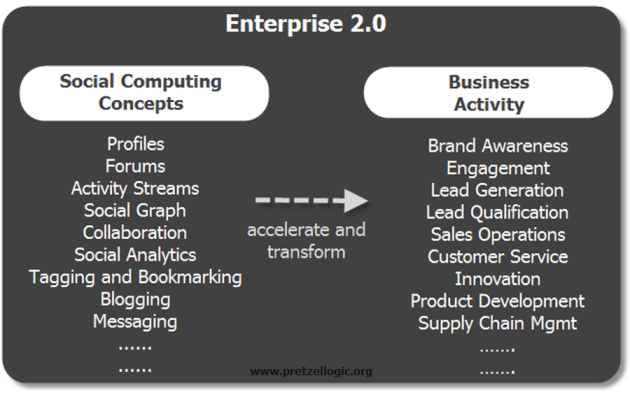
Back in March 2009, Sameer Patel wrote, don’t confuse Enterprise 2.0 with social computing concepts. He was making this exact point, and included this illustrative diagram:

Credit: Sameer Patel, Span Strategies

Credit: Sameer Patel, Span Strategies

His point is that the left side are tools, whereas the right side are results-based activities. Key here is to create applications aligned with the processes for those activities. That means going deeper than a general purpose tool.

Successful Applications Will Be Designed for Results

So back to the original question. Would you manage CRM with a wiki? Could you? Perhaps there’s a geek hack to do this, but for mainstream business, the answer is ‘no’. Customer relationship management includes:

  • Case management
  • Customer revenue analytics
  • Sales pipeline
  • Individual prospect opportunity workflow
  • And lots of other stuff

It would be really hard to use generic off-the-shelf social software to deliver the above functionality. Yet, going back in time, here’s what was prescribed for CRM success in April 2002:

People [who fail] don’t integrate CRM into the other parts of their business or implement CRM as a stand-alone and don’t have it communicate with core systems. A bigger and more frequent stumbling block is forgetting to address the people issues around a CRM implementation. In almost all of the cases we described earlier, CRM is a behavior modification tool.

There is a need for the “hard” functions that CRM can provide, like case management, campaigns and analytics. But that’s not enough (e.g. see social CRM), and enabling the customer-centric firm seems to require a good bit of what makes Enterprise 2.0 tick: cross-organizational perspectives, contributions from different departments, a more collaborative orientation to an end-goal. Integrate CRM into “other parts of their business”.

Wikis, by themselves, don’t provide the necessary CRM functions that are table stakes to be useful for companies. But CRM platforms could benefit from integrating more social software tools and conventions.

And that’s the case for a lot of the current processes that define companies today. They aren’t going to be addressed by off-the-shelf generic social software tools. But they benefit by incorporation of social software tools.

“Activity-specific social applications”. A few examples:

Dachis Group talks about social business design as “the intentional creation of dynamic and socially calibrated systems, process, and culture.” Indeed, there’s a huge opportunity to apply social software to the multitude of applications and processes that make up organizations, beyond the insertion of standalone generic tools.

Watch this space.

My Ten Favorite Tweets – Week Ending 101609

From the home office in a balloon 7,000 feet above Colorado…

#1: Well, this was unexpected. The Spigit funding news has hit Techmeme http://bit.ly/3ETPFp #e20 #innovation

#2: LinkedIn: 50 million professionals worldwide http://ow.ly/uq7s “Last million took only 12 days” Wow. Tipping point?

#3: RT @mwalsh: Seth’s best post of the year – get over yourselves…you’re not that cool, interesting or smart. http://bit.ly/3HwrV6

#4: Is Social Media the New Cigarette? asks @billives http://ow.ly/u8IY Looking at social media addiction

#5: RT @nyike First Jive, now Spigit building #e20 and collaborative functionality on top of Sharepoint http://bwbx.io/hina

#6: Within firms, collaboration technologies are dictated by most powerful person involved in the collab http://ow.ly/tJgf by @amcafee

#7: Just as interesting as this WSJ piece is, Why Email No Longer Rules… http://ow.ly/tZpj are the skeptical cmts left by readers #e20

#8: If companies like $GOOG and $MMM excel and incl employee 15-20% personal time for innovation, why haven’t others adopted same?

#9: Wind farm firm makes sure its wind mills are 30 miles away from nearest Starbucks. http://ow.ly/tRQP Why? Best way to avoid NIMBY’s

#10: When a company gets funding, all sorts of interesting “opportunities” emerge. Just got a solicitation for Spigit to sponsor a NASCAR driver.

My Ten Favorite Tweets – Week Ending 091109

From the home office in Athens, Santorini and Crete…

#1: Salesforce emerging as a competitor to Jive, Socialtext, Atlassian, Telligent? http://bit.ly/71hbn That’ll be tough #e20

#2: What Exactly is a Social Business? http://bit.ly/2g9u82 by @lehawes #e20

#3: 15,000 Thoughts per Day – Why We Need Constraints for Innovation (via Spigit blog) http://bit.ly/ltaxP #innovation

#4: “Innovation is one of the easiest & least risky areas that can be tapped by organizations” http://bit.ly/uLk6K by @dhinchcliffe

#5: RT @armano “innovation happen in the corners of an organization—they need to be connected” (we call this Ecosystem) #futurebiz

#6: McKinsey has created the “innovation performance score” http://bit.ly/2YWPQ9 It’s, of course, a smart analytical tool #innovation

#7: Love @fredwilson‘s attitude here: The Foursquare “Crush” http://bit.ly/10g4kb Using his blog as valuable feedback for future investments

#8: RT @GraemeThickins Wall Street Journal & New York Times plan San Francisco editions http://bt.io/AwZ (via @thefutureofnews)

#9: RT @skap5 Is it possible to have an economy where everyone is a consultant?

#10: RT @Danny_DeVito I just joined Twitter! I don’t really get this site or how it works. My nuts are on fire.

Noted: Innovation Management races past Enterprise 2.0

I belong to two groups on FriendFeed, Enterprise 2.0 and Innovation Management. These groups track tweets and Delicious bookmarks related to their respective topics. The Enterprise 2.0 Group was set up in June 2008, meaning it’s about 15 months old.  The Innovation Management Group was set up July 24, 2009, meaning it’s  about 1 1/2 months old.

So the Enterprise 2.0 Group has a 13 1/2 month head start in terms of attracting members.

Which makes this all the more remarkable:

Innovation Mgt vs E2.0 - FriendFeed GroupsThe Innovation Management Group tied the Enterprise 2.0 Group in membership last Friday (9/4/09). It now has 607 subscribers vs. 590 in the Enterprise 2.0 Group.

Noted.

My Ten Favorite Tweets – Week Ending 090409

From the home office in Los Angeles Station fire…

#1: CNN: Hired! I got my job through Twitter http://bit.ly/1L7lT8

#2: Reading: New Approaches for Analyzing Influence on Twitter http://bit.ly/lz6VP Deep, detailed analysis. Focuses on 12 big hitters.

#3: What an interesting concept. Check the social web to see who scores high on key terms. http://test.jobshouts.com/ (via @gyehuda)

#4: Collaboration King picks the top 3-5 vendors in 11 different categories of collaboration software http://bit.ly/j22WW #e20

#5: Enterprise 2.0: If you (just) build it, they won’t come http://bit.ly/XumO9 “Focus on the low-hanging fruit of human behavior”

#6: Delicious blog: Two PhDs are working on a reputation system for Delicious to make finding good content easier http://bit.ly/4sbGyI

#7: Innovation = problem to be solved + ideas/knowledge of others + presence of mind

#8: Jeffrey Phillips of OVO: External Innovation Communities (via Spigit blog): http://bit.ly/13MJC9 #innovation #spigit09

#9: Do Users Want Innovation? http://bit.ly/Zk5Mp by @jkuramot Truly breakthrough? Not initially – only early adopters. #innovation

#10: RT @innovate Cash for Clunkers – 10 out of Top 10 clunkers turned in were American, but only 2 of Top 10 purchases were. #cars #usa #green