Toluu Rolls Out Tagging {cool} {powerful} {discovery} {easy}

Toluu, everyone’s favorite blog recommendation application, has released a powerful new feature: tagging.

Tagging is a ubiquitous element of Web 2.0. As content creators and consumers add tags, everyone benefits. Things are easy to find, and there’s fun in clicking those tags – you never know what you’ll discover. I’m also a fan of the idea that tagging illuminates someone’s interests. Know someone’s tags, know their interests. A look to the right side of this blog shows the areas that I like to cover. As Toluu founder Caleb Elston has previously noted:

Tagging is super powerful. A few simple words can bring a ton of order and new usefulness.

And Caleb has followed up on that observation with powerful new tagging features in Toluu. Here is what’s new:

  • Tag Tab: Clickable tab for each blog page in Toluu, with several tag related features
  • Explore by Tag: every tag is clickable, leading to a list of related blogs
  • Inline Tagging: Instantly tag a blog right from a list of blogs
  • Users’ Tags: See the tags that a user has applied within the Toluu application

All in all, the features bring a new level of sophistication and community-generated perspective to the blog recommendations. Let’s check ’em out.

Tag Tab

The tag tab is chock full of information for every blog listed in the Toluu system. Here’s a screen shot for this blog:

Tagging: The top of the Tag Tab has an entry box for entering new tags. A couple of notes:

  • Tagging is multiple word, comma separated. Yes!
  • Tags are auto-suggested, based on tags you’ve used before. This is a great feature. It makes it easier to add tags, and enforces consistency, which is so important in tagging.

My Tags: These are the tags you have already applied to a given blog.

Top Tags: These are the most popular tags applied by others to a given blog.

Related Blogs: Each Tag Tab includes a list of related blogs. These are blogs that share similar tags to the ones applied to a given blog. This makes discovering a bunch of blogs with a specific area of focus very easy.

Follow the Bouncing Tag

In fact, it gets even easier to find blogs with a specific focus. Just follow a tag where it takes you.

Notice the nice distinction above? You can see blogs with specific tags applied by anyone in the system. Or you can take a deeper dive, and see what someone you trust has tagged.

Sorting: There are four different ways to sort the list of blogs by tag:

  1. Popular = blogs are ranked by the number of times they received a particular tag
  2. Recent = sort by how recently a specific tag was applied to a blog
  3. Subscribers = sort by the number of Toluu subscribers to a blog
  4. A-Z = alphabetical

Inline Tagging

To make tagging easy and pervasive, inline tagging is supported.

As you look at your list of blogs, you can quickly tag them. I like this because it makes the tagging process fast and easy. I don’t have to go to each individual blog’s page inside Toluu to add tags.

User Profiles Now Have a Tag Story

All this tagging by users has another benefit. You can quickly see what someone is all about when you visit their profile in the Toluu system.

This is great. Toluu isn’t a full-fledged social network, but you can use it to find like-minded people. From these like-minded people, you can discover other blogs of interest.

The tags of a user are essentially a form of self-identification. Like declaring what political affiliation you have, or saying where you work. This at-a-glance insight into someone’s interests is a great way to figure out new people to follow inside Toluu.

Are You Toluu-ing Yet?

Caleb and his team have done a really great job with this new functionality. A lot of attention was paid to ease of use, and the subtleties of information discovery. He has built in the notion of discovery via the collective wisdom of crowds, or discovery via trusted information filters.

Toluu continues to innovate. Click here to see all posts tagged ‘toluu’ on this blog. It’s an impressive list of activity.

If you’re on Toluu, follow me at http://www.toluu.com/bhc3. I’ll follow back. And if you’re not yet on Toluu, I’m happy to email you an invite. Just leave a comment.

Nice job Caleb!

How Enterprise 2.0 Fosters Innovation: Stop Groupthink

I’ve had a chance to read some interesting research about innovation. In this case, whether more quality ideas emerge…

  • When people are in group sessions; or
  • Thinking independently

The background of this research ties into a well-known corporate activity: group meetings. I imagine most of us go through the ritual team meetings. Team meetings are good for a lot of things, but innovation may not be their highest and best use.

Turns out, research says that companies would be better off if employees had a way of coming up with ideas on their own, not in group meetings.

Here are three separate findings:

Via Marc Andreessen’s blog, the findings of researchers as related by Frans Johansson in The Medici Effect:

Via MSNBC, the findings as reported in the Journal of Consumer Research.

Via MIT Sloan Management Review, research published by INSEAD Business School

These observations about brainstorming ring true to me. I’ve been in enough meetings to know that strong personalities and prior relationships can hold sway over a group. The quote above by the Indiana University associate professor describes a dynamic I’ve seen time and again. An idea suggested early in the session gets traction, and becomes the focal point of the brainstorming. At some point, groupthink takes over. Maybe it’s exhaustion, maybe it’s an inability to focus on the other ideas anymore.

Yes, good ideas can emerge. But often, the whole exercise feels forced, and in my personal experience, employees don’t expect much from these meetings. Particularly if they’re run by outside consultants.

It Turns Out Group Brainstorming Does Have Its Attractions

The INSEAD paper referenced above does have some good news about group meetings. The paper studied two types of brainstorming groups:

  1. The traditional model, assembling a group of people.
  2. The other group took a “hybrid” approach, working on ideas by themselves before coming together to share their thinking.

The quote I selected above is from the research. But the study also has this to say about the two types of brainstorming:

Which technique yielded the best ideas? Strictly speaking, the traditional brainstorming groups consistently came up with the very best idea — and the very worst one, too. In other words, the quality of their results varied much more than those that came out of the hybrid groups that combined individual and group idea generation. However, the hybrid groups produced more ideas that were, on average, of higher quality. Nonetheless “for the very best idea, you need to have a pure brainstorming group,” notes Girotra. “Random interactions are likely to produce better-quality ideas.”

A few thoughts from that quote. One, the best idea can emerge from the group brainstorming, but I suspect it takes a truly motivated group. People need to come to meetings energized, ready to participate in a rapid-fire exchange of ideas and counter-arguments. In my experience, most meetings aren’t like that.

Also, how does that research that both the best and worst ideas emerge from group brainstorming play out there? Who doesn’t want the best ideas to emerge, but are you ready to put up with the worst ones too? Is there an argument for maintaining a larger number of ideas that are consistently above average?

Why can’t we get the best of both worlds? I want a higher quantity of good ideas, and I want the best ideas to emerge. While avoiding the worst ideas, if possible.

Enterprise 2.0: Hybrid Between Individualism and Group Dynamics

The graphic below describes the way Enterprise 2.0 captures the advantages of both brainstorming styles, group and hybrid:

Source Ideas: In the model above, the bottom level speaks to the core driver of Web 2.0: user-generated content. In this case, employee-generated ideas. Applying the familiar design and functionality of the consumer web (e.g. Twitter, Flickr, FriendFeed, WordPress, etc.) allows the easy creation of ideas.

Filter Ideas: Something I’ve learned by participating in social media is that your peers are amazing filters. Find a group of people with common interests – but with different opinions – and you’d be amazed at how the most useful stuff floats to the top. Happens in blogging, photos, videos, tweets etc.

Execute Ideas: After all this idea creation and filtering is done, the ideas need to be executed. Here’s where the group dynamic becomes a huge plus. Most ideas in a corporate setting will touch a number of areas, and the group makes it happen.

The key to getting the best of both worlds – more ideas of better quality, identification of the top ideas – is to create a culture where ideas are rapidly created and evaluated, while also letting advocates gestate their ideas to fix areas of weakness.

The ‘Source Ideas’ part of the model speaks to the best of brainstorming as researchers have found, in the above quotes. In my own experience, it’s hard to find those channels for new ideas, either fully baked or based on a hunch. You’d typically have to email someone, or call a meeting with several folks. Coming up with new ideas is challenging enough…you then have to go through workplace Olympics to see an idea get discussed and considered.

‘Filter Ideas’ gets to the heart of what makes group brainstorming powerful, when it works. The rapid creation and analysis of ideas helps everyone. Different points of view, people seeing unique opportunities with an idea or recognizing weaknesses…all are vital to the corporate innovation process. Currently, this can only happen in a group setting, but the group brainstorming dynamics have to be “right”.

Enterprise 2.0 has this figured out. Ideas are easily created and shared. Proponents and opponents can develop analyses of ideas. Simple commenting is very powerful, while longer form blogging can lay down foundational elements. Proposed ideas and discussions live longer than the one hour everyone is together in a conference room.

I know this, because I see it everyday in places like FriendFeed, blogs and Twitter. The diverse opinions, knowledge, creativity and world views result in some really good ideas and perspectives.

I’m not prescribing the particular technology to capture the best of individual and group brainstorming. There are different ways to approach that. What matters is letting the employees try this out for themselves.

Groupthink has its place. A unified group taking on the challenges of the market is vital. But groupthink should kick in after the innovation processes have occurred. First, a healthy scrum of ideas, ultimately filtered to the ones that a company will execute. Then everyone working together with a common sense of purpose.

A utopian vision? Perhaps. But like all stretch goals…if you get halfway to them, you’ve accomplished a lot.

*****

If you want an easy way to stay on top of Enterprise 2.0, I invite you to join the Enterprise 2.0 Room on FriendFeed. The room takes feeds for Enterprise 2.0-related items on Twitter, Del.icio.us and SlideShare. To see this room, click here: http://friendfeed.com/rooms/enterprise-2-0

*****

See this post on FriendFeed: http://friendfeed.com/search?q=%22How+Enterprise+2.0+Fosters+Innovation%3A+Stop+Groupthink%22

Weekly Recap 072508: Twittering into the Mainstream

Twitter got some big play this week: 2 good, 1 bad…let’s start with good…

USA Today had a nice feature on Twitter, Twitter took off from simple to ‘tweet’ success…this quote from the article really gets it right about Twitter these days…

Twitter has become so popular, so fast, that keeping up with its fast-growing user base is a real issue. So many people now use Twitter to update friends that the system often crashes.

The outages are the markers of a company that is experiencing success beyond its expectations…

The New York Times ran a story about how companies use Twitter, blogs and other social media to keep up with customer issues and questions…

If you’re scoring at home, that’s two mainstream, huge-circulation newspapers writing positive stories about Twitter this week…if you wonder a couple years from now how Twitter became so mainstream, remember weeks like this…

But not all was well with Twitter this week…the company inexplicably chopped off subscribers from every user…there were a lot of pissed Twitterers…people threatened to leave Twitter…but when the followers were restored?…

Temporary retraction .. comes back up 50 more followers ? I can’t help it … it’s sticky”

Twitter’s je ne sais quoi

*****

I’ve never said jailbreaking

*****

SmugMug seems to have figured out FriendFeed’s visual dynamics…SmugMug pictures come thorugh big, bright and beautiful on FriendFeed, especially compared to Flickr pictures…

SmugMug pix on FriendFeed, courtesy of Dave Cohen:

Dave Cohen SmugMug Pictures

Dave Cohen SmugMug Pictures

Same pix, this time Flickr on FriendFeed:

Dave Cohen Flickr Pictures

Dave Cohen Flickr Pictures

Great advertisement for SmugMug…and the little guy is cute regardless of the photo service…

*****

Noticed a change in my Google Reader shares these days…I’m tending to share blog posts that I haven’t already seen a few times on FriendFeed…that means fewer TechCrunch shares…more emphasis on those nuggets that haven’t seen wide circulation yet…

Figured people were seeing the big blogs enough already…

*****

I got to do a guest post on Louis Gray’s blog this week…really good reactions out there in the blogosphere, which was great…blogger Barry Schwartz thought enough of the post that he wrote his own post in response, Am I Losing the Connection?

Unfortunately, Barry got the author wrong…he overlooked the “guest post” announcement at the start of the post, and naturally figured Louis wrote it…from Barry’s post…

  • Louis Gray wrote a blog post named Bloggers’ Interactions With Readers Decrease With Prominence
  • Louis Gray documents what are “interactions:”
  • “It’s these two dynamics that cause some bloggers to head onto the next stage,” explains Louis.

Sigh…I am happy the post resonated, but it’d be nice to get a little recognition…so I left a comment on Barry’s post a few days ago:

Barry – glad you liked the post. One small correction – I actually wrote that particular post. Louis was kind enough to let me guest post on his blog.

As for losing your connection to the industry. Look to people like Fred Wilson and Louis Gray as examples. I don’t think any blogger should feel the need to connect with every reader. Just like connecting anywhere else – pick your spots, right?

Despite the comment, Barry hasn’t updated his blog…Barry – you’re losing touch with your readers!…

Well, I’m not alone…Rob Diana wrote a piece on Louis’s blog, Can Microblogs Just Talk to Each Other?…Dave Winer thought it was Louis’s post…such are the benefits and perils of guest blogging…

*****

According to Allen Stern, Mahalo employees are busily writing articles for Google Knol…Unsure of Google Knol’s future impact on his company Mahalo, Jason Calacanis is making sure they have plenty of articles with links pointing to Mahalo pages…

*****

Plan to buy an iPhone this week, if they have inventory

*****

See this post on FriendFeed: http://friendfeed.com/search?q=%22Weekly+Recap+072508%3A+Twittering+into+the+Mainstream%22&public=1

My Cameo Appearance on Louis Gray’s Blog

I had a chance to do a cameo blog post over on Louis Gray’s blog. You can see it right now, Bloggers’ Interactions With Readers Decrease With Prominence.The gist of the post is this:

One observation to make is this: the level of interaction seems to vary by the blogger’s level of established reputation. As a blogger gets more well-known on the Web, the level of interaction declines.

This was my first-ever guest blog post. I’ve seen others do it. Pretty neat, ain’t it? Here are some things that occurred to me as a I wrote it.

Louis’s blog is a lot bigger than mine. Per Technorati, Louis is a Top 5,000 blogger. A much bigger audience than mine. He’s a regular on Techmeme. I always want to put my best content here, but I have some coverage if a post doesn’t get much traction. People who read this blog know me, and have a sense of what I’ll write n the future.  Over on Louis’s blog, there’s a much bigger audience. They’ve come to expect a certain quality. Louis’s expectations became my expectations.

The chart below is the one I used in the guest post on Louis’s blog:

Louis is a Stage 3 blogger. With that, some of the crazy experimentation I like to do (such as my stick man representation of social media interactions) is not appropriate on his blog. I was cognizant of that.

I picked a subject that is consistent with Louis’s overall blog. The role of bloggers, and their interactions is the kind of subject that Louis regularly covers. I wanted a post that fit his “brand”. So I didn’t write one of my Enterprise 2.0 pieces, because that’s not something he covers.

I took forever to write it. Weirdly, it just took me longer to finish up this post than it usually does. Probably for the two reasons listed above.

A lot of fun, and I thank Louis for letting me rent his blog for a day. Go check out my post on his blog:

http://www.louisgray.com/live/2008/07/bloggers-interactions-with-readers.html

UPDATE: My guest blog post made it onto Techmeme: http://www.techmeme.com/080722/p142#a080722p142

Hey Toluu Heads! Check Out the New Hover Boxes!

Toluu, everyone’s favorite blog discovery app, released a cool feature Wednesday morning. Hover boxes that show the last five posts for a blog:

Just put your cursor over any link to a blog, and the hover box appears. Anytime a blog is displayed in these places:

  • Profile
  • Matches
  • Feed Lists
  • Subscribers View

Discovery of interesting blogs just got that much easier. No need to click on the blog name and land on Toluu’s page for that blog. With a quick scan, you can determine your interest in the blog by reading the last five blog post titles. Founder Caleb Elston explains why this feature was rolled out:

We decided to build in this functionality when we found ourselves passing by feeds because we didn’t want to wait for the page to load or have to hit the back button if the feed wasn’t so interesting. Since we weren’t always willing to take a risk on a feed to see if it might be cool, we knew other users wouldn’t either.

And…the five blog posts listed are all hyperlinks that will take you directly to each individual blog post. My suggestion for Caleb – set the links to default as ‘open in new window’. I’d like to keep my Toluu window open so I can return to it.

Also, I think I see some FriendFeed inspiration for the new hover boxes…

As usual Caleb, really nice work on this feature. Both useful and usable.

If you haven’t tried Toluu, here are a couple posts that describe it:

If you need an invite, just leave your email in the comments below. I’ll shoot one out to you. And you can check out my Toluu page here.

*****

See this post on FriendFeed: http://friendfeed.com/search?q=%22Hey+Toluu+Heads!+Check+Out+the+New+Hover+Boxes!%22&public=1

Email’s Changing Role in Social Media: Digital Archive, Centralized Identity

Alex Iskold wrote a great post recently, Is Email in Danger? This quote lays out the premise of the post:

From the 20th century mail was a fundamental form of communication. The invention of electronic mail (email) changed two things. It became cheap to send mail, and delivery was instant. Email became favored for both corporate and personal communication. But email faces increasing competition. Chat, text messages, Twitter, social networks and even lifestreaming tools are chipping away at email usage.

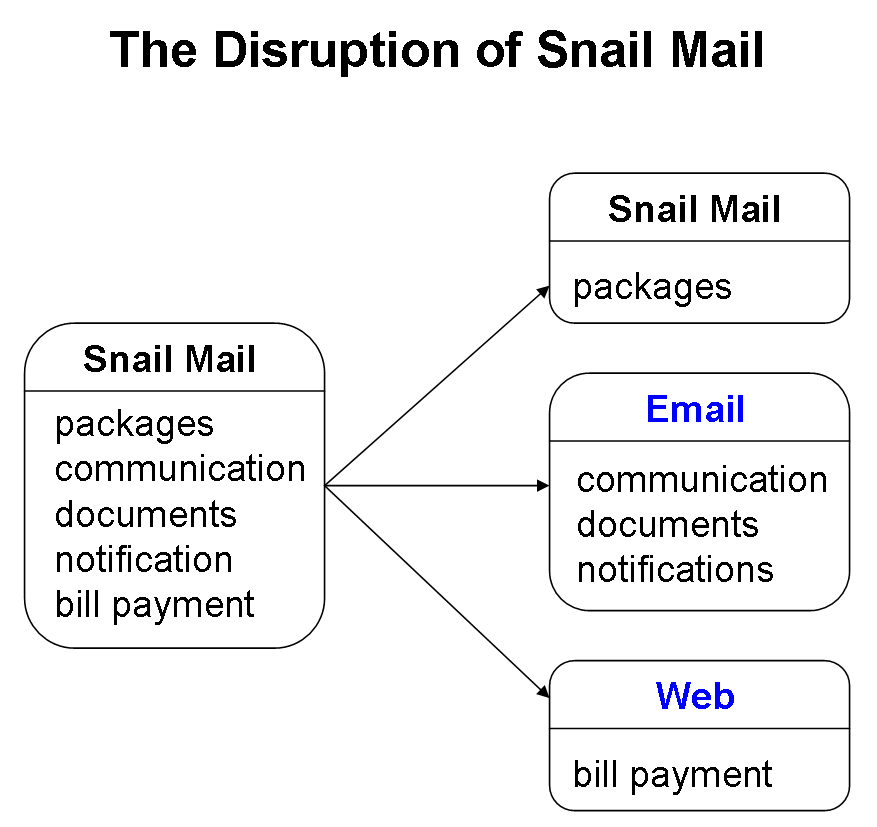
When it comes to email, there are some parallels to what happened to snail mail with the spread of the Internet and email. The biggest thing is this:

Snail mail found an unexpected opportunity for growth with the rise of the Web.

Email will lose out on some of its uses, but there are some interesting possibilities that will emerge.

The Disruption of Snail Mail

The diagram below depicts the disruption that occurred to snail mail.

I’ve kept the disruption focused on the effects of the Internet. In other words, no fax machine or FedEx in here.

Back in the day, the mail system was the way you got a variety of important communications to other people. Our grandparents wrote letters. L.L. Bean mailed us the stuff we ordered via their catalogs. All our bills came through the mail. We were notified of things like jury service.

With the arrival of the Net, a good portion of snail mail’s portfolio was assumed by other technologies. And it’s had an effect. Here’s a quote from a 2001 General Accounting Office report on the future of the U.S. Postal Service:

Although it is difficult to predict the timing and magnitude of further mail volume diversion to electronic alternatives and the potential financial consequence, the Service’s baseline forecast calls for total First-Class Mail volume to decline at an average annual rate of 3.6 percent from fiscal years 2004 through 2008.

Pretty bad, eh? Electronic alternatives were evaporating the revenues of the post office.

But something else was out there which would help offset these losses in first-class mail: e-commerce. With the growth of the Internet, people got more comfortable shopping online instead of going to their local mall.

Those packages had to get to shoppers somehow. That’s where the U.S. Post Office shined. It already had the infrastructure to get things from a centralized place to multiple individual residences. What got disrupted were the trucking companies who moved merchandise from manufacturers to retailers.

Sure enough, the U.S. Postal Service saw a rebound thanks to online purchases, according to Web Designs Now:

In 2005, revenue from first-class mail like cards and letters, which still made up more than half the Postal Service’s total sales of $66.6 billion, dropped nearly 1% from 2004. But revenue from packages helped make up for much of that drop, rising 2.8%, to $8.6 billion, last year, as it handled nearly three billion packages.

And the dark mood at the U.S. Postal Service headquarters brightened quite a bit:

“Six years ago, people were pointing at the Web as the doom and gloom of the Postal Service, and in essence what we’ve found is the Web has ended up being the channel that drives business for us,” said James Cochrane, manager of package services at the Postal Service.

There is a lesson here for email.

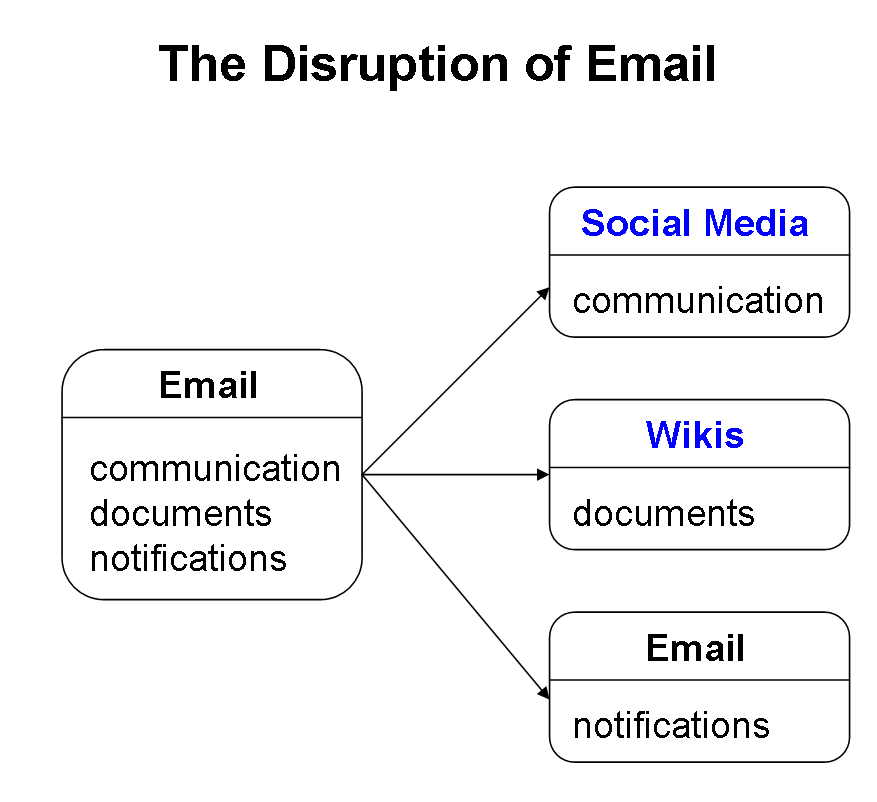
The Disruption of Email

Email is undergoing its own disruption:

Again, similar to the previous diagram, I’m focusing on the web here. No mobile texting as an email disruptor, even though it is.

As Alex outlined in his post, the easy messaging of social media is supplanting the email messages that used to be sent. I haven’t seen any surveys that show the decline in person-to-person communications because of email. But my own experience reflects the migration of communications to the various social media.

  • LinkedIn messages
  • Facebook messages
  • Twitter
  • FriendFeed comments

As Zoli Erdos pointed out in his blog post Email is Not in Danger, Thank You, wikis are growing as the basis for sharing documents. They provide better capabilities than does email: wider visibility, versioning and searchability.

But it’s in notifications where email’s future is bright. Many of us are members of social media sites. As we go through our day, it’s hard to stay on top of activity in each one: new messages, new subscribers, new friend requests, etc.

Where is the central clearinghouse of my multiple social media identities? Email.

Email is the permanent record of what’s happening across various sites. This is actually a very valuable position in which to be. Here are two examples where email helped me:

  • After I wrote a post about nudity on FriendFeed, I lost some FriendFeed subscribers. I know this because my number of followers went down. There was one person in particular I wanted to check. This person wasn’t on my list of followers, and I thought, “maybe wasn’t subscribed to me in the first place?” Checked email, and I did indeed have a follow notification from this person a few weeks earlier. So I knew I’d been dropped.
  • I inadvertently deleted a comment to this blog. On wordpress.com, once deleted, the comment is not recoverable. I was in a bind. But then I realized I get whole copies of comments to this blog emailed to me. So I went to Gmail and found the comment notification. I was able to add the comment back by copying it from my email.

As snail mail had to adjust to the rise of email, so too will email adjust to the rise of social media:

As the number of social media sites and participation in them expands, email will find new growth and value in being the centralized notifications location.

Email = Centralized Identity Management

Much has been written about email being the ultimate social network. The basis for this is your address book and the emails you trade with others. But might there be another opportunity for email?

If email has all these subscription and message notifications, doesn’t it potentially have a role in helping you manage your centralized identity? Gmail could map out my connections across various sites. Find those that are common across the sites. Gauge the level of interaction with others.

Even add APIs from the various sites and let me send out communications from email. Suddenly, email’s back in the communication game as well.

I’m just scratching the surface of what might be possible here.

What Do You Think?

Email’s primary role as a communication medium is diminishing. Many of us are enjoying the easy, contextual basis of communicating via the various social media sites.

But like snail mail before it, email has interesting possibilities for what it will do for us in the future.

What do you think?

*****

See this post on FriendFeed: http://friendfeed.com/search?q=%22Email%E2%80%99s+Changing+Role+in+Social+Media%3A+Digital+Archive%2C+Centralized+Identity%22&public=1

Do FriendFeed Comments Hurt Bloggers’ Ad Revenue?

Allen Stern at CenterNetworks recently wrote a post arguing that FriendFeed was hurting bloggers by taking away page views. I’d paraphrase his position as this:

Once people comment on the actual blog post, they tend to return many times to see the comments that follow theirs.

I mean, they reload the blog post…MANY, MANY times…

The numbers sounded aggressive to me, so I wanted to give some consideration to Allen’s calculations. I also created a separate spreadsheet that estimates the ad revenue generated from comments on FriendFeed. The tables are presented below.

One note. Allen’s CenterNetworks worksheet for blog-based comments shows ad revenue that crushes the revenue I show for FriendFeed-based comment ad revenue. But here’s the catch – there’s an uber-aggressive assumption about repeat visitors to blogs in Allen’s calculations. Right-size that assumption, and I think FriendFeed ends up looking better.

If you leave this post with one thought, it’s this:

FriendFeed will help the vast majority of ad-based blogs to increase their revenue by driving higher page views.

OK, on to the calculations.

CenterNetworks Blog Comment Ad Revenues

Allen wrote most the calculations below in his blog post. I did have to make some assumptions to hit the $100,000 annual revenue level he associated to commenter page views.

As Allen says in explaining the $100,000 in comment-related revenue:

Last step in the equation – how many people visiting the blog will reload the page a number of times to view and/or interact with the comments – on sites with major trollage, this number can be astronomical. Using our numbers above, I estimate that this could be a minimum of $25,000-75,000 per year. Again this is most likely a bare minimum and for large blogs with controversial content, this dollar figure could be way higher.

At the end of the day, a large blog could easily be generating more than $100,000 a year in commenting revenue alone.

Allen does say the number of reloads is astronomical. As the table above shows, to hit his $100,000 in comment-related revenue, commenters must hit reload 39 times. For all 10 posts. Every day. All year long. All commenters.

And presumably they’re doing this for all the big blogs: TechCrunch, BoingBoing, ReadWriteWeb, Mashable, Engadget, Gizmodo, Huffington Post…and do these blogs actually average 70 comments per post?

Anyway, I’m sure there are those who actually refresh 39 times per post on all these blogs. But are there enough to generate $100,000?

FriendFeed Comment Ad Revenues

The crux of my analysis is not page views driven by reloads. It’s based on unique visitors clicking to the blog because of the viral attention features of FriendFeed. Specifically the tendency of comments to bounce a blog post to the top of people’s FriendFeed. Comments in general will advertise the content, and comments by someone you trust will increase the odds of clicking.

As you see, I set the revenue as 10% of what Allen has in his, but I’d argue it’s based on a more realistic assumption about page views. Remember this spreadsheet focuses only on the comments effects, not the Likes or the multiple times a blog post shows up in FriendFeed: Google Reader Shares, bookmarks, Stumbles, etc.

A problem with my spreadsheet is that I carry over the aggressive assumption about comments (70 per FriendFeed entry). But I want to make the comparison to Allen’s spreadsheet apples-to-apples.

Analyzing TechCrunch’s Comment Activity

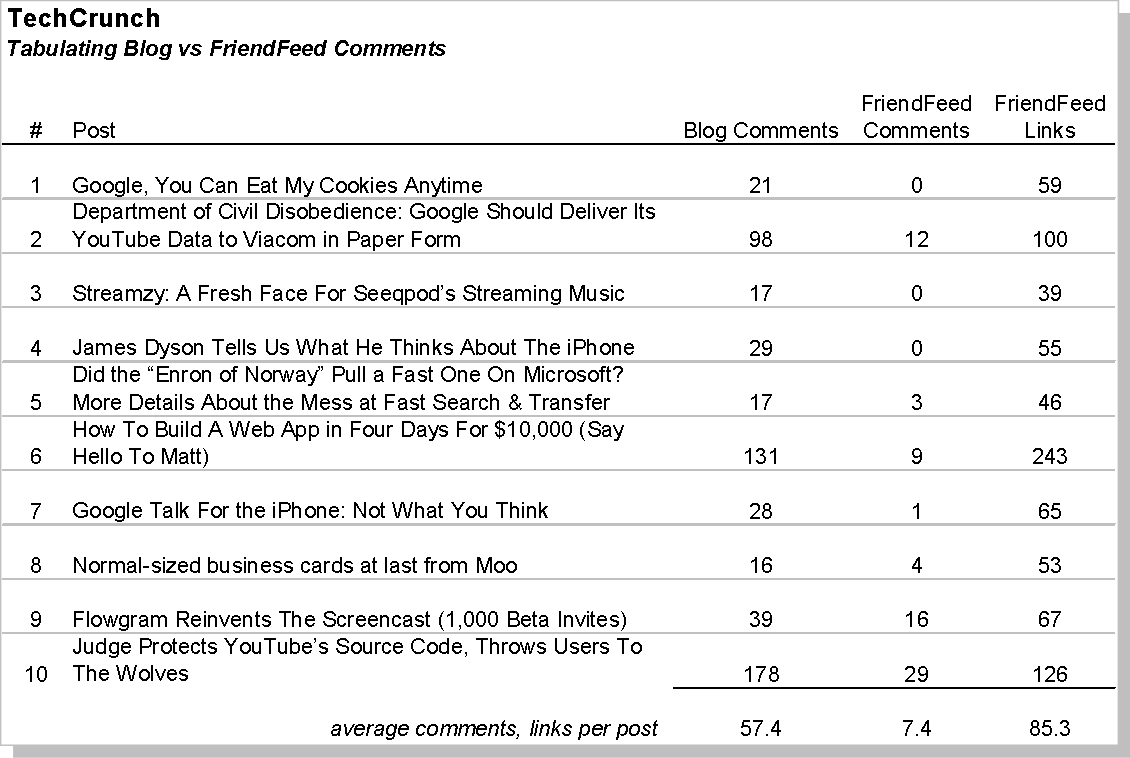
To get a sense of FriendFeed’s impact thus far, I looked at ten TechCrunch posts from the July 3 period. I counted the number of comments the posts received directly on TechCrunch, and how many they received on FriendFeed. For FriendFeed, I found all instances of the link – TechCrunch’s RSS feed, Google Reader shares, del.icio.us bookmarks, Stumbles, etc.

I excluded notes included with Google Reader shares or del.icio.us bookmarks from the FriendFeed comment count.

Looking at the table a couple things stand out:

  • FriendFeed does not appear to have stolen too many comments from TechCrunch
  • FriendFeeders have put the link out into their individual networks an average of 85 times – that’s the kind of visibility most blogs would kill for

I want to call your attention to post #10 in the above table, “Judge Protects YouTube’s Source Code”. 29 comments on FriendFeed. 14 of those comments came on a direct post of the TechCrunch article by Jason Calacanis. Jason has 29,000 followers on Twitter, and many of those have come over to FriendFeed. So when posts a question, he can get a lot of comments. But more importantly, the people commenting on his post are in all likelihood doing it because it’s Jason Calacanis.

My guess is that most of those commenting would not comment on the TechCrunch post. They’re more interested in what Jason is discussing.

Some Conclusions

I’m sure Allen is right about the TechCrunch “regulars” who post and reload multiple times. I’ve seen the reload behavior in myself when it comes to FriendFeed. However, I suspect his estimated number of reloads is way overstated. If you were to look at the 70 commenters in his scenario, you’d be lucky to get an average reload of 3 times, not 39 times. Sure, some commenters will hit double digits in their reloads. But many commenters won’t return at all.

The other consideration is that FriendFeed will take away some of those diehard reloaders. But I’d be willing to bet most of the die-hards will stay on the blog itself. Why? These guys’ relationship is with the blog and if you’re really reloading 39 times, you won’t stop commenting on the blog itself. I’ll bet there are a bunch of TechCrunch-heads who know one another via posting there. The TechCrunch site is their social network.

For most blogs that don’t generate 70 comments per post, the viral attention features of FriendFeed hold greater benefit than comments on the blog itself. Look at the ratio of FriendFeed links-to-comments for TechCrunch:

11.5 times more links for a post than comments (85.3/7.4)

As a blogger, I’ll take that trade-off. All those links are added visibility. FriendFeed is just as much about discovery as it is about conversations. That shouldn’t be overlooked.

Even Allen’s post about this was visible 24 separate times on FriendFeed.

Finally, in an interesting development, check out how ReadWriteWeb is integrating FriendFeed comments into each blog post. That’s one of the top 11 blogs worldwide embracing FriendFeed comments.

*****

See this post on FriendFeed: http://friendfeed.com/search?q=%22Do+FriendFeed+Comments+Hurt+Bloggers%E2%80%99+Ad+Revenue%3F%22&public=1

Why Bloggers Should Want Comments on FriendFeed

Blog comments aren’t dead, but FriendFeed comments have emerged as equally valuable. Robert Scoble has a post up now in which he states:

My Tesla post gathered two comments here.

13 comments and 12 “Likes” over on FriendFeed.

Let’s just stick a fork in it. Comments are dead.

I don’t think they’re dead, but I do think he raises a good point. The interaction that occurs on FriendFeed is so much easier and freewheeling than it is on blogs.

Blogs that don’t have a lot of comments can feel like museums (“look, but don’t touch”). It feels like it takes an extra effort to put a comment there, because you can’t really feed off others’ participation.

FriendFeed’s got four things that make it really, really good for commenting:

  1. Wide open nature – anyone can jump in
  2. More lively subscription base – RSS subscribers are great for views, but not for comments. FriendFeed’s interaction nature stokes conversations in a much better way
  3. The barrier to commenting is lower – I commented on Robert’s post about this, and got a message saying my comment was “awaiting moderation”. Not on FriendFeed – where I just typed and clicked “Post”.
  4. FriendFeed’s viral attention features – Likes/Comments cause content to bounce to the top of the screen and friend-of-friend interactions cause people outside your subscription base to see your blog post, generating more views and comments

Keep the blog comments coming, but I’m quite happy to have you comment on FriendFeed too.

*****

See this post on FriendFeed: http://friendfeed.com/search?q=%22Why+Bloggers+Should+Want+Comments+on+FriendFeed%22&public=1

What’s Your Blogging Style? Use FriendFeed Likes/Comments Ratio to Find Out

Julian Baldwin asked a question today on FriendFeed: “Roughly speaking, what is your comment to like ratio here on FriendFeed?” Based on the responses, a  lot of folks are doing more commenting than liking, but I suspect the responses aren’t totally representative. Still you can see a lot of emphasis on commenting.

Which made me wonder about turning this around a bit. Instead of looking at each person’s ratio of Likes to Comments, what could be gleaned from figuring that ratio out for a blog?

I selected several blogs, and totaled the number of Likes and the number of Comments for the last 30 posts of each blog. I then calculated the ratio of Likes to Comments, and mapped the bloggers to roughly one of four blogging styles:

  • Stir it up
  • Can we talk?
  • Observing the scene
  • Stuff you want to know

There are some adjustments and limitations related to this; they follow below. But first, the map of bloggers to blogging styles. To reiterate, the ratios you see below are calculated this way:

# Likes / # Comments = blogging style

So for instance, Dave Winer’s ratio is actually below 1.0. He gets more Comments than Likes. Here’s the map:

As I put this together, the analysis does seem to ring true from my perspective.

Here are the adjustments and limitations:

  • Some bloggers are really active at responding to comments on FriendFeed. This tended to drive their number of Comments up. For instance, Alexander van Elsas could put on a clinic in terms of engaging commenters on FriendFeed. I should be so good. So I gave the number of Comments a haircut for several bloggers.
    • Alexander van Elsas – 33% haircut
    • Myself – 25%
    • Mark Dykeman – 25%
    • J. Phil – 25%
    • Colin Walker – 25%
  • The analysis only applies to the main blog for each person (listed below)
    • No Toluu activity updates
    • No Qik videos
    • No side blogs that augment the main one
    • Etc.
  • Only the blogger’s own feed was used in this analysis. This is imperfect, as it does not include Likes and Comments for other ways thr blog post gets into FriendFeed:Google Reader shares, tweets, direct posts, del.icio.us, etc.
  • Some great new bloggers aren’t here, as they build out their blogs with posts.
  • The 30 blog posts per author only included entries with at least 1 Like or Comment.

And quickly, here are the links to the blogs used in the analysis:

What do you think? Does the Likes/Comments Ratio make sense as a blog style indicator?

*****

See this item on FriendFeed: http://friendfeed.com/search?q=%22What%E2%80%99s+Your+Blogging+Style%3F+Use+FriendFeed+Likes%2FComments+Ratio+to+Find+Out%22&public=1

Fred Wilson’s Techmeme Challenge: Can a Little Tweet Go Big Time?

Last week, Fred Wilson asked this:

What will be the first twitter post to get picked up on Techmeme and who will post it?

It’s a good question. First hurdle is a technical issue – Techmeme doesn’t index and scan activity around Twitter.  Here’s Gabe Rivera’s response in full:

It’s hard for me to see how automated aggregation of tweets could be a net win for Techmeme. As others have said, tweets lack context, unlike blog which are much more self contained. Could tweets be reassembled into something more coherent for Techmeme? Automated processes for doing that are too error prone, at least by the standards Techmeme would demand. And even if they were perfect, the results will still look strange and disjointed. And in any case, blog posts tend to emerge quickly for the most important stories “breaking” on Twitter. Techmeme has definitely benefited from the Twitter ecosystem. For one thing, Twitter serves as a backchannel that prompts people to blog about things they otherwise would have discovered too late or not at all. Of course Techmeme publishes to Twitter too. But aggregation of the tweets themselves is a tough nut to crack.

In there, you’ll see the technology answer. He also addresses a larger issue, which is that tweets lack context as standalone content. But Fred Wilson answers that question this way:

But you can permalink to a tweet So if dozens of high profile blogs did that, then would that tweet be techmeme material and would it be right for that to be the anchor post?

Context is the name of the game here. If Gabe ever tracked individual tweets (thus solving the technical issue), I think there are two paths toward getting context.

  1. Self-evident context for the specific tweet
  2. An aggregation of comments around the tweet

These are different angles on the context subject. Let’s break ’em down, shall we?

Self-Evident Context

Fred Wilson hits the nail on the head for one way to evaluate context. What blogs are linking to the tweet?

My understanding of the inner workings of Twitter is incomplete, but one thing that’s important is whether a given party has been on Techmeme before.  Even better if said party was part of the Techmeme 100. Here’s how Robert Scoble described it:

TechMeme works partly on this principle: past behavior is best indiction of future success. So, Techcrunch gets on top for a lot of things because he’s been best in the past.

With zero tweets on Techmeme thus far, any tweet that makes it there will need an extra boost to get there. Self-evident context will be provided by two sources:

  • The Techmeme status of the person who made the tweet
  • The Techmeme status of the blogs that link to it

The Techmeme status of the person twittering is key. It’s one thing for Joe Blow to tweet “rumor: amazon.com to buy yahoo”. But if Techmeme regular Kara Swisher tweeted it, then we’re talking! There’d be the challenge of linking Boomtown Kara Swisher with Twitter Kara Swisher. But that doesn’t seem insurmountable.

The first element of context – the Twitterer’s Techmeme status – is linked to the second element, which blogs will link to the tweet. Unless we see a delphic newbie emerge, most high profile bloggers will pay attention to existing A-Listers. Here’s a visual description of all this:

This shouldn’t come across as a negative. It’s reality. The A-Listers got there by knowledge and skill, and have reputations to protect. If they put something out there, you really can put greater credence in it.

That’s self-evident context.

Aggregation of Comments Around the Tweet

The second scenario for a tweet would be the aggregation of conversations around it. The thing here is that the heat of the comments drives its placement on Techmeme. Assuming a lot of comments, and that the subject matter fits the Techmeme sphere.

But this scenario for context still requires some Techmeme juice. Both the original Twitterer and the subsequent commenters will need Techmeme status. Using the commenting from FriendFeed, here is an example:

The red boxes on the FriendFeed comments are for bloggers who regularly make Techmeme (Fred Wilson, Mathew Ingram, Louis Gray, Steve Rubel, Robert Scoble). So the presence of those comments gives the tweet the right context. It’s got Techmeme firepower.

I could see the aggregated comments for a tweet driving that tweet onto Techmeme. And FriendFeed makes it easy to track the conversations around a tweet. Which answers one of Gabe’s concerns in his comment above about tracking the contextual conversations around the tweet.

Final Thoughts

Fred ain’t so crazy. I could see a tweet hitting Techmeme, under a couple scenarios. But it will take the right combination of existing A-Lister Techmeme firepower to make it happen.

*****

See this item on FriendFeed: http://friendfeed.com/search?q=%22Fred+Wilson%E2%80%99s+Techmeme+Challenge%3A+Can+a+Little+Tweet+Go+Big+Time%22&public=1

Smart Social Media Marketing: Caleb Elston and Toluu

Interacting with bloggers called vital for business

Brice Wallace, Deseret News, June 7, 2008

Toluu released several new features on Wednesday. The features are cool, and are covered in another post on this blog. Which leads to the point of this post…

Caleb Elston did a masterful job of getting coverage for his fledging company Toluu. By himself, with no PR firm. How?

Caleb is a participant in social media. He’s established relationships and credibility with bloggers, and with others on FriendFeed and Twitter.

In a recent post, I asked Will Brands Figure Out FriendFeed? The idea is that rather than rely only on standard press releases and marketing campaigns, companies should look at engaging customers out in various social media, with a focus on FriendFeed. Establishing these deeper relationships pays dividends:

  • Reliable audience for updates
  • Viral distribution of company information
  • Customer advocates
  • Feedback from the market, with the ability to follow-up on questions/comments

Caleb has all of these advantages through his efforts in social media. How involved is he? On FriendFeed, he subscribes to 278 people, has 248 Comments and 244 Likes. On Twitter, he’s following 479  people and has 734 updates. In other words, he’s involved. Which is actually pretty amazing considering he has a day job on top of building out Toluu.

Yesterday, his involvement paid dividends. He reached out to bloggers the day before to let them know of an upcoming release for Toluu, and asked us if we wanted to cover it. Well, since I know him already, saying ‘yes’ was easy. He got eight different bloggers to write about the new release:

The combined Technorati Authority of those eight blogs is 872, which is like getting a top 5,000 blog to write about you. Many of the bloggers are active on FriendFeed, which combined with their existing subscribers, meant that a lot of people saw the news about the new features.

Caleb describes the payoff:

All I can say is wow. Yesterday was an amazing day for Toluu, you helped us shatter every metric we track. We had a record number of pageviews, visitors, signups, new feeds, connections made, invites requested, and time spent on the site. All I can say is thank you.

He even picked up technology celebrity Leo Laporte as a user. Said Leo, “I’m in dire need of a feed reset!”

Admittedly, as a small start-up with limited resources, this is all he could really do. He can’t crank up the PR, marketing and advertising machine.

But that doesn’t devalue the accomplishment. Caleb managed to get people interested in his company thanks to his active involvement in social media.

Big companies…are you listening?

*****

See this item on FriendFeed: http://friendfeed.com/search?q=%22Smart+Social+Media+Marketing%3A+Caleb+Elston+and+Toluu%22&public=1

Subscribe or Not? Toluu Just Got Better at Helping You Decide

A couple months ago, I had a chance to review Toluu, the blog recommendation site. The site is great, and has gotten really good uptake. In that review, I did write this:

I’d like to get a little more info about some of these blogs in a summary fashion, without having to click each one.

Well, Caleb Elston and team have delivered some nice new features that do just that. Here’s what is new at Toluu:

  • View the most popular posts from a blog
  • Who else has subscribed to the blog within the Toluu world
  • What other blogs those same subscribers have subscribed to recently
  • Posts now have datestamps
  • The contact page loads 5 times faster

The new features providing context around a blog are particularly interesting for me. Let’s look at those.

Toluu Before and After

Here’s a screen shot of the page for a blog before the updates. The most recent post for the blog is shown, without any date information.

Next, the same screen with the updates. Below, you’ll see new tabs for the blog: Recent, Popular, Subscribers. Also, note that the post for the blog now has timestamp information (“Yesterday”).


With the addition of the tabs, you now have quick access to more information about the blog.

Popular Posts = Better Insight into the Blog’s Best Stuff

As you’re checking out whether to subscribe to the blog, you click on the Popular link. This is pretty nice. The blog’s most popular recent posts are shown. At a glance, the user can see if the blogger’s top stuff is interesting. A good way to gauge what animates the blog.


According to Toluu founder Caleb Elston, the determination of what’s popular for a blog is “a combination of our own data mixed in with some data from AidRSS and soon a few more sources.”

The list shown for this blog is a pretty good indicator of popularity.

Subscribers = Who Else Likes this Blog?

This feature is really cool on a couple fronts. As a user deciding whether to subscribe to a blog or not, the list of subscribers provides a reference of sorts. Who feels like there’s enough “there” to warrant a subscription?


You can see what other blogs the subscribers have added as well. For example, I see that Corvida added Blogsessive. I checked it out, and decided to add it myself. A really nice way to leverage the filters of others in finding blogs you may like.

In fact, in terms of human filtering, you now have three ways in Toluu to handle that:

  • The algorithm-based matches to others
  • Your selected contacts’ additions to their feeds
  • What are the other feeds of people who subscribe to your blog

As a blogger, I also find this feature very nice. You may know your number of subscribers, but do you know who they are? Well, with Toluu, it’s pretty easy to see who some of them are.

Nice Job

These changes are a great step forward in helping you decide which blogs warrant your subscription. Better sense of the blog’s content. Better sense of the crowd that likes a particular blog.

My wishlist still includes better macro, summary recommendations for blogs. But all in due time. Hats off to Caleb and team for adding these excellent features.

Also – I invite you to check out my Toluu page: toluu.com/bhc3 If want an invite, just leave me a comment.

*****

See this item on FriendFeed: http://friendfeed.com/search?q=%22Subscribe+or+Not%3F+Toluu+Just+Got+Better+at+Helping+You+Decide%22&public=1