On the Utility of Thinking in Terms of Jobs-to-Be-Done

Cottonball clouds In a recent post examining the future of retail, I used the jobs-to-be-done approach to break down the industry. And I’ve been using it more in other ways. It’s quite useful as a basis for innovation.

The premise of the jobs-to-be-done approach is that it provides a much better basis for innovation. The focus is on unmet needs of customers. Compare this to asking wide open, pie-in-the-sky types of questions.

I thought about this when I saw this question posted on Quora:

What currently nonexistent websites would you want to be created?

Wow. Talk about an open ended question. I don’t know about you, but that question doesn’t help me. I get brain freeze. I need a prompt to come up with something. Wide open questions like that are somewhat divorced from what people actually need. And will generate a lot of ideas off the mark, or none because it’s too divorced from what people are thinking about (although one guy has an idea there).

Now I’ll describe a different situation. For Spigit, I often find myself needing to come up with a new idea to show off the system functionality. If I used that question from Quora, I’d find myself straining to generate ideas that pass the smell test.

So instead, I’ve been using the jobs-to-be-done framework. I think of my own jobs-to-be-done. Here’s one I actually used to come up with an idea for a client demo:

When I’m traveling with my family on vacation, I want to keep the kids entertained happily the entire trip.

From this job-to-be-done, I came up with an idea for a long haul family SUV (or could be a minivan). It’d have storage for games, and a flat surface for playing them. A refrigeration unit on board to keep beverages and food fresh. Multimedia for videos, music and games. It would take some design genius to develop. But it’s a vehicle I’d actually take a good look at.

[tweetmeme source = “bhc3”]

And that’s the point. The jobs-to-be-done approach is incredibly useful for generating ideas that are relevant and actually have potential. You’re plumbing the depths of what people really feel and what they actually want to accomplish. A powerful head start on innovating.

OK, let’s take this one out with a little Holiday Road.

5 Social Business Truths

Meritocracy trumps hierarchy: Companies don’t get a “pass” on Wall Street or the London Exchange becauswe they’re been around way before new companies. Political candidates aren’t immune from beingf being upended when they don’t perform. Why should work be any different? Companies that focus on the meritocracy are focused on growth. Those that pay too much attention to hierarchy are limiting their growth.

[tweetmeme source=”bhc3″]

Knowledge and ideas want to be free: When you learn something new, ever feel the urge to share it? When you know something that can help, don’t you want to answer a question? When you have an idea, isn’t it great to bounce off others? From a behavioral and technological perspective, we want knowledge and ideas to be free. Why lock ’em down?

Cognitive surplus must be a competitive advantage: Cognitive surplus – knowledge, perspectives, heuristics – is perhaps one of the most wasted assets organizations have. Each person’s surplus can be applied to a much greater range of problems and opportunities than what defines the daily tasks of her day. It’s a shame if employees go home every day without going beyond their job titles at the office.

Social and interest graphs generate positive returns: Activity streams, notifications, public interest spaces, recommendations – these new tools are exposing people to a greater range of relevant information than ever before. We’re not limited to our immediate cubicle neighbors. We are part of larger social and interest graphs. This increases the diversity of inputs, which increases our own, and organizational, odds of finding optimal solutions.

Transparency raises organizational IQ: When the left hand knows what the right hand is doing, we operate more effectively. Knowing the different initiatives, information and problems affecting other parts of the organization makes us better prepared in our own work. Operating in a vacuum sucks, because you get knocked over hard by things you don’t know. Transparency of information and conversations makes everyone smarter in their own work.

Carving Up the Retail Industry by Customer Jobs to Be Done

Online retailers had a heck of 2011 holiday season, up 15%. Whew, in a tough economy no less. But the news wasn’t as good for some physical retail stores. Sears Holdings announced disappointing sales and will be closing over 100 stores. Best Buy same store sales dropped, and some have expressed their sentiment that the retailer is on a long downward slide.

Digital disruption. Coming to a store near you.

That online and mobile commerce is increasing its share of business really isn’t a surprise. The  Internet, as promised in the 1990s, is turning over many industries.

[tweetmeme source=”bhc3″]

Retail being another such industry, although it’s a much slower process of disruption. Which means the physical retailers have time.

Time to take their natural advantages and build on them.

Determining Physical Retailers’ Competitive Advantage

Given the retail industry’s importance to the global economy and its periodic restructuring, it should come as no surprise that there’s plenty of advice for the industry. Three of the larger, well-known consultancies weigh in.

Booz and Co.’s Karla Martin sees a need for retailers to reduce selections and assortments. Bain’s Darrell Rigby sees omnichannel engagement with customers as the path for physical retailers to re-assert themselves.

In both Booz’s and Bain’s advice, there are elements of incorporating the jobs for which a customer hires a retailer. In the Booz piece, it’s a curation job: “Help me navigate an increasingly overloaded product landscape!” In the Bain piece, it’s a…well, not entirely sure what job is being satisfied. It appears to combine several customer jobs to be done. It is also a good thought piece about future industry infrastructure requirements.

These advice pieces raise the question of how to drill deeper into customer needs. Go beyond the meta trends and get specific around customers. Consulting firm McKinsey offers this thought:

“One way that manufacturers and retailers can investigate these trends is through consumer surveys designed to identify ‘purchase drivers’ – meaning those factors that are decisive in the decision to buy a product or shop at a certain retailer. This survey should not only cover conventional topics like price, quality, and service but also such factors as corporate responsibility and traceability of product origin.”

Survey fatigue notwithstanding, McKinsey starts down the right path. Get the customers’ input. McKinsey talks in terms of purchase drivers. An example of such an influence is convenience, deemed to include shopping ease and practicality.

But does that go deep enough? The risk here is that only surface-level influences are elicited, while the real drivers are buried deeper. A case of “what they say” vs. “what they do”.

A good alternative to get deeper into customers’ minds? The jobs-to-be-done approach.

Components of a Job-to-Be-Done

To create a jobs-to-be-done structure, I’ve followed the work of Strategyn’s Tony Ulwick and Lance Bettencourt, and Re-Wired Group’s Bob Moesta. They’re practitioners who have been working with organizations for years.

Ulwick and Betterncourt have defined the structure of a desired outcome statement (pdf link):

  • Direction of improvement
  • Unit of measure
  • Object of control
  • Contextual clarifier

As example, he gives:

Minimize…the time it takes…to verify the accuracy of a desired outcome…with a customer…e.g. its meaning, completeness, exactness, etc.

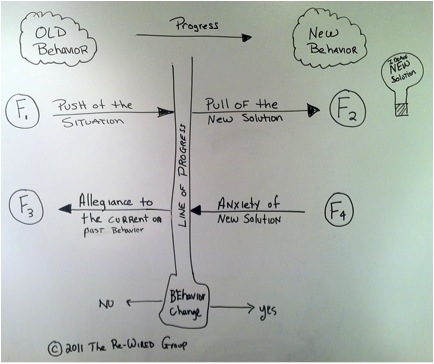
Bob Moesta has identified four influences on how a customer decides what product will satisfy a job to be done.
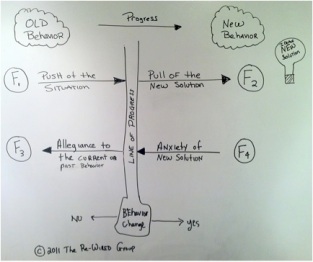
Push (F1): The situation which is driving a person to seek a solution. What is it we’re dealing with? What’s the impetus?

Pull (F2): The promise of a new solution that can satisfy the need. As customer’s consider a new solution, how well does it map to their needs?

Allegiance (F3): The familiarity of an existing solution is a risk mitigator, leverages already learned usage and known benefits.

Anxiety (F4): The unknown characteristics of the new solution, and the potential missteps that await. Would if the new solution isn’t all it’s advertised to be?

I like both forms of analysis, they are quite complementary. So I combined Ulwick, Bettencourt and Moesta’s work to use as an analytical tool.

Retail’s Jobs to Be Done

There are many jobs that retail must fulfill for customers. Below, I’ve picked four of them for analysis. Four that are ones you’d probably see as well. Each job has a defined outcome statement, and a listing of drivers which influence the retailer selected for the job. These aren’t actual customer insights I’ve surveyed, they’re from me. But they address the right type of analysis needed.

The analysis is done from the perspective of switching from a physical retailer to an online one. This is the disruption which is occurring. This perspective was chosen to illuminate possible innovations for physical retailers, or to point out the long term trend they will need to accept.
Retail Jobs - Desired Outcomes

Retail Job: Low Price

Getting the lowest price. Isn’t that what everyone wants? It’s been a human goal since we were bartering woolly mammoth skins for stone weapons.

Frankly, this job is one that will be challenging for physical retailers to fulfill. As has been noted, Amazon – and other online retailers – don’t have the overhead of physical stores. They can and do price lower. And you can see the differences, right there, on your screen.

The anxieties that consumers feel about online retailers providing this job – retailer performance, shipping delays – are there, but don’t rise to the level of overturning the pull of the online retailers. Too many online retailers have proven themselves over the years. They’ve overcome these anxieties.

Physical retailers competing to fulfill this job need scale to overcome their higher infrastructure costs: physical plant, distribution systems, inventory, in-store personnel. Kmart, for instance, is losing the scale war to Walmart, and the online retailers are generally able to outprice it.

Verdict: Long term, this job will be fulfilled by mega-stores and online retailers. But only in categories where it makes sense. Groceries, for instance, are tougher for online fulfillment of the Low Price job, due to the delivery costs of home delivery.

Retail Job: Immediacy

There’s times when you just have to have something today. Even now. Something needed for a home project. Last minute gift. Car maintenance. The list goes on and on. The Immediacy job occurs when the unforeseen happens, or the unplanned realize they need something.

So what’s the pull of online here? Well, you can see the item from your comfortable home. See, it’s right there on my screen! And even better, I can buy it right now! Hmm…not quite the same as actually having it in hand, is it?

Actually, the online retailers are working to provide the “holy grail” of e-commerce, same day delivery. There are different strategies here, although working with physical retailers is a core part of several initiatives. But the costs appear prohibitive: one start-up, Postmates, charges $10 to make short deliveries inside cities.

Verdict: The physical retailers have a distinct advantage here. That expensive distribution system that hurts them with the Low Price job? It’s a distinct advantage here. Physical retailers should play the immediacy game full tilt. Develop an app that tells customers whether something is available, and make it easy to pay for the item. Create a drive-through pick-up experience.

Retail Job: Selection

What did Henry Ford say? You can choose any color you want, as long it’s black. That may have been the case earlier in the industrial age, but not so anymore.

As a general observation, people desire with the ability to select from distinct offerings when making a purchase. For instance, when buying a shirt, isn’t good to see a variety of colors, patterns, cuts, etc.? You’re looking for something that fits your style. If you’ve got a home repair, don’t you want the right tool for the job? Purchasing for your kids, and it’s great to see smaller sizes of an item.

Online retailers can fulfill the Selection job nicely with their ability to provide a long tail inventory. If one retailer doesn’t have what you want, the next retailer is a click away, thanks to Google search and dedicated shopping engines. Online sites can also “own” a category with a larger selection by accessing buyers globally, not just in the local market.

Physical retailers have competed to fulfill this job by offering a wide selection of categories (mass merchandisers) or by going deep in a single category (electronics, books, pet supplies, etc.). One advantage the physical retailers have is the ability to hold and touch items, useful when considering a large number of options.

Verdict: Physical retailers will eventually cede most of the Selection job to online, due to online’s distinct advantages.

Retail Job: Help

With so many options available to us, a distinct #firstworldproblem, it can be daunting to navigate the product landscape. You’ve got a personal style, but could use some help in finding items to match it. There are multiple philosophies for raisi9ng baby, what items fit the one you’re following?

Shoppers want information to help them in their purchases. Beyond information, they want advice. Because a low price on something that misses the mark is just throwing money away. The Help job relates to what a products are being purchased for, not for how complex the product is.

Online commerce offers shoppers great amounts of information. With a click, detailed product information – the kind not available in-store – can be found. Ratings by other shoppers are aggregated, helping distinguish between good and bad products. Online retailers who can specialize in a more narrow category can offer expert advice.

But…and it’s a big but…it’s hard to replicate the give-n-take, the weighing of trade-offs with a live person in front of you. That’s the advantage physical retailers have. There are just times when you really want to talk to someone.

Verdict: This is the physical retailers’ job to lose. With local presence and real live people, they’re positioned to do well here.  The best opportunities lie in cases where the outcome of the product has a fairly high degree of emotional or monetary value for the customer.

Which Customer Job to Fulfill?

For physical retailers, the customer job to fulfill should be a natural extension of their strengths. A company’s assets lead naturally to addressing a particular job the customer wants fulfilled. You really can look at industry structure based on the jobs to be done. And see that some long term trends suggest where retail is heading.

Keep in mind that a larger set of real customers could well describe the jobs they’re seeking fulfilled. My four above are drawn from own experience. But it’s getting input from multiple customers where this methodology comes alive. I’m sure there are some additional jobs that aren’t being fulfilled very well right now, which are opportunities for the future.

I’m @bhc3 on Twitter.

Four Innovation Insights Customers Provide

Customers, properly, have been having a renaissance of sorts in terms of business thinking. Peter Drucker famously espoused a very customer-centric business philosophy. Nowadays, social CRM represents the return of a customer-first orientation. Last year, Altimeter published the 18 use cases of social CRM. Included in those use cases were several that relate to innovation.

Customers are a rich source of innovation insight, and the ultimate authority on what innovation is useful. So it’d be good to understand what types of insights they provide. OK, not just good. Vital. While the incorporation of customers in the innovation process is…honestly….still nascent, it will ultimately be the primary basis of innovation insight. It just will take some time.

It turns out, there is a structure to customer insight. Customers’ innovation insight takes several different forms:

Spectrum of Customer Insight 1
Based on research, the four types of insight are different, and vary in the ease of eliciting and what they address. Let’s take a look.

All Customers – Jobs to Be Done

“Jobs to Be Done”. What is that? It’s why someone purchases a product. A classic formulation of this is by Theodore Levitt: “People don’t want to buy a quarter-inch drill. They want a quarter-inch hole.” That starts to hit on the notion of the job. But it’s more than the direct outcome one is looking for from a product. As the diagram to the right shows, it also includes the consumption context and the emotional effect. Context paints the broader picture of the job to be done. Emotional effect broadens the discussion to include the experience of using the product.

Clayton Christensen provides a wonderful example of this, talking about the job that customers were hiring…a milkshake…for. Yes, a milkshake. There was a lot more behind that purchase than its direct usage as a cold, sweet drink. 40% of shakes were being bought in the early morning. The consumption context was people commuting in the morning, drinking a shake in lieu of breakfast. The shake’s emotional effect was stave off boredom and satisfy a general hunger at the start of the day.

Of all the innovation insights available, the jobs-to-be-done is the most plentiful. The challenge with this feedback is that it’s buried inside people’s heads, and it must be elicited from them. Practitioners such as ReWired Group and Strategyn get at the jobs to be done through deep dive interviews with customers.

Emergent Customers

Say you had a product concept, and you wanted to get a read on its applicability to people’s jobs-to-be-done. More broadly, you’d love to know what works, what doesn’t and what else is needed to make a splash in the general market. Will any old customers do? Turns out…no. What you’re looking for are emergent customers.

In research done by professors at UC-Riverside and Dartmouth Tuck School of Business (pdf link), customers exhibiting a specific set of characteristics were much better at identifying and improving concepts that are more attractive to the market. Called emergent customers, these people possess “the unique capability to imagine or envision how concepts might be further developed so that they will be successful in the mainstream marketplace.”

Sounds pretty valuable, no?

What are these traits that define a customer’s emergent nature?

The researchers created two separate field tests of example products – home delivery and oral care – to validate their hypotheses about emergent customers vs. other types. Their tests confirmed the ability of these customers to better refine a concept for mainstream acceptance than other types of customers.

Lead Users

Lead users are those customers who alter a company’s product to fit an emerging job they need fulfilled. MIT professor and economist Eric von Hippel popularized the existence of these users in his book Democratizing Innovation. Why are they so important? Because they experience new needs for products before the general market does. Find these users, and you gain an early read on what will be important more broadly in the months and years ahead.

Lead users not only experience these emerging market trends earlier, they are motivated to take action on them. The needs they experience and the product adaptations they make are quite valuable.

In one example cited by von Hippel, lead user surgeons were identified. These surgeons had modified equipment and materials to suit the needs they had, when the standard products sold wouldn’t suffice. Nearly half of these innovations were eventually marketed by the big manufacturing firms. In another example, 3M ran a test of concepts developed by its lead users vs. ideas derived from other methods. Thew lead users’ ideas were “significantly more novel than those generated by non-lead user methods. They were also found to address more original or newer customer needs, to have significantly higher market share, to have greater potential to develop into an entire product line, and to be more strategically important.”

Find these users, and learn where your market’s going.

Creative Customers

Creative customers are the uninvited dinner guests in the path toward mainstream innovation. While the jobs to be done, emergent customers and lead users provide incredibly valuable insight to make stronger, more successful innovations, creative customers…um…don’t really? The phenomenon of creative customers was researched by academics Pierre R. Berthon, Leyland F. Pitt, Ian McCarthy and Steven M. Kates in their paper, When customers get clever: Managerial approaches to dealing with creative consumers.

The researchers define creative customers simply as “customers who adapt, modify or transform a proprietary offering”. That actually sounds a lot like the customer type just described, lead users. But the researchers differentiate here by whether the innovations reflect emerging needs of the general market, and by whether creative customers are satisfying a core need or not. I’d add that creative customers are those whose innovations are pretty far afield from the mainstream path of expected product usage. And it’s not clear how companies should handle them:

Creative customers are different

Examples of creative customer innovations include the guy who used FedEx boxes to create furniture. Admittedly, not what those boxes were made for. Or the car fueled by Mentos candy and Diet Coke. They’re creative, but certainly not of the lead user class of innovations. Yet, each in their own way, point to impressions people have about the products (the incredible stiffness of FedEx boxes makes them a furniture material, the fizz of Diet Coke and Mentos is a fuel source).

Companies gain diverse thinking about their products, but such innovations do pose challenges around intellectual property, branding and liability. The researchers categorize the possible firm responses to such innovations in a 2×2 grid (shown above), based on attitudes and actions toward creative customers. But here’s the thing: creative customers aren’t going away, and their legions will increase over time. They make interesting dinner companions at the innovation banquet.

The four innovation insights described here form a broad and powerful set on inputs from customers. While the broad involvement of customers in innovation is still limited and nascent, these different types of insight provide a path for future activity by firms.

I’m @bhc3 on Twitter, and I’m a Senior Consultant with HYPE Innovation.

Is Google+ More Facebook or More Twitter? Yes

Quick, what existing social network is Google+ most likely to displace in terms of people’s time?

Another Try by Google to Take On Facebook

Claire Cain Miller, New York Times

This isn’t a Facebook-killer, it’s a Twitter-killer.

Yishan Wong, Google+ post

A hearty congrats to Google for creating an offering that manages to be compared to both Facebook and Twitter. The initial press focused on Google+ as a Facebook competitor. But as people have gotten to play with it, more and more they are realizing that it’s just as much a Twitter competitor.

I wanted to understand how that’s possible. How is it Google+ competes with both of those services? To do so, I plotted Google+’s features against comparable features in both Facebook and Twitter. The objective was to understand:

  • Why are people thinking of Google+ as competitor to both existing social networks?
  • How did the Google team make use of the best of both services?

The chart below is shows where Google+ is more like Facebook or Twitter. The red check marks () and gray shading highlight which service a Google+ feature is more like.

A few notes about the chart.

Circles for tracking: Twitter has a very comparable feature with its Lists. Facebook also lets you put connections into lists; I know because I’ve put connections into lists (e.g. Family, High School, etc.). But I had a hard time figuring out where those lists are. in the Facebook UI. Seriously, where are they for accessing? They may be available somewhere, but it’s not readily accessible. So I didn’t consider Facebook as offering this as a core experience.

+1 voting on posts: Both Google+ and Facebook allow up votes on people’s posts.Twitter has the ‘favorite’ feature. Which is sort of like up voting. But not really. It’s not visible to others, and it’s more a bookmarking feature.

Posts in web search results: Google+ posts, the public ones, show up in Google search results. Not surprising there. Tweets do as well. Facebook posts for the most part do not. I understand some posts on public pages can. But the vast majority of Wall posts never show up in web search results.

Google+ One-Way Following Defines Its Experience

When you look at the chart above, on a strict feature count, Google+ is more like Facebook. It’s got comment threading, video chat,  inline media, and limited sharing.

But for me, the core defining design of Google+ is the one-way following. I can follow anyone on Google+. They may not follow back (er…put me in a circle), but I can see their public posts. This one-way following is what makes the experience more like Twitter for me. Knowing your public posts are out there for anyone to find and read is both boon and caution. For instance, I’ll post pics of my kids on Facebook, because I know who can see those pics – the people I’ve connected with. I don’t tend to post their pics on Twitter. Call me an old fashioned protective parent.

That’s my initial impression. Now as Google+ circles gain ground in terms of usage, they will become the Facebook equivalent of two-way following. Things like sharing and +mentions are issues that are hazy to me right now. Can someone reshare my “circle-only” post to others outside my circle? Do I have to turn off reshare every time? Does +mentioning someone outside my circle make them aware of the post?

Google has created quite a powerful platform here. While most features are not new innovations per se, Google+ benefits from the experience of both Twitter and Facebook. They’re off to a good start.

I’m @bhc3 on Twitter.

Four reasons enterprise software should skip native mobile apps

The desire to “consumerize” mobile apps for their own sake is stoking today’s outsized enthusiasm with device-specific enterprise mobile apps at a time when HTML5 is right there staring us all in the face.

Tony Byrne, Enterprise 2.0 B.S. List: Term No. 1 Consumerization

The runaway success of the iPhone app store has demonstrated that people love mobile, and seek the great user experiences that mobile apps provide. You see these wonderful little icons, beckoning you to give ’em a tap on your phone. You browse the app store, find an app that interests you, you decide to try it on and see if it fits.

[tweetmeme source=”bhc3″]

And all the cool kids are doing the native app thing. Path is an iPhone app. Facebook wins high praise for its iPhone app. And Wired ran a story declaring, essentially, that apps killed the web star.

There has been a clear market shift to the apps market, and consumers have gotten comfortable with the different apps on their phones. It’s come to define the mobile experience.

So why doesn’t that logic extend to the enterprise? Because the native app experience isn’t a good fit with enterprise software. Four reasons why.

1. Lists, clicks, text, images

Think about your typical enterprise software. It’s purpose is to get a job done. What does it consist of? Lists, clicks, text and images. And that’s just right. You are presented efficient ways of getting things done, and getting *to* things.

This is the stuff of the web.

For the most part, the on-board functionality afforded by a mobile OS and native features are not relevant for the enterprise software. When trying to manage a set of projects, or to track expenses, or to run a financial analysis…do you really need that awesome accelerator function? The accelerometer? The camera?

The functions of mobile hardware and OS are absolutely fantastic. They’re great for so many amazing apps. But they’re overkill for enterprise software.

2. Enterprise adoption is not premised on the app store

A key value of the app store is visibility for iPhone and Android  users. A convenient, ready-to-go market where downloads are easy and you get to experience them as soon as they’re loaded. This infrastructure lets apps “find their way” with their target markets.

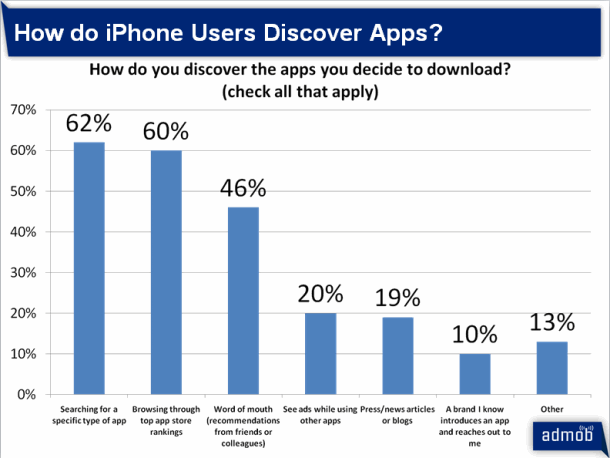
An AdMob survey looked at how consumers find the mobile apps they download. Check out the top 3 below:

Users find apps by search, rankings and word-of-mouth. Great! As it should be. Definitely describes how I’ve found apps to download.

Irrelevant, however,  for enterprise software. Distribution and usage of enterprise software is not an app store process. Employees will use the software because:

  • It’s the corporate standard
  • They’re already using it
  • They need to use it
  • It’s already achieved network effects internally, it’s the “go to” place

Adoption via the app store is not needed. The employee will already have a URL for accessing the app. For example, I use gmail for both my personal and work emails. For whatever reason, the second work gmail will not “take” on the native email function of my iPhone. So I’ve been using the web version of gmail the last several months. It’s been easy, and I didn’t need to download any app. I knew where to access the site.

3. Mobile HTML looks damn good

Visually, native apps can look stunning. They are beautiful, and functional. No limitations of web constructs means freedom to create incredible user experiences.

But you know what? You can do a lot with HTML5. Taking a mobile web approach to styling the page and optimizing the user experience, one can create an experience to rival that of native apps.

As you can see on the right, an enterprise software page presented in a mobile browser need not be a sanitized list of things. It can pop, provide vibrant colors, present a form factor for accessing with the fattest fingers and be indistinguishable from a native app.

Indeed, designing for a mobile experience is actually a great exercise for enterprise software vendors. It puts the focus on simplicity and the most commonly used functions. It’s a slo a chance to re-imagine the UX of the software. It wouldn’t surprise me if elements the mobile optimized HTML find their way back to the main web experience.

4. Too many mobile OS’s to account for

We all know that Apple’s iOS has pushed smart phone usage dramatically. And corporations are looking at iOS for both iPhone and iPads. Meanwhile, Android has made a strong run and is the leading mobile OS now. However, in corporates, RIM’s various Blackberry flavors continue to have a strong installed base. On Microsoft’s Phone 7 OS, “developer momentum on Windows Phone 7 is already incredibly strong.” (ArsTechnica).

Four distinct OS’s, each with their own versions. Now, enterprise software vendors, you ready to staff up to maintain your version of native apps for each?

37signals recently announced it was dropping native apps for mobile. Instead, they’re focusing on mobile web versions of their software. In that announcement, they noted the challenge of having to specialize for both iOS and Android.

Meanwhile, Trulia CEO noted the burden of maintaining multiple native apps for mobile:

“As a brand publisher, I’m loathe to create native apps,” he told me, “it just adds massive overhead.” Indeed, those developers need to learn specific skills to building native mobile apps, arguably having nothing to do with his core business. They have to learn the different programming code, simulators and tech capabilities of each platform, and of each version of the platform. By diverting so much money into this, he’s having to forgo investment in other core innovation.

A balkanized world of OS variants creates administrative, operational support and development costs. Not good for anybody.

While I’m sure there are enterprise software apps that can benefit from the native OS capabilities, such as integrated photos, for most enterprise software, mobile should be an HTML5 game.

I’m @bhc3 on Twitter.

Will Quorans Develop Enough Spine to Ensure Quality?

On Quora, this question was recently asked:

Is the upvote bias towards more popular answerers a threat to quality on Quora?

One answer caught my attention, and it’s one with which I wholeheartedly agree:

I would say it’s very important for Quora users to use those voting powers to downvote answers by A-listers that are just not good enough. There is a LOT of expertise by practitioners now, it’s up to us to upvote knowledgeable answers and downvote answers without substance when they occur, regardless of how popular the responder might be.

This is a critical cultural element that must take hold in Quora for it to thrive. If it becomes an A-Lister’s club where everything they say is gold, well, the site will slowly die.

[tweetmeme source = “bhc3”]

I’m going to give two examples where A-Listers gave irrelevant, humorous answers to a discussion. In one case, it was on Quora. In the other, it was Hacker News. The outcomes are instructive.

Dave McClure on Quora

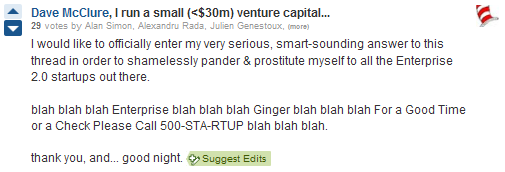
First, on Quora. There’s a question that asks, Which VCs and angels are investing in early stage, enterprise 2.0 companies? A number of VCs weigh in there. After a while, well-known angle investor Dave McClure added his own answer, a faux pandering to Enterprise 2.0 start-ups, which came across as mocking some of the other VCs’ answers. Funny? Sure. Meta commentary on the other answerers? Yup. Relevant to the original question? Not at all.

Yet check out the number of up votes it’s gotten:

Fortunately, the answer has been down-voted enough to fall from its #1 position. But it’s still the #4 answer of 17 provided. What’s with the 29 up-votes there?As a point of reference, imagine if you had written a similar answer. It would have been quickly buried at the bottom of the question with multiple ‘Not Helpfuls’.

This is not about Dave McClure, whose answer is very consistent with his personality. He’s a funny, smart guy. You’re always going to have some answers that aren’t helpful, it’s a fact of online life. But it is about the culture of the Quora community and the disconnect between the site’s objectives and the community’s actions.

Joshua Schachter on Hacker News

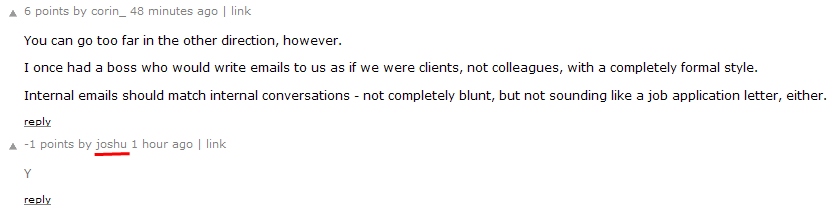
Let’s look at the case of the second A-Lister. On Hacker News, someone posted a story in the Wall Street Journal, Five Signs You’re a Bad Boss. First sign? “Most of your emails are one-word long.” That one includes an anecdote about a boss who was even worse – he wrote in single characters. Y for yes, N for no.

It hit the front page, and got a number of comments. Including one from Delicious founder Joshua Schachter (“joshu”) that was a humorous homage to that bad boss:

But check that out. Joshua was voted down by some power user on Hacker News. He actually has -1 points there. No immediate fawning, no appreciation for the humor of the A-Lister. Now in checking the answer several hours later, it has 3 points. So even Hacker News has some of that “A-Lister gets the benefit” element.

Overall, these two examples offer a clear distinction in culture between Quora and Hacker News. Hacker News continues to grow, and includes Fred Wilson as a fan:

I use techmeme, hacker news, tim o’reilly’s twitter links, dave winer’s 40 most recently links for tech news

Developing the culture that will mercilessly ding a poor or irrelevant answer regardless of source is critical to Quora. Learn to love the downvote, otherwise Quora becomes a graveyard of dead questions.

[tweetmeme source = “bhc3”]

Three Pluses, Three Minuses of Quora as a KM System

This question was posted on Quora, “In 10 words or less, what is Quora?” My answer:

Powerful application of crowdsourcing and social networking to knowledge management

[tweetmeme source=”bhc3″]

Knowledge Management (aka “KM”) is a field that I don’t have personal experience in. It’s supposed to be practices, processes and systems where valuable knowledge of workers is collected and made available for others. KM continues to be an important topic for enterprises these days, but it also freighted with many failures and disappointments.

Without the benefit of a KM history, I wanted to look at Quora in the context of someone with an objective today: how do I make it easier for employees to find and share their knowledge?

In that cntext, I see three really good things about Quora, and three things that distort its value.

The Pluses

Purpose-Built: A premise of Enterprise 2.0 is that tools need to be lightweight and flexible for multiple purposes. That’s what you get with microblogging, wikis, blogs, forums. The problem there is that the flexibility undermines their value for delivering on specific needs. One must wade through a lot of other stuff to get to what you want.

Quora is purpose-built. It’s not a place for sharing links you find interesting or talking about the American Idol selection process. It’s a place where you know there will be relevant questions, and often good answers. Which means they can focus on delivering to the purpose, not try to be all-things to all people. Important for KM.

Crowdsourcing: Very, very important. Quora leverages the the principles of crowdsourcing to elicit knowledge. It’s not just a system for experts. Too often the focus of people is to get “the experts” on the record, assuming most others have little to add. That is a shame.

The ability to follow topics allows people to track areas of either interest (to find answers) or expertise (to provide answers). As Professor Scott Page notes in his book, The Difference, everyone has a unique set of cognitive skills. To assume there are the “masters” and then there’s the “riff raff” is to lose a significant percentage of knowledge. Crowdsourcing ensure broader opportunity to get at all relevant knowledge.

Social networking: We have people we like to follow. They may be friends, and we enjoy their takes on things. Or they may be people we admire, and who have demonstrated a capacity to provide valuable answers. The personal connection here, that we have an interest in a person as opposed to a topic is valuable.

By letting me follow people, I am exposed to things that have a higher likelihood of interest to me. We can’t all be on Quora, or a KM site. But some portion of our networks will be, and seeing what they’ve been up to keeps me interested and contributes to a serendipity in acquiring knowledge.

It’s also encouraging to know I have a set of people who are receptive to me questions and my answers. Much better than a cold system of questions and answers only.

The Minuses

Discerning the wheat from the chaff: Quora gets noisy. For some, too noisy. That happens in an open platform. There will be some great answers to questions, but some pretty bad ones too.  In terms of KM, some argue for restricting participation to only the known experts:

Few are blessed with serious, specifically relevant knowledge or know-how. Any system which facilitates overly broad participation will inextricably bury any expert knowledge under a pile of low value chatter. I am persuaded that for valuable ideas & thoughts to produce innovation there need to be a highly afferent and efferent system capable of synthesizing powerful multidimensional analytical databases with the know-how of subject matter experts, the imagination of visionaries and the creative mind of innovators who do not fret from the challenge of thinking.

The community culture needs to have a strict sense of what’s valuable, what’s not. And up-vote and down-vote accordingly.

Lots of followers means lots of up-votes: This is the downside of social networking. Some people have HUGE numbers of connections. Which means they have a built-in audience for their answers above and beyond the topic followers. An army of followers can come in and cause an answer to move to first position based on that alone, regardless of answer quality.

A good solution here is to employ a form of reputation to weight those votes. Don’t let just the volume of votes determine the top answer, look at the reputation of those who are voting.

You could also weight the answers themselves according to reputation, although I’m a little wary of that. Makes it harder for new voices with quality contributions to get traction.

Incentives to participate: I’m busy. You’re busy. We’re all busy. Who has time to participate? This will always be an issue. With things like microblogging, there’s a core communication need they satisfy. So that more closely aligns with my day-in-, day-out work. But answering some distant colleague’s question?

There are a lot of ways to address this. Getting participation early on from enthusiasts goes a long way in terms of demonstrating value (something Quora has done). Getting kudos for good answers is a huge motivator. Obviously, getting a good answer just once is critical to seeing the value. And Q&A seems like a perfect activity for applying game mechanics.

All in all, I really like the KM potential for Quora. It doesn’t need to be as heavily active as Twitter, but benefits from a broader participation than what is seen in Wikipedia. The minuses are challenges to overcome, but they are not insurmountable.

[tweetmeme source=”bhc3″]

Three Reasons Google Should Acquire Delicious from Yahoo

[tweetmeme source=”bhc3″]

So the news is out. Yahoo plans to shutter Delicious, the largest social bookmarking site. Which is shocking, particularly among the tech savvy and socially oriented. Delicious is iconic for its application of social sharing and collective intelligence. Hard to believe Yahoo wants to shut it down.

But wait…this doesn’t have to be the end. Why not seek alternatives to shutting down the service? Might there be a logical company to take on Delicious, and all the value it holds? Why yes, one company comes to mind.

Google.

Delicious fits Google’s mission

Hmmm…what is it Google wants to do? What defines their corporate philosophy? Ah yes, here’s Google’s mission:


“Organize the world’s information.” Now, doesn’t that sound like the kind of thing that applies to Delicious? Millions of people organizing the world’s information, according to their own tags. Which makes it easier to find for others. Crowdsourced curation.

For that reason alone, Google would be wise to take on Delicious.

Glean new insights about what people value

Google’s pagerank is amazing. It’s incredibly good at finding nuggets. But it’s not perfect, as anyone who regularly use it knows. The use of links is powerful, but is a limited basis for identifying valuable web pages.

What people elect to bookmark is a different sort of valuation. Which is important, because not everyone blogs, or creates web pages with links to their favorite sites. But there is a distributed effort of indicating value via bookmarking.

This activity would be a valuable addition to Google’s search results. Take a look at this thread on Hacker News (a bunch of tech savvy types) about Delicious:

I added that highlighting. And here’s what Michael Arrington said when Yahoo experimented with adding Delicious bookmarks to its search results:

I have previously written that Delicious search is one of the best ways of searching for things when a standard search doesn’t pull up what you are looking for. After Google, it is my favorite “search engine.” Adding this information into Yahoo search is a great idea.

Google could leverage the activity of Delicious users to improve its search results, or at least give users an additional place to find content. Mine the tags to provide more context and connections among pages.

Note that Google, and Bing, are exploring different ways to apply social signals from Twitter and Facebook. Inclusion of Delicious in the search process would be consistent with that.

And Google would still benefit from its Adwords program here. Which would be a monetization strategy for Delicious, which has no ads.

Great PR move with the tech community

Google finds itself in a fight with Facebook for employees. Google is public, Facebook is pre-IPO. Social is hot, and Facebook is dominant in that. Google isn’t.

But as Allen Stern notes, Google does have a special appeal to the tech crowd for its developer-friendly moves. Stepping in and taking over a legendary Web 2.0 site like Delicious would be a good fit with that reputation. Enhance the usage of the data and make it easy for developers to access.

More importantly, Delicious holds a special appeal among the geekier set. Many of us are still active bookmarkers, and use the service. Google is known for being a geek-centric paradise, with a bunch of high-GPA, advanced degree types on its campuses.

What do you think it costs to run Delicious “as is”? I’d hazard a guess that it’s not too much. And Google is throwing off some serious cash ($10 billion in last 12 months):

So they do have some capacity, but obviously need to invest it wisely.

For a relatively low cost, they gain a treasure trove of data on relevance and value, and a solid boost to their PR. Seems like a big win to me. How about it Google? Why not step in and take over Delicious?

[tweetmeme source=”bhc3″]

Using Open Innovation to Be Competitively Unpredictable

During a Twitter Q&A organized by open innovation thought leader Stefan Lindegaard, Psion Teklogix CEO John Conoley posted this:

http://twitter.com/#!/johnCEOatPsion/status/22796327966

How interesting is that? Using open innovation to be “competitively unpredictable”. I love that concept. Let’s understand where John is coming from.

[tweetmeme source=”bhc3″]

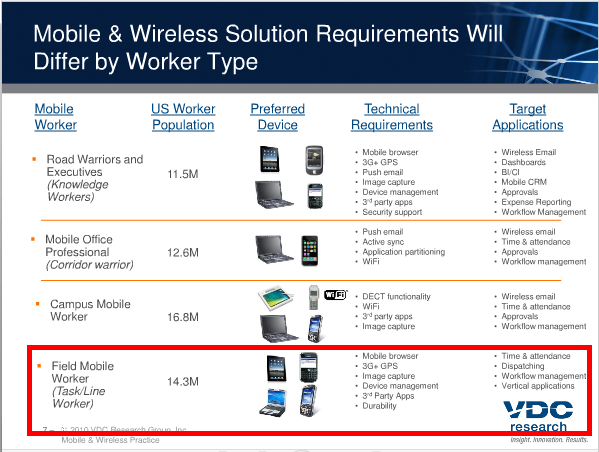
First, have you heard of Psion Teklogix? They make “rugged mobile computers”. Think Blackberry or iPhone, but industrial strength with specialized purposes, hardware, and made to withstand punishment. From an enterprise perspective, the chart below by VDC Research provides some perspective on mobile computing for work. I’ve outlined in red the section where Psion operates:

Psion’s computers are used in a variety of industries for inventory tracking, couriers, field service and other demanding jobs. The company is #3 in its industry (Motorola occupies the top spot). A key part of Psion’s strategy is to make its rugged mobile computers modular and customizable. This customization allows them to be adapted to different uses. Building on this modular and customization philosophy, the company has developed an ecosystem of third party vendors who make components that plug in with Psion’s products.

I had a chance to talk with Todd Boone, Director of Market Development for Psion. He described the company’s open innovation efforts.

Pace of Change in Mobile Has Accelerated

Before talking about open innovation, first understand this. Todd Boone noted that the pace of change of mobile computing has accelerated in the past several years. Anyone tracking the space probably gets that intuitively. This means is that the uses of mobile, the emergence of new competitors and the changes in technology change more frequently. As an example, on the consumer side, how long have Apple and Android been so influential in the mobile sector?

Indeed, VDC Research noted the changing dynamics of the rugged mobile computing market in a recent article:

Another critical challenge facing rugged handheld vendors is the increasing level of competition from smartphones and other emerging devices – especially for field mobility applications. While smartphones do not have the same level of integrated I/O capabilities nor the level of ruggedness offered by rugged handheld devices, their proliferation in the enterprise (and lower adoption cost) are making them target devices to support more sophisticated enterprise applications. Plus, in the field mobility market the rugged handheld community is most challenged from an OS perspective. Although there is a strong application and developer community supporting field mobility applications on Windows Mobile devices, customer expectations in terms of user interface and experience – especially for field mobility applications – is increasingly influenced by consumer oriented smartphones.

For companies operating in the mobile space, such dynamics make it harder to “know” everything, and to have the resources to respond accordingly. Nimbleness and flexibility are needed to address the unpredictable course the mobile sector takes.

As Todd Boone explained to me, Psion needed a strategy that leveraged their modular platform strategy while recognizing they can’t realistically know all the emerging use cases and technologies out there.

Answer? Open innovation.

Ingenuity Working

On March 4, 2010, Psion launched Ingenuity Working (IW), a site built to expand its open innovation activities. Psion CEO John Conoley described its mission this way:

The open, online community in Ingenuity Working brings us closer to our customers and their thoughts and will allow us to socialise and commercialise innovation. We are using social media to bring our developers and resellers together with our customers, all over the world. Essentially, everyone will be putting their heads together to help create technology that best fits a company’s individual requirements – that has to be a good thing.

In talking with Todd, I learned that the initial thrust of the IW community is focused on partner vendors, rather than direct feedback from end-user customers. In some ways, this is similar to P&G’s open innovation approach.

Engagement with external parties occurs via discussion forums, blogs and a “secure zone” for each partner. In these arenas, there is a two-way exchange of product ideas and use cases. An example can be seen in the section of IW devoted to discussions for developers of Windows/CE/WM/Embedded.

Now that’s some esoteric stuff there. But here’s the thing. It’s groundbreaking in the rugged mobile computing industry to have this all ‘hanging out there’. It becomes free research for competitors too, in a way. Which one may view as a risk of this whole endeavor,

Here’s how Todd describes the Psion open innovation vision:

Rather, we think it’s the opportunity to drive the market to a new reality. A market that drives itself in a way that is inherently beneficial to customers and partners alike based on the real-time, open dialogue that starts prior to any development activities taking place and continues through to product maturity. Real success will come, I think, when marketing and engineering no longer make product decisions but rather our community of customers, partners and developers does.

Psion is early in its open innovation initiative, and plans to improve and evolve its program. The company is engaging partners on hardware, software, standards and a wide variety of use cases. These efforts complement its existing offline channels and research.

Becoming Competitively Unpredictable

Finally, that great quote from Psion’s CEO about embracing open innovation to be competitively unpredictable. I asked Todd for a bit more context. What exactly does that mean?

He noted that typically, large companies describe their roadmap for the next several quarters or years in terms of product development. The challenge with that approach is that it’s company-centric, and its effectiveness is limited by the increasing rate of change in the industry.

The other dynamic is Psion’s orientation toward creating an open platform that can be configured for different uses. This platform philosophy is a core strategy.

So by engaging with external parties, Psion is looking to (i) stay on top of emerging market changes; and (ii) leverage this large collective intelligence to develop applications and hardware for its configurable platform.

Ideas which would be hard to forecast out over the next 6, 12 or 24 months. If you’re a competitor, this makes it harder to know what Psion will do.

In other words, they become competitively unpredictable.

[tweetmeme source=”bhc3″]

Phone Cameras + Social Are Expanding the Historical Record

"There's a plane in the Hudson. I'm on the ferry going to pick up the people. Crazy."

In a critique of the rise of Instagram (current photo sharing app du jour), Laurie Voss argues that the rise of cheap, low fidelity cameras on phones is undermining the data contained in them. And it’s not just that these pictures are lower quality now, it’s affecting their value for future generations:

With these rubbish phone cameras we take terrible photos of some of our most important moments and cherished memories. I am not complaining about composition and lighting here; I’m not a photographer. I am talking about the quantity of meaningful visual data contained in these files. Future historians will decry forever the appalling lack of visual fidelity in the historical record of the last decade.

I read that, and at first though, “Yeah, that could be an issue.” But then I realized that, well no, it’s actually the opposite. The rise of cheap phone cameras is actually increasing the historical record. This even has disruptive innovation undertones to it.

Why?

Picture = Moment + Equipment

[tweetmeme source=”bhc3″]

When thinking about recording data for history pictorially, I consider two elements:

  • Moment
  • Equipment

"The line at 9 am at the Pleasanton @sfbart stretches for blocks. Huge crowd downtown today for #sfgiants parade."

Now moments are always going to arise. They may be significant moments, such as Janis Krums’ iconic picture above after a US Airways plan crash landed on the Hudson. Recently, the San Francisco Giants were celebrated for their 2010 World Series title with a ticker tape parade in downtown San Francisco. When I arrived at the Dublin/Pleasanton BART the morning of the victory parade, I was shocked by the number of people waiting in line for get to SF.

Just as important as the moment is the equipment. I’m not talking about the quality of the photographic equipment. I’m saying, “do you have something to take the picture?”

Before I got a phone with a camera on it, I had no way of photographing any moments. I could tweet about them, email a description of them and tell people about them. But there was no visual record at all.

I wasn’t carrying a camera around with me. Just not something I wanted to deal with as I also carried my ‘dumb’ phone.  And wallet. And keys. Just too much to deal with.

But a camera included with my mobile phone? Oh yeah, that works. I’ll have that with me at all times.

Which is a much better fit with the notion of capturing moments. They are unpredictable, and do not schedule themselves to when you’re carrying a separate camera.

As for the “quantity of meaningful visual data” being reduced, I think of it mathematically:

The X/Y variable represents the decrease in data per picture. If Y is the “full” data from a high resolution photo, then X is the reduced data set. The loss of scene details, the inability to discern people’s expressions, etc. Yeah, that is a loss due to low quality cameras.

The B/A variable represents the increased number of pictures enabled by the proliferation of convenient low quality cameras. If A is the quantity of photos with high resolution cameras, B is the overall number of photos inclusive of the low quality cameras.

Multiply the ratios, and I believe the overall historical record has been improved by the advent of phone cameras. In other words, “> 1”.

Sharing Is Caring

Something the higher quality, standalone cameras have lacked is connectivity. They miss that aspect we have to share something in the moment. The fact that I can share a picture just as soon as a I take it is extra incentive to take the picture in the first place.

I share my kids’ pics with family via email, and other pics end up in my Twitter and Facebook streams. You know how painful it is to upload photos from the camera and share them? Very.

Standalone cameras are like computer hard drives, locking data off in some siloed storage device somewhere. Good luck to historians in extracting that photographic data.

Convenience Wins Out

This is the disruptive innovation of convenience. People are swapping the separate cameras for the all-in-one mobile devices. And like any good low-end innovation, the quality will increase. Meaning more pictures with better detail and fidelity.

I mean, imagine if there were a bunch of phone cameras at Gettysburg?

Only known photo of Abraham Lincoln (center, without hat) at Gettysburg

We’d have thousands of pics, and it’d be a Twitter Trending Topic. As for the lower data per picture, damn the torpedoes, full steam ahead. Phone cameras will enrich the historical record for future generations.

[tweetmeme source =”bhc3″]

iPad’s Climb Up the Disruptive Innovation Cycle

Blockbuster’s recent bankruptcy filing was yet another chapter in the Clayton Christensen annals of disruptive innovation. A major brand with convenient locations that got disrupted by a website and the U.S. Mail. Note that we’re seeing the backend of the disruption, when it all seems so clear.

[tweetmeme source=”bhc3″]

How easy is it to see such a disruption beforehand? “Not very” would be the honest answer. What distinguishes a truly disruptive technology or business model from a flash-in-the-pan idea? Keep in mind the basis of a disruptive innovation:

A technology initially addressing low-end market needs that slowly moves upstream as its capabilities evolve.

From that perspective, think of all the things out there that have stayed low level and did not disrupt industries. Disruptive innovation is like a Category 5 hurricane: powerful, slow-moving and rare.

Which brings me to the Apple iPad. Are we witnessing a disruptive tropical depression?

DISRUPTIVE INNOVATION LADDER

The graphic below (via wikipedia reproduced on the TouchDraw iPad app) describes the levels of usage for disruptive technologies.

Disruptive Innovation Cycle

The target of the iPad here is the global laptop market. In that context, the beautiful, sublime, innovative iPad is solidly…in the low quality usage band of the chart above.

What represents the iPad’s “low quality use”?

  • Email
  • Surfing the web
  • Facebooking
  • Tweeting
  • Playing music

“Low quality” is not a pejorative term here. It’s a reflection of the computing power needed for the listed activities. This is the iPad’s entre into the laptop market. Consider how much of your own digital activity is covered by those items listed above. IPad already offers a great experience here.

Indeed, the Best Buy CMO recently confirmed the iPad’s move into this end of the market.

MEDIUM QUALITY USE

When you see those low quality uses, they’re primarily consumption oriented. If they are production oriented, they’re pretty basic. But there are things that can be done at the next level, medium quality use.

Games are well done on the iPad. They take advantage of the touch aspect of the device. In my opinion, games on the iPad are quickly moving up the quality ladder.

For the office, there are Apple’s apps. The Pages word processing app looks like a winner. For document production, Pages appears to fill the bill. Especially without a Microsoft Word app on the iPad. The other major office apps – spreadsheets and presentations – are available as well.

I really like the graphics program TouchDraw on the iPad. You can create very nice graphics, for business use, with just your finger. The simple graphic above was done with TouchDraw.

While I couldn’t possibly survey all apps that address different activities, I get the sense that a number of them qualify for medium or high quality uses. The question is the breadth of apps addressing the “power use cases” of laptop owners.

Finally, a word about the keyboard. I love it. I find it very easy to type out this post. It’s not without its imperfections, but generally I’m flying around it as I type. One disclaimer: I hunt-n-peck to type. I’ve never learned real typing.

GAPS THAT NEED TO BE CLOSED

In my experimenting to see how much I could do with an iPad instead of a laptop, I’ve found several areas that need to be shored up to move the overall experience to the medium quality use level.

Safari usage: Safari is the browser used for the web on the iPad. It is surprising how many sites aren’t built for usage via Safari. For example, wordpress.com, surprisingly in my view, doesn’t work well with Safari. Google Docs? Similar issue. Doesn’t work well, or at all, with Safari. I’m embedding HTML tags in this post-by-email blog post.

I cannot accept an event into my Google Calendar via Safari. I cannot create a WebEx meeting from Safari, and the WebEx iPad app doesn’t allow you to create an event. In short, doing business via iPad is tough.

As the iPad continues to gain market share, expect better support by websites for Safari. Which will dramatically improve the end user experience with the iPad.

Graphics uploads: Want to add a graphic to a document, presentation, wiki, blog or email? Hard to do. We’re used to having graphics on our local drive, and a simple button to upload/embed that graphic.

Where’s my master upload button on the iPad?!!

Answer: there isn’t one. The graphic above is one that I emailed to Flickr, grabbed the embed code and pasted it into this post. Which works fine for publicly accessible graphics. But not so much in the work context.

I’d like to see the native Photos app become a universal location for accessing graphics in any app.

Stuff at my fingertips: The ability to easily click around different apps on the PC tray at the bottom of my screen, and to click quickly among different websites via tabs, is a great productivity benefit. If you’re like me, you’re zipping around easily.

With iPad, it’s slower going back-n-forth. A lot of clicking the home button to get to other apps, or clicking the button on Safari to view other sites. Which is a pain, reducing the pace of work.

iPAD’S INEVITABLE CLIMB UP THE DISRUPTION CYCLE

So the iPad is still fundamentally in the low quality usage band, but with some clear indications of moving up. I’ve taken to using my iPad for my non-work hours computing needs.

My full expectation is that slowly, but surely, Apple and the third party app developers will improve the utility of the iPad experience. It will take some time.

But the key observation is this: Apple has the time to enhance the iPad. Two points:

That’s why I expect iPad to get better over time: market momentum. How about you? Are you thinking the iPad, and even the new crop of competitor tablets, will disrupt the laptop industry?

[tweetmeme source=”bhc3″]

Sent from my iPad