Would You Apply a ‘Dislike’ to Your Co-Workers’ Content?

On Digg, you can apply the “bury” rating to stories. On Amazon.com, you can apply a single star to rate something negatively.

Would you ever do that to the work of your colleagues?

I’m not talking the annual HR exercise of 360 reviews. I’m talking Enterprise 2.0 apps, which incorporate the features we see out in Web 2.0. The ability of people to rate the content they see.

A few social media sites have taken a binary approach to ratings: (1) positive rating, or (2) abstain:

While some others are incorporating the notion of negative ratings:

Out on the Web, where you’re interacting on platforms with thousands of anonymous or unknown people, negative ratings make sense and help bring some order to the scrum of content and products.

See Louis Gray’s post for a good perspective on this whole rating thing in social media.

Inside companies, things are a little different. There’s a vetting of other Enterprise 2.0 users, in the form of the hiring and annual review process. This automatically raises the average quality of contributions.

And there’s this….Enterprise 2.0 apps are used by people you know and work with. People you’re going to see in meetings, on projects and who have common connections. A negative rating to someone’s Yammer or wiki entry or social bookmark is a big deal. You’re essentially saying:

“Dude, this is bad. I mean really bad. So bad that I had to ‘dis you and let the rest of the organization know how bad it is.”

Personally, I’d have a hard time with this. In the most egregious cases, I’d apply the negative rating. But I’d strongly prefer to “work it out” in the comments to the original content.

My concern is that a negative rating turns into a basis for internal feuding and chills open discussion about ideas, information and observations. But in a large organization with a heavy flow of content, maybe the negative rating is the most efficient way to handle the value if information.

Perhaps I’m in the minority here. How about you? Would you give a thumbs down to your co-workers’ content via Enterprise 2.0 apps?

*****

See this post on DFriendFeed: http://friendfeed.com/search?q=%22Would+You+Apply+a+%E2%80%98Dislike%E2%80%99+to+Your+Co-Workers%E2%80%99+Content%3F%22&who=everyone

Entrepreneurship as Signal: Quitting Facebook to Tackle Enterprise 2.0

In a recent post, Fred Wilson had this to say about Enterprise 2.0:

This is one of the reasons we’ve struggled so hard to invest in “enterprise 2.0” at Union Square Ventures. We have tried pretty hard to find companies that we can invest in that bring the new web technologies to the enterprise, but often we’ve found what happens is that consumers (ie employees) bring the web technologies they use every day to work and they prefer that.

I understand the sentiment, but I’m not really agreeing with Fred on this one. Corporate employees don’t use their Gmail and Yahoo Mail in lieu of their company’s Microsoft Outlook application. It’s really a matter of making an application that solves some key issues and has an appropriate experience for what it needs to accomplish.

But Fred’s opinion is interesting in the context of Friday’s news that two key Facebook executives are leaving the company “to build an extensible enterprise productivity suite”. They plan to leverage many of the conventions of Facebook for this new company.

Enterprise 2.0? Are they crazy?

Enterprise Software Is So Boring

Robert Scoble set off a firestorm last December when he wrote Why enterprise software isn’t sexy. In that post, he observed a couple things:

  1. “Business software like that from Oracle, SAP, Microsoft etc makes a TON of money.”
  2. “I know that when I talk about enterprise software the numbers of viewers just don’t show up. So, tech bloggers quickly learn that if they talk about enterprise software they aren’t going to get many advertising impressions.”

Michael Arrington of Techcrunch said the same thing in this tweet in April:

“@dahowlett enterprise is boring. no way around it. people just don’t care.”

Nick O’Neill wrote this about the Facebook execs’ departure:

“Apparently Rosenstein and Moskovitz are leaving to create an enterprise level productivity software package. Sounds thrilling doesn’t it?”

Rosenstein and Moskovitz are deeply ingrained at Facebook. They’ve been there for a while, and have seen it blossom as the go-to social network. They’ve were there for the heady valuation of $15 billion. The pre-IPO company still has work in front of it, but surely it’s pretty interesting.

So what do they do? They quit to go start a BORING enterprise software company.

What could this possibly tell us?

Entrepreneurship As Signal

Here’s one clue for why the Facebook guys would quit to start their own Enterprise 2.0 company:

Via ReadWriteWeb

Via ReadWriteWeb

Social networking inside the enterprise is expected to dominate spending in the category. And what is Facebook? The most successful consumer social network.

The Enterprise 2.0 market is still quite nascent and fragmented. Combine that industry profile with projected spending in the category, and suddenly you understand why these guys are striking out on their own.

It’s not an easy market to crack, and working inside the enterprise is much different from working out on the Web. Looking forward to watching their progress.

*****

See this post on FriendFeed: http://friendfeed.com/search?q=%22Entrepreneurship+as+Signal%3A+Quitting+Facebook+to+Tackle+Enterprise+2.0%22&who=everyone

Facebook Is Starting to Get My Attention Again

Facebook recently made its new design permanent, despite the protests of many vocal users. Where the old focus was on a slow newsfeed, ornamenting your profile and interacting through thrird party apps, the new design puts content and conversations at the center of the user experience.

I think Michael Arrington still has one of the best perspectives on it when he wrote The Friendfeedization Of Facebook back in July.  As he said there:

But it’s also clear that they like what they see at Friendfeed, which expertly combined the idea of an activity stream that was first popularized by Facebook with the microblogging trend introduced by Twitter. Users constantly add content that their friends read and comment on, which creates yet new content. The virtuous page-view creating cycle continues.

The attraction of FriendFeed for me is the ability to discover new things via the variety of feeds, and to engage others in conversations about a wide range of topics. I had stopped using Facebook because of the inane apps and the funky secret algorithm that controlled what went into the news feed. Movie trivia games and sheep throwing with old school friends just wasn’t that fulfilling.

Interactions from My Facebook Network Are Increasing

But recently, I’ve noticed activity in my Facebook network picking up. I generally don’t post anything in Facebook – tweets are my status updates, FriendFeed is my activity stream. In the past few days, I’ve had more interactions via those tweets than I’ve had in a while. Here’s an example.

Tweet: “Alternative theory…Palin’s interview with Couric was just to set the bar incredibly low for her upcoming debate with Biden.”

Responses from my network…

High school friend: “If so, she’s a genius.”

College friend: “Brilliant tactic IMO.”

Cousin: “I can hardly wait. It will be so cringe-worthy!”

Former co-worker: “hmmm, I have my fingers crossed. Sadly, Biden has the tendency to put his foot in his mouth too……”

As a point of comparison, here’s the response this tweet got on Twitter:

N/A: no one replied.

Now it’s not like I’m the most active Twitterer. But I’ve been more active there than on Facebook. Facebook had more interaction in this case.

And as one more point of comparison…here’s the response on FriendFeed:

5 Likes, no comments

Likes are great, they are the currency of FriendFeed. No conversations though in this case.

Facebook: The Value of Context and Better Interaction Hooks

Actively engaging in FriendFeed and (somewhat) Twitter, I’ve built up some context with my networks on those sites. And there are plenty of good conversations there. FriendFeed is still my favorite haunt.

What interests me with the Facebook experience is the variety of people from my life – classmates, family, colleagues – that commented on that tweet. I really haven’t maintained a strong interaction with those folks. But there’s an existing reserve of “context” from my past interactions that is the basis for interacting.

And Facebook really did take a page from FriendFeed, with commenting on various activities. I’ve been impressed with how non-FriendFeeding, non-Twittering people in my network have started using the new commenting functionality.

I don’t know if it will last, but early results are promising.

*****

See this post on FriendFeed: http://friendfeed.com/search?q=%22Facebook+Is+Starting+to+Get+My+Attention+Again%22&who=everyone

Tim O’Reilly Course Corrects the Definition of Web 2.0

eBay was Web 2.0 before Web 2.0 was cool.

Tim O’Reilly wrote a nice piece the other day Why Dell.com (was) More Enterprise 2.0 Than Dell IdeaStorm. In the post, he re-asserted the proper definition of Web 2.0. Here’s a quote:

I define Web 2.0 as the design of systems that harness network effects to get better the more people use them, or more colloquially, as “harnessing collective intelligence.” This includes explicit network-enabled collaboration, to be sure, but it should encompass every way that people connected to a network create synergistic effects.

The impetus for Tim’s post was that people leave Google and its search engine off the list of Web 2.0 companies. As Tim writes, seeing the power of what Google’s search engine did was part of the notion of Web 2.0.

Here’s a way to represent what Tim is talking about:

I like that Tim sent out this reminder about Web 2.0. Here’s how Web 2.0 has become defined over the years:

  • Social networking
  • Ad supported
  • Bootstrapped
  • Fun and games
  • Anything that’s a web service

This seems to have fundamentally altered Web 2.0. I’m reminded of a post that Allen Stern wrote back in July, CenterNetworks Asks: How Many Web 2.0 Services Have Gone Mainstream? In that post, he wondered how many Web 2.0 companies will really ever go maintream.

Check out the comments on Allen’s blog and on FriendFeed:

I would say MySpace but that really came before Web 2.0

mainstream – Facebook/hi5/bebo, Flickr, Youtube, Slide, Photobucket, Rockyou

Oh and you’ll have to add Gmail to the list as well.

I’ve yet to see one, really. 😉

Is eBay web 2.0-ish? [this was mine]

Agree with Facebook, MySpace, YouTube. I’d add Blogs as another 2.0 winner. I’d put eBay and Amazon as 1.0 success stories

A better way to ask this is “which web services since 2000 have gone mainstream?” Blogger. Flickr. Gmail. Facebook. MySpace. Digg. YouTube. WordPress. Live Spaces

Look at those responses! You can see a massive disconnect between Tim O’Reilly’s original formulation of Web 2.0 and where we are today.

One example I see in there: Gmail. Gmail is a hosted email application. Does Gmail get better the more people use it? No. There’s no internal Gmail application functionality that makes it better the more people use it. It’s just an email app the way Yahoo Mail is an email app. Being a web service and ad-supported isn’t, strictly speaking, a Web 2.0 company.

Terms do take on a life of their own, and if the societal consensus for a definition changes over time, then that’s the new definition. But the responses to Allen Stern’s post highlight two problems:

  • People discount or ignore key components of the Web 2.0 definition
  • Web 2.0 is slowly coming to mean everything. Which means nothing.

Finally, Tim’s post helps me differentiate the times I should use “social media” as opposed to “Web 2.0”.

What do you think? Should we go back to first principles in defining what really is “Web 2.0”?

*****

See this post on FriendFeed: http://friendfeed.com/search?q=%22Tim+O%E2%80%99Reilly+Course+Corrects+the+Definition+of+Web+2.0%22&who=everyone

Don’t Be Boring, Don’t Sweat Page Views: Ten Company Blogs Analyzed

Courtesy of user 'twob' on Flickr

Courtesy of user twob on Flickr

I read an amusing and insightful post by B.L. Ochman, 10 Reasons Your Company Shouldn’t Blog. Several reasons don’t argue against blogging (e.g. “A blog is not a quick fix”), but a few are worth considering. Here are a couple that I liked:

1. The blogs most companies want to create are guaranteed to join the 900,999 out of every million blogs with no readers. Why? They’re boring.

2. A blog has to have a personal voice. If you sound like a corporate drone, nobody will read your blog.

In a similar vein, Wall Street Journal blogger Ben Worthen reported on a  study by Forrester Research. Forrester reviewed 90 B2B blogs, and came away decidedly unimpressed: most corporate blogs are “dull, drab, and don’t stimulate discussion.”

I’ve just started to blog for my company Connectbeam. I’ve got a couple posts under my belt, and I’m curious as to what other companies are doing. I decided to take a look at 10 companies’ blogs. I looked at 10 posts each for the 10 companies, and scored each post on 10 content attributes. This “10 cubed” analysis is presented below.

Ten Companies’ Blogs Compared

The table below shows counts for each company on the different content attributes.

Links to the ten companies’ blogs: Adaptive Path, Amazon Web Services, Boeing, Emerson Process, LinkedIn, Marriott, Pitney Bowes, Petro-Canada, Southwest Airlines, Starbucks. Hat tip to SocialText for maintaining a list of corporate blogs.

The table is sorted by the number of instances for the different types of content. And the content types? Made ’em up myself. They are the kinds of things I’m thinking about with regard to Connectbeam’s blog.

What About Those Different Types of Content

Explain Company’s Actions. The idea here is that the blog enables more freedom to give details behind the things a company does. I imagine for public companies, there are limits on how open they can be. But certainly there is opportunity for more than the canned quotes we often see in press releases.

Petro-Canada is currently very big in this category. I don’t know the company, but from reading its blog, it appears they’re having trouble getting gas to western Canada stations. One of their refineries is down. So they’re using their blog to keep people updated on progress.

This is a good use of a company blog.

Warmed Over Press Releases. That sounds harsh, doesn’t it? And it can be if that’s all a blog is. But there is a role for the press release type of information on blogs. After all, a press release tells a company’s latest activity, which fits a blog’s purpose. Another aspect is that a lot of blog entries are essentially mini-press releases. They have the quality and informational value of press release, but for a minor event that wouldn’t normally warrant a full press release.

Amazon Web Services leads this category. But that makes a lot of sense to me. AWS is hot. They’re getting traction in the cloud computing arena. Right now, they probably are best served dishing out updates to current and prospective customers. They are in a good position to lead industry thinking around cloud computing.

Company Events. Companies are having, and participating in, events all the time. They are good opportunities for blog write-ups, usually because of interesting things learned when people come together. Events may also relate to things outside the companies control, but which affect them nonetheless.

Boeing blogged about events related to the strike against it by the IAM union. Marriott blogged about the bombings outside one of its hotels in Pakistan.

Wax philosophical. This is one of my favorites. Companies are deep into the machinations of an industry, and of their markets. They see a lot, and are working hard to understand customers’ pain points and the future of their industries. This gives them both information and motivation to put forth interesting thinking. Admittedly, the thinking will slant toward what benefits the company. But I like different points of view.

Starbucks does this a bit on its blog. One entry discusses efforts in Costa Rica to establish sustainable coffee farming. Adaptive Path is really good about this. This post describes the merits of simple presentation styles using hand-drawn graphics. Reminds me of Common Craft.

Link to another blog. Linking to another blog establishes a company blog as being part of a great conversation. It says that the company is following activity in its industry, and finds value in things outside what its own employees do. It also gives a sense for the areas that a company is looking at.

Adaptive Path does this a lot. Their blog includes a lot of linking to other blogs, which makes their posts an interesting place to find more information. LinkedIn also links to other blogs, generally those that include something related to LinkedIn.

Discuss industry issues. As participants in their industries, companies can illuminate issues that affect them. Customers and suppliers will have an interest in these type of blog posts, because they want to know what’s affecting the market. Companies can also apply some influence on industry standards, legislation and developments through their words and analysis.

Emerson Process covers issues that affect its industry. In The Value of Inherent Safety?, there’s a discussion about the need to incorporate incident avoidance into the financial analysis of projects. Seems like a smart idea.

Link to another company. Linking to another company is a Profile In Courage. OK, that’s overstating it, but linking to another company is probably a little worrisome. Will I lose my reader when they click a link? Am I confusing a reader by mentioning a different company? I like when companies do this, because it’s an acknowledgment that there are other entities in the universe.

LinkedIn does this fairly often. For them, the links are to companies that have had some success on the professional networking site. Adaptive Path links to fellow panelists from a conference it attended.

Unrelated to core operations. This is a funny content category. Blog posts about things that don’t relate to company operations or industry issues. I guess it’s a way to attract readers who usually don’t read the company’s blog.

The Pitney Bowes blog is an example of this. Or perhaps it’s better to describe it as Pitney Bowes CEO Mike Critelli’s blog. He doesn’t really cover his company. Rather, he takes aim at wasteful spending and regulaiton by the government.

Describe product use cases. Blogs are great homes for product use cases. There really isn’t a place for these in a press release. You can put some on the company website. But blogs are conversational and open to all types of content. And use cases help customers see the possibilities for a product.

LinkedIn goes after this type of content hard. Their posts name names, tell how the social networking site was used and quantify the outcomes. They’re well-done.

Silliness. A bit of  irreverence can lighten a company blog. Put some fun in reading it.

Southwest Airlines’ blog incorporates plenty of good wholesome silliness and fun. Not surprising, considering the company’s personality. I like this one about this summer’s earworm, Kid Rock’s All Summer Long song.

Special bonus points to the Emerson Process blog for including a link in one its posts to a FriendFeed discussion.

What conclusions to draw from the above table?

  1. Explaining corporate actions is a key use of company blogs
  2. I was pleased to see that “waxing philosophical” is a recurring theme for blogs – this gives context to companies’ actions and product releases
  3. Describing product use cases seems like a great idea, but perhaps is not the right approach for the companies whose blogs I analyzed

One last thought…

Companies Aren’t Blogging for Page Views

Implicit in the “boring” analysis of blogs is the idea that the poor companies are suffering anemic page views.  Of course, high page views are something everyone would love. Google’s blog is daily reading for a lot of people.

But many companies will get value from blogging to a smaller audience. I think this is particularly true for companies in the B2B space. It’s the old quality vs. quantity situation. Earning the attention of key people in your markets justifies the time investment in blogging.

*****

If you want an easy way to stay on top of Enterprise 2.0, I invite you to join the Enterprise 2.0 Room on FriendFeed. The room takes feeds for Enterprise 2.0-related items on Twitter, Del.icio.us and SlideShare. To see this room, click here: http://friendfeed.com/rooms/enterprise-2-0

*****

See this post on FriendFeed: http://friendfeed.com/search?q=%22Don%E2%80%99t+Be+Boring%2C+Don%E2%80%99t+Sweat+Page+Views%3A+Ten+Company+Blogs+Analyzed%22&who=everyone

Microsoft Is Getting Much More from Its Investment in Facebook

When Microsoft invested $240 million in Facebook at a $15 billion valuation, the general reaction was one of disbelief. The valuation is too high to justify. But some people at the time felt like the dollar amount was well within the comfort zone of a giant like Microsoft. Here’s how commenter Prashant put it on TechCrunch:

I don’t think that MSFT expects to make money on the $250MM at a $15B valuation. Internally for them it is a $250MM investment to get an exclusive advertisement deal over the next 4 years. The 2% stake is only icing on the cake. Had they announced that they have given $250MM to Facebook for a 4 year exclusive ad deal, no one would have flinched, this is cheaper than the Google/MySpace deal.

Over the past few days, I’ve read a couple other blog posts that make me think Microsoft may be getting much more from its investment. Here’s a quick list of what what Microsoft seems to be getting:

  1. Exclusivity on a huge number of page views, and experience with social context advertising
  2. Insight into an emerging competitor to its operating system and productivity apps hegemony
  3. Model for bringing social networking into the enterprise

Let’s look at #2 and #3.

Operating System and Productivity Apps

Dan Kimerling wrote a great piece on TechCrunch about how Generation Y looks to the new wave of social media apps for functionality previously provided by Microsoft’s desktop and web offerings. As Dan notes:

Facebook succeeds because it is the killer web application for communications and personal information management

These are in-the-flow tools. Facebook users don’t leave Facebook, open email and send a separate message. They do it all, right there. The level of functionality is just right for their usage.

The original Microsoft email and productivity apps were pretty simple, but they did just what people needed, and with skillful marketing tie-ups, Microsoft became the standard for millions of us. Over time, Microsoft has added new features to each release, because that’s how they grew their revenues. You had to get the latest. But what happened was we got to feature bloat.

Via Kathy Sierra, Creating Passionate Users Blog, 2005

Via Kathy Sierra, Creating Passionate Users Blog, 2005

I think Kathy Sierra’s graphic is spot-on for general mainstream users. Personally, I probably use only 5% of the functionality available with the applications.

I’ve talked previously about the Innovator’s Dilemma here. As market incumbents grow, they tend to move up-market in terms of functionality in their offerings. What this does is open the door for competitors with new functions that are simpler to use. These new competitors target a niche, and grow slowly upward from there.

Facebook’s niche is still heavily Gen Y. But they’re gaining a foothold. Microsoft’s investment gives them a ringside seat for what’s happening there.

Social Networking Inside the Enterprise

I was reading a blog post by Doug Cornelius where he reported out notes from a session at the Real World SharePoint Experiences conference. A Microsoft Solution Specialist was describing the roadmap for SharePoint. If you don’t know, SharePoint is Microsoft’s enterprise collaboration software, where teams can build out individual sites to shhare and work on documents and to communicate. Each employee has a MySite, which includes their corporate directory information as well as the the list of groups and documents that are theirs.

Here’s a quote from Doug’s post:

Social networking. Mysite will be the hub of the social network. There will likely be Knowledge Network integration. They are looking to take some lessons from their investment in Facebook.

The Enterprise 2.0 space is hot, and social networking is a big focus for companies and vendors. Through its investment in Facebook, Microsoft can learn a lot of what drives interactions, how people connect and watch the mistakes the young company makes. As Dave Ferguson put it:

Good judgment comes from experience. Experience comes from bad judgment. The corollary is that the bad judgment doesn’t have to be yours.

Microsoft continues to evolve its SharePoint offering, and I look forward to SuperPoking my colleagues one day.

Wrapping Up

At first, the only purpose for the Facebook investment appeared to be advertising related. I’m sure that’s still primary, because of the huge dollars involved.

But Microsoft is also gaining an information advantage for the new wave of social computing that is finding its way into both consumer and business experiences. Given the vast reach of the company’s product lines, that’s pretty valuable as well.

*****

See this post on FriendFeed: http://friendfeed.com/search?q=%22Microsoft+Is+Getting+Much+More+from+Its+Investment+in+Facebook%22&who=everyone

WordPress Acquires IntenseDebate. Disqus Just Got Big Competition.

VentureBeat reports that Automattic, provider of WordPress blogs, has acquired social commenting application Intense Debate. [Update – IntenseDebate has a post about this]. As a blogger on WordPress.com, I welcome this. I’ve seen the power of Disqus for other blogs, and I’ve wanted it here. But there wasn’t a way to add Disqus to WordPress.

In an earlier post, Could WordPress.com Create a Disqus Killer?, I wrote about what would happen if WordPress enabled a similar social commenting system. Here’s a quote from that post:

Imagine if a lot of those folks streamed their comments into FriendFeed. The viral nature of FriendFeed would be an accelerator on that volume. A WordPress.com commenting system would dwarf disqus.

WordPress.com has the built-in advantage of already hosting millions of blogs and comments. Disqus is still in its infancy in acquiring new blogs.

If Automattic is serious about this, they should enable a new commenting system to work on non WordPress.com blogs as well. As a blog reader, once you have a profile set up, you’d like to use it everywhere.

Interesting to see where this leads.

*****

See this post on FriendFeed: http://friendfeed.com/search?q=who%3Aeveryone+WordPress+Acquires+Just+Got+Big+Competition

“What’s the Difference Between IM and Yammer?”

It’s been a couple weeks since Yammer launched at TechCrunch50, and I assume Yammer is getting a road test out there in the workplace. One thing I saw after the launch was people wondering if Yammer was really just a copy of instant messaging. Here’s a representative tweet:

What’s cool about it? What’s the difference between IM and yammer?

Let’s hold off from noting the irony of posting that question on Twitter…

It is a fair question, because of their high similarity: short messages to a group of subscribers. But there’s so much more to the story.

Comparing IM and Yammer

The table below describes similarities and differences between instant messaging and microblogging (e.g. Yammer):

The table is pretty self-explanatory. Let me add a little more context from two blog posts related to this.

Sam Lawrence of Jive Software has a nice post, 18th Century Twitter. A quote from his post:

Everyday thousands of employees miss the opportunity to find people who can make what they’re doing less redundant or more valuable. What’s the ROI of a fully networked, 100% connected workforce? What’s the value of having all those connections saved for others to profit from?

And John Tropea writes about 140 characters to knowledge share. He makes several points about how Twitter inside the enterprise (e.g. Yammer) is a powerful basis for surfacing knowledge. In this quote, he comes at microblogging from a blogging perspective, not an IM perspective:

Twitters value contribution to the knowledge flow-spontaneous, unpolished, work in progress, thinking out loud-lends itself to this type or quality of participation due to its brief, immediate, and intimate publishing format…let’s hope internal blogs generate the same calibre of tacit value without being hindered by their format.

The fact that John looked at services like Yammer from a blogging perspective as opposed to an instant messaging perspective illuminates a key difference between IM and Yammer.

When you know what you write is visible to everyone, trackable and does not have the burden of being “on point” to recipients, you’re somewhere between instant messaging and blogging. I think Sam’s post does a nice job of summarizing the value of that.

I’m @bhc3 on Twitter.


Using Social Media In Hollywood – An Interview with MADtv’s Chris Kula

Chris Kula is a comedy writer living in Los Angeles. He currently writes for MADtv, seen Saturday nights on the Fox Network. I learned about Chris through an unusual connection – a link on my blog.

A few months back I wrote How to Write a Farewell Email to Your Co-Workers. The post ranks pretty high in the search engines, and is a consistent traffic source. It includes a link to a parody farewell email blog post by Chris, and I’ve noticed each week that many people click on that link. I was curious about who Chris is, so I reached out to him. He’s social media savvy, and I wanted to find out what’s happening in Hollywood these days with regard to social media.

First, some background.

Chris Is a Funny Dude

On Chris’s site, you’ll find a number of creative videos he’s put together, hosted on Vimeo. Check them out when you get a chance, they’re very good and are terrific displays of his comedic talents. These videos are Chris’s work done on his own time, not because he was being paid. Here’s one of Chris’s creations,”This Is Budweiser”:

Vodpod videos no longer available.

more about “Chris Kula – This Is Budweiser“, posted with vodpod

Chris started Flickr Punch on blogspot. Flickr Punch is a site where Chris applies punch lines to pictures he and others find on Flickr. He includes several of these “punchlined” Flickr pix on the home page of his personal site.  Here’s one for Storm Trooper fans:

Finally, Chris has also written for the Onion News Network. Perhaps his best known creation for The Onion is Child Bankrupts Make-A-Wish Foundation With Wish For Unlimited Wishes. This spoof is so realistic, concerned citizens contacted the charity about the news. The Make-a-Wish Foundation issued a press release saying that the charity was indeed OK. Chris’s creation even earned its own Snopes page.

He’s Got Social Media Chops

Chris clearly knows his way around Web 2.0 and social media. Above I’ve noted his work with Vimeo, Flickr and Blogspot (Blogger).  He finds humor in Wikipedia entries in a couple of his videos. He maintains a Tumblr blog about food he eats. He has his own blog, and includes links to his Facebook and MySpace profiles.

I was curious about the role of social media in the entertainment industry. Most coverage of entertainment focuses on industry efforts to clamp down on copying music, TV shows and movies. But what about people that work in the industry? How do they use social media in their personal and professional lives?

I’m particularly interested because Facebook has attracted a solid user base, and now faces the work of penetrating parts of the market that are less likely to try social media. Twitter hit a growth inflection point in March 2008, and continues to move forward into the consciousness of the mainstream. So how is social media playing outside the technology geek hot house?

I asked Chris eight questions, which he answers below. Obviously, these are just Chris’s experiences, but they do shine a light on what’s happening in Hollywood.

Eight Questions for Chris Kula

1. You’ve got some great stuff on social video site Vimeo, and your Flickr Punch site is great. What made you create those?

When I was working crappy day jobs in New York, I was really proactive about creating my own online content – be it videos or photo caption stuff (like FlickrPunch) or writing on my blog. At the same time I was doing improv and sketch at the Upright Citizens Brigade Theatre, but that was more an ensemble type thing; making web videos and producing blog content was my way of establishing my individual voice as a writer. I got my first comedy writing job (at the now-defunct Time Inc. website Office Pirates.com) based largely on the content I’d been producing on my own.

2. Looks like you stopped updating on Vimeo and FlickrPunch a couple years ago. Did your social media stuff tail off after getting a job with Onion News Network and MADtv?

Yeah, I started producing less of my own stuff once I started getting paid to write. So now I don’t get as much chance to do my own thang as I used to, but on the other hand, I’m able to pay my rent and, you know, eat. It’s a fair trade. (But, given the very fickle nature of TV writing jobs, it’s really only a matter of time ’till I am once again updating my blog with sparkling new content just for the pro bono joy of it.)

3. A couple years ago, The New York Times ran a piece about United Talent Agency sourcing new talent via social media. Have you seen an increase in studios/talent agencies’ use of social media to source talent in Hollywood? Are the next generation of people trying to break into Hollywood using social media a lot more, with link to examples of their work instead of portfolios?

Absolutely. I think that’s the number one thing you can do as a writer/performer type today: have an online presence. The potential audience you can reach online is just so great, be it on YouTube or something more comedy-specific like Funny or Die. And yes, that audience includes the suits – I know a lot of sketch groups whose online body of work has earned them agents, managers, pilot deals, magic beans, etc. There are still the “conventional” routes to getting representation – writing a spec script, or putting up a live sketch show – but now you should absolutely be posting your own videos *in addition* to working on that stuff.

4. What’s your favorite social network these days? Why?

I really should make Facebook the Home page on my Firefox, as it’s basically always my first click. I like that I can keep up with what my friends “are doing right now” in an entirely passive fashion. Highly useful: event invitations for plugging shows, photo/video tagging. Highly ignorable: invitations to become werewolves, vampires, zombies and/or slayers of these creatures. (My second favorite social network is Tumblr, and these days I check my Myspace only about once a fortnight.)

5. You and your friends ever tweet?

Twitter has yet to infiltrate my friends. How I’ve managed to survive this long without knowledge of Julia Allison’s every waking activity, I do not know.

6. I checked out your Tumblr blog, Kula Foods. It’s cool. You really like food, don’t you?

My food blog is quite literally an exercise in self-indulgence. Delicious, savory self-indulgence. I post all the photos and text directly from my Blackberry Pearl. I’ll keep updating it as long as my metabolism allows.

7. What do you think of Ashton Kutcher’s Blah Girls?

re: Blah Girls – As a celeb-obsessed teen girl, I’m so loving it! Annnd… now I’m so over it. LOL

8. You’re a big Michigan fan. Are they going to make a bowl this year?

As a proud-bordering-on-elitist Michigan alum and fan, I used to complain about how other major conference teams can win, like, six games and still end up in a bowl game. Cut to: present day – Michigan football is the shakiest it’s been in, oh, three generations and I’m praying that FIVE wins might get us into the prestigious Carquest Motor City Bowl. Go Blue?

Thanks Chris.

You can see Chris’s work on his blog, and on MADtv Saturday nights.

*****

See this post on FriendFeed: http://friendfeed.com/search?q=%22Using+Social+Media+In+Hollywood+-+An+Interview+with+MADtv%E2%80%99s+Chris+Kula%22&who=everyone

How to Mess with Bloggers’ Heads Using FriendFeed Lists

Steven Hodson, blogger extraordinaire at Winextra, posted this on FriendFeed:

“Okay this is cool .. someone has setup a Curmudgeons list and I’m apparently part of the list ROFL”

Inside the blue highlight box, you can see a referring URL that someone used to get to his blog:

http://beta.friendfeed.com/list/curmudgeons

That is someone’s List on FriendFeed. They’re put him into a List called “Curmudgeons”.

You can customize your own referral URLs with FriendFeed Lists. The tags you use for a blogger will be seen by that blogger as they look at their referral traffic.

Oh the possibilities…

  • beta.friendfeed.com/list/brilliant
  • beta.friendfeed.com/list/dumbass
  • beta.friendfeed.com/list/stop-blogging-about-twitter
  • beta.friendfeed.com/list/free-trial-of-viagra
  • beta.friendfeed.com/list/can-you-come-upstairs-for-dinner-please

You can create a List, click through on it, and the blogger will see your special anonymous message. Lists are easy to create and delete, meaning you can do it as much as you want.

So have fun with your favorite bloggers – send ’em those subtle messages with the tags you use in your Lists.

But you don’t have to do that with me…uh…we’re cool, right?

*****

See this post on FriendFeed: http://friendfeed.com/search?q=%22How+to+Mess+with+Bloggers%E2%80%99+Heads+Using+FriendFeed+Lists%22&public=1

Business Week Launches Info Sharing Social Network – Will It Float?

Business Week Magazine has entered the social networking world with Business Exchange. Business Exchange is built around the sharing of information and discussing it with others. Here’s how Editor-in-Chief Stephen J. Adler described it:

“Business Exchange, a free online information hub, is a new initiative of BusinessWeek.com. It enhances the ongoing reporting and analysis of Business Week writers and editors in print and online by aggregating other sources of news and analysis (including other media brands, blogs, videos, and research reports). Readers can use it to track business trends, with hundreds of topics available at launch, or create a specific topic that’s not currently on the Exchange.

The best part is the social underpinning of this platform. Users (including our journalists and editors) can share their own knowledge about a subject to enrich each topic far beyond what any single person or search engine can accomplish.

Business Exchange is a mix of:

  • Social bookmarking
  • Forums
  • Social network

Business Exchange vs. FriendFeed

FriendFeed actually has a similar mission to that described by Business Week’s editor-in-chief. So I put together a quick comparison of the two sites:

FriendFeed feels like a hotbed of activity, the kind of site where you’re compelled to hit the F5 refresh button. Business Exchange is more staid, partly because it doesn’t yet have an active user base, partly due to its design. The key design points from the table above that make a difference are:

  • Bounce to the top – Adding a comment or a save doesn’t move an item to the top of the Business Exchange page for a given topic, losing that feeling of “what’s hot”.
  • Forced segregation of content – For a given topic in Business Exchange, you can look at News or Blogs or References. But you can’t take them all in at once.
  • View Saves by user – In the list of entries on Business Exchange, you can’t see how many times an item has been Saved. This information is available for an individual item. But it’s not an easy experience to see what others found valuable.

As seen in this discussion, community, conversations, variety and outstanding design are making a difference for FriendFeed.

That being said, Business Exchange is new and it’s beta. Let’s see what they are doing.

Business Exchange’s Features

Content is both streamed and added. Being streamed into Business Exchange seems like a nice bonus for a media site or blogger. Check out the difference below in the way these two items made it into Business Exchange:

The MyDebates post was “published” into the topic. The Soul of the Enterprise post was “added” to the topic. From what I can tell, designated media sites and blogs are automatically added based on either key words or tags.

Full Profile. You get a full profile page on Business Exchange. Work, education, picture and up to four links to other sites. It also shows your recent activity, which is nice.

Building a social network. You can’t search for other users. So you find them when they’re displayed as “Active Users” on the site, via the items they Save or Comments they make. It makes it a bit challenging to build out your list of subscriptions. Your subscriptions are simply a list, and you can click an individual to see their activity. There is not currently a way to see the aggregated activities only of your subscriptions.

Focus on Most Active. At different points on the site, Business Exchange gives a list of what’s most active. The home page tells you the most active Topics, and gives a list of Active Users. Each topic includes a list of Most Active, which does aggregate from News, Blogs and References.

The definition of Most Active inside a topic is probably based on the number of Views, Saves and Comments. You can see all of those stats for an item when you go to make a Comment. I like seeing those stats.

If You’re Business Minded, Check It Out

It’s early in the life of Business Exchange. Getting more users will, of course, make it a more interesting place to hang out. It doesn’t hurt that it hangs off the businessweek.com site, and that it can get periodic boosts from the print magazine.

I’m still learning the site, and maybe the Most Active tab for each Topic is the place to be.

My profile on Business Exchange is here. If you sign up, add me, and I’ll add you back.

*****

See this post on FriendFeed: http://friendfeed.com/search?q=%22Business+Week+Launches+Info+Sharing+Social+Network+-+Will+It+Float%3F%22&public=1

Yammer Gets Bronx Cheers from the Blogosphere. Why?

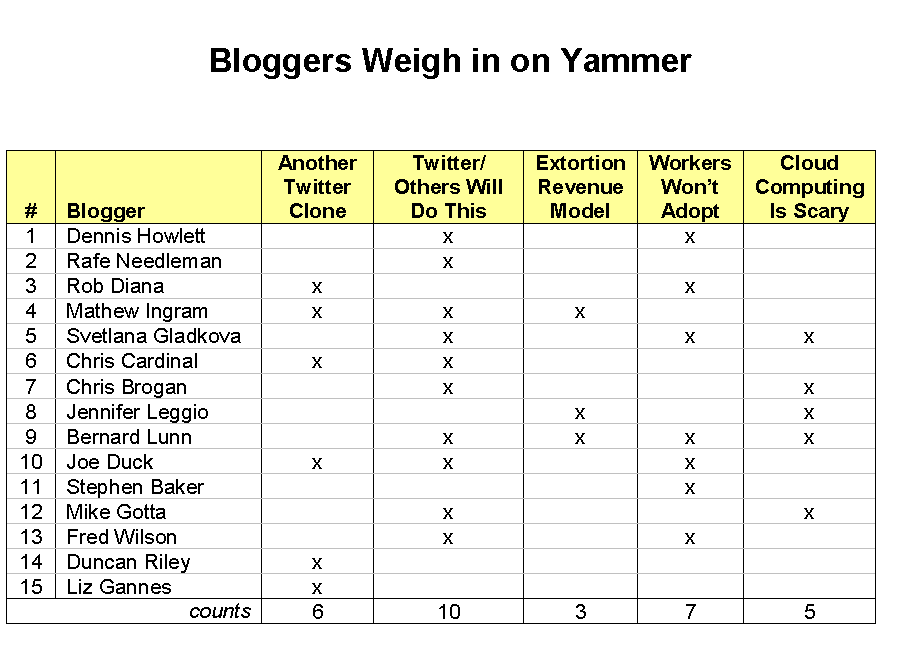
Yammer, as much of the free world seems to now know, won “best of show” at TechCrunch50. Yammer is an enterprise 2.0 company. The blogosphere had a fairly negative opinion about this. I read a number of these posts, and the table below outlines the reasons Yammer was viewed negatively:

Links to source posts: Dennis Howlett, Rafe Needleman, Rob Diana, Mathew Ingram, Svetlana Gladkova, Chris Cardinal, Chris Brogan, Jennifer Leggio, Bernard Lunn, Joe Duck, Stephen Baker, Mike Gotta, Fred Wilson, Duncan Riley, Liz Gannes

It’s a diverse collection of bloggers, and they each bring different perspectives. But there was enough commonality that I bucketed the reasons into the five groups you see in the table.

The reactions surprised me a bit – although there were positive reactions too. Let’s break down these five buckets.

Another Twitter Clone

Understandable reaction. We’ve seen Plurk, Identi.ca, Rejaw, etc. So I get the weary “Yet Another Twitter Clone” reaction.

Key difference here is the market Yammer is pursuing: enterprise. That makes all the difference in the world.

  • For Identi.ca to succeed, people would have to stop using Twitter (see Louis Gray’s post for analytical back-up to this point)
  • For Yammer to succeed, the more people use Twitter, the better.

Twitter ain’t enterprise, and I’d be surprised it gets there anytime soon. But using Twitter makes people understand the value of microblogging, which in turn helps Yammer.

Twitter/Others Will Do This

Given Twitter’s problems with keeping the service stable, I’d be shocked if they had also been putting in cycles figuring out how to go after the corporate market.

The other key difference is this. Enterprise is a different world than consumer. Probably one of the better explanations of the differences was by Mike Gotta, in discussing microblogging inside the enterprise:

“Within the enterprise, it is highly probable that IT organizations will classify these tools as messaging platforms (I would BTW). As a messaging platform, these tools would have to support security, logging, audit and archival functions to satisfy regulatory, compliance and records management demands.”

To succeed in the enterprise, you really need to focus on the enterprise. Twitter is having a field day in its growth in the consumer world. Wachovia just added their Twitter account to the website Contact Us page. Keith Olbermann is now on Twitter. Twitter should really focus on the consumer market, and own that.

Yammer is more likely to bump up against SAP’s ESME and Oracle’s OraTweet.

Extortion Revenue Model

The extortion is based on the fact that Yammer is free for sign-up and use. But if a company wants to control it, access to the administrative functions costs money. So companies will feel compelled to pay in order to manage the goings-on inside Yammer.

I’ll admit it’s a pretty creative enterprise pricing model. It seems to address two issues that bedevil enterprise software vendors:

  • How do I get a company to try my software
  • How do I prove employees will use it and get value from it

Companies don’t pay until they’ve seen employees use it and get value from it. Not bad, and it really wouldn’t be that hard for a CIO to tell employees to stop using Yammer (and block the site).

It is sneaky, but it’s also a clever way to address the adoption and value proposition issues that enterprise software vendors will always face. Atlassian Confluence achieved a solid share of the wiki market via viral adoption. Atlassian doesn’t have sales people – it’s all word of mouth.

Workers Won’t Adopt

This is where Yammer faces the toughest road. Getting people to microblog. Twitter is available to the hundreds of millions of people around the globe who might be interested. And it’s gotten a very small percentage of them.

Inside the enterprise, you need a much higher adoption rate. People already on Twitter are natural adopters, but a lot of employees will still have the “why would I do that?” reaction.

The “sell” has to compare Yammer to existing communication modes:

  • Email
  • Instant messaging
  • Forums

Note that relative to Twitter, Yammer has immediate context and built-in users. Context comes because the internal messages will generally center around work that colleagues have a stake in. In other words, they care more about each Yammer message than they do about individual tweets out in the wild.

The other thing is that managers at the departmental level can join and start using Yammer. On Twitter, if you don’t follow an A-Lister…so be it. On Yammer, if you don’t follow your boss…you’re going to miss something.

Cloud Computing Is Scary

This is an ongoing issue for the entire cloud computing/web apps world. Amazon S3 and Gmail’s recent outages highlight the issue.

Salesforce.com experienced outages back in late 2005 and early 2006. They were a blow to the software-as-a-service sector, but the company appears to have righted the ship since then.

Salesforce.com has a market cap of $6.9 billion. Yammer doesn’t.

But Yammer doesn’t have the database-of-record mission that Salesforce.com does, so the threshold for Yammer is lower. Still, ideally for Yammer, people will message about critical issues for their companies, not just what they’re having for lunch. So Yammer’s scalability, security and reliability will be important.

Cloud computing still has a sell-job of its own, but I like the way Anshu Sharma put it:

“No one (at least not me) is suggesting that on-premise software will disappear – its just that growth in enterprise software will come from SaaS and not on-premise (which is growing at about 4%). Venture capitalists like Emergence Capital and Humbold Winblad are voting with their dollars!”

A lot of action is around SaaS, it’s a question of how long the adoption curve will be. Yammer is counting on this one.

Gartner’s Hype Cycle

Gartner puts out updates on something it calls the Hype Cycle for Emerging Technologies. The hype cycle tracks the market views of various technologies, which go through predictable cycles:

  • Technology Trigger
  • Peak of Inflated Expectations
  • Trough of Disillusionment
  • Slope of Enlightenment
  • Plateau of Productivity

In July 2008, Gartner released its latest view regarding the hype cycle. This one included both microblogging and cloud computing, Yammer’s model:

Courtesy marketingfacts on Flickr

Courtesy marketingfacts on Flickr

Neither microblogging nor cloud computing is anywhere near mainstream uptake. Gartner pegs that at a 2 to 5 year horizon.

The companies that are in now, though, will be best positioned to figure out what drives the Plateau of Productivity. It takes time to learn a market, get some positive customer stories and gain a wider customer base.

I’ll be watching Yammer.

I’m @bhc3 on Twitter.