It’s an Innovation Geekfest! AT&T’s Tech Showcase

On Thursday, November 5, I attended the AT&T Technology Showcase in San Francisco. The Tech Showcase presents some of the latest cool inventions coming from AT&T Labs. Imagine a highly professional, well-resourced Maker Faire. AT&T calls the showcase, “The Art of the Possible”, stressing the experimental nature of this stuff.

While I’m not actually a geek, there were some cool things there. And notice the iPhone usage in these inventions.

For easy reference, I’ve included some anchor links below:

iPhone Microprojector

AT&T iPhone microprojectorThis was really cool. It’s a device that lets you broadcast video and images on any surface. You insert your iPhone into the microprojector and point it where you want to display. It uses three-color lasers to display images. With lasers, the image is always in focus, regardless of distance from the display surface.

The inventor stressed the medical uses of it. He showed how a brain scan would look. Doctors can view results on-the-fly, on any surface. This gives them the ability to react much more quickly to medical conditions.

But another guy watching this and I both had the same thought: this would be great for business. Sales presentations held on your iPhone. It also seems like something that work at trade shows.

And how about watching videos through your iPhone? Not on the small iPhone screen, but broadcast on a nearby wall or a screen in the back of a car seat? That would be pretty slick.

iPhone as Voice-Powered TV Remote

For the ultimate in minimizing the steps needed to find a show: the voice-powered TV remote. Here’s how I saw it work:

  • Say something like “basketball this evening”
  • System searches a show schedule for “basketball” instances
  • It’s intelligent enough to understand “evening” as a set of defined hours
  • Serves up a list of programs that match the voice-entered search
  • Pick the one you want, watch or record it

To use this, you need an Internet Protocol (IP) TV. For a demo, see MG Siegler’s YouTube video, taken as part of his TechCrunch coverage:

Ad Hoc Social Networking

Under the research initiative, “Just in Time Mobile Services”, is this wild concept.You ask total strangers to provide you with information about some location in which you’re interested. Here’s a process flow:

Ad Hoc Social Networking process flow

Say there’s some place you want to go to, but it can be hit-or-miss there. Maybe too crowded, not enough people, delay in some event, etc. You reach out this Ad Hoc Social Network. The Network system finds people who are in that location. They agree to answer a question. You check out the ratings for those people, select the one with a sufficient rating. You then ask them about the location. After they give you an answer, you determine whether the answer was good, and rate them.

All of this done anonymously.

Key here are the ratings. Your rely on those with better online reputations. As for incentives to participate, maybe there’s some lessons in foursquare (points, badges, mayors).

Internet Protocol TV

AT&T offers a digital TV content  delivery service called U-verse. It uses Internet Protocol to deliver signals, and competes with Comcast and other cable providers, as well as satellite TV providers. There are some cool experiments developed for U-verse, including a few they aren’t ready to make public.

Here are some of the cool things they’ve done in the Lab for IPTV:

Use iPhone pictures to find programs: The monthly U-verse guide provides information on upcoming programs, including photos from those programs. Use the iPhone to snap a picture of a program. Send it to the application in the  IPTV. The TV matches the picture from the iPhone to a program, and shows a list of upcoming episodes. Record the ones you want.

Twitter: Add a scrolling ticker to the bottom of your screen. You when this would be good? When BIG stories break that capture the nation’s attention. They invariably have # hashtags. Have a running ticker of hashtags across the bottom of your screen while watching live coverage from a new station.

Throw media objects from phone to TV: Say you have a video on your iPhone 3GS. With this app, you simply “throw” it to the IPTV. The video will be loaded to the TV, and begins to play. If you had an IP stereo, this would work for music.

FamilyMap: Want to know where your kids are? This app tracks the signals for your family’s phones, and plots their locations on a map. A FamilyMap. I’m going to remember this for my kids in about a decade.

Telehealth Remote Monitoring

At the World Innovation Forum, futurist Paul Saffo said that sensors are the BIG next technology wave. The telehealth remote monitoring project shows one way this will be true.

At the Technology Showcase, one Labs researcher showed off a sensor that tracks the foot signature of people (“smart slippers”). With four sensors in a slipper, it tracks the unique foot signature of an individual. The sensors will measure the footstrike, and provide data that can identify if something is off. If something is off, family and care providers can be alerted.

AT&T has a vision to develop sensors that can track a number of health related conditions. I took a picture of a poster that gives a high level view of their direction. Notice the age demographic of the couple under “You” to the left of the picture:

AT&T Telehealth Remote Monitoring

This is an area of growth, not just for AT&T, but for the technology industry overall. The New York Times just ran a story about this topic, Watch the Walk and Prevent a Fall. The article noted:

Researchers are beginning to apply the digital tools of low-cost wireless sensors in carpets, clothing and rooms to monitor an older person’s walking and activity. The continuous measurement and greater precision afforded by simple computing devices, researchers say, promise to deliver new insights on risk factors and tailored prevention measures.

If The Graduate were remade today, the man at the graduation party would whisper “sensors” in Dustin Hoffman’s ear.

GeoCasting

Finally, I took in the GeoCast demo. What is GeoCasting? It allows you to communicate between mobile handsets without the need for a cell or data network.

Sort of like an updated version of walkie talkies.

This is essentially a very localized peer-to-peer way of communicating. It relies on sensing nearby phones. The use case demo I saw related to public safety. Imagine there is a disturbance of some type on a college campus. School authorities would have access to a broadcast application, which would localize instructions to students on the campus. If you were inside a building where the disturbance was occurring, you’d get one set of instructions, perhaps telling you the safe way out. If you were on a different part of campus, away from the problem, you’d get instrucitons to stay in your room and lock it down.

GeoCasting is an innovative way to localize information out to mobile handset holders. One could see interesting commercial applications for this, such as retailers sending messages to consumers nearby.

Good stuff coming from the AT&T Labs guys. Look forward to some of this becoming commercial. I may seriously have to get U-verse TV when it becomes available in my neighborhood.

My Ten Favorite Tweets – Week Ending 110609

From the home office along the former Berlin Wall in Germany…

#1: McAfee: Bad practice of #e20 evangelists = Declare war on the enterprise. Presents a bad msg to corporate buyers. #e2conf

#2: Frappaolo: His work finds that age has little to do with #e20 adoption. Creative thinkers span all ages. Org culture is the issue. #e2conf

#3: Yup, SharePoint 2010 is a platform: Microsoft To Offer Application Marketplace In SharePoint 2010 http://ow.ly/zYM2 via @rww #e20

#4: Google Wave product mgr. Best way to use #googlewave is for collaborative activities, not wholesale replace email. #e2conf

#5: RT @Brioneja: Google’s Wave Might Find Its Real Home Inside Company Servers http://bit.ly/2VJkxP #collaboration #software

#6: For #innovation, conflict is good. Conflict is right. Conflict works. Read @AndreaMeyer‘s post to find out why: http://ow.ly/za7v

#7: Good take @zeroinfluencer: All User Centric Design is modeled around the ego. Good software design keeps that in mind. http://bit.ly/39gim3

#8: Gov 2.0 – City of Manor Taps Citizens’ Ideas for Improvement (via Spigit blog) http://bit.ly/4A1hNc #gov20 #innovation

#9: RT @zee RT @jestei I find twitter #lists weirdly, narcissisticly fascinating; they provide a rare window into how others would define you

#10: http://twitpic.com/noz7d – Tonight’s Jack O’ Lantern is a wink emoticon 😉 My 5 yo’s choice. Future geek.

Twitter to Clean Up Trending Topic Searches – Is This that Reputation Thing?

On Twitter’s blog, they announced an initiative to clean up the spammy tweets that often appear for trending topics. As described from the post:

Today we’re starting to experiment with improvements to trends that will help you find more relevant tweets. Specifically, we’re working to show higher quality results for trend queries by returning tweets that are more useful.

MG Siegler over on Techcrunch and Jolie O’Dell of ReadWriteWeb wonder how this will be accomplished. My guess? Twitter is starting some sort of reputation score for accounts. The lowest-of-the-low accounts in terms of reputation will get shunted aside.

For background on this reputation thing, see a couple earlier posts on this subject:

Included in that second link is this quote from a Rafe Needleman post in May 2009:

Twitter Search will also get a “reputation” ranking system soon, Jayaram told me. When you do a search on a “trending” topic–a topic that is so big it gets its own link in the Twitter.com sidebar–Twitter will take into account the reputation of the person who wrote each tweet and rank the search results in part based on that.

Curious to see how this one plays out.

How Should Tweets Be Ranked in Search Engine Results?

Tweet searchAnyone remember when Loic LeMeur had the temerity to suggest Twitter rank its search results by the number of followers people have? His post, with 109 comments and reaction from Michael Arrington, Robert Scoble and many others, clearly struck a nerve.

Fast forward to the past couple weeks. Both Microsoft Bing and Google announced deals to provide tweets in search results. Let me say that again: Google and Bing will be providing tweet search results!

Bing’s version is the first out the gate. In light of the earlier brouhaha, this may come across as insensitive…but I have to ask:

How should tweets be ranked in Bing and Google search results?

I hope your answer isn’t, “I wouldn’t.” Because that’s contrary to what made Google such a global powerhouse used by billions every year. And why Microsoft is working hard to increase Bing’s market share. Google and Bing built their business by presenting search results based on the authority of websites. This system of authority (e.g. PageRank) makes the results relevant to users.

So what about running searches for tweets? Should their presentation be utterly devoid of any authority ranking? Does it make sense to just show the latest tweet containing a given term? After all, that would simply be imitating what Summize (aka Twitter Search) does.

First, a good question to ask is, why do people want to search tweets? How does this differ from web search?

Why Are You Searching Tweets?

To my mind, there are three use cases where people will search for tweets rather than search for websites:

  1. Find people
  2. Find latest on a subject that won’t show up in search engines yet (lack of indexing, lack of authority)
  3. Jump into conversations on something

Find people: You’re interested in a topic, and want to find others who can either improve your knowledge on it or with whom you want to connect. This is using Twitter as people search. The model for all of here is, you are what you tweet. It’s what makes you findable to others.

In this case, my sense is that people will have an desire to find those who would have the most authority on a given topic.

Find latest on a subject: The appearance of an article or blog post in the search engines can take a while. That contributes to the challenge of finding the latest. But the more pressing issue is the display of new articles in the search results. A good article or post on a subject, such as Enterprise 2.0, is likely not going to be ranked very high in the Google or Bing search results. No one links to the article yet, and it competes against a bunch of other incumbent articles in the search indexes.

If something shows up on the third page of Google’s search results, does it really exist?

This issue is even more pernicious for current events. The San Francisco Bay Bridge has been closed for several days now. It seems every estimate about when it will reopen has been wrong, meaning we all have to scramble to figure out our commute for the next day. To get the latest on the Bay Bridge, I searched Google, including the aggregate news results. Everything was too old when I did that, reflecting previous pronouncements. I needed what people knew right now. I went to Twitter, and found tweets that told me the latest status. Very helpful.

To find the latest on topics, I think there is a role for leveraging some sort of authority. People who have established credibility can be good first filters on what’s relevant and useful. For Enterprise 2.0, what is Dion Hinchliffe tweeting? For the Bay Bridge, I most trusted the KTVU tweet I saw.

Jump into conversations: This is Twitter as water cooler. You know something is going on. But how do you connect with people? Searches are good for this. Hash tags for conferences or big stories. Take the recent fraudulent #balloonboy story. It definitely captivated everyone. But even now, you’ll see tweets like this:

Watch top quality streaming Movie -> Up here http://cli.gs/dpNT5N Make $ From Home #mileycomeback #balloonboy

What is that? That’s someone taking a popular hash tag and polluting the search stream with spam. Again, a case where adding some authority to the tweet search rankings will help.

Tweet Authority Criteria

Keep in mind that “authority” is used in the context of Google and Bing searches. Of course web searches miss many authorities on subjects, but they work pretty well for giving relevant information.

I categorize the bases of authority in three buckets:

  1. Relevancy of tweet stream to a subject
  2. Crowdsourced signals of authority
  3. Effectiveness in providing relevant content

As a point of reference, Bing’s initial measure of relevance was reported to be the number of followers a person has. Let’s look at the three categories of authority.

Relevancy of Tweet Stream to a Subject

The first basis for authority should be…does someone tend to post about a given topic? Frequency of posts are a good marker that a person has something of interest to share. If someone is going to be deemed an authority on a subject, I’d expect a fair number of tweets related to it.

One twist that would make this better. A semantic basis for linking terms. For example, if some one searches on Foo Fighters, consider people whose tweet streams include posts about “music” frequently as having higher authority.

Crowdsourced Signals of Authority

What does the crowd think of a given person or tweet? Let’s start with a single tweet. If someone posts something on a given topic, and it gets retweeted a lot, that should count hugely in terms of its authority for a given topic.

OK, now for the general stats. How many followers does someone have? Yes, it’s getting gamed. So the presence of a high number of followers isn’t an automatic definition for authority. But it does have relevance in constructing authority.

The benefit of computing this for users is that the authority of those who follow a person can be an input into his or her own authority.

Next… Twitter Lists. Number of followers is not the end of the story. Lists have two characteristics that can be used to compute authority. First is the number of Lists one is on. Tim O’Reilly is on over 2,500 Lists. No surprise – he really made ‘web 2.0’ ubiquitous in our culture.

But an even better indicator of authority is embedded in Lists. How does the crowd characterize a person? Those Lists are valuable for granting higher authority for a given topic.

Effectiveness in Providing Relevant Content

When someone tweets, how do people react? Robert Scoble has a good take from his blog post:

  1. Number of retweets of that tweet
  2. Number of favorites of that tweet
  3. Number of inbound links to that tweet
  4. Number of clicks on an item in Twitter search

I particularly like that #4 item – number of clicks. Once these tweets are in the Google and Bing search results, the clicks can be measured. These are powerful bases for measuring someone’s authority.

I’d add a measure for how often a shared link is clicked; say bit.ly’s click information. While the actual number of clicks tracked by bit.ly is wrong, let’s assume it’s wrong in a similar fashion for everyone. So the bit.ly clicks counts can give a measure of relative effectiveness in providing content.

What Do You Think?

That’s my somewhat exhaustive description of inputs for ranking tweets in Google and Bing search results. There’s more that would be needed. I can think of incorporating some element of time decay in how tweets are presented as well. But this post is long enough.

What do you think? How would you rank tweets in the big search engines?

My Ten Favorite Tweets – Week Ending 103009

From the home office, waiting for the Great Pumpkin in the pumpkin patch…

#1: NIH grants $12mm to create a national, Facebook-like social network for scientists http://ow.ly/xtAD Goal? Find collaborators

#2: RT @jowyang Ritz Carlton’s mktg chief says hotel mgt at each property spends 1 hour reviewing online convos each am –even tweets #forbescmo

#3: The Time I was Written Up for Blogging http://ow.ly/x3ph by @tacanderson Lesson on employees and social media

#4: Skating to where the puck will be – Apple & advertising http://ow.ly/xnXJ Apple has offered to rebuild a Chicago mass transit stop?

#5: Very cool: Los Angeles adopts Google e-mail system for 30,000 city employees http://ow.ly/x3hP Cloud makes inroads #saas

#6: 84% of firms say #innovation is important to firm success. 51% of firms do not have anyone who is steering the innovation ship. #iai09inno

#7: 10 examples of minimum viable products http://ow.ly/xbi1 Cool list of minimalist approaches to engage customers & build product

#8: Stuck trying to write that next blog post? 100 Ways to Find Ideas for Your Blog Posts http://ow.ly/wA1T from the LifeSnips blog

#9: Geek alert! RT @PaulSloane: @DougCornelius RT Awesome T-Shirts for twins: http://bit.ly/14LYeI

#10: OK, figure this one out. @gaberivera created a tweet that links to itself. See for yourself: http://bit.ly/2IIkJG

Bonus just for this week…

#11: Small change to my Twitter bio…I’m now VP of Product at Spigit. Carry on…

Innovation ROI – Why Every Enterprise 2.0-Enabled Connection Counts

In a recent post on the Spigit blog, Study – Collaborative Networks Produce Better Ideas, I described the research of Professor Ronald Burt. He found that employees who are better connected across the organization generate higher quality ideas than those with limited connections. Wider access to the ideas, knowledge, experiences and judgment of colleagues makes employees stronger in innovation.

I posted this write-up in the Continuous Innovation group on LinkedIn. One person made this observation:

Need to keep in mind that collaborative networks have little to do with technology. There are certain personality types that keep the organization connected. The proportions of those people in an organization is related to the specific corporate culture.

There’s a good alternative perspective. That really, the same people that connect via collaborative networks are those that would be doing it in an offline world as well. The rest of the employee population likely continues to work in a more insular world.

I see it differently though. First, I agree that there are people with natural connector personalities. They would span the different parts of the organization no matter what. Anyone think David Armano wouldn’t be one of those types?

But not everyone need be an uber connector to see benefits from plugging into a more connected network. My personal experience on sites like Twitter and FriendFeed tells me that everyone benefits from these online social networks. We may not all be uber connectors, but we do increase our degree of connectedness.

The graph below is my concept for how this effect manifests:

Offline vs online degree of connectedness
Assume a population of employees: 25 in this hypothetical example. The blue line is the level of connectedness for employees working the way they have for decades. Your connections tend to be local and departmental, with some tenure you gain a larger informal network. In Professor Burt’s terms, most workers are relatively insular in terms of who they access for information and ideas. But some broker connections across different corporate “tribes”.

The red line represents the level of corporate connectedness for employees including the ability to find others online. To me, this is a no-brainer. Of course people are going to connect with others they wouldn’t have otherwise. The number, diversity and depth of connections increase.

The gray zone between the red and blue lines represent that improvement. Some people won’t get too much increase. They really are in-person types of connectors. But others thrive in the online environment. They have more specific interests, and didn’t know who else in the organization held them. Through the social software, they find more people with interests similar to theirs. Or at least with experience relevant to their interests.

Don’t need to be an uber connector there. Just need to be able to make connections.

Next…the ROI math.

The Natural Logarithm Method

Take a look at the graph below. It shows the scatter plot of how ideas were rated for different employees (Y axis). The X axis represents the degree of connectedness for employees, based on actual social network analysis conducted by Professor Burt in his study:

Measuring Innovation ROI from E2.0 Connections

The scatter plots show that employees who have a high diversity of connections across the organization provided higher quality ideas. The converse holds true as well.

Regression shows the equation that represents the observations:

Value of Idea = 5.51 – 0.91 * ln(Level of Network Constraint)

The equation shows that, on average, every increase in a person’s level of connectedness with different parts of the organization produces higher quality ideas. Note the natural log curve. The effect increases as connectedness improves. What I like about that is that the benefits increase, even if the work of increasing employees’ network diversity gets more difficult as you try to connect those last holdout groups.

Extrapolate the effect out to the organization at large. Raising the overall level of workforce connectedness will have a salutary effect on the average quality of ideas generated. In an era of ever higher levels of market volatility, improving the organizational “innovation IQ” is a critical aspect of surviving and thriving.

One thought on the accelerating benefit – increased idea quality – as connectedness improves. In a large population, would this have any correlation to network effects?

It’s not perfect, but Professor Burt’s analysis demonstrates a strong ROI basis for leveraging social software to increase the diversity of connections.

My Ten Favorite Tweets – Week Ending 102309

From the home office in Kabul, Afghanistan…

#1: Twitter’s Web Traffic Flatlines http://ow.ly/viH9 …while Facebook continues to grow.

#2: Initial take on MSFT’s Twitter integration (http://ow.ly/vLGF)…that is sweet! Now will they show tweets beyond the last 3 days?

#3: RT @danschawbel REPORT: 65.6% of CMO’s feel that social media should be done in-house http://tinyurl.com/ygdjtfb

#4: If the Enterprise 2.0 crowd wanted to share a link, my guess for the top 5 services: Twitter, Facebook, LinkedIn, Posterous, Yammer. Agree?

#5: Study – Collaborative Networks Produce Better Ideas (via Spigit blog) http://bit.ly/3xoPM5 #e20 #innovation

#6: Interesting point from #spc09 – SharePoint is a critical driver of MSFT’s future growth. #e20

#7: Two SharePoint 2010 articles – RWW http://bit.ly/1zjI49 | @olivermarks http://bit.ly/4f9en0 – paint a good picture of its #e20 initiatives

#8: Southwest Airlines is running a “test lab” of ecofriendly products on its new Green Plane http://ow.ly/w3fR

#9: RT @Cubba: @bhc3 I thought this was timely based on our conversation at Patsy’s; http://bit.ly/1WQGwH = “10 Tips for Retrosexing on FB”

#10: http://twitpic.com/m13gk – It’s pumpkin patch time! Kids have their own. #halloween

Would You Manage CRM with a Wiki?

Or human resources with a blog? How about project management with forums?

Funny questions to ask, no doubt. Of course it’s not possible to effectively address many of the critical business functions using basic Enterprise 2.0 tools. Yet when it comes to social software, it often seems that the only game in town is to be a provider of such tools. For instance, Gartner’s Social Software Magic Quadrant requires that vendors have wikis, blogs and forums to be considered (side note – for the record, Spigit has all three social software tools and more).

I am fully on board that there are great opportunities for new types of communication, collaboration and information discovery in these tools. For instance, see my post, Microblogging Will Marginalize Corporate Email.

But there’s an enormous opportunity for applying the ethos and value of  ‘social’, ‘transparency’ and ‘collaboration’ to a wider range of business processes. Key here is not to force specific processes into a general purpose tool, but to bring social software ethos to longstanding enterprise activities.

Hmm…sounds Dachis Group-like (“social business design”), eh?

Activity-Specific Social Applications

In the recent Gartner Social Software Hype Cycle, analyst Anthony Bradley introduced a new category, Activity-Specific Social Applications:

“As social software implementations mature, application patterns are evolving, and the software industry is responding with activity-centric social application offerings rather than with generic social software capability suites. Delivering a targeted social solution with a general purpose social tool (such as wikis and blogs) can involve significant development, configuration, and templating effort.”

Bradley has identified the next opportunity in enterprise social social software. Integrating the valuable characteristics of social software into the in-the-flow activities that make up our days. As a percentage of employees’ time, activity-specific social applications will be quite large.

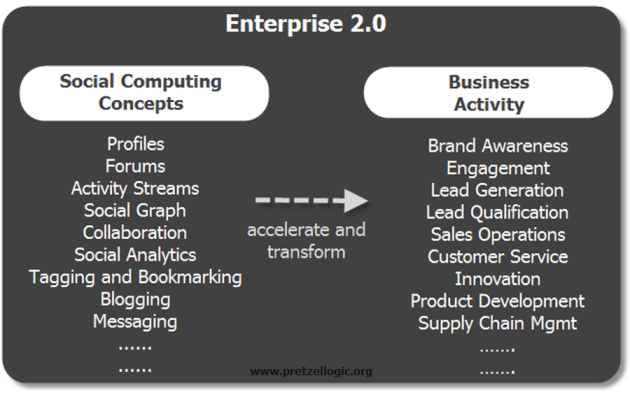
Back in March 2009, Sameer Patel wrote, don’t confuse Enterprise 2.0 with social computing concepts. He was making this exact point, and included this illustrative diagram:

Credit: Sameer Patel, Span Strategies

Credit: Sameer Patel, Span Strategies

His point is that the left side are tools, whereas the right side are results-based activities. Key here is to create applications aligned with the processes for those activities. That means going deeper than a general purpose tool.

Successful Applications Will Be Designed for Results

So back to the original question. Would you manage CRM with a wiki? Could you? Perhaps there’s a geek hack to do this, but for mainstream business, the answer is ‘no’. Customer relationship management includes:

  • Case management
  • Customer revenue analytics
  • Sales pipeline
  • Individual prospect opportunity workflow
  • And lots of other stuff

It would be really hard to use generic off-the-shelf social software to deliver the above functionality. Yet, going back in time, here’s what was prescribed for CRM success in April 2002:

People [who fail] don’t integrate CRM into the other parts of their business or implement CRM as a stand-alone and don’t have it communicate with core systems. A bigger and more frequent stumbling block is forgetting to address the people issues around a CRM implementation. In almost all of the cases we described earlier, CRM is a behavior modification tool.

There is a need for the “hard” functions that CRM can provide, like case management, campaigns and analytics. But that’s not enough (e.g. see social CRM), and enabling the customer-centric firm seems to require a good bit of what makes Enterprise 2.0 tick: cross-organizational perspectives, contributions from different departments, a more collaborative orientation to an end-goal. Integrate CRM into “other parts of their business”.

Wikis, by themselves, don’t provide the necessary CRM functions that are table stakes to be useful for companies. But CRM platforms could benefit from integrating more social software tools and conventions.

And that’s the case for a lot of the current processes that define companies today. They aren’t going to be addressed by off-the-shelf generic social software tools. But they benefit by incorporation of social software tools.

“Activity-specific social applications”. A few examples:

Dachis Group talks about social business design as “the intentional creation of dynamic and socially calibrated systems, process, and culture.” Indeed, there’s a huge opportunity to apply social software to the multitude of applications and processes that make up organizations, beyond the insertion of standalone generic tools.

Watch this space.

My Ten Favorite Tweets – Week Ending 101609

From the home office in a balloon 7,000 feet above Colorado…

#1: Well, this was unexpected. The Spigit funding news has hit Techmeme http://bit.ly/3ETPFp #e20 #innovation

#2: LinkedIn: 50 million professionals worldwide http://ow.ly/uq7s “Last million took only 12 days” Wow. Tipping point?

#3: RT @mwalsh: Seth’s best post of the year – get over yourselves…you’re not that cool, interesting or smart. http://bit.ly/3HwrV6

#4: Is Social Media the New Cigarette? asks @billives http://ow.ly/u8IY Looking at social media addiction

#5: RT @nyike First Jive, now Spigit building #e20 and collaborative functionality on top of Sharepoint http://bwbx.io/hina

#6: Within firms, collaboration technologies are dictated by most powerful person involved in the collab http://ow.ly/tJgf by @amcafee

#7: Just as interesting as this WSJ piece is, Why Email No Longer Rules… http://ow.ly/tZpj are the skeptical cmts left by readers #e20

#8: If companies like $GOOG and $MMM excel and incl employee 15-20% personal time for innovation, why haven’t others adopted same?

#9: Wind farm firm makes sure its wind mills are 30 miles away from nearest Starbucks. http://ow.ly/tRQP Why? Best way to avoid NIMBY’s

#10: When a company gets funding, all sorts of interesting “opportunities” emerge. Just got a solicitation for Spigit to sponsor a NASCAR driver.

Warburg Pincus Invests $10 Million in Spigit

Warburg Pincus SpigitWell, this is pretty cool. I’m pleased to announce that Spigit has received a $10 million equity investment from Warburg Pincus. The investment will be used for the usual things a growing start-up needs: product development, sales and marketing and program management. Here’s coverage in the New York Times and TechCrunch.

I’ve been with Spigit for 6 1/2 months, during which time I’ve seen firsthand how things have progressed. Both the company and me.

If you’ve ever checked my bio, you’ll know I worked in investment banking from 1996 to 2000. If not for a banking merger that shut down my San Francisco office, I’d likely still be there as a Managing Director, doing financings for companies.

OK, wait. Considering the recent financial market collapse, let me rethink that…

Rather, I moved into technology. And let me tell you, it ain’t easy making the transition from banking to technology. You have zero geek cred (note the name of this blog). Since 2000, I’ve worked for several small technology start-ups. From each of them, I’ve learned a lot. I will say that in Spigit I’ve found a place that nicely combines my MBA company performance orientation with my social software enthusiasm. Innovation management meets Enterprise 2.0.

The team at Spigit is a hard-working one. I’m impressed with the seriousness of purpose each of them brings to the job every day. When we closed the funding this week, our CEO Paul Pluschkell got a couple bottles of champagne for a company toast. After we drank a bit of champagne (not too much, customers reading this blog…), everyone quickly went back to their desks to do work. Dorks. :-p

Which is appropriate. There’s a lot of work to do. I’m looking forward to it.

Here’s to the Passionate Creatives

Here’s to the crazy ones. The misfits. The rebels. The troublemakers. The round pegs in the square holes. The ones who see things differently. They’re not fond of rules. And they have no respect for the status quo. You can quote them, disagree with them, glorify or vilify them. About the only thing you can’t do is ignore them. Because they change things. They push the human race forward. And while some may see them as the crazy ones, we see genius. Because the people who are crazy enough to think they can change the world, are the ones who do.

Apple ad, “Think Different”, 1997

Why did Apple’s ad resonate so well with you? After all, how much time do we spend disagreeing. Admit how happy it can make you when your manager praises you for executing well on an assignment. I know I feel it. No “think different”. More like “think excellence”.

But that Apple ad. It was damn good, wasn’t it? Seemed to reach inside us to something else beside the praise we get for doing an assigned job well. It was celebrating some thing in each of us.

John Hagel recently wrote A Labor Day Manifesto for a New World. The post is a call to action for work that better fits our human nature. Our desire for creating better ways to address problems, in ways that fit our personality, interests and skills. To reach our full potential. We’re not all doing this though.

Hagel terms people whose personalities and drive are based on making situations better than what currently exists as “passionate creatives”. There have always been these types, but recent changes in the global economy and shifting market dynamics (e.g. digital technology rewriting one industry after another) are increasing their importance.

Passionate creatives exist within organizations, and as independent entrepreneurs. For those inside firms, Hagel notes:

They experience deep frustration today with the institutional barriers that have been put in their way as they seek to more effectively achieve their full potential.  They want and need platforms that can help them connect with others and drive performance to new levels.

For many of us, even if we wouldn’t label ourselves “passionate creatives”, the point about frustration resonates. How often have you had an idea, but can’t attention for it, nor resources, nor figure out who else to work with? I’ve had jobs like that in the past. You know some things are not working well, and you can see how to improve the product/delivery/business model. But you can’t make headway on iterating through new possibilities.

Hagel’s manifesto is a great read. I want to hit on two points I take away from it:

  • What is the role of “passionate creativity” in daily work?
  • The gathering of passionate creatives at the edges and the accelerating rate of change in markets

The Role of Passionate Creativity in Work

Very few of us get to live a life of unfettered passionate creativity. The realities of the mundane trump the thrill of the new. And that’s not a fault of the system. If all we did was work on new stuff, there’d be no stability and no scalability. More like mass economic anarchy.

But that’s too heavy handed a look at it. We can be quite productive and help our companies, and careers, while working on tasks that hit our passionate creative sweet spot. A good question to ask is, how much of this passionate creativity infuses our work days?

Work imbued with passionate creativity

Take a look at those two Venn Diagrams. They’re saying different things. The left one says that we all have to execute on tasks assigned by others, or assigned by ourselves for the role we fill. In some of that work, we’ll have the opportunity to reach deeper, to deliver creativity on an activity that animates us. But the primary focus is executing on the plans and processes already in place.

The right one indicates a job which is dominated by passionate creativity. Hagel’s call-to-action is more aligned here. We work primarily on things which stimulate and energize us regularly. But there is a twist to this notion. It doesn’t mean spending one’s time on only starry-eyed big picture thinking, producing little of tangible value for your organization. It includes work by those “who are searching for new and creative ways to do the most ‘routine’ tasks.”

Which model of work are we likely to see arise in the next decade or two? Both. Neither. Yes.

Hagel’s manifesto is not so much a clear-eyed plan for rearranging organizations. Rather, it’s a wake-up call to the corporate world that the nature of work and what employees seek is changing. As he says:

Why will more and more people evolve into passionate creatives? Because we live in a world that is shifting inexorably from an obsession with efficiency to an obsession with learning.  We have come to call this the Big Shift.

In that statement, I draw some conclusions that relate which model above will emerge. First, note that the Big Shift is a shift in “obsessions”. From efficiency to learning. That’s a shift in attention, and in resources. It’s a shift in the dynamics of the supply side of the equation.

What hasn’t shifted is the demand side of the equation. Consumers worldwide still depend on the massive efficiencies that Tayloresque methodologies have brought to our economy.

So there’s the quandary: if we’re all working on things that inflame our passionate creativity, who is minding the massive scalability store?

My sense is that the Venn Diagram on the left is closer to what we’ll see. Enlightened companies will follow the examples set by Google and 3M, encouraging employees to pursue initiatives outside their regular routines. This does a couple things:

  • It provides an outlet for growing passionate creativity on a wider basis
  • Some of those initiatives will turn into full-fledged projects

The second point then lets employees live a life in the right-side Venn Diagram.

Passionate Creatives at the Edges

Another point Hagel makes is that passionate creatives tend to occupy spaces that are “edges”:

Passionate creatives are everywhere among us, but they are not evenly distributed. They tend to gather on the edges where unmet needs intersect with unexploited capabilities.  Edges are fertile seedbeds for innovation.

Reading this, I was struck by how well this fits with the observation that Gary Hamel made. The pace of change in markets is faster now than it ever has been in history. What this means is that Hagel’s edges – unmet needs intersect with unexploited capabilities – will be more frequently found.

Companies need to get better in pivoting to meet changes in their markets. And this keeps CEOs up at night. IBM surveyed global CEOs in 2008, asking them about their view of changes in their markets. The results are eye-opening:

Collectively, CEOs set their organization’s ability to manage change 22 percentage points lower than their expectations for the level of change they will have to manage — a ‘change gap’ that is widening.

A wide ‘change gap’ there, isn’t it? If Hamel identifies the problem companies face, Hagel identifies the types of workers who will make a difference in addressing the problem. The passionate creatives.

The edges are places of opportunity and uncertainty. It’s hard to know what the demand dynamics are, and existing infrastructure and processes don’t address the changing market needs. New alternatives are emerging, it’s time for fresh approaches by existing firms.

Companies are best-served by allowing employees who are attracted to these changes to pursue innovative ways to address them. Why? They get energy. They get an experimenter’s mentality. They get a happier workforce. Let employees exercise some form of self-organization to accomplish this.

The alternative may be incumbent staffers who have fallen into routines, or have reason to protect the status quo. This does not help companies address rising levels of volatility. Free the passionate creatives!

Passionate Creativity Will Fall on a Spectrum

My sense is that work will evolve, over years and decades, to allow people to shift attention to work that energizes them more fully. It will happen on a spectrum, with daily jobs that fall between those two Venn Diagrams above. Society cannot get away from the requirements of predictability, efficiency and scalability. We’re all going to have elements of our jobs that are routine.

I think Hagel’s post is right on though. It will be a slow change where companies integrate the existing passionate creatives more effectively, and develop the passionate creativity in all employees. Companies doing it well will need to celebrated and publicized repeatedly for the value to be understood more widely in the market.Over time, we’ll see the change.

Note what G. Michael Maddock and Raphael Louis Vitón wrote in this recent Business Week article. Passionate creatives like to “follow the challenges”:

Stop and think about the last truly great person who left your organization. First think about what made that employee great. We bet you name such characteristics as action-oriented, driven, passionate, fun, and genuine.

Now think about where that worker went. Chances are, to a position with a perceived promise of putting his or her talents to better use—moving into a role with greater challenges and opportunities to learn and make a difference. It wasn’t about money.

It will happen. Here’s to the passionate creatives.

I’m @bhc3 on Twitter.

My Ten Favorite Tweets – Week Ending 100909

From the home office in Oslo…

#1: I’d like to publicly state for the record that I never accept sponsorship or freebies for my blog posts…because no one ever offers any…

#2: The Nobel Peace Prize for Obama is a signal to him, a very large signal, to keep doing what he’s doing. It’s not an achievement award.

#3: Did you see @defrag‘s mashup of Gartner Hype Cycle & Moore’s Chasm? http://ow.ly/tr6d Social media/E20 in trough of visionary adoption

#4: Firms Need a System for Recognizing and Empowering Innovation Catalysts (via Spigit blog) http://bit.ly/RlMS8 #innovation #wbf09

#5: Slideshare Gets More Serious About Monetizing Their Business http://ow.ly/t79P Two options: Adshare, Leadshare

#6: Hamel: WL Gore manages T&E this way = all expenses posted online for peers to see. Outcome? No need for restrictions. #wbf09

#7: Lucas: “Never imagined people would go frame by frame in Star Wars, and tweet their friends about its [cinematic tricks]” #wbf09

#8: Pickens: I’m more powerful in Washington D.C. now because I have 1.6mm people signed up in support of my energy plan. #wbf09

#9: Lencioni: Need to be able to disagree on things. Need trust for this to work. Conflict without trust is politics. #wbf09

#10: http://twitpic.com/k68s4 – I’m at a wedding that starts in 10 minutes. My son is ring bearer.

From the home office in Oslo…

#1: I’d like to publicly state for the record that I never accept sponsorship or freebies for my blog posts…because no one ever offers any…

#2: The Nobel Peace Prize for Obama is a signal to him, a very large signal, to keep doing what he’s doing. It’s not an achievement award.

#3: Did you see @defrag‘s mashup of Gartner Hype Cycle & Moore’s Chasm? http://ow.ly/tr6d Social media/E20 in trough of visionary adoption

#4: Firms Need a System for Recognizing and Empowering Innovation Catalysts (via Spigit blog) http://bit.ly/RlMS8 #innovation #wbf09

#5: Slideshare Gets More Serious About Monetizing Their Business http://ow.ly/t79P Two options: Adshare, Leadshare

#6: Hamel: WL Gore manages T&E this way = all expenses posted online for peers to see. Outcome? No need for restrictions. #wbf09

#7: Lucas: “Never imagined people would go frame by frame in Star Wars, and tweet their friends about its [cinematic tricks]” #wbf09

#8: Pickens: I’m more powerful in Washington D.C. now because I have 1.6mm people signed up in support of my energy plan. #wbf09

#9: Lencioni: Need to be able to disagree on things. Need trust for this to work. Conflict without trust is politics. #wbf09

#10: http://twitpic.com/k68s4 – I’m at a wedding that starts in 10 minutes. My son is ring bearer.