Four Innovation Insights Customers Provide

Customers, properly, have been having a renaissance of sorts in terms of business thinking. Peter Drucker famously espoused a very customer-centric business philosophy. Nowadays, social CRM represents the return of a customer-first orientation. Last year, Altimeter published the 18 use cases of social CRM. Included in those use cases were several that relate to innovation.

Customers are a rich source of innovation insight, and the ultimate authority on what innovation is useful. So it’d be good to understand what types of insights they provide. OK, not just good. Vital. While the incorporation of customers in the innovation process is…honestly….still nascent, it will ultimately be the primary basis of innovation insight. It just will take some time.

It turns out, there is a structure to customer insight. Customers’ innovation insight takes several different forms:

Spectrum of Customer Insight 1
Based on research, the four types of insight are different, and vary in the ease of eliciting and what they address. Let’s take a look.

All Customers – Jobs to Be Done

“Jobs to Be Done”. What is that? It’s why someone purchases a product. A classic formulation of this is by Theodore Levitt: “People don’t want to buy a quarter-inch drill. They want a quarter-inch hole.” That starts to hit on the notion of the job. But it’s more than the direct outcome one is looking for from a product. As the diagram to the right shows, it also includes the consumption context and the emotional effect. Context paints the broader picture of the job to be done. Emotional effect broadens the discussion to include the experience of using the product.

Clayton Christensen provides a wonderful example of this, talking about the job that customers were hiring…a milkshake…for. Yes, a milkshake. There was a lot more behind that purchase than its direct usage as a cold, sweet drink. 40% of shakes were being bought in the early morning. The consumption context was people commuting in the morning, drinking a shake in lieu of breakfast. The shake’s emotional effect was stave off boredom and satisfy a general hunger at the start of the day.

Of all the innovation insights available, the jobs-to-be-done is the most plentiful. The challenge with this feedback is that it’s buried inside people’s heads, and it must be elicited from them. Practitioners such as ReWired Group and Strategyn get at the jobs to be done through deep dive interviews with customers.

Emergent Customers

Say you had a product concept, and you wanted to get a read on its applicability to people’s jobs-to-be-done. More broadly, you’d love to know what works, what doesn’t and what else is needed to make a splash in the general market. Will any old customers do? Turns out…no. What you’re looking for are emergent customers.

In research done by professors at UC-Riverside and Dartmouth Tuck School of Business (pdf link), customers exhibiting a specific set of characteristics were much better at identifying and improving concepts that are more attractive to the market. Called emergent customers, these people possess “the unique capability to imagine or envision how concepts might be further developed so that they will be successful in the mainstream marketplace.”

Sounds pretty valuable, no?

What are these traits that define a customer’s emergent nature?

The researchers created two separate field tests of example products – home delivery and oral care – to validate their hypotheses about emergent customers vs. other types. Their tests confirmed the ability of these customers to better refine a concept for mainstream acceptance than other types of customers.

Lead Users

Lead users are those customers who alter a company’s product to fit an emerging job they need fulfilled. MIT professor and economist Eric von Hippel popularized the existence of these users in his book Democratizing Innovation. Why are they so important? Because they experience new needs for products before the general market does. Find these users, and you gain an early read on what will be important more broadly in the months and years ahead.

Lead users not only experience these emerging market trends earlier, they are motivated to take action on them. The needs they experience and the product adaptations they make are quite valuable.

In one example cited by von Hippel, lead user surgeons were identified. These surgeons had modified equipment and materials to suit the needs they had, when the standard products sold wouldn’t suffice. Nearly half of these innovations were eventually marketed by the big manufacturing firms. In another example, 3M ran a test of concepts developed by its lead users vs. ideas derived from other methods. Thew lead users’ ideas were “significantly more novel than those generated by non-lead user methods. They were also found to address more original or newer customer needs, to have significantly higher market share, to have greater potential to develop into an entire product line, and to be more strategically important.”

Find these users, and learn where your market’s going.

Creative Customers

Creative customers are the uninvited dinner guests in the path toward mainstream innovation. While the jobs to be done, emergent customers and lead users provide incredibly valuable insight to make stronger, more successful innovations, creative customers…um…don’t really? The phenomenon of creative customers was researched by academics Pierre R. Berthon, Leyland F. Pitt, Ian McCarthy and Steven M. Kates in their paper, When customers get clever: Managerial approaches to dealing with creative consumers.

The researchers define creative customers simply as “customers who adapt, modify or transform a proprietary offering”. That actually sounds a lot like the customer type just described, lead users. But the researchers differentiate here by whether the innovations reflect emerging needs of the general market, and by whether creative customers are satisfying a core need or not. I’d add that creative customers are those whose innovations are pretty far afield from the mainstream path of expected product usage. And it’s not clear how companies should handle them:

Creative customers are different

Examples of creative customer innovations include the guy who used FedEx boxes to create furniture. Admittedly, not what those boxes were made for. Or the car fueled by Mentos candy and Diet Coke. They’re creative, but certainly not of the lead user class of innovations. Yet, each in their own way, point to impressions people have about the products (the incredible stiffness of FedEx boxes makes them a furniture material, the fizz of Diet Coke and Mentos is a fuel source).

Companies gain diverse thinking about their products, but such innovations do pose challenges around intellectual property, branding and liability. The researchers categorize the possible firm responses to such innovations in a 2×2 grid (shown above), based on attitudes and actions toward creative customers. But here’s the thing: creative customers aren’t going away, and their legions will increase over time. They make interesting dinner companions at the innovation banquet.

The four innovation insights described here form a broad and powerful set on inputs from customers. While the broad involvement of customers in innovation is still limited and nascent, these different types of insight provide a path for future activity by firms.

I’m @bhc3 on Twitter, and I’m a Senior Consultant with HYPE Innovation.

Is Google+ More Facebook or More Twitter? Yes

Quick, what existing social network is Google+ most likely to displace in terms of people’s time?

Another Try by Google to Take On Facebook

Claire Cain Miller, New York Times

This isn’t a Facebook-killer, it’s a Twitter-killer.

Yishan Wong, Google+ post

A hearty congrats to Google for creating an offering that manages to be compared to both Facebook and Twitter. The initial press focused on Google+ as a Facebook competitor. But as people have gotten to play with it, more and more they are realizing that it’s just as much a Twitter competitor.

I wanted to understand how that’s possible. How is it Google+ competes with both of those services? To do so, I plotted Google+’s features against comparable features in both Facebook and Twitter. The objective was to understand:

  • Why are people thinking of Google+ as competitor to both existing social networks?
  • How did the Google team make use of the best of both services?

The chart below is shows where Google+ is more like Facebook or Twitter. The red check marks () and gray shading highlight which service a Google+ feature is more like.

A few notes about the chart.

Circles for tracking: Twitter has a very comparable feature with its Lists. Facebook also lets you put connections into lists; I know because I’ve put connections into lists (e.g. Family, High School, etc.). But I had a hard time figuring out where those lists are. in the Facebook UI. Seriously, where are they for accessing? They may be available somewhere, but it’s not readily accessible. So I didn’t consider Facebook as offering this as a core experience.

+1 voting on posts: Both Google+ and Facebook allow up votes on people’s posts.Twitter has the ‘favorite’ feature. Which is sort of like up voting. But not really. It’s not visible to others, and it’s more a bookmarking feature.

Posts in web search results: Google+ posts, the public ones, show up in Google search results. Not surprising there. Tweets do as well. Facebook posts for the most part do not. I understand some posts on public pages can. But the vast majority of Wall posts never show up in web search results.

Google+ One-Way Following Defines Its Experience

When you look at the chart above, on a strict feature count, Google+ is more like Facebook. It’s got comment threading, video chat,  inline media, and limited sharing.

But for me, the core defining design of Google+ is the one-way following. I can follow anyone on Google+. They may not follow back (er…put me in a circle), but I can see their public posts. This one-way following is what makes the experience more like Twitter for me. Knowing your public posts are out there for anyone to find and read is both boon and caution. For instance, I’ll post pics of my kids on Facebook, because I know who can see those pics – the people I’ve connected with. I don’t tend to post their pics on Twitter. Call me an old fashioned protective parent.

That’s my initial impression. Now as Google+ circles gain ground in terms of usage, they will become the Facebook equivalent of two-way following. Things like sharing and +mentions are issues that are hazy to me right now. Can someone reshare my “circle-only” post to others outside my circle? Do I have to turn off reshare every time? Does +mentioning someone outside my circle make them aware of the post?

Google has created quite a powerful platform here. While most features are not new innovations per se, Google+ benefits from the experience of both Twitter and Facebook. They’re off to a good start.

I’m @bhc3 on Twitter.

Four reasons enterprise software should skip native mobile apps

The desire to “consumerize” mobile apps for their own sake is stoking today’s outsized enthusiasm with device-specific enterprise mobile apps at a time when HTML5 is right there staring us all in the face.

Tony Byrne, Enterprise 2.0 B.S. List: Term No. 1 Consumerization

The runaway success of the iPhone app store has demonstrated that people love mobile, and seek the great user experiences that mobile apps provide. You see these wonderful little icons, beckoning you to give ’em a tap on your phone. You browse the app store, find an app that interests you, you decide to try it on and see if it fits.

[tweetmeme source=”bhc3″]

And all the cool kids are doing the native app thing. Path is an iPhone app. Facebook wins high praise for its iPhone app. And Wired ran a story declaring, essentially, that apps killed the web star.

There has been a clear market shift to the apps market, and consumers have gotten comfortable with the different apps on their phones. It’s come to define the mobile experience.

So why doesn’t that logic extend to the enterprise? Because the native app experience isn’t a good fit with enterprise software. Four reasons why.

1. Lists, clicks, text, images

Think about your typical enterprise software. It’s purpose is to get a job done. What does it consist of? Lists, clicks, text and images. And that’s just right. You are presented efficient ways of getting things done, and getting *to* things.

This is the stuff of the web.

For the most part, the on-board functionality afforded by a mobile OS and native features are not relevant for the enterprise software. When trying to manage a set of projects, or to track expenses, or to run a financial analysis…do you really need that awesome accelerator function? The accelerometer? The camera?

The functions of mobile hardware and OS are absolutely fantastic. They’re great for so many amazing apps. But they’re overkill for enterprise software.

2. Enterprise adoption is not premised on the app store

A key value of the app store is visibility for iPhone and Android  users. A convenient, ready-to-go market where downloads are easy and you get to experience them as soon as they’re loaded. This infrastructure lets apps “find their way” with their target markets.

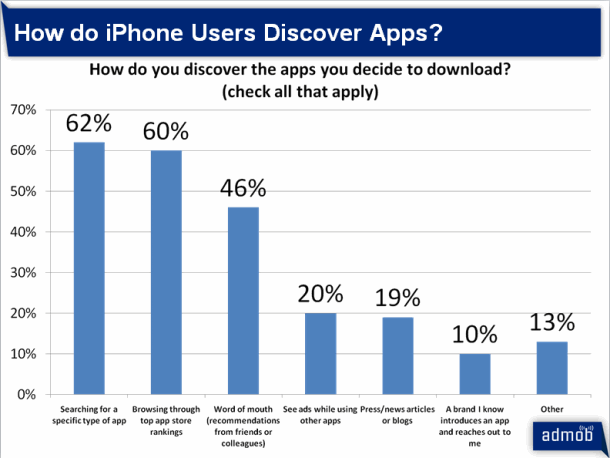
An AdMob survey looked at how consumers find the mobile apps they download. Check out the top 3 below:

Users find apps by search, rankings and word-of-mouth. Great! As it should be. Definitely describes how I’ve found apps to download.

Irrelevant, however,  for enterprise software. Distribution and usage of enterprise software is not an app store process. Employees will use the software because:

  • It’s the corporate standard
  • They’re already using it
  • They need to use it
  • It’s already achieved network effects internally, it’s the “go to” place

Adoption via the app store is not needed. The employee will already have a URL for accessing the app. For example, I use gmail for both my personal and work emails. For whatever reason, the second work gmail will not “take” on the native email function of my iPhone. So I’ve been using the web version of gmail the last several months. It’s been easy, and I didn’t need to download any app. I knew where to access the site.

3. Mobile HTML looks damn good

Visually, native apps can look stunning. They are beautiful, and functional. No limitations of web constructs means freedom to create incredible user experiences.

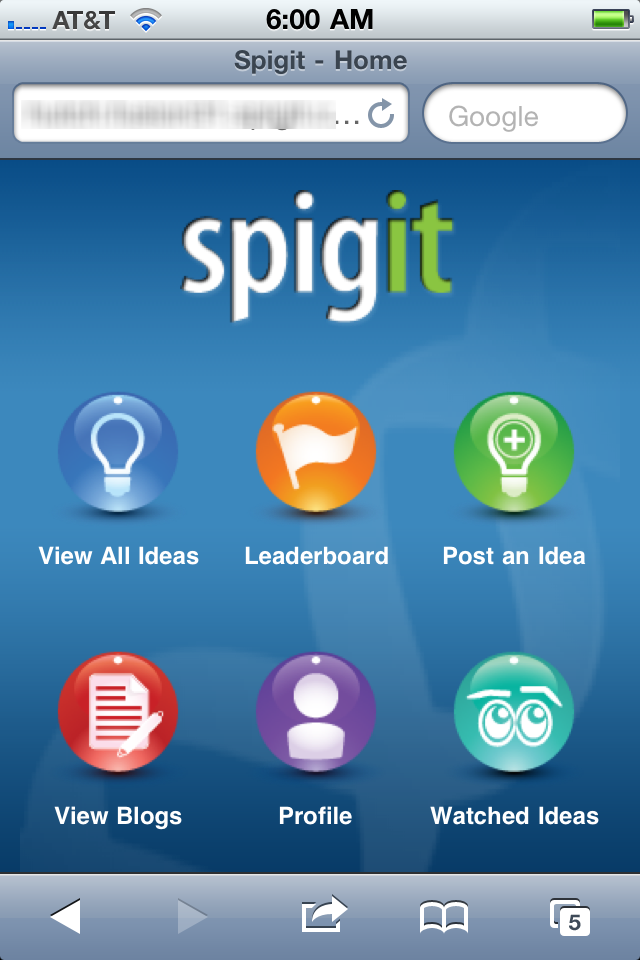
But you know what? You can do a lot with HTML5. Taking a mobile web approach to styling the page and optimizing the user experience, one can create an experience to rival that of native apps.

As you can see on the right, an enterprise software page presented in a mobile browser need not be a sanitized list of things. It can pop, provide vibrant colors, present a form factor for accessing with the fattest fingers and be indistinguishable from a native app.

Indeed, designing for a mobile experience is actually a great exercise for enterprise software vendors. It puts the focus on simplicity and the most commonly used functions. It’s a slo a chance to re-imagine the UX of the software. It wouldn’t surprise me if elements the mobile optimized HTML find their way back to the main web experience.

4. Too many mobile OS’s to account for

We all know that Apple’s iOS has pushed smart phone usage dramatically. And corporations are looking at iOS for both iPhone and iPads. Meanwhile, Android has made a strong run and is the leading mobile OS now. However, in corporates, RIM’s various Blackberry flavors continue to have a strong installed base. On Microsoft’s Phone 7 OS, “developer momentum on Windows Phone 7 is already incredibly strong.” (ArsTechnica).

Four distinct OS’s, each with their own versions. Now, enterprise software vendors, you ready to staff up to maintain your version of native apps for each?

37signals recently announced it was dropping native apps for mobile. Instead, they’re focusing on mobile web versions of their software. In that announcement, they noted the challenge of having to specialize for both iOS and Android.

Meanwhile, Trulia CEO noted the burden of maintaining multiple native apps for mobile:

“As a brand publisher, I’m loathe to create native apps,” he told me, “it just adds massive overhead.” Indeed, those developers need to learn specific skills to building native mobile apps, arguably having nothing to do with his core business. They have to learn the different programming code, simulators and tech capabilities of each platform, and of each version of the platform. By diverting so much money into this, he’s having to forgo investment in other core innovation.

A balkanized world of OS variants creates administrative, operational support and development costs. Not good for anybody.

While I’m sure there are enterprise software apps that can benefit from the native OS capabilities, such as integrated photos, for most enterprise software, mobile should be an HTML5 game.

I’m @bhc3 on Twitter.

Will Quorans Develop Enough Spine to Ensure Quality?

On Quora, this question was recently asked:

Is the upvote bias towards more popular answerers a threat to quality on Quora?

One answer caught my attention, and it’s one with which I wholeheartedly agree:

I would say it’s very important for Quora users to use those voting powers to downvote answers by A-listers that are just not good enough. There is a LOT of expertise by practitioners now, it’s up to us to upvote knowledgeable answers and downvote answers without substance when they occur, regardless of how popular the responder might be.

This is a critical cultural element that must take hold in Quora for it to thrive. If it becomes an A-Lister’s club where everything they say is gold, well, the site will slowly die.

[tweetmeme source = “bhc3”]

I’m going to give two examples where A-Listers gave irrelevant, humorous answers to a discussion. In one case, it was on Quora. In the other, it was Hacker News. The outcomes are instructive.

Dave McClure on Quora

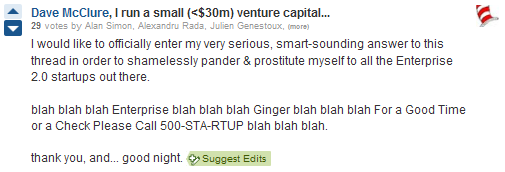
First, on Quora. There’s a question that asks, Which VCs and angels are investing in early stage, enterprise 2.0 companies? A number of VCs weigh in there. After a while, well-known angle investor Dave McClure added his own answer, a faux pandering to Enterprise 2.0 start-ups, which came across as mocking some of the other VCs’ answers. Funny? Sure. Meta commentary on the other answerers? Yup. Relevant to the original question? Not at all.

Yet check out the number of up votes it’s gotten:

Fortunately, the answer has been down-voted enough to fall from its #1 position. But it’s still the #4 answer of 17 provided. What’s with the 29 up-votes there?As a point of reference, imagine if you had written a similar answer. It would have been quickly buried at the bottom of the question with multiple ‘Not Helpfuls’.

This is not about Dave McClure, whose answer is very consistent with his personality. He’s a funny, smart guy. You’re always going to have some answers that aren’t helpful, it’s a fact of online life. But it is about the culture of the Quora community and the disconnect between the site’s objectives and the community’s actions.

Joshua Schachter on Hacker News

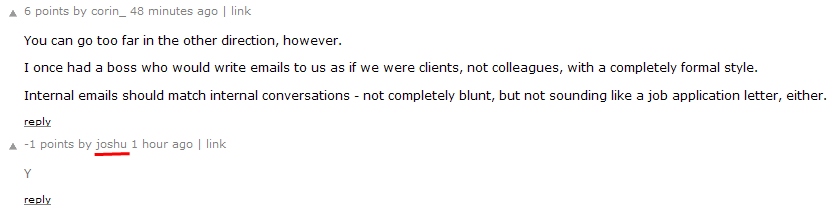
Let’s look at the case of the second A-Lister. On Hacker News, someone posted a story in the Wall Street Journal, Five Signs You’re a Bad Boss. First sign? “Most of your emails are one-word long.” That one includes an anecdote about a boss who was even worse – he wrote in single characters. Y for yes, N for no.

It hit the front page, and got a number of comments. Including one from Delicious founder Joshua Schachter (“joshu”) that was a humorous homage to that bad boss:

But check that out. Joshua was voted down by some power user on Hacker News. He actually has -1 points there. No immediate fawning, no appreciation for the humor of the A-Lister. Now in checking the answer several hours later, it has 3 points. So even Hacker News has some of that “A-Lister gets the benefit” element.

Overall, these two examples offer a clear distinction in culture between Quora and Hacker News. Hacker News continues to grow, and includes Fred Wilson as a fan:

I use techmeme, hacker news, tim o’reilly’s twitter links, dave winer’s 40 most recently links for tech news

Developing the culture that will mercilessly ding a poor or irrelevant answer regardless of source is critical to Quora. Learn to love the downvote, otherwise Quora becomes a graveyard of dead questions.

[tweetmeme source = “bhc3”]

Three Pluses, Three Minuses of Quora as a KM System

This question was posted on Quora, “In 10 words or less, what is Quora?” My answer:

Powerful application of crowdsourcing and social networking to knowledge management

[tweetmeme source=”bhc3″]

Knowledge Management (aka “KM”) is a field that I don’t have personal experience in. It’s supposed to be practices, processes and systems where valuable knowledge of workers is collected and made available for others. KM continues to be an important topic for enterprises these days, but it also freighted with many failures and disappointments.

Without the benefit of a KM history, I wanted to look at Quora in the context of someone with an objective today: how do I make it easier for employees to find and share their knowledge?

In that cntext, I see three really good things about Quora, and three things that distort its value.

The Pluses

Purpose-Built: A premise of Enterprise 2.0 is that tools need to be lightweight and flexible for multiple purposes. That’s what you get with microblogging, wikis, blogs, forums. The problem there is that the flexibility undermines their value for delivering on specific needs. One must wade through a lot of other stuff to get to what you want.

Quora is purpose-built. It’s not a place for sharing links you find interesting or talking about the American Idol selection process. It’s a place where you know there will be relevant questions, and often good answers. Which means they can focus on delivering to the purpose, not try to be all-things to all people. Important for KM.

Crowdsourcing: Very, very important. Quora leverages the the principles of crowdsourcing to elicit knowledge. It’s not just a system for experts. Too often the focus of people is to get “the experts” on the record, assuming most others have little to add. That is a shame.

The ability to follow topics allows people to track areas of either interest (to find answers) or expertise (to provide answers). As Professor Scott Page notes in his book, The Difference, everyone has a unique set of cognitive skills. To assume there are the “masters” and then there’s the “riff raff” is to lose a significant percentage of knowledge. Crowdsourcing ensure broader opportunity to get at all relevant knowledge.

Social networking: We have people we like to follow. They may be friends, and we enjoy their takes on things. Or they may be people we admire, and who have demonstrated a capacity to provide valuable answers. The personal connection here, that we have an interest in a person as opposed to a topic is valuable.

By letting me follow people, I am exposed to things that have a higher likelihood of interest to me. We can’t all be on Quora, or a KM site. But some portion of our networks will be, and seeing what they’ve been up to keeps me interested and contributes to a serendipity in acquiring knowledge.

It’s also encouraging to know I have a set of people who are receptive to me questions and my answers. Much better than a cold system of questions and answers only.

The Minuses

Discerning the wheat from the chaff: Quora gets noisy. For some, too noisy. That happens in an open platform. There will be some great answers to questions, but some pretty bad ones too.  In terms of KM, some argue for restricting participation to only the known experts:

Few are blessed with serious, specifically relevant knowledge or know-how. Any system which facilitates overly broad participation will inextricably bury any expert knowledge under a pile of low value chatter. I am persuaded that for valuable ideas & thoughts to produce innovation there need to be a highly afferent and efferent system capable of synthesizing powerful multidimensional analytical databases with the know-how of subject matter experts, the imagination of visionaries and the creative mind of innovators who do not fret from the challenge of thinking.

The community culture needs to have a strict sense of what’s valuable, what’s not. And up-vote and down-vote accordingly.

Lots of followers means lots of up-votes: This is the downside of social networking. Some people have HUGE numbers of connections. Which means they have a built-in audience for their answers above and beyond the topic followers. An army of followers can come in and cause an answer to move to first position based on that alone, regardless of answer quality.

A good solution here is to employ a form of reputation to weight those votes. Don’t let just the volume of votes determine the top answer, look at the reputation of those who are voting.

You could also weight the answers themselves according to reputation, although I’m a little wary of that. Makes it harder for new voices with quality contributions to get traction.

Incentives to participate: I’m busy. You’re busy. We’re all busy. Who has time to participate? This will always be an issue. With things like microblogging, there’s a core communication need they satisfy. So that more closely aligns with my day-in-, day-out work. But answering some distant colleague’s question?

There are a lot of ways to address this. Getting participation early on from enthusiasts goes a long way in terms of demonstrating value (something Quora has done). Getting kudos for good answers is a huge motivator. Obviously, getting a good answer just once is critical to seeing the value. And Q&A seems like a perfect activity for applying game mechanics.

All in all, I really like the KM potential for Quora. It doesn’t need to be as heavily active as Twitter, but benefits from a broader participation than what is seen in Wikipedia. The minuses are challenges to overcome, but they are not insurmountable.

[tweetmeme source=”bhc3″]