Would You Apply a ‘Dislike’ to Your Co-Workers’ Content?

On Digg, you can apply the “bury” rating to stories. On Amazon.com, you can apply a single star to rate something negatively.

Would you ever do that to the work of your colleagues?

I’m not talking the annual HR exercise of 360 reviews. I’m talking Enterprise 2.0 apps, which incorporate the features we see out in Web 2.0. The ability of people to rate the content they see.

A few social media sites have taken a binary approach to ratings: (1) positive rating, or (2) abstain:

While some others are incorporating the notion of negative ratings:

Out on the Web, where you’re interacting on platforms with thousands of anonymous or unknown people, negative ratings make sense and help bring some order to the scrum of content and products.

See Louis Gray’s post for a good perspective on this whole rating thing in social media.

Inside companies, things are a little different. There’s a vetting of other Enterprise 2.0 users, in the form of the hiring and annual review process. This automatically raises the average quality of contributions.

And there’s this….Enterprise 2.0 apps are used by people you know and work with. People you’re going to see in meetings, on projects and who have common connections. A negative rating to someone’s Yammer or wiki entry or social bookmark is a big deal. You’re essentially saying:

“Dude, this is bad. I mean really bad. So bad that I had to ‘dis you and let the rest of the organization know how bad it is.”

Personally, I’d have a hard time with this. In the most egregious cases, I’d apply the negative rating. But I’d strongly prefer to “work it out” in the comments to the original content.

My concern is that a negative rating turns into a basis for internal feuding and chills open discussion about ideas, information and observations. But in a large organization with a heavy flow of content, maybe the negative rating is the most efficient way to handle the value if information.

Perhaps I’m in the minority here. How about you? Would you give a thumbs down to your co-workers’ content via Enterprise 2.0 apps?

*****

See this post on DFriendFeed: http://friendfeed.com/search?q=%22Would+You+Apply+a+%E2%80%98Dislike%E2%80%99+to+Your+Co-Workers%E2%80%99+Content%3F%22&who=everyone

Tim O’Reilly Course Corrects the Definition of Web 2.0

eBay was Web 2.0 before Web 2.0 was cool.

Tim O’Reilly wrote a nice piece the other day Why Dell.com (was) More Enterprise 2.0 Than Dell IdeaStorm. In the post, he re-asserted the proper definition of Web 2.0. Here’s a quote:

I define Web 2.0 as the design of systems that harness network effects to get better the more people use them, or more colloquially, as “harnessing collective intelligence.” This includes explicit network-enabled collaboration, to be sure, but it should encompass every way that people connected to a network create synergistic effects.

The impetus for Tim’s post was that people leave Google and its search engine off the list of Web 2.0 companies. As Tim writes, seeing the power of what Google’s search engine did was part of the notion of Web 2.0.

Here’s a way to represent what Tim is talking about:

I like that Tim sent out this reminder about Web 2.0. Here’s how Web 2.0 has become defined over the years:

  • Social networking
  • Ad supported
  • Bootstrapped
  • Fun and games
  • Anything that’s a web service

This seems to have fundamentally altered Web 2.0. I’m reminded of a post that Allen Stern wrote back in July, CenterNetworks Asks: How Many Web 2.0 Services Have Gone Mainstream? In that post, he wondered how many Web 2.0 companies will really ever go maintream.

Check out the comments on Allen’s blog and on FriendFeed:

I would say MySpace but that really came before Web 2.0

mainstream – Facebook/hi5/bebo, Flickr, Youtube, Slide, Photobucket, Rockyou

Oh and you’ll have to add Gmail to the list as well.

I’ve yet to see one, really. 😉

Is eBay web 2.0-ish? [this was mine]

Agree with Facebook, MySpace, YouTube. I’d add Blogs as another 2.0 winner. I’d put eBay and Amazon as 1.0 success stories

A better way to ask this is “which web services since 2000 have gone mainstream?” Blogger. Flickr. Gmail. Facebook. MySpace. Digg. YouTube. WordPress. Live Spaces

Look at those responses! You can see a massive disconnect between Tim O’Reilly’s original formulation of Web 2.0 and where we are today.

One example I see in there: Gmail. Gmail is a hosted email application. Does Gmail get better the more people use it? No. There’s no internal Gmail application functionality that makes it better the more people use it. It’s just an email app the way Yahoo Mail is an email app. Being a web service and ad-supported isn’t, strictly speaking, a Web 2.0 company.

Terms do take on a life of their own, and if the societal consensus for a definition changes over time, then that’s the new definition. But the responses to Allen Stern’s post highlight two problems:

  • People discount or ignore key components of the Web 2.0 definition
  • Web 2.0 is slowly coming to mean everything. Which means nothing.

Finally, Tim’s post helps me differentiate the times I should use “social media” as opposed to “Web 2.0”.

What do you think? Should we go back to first principles in defining what really is “Web 2.0”?

*****

See this post on FriendFeed: http://friendfeed.com/search?q=%22Tim+O%E2%80%99Reilly+Course+Corrects+the+Definition+of+Web+2.0%22&who=everyone

How Would Social Media Help You in Your Job?

I’m having a ball with social media out in the consumer web. Blogging, FriendFeed, Twitter, Facebook. I’m learning so much about technology, new companies and people’s attitudes regarding Web 2.0. Along the way, some collaboration and a new job actually happened out of all this fun.

Now why can’t we see some of these same effects in the place where most of us spend a third of our day? We’re seeing live implementations of social media inside organizations (aka Enterprise 2.0). It’s a good sign.

I’m now in a job where I’m thinking about this a lot. And I figured I’d start with myself. Where would social media have made a difference in my two previous Big Corporate jobs:

Both companies were examples of today’s modern company, with a heavy information orientation. It’s been years since I worked at either, but here is how social media could have helped me in my jobs.

May Department Stores

The buying office of a retailer is responsible for picking the merchandise you see on the floor. Buyers also plan and execute promotions, set prices and ensure optimum amount of inventory on the floor and in the warehouse. We also had to communicate with the department managers of dozens of stores.

Here are the social media that would have helped me (if we had the Web back in 1990-1994):

  • Twitter: Yup, I would have loved Twitter. An easy way to fire off updates out to the field of department managers. And they would have sent back news of things they were seeing. Would have been a huge help during the crazy Christmas season.
  • Blog: I would have blogged about the weekly promotions. There’s a fair amount of work that went into them (promo prices, signage, focus of the ads), and documenting all that would have been useful. New products that we bought would have been good to discuss as well.
  • Bookmarking and notetaking: Assuming we had the world wide web back then, I would have bookmarked and noted a number of things for the job: competitor ads and pricing, product promotions I liked, new products I’d seen elsewhere.

Bank of America

At BofA, my group raised debt for corporations. Deals could run anywhere from $25 million to $6 billion. It was an information-intensive job.

The work consisted of three primary activities: (1) win the deal; (2) sell the deal; (3) close the deal via documentation. You had to stay on top of comparable deals, industry trends, capital market trends and general market chatter. Our group was divided into Structurers (me), who worked with clients to win and structure deals; and Distribution, who sold the deal to the market. Distribution always had the best information.

Social media I would have wanted:

  • Twitter: Again! I really would have wanted to see the ongoing chatter of the Distribution guys. They picked up all sorts of incredibly valuable market intelligence during the day. They used to IM. Now I’d want them to tweet.
  • Wiki: Every deal should have had a wiki space, with its “win the mandate” phase, its “sell it to the market” phase and the documentation phase. Wikis would have been good for handling the whole deal cycle.
  • Feed Reader: There were market data publications to which BofA subscribed. Getting a feed of deal information would have been a huge help. We were chasing information down in paper publications.
  • Bookmarking and notetaking: When deal, market or industry news came through, I needed a place to save it. I was always going back to find stuff I’d seen earlier. Bookmarking would have helped a lot. Note taking too – capture some information or thoughts, tag it and come back to it later.
  • Blog: My group wouldn’t have had much use for a blog amongst ourselves. But a blog that updated the rest of the bank as to what was happening in our particular capital market (syndicated loans) would have been perfect. We had other groups asking us often about market conditions.

I’d Love to Hear About You

Maybe you’re already using social media inside your company. Or perhaps you’ve been thinking, “my company really needs…”

If you’ve got any ideas to share, I’d love to hear them.

*****

If you want an easy way to stay on top of Enterprise 2.0, I invite you to join the Enterprise 2.0 Room on FriendFeed. The room takes feeds for Enterprise 2.0-related items on Twitter, Del.icio.us and SlideShare. To see this room, click here: http://friendfeed.com/rooms/enterprise-2-0

*****

See this post on FriendFeed: http://friendfeed.com/search?q=%22How+Would+Social+Media+Help+You+in+Your+Job%3F%22&public=1

Why Isn’t This the Tag Standard? Multi Word, Comma Separated

Tagging is a great way to put context on user generated content. The tag cloud to the right shows what the hundreds of thousands of blogs were talking about on the evening of August 21. (Click the image to see what bloggers are talking about right now).

Pretty much any web 2.0 service that has user-generated content supports tags. Flickr. YouTube. Del.icio.us. Google Reader. Last.fm. Tagging is entrenched in the web 2.0 world, and it’s one of those idea that spread without any standards.

But there is a problem of no single standard…

Beta, VHS.

Blue-Ray, HD-DVD.

Space or comma delimited?

What’s happened is that tagging formats are all over the map. Each web 2.0 service came up with what worked best for its product and developers:

This post at 37signals described the same tag formats above, and it got a lot of comments. Good energy around the subject. Brian Daniel Eisenberg thinks the failure to have a consistent tag method may undermine its adoption by the masses.

To me, there really is one best format.

Multiple Words, Comma Separated

I tweeted this on Twitter/FriendFeed:

Can there be a universal standard for tags? Multi-word tags, comma separated. Odd combos (underscore, dot, combined) are messy, inconsistent.

You can see the comments on the link. The gist of them? Multiple words, comma separated is the best format. Here’s why I think so:

  • Forced separation of words changes their meaning (“product management” or “product” and “management”)
  • Forced separation of words creates tag clouds that misrepresent subjects (is it “product” content? or “management” content?)
  • With single terms, too many ways for users to combine the same term:
    • productmanagement
    • product.management
    • product_management
    • product-management
  • Writing multiple words with spaces between them is the way we learn to write
  • Putting commas between separate ideas, context, meanings and descriptions is the way we write

Let people (1) use more than one word for a tag, (2) written naturally without odd connectors like under_scores, and (3) using commas to separate tags. These rules are the best fit for germanic and romance languages, and I assume for most other languages as well.

To Brian’s point about the masses, let’s make tagging consistent with writing.

For Developers, It’s Pretty Much a Non-Issue

In The Need for Creating Tag Standards, the blog Neosmart Files writes:

Basically, it’s too late for a tagging standard that will be used unanimously throughout the web.

A lot of developer types weighed in on the comments. For the most part, they’re sanguine about the issue of different formats. Rip out any extraneous characters like spaces, periods, underscores, etc. What’s left is a single string that is the tag.

It’s About the Users

The issue fundamentally is how boxed in people are if they want to tag. In the Neosmart Files post, commenter Jason wrote this:

As this topic suggests, there are issues in resolving various tags that whilst literally different they are contextually equivalent. I believe this to be the critical juncture. Perhaps the solution lies not in heaping upon more standards, but improving the manner in which tags are processed by consumers.

From my perspective, multiple word, comma separated format is the most wide open, flexible way to handle tags. If a user likes running words together, he can do it. If a user wants to put underscores between words, she can do it. If a user likes spaces between words, not a problem.

But making users cram together words in odd combinations takes them out of their normal writing and thinking style. Tags should be formatted with humans in mind, not computers.

That’s my argument. What say you?

*****

See this post on FriendFeed: http://friendfeed.com/search?q=%22Why+Isn%E2%80%99t+This+the+Tag+Standard%3F+Multi+Word%2C+Comma+Separated%22&public=1

Good Move = Kleiner Perkins Drops Web 2.0, Goes After Alt Energy

I just read a nice piece in Fortune, Kleiner Bets the Farm. The article describes Kleiner’s big move into alternative energy. And this move comes at the expense of investments in new Web 2.0 companies.

Kleiner’s halting investments in Web 2.0 generated quite a discussion last November. Tom Foremsky reported the firm’s change of heart to kick off the discussion. In that article, he wrote this:

The firm is one of the trend setters in Silicon Valley, with a long string of massively successful investments over several decades. And Silicon Valley VC firms always invest in trends, rather than companies.

Which is what makes Kleiner Perkins’ new investment focus so interesting. And a good direction.

$4.00 Per Gallon = Better Green Tech ROI

Now that filling up your car requires $50, $60, $70 or more, consumers are much more interested in changing energy habits. And businesses are going to be whacked hard as well, with the costs inevitably costing us more money everywhere. Yeah, we’re ready for some changes.

I’m no expert in the field, but a common problem with generating alternative sources of energy is the high cost of production. But now with oil prices going through the roof, those alternative sources of energy suddenly look better.

Here’s one example: hydrogen fuel-powered cars. Hydrogen is a clean, abundant source of energy. But it’s not yet commercially viable. In 2003, gubernatorial candidate Arnold Schwarzenegger proposed a plan to foster the production and adoption of hydrogen powered cars. President Bush echoed this idea in a 2006 Earth Day speech:

It (hydrogen) has the potential — a vast potential to dramatically cut our dependence on foreign oil.

Good news, right? Well, the reality has not yet met the aspirations. First, there’s the cost of hydrogen fuel. Research Capital analyst Jon Hykawy had this to say about hydrogen-powered cars:

In my view, the hydrogen car was never alive. The problem was never could you build a fuel cell that would consume hydrogen, produce electricity, and fit in a car. The problem was always, can you make hydrogen fuel at a price point that makes any sense to anybody. And the answer to that to date has been no.

And this year, Govern Schwarzenegger had to retreat from his ambitious hydrogen and electric car  goals.

Which leaves us with $4 gas.

At some point, oil prices will cross over the economic threshold for other energy sources to become economically viable. Waiting until then will be bad, because commercial development of these alternatives will take several years. We need to get our collective asses moving to drop our dependence on oil. We need new investment dollars flowing into that sector now.

Web 2.0: Feature or Business?

We’re several years deep into the Web 2.0 revolution. Allen Stern at CenterNetworks asked How Many Web 2.0 Services Have Gone Mainstream? The answer? Not many. How many have had an IPO?

That’s not to say that Web 2.0 is going away. Anything but. What does seem to be happening is that Web 2.0 is being integrated into the traditional big software and Internet players. I did product marketing for BEA Systems’ Enterprise 2.0 apps. Not some small company, but a big name Web company adding Web 2.0 to its existing portal platform.

There will be Web 2.0 businesses that succeed. Most seem to be acquisition bait. Some will break through in a public offering.

The low cost of entry to create Web 2.0 businesses has democratized company creation. If you want to be snarky, you might say that just means a bunch of crappy apps have been created. This is true. But from a capitalist point of view, all that creativity is healthy because some good companies come out of all that.

Web 2.0 companies have become easier to create, and funding has generally not been a problem.

As Kleiner Perkins Goes, So Goes Venture Capital?

Going back to Tom Foremsky’s quote, is Kleiner Perkins the first of what will be several firms to change focus to alternative energy? My impression is that alternative energy is at the stage of two guys hacking together a computer in their garage. Some interesting experimentation, but clearly there’s a need to ramp things up dramatically, with attention, experimentation and financing.

Go Kleiner Perkins. And I hope other VC firms are following suit. And don’t worry. Web 2.0 will be fine.

*****

See this post on FriendFeed: http://friendfeed.com/search?q=%22Good+Move+%3D+Kleiner+Perkins+Drops+Web+2.0%2C+Goes+After+Alt+Energy%22&public=1

Email’s Changing Role in Social Media: Digital Archive, Centralized Identity

Alex Iskold wrote a great post recently, Is Email in Danger? This quote lays out the premise of the post:

From the 20th century mail was a fundamental form of communication. The invention of electronic mail (email) changed two things. It became cheap to send mail, and delivery was instant. Email became favored for both corporate and personal communication. But email faces increasing competition. Chat, text messages, Twitter, social networks and even lifestreaming tools are chipping away at email usage.

When it comes to email, there are some parallels to what happened to snail mail with the spread of the Internet and email. The biggest thing is this:

Snail mail found an unexpected opportunity for growth with the rise of the Web.

Email will lose out on some of its uses, but there are some interesting possibilities that will emerge.

The Disruption of Snail Mail

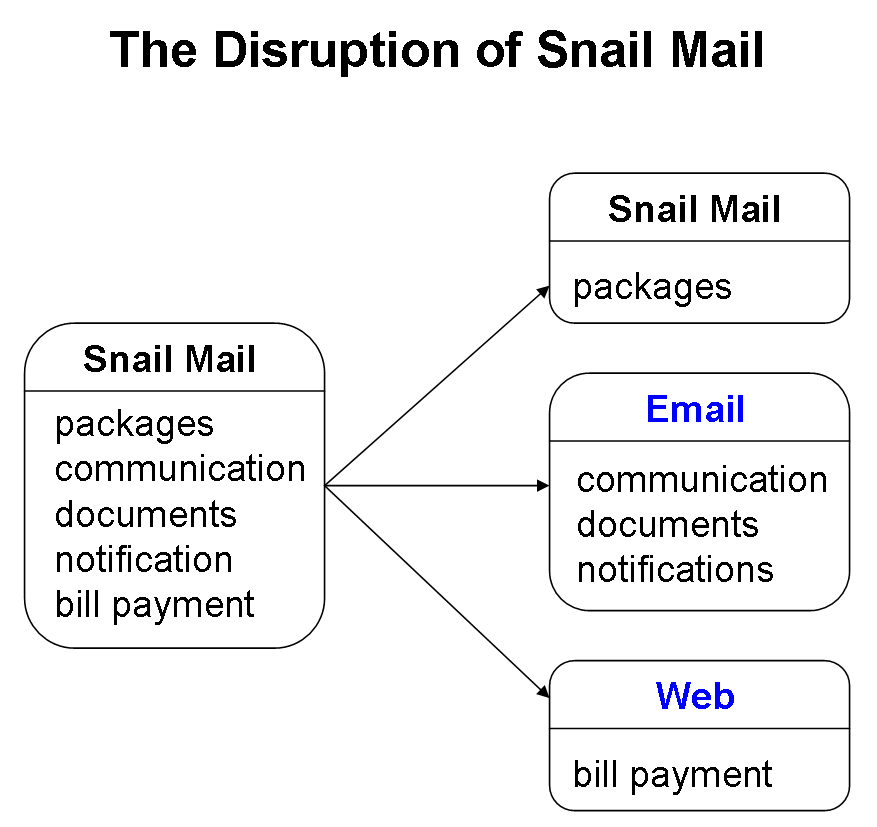
The diagram below depicts the disruption that occurred to snail mail.
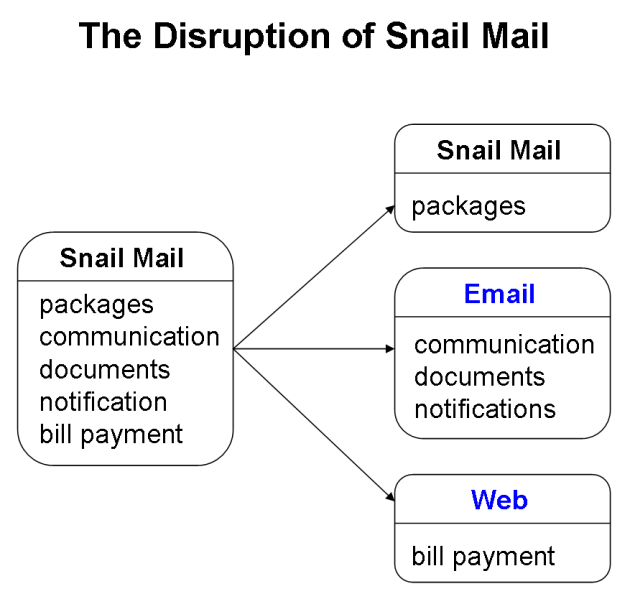
I’ve kept the disruption focused on the effects of the Internet. In other words, no fax machine or FedEx in here.

Back in the day, the mail system was the way you got a variety of important communications to other people. Our grandparents wrote letters. L.L. Bean mailed us the stuff we ordered via their catalogs. All our bills came through the mail. We were notified of things like jury service.

With the arrival of the Net, a good portion of snail mail’s portfolio was assumed by other technologies. And it’s had an effect. Here’s a quote from a 2001 General Accounting Office report on the future of the U.S. Postal Service:

Although it is difficult to predict the timing and magnitude of further mail volume diversion to electronic alternatives and the potential financial consequence, the Service’s baseline forecast calls for total First-Class Mail volume to decline at an average annual rate of 3.6 percent from fiscal years 2004 through 2008.

Pretty bad, eh? Electronic alternatives were evaporating the revenues of the post office.

But something else was out there which would help offset these losses in first-class mail: e-commerce. With the growth of the Internet, people got more comfortable shopping online instead of going to their local mall.

Those packages had to get to shoppers somehow. That’s where the U.S. Post Office shined. It already had the infrastructure to get things from a centralized place to multiple individual residences. What got disrupted were the trucking companies who moved merchandise from manufacturers to retailers.

Sure enough, the U.S. Postal Service saw a rebound thanks to online purchases, according to Web Designs Now:

In 2005, revenue from first-class mail like cards and letters, which still made up more than half the Postal Service’s total sales of $66.6 billion, dropped nearly 1% from 2004. But revenue from packages helped make up for much of that drop, rising 2.8%, to $8.6 billion, last year, as it handled nearly three billion packages.

And the dark mood at the U.S. Postal Service headquarters brightened quite a bit:

“Six years ago, people were pointing at the Web as the doom and gloom of the Postal Service, and in essence what we’ve found is the Web has ended up being the channel that drives business for us,” said James Cochrane, manager of package services at the Postal Service.

There is a lesson here for email.

The Disruption of Email

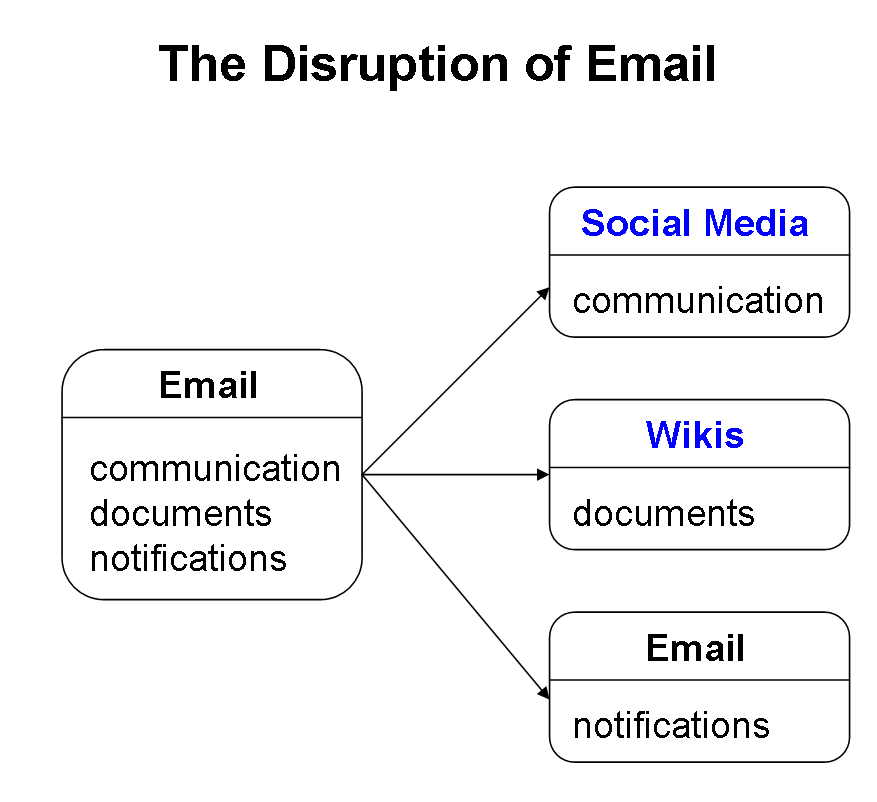
Email is undergoing its own disruption:
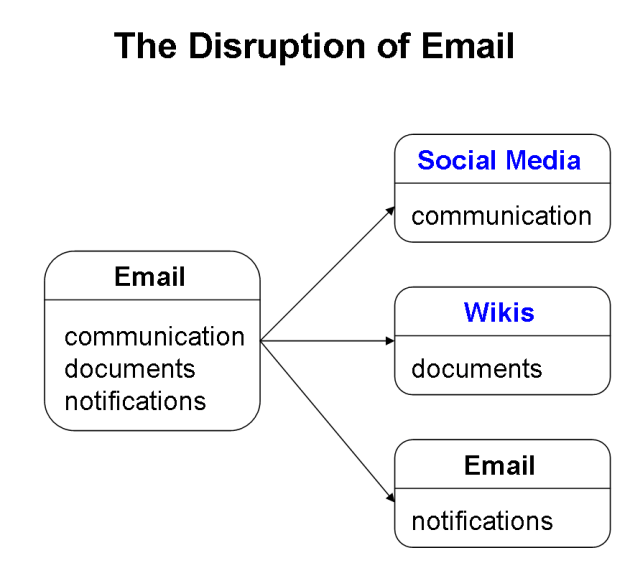
Again, similar to the previous diagram, I’m focusing on the web here. No mobile texting as an email disruptor, even though it is.

As Alex outlined in his post, the easy messaging of social media is supplanting the email messages that used to be sent. I haven’t seen any surveys that show the decline in person-to-person communications because of email. But my own experience reflects the migration of communications to the various social media.

  • LinkedIn messages
  • Facebook messages
  • Twitter
  • FriendFeed comments

As Zoli Erdos pointed out in his blog post Email is Not in Danger, Thank You, wikis are growing as the basis for sharing documents. They provide better capabilities than does email: wider visibility, versioning and searchability.

But it’s in notifications where email’s future is bright. Many of us are members of social media sites. As we go through our day, it’s hard to stay on top of activity in each one: new messages, new subscribers, new friend requests, etc.

Where is the central clearinghouse of my multiple social media identities? Email.

Email is the permanent record of what’s happening across various sites. This is actually a very valuable position in which to be. Here are two examples where email helped me:

  • After I wrote a post about nudity on FriendFeed, I lost some FriendFeed subscribers. I know this because my number of followers went down. There was one person in particular I wanted to check. This person wasn’t on my list of followers, and I thought, “maybe wasn’t subscribed to me in the first place?” Checked email, and I did indeed have a follow notification from this person a few weeks earlier. So I knew I’d been dropped.
  • I inadvertently deleted a comment to this blog. On wordpress.com, once deleted, the comment is not recoverable. I was in a bind. But then I realized I get whole copies of comments to this blog emailed to me. So I went to Gmail and found the comment notification. I was able to add the comment back by copying it from my email.

As snail mail had to adjust to the rise of email, so too will email adjust to the rise of social media:

As the number of social media sites and participation in them expands, email will find new growth and value in being the centralized notifications location.

Email = Centralized Identity Management

Much has been written about email being the ultimate social network. The basis for this is your address book and the emails you trade with others. But might there be another opportunity for email?

If email has all these subscription and message notifications, doesn’t it potentially have a role in helping you manage your centralized identity? Gmail could map out my connections across various sites. Find those that are common across the sites. Gauge the level of interaction with others.

Even add APIs from the various sites and let me send out communications from email. Suddenly, email’s back in the communication game as well.

I’m just scratching the surface of what might be possible here.

What Do You Think?

Email’s primary role as a communication medium is diminishing. Many of us are enjoying the easy, contextual basis of communicating via the various social media sites.

But like snail mail before it, email has interesting possibilities for what it will do for us in the future.

What do you think?

*****

See this post on FriendFeed: http://friendfeed.com/search?q=%22Email%E2%80%99s+Changing+Role+in+Social+Media%3A+Digital+Archive%2C+Centralized+Identity%22&public=1

What does this mean? “Organize the world’s energy”

Through a Fred Wilson post, I decided to check out Umair Haque’s call for the development of technologies that will help a number of the world’s problems:

Organize the world’s hunger.
Organize the world’s energy.
Organize the world’s thirst.
Organize the world’s health.
Organize the world’s freedom.
Organize the world’s finance.
Organize the world’s education.

The piece lays out some strong indictments of capitalism and the focus of web 2.0. To be honest, that’s pretty damn offputting for me. Socialistic urges don’t interest me.

But Fred Wilson is a smart guy, so I decided to read through Umair’s post and all the comments. I really wanted to know what he meant by “organize the world’s” problems.

As I read the comments to Umair’s post, I saw a recurring theme. Businesses and providers of capital just don’t get it, just don’t have the right incentives for this. No one really had a good answer for changing these dynamics. But the post made for some good venting, such as this comment by Platypus:

Bloggers are the online equivalent of “ladies who lunch”–a bunch of rich people chattering amongst themselves about how they’re going to spend their afternoons.

In the post itself, Umair provides an analogy that really helped me understand what he’s thinking. And it’s less socialistic than his preamble sounded:

Google utilized a market – AdWords – to utterly eviscerate a stale, broken media value chain. Here’s a more visceral example. Muhammad Yunus revolutionized finance – not by collecting more money to lend, but by using communities to fundamentally alter the value equation of lending to the poor. The result was industry transformation.

See the similarity? Two vastly different industries – finance and media – were both revolutionized by new DNA. It was new ways to organize and manage that exploded the boundaries of value creation.

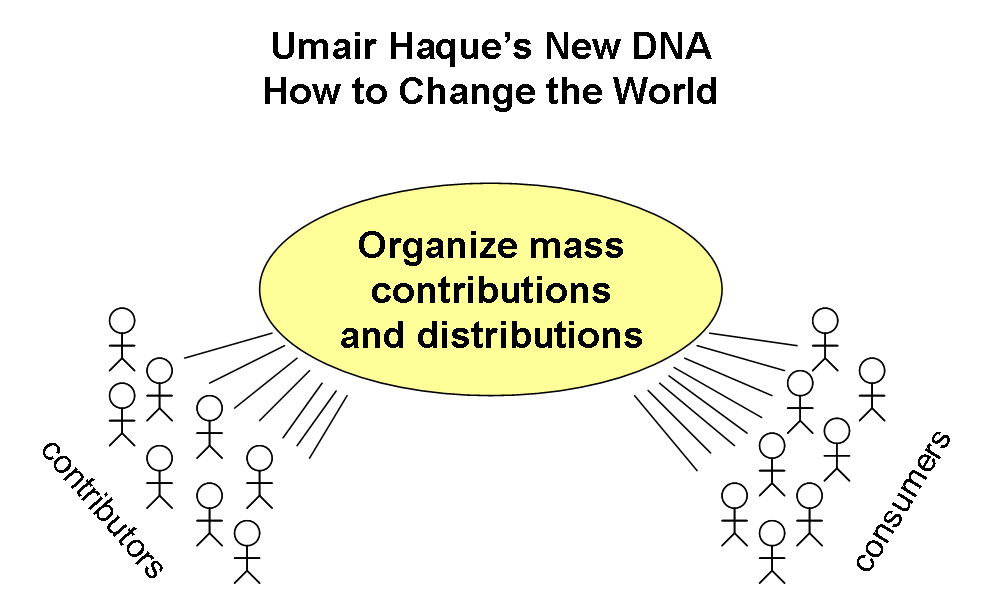
The new DNA to which Umair refers is the web 2.0 ethos – people’s contributions and ideas create new value in hidebound industries. Also note that in both cases there was an organizer for people’s contributions. Google for web pages, Muhammed Yunus for the solicitation of capital. Here’s a graphical depiction of what he’s talking about:

Yes, that looks like most social media sites. Hence the web 2.0 angle.

But it’s hard to apply this model to heavier, capital goods sectors. Google applies the above model to digital information. Microcredits apply the above model to digital currency transactions (until the “last mile” where someone actually needs cash).

Capital goods aren’t as easy as transferring digital information. Moving water is capital intensive. Energy production and transfer is capital intensive. Agriculture is capital intensive. These don’t lend themselves well to the disruptive flows that digital information does.

With oil and gas prices through the roof, I want to stay on that problem. There are two ways to read the New DNA when it comes to energy.

  1. Web 2.0 allows more people to find out about energy production, usage and alternatives
  2. People will create their own sources of energy, the way they might create their own blogs

In #1, people could provide information of value to the organizing entity. Paul Kedrosky asks about something like this in a tweet:

why is there no Mint/Wesabe for home energy use? i want a tool that integrates all my energy/water/etc into a single web dashboard

Not bad, it puts conservation at the forefront. And you could compare your usage to that of others.

In #2, people would actually provide power to the organizing entity. Well, that becomes more capital intensive. Honey, we’ve left the web.

But there are probably some good possibilities out there. Solar panels for every home sounds plausible. And in Fred Wilson’s post, there’s this idea from one of the comments:

The friend I refer to in my comments on HN: he’s a grad student who has built a small-scale digestor that can convert any type of waste — human/animal/food — into usable energy. He is not a guy for hype, but he says it could technically replace every septic tank in America. That’s huge.

I don’t how real that idea is. Sounds promising. How much energy would it really produce? My dinner scraps probably won’t power much. In that comment though, I do see that there are people much more learned in the field of energy than me. So I won’t discount the possibility that individuals could create new sources of energy. But it does seem like a stretch, just based on my physics courses where we learned about the law of conservation of energy. I don’t where the untapped energy sources are around my house.

So we’ll see what Fred comes up with over the next year or two in relation to Umair’s post. Was Umair’s manifesto more feel good exhortation or the start of innovation desperately needed in a number of areas?

*****

See this post on FriendFeed: http://friendfeed.com/search?q=%22What+does+this+mean%3F+Organize+the+world%E2%80%99s+energy%22&public=1

Do Companies Need Social Media Managers?

There are few institutions in the modern world that are not being transformed today by social media.

Shel Israel, Global Neighborhoods, 5 New Social Media Turn-ons for me.

Encouraging use and engagement with [social] tools is an area that all organizations find they have a need for at some point and time. Use of these tools and engagement by people in an organization often does not happen easily. Why? Normally, most of the people in the organization do not have a conceptual framework for what the tools do and the value the individuals will derive.

Thomas Vander Wal, vanderwal.net, Enterprise Social Tools: Components for Success

Social media is taps into a deep well of user knowledge and innovation that previously had been limited to people’s close offline contacts. FriendFeed, Twitter, Facebook, Flickr, del.icio.us and others have not so much invented new ways of thinking as they have created new ways to surface intellectual energy and creativity, and significantly expanded the conversations one has.

How does this translate into the workplace? Thomas Vander Wal’s quote above hits on one of the biggest hindrances. Just throwing tools at people and saying “have at it!” will be a colossal failure. For many people, social media requires a slow romance before they become wed to it. Want to see how much romancing is needed? Read this guy’s comment about Twitter on TechCrunch.

The thing about social media is that once people get it, they really get excited about it. Facebook has experienced terrific growth. Twitter is edging more closely to early mainstream. FriendFeed is rapidly growing. But all of these companies had a chance to incubate and grow an enthusiastic set of early adopters, which leads to broader usage.

There are two issues for companies to address in the adoption of social media:

  • Slow internal adoption can cause the initiative to die from lack of focus and budget.
  • The real benefit of social media comes when many people participate. Slow adoption means companies won’t see good benefit for a while.

How can companies accelerate adoption of social media inside by employees? An enthusiastic group of innovators is always a requirement. In addition to that, how about creating a new position? The social media manager.

The Social Media Manager?

I know such a suggestion will get eye-rolls by some. Fair enough. But hear me out.

I mentioned this idea of an employee emerging as a social media manager to someone the other day. His response was that it sounded like another version of the head of knowledge management inside a company. That was interesting take. The role of the Chief Knowledge Officer seems to include a role for social media adoption, at least as I read the definition of the role on wikipedia (here).

I’m not nearly literate enough in the field of knowledge management to know what works and doesn’t work. But I suspect there’s a big difference between a knowledge manager and a social media manager:

The social media manager is a personality-driven role

Getting people out of their shells to participate in social media will take more than a handbook and a set of best practices. The successful social media manager will be someone who can engage a wide variety of personality types. Who can handle a variety of viewpoints. Who has a thick skin, because…

The social media manager should have some skin in the game

By that, I mean the person should have some opinion about what’s best for the company. Not an absolute, draconian opinion. But a confident feeling for what makes sense for the company relative to its customers, markets, competitors and products and services. And that confidence extends to entertaining differing positions from her own. A social media manager should exemplify F. Scott Fitzgerald’s famous quote:

The test of a first-rate intelligence is the ability to hold two opposed ideas in the mind at the same time, and still retain the ability to function.

After reading this, I realize that it makes the social media manager seem like some sort of uber-participant, eclipsing all others. If that happens, then we have social media FAIL. Rather, a good social media manager will have the ability to stir up enough interest in subjects to get people participating amongst themselves.

Work of the Social Media Manager

There are three basic functions of the social media manager:

  1. Initiate discussions
  2. Participate in discussions
  3. Report on discussions

Initiation is particularly important in the early stages of the social media rollout. People need a jump start to participate, and someone willing to show how it’s done is important.

Participation keeps the social media manager relevant and build connections with others. In a large organization, no one will know everybody. So participation – the crux of social media – is a requirement.

Reporting is a way to show the benefit of participating. The social media manager can report out all sorts of things to foster interest and participation:

  • Good discussions
  • Tag buzz – hottest tags right now
  • Interesting activity streams (e.g. sales closed)
  • Rising wikis
  • Etc.

Reporting occurs via RSS and that reliable corporate communication method…email. Why report? Make sure people are aware of good stuff. And ensure good participants are recognized. This latter point is important, as it speaks to the motivation of employees. Employees are ambitious and want to succeed. Burnishing reputations via social media is a strong motivation.

It turns out this motivation dovetails with the goals of the company as well. Good social media usage benefits companies in a number of ways.

Final Thoughts

Ideally, the social media manager likely emerges organically from early users. Someone who’s a natural. If needed, someone can be appointed to the position. I’d also expect the position to change hands over time.

Note that there are those out there on the web who serve these de facto positions for a lot of us.

The thing about social media out on the world wide web is that it attracts a large number of people from all over the place, all around the world. It just takes a relatively small percentage of people to get social media going. Inside companies, more motivation is required to get things moving because there is a much more limited pool of users from which to draw adoption.

What do you think?

[UPDATE – this article mentions someone who has exactly this role: http://tinyurl.com/5zehew]

*****

See this item on FriendFeed: http://friendfeed.com/search?q=%22Do+Companies+Need+Social+Media+Managers%3F%22&public=1

Web 2.0 Inside the Enterprise? Forrester, AIIM Weigh In

Forrester produced a well-covered report this week announcing that Enterprise 2.0 will be a $4.6 billion business by 2013. In my RSS feed of FriendFeed updates containing the term Enterprise 2.0, there were probably a couple hundred related to this report – Google Reader shares, bookmarks, Twitters, etc. Sarah Perez of ReadWriteWeb has a great post about the Forrester report, with dollar figures.

About a month ago, AIIM came out with its own report on the market for enterprise 2.0. It was a work produced in conjunction with the likes of Stowe Boyd and Andrew McAfee.

After reading both of these reports, it’s clear there is a common perspective out there, but some differences worth noting as well. It’s instructive to look at both.

Forrester: Projections Focus

Forrester is paid for its expertise and forecasting. Their reports are well-regarded in this regard. Based on surveys of over 2,200 companies, this report is a forecast of the dominant technologies of Enterprise 2.0. Grounded in the market, fueled by its analysts’ views.

Forrester’s report strongly cleaves the Enterprise world into internal facing and external facing uses.

AIIM: State of the Market Focus

AIIM’s goal seems to be more of an Enterprise 2.0 temperature check of companies today. Surveying 441 company representative, AIIM didn’t try to forecast the future so much as see where companies’ heads are today.

AIIM’s report addresses both internal and external uses, but generally blurs the discussion between the two.

No Unanimous View of Top Technologies

Forrester’s report considers seven different technologies for the Enterprise 2.0 space. AIIM’s report goes much deeper. AIIM’s respondents came up with a much larger set when asked the question, what technologies make up your definition of Enterprise 2.0? To compare the two analysts, I selected the top seven participant responses from the AIIM report. Here’s how Forrester and AIIM show the leading technologies of Enterprise 2.0:

Five technologies showed up consistently between the analyst reports:

  • Social networking
  • Wikis
  • RSS
  • Blogs
  • Mashups

It’s interesting to note the differences between the two reports. Forrester included podcasting as a leading area of spend for Enterprise 2.0. AIIM’s report includes podcasting as well, but survey participants didn’t include it very often in their current definitions of an Enterprise 2.0 platform.

Forrester’s report did not include social bookmarking and tagging, but AIIM did. The Forrester omission probably says something about their view of the dollars to be spent on it.

Forrester included widgets, which is a nod to their strong focus on external uses of Enterprise 2.0. AIIM’s respondents like collaborative filtering, which is the basis for recommendation engines.

A Few Thoughts

Social networking comes in strong on both analyst reports. Forrester has spending here running away from all others by 2013. Call this the Facebook effect (MySpace didn’t seem to inspire the same trend to the enterprise). Generally, Facebook controls its “borders” and has a handle on everything that’s going on. Relationships, groups and activities all occur within the walled garden. Enterprises share a lot of these characteristics. Social networks will become the next generation intranet.

Also, note the disparity here. Companies are just coming to terms with the idea of social networks for employees, while the blogosphere seems to have left the mainstream social networks behind. Call that difference between the easy freedom of thinking and conversations, and the hard decisions of where to spend money and sweating your stock price.

Wikis come in surprisingly low on the Forrester side of things. I say that because some of the best known uses of Web 2.0 technologies inside companies are wikis. In fact, wikis are the #1 thing that respondents consider to be Enterprise 2.0 in the AIIM survey. Perhaps they have a lower cost, so that the same number of implementations will result in lower dollars spent.

RSS comes in strong for both reports. That is great to see! RSS holds so much potential. Just look at the growth of FriendFeed to see how RSS can create really new and interesting applications. RSS inside the enterprise will increase information awareness, and can be a basis for research and discovery the way FriendFeed is on the consumer web.

Blogs are ranked highly in both reports. Very nice to see. There’s still a mountain to climb before employees get comfortable with them. For companies that do have adoption of employee blogs, I expect there will be a boost in innovation.

Company blogs are interesting animals. The worst way to roll those out is treat blogs as glorified press release vehicles. That would be a waste of time. But what do you put on a blog that would be interesting? A couple of companies serve as examples. Google’s blog has a very conversational style of its products, general technology issues and other geeky stuff. Cafepress’s blog talks a lot about their products, which could be boring as hell. But Cafepress manages to relate products to larger issues, which makes it a bit more interesting.

Mashups are in the lower end of the top 7 currently, although Forrester projects spend on mashup technology to be the second highest after social networks. Here’s where I think Enterprise 2.0 will lead Web 2.0: mashup adoption. There are so many existing “big iron” software systems inside companies, that rip-and-replace is an expensive undertaking when you want to add new functionality. Mashups extend the life of these systems. In the consumer web, we’re experimenting with mashups a la Yahoo Pipes and Microsoft Popfly. I’m not sure the average consumer is going to bother with those. However, the average IT professional very much wants to look at mashups.

Those are some general thoughts. What do you think about Enterprise 2.0?

*****

See this item on FriendFeed: http://friendfeed.com/search?q=%22Web+2.0+Inside+the+Enterprise%3F+Forrester%2C+AIIM+Weigh+In%22&public=1

Innovation Requires Conversations, Gestation, Pruning

The day-in, day-out work of employees is tough on innovation. You have to get done what your managers, and the company needs today. Now there’s nothing intrinsically wrong with getting the near0term stuff done. Companies would be chaos if everyone did their own thing. But the typical work day is not conducive to maximizing innovations.

Which is where employee blogs come in. Enterprise 2.0, if you will.

Current Workplace Environment

Several things limit the amount of innovation coming out of larger companies.

General Busyness. Andrew McAfee has a nice post on this one. We’re all very busy. It feels that way, doesn’t it? And it’s not just any busyness. Your hours must have an immediate, measurable outcome. That leaves little time for the longer term, R&D-oriented type of thinking that can result in breakthrough ideas. Google’s 20% of time for personal interests stands out as an example of a company fighting this dynamic.

Existing Processes Are Hard to Change. The current products, internal practices, meetings, sales efforts, etc. are all geared to what is going on today. Much of this infrastructure is decreed from the top. New ideas which require these same corporate resources get a tough reception. It’s like you’re adding new work to everyone’s day.

Proximity Drives Relationships. We tend to share our thoughts with those we work with regularly. It’s natural. These form our relationships. So if you have a new idea, you’ll naturally bounce off these folks. But it’s crap shoot as whether you’ll get far this way. Your colleagues may not be interested or are too busy. A good idea can suffer a premature death.

Ideas Go to the Email Inbox to Die. Email is a tough medium for idea exchange. You can send your idea to someone else. If the recipient doesn’t have an immediate response, the email just sits there. And sits there. And sits there. Before long, your email is six feet under. Never to be read again. Email also suffers from limited distribution, unless you spam the corporation with your idea.

Now it’s not like innovation is failing to occur. But do companies’ internal pendulums swing so far toward busyness that they’re not maximizing their vital innovations?

Conversations, Gestation, Pruning

You ever have an idea that you really thought had legs? Well, if you just keep it to yourself, it won’t go far. Your butterfly wing flap needs to be picked up by others. The process of talking out your idea is important for validating it, refining it, seeing if it has potential.

These conversations are hard to have based on the usual workplace dynamics described above. Sure, some will happen. In a company of 10,000 people working 40 hours a week, 50 weeks a year, there are 20 million hours annually. Out of these 20 million hours, some innovation conversations will happen. But enough?

New ideas also challenge the status quo. They need time to sink in. Colleagues know the existing processes, products and services well. How does your idea affect that? How will it improve it? It’s hard to rush people to grok your idea.

This gestation also lets the idea play out more fully. It can be refined, altered, researched. Others pick up the idea and discuss it. It gets socialized. Others can become advocates, including those with a say on corporate resources.

As a result of these conversations and gestation time, some ideas will emerge as real opportunities. Many won’t. In fact, most probably won’t. But that’s OK. Real innovation is hard to achieve; if it wasn’t, we’d all be enjoying our start-up IPOs, right? This pruning is healthy and necessary.

Blogging Is a Natural Channel for Employee Innovation

In my brief blogging experience, my eyes have opened to the power of blogging. You put an idea out there, and see what others think. You make connections. You read other blogs for different perspectives.

A lot of this makes sense for addressing the hurdles to employee innovation:

  • General busyness: Blog posts need not take a lot of time. Ideas can be entered in 10 minutes.
  • Existing processes are hard to change: A blogged idea does not put someone in the awkward position of considering how it will increase their workload and change their routine.
  • Proximity drives relationships: Blogs are location neutral. Anyone can find them. Forget the guy in the cubicle next to you. The employee in Asia might grok your idea.
  • Ideas go to the email inbox to die: Blog posts live on. They’re RSS-able. They’re shareable. They’re searchable. They’re taggable. And they can be accessed by everyone.

Blogs let the conversation continue in an asynchronous fashion. You can comment on a post. Share it with a colleague. Link to it. You can build on someone else’s post. Recruit others to your cause.

All of these factors contribute to the gestation period needed for the new idea to take hold. And they help prune ideas so the ones with the most potential survive.

And a Couple Nice Benefits Also Happen

An interesting thing occurs from this: new employee social networks emerge as connections among bloggers. There are the people you work close to. Those whom you collaborate on projects. And now new connections are made based on knowledge and innovation. Those last ones may be the strongest of all.

Employees can also raise their profile and reputation with their blogging. Here’s a nice example. EMC is deploying web 2.0 technologies inside the enterprise, an effort that is being blogged by Chuck Hollis, EMC VP Technology Alliances. In a recent post, he describes how several internal employee bloggers are “graduating” to be external bloggers. That’s right – they now will engage the market on behalf of EMC.

All in all, blogging holds tremendous benefit for companies. While many employees won’t do it, those that do can become real drivers of innovation.

*****

See this item on FriendFeed: http://friendfeed.com/e/5303300f-3e4c-e5d9-b1ed-96c6d94988cf

Becoming a Web 2.0 Jedi

Thinking about the ever deeper levels of involvement one can have with Web 2.0 apps and the Web 2.0 ethos. Came up with this chart.

Thoughts?

*****

See this item on FriendFeed: http://friendfeed.com/search?q=%22Becoming+a+Web+2.0+Jedi%22&public=1

Scoble Loses Interest in Facebook – 5,000 “Friends” Will Do That

In social networks, bigger is not necessarily better. Robert Scoble, famously with 5,000 Facebook friends, recently posted this on Twitter.

Spent some time cleaning off my Facebook Profile. Stripped it way down. Much nicer now, no crap. I haven’t been into FB for months. Sigh.

Normally this may not rate as important news. In fact, Scoble had a Feb. 22, 2008 post up on his blog titled Is Facebook Doomed? But there, his issue is primarily one of limits on the number of friends and messages. He still liked Facebook fundamentally.

But then came his recent tweet. While many technorati are expressing their ennui with Facebook, with Scoble it’s significant for two reasons:

  1. He’s the living embodiment of Web 2.0 openness and try-it-all, push-it-to-the-max gusto
  2. He’s argued passionately that 5,000 friends is just fine for Facebook

Let’s start with the idea that 5,000 “friends” is appropriate for a social network. It can be…but not for Facebook.

Facebook Is for Social Interactions, Not One-Way Communications

Let’s imagine having 5,000 friends on Facebook. What must that be like?

Newsfeeds. That newsfeed must be constantly in overdrive. People’s statuses updating. New groups they joined. Apps added. New friend connections. Friends compared. Blah, blah, blah…! A 5,000-friend newsfeed must be like a stock ticker. Hit refresh every second and a new set of newsfeeds displays.

Inbox. When you have 5,000 friends, your Inbox and Notifications are probably largely untouched. How do you go through the sheer volume of messages? Inbox from hell is what that is.

App invites. How many times has Scoble been invited to try every inane app out there? Especially since its Scoble. Get him to try your app and mention it on his blog or Twitter, and you’re on your way. Not enough hours in the week to try all the new apps.

Reaching out to friends. How do you figure out which of your 5,000 friends you interact with each day? Assume Scoble attempts a meaningful exchange with 13 friends each day, on top of all his other duties. That translates to contact with each friend once per year.

Here’s what Scoble said in his blog post defending his decision to have 5,000 friends:

In social networking software a “friend” is someone you want in your social network. Period. Nothing more. The fact that people assume that you should only have “real friends” in your social network is just plain wrong.

See, I have this theory about social networks: different ones are good for different types of social interactions. What Scoble is looking for is something different than Facebook. His interactions have more of a one-way quality to them. He’s really good with discovering and analyzing new things, and is eager to share them with the world. And that’s really cool. But he really doesn’t want to know that you just joined the Austin networking group, posted your child’s picture or that you’re working on that report for your boss. Nothing wrong with that – I don’t either. But I didn’t add you as one of my 5,000 friends.

Different Social Applications for Different Purposes

I believe Facebook is fundamentally tuned to be an interactive lifestream social network. That means it wants to be the place where all parts of your life are captured and shared. It’s built around that goal. Which makes it terrible as a large-scale broadcasting platform.

So it’s no surprise that Scoble has tired of Facebook. I assume he’s still getting to broadcast his life to the 5,000 friends. I’ll bet a lot of those updates occur as apps connected to his various preferred social apps: Twitter, Jaiku, Flickr, etc. For him, Facebook is more of a broadcasting server, not a place for true social interaction.

For Scoble’s social networking style, he’s already got what he needs: his blog. He talks about what interests him. He responds only to comments that interest him. To complete his lifestream, more widgets for his favorite social apps could be added.

FriendFeed is emerging as an app to satisfy the social network needs of power users like Scoble. Unlimited (well, theoretically) numbers of people can subscribe to his feed: blog posts, Facebook status updates, Twitter posts, Flickr photos, etc. Anyone can comment on his lifestream. But he doesn’t need to subscribe to these same people. No app spam, inbox overload, etc. However, I notice he already has 1,700 “friends” there.

I suspect Scoble will probably find a better home for his mode of social networking on FriendFeed. And Facebook is just fine for what it wants to be: lifestream platform for interacting with your actual friends.

Scoble Is Great for Analysis

This post is not meant as a criticism of Scoble. Quite the opposite. He pushes the boundaries of all these social apps, and does so in a very public way. He’ll give you his take on his own actions. But by pushing things to the extreme, he also provides a great lens for analyzing Web 2.0. That guy’s got a cool life.