90-9-1 Participation and Enterprise Social Software Adoption

In 2006, Jakob Nielsen postulated that participation in online communities followed these characteristics:

  • 90% of users are lurkers (i.e., read or observe, but don’t contribute).
  • 9% of users contribute from time to time, but other priorities dominate their time.
  • 1% of users participate a lot and account for most contributions: it can seem as if they don’t have lives because they often post just minutes after whatever event they’re commenting on occurs.

This was groundbreaking research, and it is a terrific framework for thinking about communities. Its lessons can help sites design better interactions.

The 90-9-1 is useful for thinking about employee participation as well. The more people who participate, the more Enterprise 2.0 advances companies’ fortunes.

But in really thinking about communities, it occurred to me that 90-9-1 is an incomplete basis for considering participation inside the enterprise. In reality out on the web, participation levels for a typical site are more aptly described by the pyramid below:

true-rates-of-online-participation1

Of course, this is a fairly useless graphic for the consumer Web. Obviously, the vast majority of users don’t visit any single site. Tell me something I don’t know.

Inside a company, this graphic becomes critical. Consumers can live with splintered participation on various websites, be they Web 2.0 or Web 1.0. But this approach is terrible inside companies.

For instance, assume there’s a major initiative underway inside a company. Some employees are using the company wiki, but others never visit the wiki. They use email and PowerPoint decks to trade information and ideas. As things progress, some employees think to check the wiki for new items. Others never check the wiki, and exclusively head out to Google to find information, even if the same or better information has already been added by colleagues to the wiki.

Splintered participation. Out on the consumer web, it’s a personal choice. Inside companies, it’s inefficiency.

For companies to get full benefit from the social productivity tools deployed to employees, participation has got to look better than 99-0.90-0.09-0.01.

Improve Tools Visibility

A recent blog post by Oliver Marks on ZDNet examined integration of Enterprise 2.0 inside companies. This quote hypothesized a cause for low adoption of wikis and blogs in some organizations:

This is why there are so many sparsely populated wikis and blogs slowly twisting in the wind in the corporate world – because they were set up as tentative trial balloons with no clear utility or guidelines for expected use.

The gist of his point is that before you let these apps in your door, know why you want to use them. That’s solid advice, and should be clearer for projects from the start.

I’d like to suggest another way to influence participation inside companies. Wait…let me quote Dinesh Tantri’s idea for increasing participation:

We would need some means of allowing users to carry these services in a virtual backpack. This backpack should be available at all points where users interact with information systems. (Desktop, Intranet, Extranet and probably enterprise apps ). Browser and desktop extensions are one easy way of doing this. Perhaps smarter ways of doing this in a browser/platform agnostic way will emerge. The point is, usability and the interaction design of Enterprise 2.0 deployments has to be high on the agenda of enterprises trying to leverage them.

The idea is embedding social software into the regular tools and activities that employees already use. Dennis Howlett advocates this with the ESME microblogging project with which he works. It’s an idea I like a lot.

If you think about how things work out on the web, awareness grows for tools like Facebook, Twitter, Digg, FriendFeed, etc. as people find about them naturally. There’s no policy prescription for using these apps. They come into view in the course of one’s dealing on the web.

What I like about Dinesh’s idea is that it lets the “99%” crowd, those who never visit a particular site, discover content, conversations and people that are relevant to their day-to-day jobs. This raises their awareness. When you run a search and find out that something relevant to you is already on someone’s blog, or the wiki or microshared, you suddenly have more interest in that tool. That awareness is important for any tool, even more so when its use is not mandated by senior management.

Raising awareness of social software tools, content and users. A critical component of a successful rollout of Enterprise 2.0.

I’m @bhc3 on Twitter.
BackType’s Co-opetition with Disqus, IntenseDebate

friendfeed-add_edit-svcs-comments

Disqus “makes commenting easier and more interactive, while connecting websites and commenters across a thriving discussion community.”

IntenseDebate lets you track your own comments and those of people you follow.

BackType “is a service that lets you find, follow and share comments from across the web.”

Right now, it’s pretty easy to say that Disqus competes with IntenseDebate. Then you read what BackType is doing, and you think, “and they’re competing with Disqus and IntenseDebate too”. Well, they are, they aren’t.

It’s complicated.

I tweeted this last night:

β€œJust added BackType to my FriendFeed. An interesting competitor to Disqus and Intense Debate.”

That tweet set off a great discussion on FriendFeed. Two folks jumped in. Louis Gray, who has several posts up about BackType, had a couple insightful replies:

“It is a comments tracker and search, not a comments replacement system.”
“My point is that you would not install BackType on your blog. BackType is a superset comments tracker. It finds my comments on Moveable Type, Disqus, Blogger, WordPress, you name it. Then I can search it or follow people. Show me how you would replace your comments on your blog with BackType code and we have a discussion.”

And Phil Glockner added some great food for thought:

I agree with Louis that I don’t think BackType is competing directly. I do think their service overlaps with something centralized commenting systems already do, which is to.. well, track comments across various blogs and other places. BackType opens the scope by supporting tracking your comments wherever they are, in whatever form. But unlike Disqus and ID, it most definitely isn’t a centralized comment service. In other words, Backtype is not the engine you would use to create new comments.

They both really brought home the differences between BackType, and Disqus and IntenseDebate (ID). Disqus and ID are software applications that do a lot of comment management things for bloggers. Spam protection, threading, comment rating, reblog, etc. But I think there’s more to the story here. FriendFeeder Rahsheen puts his finger on it with this comment in the discussion:

I can’t actually put backtype on my blog and have people leave comments in it, but as far as sharing where I’m commenting…it pretty much owns

That’s where the line between competitor or not gets fuzzy.

Is Comment Tracking Geared for Bloggers or Blog Readers?

When I wrote my tweet, I was thinking about BackType from the perspective of a commenter, not a blogger. What I like about Disqus and ID is the ability to see all my comments across the blogosphere in one place, and the ability to track what and where others are commenting.

If I use Disqus for that purpose, then I’ll only see comments made on Disqus-enabled sites. If I use ID for that purpose, then I’ll only see comments made on ID-enabled sites.

But if I use BackType, I see comments by people everywhere! This is because BackType is a bottom-up approach: “Hey commenter! Just provide your commonly-used comment auth credentials, and we’ll find your comments!” It’s an incredibly simple, elegant approach to tracking comments.

BackType tracks comments made via Disqus, and I assume ID as well. For instance, I can see Robert Scoble’s comments on Fred Wilson’s post My Techmeme Obsession on both Disqus and on BackType. But only on BackType will I see his comments on the TechCrunch post A sheepish apology.

So if I’m interested in tracking Robert’s comments across the blogosphere, which site should I use, Disqus or BackType?

BackType also pulls in comments made on Digg and Reddit, as Louis Gray wrote about recently. Even better! So as a user, where should I spend my time?

Disqus and IntenseDebate Will Compete on Other Bases

The reason I say that BackType is in “co-opetition” is that part of the value prop for Disqus and ID is the ability to have a centralized place for your comments, and to follow those of others. It’s not their only value, but it is part of the story.

If things like ad dollars built on site visitors is something these guys are looking at, then there is definitely competition. It’s a battle for attention.

But I believe there are going to be some interesting revenue models for Disqus and ID beyond site visitors. And that makes it less of a competition. BackType founder Christopher Golda made this comment on the FriendFeed discussion:

Thanks for the comments everyone — we don’t believe we are a competitor with either Disqus or ID; in fact, we recommend both. Anything that improves the quality of comments is complementary to BackType πŸ™‚

Focus on the last part of that statement. If Disqus and ID improve the experience for commenters and bloggers, it ultimately is for the good of BackType. I’m not convinced there won’t be some competitive overlap, but I can also see the distinct value props of Disqus and ID relative to BackType.

*****

See this post on FriendFeed: http://friendfeed.com/search?q=%22BackType%E2%80%99s+Co-opetition+with+Disqus%2C+IntenseDebate%22&who=everyone

Do Not Kill Off Marketing During a Recession

It is a mystery to me why some companies (often the ones who find themselves eventually dying away) will react to a downturn by cutting marketing expenses. Cutting expenses is a super smart thing to do, but you should NOT cut back on your marketing.

David Risley, The Single Biggest Mistake in an Economic Downturn Is…

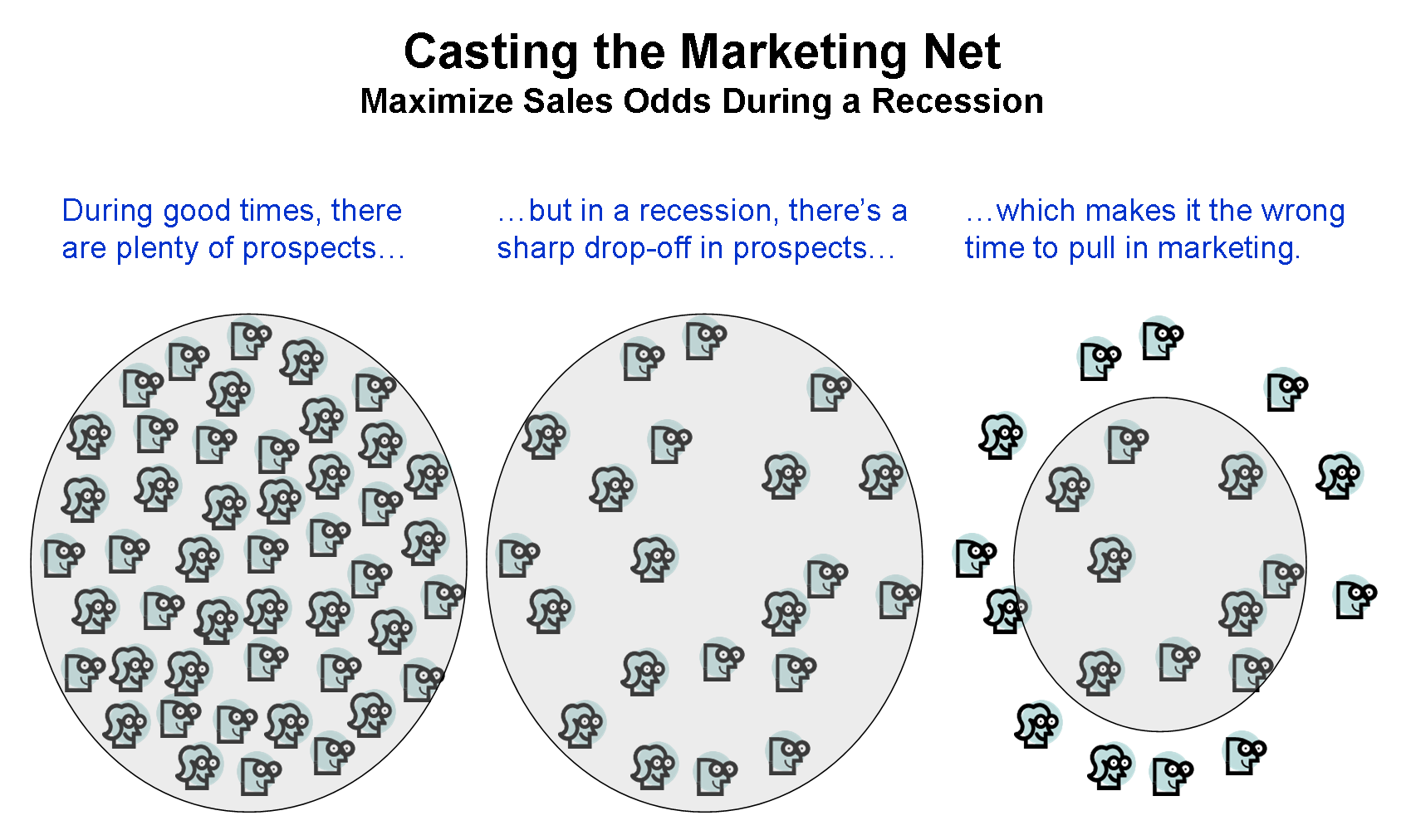
I like David’s sentiment, and I put together this graphic to complement it:marketing-radar

In the world of business sales, you cannot predict which prospects will become sales.Β  But, you know that you need touchpoints with companies. Which prospects will turn into customers? Hard to predict that.

One reaction to the reduced sales that accompany a recession is to cut back on marketing. Unfortunately, that’s just doubling down on your problems. There are fewer bona fide prospects out there during a recession as companies cut back. Which increases the value of each remaining prospect.

Thus, if you reduce the span/frequency of your marketing efforts, you’re going to miss some of the remaining prospects in the market. If you reduce the number of prospects with whom you engage, you can predict the effect on your sales.

That being said, there are wonderful opportunities to do more with less in terms of marketing, thanks to the rise of social media. Jeremiah Owyang and Chris Brogan can tell you more about how to do that.

*****

See this post on FriendFeed: http://friendfeed.com/search?q=%22Do+Not+Kill+Off+Marketing+During+a+Recession%22&who=everyone

Follow Everything by a Select Few, Select Content by Everyone

Item #1: Fred Wilson tweet:

@timoreilly i want to follow less people and more keywords in my twitter timeline. can’t wait for summize to get integrated into twitter

Item #2: Adam Lasnik FriendFeed post:

I switched over to reading mostly a ‘subgroup’ (“Favorites”) on FF, and was missing the serendipity of new voices. One way I’ve remedied that is to do searches on some of my favorite things (“a cappella”, “lindy hop”, etc.) and see who and what comes up.

Item #3: Steve Gillmor blog post:

A small number of Follows combined with Track produces a high degree of coverage on a daily basis.

The three items above share a common theme…limit the number of people you follow. At first, this sounds obvious. Isn’t that what people normally would do? Well no, it’s not. In social networks, there’s a dynamic whereby people tend to return the favor when someone follows them. This build up your follows over time.Β  As Louis Gray noted in a recent post:

While you might be following thousands of people and making new “friends” on Facebook, LinkedIn, Twitter, FriendFeed and all the other networks, you would likely hesitate before sending them an open invitation to your home.

“Thousands of people” I’m doing it: following 1,000+ people on FriendFeed, 600+ on Twitter. For seeing a broad range of information and opinion sources, it’s great to track so many people.

But there is a big downside. Much of what I see doesn’t interest me. The greater the number of people you follow, the more content you will see that falls outside your areas of interest. Putting this into attention terms, for any given minute you spend on a site, what is the probability you will see something that interests you?

It’s an odd phenomenon. I actually like that I’m following a lot of people, because it increases the number of instances where something that interests me will go by on my screen. But it affects the rate at which something interesting goes by. As you follow people that stretch outside your core interests, their streams do have a higher percentage of stuff that you don’t care about. And the overall probability of seeing content that interests you declines.

I want to differentiate this idea from Dunbar’s number, which describes limits on people’s ability to maintain inter-personal relationships. I’m not talking inter-personal relationships. I’m talking information foraging.

What Are You Trying to Get from Your Social Media

I enjoy following people that stream content outside my normal range of interests, such as Anna Haro on FriendFeed. It’s important to step outside the things that regularly occupy you, if you want to grow.

But the three items above show there is another rationale for people to participate in social media. Rather than seek content outside their interests, they want a concentrated dose. Personally, I’m finding I need this professionally. The Enterprise 2.0 space (my field) is fluid, and undergoing the stress of the global recession. Tracking the news, ideas, perspectives, trends and relationships is critical. For example, the microblogging trend (e.g. Yammer) is new and I’m interested in seeing how that plays out.

If you can see the point of that social media use case, you can understand the value of this idea:

Follow everything by a select few, select content by everyone

As I noted in my last blog post, I’m tracking everything for a select group of Enterprise 2.0 people, and keywords/tags for everyone.

In terms of the three items with which I started this post, Fred Wilson describes this approach. Adam Lasnik isn’t too far away. His manual searches for “a cappella”, “lindy hop”, etc. could be turned into persistent searches to find new content and people. Steve Gillmor is a little more of the social media whale philosophy, where he only wants to follow a specific set of users and then interact with the @replies on Twitter. But even Steve could add keyword tracking via a FriendFeed Room as a way to improve his daily “coverage”.

Will This Trend Grow?

I’m a fan of this use case. It fits my needs professionally. It’s almost like I have my 9-to-5 social media, and then my nighttime social media.

I suspect this use case will make more and more sense as social media expands its mainstream footprint. Information workers are the ones who will be most interested. The hardest part is figuring out which keyword/tags to follow, what sites to track and what mechanism to use for this tracking. I’d argue FriendFeed with its Rooms and Lists is perfect for this, but certainly there are other ways.

One final thought. If this trend takes hold out in the wider market, I can see people practicing a little SEO on their content. Get those hash tags in your tweets to make sure Fred Wilson will see your content (if he ever reveals what he tracks).

For kicks, I’m curious what you think of this idea. Please take a second to answer the poll below. If you’re reading this via RSS, click out to participate in the poll.

*****

See this post on FriendFeed: http://friendfeed.com/search?q=%22Follow+Everything+by+a+Select+Few%2C+Select+Content+by+Everyone%22&who=everyone

A Promising Future for Newspapers

nyt-front-page-111008

Item #1: FriendFeed Widget Motivates Reporters to Use Social Media:

“This last week, I have been busy reorganizing our major financial blog, Bear&Bull, adding FriendFeed widgets in hopes of encouraging more audience interaction. The results have been surprising — although the audience has been slow to react, the changes have motivated many of my normally technophobic colleagues to start using video, pictures and live-blogging techniques.”

Item #2: Al Gore speaking at Web 2.0 Summit (thanks to Dion Hinchcliffe tweet):

“Gore says regulate the Internet as little as possible and says there is a future for journalists in curating content/new media. #web2summit”

Item #3: Forrester analyst Jeremiah Owyang on a “freemium” business model for analysts:

“Talking to @susanmernit about analysts sharing. I told her I give the appetizers away for free –but still charge for entres. It’s working”

Newspapers continue to suffer declining readership, hitting their bottom lines hard. Robert Scoble started a good FriendFeed/blog post around this. Two ideas I read there were:

  • A la carte funding – you only pay the specific categories of news you like
  • Crowd funded reporting – consumers pay upfront for specific stories to be created by journalists

A la carte is interesting, and is worthy of further exploration. Crowd funding won’t make it. A critical mass of people will not take the time to fund specific stories. Forget that idea – requires too much engagement by an audience that would just turn attention elsewhere.

I’d like to suggest a different possibility that builds on the existing advertising and subscription models, while leveraging journalism’s historic role in the context of modern social media. Journalists have traditionally played a role as information filters. That is, they are dedicated practitioners of finding information, evaluating what’s true, determining what’s relevant and providing it to a wide audience.

Using that definition of journalism, the items at the start of this post point toward a promising future for journalism. Think about it. Journalists are the original information junkies. They have to be. Their livelihood depends on being better informed than most of us.

This positions them well to providing a stream of content to readers outside of the normal daily articles that are the staple of newspapers. Rather than the single daily articles they deliver, here’s what a future set of content looks like for reporters:

  1. Longer, well-developed articles
  2. Quick blog posts
  3. Twitter messages
  4. Sharing content created by others

#1 above is the stuff of today’s newspapers. It doesn’t go away. Look how much power a daily has – New York Times and Wall Street Journal articles drive a lot of linking as seen in the Techmeme Leaderboard. That’s just the online effect. And unlike social media content, newspaper articles still adhere to high standards for sourcing, finding nuggets from people most of us don’t have access to, and bring a wealth of facts and voices to the stories. This type of content continues to have value.

#2 and #3 are the lighter weight stuff. This is flow information. The tidbits that a reporter gets after talking to a source. The legislative maneuver that will affect how new laws will look. The dissatisfaction expressed by a customer. The filling of a key company or government position.

#4 is a nod to the research and content that informs the worldview of the reporter. Reporters find useful information for the beat they cover, and would be great sources for Del.icio.us bookmarks and Google Reader shares.

The Bear & Bull blog is part of the Mediafin publishing company in Belgium. The FriendFeed widget is a great example of #2 – #4 above. Sounds like reporters are intrigued with it.

Combining Flow with Subscription-Based Revenues

Two revenue models are available:

  • Lightweight flow = advertising
  • Articles = advertising, subscriptions

I can see a newspaper’s website filled during the course of a day with content generated by reporters. A lot of that content will be great standalone stuff. It should make readers want to come back to the site to see what’s new. Tweets, blog posts and shared items all displaying on the newspaper’s web page.

The Jeremiah Owyang tweet above points to another element of the future newspaper. He describes providing appetizers to potential customers. Enough to give them some information. But if they want to know the full story, they need to pay Forrester. This idea applies to newspapers as well. Reporters will reveal just enough to give a sense of a story. But not so much to fill really know it. Readers will need to read the newspaper article to know the story. Note that article need not wait until the next morning. It goes live when it’s ready.

One area that benefits from this approach is the important, but less popular beats. These may not get as much attention, but newspapers can retain reporters to continue an important role in recording society’s history. A lot of the less popular beats may “just” get coverage via blog posts and tweets. But that continues to provide visibility to them.

Curated Sources of Information

As Al Gore opined, the future of journalism has a vibrant role in curating the chaotic mass of data out there. This view appears to be shared by watchers of the newspaper space. On the Printed Matters blog, here’s a quote from Journalism is important:

In a world where anyone can post, use and re-use the news, what is the role of the professional?

Professional journalists are more important than ever in a world of oversupply. We need credible people, people we can trust, to sort the wheat from the chaff, to make sense of the barrage, to order things.

That statement appears to rally around traditional newspaper articles, but I think it applies to an expansion of journalism’s mission. Newspapers are a huge attention platform. Entrepreneurs try to get the attention of TechCrunch, ReadWriteWeb, Mashable and Robert Scoble. Why? Because they command a huge audience. Well so do newspapers. People and organizations from all parts of society – business, governement, fashion, etc. – will continue to be interested in getting coverage by newspapers. Of course there’s a need for the continuing role of sorting “the wheat from the chaff”.

And lest we forget, mainstream consumers don’t hang on every utterance of Steve Jobs or what Google is releasing today. I like the way Rob Diana put it on his Regular Geek blog:

People have been calling for the death of newspapers for quite some time. In their current printed form, they may be dying. However, we are already starting to see the evolution from a printed newspaper to the online version. Who is going to be leading the charge of RSS content for the mainstream user? Newspapers. Why? They understand what the mainstream user wants. I think we, the techies, have forgotten that.

His post focused on adoption of RSS, but I think he’s hit on an important piece of the puzzle. Newspapers are way ahead of everyone else in understanding what interests the mainstream. As the public moves to the web for news, sure they’ll go on Facebook and Twitter. But their core interests haven’t changed.

If newspapers can adapt social media tools to their (1) historic information filtering role; and (2) understanding of the interests of the mainstream, I’m betting on a bright future.

*****

See this post on FriendFeed: http://friendfeed.com/search?q=%22A+Promising+Future+for+Newspapers%22&who=everyone

Greed, Competition, Investor Expectations: Some Things Social Media Will Never Change

Courtesy Bryan Maleszyk on Flickr

Courtesy Bryan Maleszyk on Flickr

In my previous post, I wrote about the Paul Kedrosky session at Defrag 2008, Around the Horn. It was a free form session in which he queried several panelists on a range of subjects. Lots of good discussions from that.

One topic that got some extended discussion both on the panel and in audience questions was this:

Could social media and better information awareness tools have prevented the financial meltdown?

The basis of the question, in the Defrag context, was that there were signs and data that pointed to the implosion. The argument on the table was that there was a failure of information systems, and of social media, to alert the world to what was happening. And the follow-up: how can we improve this?

You can’t. Don’t even bother.

Because the problem isn’t one of not seeing the warning signs. See Morgan Stanley analyst Mary Meeker’s slides about the various financial ratios at the time of the financial collapse. We were clearly running things in the red zone when you see that data. And the data was there to see.

The problem is that people will never change. They will ignore any system telling them that things might be getting out of hand. Why? Tragedy of the commons.

Financial Meltdown = Tragedy of the Commons

In economics and game theory, there is the notion of the commons dilemma. This is the idea that when there is a common good, people will act upon their own interests in consuming that common good:

  • Person 1: consumes proportional share of large resource
  • Person 2: takes an outsized portion of resource, which by itself doesn’t destroy the resource
  • Person 3: sees Person 2 take larger share, matches that or even increases amount consumed
  • And on and on…

The problem is that as people do this, they are not acting as stewards of the common good. The result is that the common good ends up entirely consumed as each person acted in their own self-interest.

With regard to the financial crisis, what was the common good that was over consumed? Home ownership. The grpahic below is from Mary Meeker’s presentation:

morgan-stanley-home-ownership-timeline

Consider the dotted line on the above graph to be the normal consumption rate for home ownership. From 2000 onward, an increasing number of people purchased their own homes. Turns out, this put a mighty strain on the financial system. A lot of people purchased homes who shouldn’t have.

Now I don’t blame people for wanting homes. But the effect was to drive the prices up incredibly, which caused more desire for home ownership. Home ownership is sustained by a number of factors: steady incomes, mortgage tax breaks, personal financial management, a robust collateralized mortgage market, mortgage insurance, etc. All of those are part of the common resources. They were undermined by too many people partaking in home ownership.

The Banker’s Life

So in the case of home ownership, mortgage bankers ended up destroying the various shared resources that make up the market for home ownership. Each banker acted independently to get as much as he could from the system: loosened lending rules overall, finance build-n-flip construction, push home ownership into markets with lower financial means (a.k.a. sub-prime).

I understand the mentality. Once upon a time, I was an investment banker with Bank of America, in the syndicated loan group. Syndicated loans are like bonds, with the risk spread across many lenders. Here are two examples of how things work in banking.

First, I was part of a deal team trying to win a mandate with HMO company Humana. We were trying to unseat Humana’s incumbent bank, Chase Manhattan. We went in aggressively, with some pretty cut-rate financing terms. Chase did want to lose the deal, and so they went even more aggressively. In the syndicated loan market, you need a bunch of lenders to participate. Which means you need realistic pricing to sell the deal, just like in the bond or stock markets. Turns out, in its effort to keep Humana, Chase went too low in its pricing. They couldn’t syndicate the deal. Chase got caught up in the competition to keep Humana.

Second, at a dinner with the head of our group, the subject of minding the bank’s credit position came up. As in, what was the role of the syndicated loans group in being stewards of the bank’s balance sheet? Should we use our superior market knowledge to alert the credit underwriters about risks we’re seeing, and deals from which we should walk? I was a brash young guy, and provocatively opined that we were all about winning and syndicating deals. We shouldn’t focus on the credit risks, as that was the job elsewhere in the bank. To which the head of the group replied to me, “For the sake of your career, I’m going to pretend I didn’t hear that.” He was right – we really did have a responsibility. But I was reflecting the behaviors I’d seen out there in the market.

I bring up these examples to give you a sense of what it can be like inside banking. There is money splashing around everywhere, and when everything is up-up-up, you really can’t turn off the motivations of people.

Social Media Will Never Change This

What was happening in the mortgage industry was that the motivations were all one way: make the deal! You see your colleague cranking on getting deals done, and getting recognition internally. Your compensation is based on how many mortgages you get done. Competitor banks were reporting higher revenues and earnings. If you don’t match the growth of your peers, Wall Street dings your stock. The real estate market just kept going up, up, up.

Social software wasn’t going to change these dynamics. The current financial crisis is just the latest in a string of such events. And there will be more. It’s just human nature.

Professor Andrew McAfee tweeted a musing about Enterprise 2.0 and the financial collapse. I responded with my own thoughts:

amcafee: Could E2.0 have saved Lehman and Merrill? No. πŸ™‚

bhc3: @amcafee – I used to work in banking. E2.0 would have made the banks better at achieving their growth goals. But those goals hurt the banks.

Social software is a powerful tool for organizations to get better in terms of innovation, productivity and responsiveness. But companies are still run by humans, and we’ll never be rid of that, for both the good and the bad.

*****

See this post on FriendFeed: http://friendfeed.com/search?q=%22Greed%2C+Competition%2C+Investor+Expectations%3A+Some+Things+Social+Media+Will+Never+Change%22&who=everyone

Matt Drudge Is Not Your Friend

Saw Matt Drudge post this note the other day on his site:

THANKS FOR MAKING OCTOBER 2008 THE BIGGEST MONTH IN DRUDGEREPORT’S 13 YEAR HISTORY!

Drudge is bigger than ever. Sure, politics are a big driver, but his site was running in 1996, 2000 and 2004. The site’s popularity continues to grow.

I sat in on a Paul Kedrosky-moderated session today at Defrag 2008, called “Around the Horn“. An open discussion that was entertaining.

One area of discussion was the rise of social media as a source of information for people. This is something that we have seen written and discussed in many places. I’ve asked Who Is Your Information Filter? I continue to believe people will turn to trusted friends in social media for a primary source of news.

That being said, why does a one-man link-aggregation site continue to grow? After all, Matt Drudge is not your friend. Anyone got his Twitter or Facebook account info? I need to follow this guy.

*****

See this post on FriendFeed: http://friendfeed.com/search?q=%22Matt+Drudge+Is+Not+Your+Friend%22&who=everyone

Today’s Social Media A-Listers: The Archetype of Tomorrow’s Company Leaders

Dennis Howlett had a post yesterday on Chris Brogan’s blog, Web 2.0- Was It Ever Alive? In the post, he takes the postion that much of the value of “social” is overstated, and will suffer from low internal adoption. He also believes the Gen Y/millennial fascination with social media will pass as workplace realities creep in.

Another post I read a couple days ago was on the New York Times Bits blog, Will Microblogging at Work Make You More Productive? This post and Dennis’s are nearly diametrically opposed. Included in the comments to the post was a very pro-social media point of view from a 22-year old named Emma.

Taking the two viewpoints together, I came up with this chart:

This certainly parallels the recurring generational differences on things like war, helping the poor, music and many other aspects of our lives. Use of social software in the workplace is actually one of those things that I believe will survive the inevitable changes in life perspective that will occur for Emma.

The ME in Social Media

Social media is a diverse pool of interests, motivations and relationships. It’s quite flexible for the uses you want.

Emma is very much in the learning mode. She’s engaging others on Twitter to diversify her knowledge network (see The Revenue Impact of Enterprise 2.0 to understand the value of this). There is no reason for her to discontinue this behavior, and indeed, she’s helping her career via social software.

Now as Emma progresses through her career, she’ll build up an external and internal network that provides sources of information, opinion and perspectives. These will be immensely valuable to her.

She also start to lead others. Inside her company, there will be applications that integrate collaboration and social networks natively with the apps where she does her work. Emma, and other talented young executives, will emerge as key players inside their companies by playing a couple roles:

Content producers and information filters. And this is where the A-Listers of today provide the examples.

Enterprise A-Listers

What does Robert Scoble do? Louis Gray? Chris Brogan? Brian Solis? Even Dennis Howlett? They are influencers, they have the power to bring high visibility to what they talk about and what they share.

What makes a company run? Employees with the judgment to see what’s needed and the ability to influence the organizational allocation of resources.

Currently, this influence is built only on the in-person encounters that occur in meetings and common project work. This won’t go away, but it is a very serendipitous sort ecology inside the organization.

The next generation of employee leaders will skillfully use social software inside their companies to influence the direction of the company and to build out highly visible profiles that will aid their career advancement. Over on the Connectbeam blog, I wrote a post called Five Moves of Power Users in Enterprise 2.0. The post examines how proficient users of social software would operate inside companies. Here are the five moves I described:

  1. SEO your social profile
  2. Build a good-sized social network base
  3. Comment, engage, discuss
  4. Celebrate and communicate the workstreams of others
  5. Share information with a vengeance

Of course, the power in all this only happens if the employee happens to be talented and have good judgment about the company and her peers. Mediocre people will be pretty quickly exposed if they attempt this.

But the point still stands – companies will benefit by having better collaboration and dissemination of colleagues’ perspectives and ideas, and employees will benefit from a higher awareness of the things that make the company. And the social software power users will emerge in prominent roles inside companies.

I’m curious what you think. Please take a second to vote on the future of social software in the workplace:

*****

See this post on FriendFeed: http://friendfeed.com/search?q=%22Today%E2%80%99s+Social+Media+A-Listers%3A+The+Archetype+of+Tomorrow%E2%80%99s+Company+Leaders%22&who=everyone

Tim O’Reilly Course Corrects the Definition of Web 2.0

eBay was Web 2.0 before Web 2.0 was cool.

Tim O’Reilly wrote a nice piece the other day Why Dell.com (was) More Enterprise 2.0 Than Dell IdeaStorm. In the post, he re-asserted the proper definition of Web 2.0. Here’s a quote:

I define Web 2.0 as the design of systems that harness network effects to get better the more people use them, or more colloquially, as “harnessing collective intelligence.” This includes explicit network-enabled collaboration, to be sure, but it should encompass every way that people connected to a network create synergistic effects.

The impetus for Tim’s post was that people leave Google and its search engine off the list of Web 2.0 companies. As Tim writes, seeing the power of what Google’s search engine did was part of the notion of Web 2.0.

Here’s a way to represent what Tim is talking about:

I like that Tim sent out this reminder about Web 2.0. Here’s how Web 2.0 has become defined over the years:

  • Social networking
  • Ad supported
  • Bootstrapped
  • Fun and games
  • Anything that’s a web service

This seems to have fundamentally altered Web 2.0. I’m reminded of a post that Allen Stern wrote back in July, CenterNetworks Asks: How Many Web 2.0 Services Have Gone Mainstream? In that post, he wondered how many Web 2.0 companies will really ever go maintream.

Check out the comments on Allen’s blog and on FriendFeed:

I would say MySpace but that really came before Web 2.0

mainstream – Facebook/hi5/bebo, Flickr, Youtube, Slide, Photobucket, Rockyou

Oh and you’ll have to add Gmail to the list as well.

I’ve yet to see one, really. πŸ˜‰

Is eBay web 2.0-ish? [this was mine]

Agree with Facebook, MySpace, YouTube. I’d add Blogs as another 2.0 winner. I’d put eBay and Amazon as 1.0 success stories

A better way to ask this is “which web services since 2000 have gone mainstream?” Blogger. Flickr. Gmail. Facebook. MySpace. Digg. YouTube. WordPress. Live Spaces

Look at those responses! You can see a massive disconnect between Tim O’Reilly’s original formulation of Web 2.0 and where we are today.

One example I see in there: Gmail. Gmail is a hosted email application. Does Gmail get better the more people use it? No. There’s no internal Gmail application functionality that makes it better the more people use it. It’s just an email app the way Yahoo Mail is an email app. Being a web service and ad-supported isn’t, strictly speaking, a Web 2.0 company.

Terms do take on a life of their own, and if the societal consensus for a definition changes over time, then that’s the new definition. But the responses to Allen Stern’s post highlight two problems:

  • People discount or ignore key components of the Web 2.0 definition
  • Web 2.0 is slowly coming to mean everything. Which means nothing.

Finally, Tim’s post helps me differentiate the times I should use “social media” as opposed to “Web 2.0”.

What do you think? Should we go back to first principles in defining what really is “Web 2.0”?

*****

See this post on FriendFeed: http://friendfeed.com/search?q=%22Tim+O%E2%80%99Reilly+Course+Corrects+the+Definition+of+Web+2.0%22&who=everyone

Don’t Be Boring, Don’t Sweat Page Views: Ten Company Blogs Analyzed

Courtesy of user 'twob' on Flickr

Courtesy of user twob on Flickr

I read an amusing and insightful post by B.L. Ochman, 10 Reasons Your Company Shouldn’t Blog. Several reasons don’t argue against blogging (e.g. “A blog is not a quick fix”), but a few are worth considering. Here are a couple that I liked:

1. The blogs most companies want to create are guaranteed to join the 900,999 out of every million blogs with no readers. Why? They’re boring.

2. A blog has to have a personal voice. If you sound like a corporate drone, nobody will read your blog.

In a similar vein, Wall Street Journal blogger Ben Worthen reported on aΒ  study by Forrester Research. Forrester reviewed 90 B2B blogs, and came away decidedly unimpressed: most corporate blogs are “dull, drab, and don’t stimulate discussion.”

I’ve just started to blog for my company Connectbeam. I’ve got a couple posts under my belt, and I’m curious as to what other companies are doing. I decided to take a look at 10 companies’ blogs. I looked at 10 posts each for the 10 companies, and scored each post on 10 content attributes. This “10 cubed” analysis is presented below.

Ten Companies’ Blogs Compared

The table below shows counts for each company on the different content attributes.

Links to the ten companies’ blogs: Adaptive Path, Amazon Web Services, Boeing, Emerson Process, LinkedIn, Marriott, Pitney Bowes, Petro-Canada, Southwest Airlines, Starbucks. Hat tip to SocialText for maintaining a list of corporate blogs.

The table is sorted by the number of instances for the different types of content. And the content types? Made ’em up myself. They are the kinds of things I’m thinking about with regard to Connectbeam’s blog.

What About Those Different Types of Content

Explain Company’s Actions. The idea here is that the blog enables more freedom to give details behind the things a company does. I imagine for public companies, there are limits on how open they can be. But certainly there is opportunity for more than the canned quotes we often see in press releases.

Petro-Canada is currently very big in this category. I don’t know the company, but from reading its blog, it appears they’re having trouble getting gas to western Canada stations. One of their refineries is down. So they’re using their blog to keep people updated on progress.

This is a good use of a company blog.

Warmed Over Press Releases. That sounds harsh, doesn’t it? And it can be if that’s all a blog is. But there is a role for the press release type of information on blogs. After all, a press release tells a company’s latest activity, which fits a blog’s purpose. Another aspect is that a lot of blog entries are essentially mini-press releases. They have the quality and informational value of press release, but for a minor event that wouldn’t normally warrant a full press release.

Amazon Web Services leads this category. But that makes a lot of sense to me. AWS is hot. They’re getting traction in the cloud computing arena. Right now, they probably are best served dishing out updates to current and prospective customers. They are in a good position to lead industry thinking around cloud computing.

Company Events. Companies are having, and participating in, events all the time. They are good opportunities for blog write-ups, usually because of interesting things learned when people come together. Events may also relate to things outside the companies control, but which affect them nonetheless.

Boeing blogged about events related to the strike against it by the IAM union. Marriott blogged about the bombings outside one of its hotels in Pakistan.

Wax philosophical. This is one of my favorites. Companies are deep into the machinations of an industry, and of their markets. They see a lot, and are working hard to understand customers’ pain points and the future of their industries. This gives them both information and motivation to put forth interesting thinking. Admittedly, the thinking will slant toward what benefits the company. But I like different points of view.

Starbucks does this a bit on its blog. One entry discusses efforts in Costa Rica to establish sustainable coffee farming. Adaptive Path is really good about this. This post describes the merits of simple presentation styles using hand-drawn graphics. Reminds me of Common Craft.

Link to another blog. Linking to another blog establishes a company blog as being part of a great conversation. It says that the company is following activity in its industry, and finds value in things outside what its own employees do. It also gives a sense for the areas that a company is looking at.

Adaptive Path does this a lot. Their blog includes a lot of linking to other blogs, which makes their posts an interesting place to find more information. LinkedIn also links to other blogs, generally those that include something related to LinkedIn.

Discuss industry issues. As participants in their industries, companies can illuminate issues that affect them. Customers and suppliers will have an interest in these type of blog posts, because they want to know what’s affecting the market. Companies can also apply some influence on industry standards, legislation and developments through their words and analysis.

Emerson Process covers issues that affect its industry. In The Value of Inherent Safety?, there’s a discussion about the need to incorporate incident avoidance into the financial analysis of projects. Seems like a smart idea.

Link to another company. Linking to another company is a Profile In Courage. OK, that’s overstating it, but linking to another company is probably a little worrisome. Will I lose my reader when they click a link? Am I confusing a reader by mentioning a different company? I like when companies do this, because it’s an acknowledgment that there are other entities in the universe.

LinkedIn does this fairly often. For them, the links are to companies that have had some success on the professional networking site. Adaptive Path links to fellow panelists from a conference it attended.

Unrelated to core operations. This is a funny content category. Blog posts about things that don’t relate to company operations or industry issues. I guess it’s a way to attract readers who usually don’t read the company’s blog.

The Pitney Bowes blog is an example of this. Or perhaps it’s better to describe it as Pitney Bowes CEO Mike Critelli’s blog. He doesn’t really cover his company. Rather, he takes aim at wasteful spending and regulaiton by the government.

Describe product use cases. Blogs are great homes for product use cases. There really isn’t a place for these in a press release. You can put some on the company website. But blogs are conversational and open to all types of content. And use cases help customers see the possibilities for a product.

LinkedIn goes after this type of content hard. Their posts name names, tell how the social networking site was used and quantify the outcomes. They’re well-done.

Silliness. A bit ofΒ  irreverence can lighten a company blog. Put some fun in reading it.

Southwest Airlines’ blog incorporates plenty of good wholesome silliness and fun. Not surprising, considering the company’s personality. I like this one about this summer’s earworm, Kid Rock’s All Summer Long song.

Special bonus points to the Emerson Process blog for including a link in one its posts to a FriendFeed discussion.

What conclusions to draw from the above table?

  1. Explaining corporate actions is a key use of company blogs
  2. I was pleased to see that “waxing philosophical” is a recurring theme for blogs – this gives context to companies’ actions and product releases
  3. Describing product use cases seems like a great idea, but perhaps is not the right approach for the companies whose blogs I analyzed

One last thought…

Companies Aren’t Blogging for Page Views

Implicit in the “boring” analysis of blogs is the idea that the poor companies are suffering anemic page views.Β  Of course, high page views are something everyone would love. Google’s blog is daily reading for a lot of people.

But many companies will get value from blogging to a smaller audience. I think this is particularly true for companies in the B2B space. It’s the old quality vs. quantity situation. Earning the attention of key people in your markets justifies the time investment in blogging.

*****

If you want an easy way to stay on top of Enterprise 2.0, I invite you to join the Enterprise 2.0 Room on FriendFeed. The room takes feeds for Enterprise 2.0-related items on Twitter, Del.icio.us and SlideShare. To see this room, click here: http://friendfeed.com/rooms/enterprise-2-0

*****

See this post on FriendFeed: http://friendfeed.com/search?q=%22Don%E2%80%99t+Be+Boring%2C+Don%E2%80%99t+Sweat+Page+Views%3A+Ten+Company+Blogs+Analyzed%22&who=everyone

Using Social Media In Hollywood – An Interview with MADtv’s Chris Kula

Chris Kula is a comedy writer living in Los Angeles. He currently writes for MADtv, seen Saturday nights on the Fox Network. I learned about Chris through an unusual connection – a link on my blog.

A few months back I wrote How to Write a Farewell Email to Your Co-Workers. The post ranks pretty high in the search engines, and is a consistent traffic source. It includes a link to a parody farewell email blog post by Chris, and I’ve noticed each week that many people click on that link. I was curious about who Chris is, so I reached out to him. He’s social media savvy, and I wanted to find out what’s happening in Hollywood these days with regard to social media.

First, some background.

Chris Is a Funny Dude

On Chris’s site, you’ll find a number of creative videos he’s put together, hosted on Vimeo. Check them out when you get a chance, they’re very good and are terrific displays of his comedic talents. These videos are Chris’s work done on his own time, not because he was being paid. Here’s one of Chris’s creations,”This Is Budweiser”:

Vodpod videos no longer available.

more about “Chris Kula – This Is Budweiser“, posted with vodpod

Chris started Flickr Punch on blogspot. Flickr Punch is a site where Chris applies punch lines to pictures he and others find on Flickr. He includes several of these “punchlined” Flickr pix on the home page of his personal site.Β  Here’s one for Storm Trooper fans:

Finally, Chris has also written for the Onion News Network. Perhaps his best known creation for The Onion is Child Bankrupts Make-A-Wish Foundation With Wish For Unlimited Wishes. This spoof is so realistic, concerned citizens contacted the charity about the news. The Make-a-Wish Foundation issued a press release saying that the charity was indeed OK. Chris’s creation even earned its own Snopes page.

He’s Got Social Media Chops

Chris clearly knows his way around Web 2.0 and social media. Above I’ve noted his work with Vimeo, Flickr and Blogspot (Blogger).Β  He finds humor in Wikipedia entries in a couple of his videos. He maintains a Tumblr blog about food he eats. He has his own blog, and includes links to his Facebook and MySpace profiles.

I was curious about the role of social media in the entertainment industry. Most coverage of entertainment focuses on industry efforts to clamp down on copying music, TV shows and movies. But what about people that work in the industry? How do they use social media in their personal and professional lives?

I’m particularly interested because Facebook has attracted a solid user base, and now faces the work of penetrating parts of the market that are less likely to try social media. Twitter hit a growth inflection point in March 2008, and continues to move forward into the consciousness of the mainstream. So how is social media playing outside the technology geek hot house?

I asked Chris eight questions, which he answers below. Obviously, these are just Chris’s experiences, but they do shine a light on what’s happening in Hollywood.

Eight Questions for Chris Kula

1. You’ve got some great stuff on social video site Vimeo, and your Flickr Punch site is great. What made you create those?

When I was working crappy day jobs in New York, I was really proactive about creating my own online content – be it videos or photo caption stuff (like FlickrPunch) or writing on my blog. At the same time I was doing improv and sketch at the Upright Citizens Brigade Theatre, but that was more an ensemble type thing; making web videos and producing blog content was my way of establishing my individual voice as a writer. I got my first comedy writing job (at the now-defunct Time Inc. website Office Pirates.com) based largely on the content I’d been producing on my own.

2. Looks like you stopped updating on Vimeo and FlickrPunch a couple years ago. Did your social media stuff tail off after getting a job with Onion News Network and MADtv?

Yeah, I started producing less of my own stuff once I started getting paid to write. So now I don’t get as much chance to do my own thang as I used to, but on the other hand, I’m able to pay my rent and, you know, eat. It’s a fair trade. (But, given the very fickle nature of TV writing jobs, it’s really only a matter of time ’till I am once again updating my blog with sparkling new content just for the pro bono joy of it.)

3. A couple years ago, The New York Times ran a piece about United Talent Agency sourcing new talent via social media. Have you seen an increase in studios/talent agencies’ use of social media to source talent in Hollywood? Are the next generation of people trying to break into Hollywood using social media a lot more, with link to examples of their work instead of portfolios?

Absolutely. I think that’s the number one thing you can do as a writer/performer type today: have an online presence. The potential audience you can reach online is just so great, be it on YouTube or something more comedy-specific like Funny or Die. And yes, that audience includes the suits – I know a lot of sketch groups whose online body of work has earned them agents, managers, pilot deals, magic beans, etc. There are still the “conventional” routes to getting representation – writing a spec script, or putting up a live sketch show – but now you should absolutely be posting your own videos *in addition* to working on that stuff.

4. What’s your favorite social network these days? Why?

I really should make Facebook the Home page on my Firefox, as it’s basically always my first click. I like that I can keep up with what my friends “are doing right now” in an entirely passive fashion. Highly useful: event invitations for plugging shows, photo/video tagging. Highly ignorable: invitations to become werewolves, vampires, zombies and/or slayers of these creatures. (My second favorite social network is Tumblr, and these days I check my Myspace only about once a fortnight.)

5. You and your friends ever tweet?

Twitter has yet to infiltrate my friends. How I’ve managed to survive this long without knowledge of Julia Allison’s every waking activity, I do not know.

6. I checked out your Tumblr blog, Kula Foods. It’s cool. You really like food, don’t you?

My food blog is quite literally an exercise in self-indulgence. Delicious, savory self-indulgence. I post all the photos and text directly from my Blackberry Pearl. I’ll keep updating it as long as my metabolism allows.

7. What do you think of Ashton Kutcher’s Blah Girls?

re: Blah Girls – As a celeb-obsessed teen girl, I’m so loving it! Annnd… now I’m so over it. LOL

8. You’re a big Michigan fan. Are they going to make a bowl this year?

As a proud-bordering-on-elitist Michigan alum and fan, I used to complain about how other major conference teams can win, like, six games and still end up in a bowl game. Cut to: present day – Michigan football is the shakiest it’s been in, oh, three generations and I’m praying that FIVE wins might get us into the prestigious Carquest Motor City Bowl. Go Blue?

Thanks Chris.

You can see Chris’s work on his blog, and on MADtv Saturday nights.

*****

See this post on FriendFeed: http://friendfeed.com/search?q=%22Using+Social+Media+In+Hollywood+-+An+Interview+with+MADtv%E2%80%99s+Chris+Kula%22&who=everyone

Business Week Launches Info Sharing Social Network – Will It Float?

Business Week Magazine has entered the social networking world with Business Exchange. Business Exchange is built around the sharing of information and discussing it with others. Here’s how Editor-in-Chief Stephen J. Adler described it:

“Business Exchange, a free online information hub, is a new initiative of BusinessWeek.com. It enhances the ongoing reporting and analysis of Business Week writers and editors in print and online by aggregating other sources of news and analysis (including other media brands, blogs, videos, and research reports). Readers can use it to track business trends, with hundreds of topics available at launch, or create a specific topic that’s not currently on the Exchange.

The best part is the social underpinning of this platform. Users (including our journalists and editors) can share their own knowledge about a subject to enrich each topic far beyond what any single person or search engine can accomplish.

Business Exchange is a mix of:

  • Social bookmarking
  • Forums
  • Social network

Business Exchange vs. FriendFeed

FriendFeed actually has a similar mission to that described by Business Week’s editor-in-chief. So I put together a quick comparison of the two sites:

FriendFeed feels like a hotbed of activity, the kind of site where you’re compelled to hit the F5 refresh button. Business Exchange is more staid, partly because it doesn’t yet have an active user base, partly due to its design. The key design points from the table above that make a difference are:

  • Bounce to the top – Adding a comment or a save doesn’t move an item to the top of the Business Exchange page for a given topic, losing that feeling of “what’s hot”.
  • Forced segregation of content – For a given topic in Business Exchange, you can look at News or Blogs or References. But you can’t take them all in at once.
  • View Saves by user – In the list of entries on Business Exchange, you can’t see how many times an item has been Saved. This information is available for an individual item. But it’s not an easy experience to see what others found valuable.

As seen in this discussion, community, conversations, variety and outstanding design are making a difference for FriendFeed.

That being said, Business Exchange is new and it’s beta. Let’s see what they are doing.

Business Exchange’s Features

Content is both streamed and added. Being streamed into Business Exchange seems like a nice bonus for a media site or blogger. Check out the difference below in the way these two items made it into Business Exchange:

The MyDebates post was “published” into the topic. The Soul of the Enterprise post was “added” to the topic. From what I can tell, designated media sites and blogs are automatically added based on either key words or tags.

Full Profile. You get a full profile page on Business Exchange. Work, education, picture and up to four links to other sites. It also shows your recent activity, which is nice.

Building a social network. You can’t search for other users. So you find them when they’re displayed as “Active Users” on the site, via the items they Save or Comments they make. It makes it a bit challenging to build out your list of subscriptions. Your subscriptions are simply a list, and you can click an individual to see their activity. There is not currently a way to see the aggregated activities only of your subscriptions.

Focus on Most Active. At different points on the site, Business Exchange gives a list of what’s most active. The home page tells you the most active Topics, and gives a list of Active Users. Each topic includes a list of Most Active, which does aggregate from News, Blogs and References.

The definition of Most Active inside a topic is probably based on the number of Views, Saves and Comments. You can see all of those stats for an item when you go to make a Comment. I like seeing those stats.

If You’re Business Minded, Check It Out

It’s early in the life of Business Exchange. Getting more users will, of course, make it a more interesting place to hang out. It doesn’t hurt that it hangs off the businessweek.com site, and that it can get periodic boosts from the print magazine.

I’m still learning the site, and maybe the Most Active tab for each Topic is the place to be.

My profile on Business Exchange is here. If you sign up, add me, and I’ll add you back.

*****

See this post on FriendFeed: http://friendfeed.com/search?q=%22Business+Week+Launches+Info+Sharing+Social+Network+-+Will+It+Float%3F%22&public=1