Jobs-to-be-done’s place in a customer-centric organization

On Twitter, I asked this question:

I asked it, as I had a conversation in recent days with a fellow from a large corporate. Customer-centricity was recently adopted as an internal mantra, but the manifestation of that was…wait for it…sentiment analysis.

It’s a start, right? But is it really a difference-maker?

I’ve written recently about jobs-to-be-done. As in, what customers hire your product to do. Those jobs have a tendency to (i) be hidden from you; and (ii) change over time. Knowing, and acting on, jobs-to-be-done (JTBD acronymized) is probably one of the most customer-centric things a company can do. You’re getting deep into what someone is buying your product for.

While I don’t work for a large corporate, I am integrating jobs-to-be-done in some work on next generation gamification elements for the Spigit platform. Why? Because there are many different types of game mechanics that can be applied to a platform. But why would you add any of them? To better deliver on what your customers hire you to do. To accomplish this, I’m using the Listhings site – online post-it notes – to collect and socialize these. I follow my own format for JTBD: context, job, success metric. An actual (blurred-out) example is below:

You know what? Customers love talking about their jobs-to-be-done. Seriously.  I usually schedule an inital hour to talk about them, and every single company has wanted to continue to the conversation for another hour. The conversations are not just good customer relations, which they are. They are leading to areas where the Spigit platform can apply game mechanics to improve their outcomes.

But apparently, this approach is sort of radical. As only 7% of firms are deemed to be customer-centric.

Where would JTBD fit?

Which got me thinking. What exactly are companies doing today, at least in the product and service development arena? Where would customer jobs-to-be-done fit with existing approaches? The graphic below is my take on what’s happening out there:

The center blue area represents the work of ideating, designing and producing products and services. The top grey boxes floating around up there? Those are the current factors influencing the product/service development process.

Market Analysis: Classic input for product development here. What are the trends? What are competitors doing? What’s going on in adjacent markets? You’re got to do this. It’s a source of ideas, and evidence of what customers are gravitating toward.

Executive Fiat: Does this really happen??? Heh, just joking of course. This will be a reality forever, and it’s actually appropriate in mild doses.  The thing to watch is the bull-in-the-china-shop approach, where that product is gonna get done, I’m not listening to anyone! Perhaps too many executives subscribe to the Steve Jobs-attributed notion that customers don’t know what they want (“So I’m going to give it to them!”).

Usage Vectors: Once you have product out there, you learn what people are using, what they value in the existing product features. And you continue to develop along those vectors. It’d be irresponsible to do otherwise. Just watch getting stuck on those vectors and missing the market shifts.

Customer Service Tickets: As people use your product, they’re going to file requests and report issues. These items are some clues to what people are trying to get done. They suffer from being narrow, focused on a specific interaction point and grounded in what they know of the current product. But you can divine some of what people want to get done from these.

Customer Surveys: Surveys get you closer to customers. Polling people’s preferences for difference attributes and behaviors. Good input as you consider a product or venture. Problem with surveys is that the questions are set ahead of time. Whoever puts them together has to decide what the key factors are. But that leaves a huge hole in understanding what customers themselves value.

Focus Groups: A favorite activity of large companies is to get some random people in a room for a couple hours and ask them about some concept being tested. In that these sessions have actual people talking, they are nominally useful. But common critiques of these are that

  • Participants tell researchers what they want to hear
  • The format is unnatural – forced face-to-face interactions with strangers for two hours in a closed room
  • Alpha personalities sway things
  • What’s discussed are already-decided concepts, not insight on what customers are looking to get done

As was stated in this 2003 Slate article, “The primary function of focus groups is often to validate the sellers’ own beliefs about their product.”

Jobs-to-be-done fills a gap

In all of the popular bases for developing products and services, one can see a gap. Most are a triangulation to understanding what customers want. Now some are quite useful in a customer-centric sense: usage vectors, customer service tickets, surveys. But they’re also piecemeal.

They represent the hope that you’ve got a bead on customer needs and wants.

Why the reluctance to actually talk directly with customers? Seems plain talk in a (not overly) structured way will give you a better sense of where opportunities lie. Aside from the product/service tools listed above, there are the social media engagement practices of today (react to tweets, have a Facebook page, sentiment analysis). All have their place, but they fall short.

Want to be customer-centric? Try talking to your customers.

I’m @bhc3 on Twitter.
Do big companies need a ‘slow development’ movement?

Read this comment by George Ciardi from a discussion about why products fail in the Market Research Group on LinkedIn:

While proper research could certainly be part of the blame for the failure of some new products, I also see the realities of business pressures to launch “no matter what the research says”.

Most companies have internal objective to launch new products throughout the year. These new product launches have sales estimates of demand, which in turn feed through to company projections of future growth.

If you accept my statement to be true for a moment, then it would seem that part of the solution is to have a more flexible business plan and a corporate culture that would permit business objectives to be more fluid and allow for products not to be launched that are not ready to market in the first place.

But who is going to tell the CEO that they will miss their second half sales estimates because their new product isn’t ready to launch just yet? Do we have any takers for that assignment?

A rush to “get something out” can be driven by the calendar. In startup companies, specifically software ones, the advice is to release often. Get stuff out there, see how it performs. Y Combinator’s Paul Graham advocates this.

But does that advice work for large companies? Not just software entities, but other industries as well? It’s not as realistic. PT Boats can adjust course and channel resources much more quickly than can aircraft carriers.

Which puts a premium on “getting it right” as much as possible before release. Not fix what went wrong afterwards. One can argue that philosophically, big companies just need to be more nimble. That advice and $3.00 will get you a cup of coffee.

Big organizations would do well with a slower development cycle that…

Puts a premium on understanding customers jobs-to-be-done: Before developing anything, spend time talking with customers about what their needs, desires and pain points are. There is some of this via focus groups, but my sense is that those are (i) sporadically used; (ii) designed to elicit opinions on something already in development. People who express these jobs are potentially good candidates for any co-creation the company wishes to engage in.

Allows for small experiments: Once you’ve got a bead on what jobs customers are hiring for, try out some solutions. In many ways, this is taking a page from Steve Blank’s customer development methodology. Talk with some customers, particularly the ones who identified the job-to-be-done.

Finally, senior executives need to look at this as an essential part of increasing the odds of success for new product introductions.

It’s the Jobs-to-Be-Done, Stupid!

I do product management for Spigit. I’ve done product management for other companies as well. And let me tell you, the easiest thing in the world is to fall into the trap of focusing on how customers are using your product. Product forms your relationship with customers. It’s how you know them. They will tell you about your product, and the features they want improved. You can’t not listen to that. Of course, you’re going to improve your product.

But don’t confuse that with understanding what your customers need.

Just because you’re on top of what you’re customers need from your current product, doesn’t mean you’re on top of market changes. Two titans of the television industry remind us of that. They have, in recent weeks, been dismissive of a rumored Apple HDTV:

Sharp isn’t paying much heed to rumors that Apple is developing an HDTV. Nor does it have much reason to, says Kozo Takahashi, head of the company’s operations in North and South America.

All Things D

“TVs are ultimately about picture quality. Ultimately. How smart they are…great, but let’s face it that’s a secondary consideration.” – Samsung AV product manager

TechCrunch

And there you have it. Apple HDTV? Whatever.

Of course, one might be reminded of the comment by Palm’s CEO before the Apple iPhone was introduced: “PC guys are not going to just figure [phones] out. They’re not going to just walk in.” Ouch!

What we’re seeing is incumbents falling back on the thing that got them to their position: features. This is feature-led innovation. It’s got its place in the market, but relying only on it puts companies at risk for missing either (i) critical market shifts; or (ii) emerging needs that will drive organic growth.

Divergence between Product Features and Jobs-to-Be-Done

In the graphic below, a typical scenario for feature-led innovation is depicted. What happens is that over time, companies lose touch with where the market moves, with customers’ changing jobs-to-be-done.

When a company “makes it” in the market, it has the features that meet what customers are trying to get done. On the graph above, that’s set as “Time 0”, where features match Job 1. Given this is the ticket to success, a company will of course continue to develop these features. And the people who were looking for Job 1 fulfilled will follow along as the new features are rolled out.

Somewhere along the line, a new job-to-be-done emerges. Call it Job 2. New jobs enter the market all the time, via what Re-Wired Group’s Bob Moesta calls the “push” force. After Job 2, Job 3 emerges. And on and on.

But many companies are never aware of this. There are too many customers. Product is selling. You know your company’s product, and you’ve gotten lots of feedback for improvements. Systems are in place to reward and nudge you further along the path that fulfills Job 1. When they do solicit feedback from customers, it’s all Net Promoter Scores, focus groups for new features, surveys, customer service ticket analysis. Believe me, I really can appreciate how companies get lulled into this cycle of feature-led innovation. Professor Freek Vermeulen of the London Business School calls this the innovation “success trap”.

Meanwhile, customers cast about for ways of fulfilling their new jobs-to-be-done. They improvise. They settle. They experiment. They’re open to new entrants that meet their emerging jobs. And this is how it happens to companies.

Let’s look back at what the Samsung product manager said: “TVs are ultimately about picture quality. Ultimately. How smart they are…great, but let’s face it that’s a secondary consideration.”

Here are three jobs I’d personally like fulfilled that aren’t about picture quality:

Situation Job to Be Done Success Metric
When I turn on my TV I want a set of recommendations
based on my viewing habits
Increased awareness of
shows that interest me
When I want to share a moment I want a link to post to
Facebook or Twitter
Decrease steps it takes to
share on social networks
When I’m watching a sports
event
I want to order food for delivery Decrease time it takes to find
food and place order

The first two of those jobs have emerged based on new technologies in other arenas (recommendation engines, social networks). The third is a tried-and-true job that’s been around forever. Might there be a play to improve that via my TV?

All three of those jobs-to-be-done are divergent from the ongoing focus on picture quality espoused by the incumbent TV leaders.

Parable of Digital Cameras

The feature race of the HDTV manufacturers has a parallel in the digital camera industry. A key feature of digital cameras has been the megapixels. The higher the megapixels, the better the image quality. It has been escalating so much in recent years, Consumer Reports ran a piece wondering when the megapixel arms race would cease.

But in another case of new jobs emerging, lower end digital cameras are seeing their sales decline. Why? As the L.A. times noted in December 2011:

According to a survey by NPD Group, 27% of photos and videos taken this year were shot with smartphones — up from 17% last year.

Wait a minute. Are you telling me that with all that megapixel firepower, we’re gravitating toward phone cameras? What’s wrong with people these days?

Nothing actually. There’s always been the job-to-be-done of capturing moments. It’s just that lugging around a separate camera everywhere you go is a pain. But people want to be connected – talk, messaging, email, surfing – and will gladly carry their phone with them. Which is quite sufficient to fulfill the job of capturing moments. Megapixels be damned. Of course, the megapixels are getting better on smart phones too. Clayton Christensen must be amused by the ongoing disruptive innovation.

Sharp, Samsung…heck, all companies…are you listening? How well do you know the emerging jobs-to-be-done by your customers?

I’m @bhc3 on Twitter, and I’m a Senior Consultant at HYPE Innovation.

On the Utility of Thinking in Terms of Jobs-to-Be-Done

Cottonball clouds In a recent post examining the future of retail, I used the jobs-to-be-done approach to break down the industry. And I’ve been using it more in other ways. It’s quite useful as a basis for innovation.

The premise of the jobs-to-be-done approach is that it provides a much better basis for innovation. The focus is on unmet needs of customers. Compare this to asking wide open, pie-in-the-sky types of questions.

I thought about this when I saw this question posted on Quora:

What currently nonexistent websites would you want to be created?

Wow. Talk about an open ended question. I don’t know about you, but that question doesn’t help me. I get brain freeze. I need a prompt to come up with something. Wide open questions like that are somewhat divorced from what people actually need. And will generate a lot of ideas off the mark, or none because it’s too divorced from what people are thinking about (although one guy has an idea there).

Now I’ll describe a different situation. For Spigit, I often find myself needing to come up with a new idea to show off the system functionality. If I used that question from Quora, I’d find myself straining to generate ideas that pass the smell test.

So instead, I’ve been using the jobs-to-be-done framework. I think of my own jobs-to-be-done. Here’s one I actually used to come up with an idea for a client demo:

When I’m traveling with my family on vacation, I want to keep the kids entertained happily the entire trip.

From this job-to-be-done, I came up with an idea for a long haul family SUV (or could be a minivan). It’d have storage for games, and a flat surface for playing them. A refrigeration unit on board to keep beverages and food fresh. Multimedia for videos, music and games. It would take some design genius to develop. But it’s a vehicle I’d actually take a good look at.

[tweetmeme source = “bhc3”]

And that’s the point. The jobs-to-be-done approach is incredibly useful for generating ideas that are relevant and actually have potential. You’re plumbing the depths of what people really feel and what they actually want to accomplish. A powerful head start on innovating.

OK, let’s take this one out with a little Holiday Road.

Carving Up the Retail Industry by Customer Jobs to Be Done

Online retailers had a heck of 2011 holiday season, up 15%. Whew, in a tough economy no less. But the news wasn’t as good for some physical retail stores. Sears Holdings announced disappointing sales and will be closing over 100 stores. Best Buy same store sales dropped, and some have expressed their sentiment that the retailer is on a long downward slide.

Digital disruption. Coming to a store near you.

That online and mobile commerce is increasing its share of business really isn’t a surprise. The  Internet, as promised in the 1990s, is turning over many industries.

[tweetmeme source=”bhc3″]

Retail being another such industry, although it’s a much slower process of disruption. Which means the physical retailers have time.

Time to take their natural advantages and build on them.

Determining Physical Retailers’ Competitive Advantage

Given the retail industry’s importance to the global economy and its periodic restructuring, it should come as no surprise that there’s plenty of advice for the industry. Three of the larger, well-known consultancies weigh in.

Booz and Co.’s Karla Martin sees a need for retailers to reduce selections and assortments. Bain’s Darrell Rigby sees omnichannel engagement with customers as the path for physical retailers to re-assert themselves.

In both Booz’s and Bain’s advice, there are elements of incorporating the jobs for which a customer hires a retailer. In the Booz piece, it’s a curation job: “Help me navigate an increasingly overloaded product landscape!” In the Bain piece, it’s a…well, not entirely sure what job is being satisfied. It appears to combine several customer jobs to be done. It is also a good thought piece about future industry infrastructure requirements.

These advice pieces raise the question of how to drill deeper into customer needs. Go beyond the meta trends and get specific around customers. Consulting firm McKinsey offers this thought:

“One way that manufacturers and retailers can investigate these trends is through consumer surveys designed to identify ‘purchase drivers’ – meaning those factors that are decisive in the decision to buy a product or shop at a certain retailer. This survey should not only cover conventional topics like price, quality, and service but also such factors as corporate responsibility and traceability of product origin.”

Survey fatigue notwithstanding, McKinsey starts down the right path. Get the customers’ input. McKinsey talks in terms of purchase drivers. An example of such an influence is convenience, deemed to include shopping ease and practicality.

But does that go deep enough? The risk here is that only surface-level influences are elicited, while the real drivers are buried deeper. A case of “what they say” vs. “what they do”.

A good alternative to get deeper into customers’ minds? The jobs-to-be-done approach.

Components of a Job-to-Be-Done

To create a jobs-to-be-done structure, I’ve followed the work of Strategyn’s Tony Ulwick and Lance Bettencourt, and Re-Wired Group’s Bob Moesta. They’re practitioners who have been working with organizations for years.

Ulwick and Betterncourt have defined the structure of a desired outcome statement (pdf link):

  • Direction of improvement
  • Unit of measure
  • Object of control
  • Contextual clarifier

As example, he gives:

Minimize…the time it takes…to verify the accuracy of a desired outcome…with a customer…e.g. its meaning, completeness, exactness, etc.

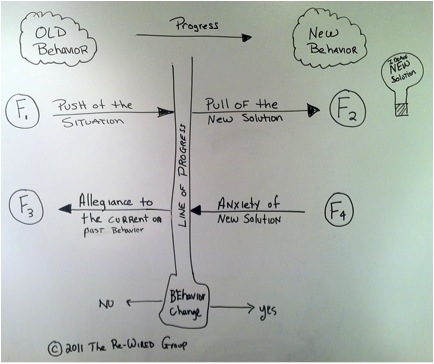
Bob Moesta has identified four influences on how a customer decides what product will satisfy a job to be done.

Push (F1): The situation which is driving a person to seek a solution. What is it we’re dealing with? What’s the impetus?

Pull (F2): The promise of a new solution that can satisfy the need. As customer’s consider a new solution, how well does it map to their needs?

Allegiance (F3): The familiarity of an existing solution is a risk mitigator, leverages already learned usage and known benefits.

Anxiety (F4): The unknown characteristics of the new solution, and the potential missteps that await. Would if the new solution isn’t all it’s advertised to be?

I like both forms of analysis, they are quite complementary. So I combined Ulwick, Bettencourt and Moesta’s work to use as an analytical tool.

Retail’s Jobs to Be Done

There are many jobs that retail must fulfill for customers. Below, I’ve picked four of them for analysis. Four that are ones you’d probably see as well. Each job has a defined outcome statement, and a listing of drivers which influence the retailer selected for the job. These aren’t actual customer insights I’ve surveyed, they’re from me. But they address the right type of analysis needed.

The analysis is done from the perspective of switching from a physical retailer to an online one. This is the disruption which is occurring. This perspective was chosen to illuminate possible innovations for physical retailers, or to point out the long term trend they will need to accept.
Retail Jobs - Desired Outcomes

Retail Job: Low Price

Getting the lowest price. Isn’t that what everyone wants? It’s been a human goal since we were bartering woolly mammoth skins for stone weapons.

Frankly, this job is one that will be challenging for physical retailers to fulfill. As has been noted, Amazon – and other online retailers – don’t have the overhead of physical stores. They can and do price lower. And you can see the differences, right there, on your screen.

The anxieties that consumers feel about online retailers providing this job – retailer performance, shipping delays – are there, but don’t rise to the level of overturning the pull of the online retailers. Too many online retailers have proven themselves over the years. They’ve overcome these anxieties.

Physical retailers competing to fulfill this job need scale to overcome their higher infrastructure costs: physical plant, distribution systems, inventory, in-store personnel. Kmart, for instance, is losing the scale war to Walmart, and the online retailers are generally able to outprice it.

Verdict: Long term, this job will be fulfilled by mega-stores and online retailers. But only in categories where it makes sense. Groceries, for instance, are tougher for online fulfillment of the Low Price job, due to the delivery costs of home delivery.

Retail Job: Immediacy

There’s times when you just have to have something today. Even now. Something needed for a home project. Last minute gift. Car maintenance. The list goes on and on. The Immediacy job occurs when the unforeseen happens, or the unplanned realize they need something.

So what’s the pull of online here? Well, you can see the item from your comfortable home. See, it’s right there on my screen! And even better, I can buy it right now! Hmm…not quite the same as actually having it in hand, is it?

Actually, the online retailers are working to provide the “holy grail” of e-commerce, same day delivery. There are different strategies here, although working with physical retailers is a core part of several initiatives. But the costs appear prohibitive: one start-up, Postmates, charges $10 to make short deliveries inside cities.

Verdict: The physical retailers have a distinct advantage here. That expensive distribution system that hurts them with the Low Price job? It’s a distinct advantage here. Physical retailers should play the immediacy game full tilt. Develop an app that tells customers whether something is available, and make it easy to pay for the item. Create a drive-through pick-up experience.

Retail Job: Selection

What did Henry Ford say? You can choose any color you want, as long it’s black. That may have been the case earlier in the industrial age, but not so anymore.

As a general observation, people desire with the ability to select from distinct offerings when making a purchase. For instance, when buying a shirt, isn’t good to see a variety of colors, patterns, cuts, etc.? You’re looking for something that fits your style. If you’ve got a home repair, don’t you want the right tool for the job? Purchasing for your kids, and it’s great to see smaller sizes of an item.

Online retailers can fulfill the Selection job nicely with their ability to provide a long tail inventory. If one retailer doesn’t have what you want, the next retailer is a click away, thanks to Google search and dedicated shopping engines. Online sites can also “own” a category with a larger selection by accessing buyers globally, not just in the local market.

Physical retailers have competed to fulfill this job by offering a wide selection of categories (mass merchandisers) or by going deep in a single category (electronics, books, pet supplies, etc.). One advantage the physical retailers have is the ability to hold and touch items, useful when considering a large number of options.

Verdict: Physical retailers will eventually cede most of the Selection job to online, due to online’s distinct advantages.

Retail Job: Help

With so many options available to us, a distinct #firstworldproblem, it can be daunting to navigate the product landscape. You’ve got a personal style, but could use some help in finding items to match it. There are multiple philosophies for raisi9ng baby, what items fit the one you’re following?

Shoppers want information to help them in their purchases. Beyond information, they want advice. Because a low price on something that misses the mark is just throwing money away. The Help job relates to what a products are being purchased for, not for how complex the product is.

Online commerce offers shoppers great amounts of information. With a click, detailed product information – the kind not available in-store – can be found. Ratings by other shoppers are aggregated, helping distinguish between good and bad products. Online retailers who can specialize in a more narrow category can offer expert advice.

But…and it’s a big but…it’s hard to replicate the give-n-take, the weighing of trade-offs with a live person in front of you. That’s the advantage physical retailers have. There are just times when you really want to talk to someone.

Verdict: This is the physical retailers’ job to lose. With local presence and real live people, they’re positioned to do well here.  The best opportunities lie in cases where the outcome of the product has a fairly high degree of emotional or monetary value for the customer.

Which Customer Job to Fulfill?

For physical retailers, the customer job to fulfill should be a natural extension of their strengths. A company’s assets lead naturally to addressing a particular job the customer wants fulfilled. You really can look at industry structure based on the jobs to be done. And see that some long term trends suggest where retail is heading.

Keep in mind that a larger set of real customers could well describe the jobs they’re seeking fulfilled. My four above are drawn from own experience. But it’s getting input from multiple customers where this methodology comes alive. I’m sure there are some additional jobs that aren’t being fulfilled very well right now, which are opportunities for the future.

I’m @bhc3 on Twitter.

Four Innovation Insights Customers Provide

Customers, properly, have been having a renaissance of sorts in terms of business thinking. Peter Drucker famously espoused a very customer-centric business philosophy. Nowadays, social CRM represents the return of a customer-first orientation. Last year, Altimeter published the 18 use cases of social CRM. Included in those use cases were several that relate to innovation.

Customers are a rich source of innovation insight, and the ultimate authority on what innovation is useful. So it’d be good to understand what types of insights they provide. OK, not just good. Vital. While the incorporation of customers in the innovation process is…honestly….still nascent, it will ultimately be the primary basis of innovation insight. It just will take some time.

It turns out, there is a structure to customer insight. Customers’ innovation insight takes several different forms:

Spectrum of Customer Insight 1
Based on research, the four types of insight are different, and vary in the ease of eliciting and what they address. Let’s take a look.

All Customers – Jobs to Be Done

“Jobs to Be Done”. What is that? It’s why someone purchases a product. A classic formulation of this is by Theodore Levitt: “People don’t want to buy a quarter-inch drill. They want a quarter-inch hole.” That starts to hit on the notion of the job. But it’s more than the direct outcome one is looking for from a product. As the diagram to the right shows, it also includes the consumption context and the emotional effect. Context paints the broader picture of the job to be done. Emotional effect broadens the discussion to include the experience of using the product.

Clayton Christensen provides a wonderful example of this, talking about the job that customers were hiring…a milkshake…for. Yes, a milkshake. There was a lot more behind that purchase than its direct usage as a cold, sweet drink. 40% of shakes were being bought in the early morning. The consumption context was people commuting in the morning, drinking a shake in lieu of breakfast. The shake’s emotional effect was stave off boredom and satisfy a general hunger at the start of the day.

Of all the innovation insights available, the jobs-to-be-done is the most plentiful. The challenge with this feedback is that it’s buried inside people’s heads, and it must be elicited from them. Practitioners such as ReWired Group and Strategyn get at the jobs to be done through deep dive interviews with customers.

Emergent Customers

Say you had a product concept, and you wanted to get a read on its applicability to people’s jobs-to-be-done. More broadly, you’d love to know what works, what doesn’t and what else is needed to make a splash in the general market. Will any old customers do? Turns out…no. What you’re looking for are emergent customers.

In research done by professors at UC-Riverside and Dartmouth Tuck School of Business (pdf link), customers exhibiting a specific set of characteristics were much better at identifying and improving concepts that are more attractive to the market. Called emergent customers, these people possess “the unique capability to imagine or envision how concepts might be further developed so that they will be successful in the mainstream marketplace.”

Sounds pretty valuable, no?

What are these traits that define a customer’s emergent nature?

The researchers created two separate field tests of example products – home delivery and oral care – to validate their hypotheses about emergent customers vs. other types. Their tests confirmed the ability of these customers to better refine a concept for mainstream acceptance than other types of customers.

Lead Users

Lead users are those customers who alter a company’s product to fit an emerging job they need fulfilled. MIT professor and economist Eric von Hippel popularized the existence of these users in his book Democratizing Innovation. Why are they so important? Because they experience new needs for products before the general market does. Find these users, and you gain an early read on what will be important more broadly in the months and years ahead.

Lead users not only experience these emerging market trends earlier, they are motivated to take action on them. The needs they experience and the product adaptations they make are quite valuable.

In one example cited by von Hippel, lead user surgeons were identified. These surgeons had modified equipment and materials to suit the needs they had, when the standard products sold wouldn’t suffice. Nearly half of these innovations were eventually marketed by the big manufacturing firms. In another example, 3M ran a test of concepts developed by its lead users vs. ideas derived from other methods. Thew lead users’ ideas were “significantly more novel than those generated by non-lead user methods. They were also found to address more original or newer customer needs, to have significantly higher market share, to have greater potential to develop into an entire product line, and to be more strategically important.”

Find these users, and learn where your market’s going.

Creative Customers

Creative customers are the uninvited dinner guests in the path toward mainstream innovation. While the jobs to be done, emergent customers and lead users provide incredibly valuable insight to make stronger, more successful innovations, creative customers…um…don’t really? The phenomenon of creative customers was researched by academics Pierre R. Berthon, Leyland F. Pitt, Ian McCarthy and Steven M. Kates in their paper, When customers get clever: Managerial approaches to dealing with creative consumers.

The researchers define creative customers simply as “customers who adapt, modify or transform a proprietary offering”. That actually sounds a lot like the customer type just described, lead users. But the researchers differentiate here by whether the innovations reflect emerging needs of the general market, and by whether creative customers are satisfying a core need or not. I’d add that creative customers are those whose innovations are pretty far afield from the mainstream path of expected product usage. And it’s not clear how companies should handle them:

Creative customers are different

Examples of creative customer innovations include the guy who used FedEx boxes to create furniture. Admittedly, not what those boxes were made for. Or the car fueled by Mentos candy and Diet Coke. They’re creative, but certainly not of the lead user class of innovations. Yet, each in their own way, point to impressions people have about the products (the incredible stiffness of FedEx boxes makes them a furniture material, the fizz of Diet Coke and Mentos is a fuel source).

Companies gain diverse thinking about their products, but such innovations do pose challenges around intellectual property, branding and liability. The researchers categorize the possible firm responses to such innovations in a 2×2 grid (shown above), based on attitudes and actions toward creative customers. But here’s the thing: creative customers aren’t going away, and their legions will increase over time. They make interesting dinner companions at the innovation banquet.

The four innovation insights described here form a broad and powerful set on inputs from customers. While the broad involvement of customers in innovation is still limited and nascent, these different types of insight provide a path for future activity by firms.

I’m @bhc3 on Twitter, and I’m a Senior Consultant with HYPE Innovation.