Bell Labs Created Our Digital World. What They Teach Us about Innovation.

What do these following crucial, society-altering innovations have in common?

  • Transistors
  • Silicon-based semiconductors
  • Mobile communication
  • Lasers
  • Solar cells
  • UNIX operating system
  • Information theory (link)

They all have origins in the amazing Idea Factory, AT&T’s Bell Labs. I’ve had a chance to learn about Bell Labs via Jon Gertner’s new book, The Idea Factory: Bell Labs and the Great Age of American Innovation. (Disclosure: I was given a free copy of the book for review by TLC Book Tours.)

I don’t know about you, but really, I had no sense of the impact Bell Labs had on our current society. Gertner writes a compelling narrative intermingling the distinctive personalities of the innovators with layman points of view about the concepts they developed. In doing so, he brings alive an incredible institution that was accessible only as old black-and-white photos of men wearing ties around lab equipment.

For the history alone, read this book. You will gain knowledge about how the products that define life today came into being back in the 1940’s, 50’s and 60’s. I say that as someone who really wasn’t “in” to learning about these things. Gertner, a writer for Wired and the New York Times, invites you into the world of these fascinating, brilliant people and the challenges they overcame in developing some damn amazing technological achievements.

Those stories really carry the book. But just as interesting for innovation geeks are the lessons imparted from their hands-on work. There are several principles that created the conditions for innovation. Sure, the steady cash flow from the phone service monopoly AT&T held for several decades was a vital element. But that alone was not sufficient to drive innovation. How many companies with a strong, stable cash flow have frittered away that advantage?

Looking beyond the obvious advantage, several elements are seen which determined the Labs’ success. They are described in detail below.

#1: Inhabit a problem-rich environment

In an interview with a Bell Labs engineer, Gertner got this wonderful observation. Bell Labs inhabited “a problem-rich environment”.

“A problem-rich environment.” Yes.

Bell Labs’ problems were the build-out of the nation’s communications infrastructure. How do you maintain signal fidelity over long distances? How will people communicate the number they want? How can vacuum tube reliability be improved for signal transmission? How to maximize spectrum for mobile communications?

I really like this observation, because it sounds obvious, but really isn’t. Apply efforts to solving problems related to the market you serve. It’s something a company like 3M has successfully done for decades.

Where you see companies get this wrong is they stray from the philosophy of solving customer needs, becoming internally focused in their “problems”. For instance, what problem did New Coke solve for customers? And really, what problems is Google+ solving for people that aren’t handled by Facebook and Twitter?

A problem of, “our company needs to increase revenues, market share, profits, etc.” isn’t one that customers give a damn about. Your problem-rich environment should focus on the jobs-to-be-done of customers.

A corollary to inhabiting a problem-rich environment: focus innovation on solving identified problems. This vignette about John Pierce, a leader in Bell Labs, resonates with me:

Pierce was given free rein to pursue any ideas he might have. He considered the experience equivalent to being cast adrift without a compass. “Too much freedom is horrible.”

#2: Cognitive diversity gets breakthroughs

Bell Labs’ first president, Frank Jewett, saw the value of the labs in this way:

Modern industrial research “is likewise an instrument which can bring to bear an aggregate of creative force on any particular problem which is infinitely greater than any force which can be conceived of as residing in the intellectual capacity of an individual.”

The labs were deliberately stocked with scientists from different disciplines. The intention was to bring together people with different persepctives and knowledges to innovate on the problems they wanted solved.

For example, in developing the solid state transistor, Labs researchers were stumped to break through something called the “surface states barrier”. Physicist Walter Brattain worked with electrochemist Robert Gibney to discover a way to do so. Two separate fields working together to solve a critical issue in the development of semiconductors.

The value of cognitive diversity was systematically modeled by professor Scott Page. Bell Labs shows its value in practice.

#3: Expertise and HiPPOs can derail innovation

Ever seen some of these famously wrong predictions?

Ken Olson, President & Founder, Digital Equipment Corp. (1977): “There is no reason anyone would want a computer in their home.”

 Albert Einstein (1932): “There is not the slightest indication that nuclear energy will ever be obtainable. It would mean that the atom would have to be shattered at will.”

Western Union internal memo (1876): “This ‘telephone’ has too many shortcomings to be seriously considered as a means of communication.”

Now, before we get too smug here…haven’t you personally been off on predictions before? I know I have. The point here is not to assume fundamental deficiencies of character and intellect. Rather, to point out that they will occur.

What makes wrong predictions more harmful is the position of the person who makes them. Experts are granted greater license to determine the feasibility and value of an idea. HiPPOs (high paid person’s opinion) are granted similar vaunted positions. In both cases, their positions when they get it wrong can undermione innovation.

Bell Labs was not immune. Two examples demonstrate this. One did not derail innovation, one did.

Mobile phones

In the late 1950s, Bell Labs engineers considered the idea that mobile phones would one day be small and portable to be utopian. Most considered mobile phones as necessarily bulky and limited to cars, due to the power required to transmit signals from the phone to a nearby antenna.

In this case, the engineers’ expertise on wireless communications was proved wrong. And AT&T became an active participant in the mobile market.

Semiconductors

In the late 1950s, Bell Labs faced a fork in the road for developing transistors. The Labs had pioneered the development of the transistor. Over time, the need for ever smaller transistors was seen as a critical element to their commercialization. Bell Labs vice president of device development, Jack Morton, had a specific view on how transistor miniaturization should happen. He believed a reduction in components was the one right way. Even as development of his preferred methodology was proving technically difficult, he was unwilling to hear alternative ideas for addressing the need.

Meanwhile, engineers at Texas Instruments and Fairchild Semiconductor, simultaneously and independently, developed a different methodology for miniaturization, one that involved constructing all components within one piece of silicon. Their approach was superior, and both companies went on to success in semiconductors.

Bell Labs, pioneers in transistors, lost its technological lead and did not become a major player in the semiconductor industry.

With mobile phones, the experts could not see how sufficient power could be generated. Fortunately, their view did not derail AT&T’s progress in the mobile market. In the case of semiconductors, Bell Labs engineers were aware of the integrated circuit concept, before Texas Instruments and Fairchild introduced it. But the HiPPO, Jack Morton, held the view that such an approach could never be reliable. HiPPO killed innovation.

#4: Experiment and learn when it comes to new ideas

When you think you’ve got a big, disruptive idea, what’s the best way to  handle it? Go big or go home? Sure, if you’re the type to put the whole bundle on ’19’ at the roulette table.

Otherwise, take a cue from how Bell Labs handled the development of the first communications satellite. Sputnik had been launched a few years earlier, and the satellite race was on. The basics of what a satellite had to do? Take a signal from Location A and relay it Location B. Turns out, there were a couple models for how to do this: ‘passive’ and ‘active’ satellites.

Passive satellites could do one thing. Intercept a signal from Location A and reflect down to Location B. In so doing, they scattered the signal into millions of little bits, requiring high-powered receptors on the ground. Active satellites were much more equipped. They could take a signal, amplify it and direct it to different places it had to get to. This focused approach required much lower-powered receiving apparatus on the ground, a clear advantage.

But Bell Labs was just learning the dynamics of satellite technology. While active satellites were the obvious future for top business and military value, they were much more complicated to develop. Rather than try to do of that at the outset, John Pierce directed his team to start with the passive satellite. To start with an experiment. He explained his thinking:

“There’s a difference, you see, in thinking idly about something, and in setting out to do something. You begin to see what the problems are when you set out to do things, and that’s why we though [passive] would be a good idea.”

#5: Innovation can sow the seeds of one’s own destruction

Two observations by the author, John Gertner show that even the good fortune of innovation can open a company up for problems. First:

“In any company’s greatest achievements one might, with clarity of hindsight, locate the beginnings of its own demise.”

One sees this in the demise of formerly great companies who “make it”, then fail to move beyond what got them there (something noted in a previous post, It’s the Jobs-to-Be-Done, Stupid!). In a recent column, the New York Times Nick Bilton related this story:

“In a 2008 talk at the Yale School of Management, Gary T. DiCamillo, a former chief executive at Polaroid, said one reason that the company went out of business was that the revenue it was reaping from film sales acted like a blockade to any experimentation with new business models.”

Gertner’s second observation was this, with regard to Bell Labs’ various innovations that were freely taken up by others:

“All the innovations returned, ferociously, in the form of competition.”

This is generally going to be true. Even patented innovations will find substitute methodologies emerging to compete. Which fits a common meme, that ideas are worthless, execution is everything. It’s also seen in the dynamic of the first-to-market firm losing the market by subsequent entrants. After the innovation, relentless execution is the key to winning the market.

Excellent History and Innovation Insight

Wrapping this up, I recommend The Idea Factory. It delivers an excellent history of an institution, and its quirky personalities, that literally has defined our digital age. No, they didn’t invent the Internet. But all the pieces that have led to our ability to utilize the Internet can be traced to Bell Labs. Innovation students will also enjoy the processes and approaches taken to achieve all that Bell Labs does. Jon Gertner’s book is a good read.

I’m @bhc3 on Twitter.
It’s the Jobs-to-Be-Done, Stupid!

I do product management for Spigit. I’ve done product management for other companies as well. And let me tell you, the easiest thing in the world is to fall into the trap of focusing on how customers are using your product. Product forms your relationship with customers. It’s how you know them. They will tell you about your product, and the features they want improved. You can’t not listen to that. Of course, you’re going to improve your product.

But don’t confuse that with understanding what your customers need.

Just because you’re on top of what you’re customers need from your current product, doesn’t mean you’re on top of market changes. Two titans of the television industry remind us of that. They have, in recent weeks, been dismissive of a rumored Apple HDTV:

Sharp isn’t paying much heed to rumors that Apple is developing an HDTV. Nor does it have much reason to, says Kozo Takahashi, head of the company’s operations in North and South America.

All Things D

“TVs are ultimately about picture quality. Ultimately. How smart they are…great, but let’s face it that’s a secondary consideration.” – Samsung AV product manager

TechCrunch

And there you have it. Apple HDTV? Whatever.

Of course, one might be reminded of the comment by Palm’s CEO before the Apple iPhone was introduced: “PC guys are not going to just figure [phones] out. They’re not going to just walk in.” Ouch!

What we’re seeing is incumbents falling back on the thing that got them to their position: features. This is feature-led innovation. It’s got its place in the market, but relying only on it puts companies at risk for missing either (i) critical market shifts; or (ii) emerging needs that will drive organic growth.

Divergence between Product Features and Jobs-to-Be-Done

In the graphic below, a typical scenario for feature-led innovation is depicted. What happens is that over time, companies lose touch with where the market moves, with customers’ changing jobs-to-be-done.

When a company “makes it” in the market, it has the features that meet what customers are trying to get done. On the graph above, that’s set as “Time 0”, where features match Job 1. Given this is the ticket to success, a company will of course continue to develop these features. And the people who were looking for Job 1 fulfilled will follow along as the new features are rolled out.

Somewhere along the line, a new job-to-be-done emerges. Call it Job 2. New jobs enter the market all the time, via what Re-Wired Group’s Bob Moesta calls the “push” force. After Job 2, Job 3 emerges. And on and on.

But many companies are never aware of this. There are too many customers. Product is selling. You know your company’s product, and you’ve gotten lots of feedback for improvements. Systems are in place to reward and nudge you further along the path that fulfills Job 1. When they do solicit feedback from customers, it’s all Net Promoter Scores, focus groups for new features, surveys, customer service ticket analysis. Believe me, I really can appreciate how companies get lulled into this cycle of feature-led innovation. Professor Freek Vermeulen of the London Business School calls this the innovation “success trap”.

Meanwhile, customers cast about for ways of fulfilling their new jobs-to-be-done. They improvise. They settle. They experiment. They’re open to new entrants that meet their emerging jobs. And this is how it happens to companies.

Let’s look back at what the Samsung product manager said: “TVs are ultimately about picture quality. Ultimately. How smart they are…great, but let’s face it that’s a secondary consideration.”

Here are three jobs I’d personally like fulfilled that aren’t about picture quality:

Situation Job to Be Done Success Metric
When I turn on my TV I want a set of recommendations
based on my viewing habits
Increased awareness of
shows that interest me
When I want to share a moment I want a link to post to
Facebook or Twitter
Decrease steps it takes to
share on social networks
When I’m watching a sports
event
I want to order food for delivery Decrease time it takes to find
food and place order

The first two of those jobs have emerged based on new technologies in other arenas (recommendation engines, social networks). The third is a tried-and-true job that’s been around forever. Might there be a play to improve that via my TV?

All three of those jobs-to-be-done are divergent from the ongoing focus on picture quality espoused by the incumbent TV leaders.

Parable of Digital Cameras

The feature race of the HDTV manufacturers has a parallel in the digital camera industry. A key feature of digital cameras has been the megapixels. The higher the megapixels, the better the image quality. It has been escalating so much in recent years, Consumer Reports ran a piece wondering when the megapixel arms race would cease.

But in another case of new jobs emerging, lower end digital cameras are seeing their sales decline. Why? As the L.A. times noted in December 2011:

According to a survey by NPD Group, 27% of photos and videos taken this year were shot with smartphones — up from 17% last year.

Wait a minute. Are you telling me that with all that megapixel firepower, we’re gravitating toward phone cameras? What’s wrong with people these days?

Nothing actually. There’s always been the job-to-be-done of capturing moments. It’s just that lugging around a separate camera everywhere you go is a pain. But people want to be connected – talk, messaging, email, surfing – and will gladly carry their phone with them. Which is quite sufficient to fulfill the job of capturing moments. Megapixels be damned. Of course, the megapixels are getting better on smart phones too. Clayton Christensen must be amused by the ongoing disruptive innovation.

Sharp, Samsung…heck, all companies…are you listening? How well do you know the emerging jobs-to-be-done by your customers?

I’m @bhc3 on Twitter, and I’m a Senior Consultant at HYPE Innovation.

On the Utility of Thinking in Terms of Jobs-to-Be-Done

Cottonball clouds In a recent post examining the future of retail, I used the jobs-to-be-done approach to break down the industry. And I’ve been using it more in other ways. It’s quite useful as a basis for innovation.

The premise of the jobs-to-be-done approach is that it provides a much better basis for innovation. The focus is on unmet needs of customers. Compare this to asking wide open, pie-in-the-sky types of questions.

I thought about this when I saw this question posted on Quora:

What currently nonexistent websites would you want to be created?

Wow. Talk about an open ended question. I don’t know about you, but that question doesn’t help me. I get brain freeze. I need a prompt to come up with something. Wide open questions like that are somewhat divorced from what people actually need. And will generate a lot of ideas off the mark, or none because it’s too divorced from what people are thinking about (although one guy has an idea there).

Now I’ll describe a different situation. For Spigit, I often find myself needing to come up with a new idea to show off the system functionality. If I used that question from Quora, I’d find myself straining to generate ideas that pass the smell test.

So instead, I’ve been using the jobs-to-be-done framework. I think of my own jobs-to-be-done. Here’s one I actually used to come up with an idea for a client demo:

When I’m traveling with my family on vacation, I want to keep the kids entertained happily the entire trip.

From this job-to-be-done, I came up with an idea for a long haul family SUV (or could be a minivan). It’d have storage for games, and a flat surface for playing them. A refrigeration unit on board to keep beverages and food fresh. Multimedia for videos, music and games. It would take some design genius to develop. But it’s a vehicle I’d actually take a good look at.

[tweetmeme source = “bhc3”]

And that’s the point. The jobs-to-be-done approach is incredibly useful for generating ideas that are relevant and actually have potential. You’re plumbing the depths of what people really feel and what they actually want to accomplish. A powerful head start on innovating.

OK, let’s take this one out with a little Holiday Road.

Carving Up the Retail Industry by Customer Jobs to Be Done

Online retailers had a heck of 2011 holiday season, up 15%. Whew, in a tough economy no less. But the news wasn’t as good for some physical retail stores. Sears Holdings announced disappointing sales and will be closing over 100 stores. Best Buy same store sales dropped, and some have expressed their sentiment that the retailer is on a long downward slide.

Digital disruption. Coming to a store near you.

That online and mobile commerce is increasing its share of business really isn’t a surprise. The  Internet, as promised in the 1990s, is turning over many industries.

[tweetmeme source=”bhc3″]

Retail being another such industry, although it’s a much slower process of disruption. Which means the physical retailers have time.

Time to take their natural advantages and build on them.

Determining Physical Retailers’ Competitive Advantage

Given the retail industry’s importance to the global economy and its periodic restructuring, it should come as no surprise that there’s plenty of advice for the industry. Three of the larger, well-known consultancies weigh in.

Booz and Co.’s Karla Martin sees a need for retailers to reduce selections and assortments. Bain’s Darrell Rigby sees omnichannel engagement with customers as the path for physical retailers to re-assert themselves.

In both Booz’s and Bain’s advice, there are elements of incorporating the jobs for which a customer hires a retailer. In the Booz piece, it’s a curation job: “Help me navigate an increasingly overloaded product landscape!” In the Bain piece, it’s a…well, not entirely sure what job is being satisfied. It appears to combine several customer jobs to be done. It is also a good thought piece about future industry infrastructure requirements.

These advice pieces raise the question of how to drill deeper into customer needs. Go beyond the meta trends and get specific around customers. Consulting firm McKinsey offers this thought:

“One way that manufacturers and retailers can investigate these trends is through consumer surveys designed to identify ‘purchase drivers’ – meaning those factors that are decisive in the decision to buy a product or shop at a certain retailer. This survey should not only cover conventional topics like price, quality, and service but also such factors as corporate responsibility and traceability of product origin.”

Survey fatigue notwithstanding, McKinsey starts down the right path. Get the customers’ input. McKinsey talks in terms of purchase drivers. An example of such an influence is convenience, deemed to include shopping ease and practicality.

But does that go deep enough? The risk here is that only surface-level influences are elicited, while the real drivers are buried deeper. A case of “what they say” vs. “what they do”.

A good alternative to get deeper into customers’ minds? The jobs-to-be-done approach.

Components of a Job-to-Be-Done

To create a jobs-to-be-done structure, I’ve followed the work of Strategyn’s Tony Ulwick and Lance Bettencourt, and Re-Wired Group’s Bob Moesta. They’re practitioners who have been working with organizations for years.

Ulwick and Betterncourt have defined the structure of a desired outcome statement (pdf link):

  • Direction of improvement
  • Unit of measure
  • Object of control
  • Contextual clarifier

As example, he gives:

Minimize…the time it takes…to verify the accuracy of a desired outcome…with a customer…e.g. its meaning, completeness, exactness, etc.

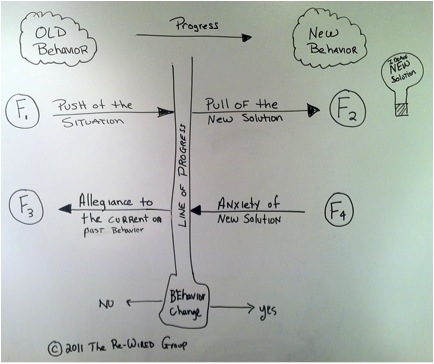
Bob Moesta has identified four influences on how a customer decides what product will satisfy a job to be done.

Push (F1): The situation which is driving a person to seek a solution. What is it we’re dealing with? What’s the impetus?

Pull (F2): The promise of a new solution that can satisfy the need. As customer’s consider a new solution, how well does it map to their needs?

Allegiance (F3): The familiarity of an existing solution is a risk mitigator, leverages already learned usage and known benefits.

Anxiety (F4): The unknown characteristics of the new solution, and the potential missteps that await. Would if the new solution isn’t all it’s advertised to be?

I like both forms of analysis, they are quite complementary. So I combined Ulwick, Bettencourt and Moesta’s work to use as an analytical tool.

Retail’s Jobs to Be Done

There are many jobs that retail must fulfill for customers. Below, I’ve picked four of them for analysis. Four that are ones you’d probably see as well. Each job has a defined outcome statement, and a listing of drivers which influence the retailer selected for the job. These aren’t actual customer insights I’ve surveyed, they’re from me. But they address the right type of analysis needed.

The analysis is done from the perspective of switching from a physical retailer to an online one. This is the disruption which is occurring. This perspective was chosen to illuminate possible innovations for physical retailers, or to point out the long term trend they will need to accept.
Retail Jobs - Desired Outcomes

Retail Job: Low Price

Getting the lowest price. Isn’t that what everyone wants? It’s been a human goal since we were bartering woolly mammoth skins for stone weapons.

Frankly, this job is one that will be challenging for physical retailers to fulfill. As has been noted, Amazon – and other online retailers – don’t have the overhead of physical stores. They can and do price lower. And you can see the differences, right there, on your screen.

The anxieties that consumers feel about online retailers providing this job – retailer performance, shipping delays – are there, but don’t rise to the level of overturning the pull of the online retailers. Too many online retailers have proven themselves over the years. They’ve overcome these anxieties.

Physical retailers competing to fulfill this job need scale to overcome their higher infrastructure costs: physical plant, distribution systems, inventory, in-store personnel. Kmart, for instance, is losing the scale war to Walmart, and the online retailers are generally able to outprice it.

Verdict: Long term, this job will be fulfilled by mega-stores and online retailers. But only in categories where it makes sense. Groceries, for instance, are tougher for online fulfillment of the Low Price job, due to the delivery costs of home delivery.

Retail Job: Immediacy

There’s times when you just have to have something today. Even now. Something needed for a home project. Last minute gift. Car maintenance. The list goes on and on. The Immediacy job occurs when the unforeseen happens, or the unplanned realize they need something.

So what’s the pull of online here? Well, you can see the item from your comfortable home. See, it’s right there on my screen! And even better, I can buy it right now! Hmm…not quite the same as actually having it in hand, is it?

Actually, the online retailers are working to provide the “holy grail” of e-commerce, same day delivery. There are different strategies here, although working with physical retailers is a core part of several initiatives. But the costs appear prohibitive: one start-up, Postmates, charges $10 to make short deliveries inside cities.

Verdict: The physical retailers have a distinct advantage here. That expensive distribution system that hurts them with the Low Price job? It’s a distinct advantage here. Physical retailers should play the immediacy game full tilt. Develop an app that tells customers whether something is available, and make it easy to pay for the item. Create a drive-through pick-up experience.

Retail Job: Selection

What did Henry Ford say? You can choose any color you want, as long it’s black. That may have been the case earlier in the industrial age, but not so anymore.

As a general observation, people desire with the ability to select from distinct offerings when making a purchase. For instance, when buying a shirt, isn’t good to see a variety of colors, patterns, cuts, etc.? You’re looking for something that fits your style. If you’ve got a home repair, don’t you want the right tool for the job? Purchasing for your kids, and it’s great to see smaller sizes of an item.

Online retailers can fulfill the Selection job nicely with their ability to provide a long tail inventory. If one retailer doesn’t have what you want, the next retailer is a click away, thanks to Google search and dedicated shopping engines. Online sites can also “own” a category with a larger selection by accessing buyers globally, not just in the local market.

Physical retailers have competed to fulfill this job by offering a wide selection of categories (mass merchandisers) or by going deep in a single category (electronics, books, pet supplies, etc.). One advantage the physical retailers have is the ability to hold and touch items, useful when considering a large number of options.

Verdict: Physical retailers will eventually cede most of the Selection job to online, due to online’s distinct advantages.

Retail Job: Help

With so many options available to us, a distinct #firstworldproblem, it can be daunting to navigate the product landscape. You’ve got a personal style, but could use some help in finding items to match it. There are multiple philosophies for raisi9ng baby, what items fit the one you’re following?

Shoppers want information to help them in their purchases. Beyond information, they want advice. Because a low price on something that misses the mark is just throwing money away. The Help job relates to what a products are being purchased for, not for how complex the product is.

Online commerce offers shoppers great amounts of information. With a click, detailed product information – the kind not available in-store – can be found. Ratings by other shoppers are aggregated, helping distinguish between good and bad products. Online retailers who can specialize in a more narrow category can offer expert advice.

But…and it’s a big but…it’s hard to replicate the give-n-take, the weighing of trade-offs with a live person in front of you. That’s the advantage physical retailers have. There are just times when you really want to talk to someone.

Verdict: This is the physical retailers’ job to lose. With local presence and real live people, they’re positioned to do well here.  The best opportunities lie in cases where the outcome of the product has a fairly high degree of emotional or monetary value for the customer.

Which Customer Job to Fulfill?

For physical retailers, the customer job to fulfill should be a natural extension of their strengths. A company’s assets lead naturally to addressing a particular job the customer wants fulfilled. You really can look at industry structure based on the jobs to be done. And see that some long term trends suggest where retail is heading.

Keep in mind that a larger set of real customers could well describe the jobs they’re seeking fulfilled. My four above are drawn from own experience. But it’s getting input from multiple customers where this methodology comes alive. I’m sure there are some additional jobs that aren’t being fulfilled very well right now, which are opportunities for the future.

I’m @bhc3 on Twitter.

Four Innovation Insights Customers Provide

Customers, properly, have been having a renaissance of sorts in terms of business thinking. Peter Drucker famously espoused a very customer-centric business philosophy. Nowadays, social CRM represents the return of a customer-first orientation. Last year, Altimeter published the 18 use cases of social CRM. Included in those use cases were several that relate to innovation.

Customers are a rich source of innovation insight, and the ultimate authority on what innovation is useful. So it’d be good to understand what types of insights they provide. OK, not just good. Vital. While the incorporation of customers in the innovation process is…honestly….still nascent, it will ultimately be the primary basis of innovation insight. It just will take some time.

It turns out, there is a structure to customer insight. Customers’ innovation insight takes several different forms:

Spectrum of Customer Insight 1
Based on research, the four types of insight are different, and vary in the ease of eliciting and what they address. Let’s take a look.

All Customers – Jobs to Be Done

“Jobs to Be Done”. What is that? It’s why someone purchases a product. A classic formulation of this is by Theodore Levitt: “People don’t want to buy a quarter-inch drill. They want a quarter-inch hole.” That starts to hit on the notion of the job. But it’s more than the direct outcome one is looking for from a product. As the diagram to the right shows, it also includes the consumption context and the emotional effect. Context paints the broader picture of the job to be done. Emotional effect broadens the discussion to include the experience of using the product.

Clayton Christensen provides a wonderful example of this, talking about the job that customers were hiring…a milkshake…for. Yes, a milkshake. There was a lot more behind that purchase than its direct usage as a cold, sweet drink. 40% of shakes were being bought in the early morning. The consumption context was people commuting in the morning, drinking a shake in lieu of breakfast. The shake’s emotional effect was stave off boredom and satisfy a general hunger at the start of the day.

Of all the innovation insights available, the jobs-to-be-done is the most plentiful. The challenge with this feedback is that it’s buried inside people’s heads, and it must be elicited from them. Practitioners such as ReWired Group and Strategyn get at the jobs to be done through deep dive interviews with customers.

Emergent Customers

Say you had a product concept, and you wanted to get a read on its applicability to people’s jobs-to-be-done. More broadly, you’d love to know what works, what doesn’t and what else is needed to make a splash in the general market. Will any old customers do? Turns out…no. What you’re looking for are emergent customers.

In research done by professors at UC-Riverside and Dartmouth Tuck School of Business (pdf link), customers exhibiting a specific set of characteristics were much better at identifying and improving concepts that are more attractive to the market. Called emergent customers, these people possess “the unique capability to imagine or envision how concepts might be further developed so that they will be successful in the mainstream marketplace.”

Sounds pretty valuable, no?

What are these traits that define a customer’s emergent nature?

The researchers created two separate field tests of example products – home delivery and oral care – to validate their hypotheses about emergent customers vs. other types. Their tests confirmed the ability of these customers to better refine a concept for mainstream acceptance than other types of customers.

Lead Users

Lead users are those customers who alter a company’s product to fit an emerging job they need fulfilled. MIT professor and economist Eric von Hippel popularized the existence of these users in his book Democratizing Innovation. Why are they so important? Because they experience new needs for products before the general market does. Find these users, and you gain an early read on what will be important more broadly in the months and years ahead.

Lead users not only experience these emerging market trends earlier, they are motivated to take action on them. The needs they experience and the product adaptations they make are quite valuable.

In one example cited by von Hippel, lead user surgeons were identified. These surgeons had modified equipment and materials to suit the needs they had, when the standard products sold wouldn’t suffice. Nearly half of these innovations were eventually marketed by the big manufacturing firms. In another example, 3M ran a test of concepts developed by its lead users vs. ideas derived from other methods. Thew lead users’ ideas were “significantly more novel than those generated by non-lead user methods. They were also found to address more original or newer customer needs, to have significantly higher market share, to have greater potential to develop into an entire product line, and to be more strategically important.”

Find these users, and learn where your market’s going.

Creative Customers

Creative customers are the uninvited dinner guests in the path toward mainstream innovation. While the jobs to be done, emergent customers and lead users provide incredibly valuable insight to make stronger, more successful innovations, creative customers…um…don’t really? The phenomenon of creative customers was researched by academics Pierre R. Berthon, Leyland F. Pitt, Ian McCarthy and Steven M. Kates in their paper, When customers get clever: Managerial approaches to dealing with creative consumers.

The researchers define creative customers simply as “customers who adapt, modify or transform a proprietary offering”. That actually sounds a lot like the customer type just described, lead users. But the researchers differentiate here by whether the innovations reflect emerging needs of the general market, and by whether creative customers are satisfying a core need or not. I’d add that creative customers are those whose innovations are pretty far afield from the mainstream path of expected product usage. And it’s not clear how companies should handle them:

Creative customers are different

Examples of creative customer innovations include the guy who used FedEx boxes to create furniture. Admittedly, not what those boxes were made for. Or the car fueled by Mentos candy and Diet Coke. They’re creative, but certainly not of the lead user class of innovations. Yet, each in their own way, point to impressions people have about the products (the incredible stiffness of FedEx boxes makes them a furniture material, the fizz of Diet Coke and Mentos is a fuel source).

Companies gain diverse thinking about their products, but such innovations do pose challenges around intellectual property, branding and liability. The researchers categorize the possible firm responses to such innovations in a 2×2 grid (shown above), based on attitudes and actions toward creative customers. But here’s the thing: creative customers aren’t going away, and their legions will increase over time. They make interesting dinner companions at the innovation banquet.

The four innovation insights described here form a broad and powerful set on inputs from customers. While the broad involvement of customers in innovation is still limited and nascent, these different types of insight provide a path for future activity by firms.

I’m @bhc3 on Twitter, and I’m a Senior Consultant with HYPE Innovation.

iPad’s Climb Up the Disruptive Innovation Cycle

Blockbuster’s recent bankruptcy filing was yet another chapter in the Clayton Christensen annals of disruptive innovation. A major brand with convenient locations that got disrupted by a website and the U.S. Mail. Note that we’re seeing the backend of the disruption, when it all seems so clear.

[tweetmeme source=”bhc3″]

How easy is it to see such a disruption beforehand? “Not very” would be the honest answer. What distinguishes a truly disruptive technology or business model from a flash-in-the-pan idea? Keep in mind the basis of a disruptive innovation:

A technology initially addressing low-end market needs that slowly moves upstream as its capabilities evolve.

From that perspective, think of all the things out there that have stayed low level and did not disrupt industries. Disruptive innovation is like a Category 5 hurricane: powerful, slow-moving and rare.

Which brings me to the Apple iPad. Are we witnessing a disruptive tropical depression?

DISRUPTIVE INNOVATION LADDER

The graphic below (via wikipedia reproduced on the TouchDraw iPad app) describes the levels of usage for disruptive technologies.

Disruptive Innovation Cycle

The target of the iPad here is the global laptop market. In that context, the beautiful, sublime, innovative iPad is solidly…in the low quality usage band of the chart above.

What represents the iPad’s “low quality use”?

  • Email
  • Surfing the web
  • Facebooking
  • Tweeting
  • Playing music

“Low quality” is not a pejorative term here. It’s a reflection of the computing power needed for the listed activities. This is the iPad’s entre into the laptop market. Consider how much of your own digital activity is covered by those items listed above. IPad already offers a great experience here.

Indeed, the Best Buy CMO recently confirmed the iPad’s move into this end of the market.

MEDIUM QUALITY USE

When you see those low quality uses, they’re primarily consumption oriented. If they are production oriented, they’re pretty basic. But there are things that can be done at the next level, medium quality use.

Games are well done on the iPad. They take advantage of the touch aspect of the device. In my opinion, games on the iPad are quickly moving up the quality ladder.

For the office, there are Apple’s apps. The Pages word processing app looks like a winner. For document production, Pages appears to fill the bill. Especially without a Microsoft Word app on the iPad. The other major office apps – spreadsheets and presentations – are available as well.

I really like the graphics program TouchDraw on the iPad. You can create very nice graphics, for business use, with just your finger. The simple graphic above was done with TouchDraw.

While I couldn’t possibly survey all apps that address different activities, I get the sense that a number of them qualify for medium or high quality uses. The question is the breadth of apps addressing the “power use cases” of laptop owners.

Finally, a word about the keyboard. I love it. I find it very easy to type out this post. It’s not without its imperfections, but generally I’m flying around it as I type. One disclaimer: I hunt-n-peck to type. I’ve never learned real typing.

GAPS THAT NEED TO BE CLOSED

In my experimenting to see how much I could do with an iPad instead of a laptop, I’ve found several areas that need to be shored up to move the overall experience to the medium quality use level.

Safari usage: Safari is the browser used for the web on the iPad. It is surprising how many sites aren’t built for usage via Safari. For example, wordpress.com, surprisingly in my view, doesn’t work well with Safari. Google Docs? Similar issue. Doesn’t work well, or at all, with Safari. I’m embedding HTML tags in this post-by-email blog post.

I cannot accept an event into my Google Calendar via Safari. I cannot create a WebEx meeting from Safari, and the WebEx iPad app doesn’t allow you to create an event. In short, doing business via iPad is tough.

As the iPad continues to gain market share, expect better support by websites for Safari. Which will dramatically improve the end user experience with the iPad.

Graphics uploads: Want to add a graphic to a document, presentation, wiki, blog or email? Hard to do. We’re used to having graphics on our local drive, and a simple button to upload/embed that graphic.

Where’s my master upload button on the iPad?!!

Answer: there isn’t one. The graphic above is one that I emailed to Flickr, grabbed the embed code and pasted it into this post. Which works fine for publicly accessible graphics. But not so much in the work context.

I’d like to see the native Photos app become a universal location for accessing graphics in any app.

Stuff at my fingertips: The ability to easily click around different apps on the PC tray at the bottom of my screen, and to click quickly among different websites via tabs, is a great productivity benefit. If you’re like me, you’re zipping around easily.

With iPad, it’s slower going back-n-forth. A lot of clicking the home button to get to other apps, or clicking the button on Safari to view other sites. Which is a pain, reducing the pace of work.

iPAD’S INEVITABLE CLIMB UP THE DISRUPTION CYCLE

So the iPad is still fundamentally in the low quality usage band, but with some clear indications of moving up. I’ve taken to using my iPad for my non-work hours computing needs.

My full expectation is that slowly, but surely, Apple and the third party app developers will improve the utility of the iPad experience. It will take some time.

But the key observation is this: Apple has the time to enhance the iPad. Two points:

That’s why I expect iPad to get better over time: market momentum. How about you? Are you thinking the iPad, and even the new crop of competitor tablets, will disrupt the laptop industry?

[tweetmeme source=”bhc3″]

Sent from my iPad

Beyond Social CRM: The Open Innovation Revolution

The idea of bringing customers into the process of defining the products and service of your organization is one that is gaining a lot of steam. One manifestation of that is the increased interest in Social CRM. In this scenario, companies engage their social customers for feedback and marketing purposes. Taking it a step further, Mark Tamis and Esteban Kolsky see the higher purpose as organizing the business around the newly social customers.

And then there’s Stefan Lindegaard.

Stefan is a leading open innovation consultant and author of the recently published book, The Open Innovation Revolution. He sees things advancing even further. From page 13 of his book:

Open innovation is about integrating external partners in the entire innovation process. This should happen not just in the idea or technology-development phase but also in all other phases toward market acceptance. User-driven innovation is great because it directs your innovation efforts toward market needs. Open innovation takes you to the next step by providing more opportunities through external partners as you address those market needs.

Stefan is on to something. To illustrate his point, I put together these two graphics, based on a hypothetical product delivery value chain. The first graphic might be properly termed, “lightweight open innovation”:

Here’s where Stefan sees the (r)evolution of this:

That’s quite a feat there, isn’t it? Incorporate a greater range of external input throughout your company’s innovation process. As Stefan describes it on page 12:

User-driven is highly related to open innovation, but it has to go further to become open innovation. This happens when you not only get ideas from external sources but also let external players become key players in the process of turning ideas into a business.

The Value of Open Innovation

And what is the value of taking open innovation to a more integrated, advanced level? Procter & Gamble illustrates the benefit. In 2000, P&G CEO A.G Lafley set a goal of having 50% of the company’s products derived from external sources. To accomplish this, the company consciously engaged external parties through its Connect + Develop initiative. Through Connect + Develop, P&G conducted a two-way exchange of ideas and feedback with industry, leveraging a dedicated staff of over 50 people. The results?

  • In 2000, the success rate of new products was 15-20%. By 2008, the new product success rate rose to between 50 – 60%. (pdf)
  • R&D investment as a percentage of sales is down from 4.8% in 2000 to 3.4% in 2006. (link)

The company attributes its success to its open innovation model. And the advantage continues. Diversified, globally-based P&G’s stock price is up 7% over the past 5 years, while the diversified, globally-based businesses of the S&P 500 are down 2%. That’s a 9 percentage point spread.

P&G sees a key benefit of its ambitious open innovation model as this: to be the preferred partner of choice when external parties have a good idea. Think about that. The volume of good ideas that can occur outside your organization is significant. When individuals, academics and industry players do have these ideas, who’s at the top of their mind for partnering? That’s a significant, sustainable competitive advantage.

The Open Innovation Revolution looks at a number of aspects companies need to address to integrate open innovation more fully into their company’s processes.

It Starts with a Vision and Planning

The initial steps are crucial for establishing an open innovation strategy. Stefan observes that you only get “one-and-a-half chances to do this thing right”. So what are the key considerations for organizations considering open innovation?

  1. Establish a clear mandate, a strong strategic purpose and an ideation theme
  2. Conduct a stakeholder analysis
  3. Develop a communication strategy
  4. Build a common language
  5. Include organizational approaches that achieve TBX (T = top; B = bottom; X = across)
  6. Strive to be innovative instead of working to become innovative

His book addresses each of those elements. He also includes examples of companies (often Danish) incorporating these steps.

The step that most resonated with me is the first one, establish a clear mandate. When this is done, it moves the initiative from an interesting suggestion to an approach supported culturally, with processes, management buy-in and identified key players.

But it’s also the hardest and is less amenable to bottom-up experimentation. I say that as someone who has read the value of bottom-up viral adoption and experimentation in the Enterprise 2.0 world. If an organization is going to engage external parties in the co-creation, co-development process, you’d better make sure you’ve got legal and senior management signed-on.

And Stefan emphasizes the issues that will be faced internally at companies as they seek to establish their open innovation mandate. A favorite term of mine is “corporate antibodies”. These are the people inside an organization that will seek to sabotage an open innovation initiative. Why?

They don’t see the effort as 2+2=5. For them, it’s 2+2=2

Essentially they fear having their own projects derailed, and potentially losing their power inside the organization. This is where senior management needs to push the effort, and even crack a few skulls if needed. Here’s how Stefan relates it (page 32):

Mads Clausen, former CEO at Danfoss, was very good at taking managers aside and looking them straight in the eye while telling them that he really believed in this innovation initiative and that he hoped the manager shared his approach.

Innovation leaders must also educate executives on open innovation and, more importantly, must make the consequences of executive decisions very clear.

In Chapter 8 of the book, Stefan addresses strategies for overcoming corporate antibodies.

People, Networking, Roadblocks, Personal Brand and Time Management

Throughout the rest of The Open Innovation Revolution, Stefan discusses a variety of elements that factor into open innovation success.

With people, he has identified two archetypes: innovation leaders and intrapreneurs. Innovation leaders work at the strategic and tactical level to build the internal platform to handle open innovation. Intrapreneurs work at the operational level on initiatives. Key questions he answers are: how to identify and develop these people?

With networking, he applies concepts of social network analysis. And spends some time talking about how you individually can go about your networking. Networking’s value is in finding new ideas and connecting with people globally, and even internally.

Roadblocks include the corporate antibodies, but other issues as well. Top executives may not “get” open innovation. Also, radical innovation is too high a threshold to seek.

Personal brand is a useful term, and one that immediately puts some people off. One interesting tidbit Stefan notes is that establishing a personal brand is seen as manipulative in many countries, but “less so in the United States.” In the chapter discussing personal brand, he includes some worksheets to help you think about your own.

Time management is no doubt an issue for most of us. He includes Parkinson’s Law, which I hadn’t heard of but immediately recognized as true: “Work expands so as to fill the time available for its completion.” He provides advice and frameworks for better managing time.

Admittedly, the personal branding and time management sections weren’t quite my cup of tea. But my guess is they reflect conversations he’s had over the years with many employees of companies who are figuring out open innovation. For example, remember his note that Europeans and the rest of the world outside the U.S. are reticent about this personal branding thing.

Start Thinking about Open Innovation

An area which I’d like to see more is a description of how open innovation works operationally. For instance, do you have existing personnel lead the interactions with external parties? Or is it better to have external connectors lead the coordination? What are the intellectual property issues to be considered? What are the contractual models for sharing the benefits of the effort?

Perhaps this is fodder for a future book by Stefan. But as it is, The Open Innovation Revolution is a smart, rich introduction to the concepts underlying this emerging practice. Stefan knows his stuff, and readers will come away with a better sense of how to prepare their organization, and themselves, for the coming revolution.

I’m @bhc3 on Twitter, and I’m a Senior Consultant with HYPE Innovation.

How Much of a Relationship Do Your Customers Actually Want?

On the Harvard Business Review, Matt Dixon and Lara Ponomareff wrote a piece that caught my eye, Why Your Customers Don’t Want to Talk to You. Consumers increasingly prefer self-service, and the authors speculate:

Maybe customers are shifting toward self service because they don’t want a relationship with companies. While this secular trend could be explained away as just a change in consumers’ channel preferences, skeptics might argue that customers never wanted the kind of relationship that companies have always hoped for, and that self service now allows customers the “out” they’ve been looking for all along.

For managers hell-bent on deepening relationships with their customers, that’s a sobering thought.

That last line is particularly relevant to the new thinking: that companies need to engage their customers in “conversations”, which social media is enabling. A related question to ask is, do they really want a “relationship” at all with companies?

[tweetmeme source=”bhc3″]

What exactly is a “relationship”?

Let’s start with an important point: what exactly is a “relationship”? Put simply, it’s a two-way connection I have with you based on some form of interaction(s). In that sense, buying a product from a company qualifies as a “relationship”. But that’s insufficient. We want to know how deep is the relationship?

The thinking of Mark Granovetter is relevant, provided helpfully by Lithium’s Michael Wu. Four elements determine the depth of a relationship:

  1. Time spend together
  2. Emotional intensity
  3. Intimacy (mutual confiding)
  4. Reciprocity

Now, apply those elements of relationship to the way you think about companies from which you buy. What’s the emotional intensity you have with the power company? Do you find yourself confiding with Amazon.com when you purchase something? How much time are you and your bank spending together?

Those questions point to a more commonly understood definition for relationship: high scores on the four Granovetter dimensions. But scoring high on those dimensions is an insurmountable hurdle for most companies vis-à-vis their customers.

The job your product is hired to do

This idea that companies need to think in terms of the “job their product has been hired to do” is one I learned from Clayton Christensen, Harvard professor and author of The Innovator’s Dilemma. It’s understanding why the customer buys your product, and what needs it fulfills. “Needs” often being different than thinking in terms of the features a product has.

This is what defines the relationship customers want to have with a company.

Leading social CRM thinker Wim Rampen argues this in his post Social CRM – What Relationships Should You Care For, And Why? In the post, he states this:

From a company’s perspective, a relationship with your Customers is not what you need most. You need most to understand what job it is your Customers are trying to get done.

Wim is spot on. That’s the innovation mantra. Nicely applied to social CRM.

The depth of a customer’s relationship depends on the job you’re hired to do

My interest in having a relationship – the deeper, more commonly understood definition – with a company is directly proportional to the complexity of the job I’ve hired you to do, as follows:

Here’s how the different jobs size up.

Efficiency, simplicity, convenience

In a consumer-based world, we have but only so much bandwidth for purchasing things which require lots of our time to engage and use. Mostly, we need commodities.

And you know what? We need ’em fast, reliable and without taking up a lot of time. In this bucket o’ jobs-to-be-done, spending a lot of cycles engaging with many companies in ongoing relationships just will not cut it. How would you get anything else done?

It’s as Jon Husband shared with me on Twitter:

<Do they even want a relationship with companies? #scrm #acinsights> I don’t

The nature of relationships in this scenario is transactional. And there’s nothing wrong with that. My bank gives me efficiency, low cost and no hassles. I’m loyal, but I don’t have a deep relationship with them.

They just happen to satisfy well a job of convenience and efficiency I need done.

Episodic interaction events

Mountain Dew ran a great social media campaign called DEWmocracy. DEWmocracy got consumers involved in a number of initiatives:

  • Ad agency selection
  • New flavor selection
  • New drink names
  • Package creation

The campaign was a great example of an episodic event to drive interactions. This was relationship-building beyond the core product offering. What made it successful is that it extended the job-to-be-done. Sure, Mountain Dew tastes great, and you can enjoy cans of it. That alone really points toward convenience and simplicity, the lowest=level relationship.

But Mountain Dew was able to elevate the complexity of the job. It got people involved in the support processes for the production and distribution. Genius, and of course, risky. But many consumers responded. They found it fun to participate, and Mountain Dew reciprocated, as Ad Age notes:

Once you’ve engaged consumers, you can’t stop. Mtn Dew made an effort to let consumers know why it was taking their advice, as well as why it wasn’t.

Now that DEWmocracy has mostly run its course, the relationship will become shallow again. Until the next event. But it has raised market awareness, and established what the company is about in consumers’ minds.

One last note here. Old Spice’s recent social media marketing blitz was not an example of addressing the job-to-be-done. It was pure marketing awareness, a point well-made by Jacob Morgan. And it worked.

Complex job, long-term usage

SAP. When you think of SAP software, do you think, “lightweight, simple-to-use, rip-n-replace anytime?” No, you don’t. SAP software is legendarily complex and powerful. They are a huge company with thousands of customers, billions in revenue and myriad business applications.

This is a complex job-to-be-done.

SAP maintains a strong customer community and extended ecosystem (including the SAP Developer Network) to manage its relationships with customers. Which makes absolute sense considering the complexity of the job-to-be-done. Customers want a relationship with SAP. Frankly, they need it.

Complex jobs often mean several things for customers:

  • Recurring need to interact with the company for information
  • Higher switching costs, increasing the need to understand what the company’s future direction is
  • Variety of use cases, meaning many ideas for future product versions

It is in these situations where the popular notion of “relationship” most closely matches what customers seek.

The core focus is the job-to-be-done

Clayton Christensen wrote this with regard to the way companies should consider their customers:

With few exceptions, every job people need or want to do has a social, a functional, and an emotional dimension. If marketers understand each of these dimensions, then they can design a product that’s precisely targeted to the job. In other words, the job, not the customer, is the fundamental unit of analysis for a marketer who hopes to develop products that customers will buy.

That’s the perspective  from companies toward customers, not so much for relationships, but for product features.

The job is also the fundamental unit of analysis going the other way, customers toward companies. Understanding the complexity of the job-to-be-done points to how deep a relationship customers want.

I’m @bhc3 on Twitter.

My Ten Favorite Tweets – Week Ending 050710

From the home office at the New York Stock Exchange, where I said “Sell Google shares, not a googol shares!”

#1: Li: CEOs have five things they focus on every day. Your “open leadership” and social strategies need to relate to one of them. #socialc20

#2: Surowiecki: The presence of a single dissenter makes a group smarter. Key? Can’t be same person dissenting every time. #feiboston

#3: Surowiecki: Having crowd diversity – cognitive & heuristics diversity – is critical to crowd assessment of ideas. #feiboston

#4: Channeling @cshirky here: “It’s Not Idea Overload. It’s Filter Failure.” (via Spigit blog) http://bit.ly/bJkyf8 #innovation #crowdsourcing

#5: RT @timkastelle Innovation through Exaptation http://bit.ly/d6G1vt > The shifting of a trait’s function over time

#6: Thoughts on Innovation Management From FEI 2010 | Forrester Blogs http://bit.ly/ah0psG #feiboston

#7: RT @jdpuva Innovate on Purpose: Innovation Failure Points: Idea Generation http://bit.ly/bBGAl2

#8: Discussions about Facebook’s privacy settings have the feel of arguing over religion.

#9: RT @ParkerLSmith The Meaning of Colors Around the World http://post.ly/ea14

#10: Learned something tonight. If you karaoke Journey’s “Don’t Stop Believin'”, the entire bar will be there with you.

My Ten Favorite Tweets – Week Ending 043010

From the home office on the Gulf Coast, where I just have to note that you never hear about “sunshine spills” or “wind slicks”.

#1: RT @mattgaston If foursquare gets it right, they could go big. Very big! NYTimes: Linking Customer Loyalty With Social Networking http://nyti.ms/cfzclt

#2: RT @TechCrunch The Huffington Post Starts To Give Out Badges To Readers http://tcrn.ch/bQopLB > Just getting started…

#3: WSJ has its own Foursquare badges http://bit.ly/a6EjmX by @mathewi > WSJ also provides news items for locations

#4: RT @tacanderson Cool webcast today by HP: An economist’s view of crowdsourcing http://j.mp/czYrSY

#5: Getting the Most from Your Crowdsourcing Initiative (via Spigit blog) http://bit.ly/cugk0z #innovation

#6: RT @jacobm spigit announces its innovation summit, should be a great one http://bit.ly/csHfNE cc @bhc3

#7: 42: Why innovation is a hard sell http://bit.ly/b83pWs by @deb_lavoy > #Innovation is problem-solving, not ideation

#8: RT @Renee_Innosight Yes! RT @MARTYneumeier: The secret to collaboration is finding a rhythm that alternates between team creativity and individual creativity.

#9: NBC’s Parenthood cracks me up. Love it. Until it inevitably jumps the shark somewhere along the line with a “very special” Parenthood.

#10: About to start Stuart Hall Miller’s Mile with my son — at Warming Hut Park Store & Cafe http://gowal.la/c/E4ah

Six Factors in Emergent Innovation

In discussing employee-driven innovation, having a technology platform to deliver on objectives is a key part of a company’s strategy. Hard to get everyone tuned in when you rely only on email and conversations with your cubicle mates. But that’s just one factor. There are many other considerations for companies seeking to vault to the top of their industries through greater innovation.

[tweetmeme source=”bhc3″]

One set of characteristics are what I term factors of “emergent” innovation. I use emergent here in the sense of conditions which let good ideas find their level inside a company, regardless of source. Think of this as an alternative to R&D-led innovation, or innovations decided solely in the executive suite and cast down for implementation by the troops.

Of course, there are more than six factors to emergent innovation. For instance, the actual process of turning someone’s idea into an innovation project has several factors of its own. But these six are a good start.

This post is long. The links below will take you directly to a specific section.

  1. Healthy use of doubt
  2. Rough alternatives
  3. Experiments
  4. Resource margin
  5. Positive deviants
  6. Diversity of viewpoints

So what are these factors?

Healthy Use of Doubt

In creative thought, doubt is good. Doubt produces creative efficiency.

David Kord Murray, Borrowing Brilliance (page 167)

Credit: Eleaf

Doubt is a word pregnant with different connotations. It can have a strong meaning of, “I don’t believe you.” In terms of working on innovations, that meaning has the potential to undermine collaborative work.

But in the quote above from David Kord Murray, it has a more productive meaning. “Doubt” refers to continually challenging existing practices to determine how things can be done better. These may be company practices, or your own. As Murray explains it, without doubt you are implicitly accepting that current practices are the best they can be. You get locked in on one way to do things. Yet, as has been documented, the rate of change in global markets is accelerating. Locking into the one best way to do things becomes a recipe for a declining business.

In his book Borrowing Brilliance, Murray relates that Albert Einstein had an apathetic relationship to his first Theory of Relativity. Why? He maintained a healthy use of doubt toward it, knowing there was more to be done. He didn’t settle on his first theory, and eventually came up with his better second Theory of Relativity.

One note about the term “healthy” here. Doubt is a mental framework in which you look at things and consider how they can be better. Doubt should not become a systemic condition that causes people to stop efforts on current projects, as in “we’re doing this wrong, so why bother”. It’d be wrong to assume everything a company does is poor and must be scrapped. Or that every individual opinion must be acted upon.

Rough Alternatives

A Stanford study investigating quick executive decision making noted that fast decision makers (a necessary component of agility) operated as though they had a rotating radar antenna; constantly refreshing context and identifying alternative paths of action. Their speed came from having rough alternatives at hand if conditions changed.

Christopher Meyer, LinkedIn discussion

Intuitively, this concept makes a lot of sense. While it may seem obvious, it’s not for those working in the trenches. The general approach is selecting the course of action, and execute like hell. Go big or go home.

And that “execution” mentality is right. It is appropriate to aggressively execute on an initiative once a decision has been made. That’s how companies get ahead.

Meyer’s comment from the LinkedIn discussion above gets at an aspect of company strategy that’s growing in importance. Be ready to pull the trigger on an alternative when conditions change. Which means having a set of rough alternatives ready.

The notion of “doubt” in the previous section is useful here. Again, not “doubt” in the sense of undermining efforts to see a particular course of action through to success. Rather, maintain a healthy perspective that even as you’re working on one way to do something, there likely are better ways still, undiscovered.

Maintaining a set of alternatives is applicable to all parts of an organization. Senior level executives, mid-level managers, project leaders and anyone doing their job. I’d argue that people in the trenches are closer to the reality of how an initiative is faring, and have a sense of rough alternatives. Enable these individuals to share what they’re seeing.

Experiments

The cost of experimentation is now the same or less than the cost of analysis. You can get more value for time, more value for dollar, more value for euro, by doing a quick experiment than from doing a sophisticated analysis. In fact, your quick experiment can make your sophisticated analysis better.

Michael Schrage, Research Fellow at MIT Center for Digital Business

Credit: jurvetson

Once a proposed idea has been identified as having merit, it needs to be put through its paces. This historically was challenging, due to constraints on building out prototypes or simulating new features. But the world has gotten more digital, and as such much more can be tested than historically has been possible. In a Wall Street Journal article by the quoted author above, Michael Schrage, Google is noted for its ongoing experiments with search results. This isn’t surprising of course. Google exists in a digital world.

But what about non-digital firms? Wal-Mart regularly experiments with signage, displays and shelf layouts to gauge the effect of different ideas. Tesco experiments with different factors that determine when another checkout lane should be opened.

Even in the realm of healthcare, experiments are being conducted. Not drug trials, but improvements to processes. Kaiser Permanente operates The Sidney R. Garfield Health Care Innovation Center. The Center “brings together technology, architecture, nurses, doctors and patients with human-centered design thinking and low-fidelity prototyping and design to brainstorm and test tools and programs for patient-centered care in a mock hospital, clinic, office or home environment.”

Experiments are a data-based method of testing potential innovations. But they differ from current practice for many corporations, which to rely less on your own experiments and ore on the advice of well-paid consultants. Why? Dan Ariely observes the following in Harvard Business Review:

There’s the false sense of security that heeding experts provides. When we pay consultants, we get an answer from them and not a list of experiments to conduct. We tend to value answers over questions because answers allow us to take action, while questions mean that we need to keep thinking.

Emergent innovation is better served by internally managed experiments, not advice from external experts.

Resource Margin

The concept of resource margin is a really good one. I came across this nice description:

No matter how I see it, agility to me is much to do with introducing margin. What I mean by this is how much the necessary margin to have within your processes, knowledge base and human resources to allow for changes. You may have a norm for people to continuously question their processes and products, “Only the paranoid survives”, but if they have no room/margin for change, it’s hard to get them to react with agility.

Jeevandra Sivarajah, LinkedIn discussion

Credit: See MidTN.com (aka Brent)

This observation just makes sense. In a world of increased busyness, employees need that bit of flex in their schedules to explore improvements to something: processes, products, customer service, etc.

Google, of course, is famous for its 20% time. Employees have the freedom to set aside their daily work and invest some cycles on exploring something new. 3M has long had a similar policy.

Now for companies, I can see the math here…employees only working 4/5 of their time on core daily tasks needed. Means you need to hire 5/4 number of employees, or an extra 25% headcount. Economy is still wobbly, hmmm…

The reality is that innovation is a core part of companies’ growth. Which company doesn’t see that? Sure, there are firms devoted to be fast followers rather than innovators. But most companies thrive-or-suffer based on their innovation performance. Note, innovation is not just slick new products.

Employees should have innovation as part of their core jobs. In other words, sure they need to file their TPS Reports and process N number of transactions. But part of their day includes thinking about improvements and bigger ideas, socializing these ideas, researching them, figuring out experiments for them, etc.

Alternatively, companies can set up special ideation events. Maybe employees don’t have the time or wherewithal to pursue an innovation all the way through. But others in a company will, and they will benefit from hearing the crowdsourced ideas of employees.

Resource margin plays an important role in emergent innovation.

Positive Deviants

I really love the juxtaposition of “positive” and “deviants”. Two words that are often at odds. But they work well together. What is a positive deviant?

This initiative is an example of “positive deviance,” an approach to behavioral and social change. Instead of imposing solutions from without, the method identifies outliers in a community who, despite having no special advantages, are doing exceptionally well.

Rebecca Tuhus-Dubrow, The power of positive deviants

Credit: asw909

As someone who has worked in large organizations, the observation that there are people with different, smart approaches is one I wholeheartedly endorse. Seen it plenty of times, from my work with headquarters, in-store and warehouse personnel at Hecht’s Department Store to my days of investment banking with Bank of America.

Here’s a good example. The sales crew at Spigit do a good amount of outbound marketing to prospective customers. As anyone who has used email for this knows, it’s hard to figure out what works in terms of email subject lines and email body. One of our sales guys came up with a totally different subject line, certainly different than anything I would have come up with. And it works. The open rate is much better for his subject line. No paid consultants needed – someone figured out a way that works.

What’s particularly appealing here is that these innovations arise from the everyday work and problem-solving people do. This is the benefit of tapping this amazing resource: employees’ ingenuity and problem solving acumen.

Leveraging the “found” solutions inside an organization is part of emergent innovation.

Diversity of Viewpoints

Ideas benefit from a diversity of viewpoints. Professor Ron Burt studied something called “structural holes”, and employees who broker them. Think of structural holes as gaps between groups of people in an organization. These gaps prevent people from accessing one another’s feedback, perspective and expertise.

People with connections across structural holes have early access to diverse, often contradictory, information and interpretations which gives them a competitive advantage in seeing and developing good ideas. People connected to groups beyond their own can expect to find themselves delivering valuable ideas, seeming to be gifted with creativity. This is not creativity born of genius. It is creativity as an import-export business.

Professor Ron Burt, Structural Holes and Good Ideas (pdf)

Credit: Marco Bellucci

Professor Burt’s empirical analysis identified exposure to a greater range of perspectives as a key element of generating higher quality ideas. I particularly like this part of his observation: “diverse, often contradictory, information and interpretations”.

That’s right. Disagreeing perspectives are good for innovation. Not a chorus of “amens”. Contradictory knowledge and perspectives as productive innovation friction.

For companies, these collaborative networks are a form of crowdsourcing. Sourcing ideas from around the organization, and more importantly letting others with interest provide feedback and ideas for refinement.

Emergent innovation benefits significantly from…emergent perspectives gathered from around the organization. Note that email and over-the-cubicle-wall conversations are limiting factors on innovation. Hard to get a diversity of perspectives with those as your only sharing modes.

For companies seeking to accelerate innovation, those six characteristics are a solid beginning. What do you think?

[tweetmeme source=”bhc3″]

My Ten Favorite Tweets – Week Ending 032610

From the home office in CTU, where I’m taking control of ’24’, not going to let it be canceled

#1: RT @scobleizer http://bestc.am/T90 This is Paul Pluschkell CEO of @spigit which is cool ideation software used by tons of companies. Now onto @pipioinc

#2: Wow – my moment in @dahowlett‘s spotlight: Enterprise 2.0: let’s be careful out there http://bit.ly/bQR3vj Great stuff, needs several reads

#3: Enterprise 2.0 and our tendency to think and talk in terms of efficiency http://bit.ly/cDe3mO by @oscarberg #e20

#4: Discussion is a good thing! RT @rawn Had to write disagreeing response to spigit post “Maslow’s Hierarchy of E2.0 ROI” http://bit.ly/9ltJo6

#5: Avoiding Innovation Chaos inside Companies (via Spigit blog) http://bit.ly/anh1cY #innovation #e20

#6: RT @govfresh Manor in WSJ: ‘A Hotbed of Tech Innovation: the Government of Manor, Texas’ http://bit.ly/aUyxbF #gov20

#7: Is Crowdsourcing Disruptive? http://bit.ly/aYybmt by @stephenshapiro > Cost per design vs cost of acquisition #innovation

#8: Can truly great design be done the open source way? http://bit.ly/bcZszD by @cdgrams > a bazaar or a cathedral? #design

#9: Actual newspaper headline: “Republicans turned off by the size of Obama’s package.” http://bit.ly/crhh2O #hcr?

#10: RT @skydiver “One of the things I love about Twitter is that you can totally make up quotations.” – Abraham Lincoln