Fostering Innovation: Lots of Little Fires or One Inferno?

An area that I find really interesting is role that social media can play in improving innovation. Before the advent of social media applications, innovation needed two primary drivers:

  1. Someone with the passion and time to see it through
  2. The luck that someone’s offline social sphere picked up on an idea and helped spread it

Today, innovation can occur much more easily than before, courtesy of social media. An idea can be disseminated and discussed far beyond (i) the originating person’s social sphere; and (ii) their level of energy to pursue it.

Which brings me back to the ongoing discussion about distributed conversations. Is innovation the product of lots of little conversational fires or one raging talk inferno? The answer is ‘both’, but I think people have undervalued the potential in lots of little fires.

The Myth of the Iconic Genius

Recently, Malcolm Gladwell wrote a great article for The New Yorker, In the Air – Who says big ideas are rare? The piece examines the history of innovation, with Alexander Graham Bell’s role in inventing the telephone as a case study. Turns out Bell wasn’t the only one working on the telephone. Elisha Gray also had a working telephone at the same time. As Gladwell describes it, this is but one example of what science historians call “multiples” – cases of simultaneous invention by completely independent persons. It happened in calculus, evolution, decimal fractions, and many, many other fields.

After discussing the findings of two researchers, Gladwell puts context to the common occurrence of “multiples” in history:

For Ogburn and Thomas, the sheer number of multiples could mean only one thing: scientific discoveries must, in some sense, be inevitable. They must be in the air, products of the intellectual climate of a specific time and place.

In other words, it’s a fallacy to think that innovation only channels through one singular genius. Which brings us back to this idea that distributed conversations are a bad thing.

The Value of Lots of Little Fires

Lets use innovation inside the enterprise as an example. An employee comes up with an idea. Not a perfect idea, perhaps not a fully formed idea. But an idea that’s got some shine to it. I hope that sounds plausible to you if you work inside a corporation. It rings true to me.

Assume the company has a good platform for this employee to propagate it. She blogs the idea on some internal web application. Other people pick up on the idea. Now stop here for second.

If her idea is to gain traction, what makes the most sense? Employees from other departments, divisions, countries all interacting with this person they don’t know? Or employees thinking through the idea with their own social circle?

I argue that employees should be free to discuss the idea how they want and with whom they want. Why? It goes back to the observation of Ogburn and Thomas – invention is often the product of current broader thinking and prior discoveries. Inside a company, this likely means an emerging issue or opportunity that employees are starting to sense.

Little fires become big fires because they burn areas that are dry and ready to ignite. In the same way, letting employees hold their own conversations is a great way to find those patches of dry tinder that are ready for your idea. Some conversations will snuff out due to lack of good kindling. But other conversations will grow as the sparks from the originating fire find lots of wood to burn.

And that’s the importance of distributed conversations. You never know from where the energy and support for your idea is going to come.

Don’t Underestimate the Value and Motivations of People

So little conversational fires are important for building a buzz inside your company. What else do they do?

  • Provide different perspectives from outside your sphere
  • Motivate employees to care about your idea

In our company example, lets say the originator of the idea is in Field Operations. She knows the customers well and has a good sense of what they’re feeling. So she writes up her idea in a blog post.

But her idea would affect a lot of different groups: product, operations, development, finance, marketing, sales, etc. Each of these departments will have a unique understanding of the idea’s requirements. Would you force all of these different perspectives through that one blog? Of course not.

Stepping outside the employee motif for a second, I think it’s important to understand that people have different experiences, interests and talents. And they have their existing peers with whom they talk. When it comes to discussing a newly presented idea, it’s unnatural to force them to abandon these existing connections and prior conversations. If that means the originating author has to chase down the conversation, so be it.

Stepping back into the employee motif, the other value of little fires is the motivational aspect. If you want an idea to take hold, you have to relinquish some control of it. If you don’t don’t, you’re going to run right into a wall of indifference.

This sounds bad to say – aren’t employees only interested in the greater company good? Maybe. But lets not make that the only basis for the success of an idea. Acknowledge that people work hard and have ambitions. The little fires of distributed conversations give them ownership of the idea within their particular social sphere. They can point out the flaws, come up with improvements and relate the idea to previous thinking.

Forcing everyone back through the originating blog post loses this dynamic, and you’ve just killed the personal motivation of some people to participate.

But Isn’t This All Messy?

Yes. It is.

Proper recognition for the idea will be an issue. Going back to Malcolm Gladwell’s article, he lists a number of people who came up with an idea at the same time as more famous inventors and discoverers. But they didn’t become household names (e.g. Elisha Gray).

Also, as different groups work through an idea, fiefdoms might emerge. Different groups laying claim to having the best vision and plan for the idea. Who’s right and who should drive it forward?

But here’s the good news – the idea got traction. Senior managers are well-paid to figure out the other issues (I’ll pause here for your Dilbert snicker…).

Now if the company’s blogging software is any good, the original author of the idea will be recognized. And more than likely, our heroine was involved in several of the distributed conversations that occurred. She is not divorced from the whole innovation process.

Final Thoughts

Distributed conversations are an important component of gaining traction for innovative ideas. They enable a greater percentage of ideas to come to fruition than in traditional company settings where dialogue is limited to your own social sphere.

I’ve used life inside the enterprise to describe why distributed conversations have value. I think a lot of the same motivations apply out on the world wide web as well. If you’re a blogger and you think you’ve got a good idea or insight, recognize that you most likely were not the only person thinking that way. So don’t be too bothered when little conversational fires start elsewhere – your spark landed in some dry tinder.

Grab some marshmallows and join the fun.

*****

See this item on FriendFeed: http://friendfeed.com/search?q=%22Fostering+Innovation%3A+Lots+of+Little+Fires+or+One+Inferno%3F%22&public=1
Do Companies Need Social Media Managers?

There are few institutions in the modern world that are not being transformed today by social media.

Shel Israel, Global Neighborhoods, 5 New Social Media Turn-ons for me.

Encouraging use and engagement with [social] tools is an area that all organizations find they have a need for at some point and time. Use of these tools and engagement by people in an organization often does not happen easily. Why? Normally, most of the people in the organization do not have a conceptual framework for what the tools do and the value the individuals will derive.

Thomas Vander Wal, vanderwal.net, Enterprise Social Tools: Components for Success

Social media is taps into a deep well of user knowledge and innovation that previously had been limited to people’s close offline contacts. FriendFeed, Twitter, Facebook, Flickr, del.icio.us and others have not so much invented new ways of thinking as they have created new ways to surface intellectual energy and creativity, and significantly expanded the conversations one has.

How does this translate into the workplace? Thomas Vander Wal’s quote above hits on one of the biggest hindrances. Just throwing tools at people and saying “have at it!” will be a colossal failure. For many people, social media requires a slow romance before they become wed to it. Want to see how much romancing is needed? Read this guy’s comment about Twitter on TechCrunch.

The thing about social media is that once people get it, they really get excited about it. Facebook has experienced terrific growth. Twitter is edging more closely to early mainstream. FriendFeed is rapidly growing. But all of these companies had a chance to incubate and grow an enthusiastic set of early adopters, which leads to broader usage.

There are two issues for companies to address in the adoption of social media:

  • Slow internal adoption can cause the initiative to die from lack of focus and budget.
  • The real benefit of social media comes when many people participate. Slow adoption means companies won’t see good benefit for a while.

How can companies accelerate adoption of social media inside by employees? An enthusiastic group of innovators is always a requirement. In addition to that, how about creating a new position? The social media manager.

The Social Media Manager?

I know such a suggestion will get eye-rolls by some. Fair enough. But hear me out.

I mentioned this idea of an employee emerging as a social media manager to someone the other day. His response was that it sounded like another version of the head of knowledge management inside a company. That was interesting take. The role of the Chief Knowledge Officer seems to include a role for social media adoption, at least as I read the definition of the role on wikipedia (here).

I’m not nearly literate enough in the field of knowledge management to know what works and doesn’t work. But I suspect there’s a big difference between a knowledge manager and a social media manager:

The social media manager is a personality-driven role

Getting people out of their shells to participate in social media will take more than a handbook and a set of best practices. The successful social media manager will be someone who can engage a wide variety of personality types. Who can handle a variety of viewpoints. Who has a thick skin, because…

The social media manager should have some skin in the game

By that, I mean the person should have some opinion about what’s best for the company. Not an absolute, draconian opinion. But a confident feeling for what makes sense for the company relative to its customers, markets, competitors and products and services. And that confidence extends to entertaining differing positions from her own. A social media manager should exemplify F. Scott Fitzgerald’s famous quote:

The test of a first-rate intelligence is the ability to hold two opposed ideas in the mind at the same time, and still retain the ability to function.

After reading this, I realize that it makes the social media manager seem like some sort of uber-participant, eclipsing all others. If that happens, then we have social media FAIL. Rather, a good social media manager will have the ability to stir up enough interest in subjects to get people participating amongst themselves.

Work of the Social Media Manager

There are three basic functions of the social media manager:

  1. Initiate discussions
  2. Participate in discussions
  3. Report on discussions

Initiation is particularly important in the early stages of the social media rollout. People need a jump start to participate, and someone willing to show how it’s done is important.

Participation keeps the social media manager relevant and build connections with others. In a large organization, no one will know everybody. So participation – the crux of social media – is a requirement.

Reporting is a way to show the benefit of participating. The social media manager can report out all sorts of things to foster interest and participation:

  • Good discussions
  • Tag buzz – hottest tags right now
  • Interesting activity streams (e.g. sales closed)
  • Rising wikis
  • Etc.

Reporting occurs via RSS and that reliable corporate communication method…email. Why report? Make sure people are aware of good stuff. And ensure good participants are recognized. This latter point is important, as it speaks to the motivation of employees. Employees are ambitious and want to succeed. Burnishing reputations via social media is a strong motivation.

It turns out this motivation dovetails with the goals of the company as well. Good social media usage benefits companies in a number of ways.

Final Thoughts

Ideally, the social media manager likely emerges organically from early users. Someone who’s a natural. If needed, someone can be appointed to the position. I’d also expect the position to change hands over time.

Note that there are those out there on the web who serve these de facto positions for a lot of us.

The thing about social media out on the world wide web is that it attracts a large number of people from all over the place, all around the world. It just takes a relatively small percentage of people to get social media going. Inside companies, more motivation is required to get things moving because there is a much more limited pool of users from which to draw adoption.

What do you think?

[UPDATE – this article mentions someone who has exactly this role: http://tinyurl.com/5zehew]

*****

See this item on FriendFeed: http://friendfeed.com/search?q=%22Do+Companies+Need+Social+Media+Managers%3F%22&public=1

Social Media Identity: Personal vs. Professional

I recently had to engage social media not using my personal identity, but under my professional identity. A bit clueless how to proceed, I sent this out on Twitter:

Facing an interesting decision about mixing my personal and professional online personas. I think I need to establish a “professional” ID.

Brian McCartney brought up a great point in response:

A “professional” ID is a good idea but there are things on my personal ID that I might want to share with the professional world…

Which got me wondering about social media identity. By that, I really mean these three things:

  • What subjects do you cover
  • What “voice” do you use
  • How does your social network perceive you

When it comes to developing professional identity in social media, a key consideration is the size of your company.

Company Size and Social Media Identities

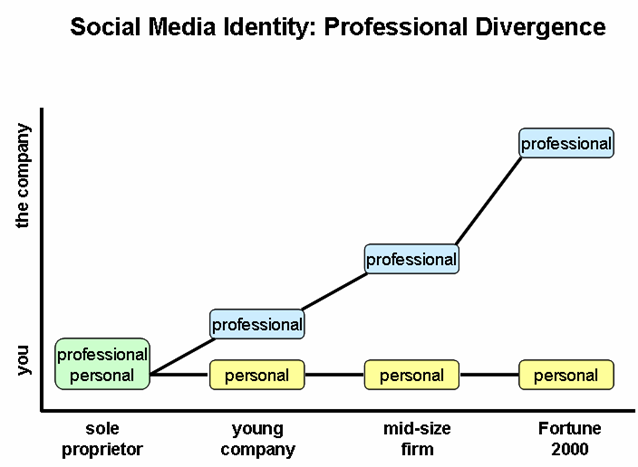
The graph below depicts where the professional and personal identities diverge.

The idea in the above chart is that the smaller the company, the more closely your personal and professional identities are tied. As the company size increases, the more separate your identities become.

Where can these identities come into play?

  • Blogging
  • Posting on blogs
  • Twittering
  • FriendFeed
  • Etc.

Entrepreneurs and Small Companies

For entrepreneurs, your social media interactions are your marketing. How you think. What you care about. What insights you can deliver. And employees of small companies are the company. So their identities are very closely tied to the company.

Sam Lawrence, CMO of Jive Software, is a good example of someone blurring professional and personal identities. Here are his social media identities:

  • Twitter: Sam mixes a heavy dose of Jive-related tweets with interesting tweets on other subjects. He ain’t afraid to keep it real out on Twitter.
  • Go Big Always: This is his personal blog, covering the social and enterprise software market. Jive gets plenty of attention, but it’s not the focus of every post.
  • JiveTalks: The official company blog. Sam can be found here, and the posts are product-related.

Here’s what Sam said about his multiple social media identities:

Up until now, I’ve been blogging on JiveTalks. But a corporate blog is just that – a corporate blog. I wanted to have a place where I could more freely voice wider observations and thoughts beyond Social Productivity and Jive’s business.

That being said, you get Sam, you get Jive Software.

Big Corporates

Employees working for larger companies will tend to have separate professional and personal social media identities. It’s tempting to say there’s the the “authentic” you and the “corporate” you. I think that oversimplifies things. The work you do is part of your authentic identity – if it wasn’t, presumably you’d quit the job.

But there are important differences when it comes to your professional identity. Here are a few that apply when using social media on behalf of a large corporate:

  • You write about things that are part of your identity only while you work for the company
  • You have to err on the side of “corporatism”, with language consistent with that of your company
  • Your company’s stuff is great, all competition sucks (of course, this applies for entrepreneurs as well!)
  • You’re likely in “sell” mode

The separation between personal identity and professional identity is the greatest for employees of large corporates. Whereas Sam Lawrence’s social media identity is very much a personal and professional combination, I decided to create a second identity for engaging social media professionally. My handle became Hutch@[company name]. You see that, you know I’m doing things on behalf of my company.

Final Thoughts

There’s a notion that someday all of our social media identities will be blurred. “Your personal identity is your professional identity in Web 2.0.” If we’re talking “professional” in terms of your career and talents you can bring to a company, then yes, that statement is true regardless of where you work.

However, if “professional” is the identity you assume on behalf of your company, then that statement really only applies to employees of small companies. For employees of big corporates, managing your social media identities is more complex than that.

I’m @bhc3 on Twitter.

Web 2.0 Inside the Enterprise? Forrester, AIIM Weigh In

Forrester produced a well-covered report this week announcing that Enterprise 2.0 will be a $4.6 billion business by 2013. In my RSS feed of FriendFeed updates containing the term Enterprise 2.0, there were probably a couple hundred related to this report – Google Reader shares, bookmarks, Twitters, etc. Sarah Perez of ReadWriteWeb has a great post about the Forrester report, with dollar figures.

About a month ago, AIIM came out with its own report on the market for enterprise 2.0. It was a work produced in conjunction with the likes of Stowe Boyd and Andrew McAfee.

After reading both of these reports, it’s clear there is a common perspective out there, but some differences worth noting as well. It’s instructive to look at both.

Forrester: Projections Focus

Forrester is paid for its expertise and forecasting. Their reports are well-regarded in this regard. Based on surveys of over 2,200 companies, this report is a forecast of the dominant technologies of Enterprise 2.0. Grounded in the market, fueled by its analysts’ views.

Forrester’s report strongly cleaves the Enterprise world into internal facing and external facing uses.

AIIM: State of the Market Focus

AIIM’s goal seems to be more of an Enterprise 2.0 temperature check of companies today. Surveying 441 company representative, AIIM didn’t try to forecast the future so much as see where companies’ heads are today.

AIIM’s report addresses both internal and external uses, but generally blurs the discussion between the two.

No Unanimous View of Top Technologies

Forrester’s report considers seven different technologies for the Enterprise 2.0 space. AIIM’s report goes much deeper. AIIM’s respondents came up with a much larger set when asked the question, what technologies make up your definition of Enterprise 2.0? To compare the two analysts, I selected the top seven participant responses from the AIIM report. Here’s how Forrester and AIIM show the leading technologies of Enterprise 2.0:

Five technologies showed up consistently between the analyst reports:

  • Social networking
  • Wikis
  • RSS
  • Blogs
  • Mashups

It’s interesting to note the differences between the two reports. Forrester included podcasting as a leading area of spend for Enterprise 2.0. AIIM’s report includes podcasting as well, but survey participants didn’t include it very often in their current definitions of an Enterprise 2.0 platform.

Forrester’s report did not include social bookmarking and tagging, but AIIM did. The Forrester omission probably says something about their view of the dollars to be spent on it.

Forrester included widgets, which is a nod to their strong focus on external uses of Enterprise 2.0. AIIM’s respondents like collaborative filtering, which is the basis for recommendation engines.

A Few Thoughts

Social networking comes in strong on both analyst reports. Forrester has spending here running away from all others by 2013. Call this the Facebook effect (MySpace didn’t seem to inspire the same trend to the enterprise). Generally, Facebook controls its “borders” and has a handle on everything that’s going on. Relationships, groups and activities all occur within the walled garden. Enterprises share a lot of these characteristics. Social networks will become the next generation intranet.

Also, note the disparity here. Companies are just coming to terms with the idea of social networks for employees, while the blogosphere seems to have left the mainstream social networks behind. Call that difference between the easy freedom of thinking and conversations, and the hard decisions of where to spend money and sweating your stock price.

Wikis come in surprisingly low on the Forrester side of things. I say that because some of the best known uses of Web 2.0 technologies inside companies are wikis. In fact, wikis are the #1 thing that respondents consider to be Enterprise 2.0 in the AIIM survey. Perhaps they have a lower cost, so that the same number of implementations will result in lower dollars spent.

RSS comes in strong for both reports. That is great to see! RSS holds so much potential. Just look at the growth of FriendFeed to see how RSS can create really new and interesting applications. RSS inside the enterprise will increase information awareness, and can be a basis for research and discovery the way FriendFeed is on the consumer web.

Blogs are ranked highly in both reports. Very nice to see. There’s still a mountain to climb before employees get comfortable with them. For companies that do have adoption of employee blogs, I expect there will be a boost in innovation.

Company blogs are interesting animals. The worst way to roll those out is treat blogs as glorified press release vehicles. That would be a waste of time. But what do you put on a blog that would be interesting? A couple of companies serve as examples. Google’s blog has a very conversational style of its products, general technology issues and other geeky stuff. Cafepress’s blog talks a lot about their products, which could be boring as hell. But Cafepress manages to relate products to larger issues, which makes it a bit more interesting.

Mashups are in the lower end of the top 7 currently, although Forrester projects spend on mashup technology to be the second highest after social networks. Here’s where I think Enterprise 2.0 will lead Web 2.0: mashup adoption. There are so many existing “big iron” software systems inside companies, that rip-and-replace is an expensive undertaking when you want to add new functionality. Mashups extend the life of these systems. In the consumer web, we’re experimenting with mashups a la Yahoo Pipes and Microsoft Popfly. I’m not sure the average consumer is going to bother with those. However, the average IT professional very much wants to look at mashups.

Those are some general thoughts. What do you think about Enterprise 2.0?

*****

See this item on FriendFeed: http://friendfeed.com/search?q=%22Web+2.0+Inside+the+Enterprise%3F+Forrester%2C+AIIM+Weigh+In%22&public=1

Innovation Requires Conversations, Gestation, Pruning

The day-in, day-out work of employees is tough on innovation. You have to get done what your managers, and the company needs today. Now there’s nothing intrinsically wrong with getting the near0term stuff done. Companies would be chaos if everyone did their own thing. But the typical work day is not conducive to maximizing innovations.

Which is where employee blogs come in. Enterprise 2.0, if you will.

Current Workplace Environment

Several things limit the amount of innovation coming out of larger companies.

General Busyness. Andrew McAfee has a nice post on this one. We’re all very busy. It feels that way, doesn’t it? And it’s not just any busyness. Your hours must have an immediate, measurable outcome. That leaves little time for the longer term, R&D-oriented type of thinking that can result in breakthrough ideas. Google’s 20% of time for personal interests stands out as an example of a company fighting this dynamic.

Existing Processes Are Hard to Change. The current products, internal practices, meetings, sales efforts, etc. are all geared to what is going on today. Much of this infrastructure is decreed from the top. New ideas which require these same corporate resources get a tough reception. It’s like you’re adding new work to everyone’s day.

Proximity Drives Relationships. We tend to share our thoughts with those we work with regularly. It’s natural. These form our relationships. So if you have a new idea, you’ll naturally bounce off these folks. But it’s crap shoot as whether you’ll get far this way. Your colleagues may not be interested or are too busy. A good idea can suffer a premature death.

Ideas Go to the Email Inbox to Die. Email is a tough medium for idea exchange. You can send your idea to someone else. If the recipient doesn’t have an immediate response, the email just sits there. And sits there. And sits there. Before long, your email is six feet under. Never to be read again. Email also suffers from limited distribution, unless you spam the corporation with your idea.

Now it’s not like innovation is failing to occur. But do companies’ internal pendulums swing so far toward busyness that they’re not maximizing their vital innovations?

Conversations, Gestation, Pruning

You ever have an idea that you really thought had legs? Well, if you just keep it to yourself, it won’t go far. Your butterfly wing flap needs to be picked up by others. The process of talking out your idea is important for validating it, refining it, seeing if it has potential.

These conversations are hard to have based on the usual workplace dynamics described above. Sure, some will happen. In a company of 10,000 people working 40 hours a week, 50 weeks a year, there are 20 million hours annually. Out of these 20 million hours, some innovation conversations will happen. But enough?

New ideas also challenge the status quo. They need time to sink in. Colleagues know the existing processes, products and services well. How does your idea affect that? How will it improve it? It’s hard to rush people to grok your idea.

This gestation also lets the idea play out more fully. It can be refined, altered, researched. Others pick up the idea and discuss it. It gets socialized. Others can become advocates, including those with a say on corporate resources.

As a result of these conversations and gestation time, some ideas will emerge as real opportunities. Many won’t. In fact, most probably won’t. But that’s OK. Real innovation is hard to achieve; if it wasn’t, we’d all be enjoying our start-up IPOs, right? This pruning is healthy and necessary.

Blogging Is a Natural Channel for Employee Innovation

In my brief blogging experience, my eyes have opened to the power of blogging. You put an idea out there, and see what others think. You make connections. You read other blogs for different perspectives.

A lot of this makes sense for addressing the hurdles to employee innovation:

  • General busyness: Blog posts need not take a lot of time. Ideas can be entered in 10 minutes.
  • Existing processes are hard to change: A blogged idea does not put someone in the awkward position of considering how it will increase their workload and change their routine.
  • Proximity drives relationships: Blogs are location neutral. Anyone can find them. Forget the guy in the cubicle next to you. The employee in Asia might grok your idea.
  • Ideas go to the email inbox to die: Blog posts live on. They’re RSS-able. They’re shareable. They’re searchable. They’re taggable. And they can be accessed by everyone.

Blogs let the conversation continue in an asynchronous fashion. You can comment on a post. Share it with a colleague. Link to it. You can build on someone else’s post. Recruit others to your cause.

All of these factors contribute to the gestation period needed for the new idea to take hold. And they help prune ideas so the ones with the most potential survive.

And a Couple Nice Benefits Also Happen

An interesting thing occurs from this: new employee social networks emerge as connections among bloggers. There are the people you work close to. Those whom you collaborate on projects. And now new connections are made based on knowledge and innovation. Those last ones may be the strongest of all.

Employees can also raise their profile and reputation with their blogging. Here’s a nice example. EMC is deploying web 2.0 technologies inside the enterprise, an effort that is being blogged by Chuck Hollis, EMC VP Technology Alliances. In a recent post, he describes how several internal employee bloggers are “graduating” to be external bloggers. That’s right – they now will engage the market on behalf of EMC.

All in all, blogging holds tremendous benefit for companies. While many employees won’t do it, those that do can become real drivers of innovation.

*****

See this item on FriendFeed: http://friendfeed.com/e/5303300f-3e4c-e5d9-b1ed-96c6d94988cf

Will Enterprise 2.0 Increase Web 2.0 Adoption?

On ReadWriteWeb, Josh Catone asks Is Facebook for Business Really Coming? The post is a good breakdown on how Facebook is growing in terms being useful for business. It touches on areas such as employees networking on Facebook, concerns about security around private content and groups, and inroad against LinkedIn.

The post is a good reference point for thinking about the effects of Web 2.0 in the enterprise. I’ve been out at the Gartner portals conference the past few days. Plenty of good analyst presentations and vendor updates. Expect to see more tagging, implicit activity integration, blogs, wikis, mashups, social networks, etc. Coming to a company near you!

As I listened to the presentations and talked with companies at our vendor booth, I came away with a strong impression that companies are looking at implementing Web 2.0 inside the enterprise. Yes, there are business cases to be built, but more companies are bringing Web 2.0 inside the firewall.

Assuming increased Web 2.0 usage inside companies, what are the outcomes? Of course, there are business improvements that will occur.

But, I think there’s another outcome from this increase. Web 2.0 tools will become more mainstream as employees are introduced to them in the enterprise.

Now, I want to make two points with regard to that statement. One is that “mainstream” is a relative term. In the U.S., there are 211 million Internet users. So one definition of mainstream could be say…50 million users. In the one quarter range. The other point is that plenty of great web sites can/will go mainstream without enterprise adoption. Nice thing about this Web, eh?

OK…with that out of the way…

This idea that companies lead the way for consumer adoption of technologies is not without precedent. Apple had the better PCs in the 1980s and 90s, but Microsoft’s operating system became the standard for the consumer market (Compaq, Dell, IBM). Why? Microsoft became the corporate standard, and employees bought the same technology when they got computers for the home.

As companies adopt Web 2.0 technologies, employee adoption is key to maximizing their benefit. As employees adopt the Web 2.0 technologies at the office, they become more familiar with them at home.

Let’s look at tagging. Del.icio.us has 3 million users. An impressive number, but only fraction of the 211 million Internet users. Many enterprise software companies are offering companies social tagging and bookmarking solutions. What happens once tagging becomes a regular part of the application stack inside the enterprise? People become comfortable with it. They ‘get’ why tagging has value (easy personal classification system, basis for discovering new content). They tag content inside their own companies. They click on tag clouds. They then come home, and want the same tagging experience.

How about RSS? RSS is a terrific way to easily stay up to date on new website content. But how many of those 211 million Internet users actually have an RSS reader of some type? Google Reader, FeedBurner, Firefox subscriptions, etc. Not that many yet. But RSS is going to be more pervasive in companies. Heck, you can even add it to Microsoft Outlook. What happens when people get used to staying updated via RSS feeds at work? They ‘get’ it. And when they get home, they’re stuck with email and their bookmarked websites. Until they realize they can enjoy the benefits of RSS on their computers.

You’re also going to see social networking introduced in the enterprise. Big as Facebook and MySpace are, the majority of Internet users do not have accounts on these services. Once employees are automatically enrolled into their companies’ social networks, they’ll start playing with them and begin to ‘get’ the value if being connected in this way. Maybe they had held off on social networks before (that’s for the kids). But after their work experience, what happens when they get home and want to keep up in a similar fashion with family and friends?

Companies need to be on top of the technology trends to stay competitive. This happens regardless of whether employees are itching for the change (how many employees were demanding groupware?). As companies roll out Enterprise 2.0, how long will it be before employee adoption makes Web 2.0 applications mainstream?