Microsoft Is Getting Much More from Its Investment in Facebook

When Microsoft invested $240 million in Facebook at a $15 billion valuation, the general reaction was one of disbelief. The valuation is too high to justify. But some people at the time felt like the dollar amount was well within the comfort zone of a giant like Microsoft. Here’s how commenter Prashant put it on TechCrunch:

I don’t think that MSFT expects to make money on the $250MM at a $15B valuation. Internally for them it is a $250MM investment to get an exclusive advertisement deal over the next 4 years. The 2% stake is only icing on the cake. Had they announced that they have given $250MM to Facebook for a 4 year exclusive ad deal, no one would have flinched, this is cheaper than the Google/MySpace deal.

Over the past few days, I’ve read a couple other blog posts that make me think Microsoft may be getting much more from its investment. Here’s a quick list of what what Microsoft seems to be getting:

  1. Exclusivity on a huge number of page views, and experience with social context advertising
  2. Insight into an emerging competitor to its operating system and productivity apps hegemony
  3. Model for bringing social networking into the enterprise

Let’s look at #2 and #3.

Operating System and Productivity Apps

Dan Kimerling wrote a great piece on TechCrunch about how Generation Y looks to the new wave of social media apps for functionality previously provided by Microsoft’s desktop and web offerings. As Dan notes:

Facebook succeeds because it is the killer web application for communications and personal information management

These are in-the-flow tools. Facebook users don’t leave Facebook, open email and send a separate message. They do it all, right there. The level of functionality is just right for their usage.

The original Microsoft email and productivity apps were pretty simple, but they did just what people needed, and with skillful marketing tie-ups, Microsoft became the standard for millions of us. Over time, Microsoft has added new features to each release, because that’s how they grew their revenues. You had to get the latest. But what happened was we got to feature bloat.

Via Kathy Sierra, Creating Passionate Users Blog, 2005

Via Kathy Sierra, Creating Passionate Users Blog, 2005

I think Kathy Sierra’s graphic is spot-on for general mainstream users. Personally, I probably use only 5% of the functionality available with the applications.

I’ve talked previously about the Innovator’s Dilemma here. As market incumbents grow, they tend to move up-market in terms of functionality in their offerings. What this does is open the door for competitors with new functions that are simpler to use. These new competitors target a niche, and grow slowly upward from there.

Facebook’s niche is still heavily Gen Y. But they’re gaining a foothold. Microsoft’s investment gives them a ringside seat for what’s happening there.

Social Networking Inside the Enterprise

I was reading a blog post by Doug Cornelius where he reported out notes from a session at the Real World SharePoint Experiences conference. A Microsoft Solution Specialist was describing the roadmap for SharePoint. If you don’t know, SharePoint is Microsoft’s enterprise collaboration software, where teams can build out individual sites to shhare and work on documents and to communicate. Each employee has a MySite, which includes their corporate directory information as well as the the list of groups and documents that are theirs.

Here’s a quote from Doug’s post:

Social networking. Mysite will be the hub of the social network. There will likely be Knowledge Network integration. They are looking to take some lessons from their investment in Facebook.

The Enterprise 2.0 space is hot, and social networking is a big focus for companies and vendors. Through its investment in Facebook, Microsoft can learn a lot of what drives interactions, how people connect and watch the mistakes the young company makes. As Dave Ferguson put it:

Good judgment comes from experience. Experience comes from bad judgment. The corollary is that the bad judgment doesn’t have to be yours.

Microsoft continues to evolve its SharePoint offering, and I look forward to SuperPoking my colleagues one day.

Wrapping Up

At first, the only purpose for the Facebook investment appeared to be advertising related. I’m sure that’s still primary, because of the huge dollars involved.

But Microsoft is also gaining an information advantage for the new wave of social computing that is finding its way into both consumer and business experiences. Given the vast reach of the company’s product lines, that’s pretty valuable as well.

*****

See this post on FriendFeed: http://friendfeed.com/search?q=%22Microsoft+Is+Getting+Much+More+from+Its+Investment+in+Facebook%22&who=everyone

“What’s the Difference Between IM and Yammer?”

It’s been a couple weeks since Yammer launched at TechCrunch50, and I assume Yammer is getting a road test out there in the workplace. One thing I saw after the launch was people wondering if Yammer was really just a copy of instant messaging. Here’s a representative tweet:

What’s cool about it? What’s the difference between IM and yammer?

Let’s hold off from noting the irony of posting that question on Twitter…

It is a fair question, because of their high similarity: short messages to a group of subscribers. But there’s so much more to the story.

Comparing IM and Yammer

The table below describes similarities and differences between instant messaging and microblogging (e.g. Yammer):

The table is pretty self-explanatory. Let me add a little more context from two blog posts related to this.

Sam Lawrence of Jive Software has a nice post, 18th Century Twitter. A quote from his post:

Everyday thousands of employees miss the opportunity to find people who can make what they’re doing less redundant or more valuable. What’s the ROI of a fully networked, 100% connected workforce? What’s the value of having all those connections saved for others to profit from?

And John Tropea writes about 140 characters to knowledge share. He makes several points about how Twitter inside the enterprise (e.g. Yammer) is a powerful basis for surfacing knowledge. In this quote, he comes at microblogging from a blogging perspective, not an IM perspective:

Twitters value contribution to the knowledge flow-spontaneous, unpolished, work in progress, thinking out loud-lends itself to this type or quality of participation due to its brief, immediate, and intimate publishing format…let’s hope internal blogs generate the same calibre of tacit value without being hindered by their format.

The fact that John looked at services like Yammer from a blogging perspective as opposed to an instant messaging perspective illuminates a key difference between IM and Yammer.

When you know what you write is visible to everyone, trackable and does not have the burden of being “on point” to recipients, you’re somewhere between instant messaging and blogging. I think Sam’s post does a nice job of summarizing the value of that.

I’m @bhc3 on Twitter.


Yammer Gets Bronx Cheers from the Blogosphere. Why?

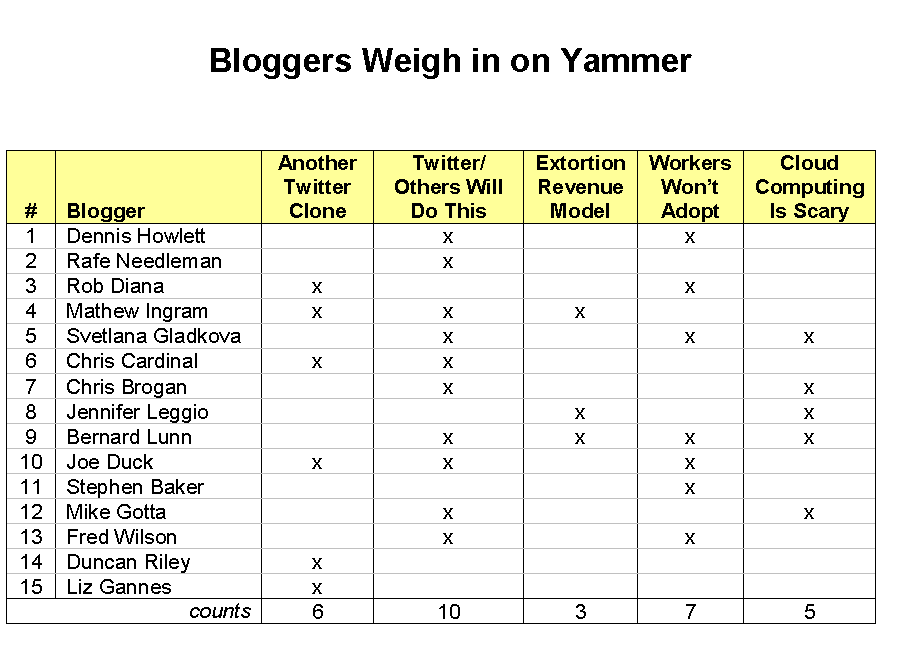
Yammer, as much of the free world seems to now know, won “best of show” at TechCrunch50. Yammer is an enterprise 2.0 company. The blogosphere had a fairly negative opinion about this. I read a number of these posts, and the table below outlines the reasons Yammer was viewed negatively:

Links to source posts: Dennis Howlett, Rafe Needleman, Rob Diana, Mathew Ingram, Svetlana Gladkova, Chris Cardinal, Chris Brogan, Jennifer Leggio, Bernard Lunn, Joe Duck, Stephen Baker, Mike Gotta, Fred Wilson, Duncan Riley, Liz Gannes

It’s a diverse collection of bloggers, and they each bring different perspectives. But there was enough commonality that I bucketed the reasons into the five groups you see in the table.

The reactions surprised me a bit – although there were positive reactions too. Let’s break down these five buckets.

Another Twitter Clone

Understandable reaction. We’ve seen Plurk, Identi.ca, Rejaw, etc. So I get the weary “Yet Another Twitter Clone” reaction.

Key difference here is the market Yammer is pursuing: enterprise. That makes all the difference in the world.

  • For Identi.ca to succeed, people would have to stop using Twitter (see Louis Gray’s post for analytical back-up to this point)
  • For Yammer to succeed, the more people use Twitter, the better.

Twitter ain’t enterprise, and I’d be surprised it gets there anytime soon. But using Twitter makes people understand the value of microblogging, which in turn helps Yammer.

Twitter/Others Will Do This

Given Twitter’s problems with keeping the service stable, I’d be shocked if they had also been putting in cycles figuring out how to go after the corporate market.

The other key difference is this. Enterprise is a different world than consumer. Probably one of the better explanations of the differences was by Mike Gotta, in discussing microblogging inside the enterprise:

“Within the enterprise, it is highly probable that IT organizations will classify these tools as messaging platforms (I would BTW). As a messaging platform, these tools would have to support security, logging, audit and archival functions to satisfy regulatory, compliance and records management demands.”

To succeed in the enterprise, you really need to focus on the enterprise. Twitter is having a field day in its growth in the consumer world. Wachovia just added their Twitter account to the website Contact Us page. Keith Olbermann is now on Twitter. Twitter should really focus on the consumer market, and own that.

Yammer is more likely to bump up against SAP’s ESME and Oracle’s OraTweet.

Extortion Revenue Model

The extortion is based on the fact that Yammer is free for sign-up and use. But if a company wants to control it, access to the administrative functions costs money. So companies will feel compelled to pay in order to manage the goings-on inside Yammer.

I’ll admit it’s a pretty creative enterprise pricing model. It seems to address two issues that bedevil enterprise software vendors:

  • How do I get a company to try my software
  • How do I prove employees will use it and get value from it

Companies don’t pay until they’ve seen employees use it and get value from it. Not bad, and it really wouldn’t be that hard for a CIO to tell employees to stop using Yammer (and block the site).

It is sneaky, but it’s also a clever way to address the adoption and value proposition issues that enterprise software vendors will always face. Atlassian Confluence achieved a solid share of the wiki market via viral adoption. Atlassian doesn’t have sales people – it’s all word of mouth.

Workers Won’t Adopt

This is where Yammer faces the toughest road. Getting people to microblog. Twitter is available to the hundreds of millions of people around the globe who might be interested. And it’s gotten a very small percentage of them.

Inside the enterprise, you need a much higher adoption rate. People already on Twitter are natural adopters, but a lot of employees will still have the “why would I do that?” reaction.

The “sell” has to compare Yammer to existing communication modes:

  • Email
  • Instant messaging
  • Forums

Note that relative to Twitter, Yammer has immediate context and built-in users. Context comes because the internal messages will generally center around work that colleagues have a stake in. In other words, they care more about each Yammer message than they do about individual tweets out in the wild.

The other thing is that managers at the departmental level can join and start using Yammer. On Twitter, if you don’t follow an A-Lister…so be it. On Yammer, if you don’t follow your boss…you’re going to miss something.

Cloud Computing Is Scary

This is an ongoing issue for the entire cloud computing/web apps world. Amazon S3 and Gmail’s recent outages highlight the issue.

Salesforce.com experienced outages back in late 2005 and early 2006. They were a blow to the software-as-a-service sector, but the company appears to have righted the ship since then.

Salesforce.com has a market cap of $6.9 billion. Yammer doesn’t.

But Yammer doesn’t have the database-of-record mission that Salesforce.com does, so the threshold for Yammer is lower. Still, ideally for Yammer, people will message about critical issues for their companies, not just what they’re having for lunch. So Yammer’s scalability, security and reliability will be important.

Cloud computing still has a sell-job of its own, but I like the way Anshu Sharma put it:

“No one (at least not me) is suggesting that on-premise software will disappear – its just that growth in enterprise software will come from SaaS and not on-premise (which is growing at about 4%). Venture capitalists like Emergence Capital and Humbold Winblad are voting with their dollars!”

A lot of action is around SaaS, it’s a question of how long the adoption curve will be. Yammer is counting on this one.

Gartner’s Hype Cycle

Gartner puts out updates on something it calls the Hype Cycle for Emerging Technologies. The hype cycle tracks the market views of various technologies, which go through predictable cycles:

  • Technology Trigger
  • Peak of Inflated Expectations
  • Trough of Disillusionment
  • Slope of Enlightenment
  • Plateau of Productivity

In July 2008, Gartner released its latest view regarding the hype cycle. This one included both microblogging and cloud computing, Yammer’s model:

Courtesy marketingfacts on Flickr

Courtesy marketingfacts on Flickr

Neither microblogging nor cloud computing is anywhere near mainstream uptake. Gartner pegs that at a 2 to 5 year horizon.

The companies that are in now, though, will be best positioned to figure out what drives the Plateau of Productivity. It takes time to learn a market, get some positive customer stories and gain a wider customer base.

I’ll be watching Yammer.

I’m @bhc3 on Twitter.

Use FriendFeed Lists and Rooms As Your Platform for Information Flow

Fred Wilson tweeted this recently:

i want to follow less people and more keywords in my twitter timeline. can’t wait for summize to get integrated into twitter

I agree with this sentiment – selected topics from a broad population, and broad topics from a selected population. When it comes to learning about particular subjects, it’s right on. FriendFeed’s beta version now gives you the ability to do exactly what Fred Wilson suggests for any topic. I’ll describe how I’m using them to track developments in the world of Enterprise 2.0.

Streaming Keyword-Based Content into the Enterprise 2.0 Room

About three months ago, I tried a little experiment. I created the Enterprise 2.0 Room on FriendFeed.

Not having time to be a Room Community Manager, I set it up to stream in content related to Enterprise 2.0. I did this as a search on FriendFeed for “enterprise 2.0“.

Well, the idea was neat. The actual implementation pretty much blew.

Because a search on FriendFeed, piped into FriendFeed as an RSS? It produces a lot of recursive results. Made the room pretty noisy and not particularly attractive to follow.

So I’ve cleaned up my act. Here’s what’s up:

  • No more FriendFeed searches
  • Using Summize Twitter Search to source content
  • Using Del.icio.us tags to source content

I’m piping in RSS feeds from Twitter and Del.icio.us. Twitter is great for those little hits. The links to content. The expression of a single perspective. And Del.icio.us is great for leveraging what people decided was worth saving.

Here are the search terms I’m using for the two services:

  • Twitter: “enterprise 2.0”, “E2.0”, “social computing”
  • Del.icio.us: enterprise2.0, enterprise20

In Case You Don’t Want it in Your Home Feed

Rooms can be set so that their entries don’t hit your Main FriendFeed stream.

You can un-check the box there that says “Show me this room’s items on my FriendFeed home page”. This works fine for Original FriendFeed.

The other option is to use Beta FriendFeed. In Beta FriendFeed, Lists have become the cool new feature. I have to admit, I’m finding it a lot easier to manage content via Lists than Rooms.

You can create a List called Enterprise 2.0. Rooms can be added to Lists. As if the Room was some sort of person on FriendFeed, streaming all sorts of content. Cool idea.

So you can run the entire Enterprise Room through a List if you want:

As you can see in #2 above, I’ve taken the Enterprise 2.0 Room out of my Home Feed. It only pipes into my Enterprise 2.0 List.

The cool thing about using Lists is that you can supplement the Twitter and Del.icio.us feeds of the Enterprise 2.0 room with other people or Rooms you like. For instance, I’ve included the FriendFeed accounts of Dion Hinchcliffe, Charlene Li, Ross Mayfield, Thomas Vander Wal and others into my personal Enterprise 2.0 List. For people not on FriendFeed, I also have created imaginary friends to pipe them into my List, such as the tweets of Harvard professor Andrew McAfee.

The Future: Keywords + People

Repeating Fred Wilson tweet from above:

i want to follow less people and more keywords in my twitter timeline. can’t wait for summize to get integrated into twitter

That pretty much describes my List set-up of the Enterprise 2.0 Room + specific FriendFeeders.

If you’re interested in a single place to track the happenings of Enterprise 2.0, I invite you to join the Enterprise 2.0 Room. Then personalize things with your own List. If you think of any search terms or data sources I should add, please let me know.

And feel free to start your own Rooms and Lists for topics you care about.

*****

See this post on FriendFeed: http://friendfeed.com/search?q=%22Use+FriendFeed+Lists+and+Rooms+As+Your+Platform+for+Information+Flow%22&public=1

How Enterprise 2.0 Fosters Innovation: Stop Groupthink

I’ve had a chance to read some interesting research about innovation. In this case, whether more quality ideas emerge…

  • When people are in group sessions; or
  • Thinking independently

The background of this research ties into a well-known corporate activity: group meetings. I imagine most of us go through the ritual team meetings. Team meetings are good for a lot of things, but innovation may not be their highest and best use.

Turns out, research says that companies would be better off if employees had a way of coming up with ideas on their own, not in group meetings.

Here are three separate findings:

Via Marc Andreessen’s blog, the findings of researchers as related by Frans Johansson in The Medici Effect:

Via MSNBC, the findings as reported in the Journal of Consumer Research.

Via MIT Sloan Management Review, research published by INSEAD Business School

These observations about brainstorming ring true to me. I’ve been in enough meetings to know that strong personalities and prior relationships can hold sway over a group. The quote above by the Indiana University associate professor describes a dynamic I’ve seen time and again. An idea suggested early in the session gets traction, and becomes the focal point of the brainstorming. At some point, groupthink takes over. Maybe it’s exhaustion, maybe it’s an inability to focus on the other ideas anymore.

Yes, good ideas can emerge. But often, the whole exercise feels forced, and in my personal experience, employees don’t expect much from these meetings. Particularly if they’re run by outside consultants.

It Turns Out Group Brainstorming Does Have Its Attractions

The INSEAD paper referenced above does have some good news about group meetings. The paper studied two types of brainstorming groups:

  1. The traditional model, assembling a group of people.
  2. The other group took a “hybrid” approach, working on ideas by themselves before coming together to share their thinking.

The quote I selected above is from the research. But the study also has this to say about the two types of brainstorming:

Which technique yielded the best ideas? Strictly speaking, the traditional brainstorming groups consistently came up with the very best idea — and the very worst one, too. In other words, the quality of their results varied much more than those that came out of the hybrid groups that combined individual and group idea generation. However, the hybrid groups produced more ideas that were, on average, of higher quality. Nonetheless “for the very best idea, you need to have a pure brainstorming group,” notes Girotra. “Random interactions are likely to produce better-quality ideas.”

A few thoughts from that quote. One, the best idea can emerge from the group brainstorming, but I suspect it takes a truly motivated group. People need to come to meetings energized, ready to participate in a rapid-fire exchange of ideas and counter-arguments. In my experience, most meetings aren’t like that.

Also, how does that research that both the best and worst ideas emerge from group brainstorming play out there? Who doesn’t want the best ideas to emerge, but are you ready to put up with the worst ones too? Is there an argument for maintaining a larger number of ideas that are consistently above average?

Why can’t we get the best of both worlds? I want a higher quantity of good ideas, and I want the best ideas to emerge. While avoiding the worst ideas, if possible.

Enterprise 2.0: Hybrid Between Individualism and Group Dynamics

The graphic below describes the way Enterprise 2.0 captures the advantages of both brainstorming styles, group and hybrid:

Source Ideas: In the model above, the bottom level speaks to the core driver of Web 2.0: user-generated content. In this case, employee-generated ideas. Applying the familiar design and functionality of the consumer web (e.g. Twitter, Flickr, FriendFeed, WordPress, etc.) allows the easy creation of ideas.

Filter Ideas: Something I’ve learned by participating in social media is that your peers are amazing filters. Find a group of people with common interests – but with different opinions – and you’d be amazed at how the most useful stuff floats to the top. Happens in blogging, photos, videos, tweets etc.

Execute Ideas: After all this idea creation and filtering is done, the ideas need to be executed. Here’s where the group dynamic becomes a huge plus. Most ideas in a corporate setting will touch a number of areas, and the group makes it happen.

The key to getting the best of both worlds – more ideas of better quality, identification of the top ideas – is to create a culture where ideas are rapidly created and evaluated, while also letting advocates gestate their ideas to fix areas of weakness.

The ‘Source Ideas’ part of the model speaks to the best of brainstorming as researchers have found, in the above quotes. In my own experience, it’s hard to find those channels for new ideas, either fully baked or based on a hunch. You’d typically have to email someone, or call a meeting with several folks. Coming up with new ideas is challenging enough…you then have to go through workplace Olympics to see an idea get discussed and considered.

‘Filter Ideas’ gets to the heart of what makes group brainstorming powerful, when it works. The rapid creation and analysis of ideas helps everyone. Different points of view, people seeing unique opportunities with an idea or recognizing weaknesses…all are vital to the corporate innovation process. Currently, this can only happen in a group setting, but the group brainstorming dynamics have to be “right”.

Enterprise 2.0 has this figured out. Ideas are easily created and shared. Proponents and opponents can develop analyses of ideas. Simple commenting is very powerful, while longer form blogging can lay down foundational elements. Proposed ideas and discussions live longer than the one hour everyone is together in a conference room.

I know this, because I see it everyday in places like FriendFeed, blogs and Twitter. The diverse opinions, knowledge, creativity and world views result in some really good ideas and perspectives.

I’m not prescribing the particular technology to capture the best of individual and group brainstorming. There are different ways to approach that. What matters is letting the employees try this out for themselves.

Groupthink has its place. A unified group taking on the challenges of the market is vital. But groupthink should kick in after the innovation processes have occurred. First, a healthy scrum of ideas, ultimately filtered to the ones that a company will execute. Then everyone working together with a common sense of purpose.

A utopian vision? Perhaps. But like all stretch goals…if you get halfway to them, you’ve accomplished a lot.

*****

If you want an easy way to stay on top of Enterprise 2.0, I invite you to join the Enterprise 2.0 Room on FriendFeed. The room takes feeds for Enterprise 2.0-related items on Twitter, Del.icio.us and SlideShare. To see this room, click here: http://friendfeed.com/rooms/enterprise-2-0

*****

See this post on FriendFeed: http://friendfeed.com/search?q=%22How+Enterprise+2.0+Fosters+Innovation%3A+Stop+Groupthink%22

How Would Social Media Help You in Your Job?

I’m having a ball with social media out in the consumer web. Blogging, FriendFeed, Twitter, Facebook. I’m learning so much about technology, new companies and people’s attitudes regarding Web 2.0. Along the way, some collaboration and a new job actually happened out of all this fun.

Now why can’t we see some of these same effects in the place where most of us spend a third of our day? We’re seeing live implementations of social media inside organizations (aka Enterprise 2.0). It’s a good sign.

I’m now in a job where I’m thinking about this a lot. And I figured I’d start with myself. Where would social media have made a difference in my two previous Big Corporate jobs:

Both companies were examples of today’s modern company, with a heavy information orientation. It’s been years since I worked at either, but here is how social media could have helped me in my jobs.

May Department Stores

The buying office of a retailer is responsible for picking the merchandise you see on the floor. Buyers also plan and execute promotions, set prices and ensure optimum amount of inventory on the floor and in the warehouse. We also had to communicate with the department managers of dozens of stores.

Here are the social media that would have helped me (if we had the Web back in 1990-1994):

  • Twitter: Yup, I would have loved Twitter. An easy way to fire off updates out to the field of department managers. And they would have sent back news of things they were seeing. Would have been a huge help during the crazy Christmas season.
  • Blog: I would have blogged about the weekly promotions. There’s a fair amount of work that went into them (promo prices, signage, focus of the ads), and documenting all that would have been useful. New products that we bought would have been good to discuss as well.
  • Bookmarking and notetaking: Assuming we had the world wide web back then, I would have bookmarked and noted a number of things for the job: competitor ads and pricing, product promotions I liked, new products I’d seen elsewhere.

Bank of America

At BofA, my group raised debt for corporations. Deals could run anywhere from $25 million to $6 billion. It was an information-intensive job.

The work consisted of three primary activities: (1) win the deal; (2) sell the deal; (3) close the deal via documentation. You had to stay on top of comparable deals, industry trends, capital market trends and general market chatter. Our group was divided into Structurers (me), who worked with clients to win and structure deals; and Distribution, who sold the deal to the market. Distribution always had the best information.

Social media I would have wanted:

  • Twitter: Again! I really would have wanted to see the ongoing chatter of the Distribution guys. They picked up all sorts of incredibly valuable market intelligence during the day. They used to IM. Now I’d want them to tweet.
  • Wiki: Every deal should have had a wiki space, with its “win the mandate” phase, its “sell it to the market” phase and the documentation phase. Wikis would have been good for handling the whole deal cycle.
  • Feed Reader: There were market data publications to which BofA subscribed. Getting a feed of deal information would have been a huge help. We were chasing information down in paper publications.
  • Bookmarking and notetaking: When deal, market or industry news came through, I needed a place to save it. I was always going back to find stuff I’d seen earlier. Bookmarking would have helped a lot. Note taking too – capture some information or thoughts, tag it and come back to it later.
  • Blog: My group wouldn’t have had much use for a blog amongst ourselves. But a blog that updated the rest of the bank as to what was happening in our particular capital market (syndicated loans) would have been perfect. We had other groups asking us often about market conditions.

I’d Love to Hear About You

Maybe you’re already using social media inside your company. Or perhaps you’ve been thinking, “my company really needs…”

If you’ve got any ideas to share, I’d love to hear them.

*****

If you want an easy way to stay on top of Enterprise 2.0, I invite you to join the Enterprise 2.0 Room on FriendFeed. The room takes feeds for Enterprise 2.0-related items on Twitter, Del.icio.us and SlideShare. To see this room, click here: http://friendfeed.com/rooms/enterprise-2-0

*****

See this post on FriendFeed: http://friendfeed.com/search?q=%22How+Would+Social+Media+Help+You+in+Your+Job%3F%22&public=1

Why Isn’t This the Tag Standard? Multi Word, Comma Separated

Tagging is a great way to put context on user generated content. The tag cloud to the right shows what the hundreds of thousands of blogs were talking about on the evening of August 21. (Click the image to see what bloggers are talking about right now).

Pretty much any web 2.0 service that has user-generated content supports tags. Flickr. YouTube. Del.icio.us. Google Reader. Last.fm. Tagging is entrenched in the web 2.0 world, and it’s one of those idea that spread without any standards.

But there is a problem of no single standard…

Beta, VHS.

Blue-Ray, HD-DVD.

Space or comma delimited?

What’s happened is that tagging formats are all over the map. Each web 2.0 service came up with what worked best for its product and developers:

This post at 37signals described the same tag formats above, and it got a lot of comments. Good energy around the subject. Brian Daniel Eisenberg thinks the failure to have a consistent tag method may undermine its adoption by the masses.

To me, there really is one best format.

Multiple Words, Comma Separated

I tweeted this on Twitter/FriendFeed:

Can there be a universal standard for tags? Multi-word tags, comma separated. Odd combos (underscore, dot, combined) are messy, inconsistent.

You can see the comments on the link. The gist of them? Multiple words, comma separated is the best format. Here’s why I think so:

  • Forced separation of words changes their meaning (“product management” or “product” and “management”)
  • Forced separation of words creates tag clouds that misrepresent subjects (is it “product” content? or “management” content?)
  • With single terms, too many ways for users to combine the same term:
    • productmanagement
    • product.management
    • product_management
    • product-management
  • Writing multiple words with spaces between them is the way we learn to write
  • Putting commas between separate ideas, context, meanings and descriptions is the way we write

Let people (1) use more than one word for a tag, (2) written naturally without odd connectors like under_scores, and (3) using commas to separate tags. These rules are the best fit for germanic and romance languages, and I assume for most other languages as well.

To Brian’s point about the masses, let’s make tagging consistent with writing.

For Developers, It’s Pretty Much a Non-Issue

In The Need for Creating Tag Standards, the blog Neosmart Files writes:

Basically, it’s too late for a tagging standard that will be used unanimously throughout the web.

A lot of developer types weighed in on the comments. For the most part, they’re sanguine about the issue of different formats. Rip out any extraneous characters like spaces, periods, underscores, etc. What’s left is a single string that is the tag.

It’s About the Users

The issue fundamentally is how boxed in people are if they want to tag. In the Neosmart Files post, commenter Jason wrote this:

As this topic suggests, there are issues in resolving various tags that whilst literally different they are contextually equivalent. I believe this to be the critical juncture. Perhaps the solution lies not in heaping upon more standards, but improving the manner in which tags are processed by consumers.

From my perspective, multiple word, comma separated format is the most wide open, flexible way to handle tags. If a user likes running words together, he can do it. If a user wants to put underscores between words, she can do it. If a user likes spaces between words, not a problem.

But making users cram together words in odd combinations takes them out of their normal writing and thinking style. Tags should be formatted with humans in mind, not computers.

That’s my argument. What say you?

*****

See this post on FriendFeed: http://friendfeed.com/search?q=%22Why+Isn%E2%80%99t+This+the+Tag+Standard%3F+Multi+Word%2C+Comma+Separated%22&public=1

Getting Overly Focused on Your ‘Regular’ Blog Audience

This week, I had one of those “lucky” blog posts, How Are Enterprise 2.0 Vendors Pitching Web 2.0? Using Wordle to Find Out. What do I mean by “lucky”? It caught the eye of someone, which led to all sorts of goodness. I’ll come back to this.

The path of success for the blog post was different than some of my other more-read posts, by which I mean FriendFeed. If I go back to the posts which have gotten the most views – direct and syndicated – FriendFeed has been incredibly important to making that happen.

So naturally, if a blog post doesn’t get a lot of uptake there, I think, “well, not one that resonated a lot out there.” In fact, I sometimes feel lulled into a sense that FriendFeed is pretty much the barometer for how a post is viewed out there:

  • Get a lot of Likes and comments on the feed URL or someone’s share? Rock on!
  • Not too many people care about the post? Take satisfaction in your own writing and move on.

That sense isn’t wholly without merit. FriendFeed has a lot of smart, engaged people who love a good discussion piece.

But I can see how sweating that too much might undermine your sense of blogging. I’m thinking of those for whom blogging lost its luster recently, such as Colin Walker. He also became fatigued with social media.

The absolute greatest thing about FriendFeed for bloggers is that you “know” your readers. You see what they think in their comments. You get feedback via Likes. You follow them elsewhere on FriendFeed and gain an understanding for their perspectives and interests.

That feedbback loop can be a bit double-edged. Over time, I’ve developed a pretty good sense for when a blog post will work well inside FriendFeed, and when one will get a lackluster reception. I plow on with my posts regardless, because I write what interests me. But that sense that something will receive limited interest can be a touch dispiriting.

But then you get these out-of-the-blue successes, these “lucky” posts, and you’re reminded that there are readers all over the place, not just FriendFeed.

I’m going to describe three blog posts that really got me a good reception, only one of which was a FriendFeed-only phenomenon.

Three Blog Successes

FriendFeed ‘Likes’ Compatibility Index: I start with a blog post that achieved success within my favorite haunt, FriendFeed. And no surprise. It was about FriendFeed, and it caught a vibe that was powering FriendFeed. We were all meeting really cool people there, and this was a way to find even more users with similar interests. Between my feed and Louis Gray’s share of the post, there were 79 Likes and 68 comments. Plus action around many other shares of the post. And the post led to a really cool app produced by felix.

This post brought home to me the power of FriendFeed. For me, it’s still something of a benchmark for uber successful posts there. Outside of FriendFeed? Not a lot of clicks.

Should I Buy the Apple 3G iPhone or Nokia N95?: Written from the perspective of both a smart phone and Apple luddite, this post examined what was known about the two smart phones. It got a good reception on FriendFeed. Then the post was picked up by MacSurfer.com. I don’t know that site, but it apparently has a lot of readers. Because a lot of them clicked through on MacSurfer’s link to my blog. Since then I’ve enjoyed some nice search engine traffic thanks to that link.

Suddenly, I found a completely different audience than the social media friends I have on FriendFeed. Apple fans.

How Are Enterprise 2.0 Vendors Pitching Web 2.0? Using Wordle to Find Out: Published this past Monday, the post got a comparatively small reception on FriendFeed. As I mentioned before, you develop a sense for what blog posts will play well on FriendFeed. I kind of knew this one wouldn’t. My enterprise 2.0 posts usually are smaller affairs there. That’s cool. I write those posts anyway because I work in that sector and the subject interests me.

And then luck struck again. The post caught fire with the enterprise 2.0 crowd. Enterprise 2.0 A-Lister Dion Hinchcliffe tweeted my blog post to his followers. Views started picking up. He then asked to publish the blog post in Social Computing Magazine. I said ‘yes’ of course, and it was the lead story for the day.

Again, I found a whole different audience outside FriendFeed. Enterprise 2.0 professionals.

So What to Take Away

I write this as a reminder to myself that there are a lot of audiences out there, and that it’s easy to fall into a pattern of focusing on what your friends on FriendFeed find interesting. If I wrote exclusively about enterprise 2.0, might I question whether anyone cared based on lower response levels on FriendFeed? And I wonder if other bloggers feel this?

As Colin felt the burn-out from social media and blogging, the thing that was best for him was to take time off. Another person who shares some of Colin’s feelings is Alexander Van Elsas. For Alexander, rather than step back from it, he has established himself as The Guy Who’s Questioning This Whole Social Media Thing.

Louis Gray had nice advice to bloggers verging on burn-out: Relax, Bloggers: Nobody Is Keeping Score, and There’s No Quota.

To that I’d add this: Stretch your creative limits. Maybe you were on a tear for a particular topic, had some success, and now find the well running dry and reader engagement dropping.

Time off is certainly a good remedy. But how about another idea? Writing something different. Try a new set of topics. For instance, perhaps there’s a tangentially related set of topics to social media. Cloud computing. Data portability. The bases for human interactions over time. Enterprise 2.0. Or go well outside that. Energy. Politics. Parenting.

Sure, you may not get a lot of clicks. Maybe the reserve of “conversation capital” you’ve built up will be quickly depleted. However, you know that’s a real possibility because you’ve switched directions on your audience. That gives you the mental safety zone to experiment and to get the creative and analytical juices flowing again.

Remember why you started blogging in the first place. Explore topics that interest you.

*****

See this post on FriendFeed: http://friendfeed.com/search?q=%22Getting+Overly+Focused+on+Your+%E2%80%98Regular%E2%80%99+Blog+Audience%22&public=1

How Are Enterprise 2.0 Vendors Pitching Web 2.0? Using Wordle to Find Out

Recently, a website called Wordle debuted. What is Wordle? You can think of it as similar to a tag cloud, except Wordle analyzes words, not tags. You can see people’s blog Wordles on FriendFeed. Wordles are only graphics – you can’t use them for navigation.

A nice use of Wordles is that you can quickly pick up the pulse of a website. Higher word counts show up as larger fonts, the way tag clouds do.

I wondered what enterprise 2.0 vendors are talking about now. We’re a couple years into the introduction of the term “enterprise 2.0“, made popular by Harvard professor Andrew McAfee. The market is still young, but a decent number of companies have entered the space. Given that they’re selling to corporate customers every day, I was curious as to how their message has evolved.

So I “Wordled” the websites of the following ten enterprise 2.0 vendors:

  1. Jive Software
  2. SocialText
  3. Connectbeam (my company)
  4. Atlassian Confluence
  5. Six Apart Movable Type
  6. Newsgator
  7. Traction Software
  8. Near-Time
  9. SpikeSource SuiteTwo
  10. Worklight

I focused on these pages for the vendors: home page, product pages, “about” page. Let’s see what’s going on out there.

Ten Enterprise 2.0 Vendors’ Wordle

For the Wordle, I removed company and product names to keep it focused on themes.

So looking at this Wordle, what do we see?

Content and information get a lot of play, while knowledge shows up less often in the messaging. That seems about right, doesn’t it? Knowledge is information that you’ve internalized. Well, enterprise 2.0 should help people with that task. Still, it does seem that the focus is on the inputs (content, information), not the outcome (knowledge).

Search shows up a lot. If you’re familiar with the enterprise 2.0 philosophy, creating and finding the good stuff that is locked up in workers’ heads is a key value proposition. Search as a basis for let workers’ connect with one another makes sense. As Nemertes Research notes:

Enterprise search is catching on with enterprises.

If search is the leading use case, what’s the next one? Collaboration. Very much in keeping with the web 2.0 ethos. After that, we see learn and networking as important use cases.

Note that RSS is only slightly bigger than email. A good acknowledgment of what the leading application in the enterprise continues to be.

Social as a top word is no surprise. Isn’t that the premise? Community falls in a similar vein.

Two other words I found interesting: can and new. Can is very much in keeping with the spirit of enterprise 2.0. Companies continue along the adoption curve, but there’s lot of opportunity out there. So emphasizing what you can do is in keeping with the state of the market. New has a similar vibe. The sector is continually iterating and innovating. Web 2.0 moves fast, and vendors have to be nimble to keep up.

Finally, note that Microsoft and SharePoint show up in the Wordle, but not Oracle, SAP or IBM. In terms of incumbent corporate software, Microsoft is the most pervasive and has enterprise 2.0 aspects with the collaborative features of its SharePoint application. As InformationWeek notes:

SharePoint dominates collaboration.

Companies’ use of SharePoint and the importance of Microsoft to the enterprise ecosystem is seen in the Wordle.

There are probably other interesting things to be gleaned from this Wordle. What do you see?

I’m @bhc3 on Twitter.


I’ve Joined Connectbeam, and Social Media Got Me the Job

On Wednesday August 13, I start my new job as Senior Product Manager for Connectbeam. Connectbeam provides social bookmarking and networking to the enterprise. The goal is to foster better information management and discovery, and to connect colleagues around projects and common interests.

Going a bit further, here is a note from privately-held Connectbeam’s about page:

Connectbeam’s architecture and core application (Spotlight) were designed to help people in any role, across the enterprise, connect with both the growing pool of information and colleagues with the expertise and experience to help them get their jobs done more intelligently and more quickly. We enable this by aggregating the social metadata that is generated naturally by using the web into a single repository that everyone in the company can access and use.

Current customers include: Procter & Gamble, CSC, Bristol-Myers Squibb, Honeywell, 3M, Intel, Pfizer and Booz Allen Hamilton.

Why Connectbeam?

The problem Connectbeam is tackling greatly interests me. How to manage information to make individuals smarter, help people find information and determine the ways in which common interests establish and build relationships. There are many posts on this blog along those lines. Here are six of them:

  1. FriendFeed ‘Likes’ Compatibility Index
  2. Hey Yahoo! Forget MSFT, GOOG. Change the Search Rules.
  3. Who Is Your Information Filter?
  4. Knowledge & Innovation: The Journey Is as Valuable as the Destination
  5. Tag Recommendations for Content: Ready to Filter Noise?
  6. Social Media Consumption: You Want Signal or Discovery?

I also like Connectbeam’s delivery model. I am a fan of cloud computing, and in my experiences at eFinance and Pay By Touch, customers got comfortable. But I also ran into companies that only wanted applications behind their firewall, which is what we sold at BEA Systems. Security, control and reliability are still important, and recent outages at Amazon S3 and Gmail highlight those concerns. Connectbeam runs as an appliance behind companies’ firewalls.

Connectbeam delivers its model as an integration with existing search engines and other applications. For instance, Connectbeam now has an integration with Microsoft’s SharePoint, the most pervasive collaboration software out there. The Microsoft SharePoint Senior Technical PM even tweeted about it.

I’m a big believer in the ability of enterprises to improve the ways that information is created, disseminated and managed by employees. Those that get this right will be better-positioned in our information-centric economy.

FriendFeed Has Opened My Eyes

I joined BEA Systems to do product marketing for enterprise 2.0. Prior to that, I had done a little tweeting and had a Facebook profile. But not a whole lot of social media. I started blogging in February to eat my own dog food when I was marketing web 2.0 to companies. I needed to immerse myself in the world to really understand it.

Well, blogging has become quite important for me. FriendFeed has become just as important.

FriendFeed opened my eyes to the possibilities of knowledge as the basis of relationships. The ways in which content from a variety of sources is a powerful, addictive basis for learning, conversations and collaboration. How activity streams are compelling reads. I’ve been active on FriendFeed since March, and it shocks me how much I know about web 2.0 and technology in general versus last year. I’ve still got much to learn, and FriendFeed will continue to be a good source for that.

So why can’t companies get better around that too? Having eaten my own dog food on FriendFeed, I’m ready to work with employees and companies to improve the ways in which information is created, tracked and shared.

How Social Media Got Me the Job

You’ve probably seen more than a few posts saying that today’s resume is your Google search results. Your social network sites, content, updates, what others say about you…all of it is searchable.

Like me, Connectbeam CEO Puneet Gupta subscribes to Google Alerts for “enterprise 2.0”. Well one of my blog posts was listed in an alert. It caught Puneet’s attention, so he read the blog a bit more. Liking what he saw, he then investigated my name out on the web. Among the sites he found was one where I was a recommended blogger to follow (thanks Daryl, Franklin, Louis, Mark, Mike, Rob, Steven). Those recommendations were in part made due to the wonderful effects FriendFeed has for bloggers.

It didn’t hurt that I had been involved with enterprise 2.0 at BEA Systems. So after doing some due diligence, he left this comment on my blog:

Hutch:
Would love to connect with you and discuss some ideas.

I reached out to him, did some interviews, and the rest is history.

Looking Ahead

The new job will give me a more structured basis for looking at the ways in which information is managed. I plan to look more deeply at some of the consumer social bookmarking sites.I’m a product manager for Connectbeam, but a lot of my job will involve product marketing too.

I expect working in this area will influence my blogging subjects some. But I’ll blog about other fun stuff along the way as well.

Gotta go – my commute is from San Francisco to Mountain View. Need to battle the 101 traffic.

*****

If you want an easy way to stay on top of Enterprise 2.0, I invite you to join the Enterprise 2.0 Room on FriendFeed. The room takes feeds for Enterprise 2.0-related items on Twitter, Del.icio.us and SlideShare. To see this room, click here: http://friendfeed.com/rooms/enterprise-2-0

*****

See this post on FriendFeed: http://friendfeed.com/search?q=%22I%E2%80%99ve+Joined+Connectbeam%2C+and+Social+Media+Got+Me+the+Job%22&public=1

Smart Workers Will Figure This Out: Social Media = Career Advancement

Do you think you’ve got more to contribute to your organization than you’ve had a chance to show? I’ll bet you do too.

There have been a fair number of posts about the adoption rate of web 2.0 inside companies. In my previous work doing enterprise 2.0 product marketing for BEA Systems, I can confirm a growing interest out in the corporate world.

But interest from the higher-ups is one thing. What makes the employees actually want to wiki/blog/tag/comment/tweet?

I came across this comment on an old Nick Carr post, Web 2.0’s Numbskull Factor:

Successful adoption [of web 2.0 inside companies] is likely to be driven by the usual three support cycles involved in effective change: achieving personal benefits from using them, seeing peers achieving the same benefits and continuous management support over the 24-36 months required to embed them in business as usual.

Graham Hill, PriceWaterhouseCoopers

Graham’s three elements are spot on. In this post, I want to discuss the first two cycles he discusses. The third cycle is for another post.

Personal Benefits Come in Two Flavors

In a company setting, personal benefits mean one thing:

How will it improve my career?

I know that’s a bit crass. But I think it speaks to what energizes us to work. You want recognition that you can “bring it”.

Two ways such an outcome occurs with social media/web 2.0:

  1. Makes me better at my job and strengthens relationships with colleagues
  2. Others with the power to advance my career start to form a good impression of me

In terms of improving your work, web 2.0 apps offer a variety of benefits. That’s actually going to be future post.

The second benefit is one of reputation. I think all us who work in big companies know that reputations are vital to career advancement. You form impressions of others, which frames your view of their work. And most assuredly, others form impressions of you.

In the typical work environment, you interact with others via email, phone, team meeting. Contributions are made, but not recorded. Knowledge of your effort is silo’d and much of the good stuff we do is invisible.

Social media changes the game. As projects run through wikis, a permanent record of your contributions is created. Your comments are visible and searchable, greatly increasing their value relative to verbal contributions or email. A blog post with a good idea is accessible everywhere, at any time. It also can be shown as the spark for that killer product the company introduced. Your tagging of internal data is like Louis Gray sharing posts from Google Reader. People love your tags.

You also get to step outside of your assigned duties, and weigh in on the big issues facing the company. Always felt like you’ve got a good bead on areas the company needs to address? But your manager and peers aren’t really interested? Blog about it. Tweet about it. Comment about it. Establish your cred. If your thinking pans out, you’ve got a basis for demonstrating your contributions.

The other thing is this. Your contributions via social media need to help others. As you offer insight, decisions and ideas, others will find value in your contributions. Well beyond the normal four walls of that cubicle you’re sitting in. You can build relationships with geographies, business units and departments that are not normally in your work sphere.

To recap the benefits of social media for you:

  • Work better
  • Get beyond relying only on the annual review, create an electronic trail of your work
  • Show you can contribute to larger issues affecting the company
  • Establish relationships with people outside your daily social circle
  • Build – better yet, control – your internal reputation

Peers Getting the Benefits

This one is pretty basic. You know those mass internal emails calling out an individual or team for doing something really outstanding? Don’t you love those?

Well, social media will have some of that. You’ll be on the company portal or wiki, and you’ll see a complimentary message for someone’s work on it. If it’s anything like what I see on FriendFeed or Twitter, there will be several of these messages. A great way to give the “atta boy” or “atta girl” to someone’s work.

And everyone else seeing these complimentary messages will start to get the hint. My colleagues are starting to have an impact. I’d better participate.

Final Thoughts

Workers already have a host of channels with which to establish their reputation: project teams, emails, meetings, water cooler. For some, adding web 2.0 apps is just another thing they have to worry about.

Smart employees are going to see things differently. These tools offer the chance to better contribute, to get a better read on the pulse of the company and to better control one’s reputation. A chance to change the rules for career advancement.

*****

If you want an easy way to stay on top of Enterprise 2.0, I invite you to join the Enterprise 2.0 Room on FriendFeed. The room takes feeds for Enterprise 2.0-related items on Twitter, Del.icio.us and SlideShare. To see this room, click here: http://friendfeed.com/rooms/enterprise-2-0

*****

See this item on FriendFeed: http://friendfeed.com/search?q=%22Smart+Workers+Will+Figure+This+Out%3A+Social+Media+%3D+Career+Advancement%22&public=1

Using FriendFeed Rooms for Work: What’s Needed?

I believe that Participation is the killer app.

Whether it is end user participation in content driven conversations on blogs and wikis, or end user developed applications, mash-ups and widgets, I think that it is participation that key difference between Enterprise 2.0 and Enterprise 1.0.

Rod Boothby, Participation Is the Killer App, Innovation Creators

Making work more interesting and more engaging would have benefits for companies and workers. To that end, I’ve suggested that FriendFeed has aspects applicable inside the enterprise. Steven Hodson took it a step further, suggesting engineers could use FriendFeed rooms to manage their software development.

The idea of using rooms for work purposes has been broached by other as well:

  • possible248: “Companies already have blogs and wikis, is there going to be something like a FriendFeed room that they can host on their own server?”
  • Jigar Mehta: “How would it be, if FriendFeed allows users to attach documents (doc, docx, ppt, pdf, txt, rtf) and discuss over them!!”

Personally, I think there’s a lot of merit to this idea. I’ve seen so many good discussions around ideas on FriendFeed. And for many of us, work is the creation, advocacy and execution of ideas – projects, presentations, campaigns, financings, etc.

The land of wikis is well developed, but most of them suffer from only emphasizing multiple user changes to documents and revision tracking. They lack the interactive participation that makes FriendFeed so compelling.

With that in mind, I wanted to come up with a list of features that would provide very basic wiki functionality in FriendFeed rooms. Wikis can have all sorts of advanced features. What would be the minimum feature set to make rooms function as lightweight wikis?

To be clear about the objective…I’ll set the wiki bar low. A room would only exist to manage the production of a smaller project or document. No large-scale stuff here. And that’s probably a good approach in business anyway.

Rooms already have three key elements for making them into wikis:

  • Ability to manage who the room members are
  • Room-specific search
  • RSS directly into rooms

Here are my four features for wikifying FriendFeed rooms:

  1. Better handling of RSS feeds for document changes
  2. Sticky setting for entries
  3. Timestamp comments
  4. New comments and entries notification

Better Handling of RSS Feeds for Document Changes

In Jigar Mehta’s entry, Nick Lothian commented:

Doesn’t GDocs have a RSS feed for changes? Hook that up and then you can have discussion about the changes to documents

That makes a lot of sense to me. FriendFeed doesn’t need to upload the document and maintain revisions. It can leverage that functionality in another app, like Google Docs. And this use case is exactly how FriendFeed works: users read blog entries and then come back to FriendFeed to Like and Comment.

I set up a public document on Google Docs, and had the document changes feed into a specific room: Rooms Wiki Experiment. If you go there, you’ll see my original entry, “Politics 2008 – Google Docs”. I commented a couple times. Then you’ll see another entry called “Restricted”. If you had access to the source document, you’d see information about revisions. I, of course, do have access. And that link only takes you to Revision #3. I made 15 revisions, but those changes didn’t stream into the room.

So that needs to work better, either from Google Docs or within FriendFeed.

Sticky Setting for Entries

Brad McCrorey posted a good question on FriendFeed:

Would having a “sticky” setting that keeps an item at the top of the room be too “forum like”? I think I’d get some use out of it.

I like this idea. In terms of advancing a project or document, this feature would let key decisions remain visible to everyone in the room.

Timestamp Comments

This is a recurring request. And it makes sense in terms of the wiki. Projects and documentsd evolve, and the timestamp helps one understand whether a comment was made before a change or after it. Or before a decision, or after it.

Timestamps give an extra bit of context to the interactions that occur around the project.

New Comments and Entries Notification

Inside a company, you are busy with multiple tasks. You’re not likely to keep the FriendFeed room up all the time (although that may be possible).

But it’s important to know when new entries have been posted. These entries would be:

  • New changes to a document
  • New direct posts of someone with an idea or question
  • New document added to the room

Notification provides the visibility needed to ensure interactive participation and timely decision-making.

Final Thoughts

The comment at the top of this post reflects my position regarding the future of work. More open, more interactive, broader participation, more engaging. FriendFeed, and Twitter as well, have created terrific interactive models not seen in most Enterprise 2.0 apps today.

I’m sure the FriendFeed guys aren’t worried about this now. But somewhere along the line, companies may see the potential in FriendFeed and begin asking for this type of functionality.

*****

See this item on FriendFeed: http://friendfeed.com/search?q=%22Using+FriendFeed+Rooms+for+Work%3A+What%E2%80%99s+Needed%22&public=1