Fostering Innovation: Lots of Little Fires or One Inferno?

An area that I find really interesting is role that social media can play in improving innovation. Before the advent of social media applications, innovation needed two primary drivers:

  1. Someone with the passion and time to see it through
  2. The luck that someone’s offline social sphere picked up on an idea and helped spread it

Today, innovation can occur much more easily than before, courtesy of social media. An idea can be disseminated and discussed far beyond (i) the originating person’s social sphere; and (ii) their level of energy to pursue it.

Which brings me back to the ongoing discussion about distributed conversations. Is innovation the product of lots of little conversational fires or one raging talk inferno? The answer is ‘both’, but I think people have undervalued the potential in lots of little fires.

The Myth of the Iconic Genius

Recently, Malcolm Gladwell wrote a great article for The New Yorker, In the Air – Who says big ideas are rare? The piece examines the history of innovation, with Alexander Graham Bell’s role in inventing the telephone as a case study. Turns out Bell wasn’t the only one working on the telephone. Elisha Gray also had a working telephone at the same time. As Gladwell describes it, this is but one example of what science historians call “multiples” – cases of simultaneous invention by completely independent persons. It happened in calculus, evolution, decimal fractions, and many, many other fields.

After discussing the findings of two researchers, Gladwell puts context to the common occurrence of “multiples” in history:

For Ogburn and Thomas, the sheer number of multiples could mean only one thing: scientific discoveries must, in some sense, be inevitable. They must be in the air, products of the intellectual climate of a specific time and place.

In other words, it’s a fallacy to think that innovation only channels through one singular genius. Which brings us back to this idea that distributed conversations are a bad thing.

The Value of Lots of Little Fires

Lets use innovation inside the enterprise as an example. An employee comes up with an idea. Not a perfect idea, perhaps not a fully formed idea. But an idea that’s got some shine to it. I hope that sounds plausible to you if you work inside a corporation. It rings true to me.

Assume the company has a good platform for this employee to propagate it. She blogs the idea on some internal web application. Other people pick up on the idea. Now stop here for second.

If her idea is to gain traction, what makes the most sense? Employees from other departments, divisions, countries all interacting with this person they don’t know? Or employees thinking through the idea with their own social circle?

I argue that employees should be free to discuss the idea how they want and with whom they want. Why? It goes back to the observation of Ogburn and Thomas – invention is often the product of current broader thinking and prior discoveries. Inside a company, this likely means an emerging issue or opportunity that employees are starting to sense.

Little fires become big fires because they burn areas that are dry and ready to ignite. In the same way, letting employees hold their own conversations is a great way to find those patches of dry tinder that are ready for your idea. Some conversations will snuff out due to lack of good kindling. But other conversations will grow as the sparks from the originating fire find lots of wood to burn.

And that’s the importance of distributed conversations. You never know from where the energy and support for your idea is going to come.

Don’t Underestimate the Value and Motivations of People

So little conversational fires are important for building a buzz inside your company. What else do they do?

  • Provide different perspectives from outside your sphere
  • Motivate employees to care about your idea

In our company example, lets say the originator of the idea is in Field Operations. She knows the customers well and has a good sense of what they’re feeling. So she writes up her idea in a blog post.

But her idea would affect a lot of different groups: product, operations, development, finance, marketing, sales, etc. Each of these departments will have a unique understanding of the idea’s requirements. Would you force all of these different perspectives through that one blog? Of course not.

Stepping outside the employee motif for a second, I think it’s important to understand that people have different experiences, interests and talents. And they have their existing peers with whom they talk. When it comes to discussing a newly presented idea, it’s unnatural to force them to abandon these existing connections and prior conversations. If that means the originating author has to chase down the conversation, so be it.

Stepping back into the employee motif, the other value of little fires is the motivational aspect. If you want an idea to take hold, you have to relinquish some control of it. If you don’t don’t, you’re going to run right into a wall of indifference.

This sounds bad to say – aren’t employees only interested in the greater company good? Maybe. But lets not make that the only basis for the success of an idea. Acknowledge that people work hard and have ambitions. The little fires of distributed conversations give them ownership of the idea within their particular social sphere. They can point out the flaws, come up with improvements and relate the idea to previous thinking.

Forcing everyone back through the originating blog post loses this dynamic, and you’ve just killed the personal motivation of some people to participate.

But Isn’t This All Messy?

Yes. It is.

Proper recognition for the idea will be an issue. Going back to Malcolm Gladwell’s article, he lists a number of people who came up with an idea at the same time as more famous inventors and discoverers. But they didn’t become household names (e.g. Elisha Gray).

Also, as different groups work through an idea, fiefdoms might emerge. Different groups laying claim to having the best vision and plan for the idea. Who’s right and who should drive it forward?

But here’s the good news – the idea got traction. Senior managers are well-paid to figure out the other issues (I’ll pause here for your Dilbert snicker…).

Now if the company’s blogging software is any good, the original author of the idea will be recognized. And more than likely, our heroine was involved in several of the distributed conversations that occurred. She is not divorced from the whole innovation process.

Final Thoughts

Distributed conversations are an important component of gaining traction for innovative ideas. They enable a greater percentage of ideas to come to fruition than in traditional company settings where dialogue is limited to your own social sphere.

I’ve used life inside the enterprise to describe why distributed conversations have value. I think a lot of the same motivations apply out on the world wide web as well. If you’re a blogger and you think you’ve got a good idea or insight, recognize that you most likely were not the only person thinking that way. So don’t be too bothered when little conversational fires start elsewhere – your spark landed in some dry tinder.

Grab some marshmallows and join the fun.

*****

See this item on FriendFeed: http://friendfeed.com/search?q=%22Fostering+Innovation%3A+Lots+of+Little+Fires+or+One+Inferno%3F%22&public=1

Weekly Recap 053008: ‘No Comment’

The week that was…

*****

Good discussion this week about comments…first, there was the latest installment of this issue: comment dispersion away from the originating blog…Fred Wilson at A VC weighed in: Jackson instigated the conversation with that post. His reward is the comments it generates…interestingly, bloggers with big established audiences agreed with him…Chris Brogan wrote this on Fred’s blog: One part of the currency I crave from doing a blog is that conversation, especially on my blog, where I spend lots of effort building the posts to be conversation starters, not just fully formed ideas…Mathew Ingram wrote a concurring blog post Bloggers get “paid” with comments

Which made me wonder, do you think there’s a divide between larger established bloggers and smaller, newer bloggers on this issue of distributed conversations?

*****

Next up on the comment discussions…who actually owns the comments?…there was a controversy early in the week where Rob La Gesse was irritated at the comments that were occurring on FriendFeed about his blog post…so he pulled his blog RSS from FriendFeed, which eradicated that post and all its comments from the FriendFeed UI…this raised the question of who owns the comments, and whether FriendFeed should do a better job of keeping records…Mathew Ingram reached out to FriendFeed co-founder Paul Buchheit, who noted the bias is toward blogger control of their feeds and that they will look at ways to solve to better retain comments…

Later, Daniel Ha of Disqus wrote a post called A Commenter’s Rights…kind of a Bill of Rights for those who leave comments on blogs…one Right that I liked: ‘The ability to edit and remove their comments’…too many blogs don’t allow that, including wordpress.com…

We’ll close this out with a quote from my favorite cranky blogger Steven Hodson: This whole discussion about comments is becoming borderline stupid

*****

FriendFeed is growing, and not surprisingly, it’s getting its share of…um…interesting personalities…click this link which takes you to a search for “tweets totally f%(#ed twitter”…you’ll understand what I mean…

*****

Hats off to a couple of developers this week…I wrote a post titled FriendFeed ‘Likes’ Compatibility Index…I manually pulled together some stats to see which other FriendFeeders had the same Likes as me…well Yuvi wrote a script that he could run from his computer for any FriendFeed handle he entered…a bunch of us wanted our stats manually calculated, and he obliged…he blogged about it, and hit Techmeme…very nice Yuvi…

Then another developer, felix, created a UI where anyone could enter their FriendFeed handle to see the people who shared Likes the most…and then felix thought, “I’m going to turn this one up to 11″…he made pie charts out of the results, which have become a big hit on FriendFeed…FriendFeed co-founder Bret Taylor gave his thumbs up on felix’s blog, “Very cool!“…very nice work felix…

BTW, we’re all one playing for second place to Shey in the Likes department…

*****

Jeremiah Owyang apparently has an interesting post on FriendFeed that he’s writing for Saturday 5/31/08…Robert Scoble talked with Jeremiah, and gave this update:

I just talked with Jeremiah. He says FriendFeed will turn on a new functionality that Jeremiah is calling “MiniMeme.” He wouldn’t give me more details, but I am intrigued.

So check your RSS reader for Jeremiah’s post, and maybe we’ll be talking about that here next week….

*****

See this item on FriendFeed: http://friendfeed.com/search?q=%22Weekly+Recap+053008%3A+%E2%80%98No+Comment%E2%80%99%22&public=1

FriendFeed ‘Likes’ Index: Case Study in Value of Distributed Conversations

By keeping comments distributed, or decentralized, more than one discussion is able to take place. New ideas are likely to be heard since readers often start with a blank slate and are more likely to participate.

Shey Smith, introspective snapshots, The Case For Distributed Conversations

Today, a great example of the value of distributed conversations took place. What started as a blog post here ended up with three different developers coming up with innovative new scripts that FriendFeeders were digging. And it all happened because of distributed conversations, not despite them.

The very smart and in-tune Fred Wilson wrote a piece yesterday decrying the distribution of conversations all over the Web, including on FriendFeed. Mathew Ingram followed up with a concurring blog post. I understand where they’re coming from, but I think they overlook the value of distributed conversations.

What I’d like to do is briefly describe the action today, and then point out how distributed conversations made innovation possible today.

FriendFeed ‘Likes’ Index Calculators

Wednesday night, I posted a piece titled FriendFeed ‘Likes’ Compatibility Index. The post reported some number crunching I did to figure out who most often Liked the same things that I do. The idea was to see what other FriendFeeders shared the same interests. At the end of the post, I made a request for someone to automate the analysis.

From this post, two separate conversations emerged. The RSS feed for the blog post hit FriendFeed (Original Post). And Louis Gray shared it on Google Reader (Shared Post), which started a second conversation.

What happened? There were three different places where conversations were happening: on this blog and on two different items in FriendFeed. And it resulted in three separate developers coming up with solutions.

Yuvi

Yuvi, a 17-year old wunderkind who does amazing stats analysis, was interested in automating this analysis. He posted the same comment on all three locations: “I could automate this…if friendfeed fixed this bug.” Yuvi was concerned about a bug in FriendFeed that won’t allow you to go more than 11 pages back in your history.

His comment generated responses in FriendFeed on both the Original Post and on the Shared Post.

Original Post:

  • Phil Glockner: “Yuvi, does that bug exist when doing queries against the API?”
  • Yuvi: “Yes, it exists in the API too.”

Shared Post:

  • Shey: Yuvi, could you automate it up to page 11?
  • Hutch: Does the limit of going back beyond page 11 risk the script failing? Or does it limit the data collected?
  • Yuvi: @Hutch: Limits data collected.
  • Yuvi:@Shey: Well, I could… But, it’ll be of limited use, no?
  • Bwana: I say do it now so when they do fix it, it’ll be ready, plus there seems to be an interest
  • Shey: @Yuvi Limited yes, but I think 11 pages of data is of some use for analysis of recent data
  • Cyndy: Yuvi, I’m not sure it’s a bug. I think it’s a limit that they have set. Since the variable is passed in the URL, if you try to go past that number of posts manually, it still won’t go. Could be that they are only pulling from cache?
  • Yuvi: @Cyndy: Well, they’ve been mum on this – so I don’t really know. But, if even *I* can’t access my old stuff, isn’t that wrong on at least “some” level?
  • Benjamin Golub: I don’t think it’s a bug either. I feel that there DB sharding might be setup such that it is very very quick to pull recent data.
  • Bwana: Well if there is a limit imposed, pages after 11 shouldn’t even be shown. It’s a bug of some kind either way.
  • Yuvi: @Benjamin: Yep, agree on that, but there should be ‘some’ way to get the older data out, no?
  • Yuvi: Just repeating – the API has the same limit in place. Script ready anyway – First Target – LouisGray 😉

So in that sequence, you see that fragmented conversation, away from the blog post itself, resulted in Yuvi creating a script to determine who shares your Likes.

And Yuvi blogged about it, linking to my blog post and even mentioning me by name. Everything a blogger could want.

Do you see what I mean Fred and Mathew?

Ole Begemann

On Louis’s Shared Post, a second developer Ole Begemann weighed in:

  • Ole Begemann: I’ve written a Python script that does this, too (for practice). Interestingly, Phil is no. 12 on my list of Louis Gray’s most compatible likers. If there’s interest, I’ll try to wrap it up on a web page (it’s command line at the moment) and publish it.
  • Hutch: @Ole – Yeah, I’d like to have a page where you could see these results.
  • Ole Begemann: I’ll get around to it Hutch. It might take me a few days. It’s my first try as a Python programmer. 😉

A second developer came up with a script for this. Again, via conversations that happened entirely away from the originating blog.

felix

Finally, back on my Original Post in FriendFeed, a developer named felix added this comment:

“I just created a little javascript to go and grab the last 30 likes of anyone and do a basic calculation. Have a couple more features I want to add, but no more time today – what do y’all think? http://is.gd/nLc

That link goes to a blog post, where Ole links back to my original blog post. Again, as a blogger who wrote something I thought might be interesting, this is all really good stuff.

None of it occurred on my blog. And it doesn’t bother me in the least! in fact, check out felix’s blog post. You’ll see that he, Yuvi and Ole are having a conversation about FriendFeed API limits.

Why the Distribution of the Conversation Made a Difference

Three points to make here.

1. Go where the conversations are

If I’d been hung up on forcing everyone back to my blog for comments, this likely would not have been as successful as it turned out. FriendFeed offers a dead simple commenting function that makes it incredibly easy to comment. People find it easy to interact around content, rather than everyone having to travel from blog to blog to hold conversations.

Some blogger removed his RSS from FriendFeed recently, because he didn’t like all the FriendFeed comments along with it. Really? I remember the story, but can’t find the link to his blog. Seriously.

2. Connect to people outside your blog subscriber base

Digg, StumbleUpon, FriendFeed…all of these give exposure to your blog outside of those who subscribe to it or bookmark it. And when conversations about your blog occur on these venues, you’re getting vital exposure.

Make no mistake about this. A Like or a Digg or a Stumble is great. But if you really want to attract people to your blog post, comments are king. They tell people that the post is interesting, and that they better go read to get in on the discussion.

Louis Gray has a bigger, and different, community than I do. So his share of the post on Google Reader, and the subsequent conversation, attracted people who might never have bothered with my post.

felix, who developed the really cool app where you can see who shares your Likes, does not subscribe to me in FriendFeed, nor does he subscribe to my blog. I looked at his subscriptions, and we do have a number of FriendFeeders in common including Louis. I presume that’s how he found his way to the conversation about the blog post. Would he have been attracted to the blog without the conversation going on inside FriendFeed? Unlikely.

Embrace distributed conversations. They are free advertising for your blog.

3. Use the everyone search feature

Have people figured out this one yet? On FriendFeed, you can run a search for your blog post title in the ‘everyone’ tab. It can be a little hectic, but also fascinating. Click here for the everyone search for the FriendFeed ‘Likes’ Compatibility Index post.

Note that not only will you see all the different instances of my original blog post. You’ll see Yuvi’s post as well as Thomas Hawk’s post on the subject. I like seeing comments on those related posts as well.

As a blogger, I get a lot of value out of seeing who liked the blog post, and all the conversations among the different tribes. They help me improve.

Final Thoughts

Would that blog post have resulted in three separate scripts being developed if conversations only happened on the blog? No. At least not for me. If you’ve got a huge subscriber base like Fred Wilson or Mathew Ingram, it might.

But if you’re small fry, the distribution of conversations provides enormous value. Now let me go see who shares my Likes on FriendFeed…

*****

See this item on FriendFeed: http://friendfeed.com/search?q=%22FriendFeed+%E2%80%98Likes%E2%80%99+Index%3A+Case+Study+in+Value+of+Distributed+Conversations%22&public=1

Could WordPress.com Create a Disqus Killer?

Disqus is an application that hosts comments for blogs, applying some nice features to improve and make more social the commenting process. Here’s what Fred Wilson said recently:

Since I converted from TypePad comments to Disqus last August, the number of comments I regularly get have gone up by a factor of at least five and maybe ten. It seems that each week I have a post that gets over 100 comments (not this past week though). That never used to happen. And the discussions in the comments have improved dramatically.

Fred Wilson, A VC, Three Reasons To Use Disqus

Automattic, the company that runs WordPress.com, has not enabled disqus to work on its blogs (including this one). Here’s what Robert Scoble reported about that:

I’ve been talking with Toni Schneider, CEO of Automattic (the folks who run my blog) and they are looking at a raft of things to do to make commenting better for WordPress.com users.

So, let the commenting wars begin!

Robert Scoble, Scobleizer.com, Seesmic & Disqus add up to video comments and more

Scoble’s update is intriguing. Commenting wars? Might WordPress.com have something in the works that could undermine Disqus?

What’s Cool about Disqus

Because I don’t have disqus implemented on this blog, I’m a bit handicapped in my assessment of disqus. But here are the things I like:

  • Easy to track where you’ve left a comment
  • You can follow others, and see their comments across various blogs
  • You can create an RSS feed for your disqus comments, and pipe that into FriendFeed. Vastly increases the social nature of blog comments.

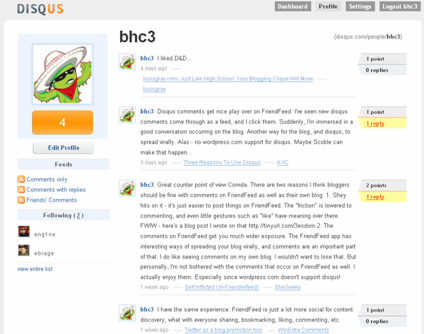
Here’s a screen shot of my comments on several blogs with the disqus commenting system:

Four comments, across four different blogs. Really nice to see that. You’ll also see a couple people that I’m following, on the left hand side of the disqus profile.

And here’s what a disqus comment looks like as it comes through FriendFeed:

As a commenter, you can extend your conversation outside the blog. Notice the ‘Likes’ and Franklin Pettit’s comment. And as a blogger, all the conversatin’ showing up in FriendFeed gets your blog post much more play.

Alas, disqus is not enabled on WordPress.com.

WordPress.com Snuffs Out Disqus?

Which brings us to Robert Scoble’s update. Sounds like the folks at Automattic aren’t sitting still. And that could be bad news for disqus. Why?

Volume, volume, volume.

On disqus’s site, they say that over 4,000 blogs are using their commenting service. Fred Wilson said it was over 10,000 blogs using disqus. Neither number compares to all the blogs hosted by WordPress.com.

If Automattic turned on similar commenting capabilities for its blogs, you’d have a sea of comments on that service. Take a look at the number of comments made on WordPress.com blogs each day:

Imagine if a lot of those folks streamed their comments into FriendFeed. The viral nature of FriendFeed would be an accelerator on that volume. A WordPress.com commenting system would dwarf disqus.

WordPress.com has the built-in advantage of already hosting millions of blogs and comments. Disqus is still in its infancy in acquiring new blogs.

If Automattic is serious about this, they should enable a new commenting system to work on non WordPress.com blogs as well. As a blog reader, once you have a profile set up, you’d like to use it everywhere.

Final Thoughts

Disqus has done an amazing job of customer service so far. That’s worth a lot of goodwill right there. I also love the upstart companies who show the world new ways of doing things.

And who knows? Automattic might be thinking of integrating disqus as one of the “raft of things to do to make commenting better for WordPress.com users”. I know I’ve requested the addition of disqus.

But if Automattic smells a good opportunity here and recognizes the value of its huge user base, then as Scoble says, “let the commenting wars begin!”

*****

See this item on FriendFeed: http://friendfeed.com/e/b0d09b39-26e0-2681-7b58-8fc234709b30

WordPress Content Recommendations: Off to a Good Start

I love recommendations. Well done, they make my life easier and provide a great source for learning things I didn’t know. So I’m pretty excited about a new feature rolled out by WordPress.com, “possibly related posts”, on April 26, 2008.

At the bottom of blog posts on wordpress.com, you’ll see a list of several blogs under the heading, “Possibly related posts: (automatically generated)”. These are posts which should have some relation to the blog post you just read. WordPress is working with Sphere to deliver these recommendations.

There’s an priority ranking to the recommendations:

  1. Similar posts on the same blog
  2. Similar posts from around wordpress.com
  3. Articles, blog posts from elsewhere on the Web

Two areas are of interest here: (i) what recommendations appear on your blog; (ii) what other blogs are showing your posts shown as ‘possibly related’.

Recommendations That Appear on Your Blog

I surveyed five of my blog posts to see what were listed as possibly related posts. They’re shown below, along with a rating of ‘yes’ for related, ‘no’ for not related, ‘sorta’ for posts that might appeal to some readers of the blog post.

I. Ten FriendFeed Visitors Beats 1,000 StumbleUpons Any Day (link)

  • Wired blog: FriendFeed Offers Developers the Key to Build Custom Social Apps (link): no
  • New York Times: Friends May Be the Best Guide Through the Noise (link): yes

II. You Can’t Win If You Don’t Play: A Blog Hits 50 Posts (link)

  • This blog: When Your Blog Is LouisGrayCrunched… (link): yes
  • A wp.com blog: asylum street spankers, and a word about hits (link): sorta
  • CBS Sportsline: Major League Baseball (link): no

III. How Do Solo Bloggers Break into the Techmeme !00? (link)

  • A wp.com blog: break (link): sorta
  • A wp.com blog: Ichimonji No Kata – Raiko No Kata – Kukishin Dakentaijutsu (link): no
  • Scobleizer: New PR Trend: Anti-Gaming TechMeme? (link): yes

IV. The Best Blogs You’re Not Reading? Toluu Knows (link)

  • A wp.com blog: ‘A Fistful of Euros’ awards (link): yes
  • A wp.com: The demise of letter writing: oh, really? (link): yes
  • A wp.com: Reading blogs simply (link): no

V. How to Write a Farewell Email to Your Co-Workers (link)

  • A wp.com blog: How To Write Emails People Will Actually Read (link): yes
  • A wp.com: Email Etiquette (link): yes
  • A wp.com blog: Getting Better Results from your Email Marketing (link): no

The recommendations are off to a decent start. “Related” is a subjective measure, and my ratings above may not match what another reader would think.

How about comparing the WordPress recommendations to other sites? Here’s what Kleiner Perkins-backed startup Aggregate Knowledge’s discovery algorithm currently shows on the Washington Post story, “Failed Yahoo Talks Leave Google on Top“:

Only one of four are related to the Yahoo – Google story. Admittedly, Aggregate Knowledge doesn’t tout itself as a ‘related articles’ service, but their list of other articles should be viewed in this context: “Will people click on those links?”

And here’s what the New York Times shows as “Related Articles” for the article “Friends May Be the Best Guide Through the Noise“, which discussed lifestream companies FriendFeed, Iminta and others:

None of the ‘related articles’ relate to the story.

Recommendations for Your Blog that Appear Elsewhere

What’s interesting here is that you, as a blogger, can see what other blogs have similar subject matter as you. Oh, and the possibility of increased traffic doesn’t hurt.

I’ve really only seen clicks to this blog on ‘possibly related’ recommendations from two sites (with links to posts that include links back to this blog):

  • Scobleizer.com (link)
  • Alexander van Elsa’s Weblog (link)

Neither of those is a surprise. Both have good posts related to social media and Web 2.0, subjects which are covered as well. The ‘possibly related posts’ from this blog shown there are relevant to the posts on which they appear.

Final Thoughts

I’m a fan of this feature, which is still in its early days. It does have its detractors though. Here are a couple comments posted on wordpress.com about the feature:

I actually hate the randomness of this, even though you’re using an engine to try to find related material. Here’s why this is a horrible bad idea, and really, you should turn it OFF everyone’s blog unless they specifically ask for it: If I want random, unvetted links on a topic, I’ll google it. The REASON why blogs are a great medium is one of TRUSTED information. If I know a blogger is smart, savvy, well connected, and honest, I will trust THEIR opinions, and look to what links THEY supply. Making these robot-choices LOOK like they are endorsed by the blogger is where this really falls down, and makes me want to shut it off immediately and everywhere. It is so unfortunate that this is on by default. I will recommend to everyone that they shut off this feature. This is so anti-blogging, it’s not funny, and in fact sad coming from a trusted blogging platform. I bet if you took this issue to serious bloggers first, they would have chimed in overwhelmingly in the negative camp.

Morriss Partee

What it seems to be designed for is to keep the readers IN wordpress, which is understandably your goal. What it PROBABLY will do for individual bloggers is take the reader away from his or her blog into someone else’s blog within wordpress, a dubious result in my way of thinking. But what do I know?

Alice

Count me as a fan, and I hope they continue to iterate through improvements to the recommendations. I fundamentally disagree with Morriss Partee. Blogging is about conversations, even if they go elsewhere. If my blog post piqued someone’s interest and they click to another blog, that’s fine by me. I’d rather the reader have a good time than try to trap him onto my blog.

Go WordPress, go!

*****

See this item on FriendFeed: http://friendfeed.com/e/7a1528d4-96c3-40ea-f5c3-6493372fa956

Ten FriendFeed Visitors Beats 1,000 StumbleUpons Any Day

The average StumbleUpon visitors stay a few seconds on the site and then leave having visited one page. That’s exactly how I use the StumbleUpon toolbar, clicking the Stumble! button quickly unless a site particularly grabs my interest immediately.

Traffic Growth #5 – What Value In StumbleUpon Visitors?
Fog of Eternity – Robin Cannon

Robin’s observation probably rings true for most bloggers. Sites like StumbleUpon and Digg can drive significant traffic to a site. If ad impressions or clicks are important to a blog, then those visitors might have value. If your goal is to build an audience with whom you mutually learn and build relationships, those sites aren’t worth much.

Traffic from StumbleUpon and Digg is like loading up on empty calories. They fill you up for a while, but they have no nutritional value and leave you hungry for more soon thereafter.

FriendFeed, on the other hand, lets bloggers build a solid foundation of long-term readers who in turn serve as the best sources of new readers.

FriendFeed Difference: Trusted Referrals

What makes FriendFeed such a great platform for building your blog readership? Two big reasons:

  • Trusted referrals
  • Blogger participation

FriendFeed enables trusted referrals at two levels of a blogger’s social networks. The first level are those people who subsribe to the blogger’s feed. They’ll be the first to see new content. These members may then comment, share or bookmark the new blog post.

The second level is more distant from the blogger. This is the “friend of friends” feature, as shown below:

With this FriendFeed feature, your blog is reaching people who do not subscribe to you. In the example above, I’m seeing Rex Hammock’s blog post because he’s a friend of Robert Scoble. A crucial thing to notice though…I only see Rex’s blog post because our mutual friend Robert ‘liked’ the post. His action is the key that makes this feature pop up. In other words, you’re not just bludgeoned with a huge flow of unfiltered feeds in the friend-of-friend feature.

I personally have used the friend-of-friend many times to follow new people I didn’t know. I have moved from being a second-degree member of the bloggers’ social network to a first degree member (i.e. a subscriber). This is a powerful feature of FriendFeed, both for bloggers to gain new readers and for members to discover new content.

The pictures below show how the FriendFeed social graph works. The initial picture shows a blogger’s beginning social graph. Four people subscribe to his FriendFeed updates. But those four have their own connections, enabling their networks to see the blog post. If they like it, then their friends will see it too. A viral process for blog exposure:

The outer bands of the blogger’s social graph get exposure to the blog. As the blog is viewed further away from the core, the viral distribution falls off. But some of the members in the outer bands will subscribe to the blogger’s FriendFeed, which increases his core social network:

The new subscribers become the source of additional readers through their social networks. A new blog post comes out, and their friends will see it, bringing new subscribers. And so it goes, on and on. With enough time, a blogger will have a terrific base of people that enjoy discussing similar topics.

StumbleUpon, Digg: Drive-By Readers

Contrast the slow-building, strong ties forged in FriendFeed to the fast, drive-by traffic coming from StumbleUpon and Digg. Sure, the traffic is great. But you likely won’t see those readers again. With StumbleUpon, many of those visitors are just clicking their ‘Stumble!’ button. With Digg, the blog serves as content for a community that exists entirely outside of the blogger’s social graph. So the blog post gets its moment in the sun with the Digg community, which then moves on to other content.

Final Thoughts

FriendFeed makes it easier for a blogger to build readership than did previous options. I also have a suspicion that exposure via FriendFeed makes it easier for smaller bloggers to make it onto Techmeme.

What do you think? Is FriendFeed becoming the true social graph of bloggers and their readers?

*****

See this item on FriendFeed: http://friendfeed.com/search?q=ten+friendfeed+visitors+beats+stumbleupons&public=1

How Do Solo Bloggers Break into the Techmeme 100?

26% of US internetters have started a blog
Stat from Universal McCann study, courtesy of the blog 3008

A couple weeks ago, Steve Hodson at Winextra wrote a post that caught my eye. In Why today’s solo bloggers may not see Scoble-like fame…, he observes that the emergence of investor-funded professional blog networks (e.g. TechCrunch) will be the dominant industry structure going forward. Breaking the top end of that oligopoly will be tough for any solo blogger.

However several solo bloggers are regularly in the Techmeme 100, as Steve notes here. It got me thinking about how someone’s blog goes from a little experiment to achieving a large audience and becoming influential. The stat above about 26% of Web users starting blog strikes me as high, but let’s assume there’s a large number of individuals starting blogs.

From where I sit (far, far outside any kind of Techmeme rankings), I can envision three ways the influx of solo bloggers can break into the Techmeme 100. To be sure, there are other rankings beyond Techmeme. For instance, the Technorati 100 is a big deal. Political blog Huffington Post doesn’t show up on Techmeme, but it dominates the Technorati 100. The paths below apply to non-tech blogs and non-Techmeme rankings.

The three paths to the Techmeme 100 are:

  1. Long Slog
  2. Big Events
  3. Celebrity

Long Slog

Slow and steady wins the race. This is the most accessible to a the solo blogger. Through a lengthy amount of time, you accumulate readers. It’s a ground war, where you need to be “good enough” most of the time with flashes of occasional brilliance. Here’s what the growth chart would look like:

Patience. Quality posts. Devoted long time fans.

Big Events

This blog experiences a series of big events that give it jumps in subscribers. Each events attracts a flood of new visitors, some of whom decide to subscribe.

What might these big events be?

  • Recognition by bigger bloggers with huge followings
  • Freakishly popular posts
  • Specialized area of focus that suddenly becomes hot

I think that if a blogger emerges on the other side of these big events to have a wide following, there’ll be this sense that they burst on the scene. But like an actress who suddenly gets hot, you’ll never see all the bit parts and ‘B’ movies that she was in before.

‘Big events’ is the one that’s most likely to get solo bloggers into the big time. This is the path that requires the most luck.

Celebrity

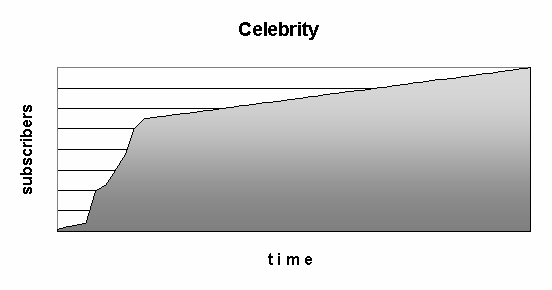
This is a path open only to a select few. Celebrities who have made a name for themselves in other realms, and then turn out to have talent in blogging as well. Celebrity blogs attract subscribers almost from day one:

Marc Andreessen has proven to be quite talented at blogging. And it didn’t hurt readership that he had already achieved legend status based on Netscape. Imagine if Microsoft buys Yahoo and Jerry Yang decides to start blogging on his own. I guarantee that will get subscribers (I know I’d subscribe).

Final Thoughts

Celebrities go right to the front of the line, but they’d better have blogging talent. Long slog blogs are testaments to the love of blogging. Big events seem to be the most likely path for the next Robert Scobles and Louis Grays to emerge.

*****

See this item on FriendFeed: http://friendfeed.com/e/d7b6d330-9c38-f5cf-f6f2-1de1582c0153

Video Blog Comments (Ironically) Aren’t Conversational

TechCrunch has added video comments to its blogs, courtesy of Seesmic. Oh lordy. Think you’re feeling overwhelmed by social media? Try following video comments.

Online video has gotten traction as a one-way communication and entertainment vehicle. Is it ready to add “conversation” to its portfolio of uses?

Where Has Online Video Worked?

YouTube is undeniably the success story of online video. And what has been so successful there? Entertainment. Selected hits from amateurs have become mega hits, like the guy playing Pachelbel’s Canon on his electric guitar. The most popular videos on YouTube are professionally produced music videos, as reported by Michael Learmonth at Silicon Valley Insider. My 4 year old is a huge fan of Feist.

This entertainment is very much a one-way experience. They play. You watch.

Online video has also been useful as a communication tool. Google has been particularly active on this front, such as with this video explaining Google Apps.

The training video, again, is a one-way communication.

Seesmic’s Mission: Make Online Video a Conversation

Seesmic wants to turns these one-way communications into conversations among two, three, heck even dozens of people. You post a video, someone posts a video in reply and you post back. Kind of an asynchronous conversation. From the Seesmic site:

Until now, online communication has lacked personality as it’s been limited to text (IM, SMS, email). Now, Seesmic brings conversation alive through video. See and hear people share their experiences straight from their webcams, join in live conversations, and engage in real interactions with real people.

The concept is pretty innovative. As always, the question is whether it makes sense in real world usage.

My Rant About Online Video

I personally do not watch videos online much. If I land on a page that has video instead of text, I usually hit the browser’s ‘Back’ button pretty quickly.

Why? I don’t have time to wait on whether the video will be interesting. After the video loads, you then sit through its latency to see what the person is saying. It’s a crap shoot as to whether the time was worth it. Thus, the Silicon Valley Inside story about professionally produced videos YouTube dominating doesn’t surprise me. You know what you’re getting ahead of time.

Which brings us back to online video comments.

The Blog Video Comment Experience

The implementation on TechCrunch seems to be well-done, based on the video comments of several people. Kudos to Seesmic for making that happen. This is an innovative idea.

Three issues make video comments less conversational overall than basic text comments:

  1. You have no idea what you’re getting when you click a video
  2. It’s hard to reference someone’s comment
  3. It takes too much time

Video comment quality: Variance in comment quality is a well-known dynamic on blogs. It will apply to these video comments as well. This comments here and here on TechCrunch intrigued me…

The big difference is that with text, you can pretty quickly size up the quality with a quick scan. You have to endure much of the online video before realizing it won’t serve up nuggets of insight.

This is a turn off, and it undermines the participative quality of comments. If people aren’t watching your video comment, then you’re not really participating in the conversation.

Referencing comments: Say someone leaves a 60-second commentary on a post. You’re going to have to remember that interesting thing that was said 27 seconds into it. And then you’ll have to rewrite the interesting thing to properly reference it in your text comment. Or in your video reply.

The burden of tracking an audio commentary for response purposes hurts the conversational aspect of video comments.

Too much time: Keeping up with the entire thread of a conversation may require viewing several videos. On the TechCrunch post, I found the time for each of 43 video comments. Average run time = 29 seconds. Median = 24 seconds. The typical text comment doesn’t take 25 seconds to read. So your time investment just went up to stay on top of videos.

And that detracts from the conversation.

Final Word

I’ll admit to sticking through several of the 43 video comments on the blog. There is something to the idea of watching a person speak their comments. The hard part is to know which ones will be worth it. I assume over time, some people would just have a flair for the medium. Regular blog visitors will consistently click their videos.

But the majority of video comments will just be time sucks. There’s probably a real opportunity to implement some sort of rating system on comments, and on people who comment that will help filter out the video noise.

Still, I prefer text comments for the conversation. Learning on my time, not the video creator’s.

*****

See this item on FriendFeed: http://friendfeed.com/e/11b7e37d-c97f-e35c-b7fe-9f1588e3876a

Web 2.0 Inside the Enterprise? Forrester, AIIM Weigh In

Forrester produced a well-covered report this week announcing that Enterprise 2.0 will be a $4.6 billion business by 2013. In my RSS feed of FriendFeed updates containing the term Enterprise 2.0, there were probably a couple hundred related to this report – Google Reader shares, bookmarks, Twitters, etc. Sarah Perez of ReadWriteWeb has a great post about the Forrester report, with dollar figures.

About a month ago, AIIM came out with its own report on the market for enterprise 2.0. It was a work produced in conjunction with the likes of Stowe Boyd and Andrew McAfee.

After reading both of these reports, it’s clear there is a common perspective out there, but some differences worth noting as well. It’s instructive to look at both.

Forrester: Projections Focus

Forrester is paid for its expertise and forecasting. Their reports are well-regarded in this regard. Based on surveys of over 2,200 companies, this report is a forecast of the dominant technologies of Enterprise 2.0. Grounded in the market, fueled by its analysts’ views.

Forrester’s report strongly cleaves the Enterprise world into internal facing and external facing uses.

AIIM: State of the Market Focus

AIIM’s goal seems to be more of an Enterprise 2.0 temperature check of companies today. Surveying 441 company representative, AIIM didn’t try to forecast the future so much as see where companies’ heads are today.

AIIM’s report addresses both internal and external uses, but generally blurs the discussion between the two.

No Unanimous View of Top Technologies

Forrester’s report considers seven different technologies for the Enterprise 2.0 space. AIIM’s report goes much deeper. AIIM’s respondents came up with a much larger set when asked the question, what technologies make up your definition of Enterprise 2.0? To compare the two analysts, I selected the top seven participant responses from the AIIM report. Here’s how Forrester and AIIM show the leading technologies of Enterprise 2.0:

Five technologies showed up consistently between the analyst reports:

  • Social networking
  • Wikis
  • RSS
  • Blogs
  • Mashups

It’s interesting to note the differences between the two reports. Forrester included podcasting as a leading area of spend for Enterprise 2.0. AIIM’s report includes podcasting as well, but survey participants didn’t include it very often in their current definitions of an Enterprise 2.0 platform.

Forrester’s report did not include social bookmarking and tagging, but AIIM did. The Forrester omission probably says something about their view of the dollars to be spent on it.

Forrester included widgets, which is a nod to their strong focus on external uses of Enterprise 2.0. AIIM’s respondents like collaborative filtering, which is the basis for recommendation engines.

A Few Thoughts

Social networking comes in strong on both analyst reports. Forrester has spending here running away from all others by 2013. Call this the Facebook effect (MySpace didn’t seem to inspire the same trend to the enterprise). Generally, Facebook controls its “borders” and has a handle on everything that’s going on. Relationships, groups and activities all occur within the walled garden. Enterprises share a lot of these characteristics. Social networks will become the next generation intranet.

Also, note the disparity here. Companies are just coming to terms with the idea of social networks for employees, while the blogosphere seems to have left the mainstream social networks behind. Call that difference between the easy freedom of thinking and conversations, and the hard decisions of where to spend money and sweating your stock price.

Wikis come in surprisingly low on the Forrester side of things. I say that because some of the best known uses of Web 2.0 technologies inside companies are wikis. In fact, wikis are the #1 thing that respondents consider to be Enterprise 2.0 in the AIIM survey. Perhaps they have a lower cost, so that the same number of implementations will result in lower dollars spent.

RSS comes in strong for both reports. That is great to see! RSS holds so much potential. Just look at the growth of FriendFeed to see how RSS can create really new and interesting applications. RSS inside the enterprise will increase information awareness, and can be a basis for research and discovery the way FriendFeed is on the consumer web.

Blogs are ranked highly in both reports. Very nice to see. There’s still a mountain to climb before employees get comfortable with them. For companies that do have adoption of employee blogs, I expect there will be a boost in innovation.

Company blogs are interesting animals. The worst way to roll those out is treat blogs as glorified press release vehicles. That would be a waste of time. But what do you put on a blog that would be interesting? A couple of companies serve as examples. Google’s blog has a very conversational style of its products, general technology issues and other geeky stuff. Cafepress’s blog talks a lot about their products, which could be boring as hell. But Cafepress manages to relate products to larger issues, which makes it a bit more interesting.

Mashups are in the lower end of the top 7 currently, although Forrester projects spend on mashup technology to be the second highest after social networks. Here’s where I think Enterprise 2.0 will lead Web 2.0: mashup adoption. There are so many existing “big iron” software systems inside companies, that rip-and-replace is an expensive undertaking when you want to add new functionality. Mashups extend the life of these systems. In the consumer web, we’re experimenting with mashups a la Yahoo Pipes and Microsoft Popfly. I’m not sure the average consumer is going to bother with those. However, the average IT professional very much wants to look at mashups.

Those are some general thoughts. What do you think about Enterprise 2.0?

*****

See this item on FriendFeed: http://friendfeed.com/search?q=%22Web+2.0+Inside+the+Enterprise%3F+Forrester%2C+AIIM+Weigh+In%22&public=1

Social Media: Lighter Beats Heavier Every Time

www.waystupid.com

Interesting tweet from Stanislav Shalunov regarding SocialThing:

Asking for my passwords makes SocialThing sound like a phisher. Won’t use for now. http://tinyurl.com/4dquxn

His tweet expressed something that I’ve been noticing for some time. I am gravitating more and more to the “lighter” interaction social media apps.

What is “lighter”? It’s the flick of a wrist. Enter text + submit. One-click subscriptions. Here are three comparisons, including the controversial one of aggregator comments versus direct blog comments.

Twitter vs Facebook

Facebook is heavy. To build out your network, you have to:

  • Invite others
  • Request a connection and wait for the response

These processes make a lot of sense for what Facebook is about – true relationships. When your friend invite shows up in the other person’s inbox, what’s their reaction? That’s the key to maintaining the integrity of true relationships there. I have turned down friend requests there from complete strangers. It’s why I’m comfortable blogging about my kids there but less so elsewhere.

And it inhibits using Facebook for me.

Twitter’s model makes social network set-up a breeze. Find someone you’re interested in, click “follow”. Done. But Twitter does support Facebook-like controls:

  • You can block specific individuals
  • You can set your updates to be private, only available to those you approve

Most people just leave their subscriptions wide open on Twitter. Which is great for the user experience. I have made connections on Twitter that I would never have made on Facebook.

The other thing that’s easier – communications. I’m a voyeur a Twitter, jumping in when I want. I just use the @sign to respond to someone, or the occasional direct message . Facebook’s status updates post to the newsfeed and a few are shown on your home page. But those aren’t really conversations. To talk with someone, you use the Facebook message system. Again, that’s really cool – you don’t need to remember email addresses. But it also is heavier.

No surprise Twitter’s been growing like a weed.

FriendFeed vs SocialThing

FriendFeed and SocialThing have a lot in common in that they show the activity streams of friends across different services. But there are key differences, which are well summarized by Mark Krynsky at the Lifestream Blog.

Creating your network: FriendFeed has the lightweight Twitter model. Find someone, subscribe. Done. SocialThing imports the friends you’ve made on each of the services. This is also light. But you can’t add new users directly inside SocialThing. You’ve got to go to the individual service, add the friend and then SocialThing is updated. This is heavier than FriendFeed.

Importing your services: FriendFeed asks for your login ID for a service (Twitter ID, Flickr ID, del.icio.us ID, etc.). enter it. Done. Your updates start flowing. SocialThing wants your ID and password. This enables SocialThing to send updates back down to each service. But as Stanislav expressed above, getting passwords is heavy.

Interaction on the originating services: SocialThing lets you respond to a friend directly back on the originating service, like Twitter. FriendFeed is adding this capability for Twitter, and perhaps others. But if you want to comment directly on the originating service, for the most part you have to leave FriendFeed and go to that service. Socialthing’s support for direct comments is the lighter experience.

It’s still early. But FriendFeed has the edge in the “lightness wins” battle right now.

Friendfeed Comments vs Blog Comments

Man, do I really want to write this? Well, here goes. Comments on FriendFeed are a lot lighter than those on blogs. Which means it’s an easier experience.

Blog comments have these qualities:

  • You want to be pithy in your comment. The blog post addressed a weighty topic, and you want to comment in keeping with that.
  • You enter your name, email and website each time
  • You might encounter a captcha
  • The blogger may hold comments in reserve until they’re reviewed
  • If you mess up, you can’t change your comment

Meanwhile, on FriendFeed, comments have these qualities:

  • You can comment pithily
  • You can write more of a meta-comment about the post
  • You can talk with others via comments
  • You can click ‘Like’ to provide a quick, simple comment about the blog post
  • Comments are easy. Click Comment. Enter text. Click Post. Done.
  • You can edit or delete your comments

This doesn’t mean commenting on blogs isn’t worthwhile or valuable. Reaching out to the writer is an important part of the participatory ethos of blogging. Your comment also breaks the ice on a post, making it easier for others to join in.

But there’s no denying the lightness of comments on FriendFeed. Expect their volume to increase.

I’ll predict that FriendFeed comments are those that bloggers never would have gotten on their blogs in the first place.

So the lightness of FriendFeed comments won’t steal from bloggers’ on-site comments. They’ll add to them. And that’s a good thing for the conversation.

What do you think?

*****

See this item on FriendFeed: http://friendfeed.com/e/92524b04-4b9d-c0db-e09e-931c4f3e5084

The Eight People You Meet in Blogging

A couple big unrelated Techmemes of this past weekend are actually two sides of the same coin.

First, there was the heavy discussion around Shyftr and the loss of a blogger’s comments. The comments exist elsewhere, and bloggers lose connection with their readers. Second, there were a lot of opinions about Andrew Baron’s sale of his Twitter account, and its 1500 subscribers. The blogger is not bemoaning the loss of connecting with his readers; indeed he’s actively encouraging it!

Here’s what these two stories made me ask: Just why are you blogging?

Blogging is a quite personal pursuit, and we all have our own reasons for doing it. Feeling a little ambitious, I sat down and came up with eight different reasons that people blog. The eight people you meet blogging. Here they are, and they are not mutually exclusive.

1. It’s a numbers game

There are a lot of ways to get readership. For some, increasing this number is the be-all, end-all. Blogging numbers are the point, not an outcome of some other reason. Case in point: Faisal Anwar. He writes about his efforts to maximize StumbleUpon traffic to his site. He figured out that funny pictures drive StumbleUpon positive reviews, leading to more StumbleUpon visits. So he loaded his blog posts with funny pictures, to the point of losing sight of his blog’s focus:

Unfortunately for me, I pumped in too much picture to my site almost every day until it became a humor site (that not my original intention).

2. One-way communication

Blogging is a forum for mass dissemination of information and opinion. Probably the best way to think of this type of blog is as a marketing vehicle. Yeah, some response back to you is OK. But that’s not the real purpose now, is it? The larger the number of followers, the harder it is to maintain connections with them.

Andrew Baron’s sale of his Twitter account…what do you think the purpose of his Twitter micro-blog was?

3. Provide valuable information to others

This is probably the most altruistic of blogs. The American Cancer Society maintains Dr. Len’s Cancer Blog. Consumer Reports maintains a safety blog. These blogs can be a bit freer and more opinionated about information, making them more engaging than just static articles.

4. Make money

A time-honored pursuit, making money. Ad money, to be specific. Engadget, TechCrunch, ReadWriteWeb, Mashable. Check out their ads – they have a lot of them. Eric Berlin even notices that Mashable has a lot of ads. These blogs put a premium on speed, frequency and exclusives. And a good dollop of opinion sure to drive page views.

5. Establish your reputation

A perhaps overlooked aspect of blogs is that they can establish your reputation out in the world. Seth Godin asks Why bother having a resume? He argues that instead of a resume, you should have “a blog that is so compelling and insightful that they have no choice but to follow up.”

A friend of mine at a law firm told me about a 3rd year associate who blogs. His intellectual property law blog is read by a number of industry folks, and some senior partners in New York have reached out to him with questions. Talk about establishing your reputation!

6. Influence your industry

Michael Arrington. Robert Scoble.

7. Learn by doing

This is why I started this blog. I’d been primarily at the lowest level of the Web 2.0 Jedi ranks. I then took a job working on enterprise 2.0 product marketing, and knew I had plenty to learn. So this blog is a two-fer. Blogging itself has been a tremendous experience that I really enjoy. And I blog about a lot of Web 2.0 topics. This has forced me to really grok these concepts.

8. Learn by connecting

The interactions on your blog posts can be incredibly valuable and rewarding. You learn so much about how others think. The loss of this connection robs the blogger of feedback about his or her thinking, and that of others. And thus loses an opportunity to grow. This last reason may have been the biggest one to fuel the Shyftr debate over the weekend.

What do you think? Fair assessment? Did I miss any other reasons?

*****

See this item on FriendFeed: http://friendfeed.com/e/111f0439-bdf0-d88b-9082-c561b48215a1

Bitchmeme Recap: What Happens on Shyftr, Stays on Shyftr

Background: Shyftr is a service that pulls the entire feed of a blog into its site, and lets users comment on the post within its site. The comments never make it back to the original blog. What happens on Shyftr, stays on Shyftr.

The spark: Louis Gray (who else?) wrote about Eric Berlin’s concern over the comments that had accrued on Shyftr, not his own site. A legitimate beef, and one that clearly generated some heat.

The bitchmeme: Some liked the idea of posts and comments being anywhere. Some didn’t. Some liked it. Some didn’t. Some…uh, well…you get the picture. I will note that Tony Hung of Deep Jive Interests became the poster boy for anti-Shyftr sentiment.

The Scoble Factor: The preeminent blogger of our time, Robert Scoble, weighs in with the post, Era of blogger’s control is over. He’s gung-ho about Shyftr and all ways by which his content is distro’d. Now based on Scoble’s preferred use of social networks, this ain’t surprising. He sets up our man Tony Hung as the old-school thinker about controlling content.

Tony Hung: Comes out swinging against Shyftr. Says the aggregation of comments away from the originating blog is wrong. To make his point, Tony proceeds to single-handedly post a comment on every single blog that weighed in on the issue. Tony, that must have taken forever. Next time just put up a comment on one of those aggregator services…

The scorecard: On the question of whether Shyftr has stepped over the comment line or not…

  1. Eric Berlin = yes
  2. Louis Gray = no
  3. Robert Scoble = no
  4. Tony Hung = no
  5. Pauk Glazowski (Mashable) = no
  6. James Robertson (Smalltalk Tidbits) = no
  7. Mark Evans = no
  8. Mathew Ingram = yes
  9. Ross Dawson = yes
  10. Alexander van Elsa = no
  11. John McCrea = no
  12. Frederic (Last Podcast) = no
  13. Mia Dand = no

So that makes the vote…two + three…carry the one….

Shyftr sucks = 3

Shyftr is OK = 10

Denouement: Shyftr announces that it will no longer carry the full feed for any blog post that has conversations “outside the reader”. I think they’re saying no more full feeds? Frankly, it’s a little unclear to me what they’re saying, but I’m not active on Shyftr. Louis Gray gives his opinion on this change here. I’ll probably have to check Shyftr out in more depth sometime.

The final word: Dave Winer provides a helpful definition of “bitchmeme”:

A Bitchmeme is something that happens on weekends when new stories are in short supply so ideas that otherwise would be buried on Techmeme rise to the top. Usually they’re people complaining about something or other which is why they’re called Bitchmemes and not Happymemes or Sarcasticmemes.

*****

See this item on FriendFeed: http://friendfeed.com/e/676399dd-b448-8c93-4970-a9b2b0ac46e1