Using Open Innovation to Be Competitively Unpredictable

During a Twitter Q&A organized by open innovation thought leader Stefan Lindegaard, Psion Teklogix CEO John Conoley posted this:

http://twitter.com/#!/johnCEOatPsion/status/22796327966

How interesting is that? Using open innovation to be “competitively unpredictable”. I love that concept. Let’s understand where John is coming from.

[tweetmeme source=”bhc3″]

First, have you heard of Psion Teklogix? They make “rugged mobile computers”. Think Blackberry or iPhone, but industrial strength with specialized purposes, hardware, and made to withstand punishment. From an enterprise perspective, the chart below by VDC Research provides some perspective on mobile computing for work. I’ve outlined in red the section where Psion operates:
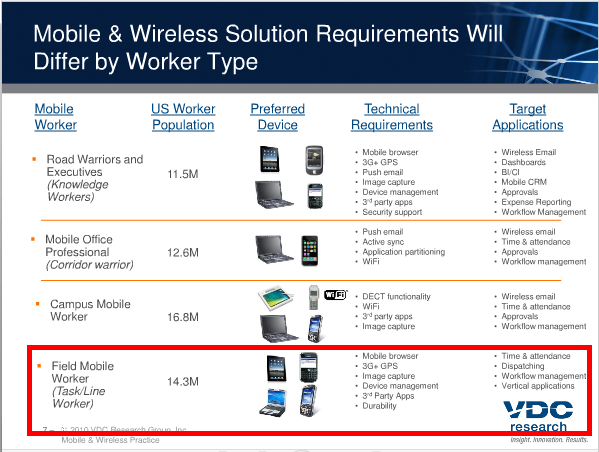
Psion’s computers are used in a variety of industries for inventory tracking, couriers, field service and other demanding jobs. The company is #3 in its industry (Motorola occupies the top spot). A key part of Psion’s strategy is to make its rugged mobile computers modular and customizable. This customization allows them to be adapted to different uses. Building on this modular and customization philosophy, the company has developed an ecosystem of third party vendors who make components that plug in with Psion’s products.

I had a chance to talk with Todd Boone, Director of Market Development for Psion. He described the company’s open innovation efforts.

Pace of Change in Mobile Has Accelerated

Before talking about open innovation, first understand this. Todd Boone noted that the pace of change of mobile computing has accelerated in the past several years. Anyone tracking the space probably gets that intuitively. This means is that the uses of mobile, the emergence of new competitors and the changes in technology change more frequently. As an example, on the consumer side, how long have Apple and Android been so influential in the mobile sector?

Indeed, VDC Research noted the changing dynamics of the rugged mobile computing market in a recent article:

Another critical challenge facing rugged handheld vendors is the increasing level of competition from smartphones and other emerging devices – especially for field mobility applications. While smartphones do not have the same level of integrated I/O capabilities nor the level of ruggedness offered by rugged handheld devices, their proliferation in the enterprise (and lower adoption cost) are making them target devices to support more sophisticated enterprise applications. Plus, in the field mobility market the rugged handheld community is most challenged from an OS perspective. Although there is a strong application and developer community supporting field mobility applications on Windows Mobile devices, customer expectations in terms of user interface and experience – especially for field mobility applications – is increasingly influenced by consumer oriented smartphones.

For companies operating in the mobile space, such dynamics make it harder to “know” everything, and to have the resources to respond accordingly. Nimbleness and flexibility are needed to address the unpredictable course the mobile sector takes.

As Todd Boone explained to me, Psion needed a strategy that leveraged their modular platform strategy while recognizing they can’t realistically know all the emerging use cases and technologies out there.

Answer? Open innovation.

Ingenuity Working

On March 4, 2010, Psion launched Ingenuity Working (IW), a site built to expand its open innovation activities. Psion CEO John Conoley described its mission this way:

The open, online community in Ingenuity Working brings us closer to our customers and their thoughts and will allow us to socialise and commercialise innovation. We are using social media to bring our developers and resellers together with our customers, all over the world. Essentially, everyone will be putting their heads together to help create technology that best fits a company’s individual requirements – that has to be a good thing.

In talking with Todd, I learned that the initial thrust of the IW community is focused on partner vendors, rather than direct feedback from end-user customers. In some ways, this is similar to P&G’s open innovation approach.

Engagement with external parties occurs via discussion forums, blogs and a “secure zone” for each partner. In these arenas, there is a two-way exchange of product ideas and use cases. An example can be seen in the section of IW devoted to discussions for developers of Windows/CE/WM/Embedded.

Now that’s some esoteric stuff there. But here’s the thing. It’s groundbreaking in the rugged mobile computing industry to have this all ‘hanging out there’. It becomes free research for competitors too, in a way. Which one may view as a risk of this whole endeavor,

Here’s how Todd describes the Psion open innovation vision:

Rather, we think it’s the opportunity to drive the market to a new reality. A market that drives itself in a way that is inherently beneficial to customers and partners alike based on the real-time, open dialogue that starts prior to any development activities taking place and continues through to product maturity. Real success will come, I think, when marketing and engineering no longer make product decisions but rather our community of customers, partners and developers does.

Psion is early in its open innovation initiative, and plans to improve and evolve its program. The company is engaging partners on hardware, software, standards and a wide variety of use cases. These efforts complement its existing offline channels and research.

Becoming Competitively Unpredictable

Finally, that great quote from Psion’s CEO about embracing open innovation to be competitively unpredictable. I asked Todd for a bit more context. What exactly does that mean?

He noted that typically, large companies describe their roadmap for the next several quarters or years in terms of product development. The challenge with that approach is that it’s company-centric, and its effectiveness is limited by the increasing rate of change in the industry.

The other dynamic is Psion’s orientation toward creating an open platform that can be configured for different uses. This platform philosophy is a core strategy.

So by engaging with external parties, Psion is looking to (i) stay on top of emerging market changes; and (ii) leverage this large collective intelligence to develop applications and hardware for its configurable platform.

Ideas which would be hard to forecast out over the next 6, 12 or 24 months. If you’re a competitor, this makes it harder to know what Psion will do.

In other words, they become competitively unpredictable.

[tweetmeme source=”bhc3″]

How Much of a Relationship Do Your Customers Actually Want?

On the Harvard Business Review, Matt Dixon and Lara Ponomareff wrote a piece that caught my eye, Why Your Customers Don’t Want to Talk to You. Consumers increasingly prefer self-service, and the authors speculate:

Maybe customers are shifting toward self service because they don’t want a relationship with companies. While this secular trend could be explained away as just a change in consumers’ channel preferences, skeptics might argue that customers never wanted the kind of relationship that companies have always hoped for, and that self service now allows customers the “out” they’ve been looking for all along.

For managers hell-bent on deepening relationships with their customers, that’s a sobering thought.

That last line is particularly relevant to the new thinking: that companies need to engage their customers in “conversations”, which social media is enabling. A related question to ask is, do they really want a “relationship” at all with companies?

[tweetmeme source=”bhc3″]

What exactly is a “relationship”?

Let’s start with an important point: what exactly is a “relationship”? Put simply, it’s a two-way connection I have with you based on some form of interaction(s). In that sense, buying a product from a company qualifies as a “relationship”. But that’s insufficient. We want to know how deep is the relationship?

The thinking of Mark Granovetter is relevant, provided helpfully by Lithium’s Michael Wu. Four elements determine the depth of a relationship:

  1. Time spend together
  2. Emotional intensity
  3. Intimacy (mutual confiding)
  4. Reciprocity

Now, apply those elements of relationship to the way you think about companies from which you buy. What’s the emotional intensity you have with the power company? Do you find yourself confiding with Amazon.com when you purchase something? How much time are you and your bank spending together?

Those questions point to a more commonly understood definition for relationship: high scores on the four Granovetter dimensions. But scoring high on those dimensions is an insurmountable hurdle for most companies vis-à-vis their customers.

The job your product is hired to do

This idea that companies need to think in terms of the “job their product has been hired to do” is one I learned from Clayton Christensen, Harvard professor and author of The Innovator’s Dilemma. It’s understanding why the customer buys your product, and what needs it fulfills. “Needs” often being different than thinking in terms of the features a product has.

This is what defines the relationship customers want to have with a company.

Leading social CRM thinker Wim Rampen argues this in his post Social CRM – What Relationships Should You Care For, And Why? In the post, he states this:

From a company’s perspective, a relationship with your Customers is not what you need most. You need most to understand what job it is your Customers are trying to get done.

Wim is spot on. That’s the innovation mantra. Nicely applied to social CRM.

The depth of a customer’s relationship depends on the job you’re hired to do

My interest in having a relationship – the deeper, more commonly understood definition – with a company is directly proportional to the complexity of the job I’ve hired you to do, as follows:

Here’s how the different jobs size up.

Efficiency, simplicity, convenience

In a consumer-based world, we have but only so much bandwidth for purchasing things which require lots of our time to engage and use. Mostly, we need commodities.

And you know what? We need ’em fast, reliable and without taking up a lot of time. In this bucket o’ jobs-to-be-done, spending a lot of cycles engaging with many companies in ongoing relationships just will not cut it. How would you get anything else done?

It’s as Jon Husband shared with me on Twitter:

<Do they even want a relationship with companies? #scrm #acinsights> I don’t

The nature of relationships in this scenario is transactional. And there’s nothing wrong with that. My bank gives me efficiency, low cost and no hassles. I’m loyal, but I don’t have a deep relationship with them.

They just happen to satisfy well a job of convenience and efficiency I need done.

Episodic interaction events

Mountain Dew ran a great social media campaign called DEWmocracy. DEWmocracy got consumers involved in a number of initiatives:

  • Ad agency selection
  • New flavor selection
  • New drink names
  • Package creation

The campaign was a great example of an episodic event to drive interactions. This was relationship-building beyond the core product offering. What made it successful is that it extended the job-to-be-done. Sure, Mountain Dew tastes great, and you can enjoy cans of it. That alone really points toward convenience and simplicity, the lowest=level relationship.

But Mountain Dew was able to elevate the complexity of the job. It got people involved in the support processes for the production and distribution. Genius, and of course, risky. But many consumers responded. They found it fun to participate, and Mountain Dew reciprocated, as Ad Age notes:

Once you’ve engaged consumers, you can’t stop. Mtn Dew made an effort to let consumers know why it was taking their advice, as well as why it wasn’t.

Now that DEWmocracy has mostly run its course, the relationship will become shallow again. Until the next event. But it has raised market awareness, and established what the company is about in consumers’ minds.

One last note here. Old Spice’s recent social media marketing blitz was not an example of addressing the job-to-be-done. It was pure marketing awareness, a point well-made by Jacob Morgan. And it worked.

Complex job, long-term usage

SAP. When you think of SAP software, do you think, “lightweight, simple-to-use, rip-n-replace anytime?” No, you don’t. SAP software is legendarily complex and powerful. They are a huge company with thousands of customers, billions in revenue and myriad business applications.

This is a complex job-to-be-done.

SAP maintains a strong customer community and extended ecosystem (including the SAP Developer Network) to manage its relationships with customers. Which makes absolute sense considering the complexity of the job-to-be-done. Customers want a relationship with SAP. Frankly, they need it.

Complex jobs often mean several things for customers:

  • Recurring need to interact with the company for information
  • Higher switching costs, increasing the need to understand what the company’s future direction is
  • Variety of use cases, meaning many ideas for future product versions

It is in these situations where the popular notion of “relationship” most closely matches what customers seek.

The core focus is the job-to-be-done

Clayton Christensen wrote this with regard to the way companies should consider their customers:

With few exceptions, every job people need or want to do has a social, a functional, and an emotional dimension. If marketers understand each of these dimensions, then they can design a product that’s precisely targeted to the job. In other words, the job, not the customer, is the fundamental unit of analysis for a marketer who hopes to develop products that customers will buy.

That’s the perspective  from companies toward customers, not so much for relationships, but for product features.

The job is also the fundamental unit of analysis going the other way, customers toward companies. Understanding the complexity of the job-to-be-done points to how deep a relationship customers want.

I’m @bhc3 on Twitter.

When Should Management Push Enterprise 2.0 Adoption?

After the Boston edition of the Enterprise 2.0 Conference, IBM’s Rawn Shah wrote a great follow-up post outlining ten observations from the event. A couple points that I found myself agreeing with wholeheartedly were:

Adoption is about transforming human behaviors at work – More folks are starting to recognize that it is not trivial to bring communities and other social environments to life.

‘Let’s get beyond “adoption”’ – This was another sentiment I heard several times, but I attribute it to short-attention span. The general statement was ‘adoption’ was last-year’s thing, and we needed a new ‘thing’.

[tweetmeme source=”bhc3″]
The underlying philosophy of his post contrasts with that of Paula Thornton, who finds talk of driving adoption to be antithetical to the true nature of Enterprise 2.0. As she described in a post from several months ago:

If you have to “drive adoption” you’ve failed at 2.0 design and implementation. The fundamentals of 2.0 are based on design that is organic — meets the individual where they are and adapts based on feedback — it emerges. The ‘adoption’ comes from rigorous ‘adaptation’ — it continuously morphs based on involvement from the ‘masses’. If done right, you can’t keep them away…because you’ve brought the scratch for their itch.

While I empathize with her design-driven perspective, I personally find there to be more to people’s adoption patterns. Sometimes the superior design does not win. Existing network effects may prove a high barrier to adoption of something new. Embedded history makes the current approach valuable. And other reasons intrude.

In considering adoption, we have the push strategy (by management), and the pull strategy (viral, organically spreads). Both are viable approaches. The key factor is to determine when each needs to be employed.

A Decision Framework for Pushing Enterprise 2.0 Adoption

The graphic below outlines a basis for determining when Enterprise 2.0 adoption must be pushed, and when to let adoption be pulled:

The two key factors in the framework are user-centric and organization-centric.

The X-axis highlights a key reality. If a current approach/technology is working well enough for users, there is an inertia to making a switch of any kind. This principle is nicely captured in the “9x problem”, an explanation by Harvard professor John Gourville that was highlighted by Andrew McAfee. The 9x problem is this:

Users will overvalue existing products/solutions by 3 times, and undervalue the benefits of a new products/solutions by 3 times.

We’re for the most part risk-averse (e.g. technology adoption lifecycle is back-end loaded), and giving up existing ways presents a level of uncertainty. It’s the devil we know versus the devil we don’t. We place a value on the certainty of current methods, even if flawed.

The other part of the 9x equation is that users will place an uncertainty discount against new products/solutions enumerated benefits. Yes, it’s true. We don’t always buy everything we’re told.

The Y-axis speaks to the value of E2.0 to organizations. Certainly there will be use cases that can drive high value for the organization. And just as certainly, there will be those use cases that contribute little to organizational value.

Let’s run through the different approaches mapped on the graph, clockwise from top right.

Requires a Top-Down Push

Situation:

  • Existing ways are ‘good enough’ for employees
  • Executives see great potential for value from adoption

What might this be? Imagine management has seen too many examples of people missing key information and connecting the dots well with others are working on. An enlightened C-level type knows there is an opportunity to pick it up a level.

So some sort of social software – e.g. wiki, collaboration groups, etc. – is selected to make this a reality. But guess what? People keep emailing to one another and saving docs to the LAN.

Why? Because those are the tools they know, there is no learning curve and everyone operates on a shared set of processes and assumptions. Things work “as is”.

This is where management needs to wield its power, and come up with ways to influence employees to alter their entrenched behaviors that work “good enough”.

Mix a Push-Pull Strategy

Situation:

  • Existing ways are actually not “good enough”
  • There is high value in large-scale adoption

This is the home run of initiatives. Solves a “what’s in it for me” need of individuals, while also presenting a great chance to advance the value of the organization.

An innovation platform is a good example here. A place for individuals to express those ideas that fire them up or just plain solve annoyances. Which get lost in the email inbox.

But the opportunity for new ideas that deliver to the bottom line gets management’s attention.

Pull works here, as word spreads about the initiative. But management has an interest in making sure everyone is aware of the initiative, as soon as possible. Push tactics are good supplements.

Let It Grow Organically

Situation:

  • Existing ways are actually not “good enough”
  • There is low value in large-scale adoption

This is a tough one. Clearly the “Enterprise 2.0 way” can solve a problem for employees, but its adoption cannot be seen to lead to high impact on company value. An example here? Hmm…tough one. Enterprise bookmarking might be one area. Solves the, “how do I find things?” conundrum, for me personally and for others. But hard to see just how it will increase firm value. At least on a standalone basis.

Best to let these initiatives grow of their own accord. Let their value emerge, often with stories.

Don’t Waste Your Time

Situation:

  • Existing ways are ‘good enough’ for employees
  • There is low value in large-scale adoption

Suffice to say, this one should be killed before it ever starts.

[tweetmeme source=”bhc3″]

Is Crowdsourcing Disrupting the Design Industry?

This is an issue that I simply cannot wrap my head around. Spec work appears in the design field infinitely more times than any other industry. It absolutely floors me that people think that it is even remotely ethical to build their businesses by tearing down ours.

Mark Hemmis’s comment on AIGA policy statement on spec work

The past couple years have seen an increase in the use of crowdsourcing by companies to procure design assets. It works like this:

  • Requesting organization posts a request for submissions to a design crowdsourcing site (e.g. 99designs, crowdSPRING, MycroBurst, etc.)
  • Interested designers review the request, and create their entry
  • They submit their entry to the site
  • Requesting organization selects its favorite, pays the winning designer the announced fee

These design requests are often for logos, but for a number of other types of initiatives as well. For example, 99designs’ list of requests (to the right) gives some sense of the types of projects.

So far, so good, right? Well, a lot of designers think not. As Mark Hemmis’s comment above shows, these open spec work contests have been raising the ire of the designer community.

Is crowdsourcing ripping their industry asunder?

Designers’ Beefs with Crowdsourcing

Three aspects of crowdsourcing design raise concern for many in the design industry:

  1. Lack of compensation for designers whose entries are not selected
  2. Diminishes the design profession
  3. Not sustainable in the long term

Compensation: To be competitive, individuals will need to invest some time in designing a submission for a company. With a good number of entries, this equates to a decent number of hours invested. As Pamela Pfiffner writes:

The problem is, spec and crowdsourcing can lower your value and hourly rates so far that minimum wage looks like a fat paycheck.

Her statement takes things to a logical extreme – someone would have to do nothing but spend their time entering contests. But she does a good job framing the issue.

Diminishing the profession: The issue with crowdsourcing is that it says, “this stuff is easy!” A commenter on this post, How NOT to Design a Logo, baldly gives this concern legitimacy:

Logo design contests are great, its the only way I go. I get my pick of 5-10 designs for less then $20. Designers these days are a dime a dozen, be happy you get the work.

The design industry has characteristics of being craftsman, as well as strategists. At least the higher end firms do. Sentiments like that are grating.

Not sustainable: The concern here is that over the long term, the economics of crowdsourcing will cause existing designers to exit the industry, and potential designers will opt for different careers. Here’s how Jacob Cass thinks about it:

Design contest sites are not the future of graphic design… nor do I see a time when it ever will be, however, in the long term I believe spec work is going to be detrimental to the design industry… both devaluing design and designers as a whole.

The argument here is that rather than expand the pool of talent for design, crowdsourcing will ultimately reduce the industry.

So designers themselves are lining up against these types of crowdsourcing design contests. Which begs the question…

Why Are Crowdsourcing Design Contests Growing?

I saw this comment from Jason Aiken of 99designs (March 1, 2010):

Truth is – 99designs is growing by leaps and bounds. We have record numbers of projects being launched and have needed to hire new staff to help us keep up with the growth.

The motivation of organizations seeking design work seem clear enough – tap a large network of creativity, manage expenses within budget. But what are those designers doing there?

It seems that not all designers are of the same mind about these crowdsourcing design contests. Some actually embrace them. Why?

Build your portfolio: Not all designers in the world have 10 years experience and a roster of paying clients. For those starting out in the business, the competitions provide great fuel for creating designs. If you want prospective clients to see what you’re capable of, the design competitions seem to offer a chance to create that portfolio. Benefits:
  • You need to think not abstractly about design principles, but concretely about how a design project relates to a business
  • Competitions are great for elevating one’s focus and creativity
  • You can benchmark yourself against other submissions, including those selected if yours is not

Personal interest: Some projects just pique the interest of a person. Maybe there’s a day job with a paying company, and then a chance at night to do things “your way” on a project of interest. The project taps some areas you want to pursue, or maybe allows you to try something out without concern as to whether the client will ultimately want the design.

Extra business: Everyone is hustling in a weak economy. If your design business has some slack in demand, why not apply the available creative resources toward an occasional crowdsourcing project? If you’re a professional shop, presumably your odds are better than most.

Access to high-end ad agencies: This was the case when Porter Crispin + Bogusky solicited logo designs for their start-up client Brammo, maker of electric motorcycles. They ran the contest through crowdSPRING. The contest sparked plenty of debate, but also saw 700 entries. One reason was that young up-n-coming designers wanted the chance to impress a firm of the caliber of PC+B, who can send many paying clients their way.

That’s the designer participation set of motivations. I guess the best way to think about companies’ motivation is this:

Do they get results?

Since the number of requests from companies is growing, design crowdsourcing sites are working at some level. If they weren’t, word would spread pretty quickly and companies would stop using them. This comment from designer  Morgan Stone on Alex Bogusky’s blog post about PC+B’s use of crowdSPRING is illuminating:

As a designer… crowdsourcing scares me. I think it has to do with the harsh reality that sometimes it doesn’t take experience or a big title to design something truly amazing.

What’s the staying power of the crowdsourced design contest approach? And will it disrupt the industry, in the Clayton Christensen sense?

Sustainability and Reach of Crowdsourcing Design Contests

Altimeter Group’s Jeremiah Owyang wrote last year, “Without a doubt, Specwork (like crowdspring or 99 designers) is here to stay – economics will drive this forward.” For the buyers, yes. But the supply side of the equation – the designers – is that here to stay?

I believe it is. The numbers say it is. Here’s what I mean:

In a 2009 article, Forbes noted that there are 80,000 free lance designers in the U.S. alone. Add in the talent from around the world, and you can see that there is a large of pool of creativity. Maybe 200,000 designers globally? 99designs claims roughly 54,000 designers on its site.

Designers have some motivation to participate in crowdsourcing design contests, as noted for the reasons above. It’s not like every designer will submit regularly. But every project reaches some new set of designers, and occasionally gets a repeat one as well.

All it takes is for a business seeking design work is maybe 30, 40, 50 submissions? As a percent of the global number of designers, that’s not much.

40 / 200,000 = 0.02%

Here’s what one designer said about getting clients from crowdsourcing sites:

I’ve had direct clients and also have been one of those in the crowd. Surprisingly, some of my best clients are the ones that followed me from these crowd sourcing sites. That’s probably because they’ve already been through a working process with me, and they like what they’ve experienced, so there’s no mismatch of expectations like a new client.

I do see the sustainability of the business. It’s complex, but there are enough people who do see advantages to participating. Even if only for certain periods of their lives or only on occasion. I don’t see entering crowdsourcing design contests as a full-time pursuit for someone.

Next question: how much can crowdsourcing chip away at the traditional areas of the design industry? There’s a gap that crowdsourcing addresses (Erica’s post, Bokardo’s post):

Many designers in the debate note the importance of establishing a rapport with clients, and understanding their clients more deeply than a set of colors and fonts. A firm such as Nocturnal Graphic Design Studio appears to deliver value through deeper relationships and more strategic approaches with its clients.

But Erica’s point above is well-taken. Sometimes, you’re not in the market for that level of involvement. Small and mid-sized businesses do not need the full horsepower of high-end design firms. As one designer (snootily) commented on the PC+B blog post about using crowdSPRING:

99 designs and their nefarious brethren have a client roster whose market recognition for the most part is similar to that of “joe’s morgue & jerky outlet.”

Of course, this may not be contained to SMBs.

The Disruptive Potential

Have you checked out what Mountain Dew is doing with crowdsourcing (aka “DEWmocracy”)? As Wired notes in a January article:

Mountain Dew is asking consumers to choose three new sodas, from selecting the flavors to naming them, designing the cans and choosing the ad agency to promoting the product.

Not all of this is crowdsourcing design, but it is an edgy experiment in leaving the professional firms behind.

Right now, as Steve Douglas of the Logo Factory notes, the biggest chunk of business is for logos. Which you can see at the start of this post in the 99designs project list.

The U.S. Census Bureau had the graphic design industry generating $2.8 billion in revenue in 2002. It is a large, diverse, complex industry. My expectation is that design contest crowdsourcing will encroach more into large enterprises for tactical projects, as the smaller businesses continue to use them and get good results. Large companies’ efforts, such Mountain Dew’s DEWmocracy, Unilever’s crowdsourcing contest for a TV campaign for its Peperami snack food, and Doritos’ crowdsourced Super Bowl ads, add fuel to this.

Two things are needed for the crowdsourcing model to encroach further into the design industry:

  • Leaderboards/reputation
  • Smartsourcing

Leaderboards let prospective buyers know who the best are. We see them on Topcoder for programming contests. It’s a way to establish visibility and credibility far beyond the recommendations you maintain on your own site. It will take some changes by the crowdsourcing sites, enabling recognition for designers who do well in contests, even if they are not picked. It also would need to have different bases for identifying top designers.

The other wrinkle is to allow a form of smartsourcing. Once the top designers are identified, they are invited for larger companies’ design projects. This is pretty similar to the current state of things, except the basis for access changes somewhat. It’s not just business relationships a designer/firm has established with the big ad/marketing.brand agencies. It’s based on performance.

With these two elements, I can see how crowdsourcing becomes more important, more disruptive, in the world of business design.

I’m @bhc3 on Twitter.

My Other Blog Covers Innovation, Crowdsourcing and Social Software

To really work, Sierra observed, an entrepreneur’s blog has to be about something bigger than his or her company and his or her product. This sounds simple, but it isn’t. It takes real discipline to not talk about yourself and your company. Blogging as a medium seems so personal, and often it is. But when you’re using a blog to promote a business, that blog can’t be about you, Sierra said. It has to be about your readers, who will, it’s hoped, become your customers. It has to be about making them awesome.

This is from Joel Spolsky’s Inc. column, where he also announces that he’s quitting his uber popular blog, Joel on Software. Which is incredible. Like Louis Gray giving up his blog.

[tweetmeme source =”bhc3″]

Joel notes that he’s been at it for 10 years, and his company Fog Creek Software, has grown to the point where he needs to focus on its operations and alternative marketing modes. He does offer business owners some thoughts consistent with what “got him there” in terms of Fog Creek’s growth:

  • If you’re selling a clever attachment to a camera that diffuses harsh flash light, don’t talk about the technical features or about your holiday sale (10 percent off!). Make a list of 10 tips for being a better photographer.
  • If you’re opening a restaurant, don’t blog about your menu. Blog about great food. You’ll attract foodies who don’t care about your restaurant yet.
  • If you make superior, single-source chocolate, don’t write about that great trip you took to the Dominican Republic to source cocoa beans. That’s all about you. Instead, write the definitive article about making chocolate-covered strawberries.

Joel’s been at it longer than me, but those tips are spot-on for the way I approach writing on the Spigit blog. Don’t write endlessly about the product features and press releases. Write to illuminate and give identity to the nascent Innovation Management 2.0 market. What’s important to organizations beginning to look at innovation management seriously?

If You’re Tracking the Innovation Space…

To that end, I know I’ve got some readers here who have an interest in both Enterprise 2.0, and innovation. In addition to this blog, I’m writing relevant posts over on the Spigit blog. Many of these of have garnered a lot of attention (a republished version of one on Braden Kelley’s multi-author blog was the #3 most viewed post there for February).

But don’t just take my word for it. See what you think. Here are seven posts I’ve written over there. Do any of them grab you?

Study – Collaborative Networks Produce Better Ideas: Presents the research of University of Chicago professor Ron Burt, who found that more connected employees generated hiogher quality ideas.

Ideas as the Basis of Social Networks: Begins with a video by Brian Solis, who discusses the concept that ideas, more than pre-existing relationships, will be the basis of social networks. Then weaves in Joshua “Bokardo” Porter’s thoughts on social object design.

Crowdsourcing Is the New Collaboration: Compares the behaviors, groups formation and expectations between traditional collaboration and crowdsourcing. They each have a place inside organizations. Also, a good antidote to the rising outcry over spec work crowdsourcing contests.

Four Models of Competitive Crowdsourcing: Provides a look at four different ways organizations can engage customers and interested participants in the crowdsourcing process: Crowd Sentiment, Expert Decision; Crowd Decision; Expert Decision; American Idol.

Who Are Your Positive Deviants?: Positive deviance refers to practices that fall outside the standard ways in which things are done, and which provide much better than standard results. People trying unorthodox things. Finding and propagating these positive deviances is important for social and corporate advancement.

Gary Hamel: Hierarchy of Employee Traits for the Creative Economy: Hamel lays out what he views as the key employee traits in the future, as we shift from the Information Economy to Creative Economy: initiative, creativity, passion. Key for workers is to get above the line of commoditization.

Study – Distributed Idea Generation Outperforms Team Brainstorming: Researchers at INSEAD and Wharton conducted a rigorous field study, comparing in-person team brainstorming to individualized, distributed idea generation. They found distributed idea generation outperformed the old corporate standby, team brainstorming.

If those topics interest you, I encourage you to subscribe. For reference, here’s the blog’s RSS feed:

http://blog.spigit.com/feed/blog/Hutch

See you there.

[tweetmeme source =”bhc3″]

Apple iPad and Google Buzz: Harsh Reality of Innovation

Nothing like putting your heart and soul in an innovation, and then getting this:

[tweetmeme source=”bhc3″]

Man, tough audience. But very much in keeping with some the best advice on innovation. Which is, you can’t have innovation without some failure along the way. It’s inevitable.

That advice is both true, and glib. Innovation consultant Jeffrey Phillips catches the right spirit when he says:

Another thing about “failure” is that we try to kid ourselves that failure is a “good thing” a learning opportunity.  Well, not in most cultures.

This is the reality of innovation. It’s tough. The more disruptive an innovation, the tougher it gets. And we’re in the middle of seeing how it plays right now with Apple iPad and Google Buzz.

Let me ask you this: Do you personally think either the iPad or Buzz will be guaranteed successes for their respective companies? Be honest now.

My guess is you’re like most of us: I don’t know.

Well, truth be known, neither do Apple and Google. But they’ve got a history you’d bet on.

Apple and Google: Big Time Failures, Big Time Innovations

Both Apple and Google have had their share of duds in the market:

Obviously, these companies do not have a perfect record of successful innovations.

But they do have a record of pressing through failures and continuing to roll out innovations. In fact, they’re consistently ranked the best in the world:

It pays to stick-to-it in trying out innovations. But can everyone?

Does Your Company Really Want Radical Innovation?

In Psychology Today, a professor at the University of Michigan gets to the issue:

From vaccines to Velcro, many inventions were spawned from accidents, seeming failures. But when Fiona Lee, psychology and business professor at the University of Michigan, explored which conditions help people experiment with novel ideas, she uncovered an interesting phenomenon: “Managers talk a lot about innovation and being on the cutting edge, but on an individual level, many people are not willing to try new things.”

What’s holding us back? A fear of failure.

Think about your own reaction to the question of whether the iPad and Google Buzz will be successful. It’s easy enough to be uncertain as an observer. But imagine if you have to put shareholder capital in to it, affect your brand in the market and risk some career trajectories?

I will often read of the importance of taking risks and accepting some level of failure for companies to be innovative. This is very true. But it can be glib to summarily dismiss companies for not “getting it”. When they’re made up of people like you and me who possess ordinary…well, human characteristics.

Because how do you know when you’re iterating toward a true high-value innovation, or you’re just spinning your wheels? I’ll turn again to Jeffrey Phillips:

As Edison and countless others have demonstrated, you rarely get it right the first time, and if you are stymied by early failure, then you’ll never find and implement the best ideas.  Innovation, as has been pointed out by individuals with far more to say about it than me, will create some failures.  Your job isn’t to avoid the failures, since you can’t predict them in advance, but to reduce the cost and impact of the inevitable failures.  In other words, keep moving.

As I said before, I can’t know for sure whether the Apple iPad or Google Buzz will be successful. But kudos to those companies for rolling out innovations that might fail. And in case you’re wondering whether allowing employees some latitude to fail is worth it, check out the 5-year stock performance of Apple and Google versus the S&P 500:

Let’s take this one out with the great speech from Teddy Roosevelt:

It is not the critic who counts; not the man who points out how the strong man stumbles, or where the doer of deeds could have done them better. The credit belongs to the man who is actually in the arena, whose face is marred by dust and sweat and blood; who strives valiantly; who errs, who comes short again and again, because there is no effort without error and shortcoming; but who does actually strive to do the deeds; who knows great enthusiasms, the great devotions; who spends himself in a worthy cause; who at the best knows in the end the triumph of high achievement, and who at the worst, if he fails, at least fails while daring greatly, so that his place shall never be with those cold and timid souls who neither know victory nor defeat.

Indeed.

I’m @bhc3 on Twitter.

Open Innovators Outperform the Market by 16.9%

At the Open Innovation Summit last week in Orlando, there were a number of companies there discussing their various initiatives for open innovation. What is open innovation? UC Berkeley professor Henry Chesbrough, perhaps the father of the movement, formulated this definition several years ago:

Open innovation is a paradigm that assumes that firms can and should use external ideas as well as internal ideas, and internal and external paths to market, as the firms look to advance their technology.

At the Summit, several companies expressed their growth related to and/or impact of open innovation:

Cisco: Cisco’s internally generated growth is at 5%. Its partner-based growth is 10%. #ois09

Clorox: Clorox target for growth from innovation is 4%. Last few years around 2.5% to 3.5% = significant portion of growth. #ois09

Royal Dutch Shell: Conser: About 40% of projects in Shell’s R&D program come from GameChanger. #ois09 [GameChanger is its open innovation program]

Rockwell Collins: Aggarwal: 75% of firms expect 40% of innovation to come from external sources by 2012. #ois09

Hewlett Packard: McKinney: 60% of ideas generated internally. Via HP Garage. Use employee crowdsourcing to filter and refine these. #ois09

Given the way these companies described their open innovation efforts, I decided to check out their stock performance. Hat tip to Jackie Hutter for suggesting this idea.

The table below compares the 5-year performance of the companies presenting at the Open Innovation Summit against the S&P 500:

It’s not a clean sweep, but most of the companies have outperformed the S&P 500 handily the past five years. While it’s not all due to initiating open innovation, it appears that you can’t rule out its influence on company performance.

Here’s how industry consultant Stefan Lindegaard describes the open innovation landscape:

I also argued that only about 10% of all companies are adept enough at open innovation to get significant benefits today. Another 30% have seen the light and are scrambling to make open innovation work and provide results that are worth the bother. I call them contenders.

The other 60% are pretenders—companies that don’t really know what open innovation is and why or how it could be relevant for them.

Looking for growth ideas? See what the firms in this open innovators stock index are doing right.

Being Upfront Gets Better Results than Trying to Sneak It By

Credit: dbking

I’m generally not tracking the “post ads to your social networks” movement, be it sponsored blog posts or tweeting ads to your followers on Twitter. There is one aspect to it that I think is most important: disclosure. Robert Scoble has a post up, More thoughts on in-Tweet advertising, where he notes that he unfollowed people on Twitter who were running ads:

So, I unfollowed and won’t be looking back. Actually I unfollowed Pirillo too. I don’t think he’s disclosed everything clearly or explained where his ads were coming from and until he does I’ll stay away.

His perspective reminded me of an experience I had years ago in the late 90s when I worked as an investment banker for Bank of America. It taught me the right way to disclose unsavory facts.

Selling a Superfund Deal: The Wrong Way

You know what the Superfund is? It’s the federal government’s program to clean up the nation’s uncontrolled hazardous waste sites. Throughout America, there are parcels of land with dangerous materials in them. Superfund is there to help get them cleaned up.

We had a client, a rising star in the software world, that need financing for a new headquarters in Mountain View, CA. A headquarters built on a Superfund site. That designation, from 8 years before, meant the land had been declared a hazardous waste site. By the time of the deal, the site itself was cleaned up, and was in an “operation and maintenance” phase. Its status was sufficient for the company to build on. But anything with “Superfund” on it is a big red flag in banking. And we knew it.

I was in the debt financing unit, and I worked with our real estate group on this one. After deliberating, we decided to bury the Superfund status deep in the materials selling the deal – in the prospectus, in the deal presentation. Act essentially as if it was a non-event.

Which at this point, was true. The property was clean and ready for development.

It was also a mistake.

Other banks got to the Superfund status of the site as they went through their analysis of the deal, and saw that it had an afterthought treatment. They didn’t like that.

And they didn’t participate in the deal at the levels we had expected. We got stuck with a larger percentage of the deal than we wanted. We scrambled, got one other bank to join and accepted holding a larger portion of the deal.

Wasn’t a pleasant experience. Nope, not at all.

Selling a Superfund Deal: The Right Way

It’s not often in life you get a chance to rectify a mistake so readily. But I did. Several months later, the software company approached us to increase the deal size, by nearly double. You might imagine the trepidation that request caused internally.

To raise double the amount, after having a number of banks turn us down, meant we were going to have to go much deeper in the market. It wouldn’t be easy.

We decided to do it, but with a big shift in approach. We led with the Superfund status. Put it out there, and directly address issues. Create a separate write-up that specifically addressed the Superfund status, the remediation efforts, and the reasons Bank of America was comfortable with it.

When I got out there and presented the deal at the prospective lenders meeting, I talked in detail about the Superfund site, upfront. Amazingly, no one got up and left the meeting. They seemed to take it in stride.

And the result? Easily got the larger deal done, and even increased its size a bit.

Lesson: Don’t Be Cute

What did I learn? People aren’t stupid. Treating them that way is a sure recipe to piss them off. Scoble’s comment illuminates that fact.

I’m not saying openly declared ads will be welcome, but for sure trying to slip ’em in to the tweet stream is the wrong way to go. There is a “right” way to go about this advertising thing, if it’s going to happen. Acknowledge people’s concerns, and address them intelligently. You’d be surprised the effect that has.

Don’t make your Twitter account a hazardous waste site.

UPDATE: I received an email from the EPA’s Superfund program manager regarding how to find information about Superfund site. I’ve posted it in the comments below.

Would You Manage CRM with a Wiki?

Or human resources with a blog? How about project management with forums?

Funny questions to ask, no doubt. Of course it’s not possible to effectively address many of the critical business functions using basic Enterprise 2.0 tools. Yet when it comes to social software, it often seems that the only game in town is to be a provider of such tools. For instance, Gartner’s Social Software Magic Quadrant requires that vendors have wikis, blogs and forums to be considered (side note – for the record, Spigit has all three social software tools and more).

I am fully on board that there are great opportunities for new types of communication, collaboration and information discovery in these tools. For instance, see my post, Microblogging Will Marginalize Corporate Email.

But there’s an enormous opportunity for applying the ethos and value of  ‘social’, ‘transparency’ and ‘collaboration’ to a wider range of business processes. Key here is not to force specific processes into a general purpose tool, but to bring social software ethos to longstanding enterprise activities.

Hmm…sounds Dachis Group-like (“social business design”), eh?

Activity-Specific Social Applications

In the recent Gartner Social Software Hype Cycle, analyst Anthony Bradley introduced a new category, Activity-Specific Social Applications:

“As social software implementations mature, application patterns are evolving, and the software industry is responding with activity-centric social application offerings rather than with generic social software capability suites. Delivering a targeted social solution with a general purpose social tool (such as wikis and blogs) can involve significant development, configuration, and templating effort.”

Bradley has identified the next opportunity in enterprise social social software. Integrating the valuable characteristics of social software into the in-the-flow activities that make up our days. As a percentage of employees’ time, activity-specific social applications will be quite large.

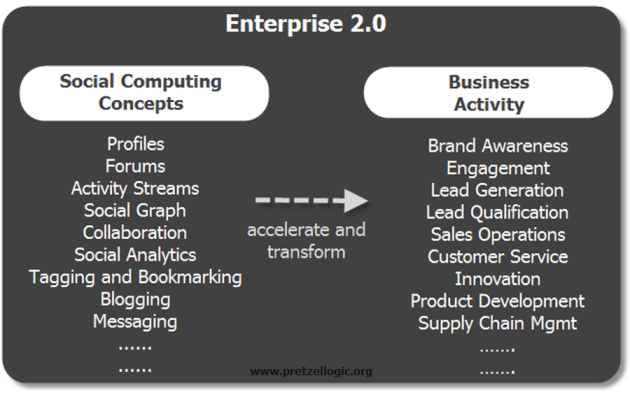
Back in March 2009, Sameer Patel wrote, don’t confuse Enterprise 2.0 with social computing concepts. He was making this exact point, and included this illustrative diagram:

Credit: Sameer Patel, Span Strategies

Credit: Sameer Patel, Span Strategies

His point is that the left side are tools, whereas the right side are results-based activities. Key here is to create applications aligned with the processes for those activities. That means going deeper than a general purpose tool.

Successful Applications Will Be Designed for Results

So back to the original question. Would you manage CRM with a wiki? Could you? Perhaps there’s a geek hack to do this, but for mainstream business, the answer is ‘no’. Customer relationship management includes:

  • Case management
  • Customer revenue analytics
  • Sales pipeline
  • Individual prospect opportunity workflow
  • And lots of other stuff

It would be really hard to use generic off-the-shelf social software to deliver the above functionality. Yet, going back in time, here’s what was prescribed for CRM success in April 2002:

People [who fail] don’t integrate CRM into the other parts of their business or implement CRM as a stand-alone and don’t have it communicate with core systems. A bigger and more frequent stumbling block is forgetting to address the people issues around a CRM implementation. In almost all of the cases we described earlier, CRM is a behavior modification tool.

There is a need for the “hard” functions that CRM can provide, like case management, campaigns and analytics. But that’s not enough (e.g. see social CRM), and enabling the customer-centric firm seems to require a good bit of what makes Enterprise 2.0 tick: cross-organizational perspectives, contributions from different departments, a more collaborative orientation to an end-goal. Integrate CRM into “other parts of their business”.

Wikis, by themselves, don’t provide the necessary CRM functions that are table stakes to be useful for companies. But CRM platforms could benefit from integrating more social software tools and conventions.

And that’s the case for a lot of the current processes that define companies today. They aren’t going to be addressed by off-the-shelf generic social software tools. But they benefit by incorporation of social software tools.

“Activity-specific social applications”. A few examples:

Dachis Group talks about social business design as “the intentional creation of dynamic and socially calibrated systems, process, and culture.” Indeed, there’s a huge opportunity to apply social software to the multitude of applications and processes that make up organizations, beyond the insertion of standalone generic tools.

Watch this space.

Warburg Pincus Invests $10 Million in Spigit

Warburg Pincus SpigitWell, this is pretty cool. I’m pleased to announce that Spigit has received a $10 million equity investment from Warburg Pincus. The investment will be used for the usual things a growing start-up needs: product development, sales and marketing and program management. Here’s coverage in the New York Times and TechCrunch.

I’ve been with Spigit for 6 1/2 months, during which time I’ve seen firsthand how things have progressed. Both the company and me.

If you’ve ever checked my bio, you’ll know I worked in investment banking from 1996 to 2000. If not for a banking merger that shut down my San Francisco office, I’d likely still be there as a Managing Director, doing financings for companies.

OK, wait. Considering the recent financial market collapse, let me rethink that…

Rather, I moved into technology. And let me tell you, it ain’t easy making the transition from banking to technology. You have zero geek cred (note the name of this blog). Since 2000, I’ve worked for several small technology start-ups. From each of them, I’ve learned a lot. I will say that in Spigit I’ve found a place that nicely combines my MBA company performance orientation with my social software enthusiasm. Innovation management meets Enterprise 2.0.

The team at Spigit is a hard-working one. I’m impressed with the seriousness of purpose each of them brings to the job every day. When we closed the funding this week, our CEO Paul Pluschkell got a couple bottles of champagne for a company toast. After we drank a bit of champagne (not too much, customers reading this blog…), everyone quickly went back to their desks to do work. Dorks. :-p

Which is appropriate. There’s a lot of work to do. I’m looking forward to it.

Here’s to the Passionate Creatives

Here’s to the crazy ones. The misfits. The rebels. The troublemakers. The round pegs in the square holes. The ones who see things differently. They’re not fond of rules. And they have no respect for the status quo. You can quote them, disagree with them, glorify or vilify them. About the only thing you can’t do is ignore them. Because they change things. They push the human race forward. And while some may see them as the crazy ones, we see genius. Because the people who are crazy enough to think they can change the world, are the ones who do.

Apple ad, “Think Different”, 1997

Why did Apple’s ad resonate so well with you? After all, how much time do we spend disagreeing. Admit how happy it can make you when your manager praises you for executing well on an assignment. I know I feel it. No “think different”. More like “think excellence”.

But that Apple ad. It was damn good, wasn’t it? Seemed to reach inside us to something else beside the praise we get for doing an assigned job well. It was celebrating some thing in each of us.

John Hagel recently wrote A Labor Day Manifesto for a New World. The post is a call to action for work that better fits our human nature. Our desire for creating better ways to address problems, in ways that fit our personality, interests and skills. To reach our full potential. We’re not all doing this though.

Hagel terms people whose personalities and drive are based on making situations better than what currently exists as “passionate creatives”. There have always been these types, but recent changes in the global economy and shifting market dynamics (e.g. digital technology rewriting one industry after another) are increasing their importance.

Passionate creatives exist within organizations, and as independent entrepreneurs. For those inside firms, Hagel notes:

They experience deep frustration today with the institutional barriers that have been put in their way as they seek to more effectively achieve their full potential.  They want and need platforms that can help them connect with others and drive performance to new levels.

For many of us, even if we wouldn’t label ourselves “passionate creatives”, the point about frustration resonates. How often have you had an idea, but can’t attention for it, nor resources, nor figure out who else to work with? I’ve had jobs like that in the past. You know some things are not working well, and you can see how to improve the product/delivery/business model. But you can’t make headway on iterating through new possibilities.

Hagel’s manifesto is a great read. I want to hit on two points I take away from it:

  • What is the role of “passionate creativity” in daily work?
  • The gathering of passionate creatives at the edges and the accelerating rate of change in markets

The Role of Passionate Creativity in Work

Very few of us get to live a life of unfettered passionate creativity. The realities of the mundane trump the thrill of the new. And that’s not a fault of the system. If all we did was work on new stuff, there’d be no stability and no scalability. More like mass economic anarchy.

But that’s too heavy handed a look at it. We can be quite productive and help our companies, and careers, while working on tasks that hit our passionate creative sweet spot. A good question to ask is, how much of this passionate creativity infuses our work days?

Work imbued with passionate creativity

Take a look at those two Venn Diagrams. They’re saying different things. The left one says that we all have to execute on tasks assigned by others, or assigned by ourselves for the role we fill. In some of that work, we’ll have the opportunity to reach deeper, to deliver creativity on an activity that animates us. But the primary focus is executing on the plans and processes already in place.

The right one indicates a job which is dominated by passionate creativity. Hagel’s call-to-action is more aligned here. We work primarily on things which stimulate and energize us regularly. But there is a twist to this notion. It doesn’t mean spending one’s time on only starry-eyed big picture thinking, producing little of tangible value for your organization. It includes work by those “who are searching for new and creative ways to do the most ‘routine’ tasks.”

Which model of work are we likely to see arise in the next decade or two? Both. Neither. Yes.

Hagel’s manifesto is not so much a clear-eyed plan for rearranging organizations. Rather, it’s a wake-up call to the corporate world that the nature of work and what employees seek is changing. As he says:

Why will more and more people evolve into passionate creatives? Because we live in a world that is shifting inexorably from an obsession with efficiency to an obsession with learning.  We have come to call this the Big Shift.

In that statement, I draw some conclusions that relate which model above will emerge. First, note that the Big Shift is a shift in “obsessions”. From efficiency to learning. That’s a shift in attention, and in resources. It’s a shift in the dynamics of the supply side of the equation.

What hasn’t shifted is the demand side of the equation. Consumers worldwide still depend on the massive efficiencies that Tayloresque methodologies have brought to our economy.

So there’s the quandary: if we’re all working on things that inflame our passionate creativity, who is minding the massive scalability store?

My sense is that the Venn Diagram on the left is closer to what we’ll see. Enlightened companies will follow the examples set by Google and 3M, encouraging employees to pursue initiatives outside their regular routines. This does a couple things:

  • It provides an outlet for growing passionate creativity on a wider basis
  • Some of those initiatives will turn into full-fledged projects

The second point then lets employees live a life in the right-side Venn Diagram.

Passionate Creatives at the Edges

Another point Hagel makes is that passionate creatives tend to occupy spaces that are “edges”:

Passionate creatives are everywhere among us, but they are not evenly distributed. They tend to gather on the edges where unmet needs intersect with unexploited capabilities.  Edges are fertile seedbeds for innovation.

Reading this, I was struck by how well this fits with the observation that Gary Hamel made. The pace of change in markets is faster now than it ever has been in history. What this means is that Hagel’s edges – unmet needs intersect with unexploited capabilities – will be more frequently found.

Companies need to get better in pivoting to meet changes in their markets. And this keeps CEOs up at night. IBM surveyed global CEOs in 2008, asking them about their view of changes in their markets. The results are eye-opening:

Collectively, CEOs set their organization’s ability to manage change 22 percentage points lower than their expectations for the level of change they will have to manage — a ‘change gap’ that is widening.

A wide ‘change gap’ there, isn’t it? If Hamel identifies the problem companies face, Hagel identifies the types of workers who will make a difference in addressing the problem. The passionate creatives.

The edges are places of opportunity and uncertainty. It’s hard to know what the demand dynamics are, and existing infrastructure and processes don’t address the changing market needs. New alternatives are emerging, it’s time for fresh approaches by existing firms.

Companies are best-served by allowing employees who are attracted to these changes to pursue innovative ways to address them. Why? They get energy. They get an experimenter’s mentality. They get a happier workforce. Let employees exercise some form of self-organization to accomplish this.

The alternative may be incumbent staffers who have fallen into routines, or have reason to protect the status quo. This does not help companies address rising levels of volatility. Free the passionate creatives!

Passionate Creativity Will Fall on a Spectrum

My sense is that work will evolve, over years and decades, to allow people to shift attention to work that energizes them more fully. It will happen on a spectrum, with daily jobs that fall between those two Venn Diagrams above. Society cannot get away from the requirements of predictability, efficiency and scalability. We’re all going to have elements of our jobs that are routine.

I think Hagel’s post is right on though. It will be a slow change where companies integrate the existing passionate creatives more effectively, and develop the passionate creativity in all employees. Companies doing it well will need to celebrated and publicized repeatedly for the value to be understood more widely in the market.Over time, we’ll see the change.

Note what G. Michael Maddock and Raphael Louis Vitón wrote in this recent Business Week article. Passionate creatives like to “follow the challenges”:

Stop and think about the last truly great person who left your organization. First think about what made that employee great. We bet you name such characteristics as action-oriented, driven, passionate, fun, and genuine.

Now think about where that worker went. Chances are, to a position with a perceived promise of putting his or her talents to better use—moving into a role with greater challenges and opportunities to learn and make a difference. It wasn’t about money.

It will happen. Here’s to the passionate creatives.

I’m @bhc3 on Twitter.

Crowdsourced or Elite Unit Innovation?

A classic dilemma for companies is determining the best way to foster innovation. There are many good books with different approaches. Clayton Christensen’s Innovator’s Dilemma has influenced a generation’s thinking about innovation. He focuses management and entrepreneurs’ attention on the Big I: disruptive innovation.

One outcome of the popularity of Christensen’s book is the awareness people have that entrenched business practices can inhibit companies’ ability to recognize and address discontinuous innovations from new market entrants. Motorola, for example, is often held up as an example of this. The company continued to develop only analog cell phones even as the digital phones were getting traction. In clinging to analog, which it dominated, it fell far behind in the mobile phone market.

A key practice espoused by Christensen is for companies to tackle discontinuous innovations by creating separate divisions. These divisions have an R&D profile, meaning they are funded without requiring a financial return. They do not have to prove themselves to sales or other parts of the organization. This gives them the room they need to figure out how to approach the impending market shift.

The issue with the popularization of this framework is that it sets up a binary approach to innovation. You’re either addressing disruptive or discontinuous innovations, or you’re executing on yesterday’s business. It’s this dichotomy that obscures the value of innovations that move organizations forward, competing to increase market share and profits.

To that end, let’s examine two ways companies create work structures for innovation.

Integrated or Separate Innovation

The graphic below highlight two very different ways to approach innovation. And that’s a good thing.

Innovation Work Structures

Separate Division: As advised by Clayton Christensen, this approach is best for companies that need to address disruptive innovations. And all companies need to address disruptive innovations.These days, it’s not a matter of if, but when. For fundamental market shifts, too much is invested in the current operations for companies to address changes. Freeing a group of people from these constraints is critical, if the corporate culture is not open to big-bet innovations.

A couple examples of interest here. First, let’s go back to Motorola. Yes, the company muffed it badly on the transition from analog to digital. But there was something that it did right years before. Motorola researcher Jim Mikulski could see in the 1960s that existing cellular technology was insufficient for the emerging uses of the mobile technology. He had a new technology to replace it, and asked the head of Motorola’s communications division, John Mitchell to fund its development. Mitchell said “no”,

Arguing that 400MHz technology offered sufficient capacity and met consumer needs. The Communications Division current product line was the market leader, and a new product, which would likely cannibalize the current system, was deemed to be both unnecessary and potentially harmful to this business line.

So Mikulski found refuge in Motorola’s Corporate Research Laboratory. He worked on the new technology there, receiving funding for its development. When his view of the coming changes proved to be true, Motorola was ready with its new technology.

In other words, he addressed innovation that affected the communications division in a completely separate division.

Microsoft, on the other hand, has programmatically set up a separate division for innovation. The Microsoft Research group works on ideas that may never have commercial appeal. But some of their work has resulted in product features and direction for its new Natal gaming system, its Bing search engine, and an upcoming release of Outlook email.

They have a separate division, but the innovations arguably are of the sustaining variety, not disruptive.

Integrated into Daily Work: In this work structure, everyone is involved in innovation. The company sets expectations, and encourages employees’ to share ideas. Done right, this is in-the-flow stuff. Employees are encountering issues to be addressed daily, and they’re hearing new customer feedback all the time. They are well-positioned to come up with innovative solutions and products, if senior management makes that a priority.

Whirlpool is a good example of this. In 1999, then-CEO David R. Whitwam made the determination that Whirlpool needed to stop competing on price, and make innovation its central strategy. Fast forward to today, and the results have been stellar. Whirlpool has escaped competing as a commodity vendor, with $4 billion in revenue (21% of total sales) generated from its innovation efforts. Are they satisfied? No. CEO Jeff Fettig stated that while participation in innovation from 5,000 employees is good, he’s looking to increase it to 15,000.

That’s integrating innovation into employees’ daily work for sustaining innovation. In this case, sustaining innovation has been the source of growth and profits.

Another company where innovation is part of everyday work is 3M. The company is legendary for its innovation. And clearly, the encouragement of all employees to be part of innovation has taken hold. For instance, there was this story recently in Fast Company:

3M told a great innovation story at the ARF annual conference about a new product that started with a complaint call into customer care. The representative did his own research online, came up with a solution, filmed a video that he put on YouTube and re-contacted the customer to see if that is what he was looking for.

The sheer volume of ideas that employees have to improve companies’ existing businesses puts a premium on crowdsourcing ideas. And inevitably, some of that culture and the ideas emerging from sustaining innovation will relate to discontinuous or disruptive innovations.

Why Not Do Both?

Google is a good example of a company that does both. It’s 20% time for employees to devote to innovation is the stuff of business legend. And according to the company, half of its new products result from this employee time.

But then look at Google Wave. This project was done beyond 20% time. It was actually a completely separate project developed by a 5-person “startup” team in Australia, far from the company’s Mountain View, CA headquarters. Google Wave is transformative, and will likely usher new design principles into a host of software applications.

Google is a good example of an innovation-led company. They mix the elite unit approach to innovation with the everyday encouragement for employees to innovate.

There’s not this dichotomy of “all disruptive/discontinuous innovation, or you’re just falling behind”. Rather, it’s a smart blend of the strategies.

I’m @bhc3 on Twitter, and I’m a Senior Consultant with HYPE Innovation.