McDonald’s wins on the fast food jobs-to-be-done that matter

Consumer Edge Insight conducted a survey of consumer perceptions about 20 different fast food restaurants. Specifically, how are they ranked by consumer perceptions on different attributes, such as:

  • Good value
  • Convenience
  • Low prices
  • Fast service
  • Great tasting food
  • More…

The customers were asked to rank order the different attributes, and “great tasting food” actually ranked 8th. The first four above were the top ranked attributes.

Which explains this unusual finding when it comes to McDonald’s:

McDonald’s scored very low in “satisfaction with last visit”. Only 22% of respondents were extremely satisfied with their last McDonald’s experience. Highest satisfaction scores went to Chick-fil-A (66%), Long John Silver (56%), and Whataburger (54%).

McDonald’s scored very high in “extremely likely to visit again”. McDonald’s 64% score on that measure was third behind Subway (68%) and Chick-fil-A (67%).

Wha…? Yeah, low satisfaction combined with high intent to visit again. Strange isn’t it? Are consumers masochists? Well, no. The key here is recognizing that customers have a number of jobs-to-be-done when it comes to eating. Translating the four attributes into jobs-to-be-done (using the previously defined structure):

Attribute Context Job Success Metric
Good value When I purchase food… I want to spend the same or less than what I would for preparing the same food myself. Perception that the food quantity and quality is commensurate with the price paid.
Convenience When I need to eat with limited time… I want to find food to eat quickly Decreased time to get to the food that I will eat.
Low prices When I need to feed myself and others… I want food costs that fits within my budget. Food that costs less than [X]% of my daily income.
Fast service When I need to eat with limited time.. I want food that is served quickly after I’ve ordered. Food is served within [2 minutes] after I order it.

On the highest ranked jobs-to-be-done (remember, jobs should be ranked ordered), McDonald’s is at or near the top. What’s interesting is that the “satisfaction with last visit” score was low for McDonald’s. But it turns out that’s not the most important question. Rather, the question should be, “how satisfied are you with the jobs-to-be-done that matter?”

I’m @bhc3 on Twitter.

A Method for Applying Jobs-to-Be-Done to Product and Service Design

Say you’re designing something new for a product or service. Of course, you have your own ideas for what to do. But, how informed are you really about what is needed?

This is a question I faced in thinking about game mechanics used in a social platform. A common product approach is to work up some game mechanics ideas, get them designed and deployed. The source for ideas? My own fertile mind. Inbound suggestions (“in World of Warcraft, you can…”). Competitors. What companies in other markets are doing.

But that wasn’t sufficient. Game mechanics are an evolving, somewhat complex field.  I wanted to understand at a more fundamental level: why game mechanics? So I decided to learn more from our customers. What needs would game mechanics address? Initial question: what’s the best way to go about this?

Jobs-to-Be-Done: Only for game-changing innovation?

The jobs-to-be-done framework struck me as the right approach here. What are customers trying to get done? As legendary professor Theodore Levitt said:

People don’t want to buy a quarter-inch drill. They want a quarter-inch hole.

Similarly, I didn’t believe customers wanted to buy “game mechanics”. They want to buy results, which game mechanics can help deliver. Using the jobs-to-be-done framework, what jobs were game mechanics being hired for?

Yet, in reading the advice on jobs-to-be-done, one gets the impression that eliciting jobs-to-be-done can only be done effectively via intensive in-person interviews. Well, I didn’t have the capacity to fly around for one-day deep-dive sessions to understand the jobs-to-be-done related to game mechanics.

Customer Insightini

And this gets at something related to jobs-to-be-done as it stands today. It’s very much positioned for high-impact, game-changing innovation. Which is awesome, by the way. Firms like Strategyn and ReWired Group are setting the tone here. When the payoff for intensive, expensive efforts like in-person interviews is high-value innovation, you do them.

But my needs were at a lower level than that. In the Customer Insightini™ to the right, I segment the types of initiatives where customer insight can be useful. The bottom is the minor stuff (“it should support colors red, green, blue…”). The top is the game changing endeavors (e.g. surgery stents). My game mechanics inquiry? Right there in the middle. Introduction of something new in the same market.

Since I couldn’t find a good framework to elicit customers’ jobs-to-be-done, I hacked together my own methodology. It’s described below.

  1. Job-to-be-done structure (link)
  2. Focus the effort (link)
  3. Rate satisfaction with fulfillment of each job (link)
  4. Rank order importance of jobs to create an Opportunity Map (link)
  5. Use a website to manage the jobs-to-be-done (link)
  6. Conversations are as valuable as the jobs themselves (link)
  7. Step-by-step plan (link)

Job-to-be-done structure

I needed a common language for the various jobs-to-be-done. Specifically, I needed a reliable format that provided the right information. I came up with the following:

Context: “When I am…”

Job: “I want to…”

Success metric: “Increased…”

Context is important, because I want to understand the background for the job to be done. When did it happen? What was the larger goal? The job itself is the core information to be collected. The success metric told me what the customer valued in an outcome, and provided a basis for measuring whether the idea implemented to fulfill the job was actually doing so.

Focus the effort

Something I’ve learned in the realm of innovation management: focused initiatives outperform post-whatever-you-want initiatives. In other words, participants should be asked for insight on a specific topic. Otherwise the exercise risks spinning off in many directions you’re not ready to pursue.

In the game mechanics effort, I started with a definition of gamification itself. This set the tone for the discussion. I believed there were several areas that could benefit, so I focused the discussion around collaboration, engagement and three other areas. This framed the discussion without corralling customers too tightly in what they wanted to express. It also gave a nice rhythm, as we worked through each of the five areas.

Unsurprisingly in the discussions with customers, they had ideas for applying game mechanics to a job-to-be-done. Since the discussion was focused on their needs and wants, I would take these ideas and add them to a separate idea community.

Rate satisfaction with fulfillment of each job

This step was critical. It wasn’t enough to have the various jobs-to-be-done. Understanding the level of satisfaction with each one is the metric which shows where good opportunities lie.  I asked customers to bucket each job-to-be-done as:

  • Satisfaction with current outcomes = HIGH
  • Satisfaction with current outcomes = MODERATE
  • Satisfaction with current outcomes = LOW

Now, there was a natural bias for customers to provide jobs where their satisfaction was lower. They wanted to talk about things that need to be improved. But I wanted to ensure a broader look at the landscape of jobs. So in the course of the discussion, there were three sources of jobs-to-be-done that came outside of these  low-satisfaction ones:

  1. Seeded obvious jobs: I seeded the site with some of the more obvious jobs, to provide examples.
  2. Jobs provided by previous customers: As I learned new jobs from a previous discussion, I’d add them to the new discussion. This was good to see how customers felt about what others were trying to get done.
  3. Jobs elicited in discussions: After getting one job from a  customer, we’d discuss it. In that discussion, you’d hear another job-to-be-done. While that one may not be low satisfaction, it was important to capture it for a fuller understanding.

As you can imagine, there were varying views on level of satisfaction for the same job across customers. Is the software performing differently for each? No. But each customer was communicating the level of outcome they deemed satisfactory.

Rank order importance of jobs to create an Opportunity Map

After the jobs were sorted into the LOW, MODERATE, HIGH satisfaction buckets, I asked the customer to rank them in relative importance, highest to lowest. This was their chance to tell me just what they valued most. Even if their satisfaction was moderate with a job’s outcome, it was valuable to know what they deem most important. Useful for fuller understanding of why customers buy. Because you want to avoid being one of these companies:

The vast majority of companies have no clue what their customers value in the products and services they buy.

Here’s what you get after you’ve done this: an Opportunity Map as determined by the customer’s expressed needs.

JTBD Opportunity Map

After talking with each customer, you’ll be able to generate an Opportunity Map. By aggregating the responses by customers, you have a broader Opportunity Map    that begins to reflect something of the market.

Use a website to manage the jobs-to-be-done

The preceding elements of eliciting jobs-to-be-done are the method. The method needs a place to execute it. For my gamification project, I used the free post-it note site Listhings. With that site, I can add unlimited canvases (for different customers) and individual notes (for the jobs). You can color code the different sub-topics within the question you are asking.

Examples of Listhings culled from an actual customer discussion:

Listhings example

Conversations are as valuable as the jobs themselves

In the process of collecting the jobs-to-be-done, I found the discussions around each job-to-be-done to be incredibly valuable. And this is an important point: customers want to talk to you about what they’re trying to get done! The discussions were intelligent and gave me insight into their world. An insight I cannot get from data about usage or the user stories I write in a vacuum.

This experience is what makes me cringe when I read others throwing around the old Henry Ford chestnut: “If I had asked people what they wanted, they’d have said faster horses.” It assigns customers to the Dumb Bucket.

Interesting experience in doing these with 8 different customers. I would schedule a one-hour session with our admin leads at each. Inevitably, we’d run out of time in that first session. Every single customer was up for a second session. One customer even wanted a third and fourth session, bringing actual end users into it for their perspective.

Perhaps this can be a good path for a design thinking approach, as it really boosts your empathy for what customers are trying to get done as you discover their jobs-to-be-done.

Step-by-step plan

OK, that was a lot of information about individual parts of this jobs-to-be-done methodology. Let’s put it together into a plan:

  1. Establish a topic you want to explore more deeply with customers.
  2. If the topic is somewhat broad, break it down into sub-themes.
  3. Sign up for a site where you can collect jobs. Criteria for such a site:
    • Each job is visible in full on screen
    • Ability to segment the jobs by sub-themes
    • Ability to categorize jobs by level of satisfaction
  4. Seed the site with some obvious jobs that your product/service provides.
  5. Select customers to engage.
  6. Use a web/screen sharing tool to run the discussion (e.h. WebEx, GoToMeeting, Skype, Google Plus).
  7. Plan for an hour, expect to need a second one.
  8. As you talk with the customer, post the jobs in real time so she sees them on screen.
  9. Run through the satisfaction bucketing (LOW, MODERATE, HIGH)
  10. Rank order the jobs within each satisfaction bucket
  11. Collate and aggregate the responses after you have finished the customer discussion. I used Excel for this.
  12. Identify the jobs that were most important and received LOW or MODERATE satisfaction across your customers.
  13. Plumb your notes from the discussions for additional insight that will be useful

The other thing you’ll gain from this are customers who have a demonstrated interest in the phases that follow in the design and development process: ideas, prototypes, early purchasers.

I’m @bhc3 on Twitter, and I’m a Senior Consultant with HYPE Innovation.

Net Promoter Score is a window into jobs-to-be-done fulfillment

I’m a big advocate for better understanding customer needs, particularly in the jobs-to-be-done form. Companies should spend more time on this, instead of the all-too-common approach of implementing someone’s vision in a near vacuum. Although I admit it isn’t easy to do. Focus groups are a start, but are both logistically and financially hard to scale, and fraught with their own issues. So the state of getting customer insights is still fairly immature.

So I was interested when I received this email invitation from American Express:

See there? AmEx wants to better understand my needs. Charge cards fall into that overall payment realm which includes PayPal, Square, Stripe, Google Wallet, etc. It’s a deep part of our society and something we can all relate to.

Sure, the most basic job-to-be-done is:

When I am purchasing something, I want to provide payment to the seller. Success means I complete the purchase.

But is that all there is? No, of course not. I have jobs around paying off AmEx, understanding my spending habits, merchandise assurance, along with emotional ones like a feeling of assurance I can buy when I want to. AmEx even works on fulfilling a status-based job-to-be-done. Extending out from there, there are adjacent jobs related to the purchase decision process before the transaction and better understanding my financial activity after the transaction. Heck, I’ll bet AmEx could come with more areas where I have relevant jobs-to-be-done.

 I click on the Begin Survey button in the email, passing through three set-up screens first:

Now, if you look at those three screens, that’s a good amount of setup. An intro screen, a list of “helpful hints” and finally confirmation of the product I’m using. Feels like I’m about to undergo a weighty exercise.

Well…no. Rather, this is the meat of the entire survey:

A net promoter score question. NPS has become more and more popular, and is a simple report card on how your customer perceive your product or service. Customers who click 9 or 10 are called Promoters, 7 or 8 are Passives, and 1 to 6 are Detractors (read more on net promoter scores). For the record, I picked ‘7’. AmEx is a fine card, but in my wallet I can’t really distinguish it from my Visa or Mastercard. It’s the only charge card Costco takes, so I can recommend it based on that.

But a broader question occurred to me. What will AmEx do once they have all the NPS’s collected from customers? Say the NPS comes in averaging ‘9’. They’re done, right? Pretty much nailing it. If it comes in around ‘7’, they’ll wonder what is wrong, why people aren’t more gung ho.

Assuming they will take action based on the NPS collected from us customers, I can see a few paths here for what happens next.

Marketing focus: Product is fine as-is, it’s the messaging around it that we need to improve. Also, we’re not reaching customers where they are. TV is declining, we need new ways to get across why our card is better. That will get our NPS’s up.

Internal product development focus: Work on ways the card features and experience can be improved. Smart people work at AmEx, and they can come up with some interesting approaches. Focus group the ideas after they’ve honed them down to a few. That is, get customer insight after the fact.

Jobs-to-be-done focus: As Steve Blank espouses, there are no facts inside your company’s walls, get outside of your purely internal focus. Initiate a program of exploring jobs-to-be-done by customers. Incorporate customer wants into determining the design of new products. This is insight before committing to any ideas.

Indeed, the NPS is a great first cut on identifying customers to approach about getting deeper insight. Each person’s NPS is essentially a window telling you how well AmEx Green matches their particular jobs-to-be-done.

What do you think AmEx will do next?

I’m @bhc3 on Twitter.

What’s your view on customers’ value to innovation?

More and more, customer-centricity is becoming a thing. As in, an increasingly important philosophy to companies in managing day-to-day and even longer term planning. In comes in different forms: design thinking, social CRM, service-dominant logic, value co-creation.

But it’s not pervasive at this point. Companies still are spotty on how much they integrate customers into their processes. This is a revolution that will take some time to unfold.

In terms of innovation and product or service development, there is a spectrum of where organizations are today:

Quick descriptions of each point on the spectrum…

Customers have thoughts?: For these firms, customers are transactions. How will I know if I’m attuned to the customer? I look at my daily sales receipts. If they’re up, I’m attuned. If they’re down, I’m not!

Customers don’t know what they want: What was it Steve Jobs said again? Ah, yes: “A lot of times, people don’t know what they want until you show it to them.” Unlike the previous point on the spectrum, here, companies have considered that their customers have thoughts. They just don’t think there’s much point in paying attention to them. In a more charitable vein, Roberto Verganti cites companies that “make proposals to people”. While there’s no direct customer engagement, these companies build product intuition through trends changing other sectors. Unfortunately, many companies with the “customers don’t know” aren’t actually doing that either. It’s more someone’s whim defining the offering.

We respond to questions and issues: In this part of the spectrum, companies may proudly say they listen to their customers. Not too deeply though. It’s more a surface-level valuation of customer input. It doesn’t fundamentally change the company culture, or really draw customer insights more deeply into the organizational workings. The hip companies have extended this work out into social media. They monitor tweets, Facebook posts, Pinterest pins, etc. for complaints, questions and sentiment analysis.

We have a Customer Advisory Council: Take some of your best customers, and appoint them to a special panel that meets periodically during the year. Good forum for airing bigger picture issues. In this case, companies asttempt to more directly solicit customer input into their thinking. These sessions are good, because otherwise the only way customer feedback gets into an organization is during the sales process and then one-on-one with an account/customer rep. Insight gets trapped in a CRM account somewhere. While progressing on being attuned to customer insight, CACs are still siloed affairs. Many in the company have no idea what comes out of them. And they are removed from the day-to-day work that truly defines an organization.

We focus group new innovations we’ve already developed: As opposed to developing something and putting it out there, these companies work with focus groups to understand what is liked or disliked about an offering they have developed. This can be quite valuable done right, and becomes a direct conduit for customer insight into the company. The biggest problem here is that it’s after-the-fact: the product or service has already been designed. Now, in the lean startup methodology, this approach of develop and test is a core principle. In corporate land, focus groups may be less about test-and-learn, and more about affirming one’s pre-held views.

We solicit customer jobs-to-be-done: As part of their planning and design process, companies solicit customers’ jobs-to-be-done. They want to get a bead on customers are trying to accomplish with their products and services. This is no small feat. I’ve done this work myself, and it does take a willingness to open one’s mind beyond your own personal beliefs. But getting and using jobs-to-be-done in product and service design is a basis for better, more valued offerings to the market. Key here is not just engaging customers on their jobs, but actually incorporating that into design.

We gather customer ideas: Customers are using your offerings, and can see opportunities where new features and services would help them. While certainly product, R&D and marketing will come up with ideas on their own, what about the people who actually use your products? This is a form of open innovation. The amount of ingenuity outside your company walls dwarfs what you have internally. Key here is to solicit around focused areas for development, which makes using the ideas more feasible inside companies. Wide open idea sites can be harder for companies to process, as they don’t fit an existing initiative. Defined projects have a receptive audience and a commitment to progress forward.

We co-design with customers: The most advanced form of customer-centricity. Customers have a seat at the table in the actual development of products and services. This is, frankly, pretty radical. Their input guides the development, their objections can remove a pet feature favored by an executive. This is hard to pull off, as it is counter to the reason you have employees in the first place (“experts on the offering”). It requires a mentality change from being the primary source of thought to a coordinator and curator. Key here is deciding which customers to involve at what point in the process.

My guess is that most companies are still toward the left side of the spectrum, but as I say, it is a changing business world.

I’m @bhc3 on Twitter.

Tweets Offer Little Value in Understanding Customer Needs

https://twitter.com/rwilcox/status/203838810809835520

Social media. A rich source of insight and opportunity for companies. Why, it’s an article of faith that customers are talking…on their terms…where they want. So get out there and learn from them! See what this IBM executive says:

Companies that embrace social media as a source of insight will be rewarded. They’ll develop a deeper understanding of customer needs and will be able to attract new customers more easily. They’ll have a better shot at providing the products and services that the market wants – before the competition does.

It’s true, there are opportunities. But really, my sense is the opportunities lie on the marketing (read: sell) side of the house. Now social media occupies a large landscape. So how about narrowing focus, to Twitter. How useful are people’s tweets for customer insight? Specifically, giving companies a better handle on customers’ jobs-to-be-done?

tl;dr answer: Not so much. Lots of grousing about personal circumstances, and some silliness. But not much insight.

Saving and paying for college, in 450 tweets

Source: Mark J. Perry

To examine this question, I assumed the perspective of a financial firm trying to get a better handle on the “paying for college” jobs-to-be-done. In aspirational, emotional terms,  college continues to be a top goal of parents for their children, and of teenagers as well. In economic terms, colleges have an insatiable appetite for tuition increases.

Importance for our children, increasing costs, need to save. Surely, there are some unfulfilled jobs-to-be-done out there. So I turned to Twitter to see what people were talking about. What needs were they expressing? What insight on this topic?

To see what people are saying, I ran Twitter searches on three terms:

  1. college savings
  2. “saving for college”
  3. “pay for college”

I collected 150 tweets each for those three Twitter search terms (you can see them in this Google spreadsheet). With that data, I looked at (i) how many contained usable insight, (ii) what were the common words, and (iii) the collective sentiment.

Now, my research here is one of…oh say…a quadrillion possible customer insight areas to explore. Conclusions I draw here are not necessarily applicable to all areas. But it’s a good start.

Mining for jobs-to-be-done

Imagine you work for a large financial services company. You know in the U.S., people have put nearly $150 billion into 529 college savings plans. It’s a potent cocktail: lots of money; aspirations for, and symbolism of, a college degree; and escalating tuition. There have got to be opportunities to improve people’s lives here!

You want jobs-to-be-done, defined as people’s expressions of things they’re trying to get done in relation to saving and paying for college. Just what are they tweeting about out there?

You collect the tweets, and then categorize each tweet according to its value in understanding jobs-to-be-done:

  • No value
  • Points toward a job-to-be-done (a shadow of a job)
  • Direct expression of a job-to-be-done

In reviewing 450 separate tweets, here are the results:

Twitter search term No value Points to a JTBD Direct JTBD
college savings 137 12 1
“saving for college” 141 9 0
“pay for college” 150 0 0
Totals 428 21 1

Looking at those, you begin to understand the challenge of looking at tweets as sources of customer insight.

Tweets with no value

By far, the most prevalent case was that the tweets provide no value in understanding what jobs people are trying to get done. At least, no actionable value. Below are examples of these types of tweets:

Many tweets in the “no value” category were of this type. Honest, authentic? You bet. Fuel for developing new innovations in products and services? Not so much. I’ll admit that value may be in the eye of the beholder. Perhaps someone wants to target scholarship-winning kids to buy new cars. But for the financial services firm, looking for insight from customers, these tweets don’t help.

Note that many of the tweets in this category weren’t from real people. They were marketing tweets by institutions. Which makes it hard to just dig in to those tweets. First you need to separate the manufactured marketing tweets from the honest expressions of individuals. Welcome to the jungle.

Tweets pointing to a job-to-be-done

I’ll admit, this categorization sounds funny: “pointing toward” a job. What does that mean? Look at a couple examples:

The tweets are not themselves the jobs-to-be-done. But they reflect jobs, if you read them carefully. In the first tweet, Raeleen wants to contribute to the college fund of her nephew. The larger story is that family, beyond the kid’s parents, can be part of the college savings effort. Here’s a definition of the job-to-be-done:

Situation: When I am planning my child’s college savings…
Job: I want participation from family members and friends.
Success means: Increased savings from a broad cross-section of family and friends.

The job reflected in the second tweet is one of structurally managing the college savings apart from other savings and cash expenditures.

There weren’t a lot of these, and many of them were pretty obvious jobs-to-be-done. But in hunting for the elusive job-to-be-done in the wild, their gamey, tough meat was better than nothing.

Direct expressions of jobs-to-be-done

After going through 450 tweets, I was sure I’d find at least one person tweeting a job-to-be-done. Maybe dazed by collecting and analyzing that many, I settled on the one below:

I see here an emotional job-to-be-done. Namely, the feeling of accomplishment that one feels in preparing financially for college. That’s a feeling that should be built on. I can tell you, when my wife and I put money into our kids’ 529 plans, we get that sense of accomplishment. Something that a financial institution should plug into more strongly.

So that was a nice job-to-be-done. However, as I said, slim pickings in finding jobs-to-be-done in tweets. Which should make you question how much of the presumed insight waiting to be gathered out there is actually…there.

But I did run the tweets through a couple other analyses to see what they turn up.

Sentiment analysis

For all these tweets about saving and paying for college, how was the sentiment? Does the mood tell us something about the jobs-to-be-done? Or at least provide some form of insight?

I ran them through a couple different tools: Sentiment Analyzer and Sentiment140. Sentiment Analyzer analyzed the 450 tweets I had collected. Sentiment140 ran an analysis on the most recent 19-25 tweets it could find related to a search term. While the bases of tweets differed, the two engines came up with remarkably similar results. Sentiment140 is on top, Sentiment Analyzer is on the bottom of the graphic below:

See how the college savings tweets are strongly positive. The general idea of college savings is a positive one, as college is a very strong emotional element for us. We may have attended ourselves, with memories from that period, and we want our kids to go. Then see how the mood swings to a darker one when tweets contain the phrase “pay for college”. It’s as if the more ‘transactional’ the experience becomes, the more negative the mood gets. Another difference is that tweets about “pay for college” overwhelmingly were by teenagers and young adults, expressing frustration related to affording college.

For marketing purposes at least, this sentiment analysis may have value in targeting people in different stages of the college saving spectrum.

Word trends

Another area explored is the commonality of words in the tweets used. Do they reveal latent jobs-to-be-done? I ran the tweets through Wordle:

The Wordles do reveal some interesting patterns. When people tweet about college savings, the most common words are plan, account, day, get. In this case, day is driven by the timing of when I collected the tweets. May 29th was upcoming, and it was U.S. national 529 Day (get it? 5/29). The most frequent word plan certainly makes sense, and in some ways fits the positive sentiment seen earlier. Thinking ahead about what’s needed to pay for college.

Notice the most frequent terms switch to start, money, need, parents in the “saving for college” Wordle. Let’s focus on the transition from plan seen in the college savings Wordle to start in the “saving for college” Wordle. It’s a transition from a more abstract concept to a task that one must undertake. The vibe switches to a get-things-done mentality.

Finally, note what dominates the “pay for college” Wordle: money, gonna, help, stripper. You might look at that and say, “stripper”? First, note that I converted the various stems of strip in the tweets to a single word, stripper, so as to better capture what showed up in a lot of the tweets. Essentially, a number of people (female and male)  joking about becoming strippers to pay for school. I read these tweets as reflecting the steep costs of college, and teenagers/young adults not feeling like they have options to pay for it. A reflection of escalating tuition and cases where college savings were not available.

Usable insight on customer needs?

The title of this post highlights a particular aspect of insight that interests me: customer needs. On that score, I don’t find the tweets to be that valuable. As someone who is outside the financial services industry, I do find them to be gauges of what’s going on out there. An industry insider might already have a handle on what I discovered.

Here’s what makes tweets challenging to use for insight on customer needs:

  • Wide range to subjects: tweets run the gamut, even for a specific search term, and their volume makes it tough to sift through to find areas you want to explore
  • Odds are low that they’re speaking about core things they are looking to get done
  • People tweeting are not part of the market you’re seeking: for example, although there is $150 billion saved in U.S. 529 plans, these parents weren’t tweeting about saving and paying for college
  • Tweets have a one-off quality: follow-up and discussion to get deeper insights doesn’t happen

That’s my take. What do you think? Wouldn’t surprise me if others are seeing more value than I am. If you’re interested, you can check out the tweets I used for analysis on this Google spreadsheet.

I’m @bhc3 on Twitter.

Jobs-to-be-done’s place in a customer-centric organization

On Twitter, I asked this question:

I asked it, as I had a conversation in recent days with a fellow from a large corporate. Customer-centricity was recently adopted as an internal mantra, but the manifestation of that was…wait for it…sentiment analysis.

It’s a start, right? But is it really a difference-maker?

I’ve written recently about jobs-to-be-done. As in, what customers hire your product to do. Those jobs have a tendency to (i) be hidden from you; and (ii) change over time. Knowing, and acting on, jobs-to-be-done (JTBD acronymized) is probably one of the most customer-centric things a company can do. You’re getting deep into what someone is buying your product for.

While I don’t work for a large corporate, I am integrating jobs-to-be-done in some work on next generation gamification elements for the Spigit platform. Why? Because there are many different types of game mechanics that can be applied to a platform. But why would you add any of them? To better deliver on what your customers hire you to do. To accomplish this, I’m using the Listhings site – online post-it notes – to collect and socialize these. I follow my own format for JTBD: context, job, success metric. An actual (blurred-out) example is below:

You know what? Customers love talking about their jobs-to-be-done. Seriously.  I usually schedule an inital hour to talk about them, and every single company has wanted to continue to the conversation for another hour. The conversations are not just good customer relations, which they are. They are leading to areas where the Spigit platform can apply game mechanics to improve their outcomes.

But apparently, this approach is sort of radical. As only 7% of firms are deemed to be customer-centric.

Where would JTBD fit?

Which got me thinking. What exactly are companies doing today, at least in the product and service development arena? Where would customer jobs-to-be-done fit with existing approaches? The graphic below is my take on what’s happening out there:

The center blue area represents the work of ideating, designing and producing products and services. The top grey boxes floating around up there? Those are the current factors influencing the product/service development process.

Market Analysis: Classic input for product development here. What are the trends? What are competitors doing? What’s going on in adjacent markets? You’re got to do this. It’s a source of ideas, and evidence of what customers are gravitating toward.

Executive Fiat: Does this really happen??? Heh, just joking of course. This will be a reality forever, and it’s actually appropriate in mild doses.  The thing to watch is the bull-in-the-china-shop approach, where that product is gonna get done, I’m not listening to anyone! Perhaps too many executives subscribe to the Steve Jobs-attributed notion that customers don’t know what they want (“So I’m going to give it to them!”).

Usage Vectors: Once you have product out there, you learn what people are using, what they value in the existing product features. And you continue to develop along those vectors. It’d be irresponsible to do otherwise. Just watch getting stuck on those vectors and missing the market shifts.

Customer Service Tickets: As people use your product, they’re going to file requests and report issues. These items are some clues to what people are trying to get done. They suffer from being narrow, focused on a specific interaction point and grounded in what they know of the current product. But you can divine some of what people want to get done from these.

Customer Surveys: Surveys get you closer to customers. Polling people’s preferences for difference attributes and behaviors. Good input as you consider a product or venture. Problem with surveys is that the questions are set ahead of time. Whoever puts them together has to decide what the key factors are. But that leaves a huge hole in understanding what customers themselves value.

Focus Groups: A favorite activity of large companies is to get some random people in a room for a couple hours and ask them about some concept being tested. In that these sessions have actual people talking, they are nominally useful. But common critiques of these are that

  • Participants tell researchers what they want to hear
  • The format is unnatural – forced face-to-face interactions with strangers for two hours in a closed room
  • Alpha personalities sway things
  • What’s discussed are already-decided concepts, not insight on what customers are looking to get done

As was stated in this 2003 Slate article, “The primary function of focus groups is often to validate the sellers’ own beliefs about their product.”

Jobs-to-be-done fills a gap

In all of the popular bases for developing products and services, one can see a gap. Most are a triangulation to understanding what customers want. Now some are quite useful in a customer-centric sense: usage vectors, customer service tickets, surveys. But they’re also piecemeal.

They represent the hope that you’ve got a bead on customer needs and wants.

Why the reluctance to actually talk directly with customers? Seems plain talk in a (not overly) structured way will give you a better sense of where opportunities lie. Aside from the product/service tools listed above, there are the social media engagement practices of today (react to tweets, have a Facebook page, sentiment analysis). All have their place, but they fall short.

Want to be customer-centric? Try talking to your customers.

I’m @bhc3 on Twitter.

Bell Labs Created Our Digital World. What They Teach Us about Innovation.

What do these following crucial, society-altering innovations have in common?

  • Transistors
  • Silicon-based semiconductors
  • Mobile communication
  • Lasers
  • Solar cells
  • UNIX operating system
  • Information theory (link)

They all have origins in the amazing Idea Factory, AT&T’s Bell Labs. I’ve had a chance to learn about Bell Labs via Jon Gertner’s new book, The Idea Factory: Bell Labs and the Great Age of American Innovation. (Disclosure: I was given a free copy of the book for review by TLC Book Tours.)

I don’t know about you, but really, I had no sense of the impact Bell Labs had on our current society. Gertner writes a compelling narrative intermingling the distinctive personalities of the innovators with layman points of view about the concepts they developed. In doing so, he brings alive an incredible institution that was accessible only as old black-and-white photos of men wearing ties around lab equipment.

For the history alone, read this book. You will gain knowledge about how the products that define life today came into being back in the 1940’s, 50’s and 60’s. I say that as someone who really wasn’t “in” to learning about these things. Gertner, a writer for Wired and the New York Times, invites you into the world of these fascinating, brilliant people and the challenges they overcame in developing some damn amazing technological achievements.

Those stories really carry the book. But just as interesting for innovation geeks are the lessons imparted from their hands-on work. There are several principles that created the conditions for innovation. Sure, the steady cash flow from the phone service monopoly AT&T held for several decades was a vital element. But that alone was not sufficient to drive innovation. How many companies with a strong, stable cash flow have frittered away that advantage?

Looking beyond the obvious advantage, several elements are seen which determined the Labs’ success. They are described in detail below.

#1: Inhabit a problem-rich environment

In an interview with a Bell Labs engineer, Gertner got this wonderful observation. Bell Labs inhabited “a problem-rich environment”.

“A problem-rich environment.” Yes.

Bell Labs’ problems were the build-out of the nation’s communications infrastructure. How do you maintain signal fidelity over long distances? How will people communicate the number they want? How can vacuum tube reliability be improved for signal transmission? How to maximize spectrum for mobile communications?

I really like this observation, because it sounds obvious, but really isn’t. Apply efforts to solving problems related to the market you serve. It’s something a company like 3M has successfully done for decades.

Where you see companies get this wrong is they stray from the philosophy of solving customer needs, becoming internally focused in their “problems”. For instance, what problem did New Coke solve for customers? And really, what problems is Google+ solving for people that aren’t handled by Facebook and Twitter?

A problem of, “our company needs to increase revenues, market share, profits, etc.” isn’t one that customers give a damn about. Your problem-rich environment should focus on the jobs-to-be-done of customers.

A corollary to inhabiting a problem-rich environment: focus innovation on solving identified problems. This vignette about John Pierce, a leader in Bell Labs, resonates with me:

Pierce was given free rein to pursue any ideas he might have. He considered the experience equivalent to being cast adrift without a compass. “Too much freedom is horrible.”

#2: Cognitive diversity gets breakthroughs

Bell Labs’ first president, Frank Jewett, saw the value of the labs in this way:

Modern industrial research “is likewise an instrument which can bring to bear an aggregate of creative force on any particular problem which is infinitely greater than any force which can be conceived of as residing in the intellectual capacity of an individual.”

The labs were deliberately stocked with scientists from different disciplines. The intention was to bring together people with different persepctives and knowledges to innovate on the problems they wanted solved.

For example, in developing the solid state transistor, Labs researchers were stumped to break through something called the “surface states barrier”. Physicist Walter Brattain worked with electrochemist Robert Gibney to discover a way to do so. Two separate fields working together to solve a critical issue in the development of semiconductors.

The value of cognitive diversity was systematically modeled by professor Scott Page. Bell Labs shows its value in practice.

#3: Expertise and HiPPOs can derail innovation

Ever seen some of these famously wrong predictions?

Ken Olson, President & Founder, Digital Equipment Corp. (1977): “There is no reason anyone would want a computer in their home.”

 Albert Einstein (1932): “There is not the slightest indication that nuclear energy will ever be obtainable. It would mean that the atom would have to be shattered at will.”

Western Union internal memo (1876): “This ‘telephone’ has too many shortcomings to be seriously considered as a means of communication.”

Now, before we get too smug here…haven’t you personally been off on predictions before? I know I have. The point here is not to assume fundamental deficiencies of character and intellect. Rather, to point out that they will occur.

What makes wrong predictions more harmful is the position of the person who makes them. Experts are granted greater license to determine the feasibility and value of an idea. HiPPOs (high paid person’s opinion) are granted similar vaunted positions. In both cases, their positions when they get it wrong can undermione innovation.

Bell Labs was not immune. Two examples demonstrate this. One did not derail innovation, one did.

Mobile phones

In the late 1950s, Bell Labs engineers considered the idea that mobile phones would one day be small and portable to be utopian. Most considered mobile phones as necessarily bulky and limited to cars, due to the power required to transmit signals from the phone to a nearby antenna.

In this case, the engineers’ expertise on wireless communications was proved wrong. And AT&T became an active participant in the mobile market.

Semiconductors

In the late 1950s, Bell Labs faced a fork in the road for developing transistors. The Labs had pioneered the development of the transistor. Over time, the need for ever smaller transistors was seen as a critical element to their commercialization. Bell Labs vice president of device development, Jack Morton, had a specific view on how transistor miniaturization should happen. He believed a reduction in components was the one right way. Even as development of his preferred methodology was proving technically difficult, he was unwilling to hear alternative ideas for addressing the need.

Meanwhile, engineers at Texas Instruments and Fairchild Semiconductor, simultaneously and independently, developed a different methodology for miniaturization, one that involved constructing all components within one piece of silicon. Their approach was superior, and both companies went on to success in semiconductors.

Bell Labs, pioneers in transistors, lost its technological lead and did not become a major player in the semiconductor industry.

With mobile phones, the experts could not see how sufficient power could be generated. Fortunately, their view did not derail AT&T’s progress in the mobile market. In the case of semiconductors, Bell Labs engineers were aware of the integrated circuit concept, before Texas Instruments and Fairchild introduced it. But the HiPPO, Jack Morton, held the view that such an approach could never be reliable. HiPPO killed innovation.

#4: Experiment and learn when it comes to new ideas

When you think you’ve got a big, disruptive idea, what’s the best way to  handle it? Go big or go home? Sure, if you’re the type to put the whole bundle on ’19’ at the roulette table.

Otherwise, take a cue from how Bell Labs handled the development of the first communications satellite. Sputnik had been launched a few years earlier, and the satellite race was on. The basics of what a satellite had to do? Take a signal from Location A and relay it Location B. Turns out, there were a couple models for how to do this: ‘passive’ and ‘active’ satellites.

Passive satellites could do one thing. Intercept a signal from Location A and reflect down to Location B. In so doing, they scattered the signal into millions of little bits, requiring high-powered receptors on the ground. Active satellites were much more equipped. They could take a signal, amplify it and direct it to different places it had to get to. This focused approach required much lower-powered receiving apparatus on the ground, a clear advantage.

But Bell Labs was just learning the dynamics of satellite technology. While active satellites were the obvious future for top business and military value, they were much more complicated to develop. Rather than try to do of that at the outset, John Pierce directed his team to start with the passive satellite. To start with an experiment. He explained his thinking:

“There’s a difference, you see, in thinking idly about something, and in setting out to do something. You begin to see what the problems are when you set out to do things, and that’s why we though [passive] would be a good idea.”

#5: Innovation can sow the seeds of one’s own destruction

Two observations by the author, John Gertner show that even the good fortune of innovation can open a company up for problems. First:

“In any company’s greatest achievements one might, with clarity of hindsight, locate the beginnings of its own demise.”

One sees this in the demise of formerly great companies who “make it”, then fail to move beyond what got them there (something noted in a previous post, It’s the Jobs-to-Be-Done, Stupid!). In a recent column, the New York Times Nick Bilton related this story:

“In a 2008 talk at the Yale School of Management, Gary T. DiCamillo, a former chief executive at Polaroid, said one reason that the company went out of business was that the revenue it was reaping from film sales acted like a blockade to any experimentation with new business models.”

Gertner’s second observation was this, with regard to Bell Labs’ various innovations that were freely taken up by others:

“All the innovations returned, ferociously, in the form of competition.”

This is generally going to be true. Even patented innovations will find substitute methodologies emerging to compete. Which fits a common meme, that ideas are worthless, execution is everything. It’s also seen in the dynamic of the first-to-market firm losing the market by subsequent entrants. After the innovation, relentless execution is the key to winning the market.

Excellent History and Innovation Insight

Wrapping this up, I recommend The Idea Factory. It delivers an excellent history of an institution, and its quirky personalities, that literally has defined our digital age. No, they didn’t invent the Internet. But all the pieces that have led to our ability to utilize the Internet can be traced to Bell Labs. Innovation students will also enjoy the processes and approaches taken to achieve all that Bell Labs does. Jon Gertner’s book is a good read.

I’m @bhc3 on Twitter.

It’s the Jobs-to-Be-Done, Stupid!

I do product management for Spigit. I’ve done product management for other companies as well. And let me tell you, the easiest thing in the world is to fall into the trap of focusing on how customers are using your product. Product forms your relationship with customers. It’s how you know them. They will tell you about your product, and the features they want improved. You can’t not listen to that. Of course, you’re going to improve your product.

But don’t confuse that with understanding what your customers need.

Just because you’re on top of what you’re customers need from your current product, doesn’t mean you’re on top of market changes. Two titans of the television industry remind us of that. They have, in recent weeks, been dismissive of a rumored Apple HDTV:

Sharp isn’t paying much heed to rumors that Apple is developing an HDTV. Nor does it have much reason to, says Kozo Takahashi, head of the company’s operations in North and South America.

All Things D

“TVs are ultimately about picture quality. Ultimately. How smart they are…great, but let’s face it that’s a secondary consideration.” – Samsung AV product manager

TechCrunch

And there you have it. Apple HDTV? Whatever.

Of course, one might be reminded of the comment by Palm’s CEO before the Apple iPhone was introduced: “PC guys are not going to just figure [phones] out. They’re not going to just walk in.” Ouch!

What we’re seeing is incumbents falling back on the thing that got them to their position: features. This is feature-led innovation. It’s got its place in the market, but relying only on it puts companies at risk for missing either (i) critical market shifts; or (ii) emerging needs that will drive organic growth.

Divergence between Product Features and Jobs-to-Be-Done

In the graphic below, a typical scenario for feature-led innovation is depicted. What happens is that over time, companies lose touch with where the market moves, with customers’ changing jobs-to-be-done.

When a company “makes it” in the market, it has the features that meet what customers are trying to get done. On the graph above, that’s set as “Time 0”, where features match Job 1. Given this is the ticket to success, a company will of course continue to develop these features. And the people who were looking for Job 1 fulfilled will follow along as the new features are rolled out.

Somewhere along the line, a new job-to-be-done emerges. Call it Job 2. New jobs enter the market all the time, via what Re-Wired Group’s Bob Moesta calls the “push” force. After Job 2, Job 3 emerges. And on and on.

But many companies are never aware of this. There are too many customers. Product is selling. You know your company’s product, and you’ve gotten lots of feedback for improvements. Systems are in place to reward and nudge you further along the path that fulfills Job 1. When they do solicit feedback from customers, it’s all Net Promoter Scores, focus groups for new features, surveys, customer service ticket analysis. Believe me, I really can appreciate how companies get lulled into this cycle of feature-led innovation. Professor Freek Vermeulen of the London Business School calls this the innovation “success trap”.

Meanwhile, customers cast about for ways of fulfilling their new jobs-to-be-done. They improvise. They settle. They experiment. They’re open to new entrants that meet their emerging jobs. And this is how it happens to companies.

Let’s look back at what the Samsung product manager said: “TVs are ultimately about picture quality. Ultimately. How smart they are…great, but let’s face it that’s a secondary consideration.”

Here are three jobs I’d personally like fulfilled that aren’t about picture quality:

Situation Job to Be Done Success Metric
When I turn on my TV I want a set of recommendations
based on my viewing habits
Increased awareness of
shows that interest me
When I want to share a moment I want a link to post to
Facebook or Twitter
Decrease steps it takes to
share on social networks
When I’m watching a sports
event
I want to order food for delivery Decrease time it takes to find
food and place order

The first two of those jobs have emerged based on new technologies in other arenas (recommendation engines, social networks). The third is a tried-and-true job that’s been around forever. Might there be a play to improve that via my TV?

All three of those jobs-to-be-done are divergent from the ongoing focus on picture quality espoused by the incumbent TV leaders.

Parable of Digital Cameras

The feature race of the HDTV manufacturers has a parallel in the digital camera industry. A key feature of digital cameras has been the megapixels. The higher the megapixels, the better the image quality. It has been escalating so much in recent years, Consumer Reports ran a piece wondering when the megapixel arms race would cease.

But in another case of new jobs emerging, lower end digital cameras are seeing their sales decline. Why? As the L.A. times noted in December 2011:

According to a survey by NPD Group, 27% of photos and videos taken this year were shot with smartphones — up from 17% last year.

Wait a minute. Are you telling me that with all that megapixel firepower, we’re gravitating toward phone cameras? What’s wrong with people these days?

Nothing actually. There’s always been the job-to-be-done of capturing moments. It’s just that lugging around a separate camera everywhere you go is a pain. But people want to be connected – talk, messaging, email, surfing – and will gladly carry their phone with them. Which is quite sufficient to fulfill the job of capturing moments. Megapixels be damned. Of course, the megapixels are getting better on smart phones too. Clayton Christensen must be amused by the ongoing disruptive innovation.

Sharp, Samsung…heck, all companies…are you listening? How well do you know the emerging jobs-to-be-done by your customers?

I’m @bhc3 on Twitter, and I’m a Senior Consultant at HYPE Innovation.

On the Utility of Thinking in Terms of Jobs-to-Be-Done

Cottonball clouds In a recent post examining the future of retail, I used the jobs-to-be-done approach to break down the industry. And I’ve been using it more in other ways. It’s quite useful as a basis for innovation.

The premise of the jobs-to-be-done approach is that it provides a much better basis for innovation. The focus is on unmet needs of customers. Compare this to asking wide open, pie-in-the-sky types of questions.

I thought about this when I saw this question posted on Quora:

What currently nonexistent websites would you want to be created?

Wow. Talk about an open ended question. I don’t know about you, but that question doesn’t help me. I get brain freeze. I need a prompt to come up with something. Wide open questions like that are somewhat divorced from what people actually need. And will generate a lot of ideas off the mark, or none because it’s too divorced from what people are thinking about (although one guy has an idea there).

Now I’ll describe a different situation. For Spigit, I often find myself needing to come up with a new idea to show off the system functionality. If I used that question from Quora, I’d find myself straining to generate ideas that pass the smell test.

So instead, I’ve been using the jobs-to-be-done framework. I think of my own jobs-to-be-done. Here’s one I actually used to come up with an idea for a client demo:

When I’m traveling with my family on vacation, I want to keep the kids entertained happily the entire trip.

From this job-to-be-done, I came up with an idea for a long haul family SUV (or could be a minivan). It’d have storage for games, and a flat surface for playing them. A refrigeration unit on board to keep beverages and food fresh. Multimedia for videos, music and games. It would take some design genius to develop. But it’s a vehicle I’d actually take a good look at.

[tweetmeme source = “bhc3”]

And that’s the point. The jobs-to-be-done approach is incredibly useful for generating ideas that are relevant and actually have potential. You’re plumbing the depths of what people really feel and what they actually want to accomplish. A powerful head start on innovating.

OK, let’s take this one out with a little Holiday Road.

5 Social Business Truths

Meritocracy trumps hierarchy: Companies don’t get a “pass” on Wall Street or the London Exchange becauswe they’re been around way before new companies. Political candidates aren’t immune from beingf being upended when they don’t perform. Why should work be any different? Companies that focus on the meritocracy are focused on growth. Those that pay too much attention to hierarchy are limiting their growth.

[tweetmeme source=”bhc3″]

Knowledge and ideas want to be free: When you learn something new, ever feel the urge to share it? When you know something that can help, don’t you want to answer a question? When you have an idea, isn’t it great to bounce off others? From a behavioral and technological perspective, we want knowledge and ideas to be free. Why lock ’em down?

Cognitive surplus must be a competitive advantage: Cognitive surplus – knowledge, perspectives, heuristics – is perhaps one of the most wasted assets organizations have. Each person’s surplus can be applied to a much greater range of problems and opportunities than what defines the daily tasks of her day. It’s a shame if employees go home every day without going beyond their job titles at the office.

Social and interest graphs generate positive returns: Activity streams, notifications, public interest spaces, recommendations – these new tools are exposing people to a greater range of relevant information than ever before. We’re not limited to our immediate cubicle neighbors. We are part of larger social and interest graphs. This increases the diversity of inputs, which increases our own, and organizational, odds of finding optimal solutions.

Transparency raises organizational IQ: When the left hand knows what the right hand is doing, we operate more effectively. Knowing the different initiatives, information and problems affecting other parts of the organization makes us better prepared in our own work. Operating in a vacuum sucks, because you get knocked over hard by things you don’t know. Transparency of information and conversations makes everyone smarter in their own work.

Carving Up the Retail Industry by Customer Jobs to Be Done

Online retailers had a heck of 2011 holiday season, up 15%. Whew, in a tough economy no less. But the news wasn’t as good for some physical retail stores. Sears Holdings announced disappointing sales and will be closing over 100 stores. Best Buy same store sales dropped, and some have expressed their sentiment that the retailer is on a long downward slide.

Digital disruption. Coming to a store near you.

That online and mobile commerce is increasing its share of business really isn’t a surprise. The  Internet, as promised in the 1990s, is turning over many industries.

[tweetmeme source=”bhc3″]

Retail being another such industry, although it’s a much slower process of disruption. Which means the physical retailers have time.

Time to take their natural advantages and build on them.

Determining Physical Retailers’ Competitive Advantage

Given the retail industry’s importance to the global economy and its periodic restructuring, it should come as no surprise that there’s plenty of advice for the industry. Three of the larger, well-known consultancies weigh in.

Booz and Co.’s Karla Martin sees a need for retailers to reduce selections and assortments. Bain’s Darrell Rigby sees omnichannel engagement with customers as the path for physical retailers to re-assert themselves.

In both Booz’s and Bain’s advice, there are elements of incorporating the jobs for which a customer hires a retailer. In the Booz piece, it’s a curation job: “Help me navigate an increasingly overloaded product landscape!” In the Bain piece, it’s a…well, not entirely sure what job is being satisfied. It appears to combine several customer jobs to be done. It is also a good thought piece about future industry infrastructure requirements.

These advice pieces raise the question of how to drill deeper into customer needs. Go beyond the meta trends and get specific around customers. Consulting firm McKinsey offers this thought:

“One way that manufacturers and retailers can investigate these trends is through consumer surveys designed to identify ‘purchase drivers’ – meaning those factors that are decisive in the decision to buy a product or shop at a certain retailer. This survey should not only cover conventional topics like price, quality, and service but also such factors as corporate responsibility and traceability of product origin.”

Survey fatigue notwithstanding, McKinsey starts down the right path. Get the customers’ input. McKinsey talks in terms of purchase drivers. An example of such an influence is convenience, deemed to include shopping ease and practicality.

But does that go deep enough? The risk here is that only surface-level influences are elicited, while the real drivers are buried deeper. A case of “what they say” vs. “what they do”.

A good alternative to get deeper into customers’ minds? The jobs-to-be-done approach.

Components of a Job-to-Be-Done

To create a jobs-to-be-done structure, I’ve followed the work of Strategyn’s Tony Ulwick and Lance Bettencourt, and Re-Wired Group’s Bob Moesta. They’re practitioners who have been working with organizations for years.

Ulwick and Betterncourt have defined the structure of a desired outcome statement (pdf link):

  • Direction of improvement
  • Unit of measure
  • Object of control
  • Contextual clarifier

As example, he gives:

Minimize…the time it takes…to verify the accuracy of a desired outcome…with a customer…e.g. its meaning, completeness, exactness, etc.

Bob Moesta has identified four influences on how a customer decides what product will satisfy a job to be done.
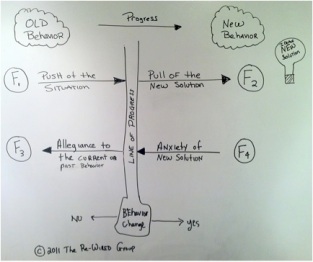
Push (F1): The situation which is driving a person to seek a solution. What is it we’re dealing with? What’s the impetus?

Pull (F2): The promise of a new solution that can satisfy the need. As customer’s consider a new solution, how well does it map to their needs?

Allegiance (F3): The familiarity of an existing solution is a risk mitigator, leverages already learned usage and known benefits.

Anxiety (F4): The unknown characteristics of the new solution, and the potential missteps that await. Would if the new solution isn’t all it’s advertised to be?

I like both forms of analysis, they are quite complementary. So I combined Ulwick, Bettencourt and Moesta’s work to use as an analytical tool.

Retail’s Jobs to Be Done

There are many jobs that retail must fulfill for customers. Below, I’ve picked four of them for analysis. Four that are ones you’d probably see as well. Each job has a defined outcome statement, and a listing of drivers which influence the retailer selected for the job. These aren’t actual customer insights I’ve surveyed, they’re from me. But they address the right type of analysis needed.

The analysis is done from the perspective of switching from a physical retailer to an online one. This is the disruption which is occurring. This perspective was chosen to illuminate possible innovations for physical retailers, or to point out the long term trend they will need to accept.
Retail Jobs - Desired Outcomes

Retail Job: Low Price

Getting the lowest price. Isn’t that what everyone wants? It’s been a human goal since we were bartering woolly mammoth skins for stone weapons.

Frankly, this job is one that will be challenging for physical retailers to fulfill. As has been noted, Amazon – and other online retailers – don’t have the overhead of physical stores. They can and do price lower. And you can see the differences, right there, on your screen.

The anxieties that consumers feel about online retailers providing this job – retailer performance, shipping delays – are there, but don’t rise to the level of overturning the pull of the online retailers. Too many online retailers have proven themselves over the years. They’ve overcome these anxieties.

Physical retailers competing to fulfill this job need scale to overcome their higher infrastructure costs: physical plant, distribution systems, inventory, in-store personnel. Kmart, for instance, is losing the scale war to Walmart, and the online retailers are generally able to outprice it.

Verdict: Long term, this job will be fulfilled by mega-stores and online retailers. But only in categories where it makes sense. Groceries, for instance, are tougher for online fulfillment of the Low Price job, due to the delivery costs of home delivery.

Retail Job: Immediacy

There’s times when you just have to have something today. Even now. Something needed for a home project. Last minute gift. Car maintenance. The list goes on and on. The Immediacy job occurs when the unforeseen happens, or the unplanned realize they need something.

So what’s the pull of online here? Well, you can see the item from your comfortable home. See, it’s right there on my screen! And even better, I can buy it right now! Hmm…not quite the same as actually having it in hand, is it?

Actually, the online retailers are working to provide the “holy grail” of e-commerce, same day delivery. There are different strategies here, although working with physical retailers is a core part of several initiatives. But the costs appear prohibitive: one start-up, Postmates, charges $10 to make short deliveries inside cities.

Verdict: The physical retailers have a distinct advantage here. That expensive distribution system that hurts them with the Low Price job? It’s a distinct advantage here. Physical retailers should play the immediacy game full tilt. Develop an app that tells customers whether something is available, and make it easy to pay for the item. Create a drive-through pick-up experience.

Retail Job: Selection

What did Henry Ford say? You can choose any color you want, as long it’s black. That may have been the case earlier in the industrial age, but not so anymore.

As a general observation, people desire with the ability to select from distinct offerings when making a purchase. For instance, when buying a shirt, isn’t good to see a variety of colors, patterns, cuts, etc.? You’re looking for something that fits your style. If you’ve got a home repair, don’t you want the right tool for the job? Purchasing for your kids, and it’s great to see smaller sizes of an item.

Online retailers can fulfill the Selection job nicely with their ability to provide a long tail inventory. If one retailer doesn’t have what you want, the next retailer is a click away, thanks to Google search and dedicated shopping engines. Online sites can also “own” a category with a larger selection by accessing buyers globally, not just in the local market.

Physical retailers have competed to fulfill this job by offering a wide selection of categories (mass merchandisers) or by going deep in a single category (electronics, books, pet supplies, etc.). One advantage the physical retailers have is the ability to hold and touch items, useful when considering a large number of options.

Verdict: Physical retailers will eventually cede most of the Selection job to online, due to online’s distinct advantages.

Retail Job: Help

With so many options available to us, a distinct #firstworldproblem, it can be daunting to navigate the product landscape. You’ve got a personal style, but could use some help in finding items to match it. There are multiple philosophies for raisi9ng baby, what items fit the one you’re following?

Shoppers want information to help them in their purchases. Beyond information, they want advice. Because a low price on something that misses the mark is just throwing money away. The Help job relates to what a products are being purchased for, not for how complex the product is.

Online commerce offers shoppers great amounts of information. With a click, detailed product information – the kind not available in-store – can be found. Ratings by other shoppers are aggregated, helping distinguish between good and bad products. Online retailers who can specialize in a more narrow category can offer expert advice.

But…and it’s a big but…it’s hard to replicate the give-n-take, the weighing of trade-offs with a live person in front of you. That’s the advantage physical retailers have. There are just times when you really want to talk to someone.

Verdict: This is the physical retailers’ job to lose. With local presence and real live people, they’re positioned to do well here.  The best opportunities lie in cases where the outcome of the product has a fairly high degree of emotional or monetary value for the customer.

Which Customer Job to Fulfill?

For physical retailers, the customer job to fulfill should be a natural extension of their strengths. A company’s assets lead naturally to addressing a particular job the customer wants fulfilled. You really can look at industry structure based on the jobs to be done. And see that some long term trends suggest where retail is heading.

Keep in mind that a larger set of real customers could well describe the jobs they’re seeking fulfilled. My four above are drawn from own experience. But it’s getting input from multiple customers where this methodology comes alive. I’m sure there are some additional jobs that aren’t being fulfilled very well right now, which are opportunities for the future.

I’m @bhc3 on Twitter.

Four Innovation Insights Customers Provide

Customers, properly, have been having a renaissance of sorts in terms of business thinking. Peter Drucker famously espoused a very customer-centric business philosophy. Nowadays, social CRM represents the return of a customer-first orientation. Last year, Altimeter published the 18 use cases of social CRM. Included in those use cases were several that relate to innovation.

Customers are a rich source of innovation insight, and the ultimate authority on what innovation is useful. So it’d be good to understand what types of insights they provide. OK, not just good. Vital. While the incorporation of customers in the innovation process is…honestly….still nascent, it will ultimately be the primary basis of innovation insight. It just will take some time.

It turns out, there is a structure to customer insight. Customers’ innovation insight takes several different forms:

Spectrum of Customer Insight 1
Based on research, the four types of insight are different, and vary in the ease of eliciting and what they address. Let’s take a look.

All Customers – Jobs to Be Done

“Jobs to Be Done”. What is that? It’s why someone purchases a product. A classic formulation of this is by Theodore Levitt: “People don’t want to buy a quarter-inch drill. They want a quarter-inch hole.” That starts to hit on the notion of the job. But it’s more than the direct outcome one is looking for from a product. As the diagram to the right shows, it also includes the consumption context and the emotional effect. Context paints the broader picture of the job to be done. Emotional effect broadens the discussion to include the experience of using the product.

Clayton Christensen provides a wonderful example of this, talking about the job that customers were hiring…a milkshake…for. Yes, a milkshake. There was a lot more behind that purchase than its direct usage as a cold, sweet drink. 40% of shakes were being bought in the early morning. The consumption context was people commuting in the morning, drinking a shake in lieu of breakfast. The shake’s emotional effect was stave off boredom and satisfy a general hunger at the start of the day.

Of all the innovation insights available, the jobs-to-be-done is the most plentiful. The challenge with this feedback is that it’s buried inside people’s heads, and it must be elicited from them. Practitioners such as ReWired Group and Strategyn get at the jobs to be done through deep dive interviews with customers.

Emergent Customers

Say you had a product concept, and you wanted to get a read on its applicability to people’s jobs-to-be-done. More broadly, you’d love to know what works, what doesn’t and what else is needed to make a splash in the general market. Will any old customers do? Turns out…no. What you’re looking for are emergent customers.

In research done by professors at UC-Riverside and Dartmouth Tuck School of Business (pdf link), customers exhibiting a specific set of characteristics were much better at identifying and improving concepts that are more attractive to the market. Called emergent customers, these people possess “the unique capability to imagine or envision how concepts might be further developed so that they will be successful in the mainstream marketplace.”

Sounds pretty valuable, no?

What are these traits that define a customer’s emergent nature?

The researchers created two separate field tests of example products – home delivery and oral care – to validate their hypotheses about emergent customers vs. other types. Their tests confirmed the ability of these customers to better refine a concept for mainstream acceptance than other types of customers.

Lead Users

Lead users are those customers who alter a company’s product to fit an emerging job they need fulfilled. MIT professor and economist Eric von Hippel popularized the existence of these users in his book Democratizing Innovation. Why are they so important? Because they experience new needs for products before the general market does. Find these users, and you gain an early read on what will be important more broadly in the months and years ahead.

Lead users not only experience these emerging market trends earlier, they are motivated to take action on them. The needs they experience and the product adaptations they make are quite valuable.

In one example cited by von Hippel, lead user surgeons were identified. These surgeons had modified equipment and materials to suit the needs they had, when the standard products sold wouldn’t suffice. Nearly half of these innovations were eventually marketed by the big manufacturing firms. In another example, 3M ran a test of concepts developed by its lead users vs. ideas derived from other methods. Thew lead users’ ideas were “significantly more novel than those generated by non-lead user methods. They were also found to address more original or newer customer needs, to have significantly higher market share, to have greater potential to develop into an entire product line, and to be more strategically important.”

Find these users, and learn where your market’s going.

Creative Customers

Creative customers are the uninvited dinner guests in the path toward mainstream innovation. While the jobs to be done, emergent customers and lead users provide incredibly valuable insight to make stronger, more successful innovations, creative customers…um…don’t really? The phenomenon of creative customers was researched by academics Pierre R. Berthon, Leyland F. Pitt, Ian McCarthy and Steven M. Kates in their paper, When customers get clever: Managerial approaches to dealing with creative consumers.

The researchers define creative customers simply as “customers who adapt, modify or transform a proprietary offering”. That actually sounds a lot like the customer type just described, lead users. But the researchers differentiate here by whether the innovations reflect emerging needs of the general market, and by whether creative customers are satisfying a core need or not. I’d add that creative customers are those whose innovations are pretty far afield from the mainstream path of expected product usage. And it’s not clear how companies should handle them:

Creative customers are different

Examples of creative customer innovations include the guy who used FedEx boxes to create furniture. Admittedly, not what those boxes were made for. Or the car fueled by Mentos candy and Diet Coke. They’re creative, but certainly not of the lead user class of innovations. Yet, each in their own way, point to impressions people have about the products (the incredible stiffness of FedEx boxes makes them a furniture material, the fizz of Diet Coke and Mentos is a fuel source).

Companies gain diverse thinking about their products, but such innovations do pose challenges around intellectual property, branding and liability. The researchers categorize the possible firm responses to such innovations in a 2×2 grid (shown above), based on attitudes and actions toward creative customers. But here’s the thing: creative customers aren’t going away, and their legions will increase over time. They make interesting dinner companions at the innovation banquet.

The four innovation insights described here form a broad and powerful set on inputs from customers. While the broad involvement of customers in innovation is still limited and nascent, these different types of insight provide a path for future activity by firms.

I’m @bhc3 on Twitter, and I’m a Senior Consultant with HYPE Innovation.