Why FriendFeed is Disruptive: There’s Only 24 Hours in a Day

Forget fractured conversations. How about fractured attention?

MG Siegler has a post up at ParisLemon titled FriendFeed Should Kill Those Who Accuse It of Murder. In the post, he writes that the current meme about FriendFeed killing Twitter and Google Reader is overblown and that all the services will exist in relative harmony for the foreseeable future.

To which I ask: did someone just extend the day to 25 hours?

Because there really is a zero sum game aspect to social media. We only have 24 hours in a day, and we have to decide where to spend those hours.

That daily time limit is what makes FriendFeed so disruptive.

Allocation of the 24 Hour Day

The chart below is a hypothetical day of a relatively advanced social media user (no laughs about Facebook please):

The chart shows our social media user at three different points. I’ve taken the liberty of assuming that certain core life stuff is maintained consistently: sleep, eat, work, family. All else is flex time.

So with the core life stuff constant at 19.5 hours, and more time spent on FriendFeed, something’s got to give? But what?

Not websites and blogs. In fact, their page views go up because of FriendFeed. Their content is the currency of FriendFeed conversations.

I think the two services that get hit the hardest as FriendFeed grows will be:

  • Twitter
  • Crowdsourced aggregators: Digg, Stumbleupon, LinkRiver, Reddit

Twitter

I left this comment on Corvida’s post The #1 Reason FriendFeed Will Not “Dethrone” Twitter at SheGeeks.net:

My two cents. FriendFeed direct posts feel like Twitters, only you can see the whole conversation, not just part of it. FriendFeed lacks the @reply and DM, so if those are important use cases, yeah it’s not replacing Twitter. But for putting something out there and having your subscribers weigh in…well, it feels like Twitter.

I’m not the only one. Two heavyweights in the blogging world have expressed their feelings about using FriendFeed in lieu of Twitter:

  • Steve Rubel :”Who’s spending less time on Twitter and more time here? I am.”
  • Duncan Riley: “@geechee_girl true, and if I can switch to FF with everyone on Twitter, I’d start considering swapping most if not all of the time”

The key to Twitter’s success is not it’s haiku format, it’s the community, as Duncan Riley mentions. Twitter is growing fantastically, as more people adopt it (and unfortunately stress its current platform). That community is what makes it vibrant special. FriendFeed appears to be rapidly growing its own community. I’ll be curious what the Compete.com May numbers look like for FriendFeed.

Note in the allocation of the day, I don’t eliminate Twitter. People have built up their networks there, and tweeting has become a habit. Also, the @reply function is quite popular, as is the DM. One might ask if those functions aren’t essentially covered by instant messaging and email, but Twitter fans love ’em.

But I see the direct post + comments as taking interaction away from Twitter.

Crowdsourced Aggregators

The basic function of these applications is to surface the content receiving the most votes. Digg, StumbleUpon, Reddit and LinkRiver are great for discovering content that others have found valuable. Digg includes robust, active commenting.

Well, doesn’t that sound like FriendFeed? The system of ‘Likes’ and comments ensures that community-ranked content appears at the top of your FriendFeed page.

Again, FriendFeed doesn’t kill these services. StumbleUpon, for example, has a persistence to it that FriendFeed lacks. Content gets its moment in the sun on FriendFeed, then gets buried in pages further back. I’ve noticed the StumbleUpon activity around content can last for days, weeks.

But over time, as users discover ranked content on FriendFeed, I’d expect them to cut back their time on the other crowdsourced aggregators. Not stop using these other services, but check in on them less frequently.

Final Thoughts

Perhaps as MG Siegler said, there really is room for all of these social media apps. Folks will just expand the amount of time they devote to them. But I question that assumption. Your employer still pays you for your hours. Your kids still want your time. The human body needs its sleep. And you still need to eat.

FriendFeed is disruptive because it challenges a number of other applications. If you find something that offers an outstanding experience and provides a good percentage of what you like in other social media apps, wouldn’t you spend more time there?

I mean, there’s only but so many hours in a day.

*****

See this item on FriendFeed: http://friendfeed.com/search?q=who%3Aeveryone++%22Why+FriendFeed+is+Disruptive%3A+There%E2%80%99s+Only+24+Hours+in+a+Day%22

Yes, FriendFeed Will Be Mainstream (by 2018) and Here’s Why

We recently went through a Twitter meme about whether it was mainstream yet. There is no debate as to whether FriendFeed is mainstream today – it’s not. The question really is, will FriendFeed ever see mainstream adoption? Robert Scoble played both sides of the coin (here, here).

FriendFeed will go mainstream. My definition of mainstream: 33% of Internet users are on it. It’s just going to take time, and it’ll look different from the way it does now.

Four points to cover in this mainstreaming question:

  1. What will FriendFeed replace?
  2. What is a reasonable timeline?
  3. What content will drive the activity on FriendFeed?
  4. What topics will drive engagement?

What Will FriendFeed Replace?

Harvard professor John Gourville has a great framework for analyzing whether a new technology will succeed. His “9x problem” says a new technology has to be nine times better than what it replaces. This is because of two reasons:

  • We overvalue what we already have by three times
  • We undervalue the benefits of a new technology by three times

What does this mean in everyday terms? There’s comfort in the status quo, and fear of the unknown.

There’s the argument that FriendFeed is a complement, not a replacement to existing services. There’s some truth there, but the bottom line is that we only have 24 hours in day. Where will end up spending our time?

Here’s what FriendFeed will replace:

  • Time spent on the individual social media that stream into FriendFeed (blogs, Flickr, etc.)
  • Visits to static, top-down media properties (e.g. CNN, ESPN, Drudge Report, etc.)
  • Visits to other user-driven aggregator sites (Digg, StumbleUpon, Yahoo! Buzz)
  • Usage of Google search (search human-filtered content on FriendFeed)

In terms of the “9x problem”, the nice thing is that people do not have to replace what they already do. Visit CNN? You can keep doing that. Like to see what’s on Digg? You can keep doing that.

Searching on FriendFeed will advance. You can do a search on a keyword or a semantically-derived tag, and specify the number of shares, likes or comments.

FriendFeed doesn’t require you to leave your favorite service. It’s the FriendFeed experience that will slowly steal more of your time. That mitigates the issue of people overvaluing what they already have. They won’t lose it, they’ll just spend less time on it. Thomas Hawk continues to be an active participant on Flickr, but more of his time is migrating to FriendFeed. As he says:

One of the best things about FriendFeed is that it gives you much of what you get from your favorite sites on the internet but in better ways.

I think FriendFeed will have the 9x problem beat, but it will take time.

What Is a Reasonable Timeline for FriendFeed to Go Mainstream?

The chart below, courtesy of Visualizing Economics, shows how long several popular technologies took to be adopted in the U.S.

Using my mainstream definition of 33% household penetration, here’s roughly when several technologies went mainstream:

  • Color TV = 11 years
  • Computer = 15 years
  • Internet = 8 years

In addition, here are some rough estimates of current levels of adoption for other technologies. Estimates are based on the number of U.S. Internet users, the recent Universal McCann survey of social media usage (warning, PDF opens with this link) and search engine rankings.

  • Google search = 68% of searches after 10 years
  • RSS = 19% of active Internet users after 4.5 years of RSS readers
  • Facebook = 9% of Internet users after 4.5 years (20mm U.S. members / 211mm U.S. Internet users)
  • Twitter = 0.6% of Internet users after 2.2 years (1.3mm members / 211mm U.S. Internet users)

Yes, the date of FriendFeed mainstream adoption is pure speculation. But looking at the adoption rates of several other technologies, ten years from now is within reason (i.e. 2018). The RSS adoption is a decent benchmark.

What Content Will Drive FriendFeed Activity?

Alexander van Elsas had a recent post where he listed the percentage for different content sources inside FriendFeed. The results were compiled by Benjamin Golub.

Not surprisingly, Twitter dominates the content sources. Original blog posts are a distant #2 content source, and Google Reader shares are #3. That speaks volumes into the world of early technology adopters.

When FriendFeed becomes mainstream, the sources of content will change pretty dramatically as shown in this table:

The biggest change is in the FriendFeed Direct Post. Relative to blogging or Twittering, putting someone else’s content into the FriendFeed stream is the easiest thing for people to do. FriendFeed Direct Posts are similar to Diggs or Stumbles. Since all the content we create, submit, like or comment is part of our personal TV broadcast on FriendFeed, Direct Posts can be just as much fun for users as newly created content by someone you know.

Direct Posts will draw from both traditional media sites as well as from other people’s blogs. Expect media sites and blogs to have a “Post to FriendFeed” link on every article.

Twitter drops as a percentage of content here. Why? FriendFeed’s commenting system replaces a lot of what people like about Twitter. Blogs drop a bit as well. More people will blog in 2018, but many of those will be sporadic bloggers. Still, 10% of the content consisting of original author submissions is pretty good.

Google Reader shares hold as a percentage as more people recognize the value of RSS versus regular-old bookmarks inside their browsers. ‘Other’ goes up, because who knows what cool other stuff will be introduced over the next ten years.

What Topics Will Drive Engagement?

Human nature won’t change. The same stuff that animates people today will continue to do so in the future. Politics, sex, technology and sports will be leaders in terms of what the content will be. There will be plenty of other topics as well. I can see the Iowa Chicks Knitting Club sharing and commenting on new patterns via FriendFeed.

One issue that will arise is that people will have multiple interests. They’ll essentially have various types of programming on their FriendFeed “TV channels”. For a good example of that today, see Dave Winer’s FriendFeed stream. Dave has two passions: technology and politics. I like the technology stuff, but I tend to ignore the political streams.

Well, this will become a bigger issue as FriendFeed expands. I personally like the noise of the people I follow, but my subscriptions seem to generally stick with recurring topics. But as more mainstream users come on board, the divergence of topics for any single person will likely increase.

FriendFeed will employ semantic web technologies to identify the topic of submitted items. These semantically-derived tags will be used to categorize content. Users can then subscribe only to content matching specific categories. How might this work?

A Dave Winer post with “Obama” in it is categorized as Politics. I could choose to hide all Dave Winer updates that are categorized in Politics.

Final Thoughts

The constant flow of new content, the rich comments and easy ‘Likes’, and the social aspect of FriendFeed will drive its mainstream adoption. It’s a terrific platform for self-expression and for engaging others who share your interests. It’s also got real potential to be a dominant platform for research. In the future, look for stories in magazines and newspapers asking, “Are we losing productivity because of FriendFeed?”

So what do you think? Will FriendFeed ever be mainstream? In ten years?

*****

See this item on FriendFeed : http://friendfeed.com/search?q=who%3Aeveryone+%22yes.+friendfeed+will+be+mainstream+%28by+2018%29%22

Could WordPress.com Create a Disqus Killer?

Disqus is an application that hosts comments for blogs, applying some nice features to improve and make more social the commenting process. Here’s what Fred Wilson said recently:

Since I converted from TypePad comments to Disqus last August, the number of comments I regularly get have gone up by a factor of at least five and maybe ten. It seems that each week I have a post that gets over 100 comments (not this past week though). That never used to happen. And the discussions in the comments have improved dramatically.

Fred Wilson, A VC, Three Reasons To Use Disqus

Automattic, the company that runs WordPress.com, has not enabled disqus to work on its blogs (including this one). Here’s what Robert Scoble reported about that:

I’ve been talking with Toni Schneider, CEO of Automattic (the folks who run my blog) and they are looking at a raft of things to do to make commenting better for WordPress.com users.

So, let the commenting wars begin!

Robert Scoble, Scobleizer.com, Seesmic & Disqus add up to video comments and more

Scoble’s update is intriguing. Commenting wars? Might WordPress.com have something in the works that could undermine Disqus?

What’s Cool about Disqus

Because I don’t have disqus implemented on this blog, I’m a bit handicapped in my assessment of disqus. But here are the things I like:

  • Easy to track where you’ve left a comment
  • You can follow others, and see their comments across various blogs
  • You can create an RSS feed for your disqus comments, and pipe that into FriendFeed. Vastly increases the social nature of blog comments.

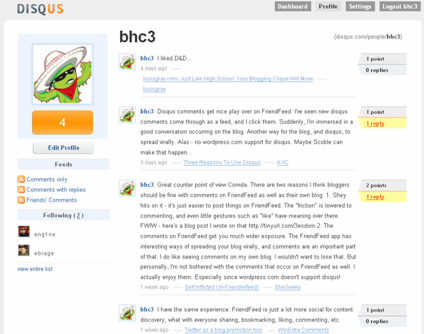
Here’s a screen shot of my comments on several blogs with the disqus commenting system:

Four comments, across four different blogs. Really nice to see that. You’ll also see a couple people that I’m following, on the left hand side of the disqus profile.

And here’s what a disqus comment looks like as it comes through FriendFeed:

As a commenter, you can extend your conversation outside the blog. Notice the ‘Likes’ and Franklin Pettit’s comment. And as a blogger, all the conversatin’ showing up in FriendFeed gets your blog post much more play.

Alas, disqus is not enabled on WordPress.com.

WordPress.com Snuffs Out Disqus?

Which brings us to Robert Scoble’s update. Sounds like the folks at Automattic aren’t sitting still. And that could be bad news for disqus. Why?

Volume, volume, volume.

On disqus’s site, they say that over 4,000 blogs are using their commenting service. Fred Wilson said it was over 10,000 blogs using disqus. Neither number compares to all the blogs hosted by WordPress.com.

If Automattic turned on similar commenting capabilities for its blogs, you’d have a sea of comments on that service. Take a look at the number of comments made on WordPress.com blogs each day:

Imagine if a lot of those folks streamed their comments into FriendFeed. The viral nature of FriendFeed would be an accelerator on that volume. A WordPress.com commenting system would dwarf disqus.

WordPress.com has the built-in advantage of already hosting millions of blogs and comments. Disqus is still in its infancy in acquiring new blogs.

If Automattic is serious about this, they should enable a new commenting system to work on non WordPress.com blogs as well. As a blog reader, once you have a profile set up, you’d like to use it everywhere.

Final Thoughts

Disqus has done an amazing job of customer service so far. That’s worth a lot of goodwill right there. I also love the upstart companies who show the world new ways of doing things.

And who knows? Automattic might be thinking of integrating disqus as one of the “raft of things to do to make commenting better for WordPress.com users”. I know I’ve requested the addition of disqus.

But if Automattic smells a good opportunity here and recognizes the value of its huge user base, then as Scoble says, “let the commenting wars begin!”

*****

See this item on FriendFeed: http://friendfeed.com/e/b0d09b39-26e0-2681-7b58-8fc234709b30

Do Companies Need Social Media Managers?

There are few institutions in the modern world that are not being transformed today by social media.

Shel Israel, Global Neighborhoods, 5 New Social Media Turn-ons for me.

Encouraging use and engagement with [social] tools is an area that all organizations find they have a need for at some point and time. Use of these tools and engagement by people in an organization often does not happen easily. Why? Normally, most of the people in the organization do not have a conceptual framework for what the tools do and the value the individuals will derive.

Thomas Vander Wal, vanderwal.net, Enterprise Social Tools: Components for Success

Social media is taps into a deep well of user knowledge and innovation that previously had been limited to people’s close offline contacts. FriendFeed, Twitter, Facebook, Flickr, del.icio.us and others have not so much invented new ways of thinking as they have created new ways to surface intellectual energy and creativity, and significantly expanded the conversations one has.

How does this translate into the workplace? Thomas Vander Wal’s quote above hits on one of the biggest hindrances. Just throwing tools at people and saying “have at it!” will be a colossal failure. For many people, social media requires a slow romance before they become wed to it. Want to see how much romancing is needed? Read this guy’s comment about Twitter on TechCrunch.

The thing about social media is that once people get it, they really get excited about it. Facebook has experienced terrific growth. Twitter is edging more closely to early mainstream. FriendFeed is rapidly growing. But all of these companies had a chance to incubate and grow an enthusiastic set of early adopters, which leads to broader usage.

There are two issues for companies to address in the adoption of social media:

  • Slow internal adoption can cause the initiative to die from lack of focus and budget.
  • The real benefit of social media comes when many people participate. Slow adoption means companies won’t see good benefit for a while.

How can companies accelerate adoption of social media inside by employees? An enthusiastic group of innovators is always a requirement. In addition to that, how about creating a new position? The social media manager.

The Social Media Manager?

I know such a suggestion will get eye-rolls by some. Fair enough. But hear me out.

I mentioned this idea of an employee emerging as a social media manager to someone the other day. His response was that it sounded like another version of the head of knowledge management inside a company. That was interesting take. The role of the Chief Knowledge Officer seems to include a role for social media adoption, at least as I read the definition of the role on wikipedia (here).

I’m not nearly literate enough in the field of knowledge management to know what works and doesn’t work. But I suspect there’s a big difference between a knowledge manager and a social media manager:

The social media manager is a personality-driven role

Getting people out of their shells to participate in social media will take more than a handbook and a set of best practices. The successful social media manager will be someone who can engage a wide variety of personality types. Who can handle a variety of viewpoints. Who has a thick skin, because…

The social media manager should have some skin in the game

By that, I mean the person should have some opinion about what’s best for the company. Not an absolute, draconian opinion. But a confident feeling for what makes sense for the company relative to its customers, markets, competitors and products and services. And that confidence extends to entertaining differing positions from her own. A social media manager should exemplify F. Scott Fitzgerald’s famous quote:

The test of a first-rate intelligence is the ability to hold two opposed ideas in the mind at the same time, and still retain the ability to function.

After reading this, I realize that it makes the social media manager seem like some sort of uber-participant, eclipsing all others. If that happens, then we have social media FAIL. Rather, a good social media manager will have the ability to stir up enough interest in subjects to get people participating amongst themselves.

Work of the Social Media Manager

There are three basic functions of the social media manager:

  1. Initiate discussions
  2. Participate in discussions
  3. Report on discussions

Initiation is particularly important in the early stages of the social media rollout. People need a jump start to participate, and someone willing to show how it’s done is important.

Participation keeps the social media manager relevant and build connections with others. In a large organization, no one will know everybody. So participation – the crux of social media – is a requirement.

Reporting is a way to show the benefit of participating. The social media manager can report out all sorts of things to foster interest and participation:

  • Good discussions
  • Tag buzz – hottest tags right now
  • Interesting activity streams (e.g. sales closed)
  • Rising wikis
  • Etc.

Reporting occurs via RSS and that reliable corporate communication method…email. Why report? Make sure people are aware of good stuff. And ensure good participants are recognized. This latter point is important, as it speaks to the motivation of employees. Employees are ambitious and want to succeed. Burnishing reputations via social media is a strong motivation.

It turns out this motivation dovetails with the goals of the company as well. Good social media usage benefits companies in a number of ways.

Final Thoughts

Ideally, the social media manager likely emerges organically from early users. Someone who’s a natural. If needed, someone can be appointed to the position. I’d also expect the position to change hands over time.

Note that there are those out there on the web who serve these de facto positions for a lot of us.

The thing about social media out on the world wide web is that it attracts a large number of people from all over the place, all around the world. It just takes a relatively small percentage of people to get social media going. Inside companies, more motivation is required to get things moving because there is a much more limited pool of users from which to draw adoption.

What do you think?

[UPDATE – this article mentions someone who has exactly this role: http://tinyurl.com/5zehew]

*****

See this item on FriendFeed: http://friendfeed.com/search?q=%22Do+Companies+Need+Social+Media+Managers%3F%22&public=1

Social Media Identity: Personal vs. Professional

I recently had to engage social media not using my personal identity, but under my professional identity. A bit clueless how to proceed, I sent this out on Twitter:

Facing an interesting decision about mixing my personal and professional online personas. I think I need to establish a “professional” ID.

Brian McCartney brought up a great point in response:

A “professional” ID is a good idea but there are things on my personal ID that I might want to share with the professional world…

Which got me wondering about social media identity. By that, I really mean these three things:

  • What subjects do you cover
  • What “voice” do you use
  • How does your social network perceive you

When it comes to developing professional identity in social media, a key consideration is the size of your company.

Company Size and Social Media Identities

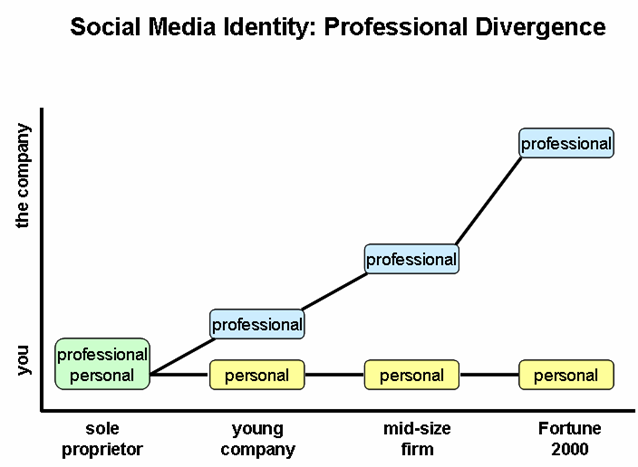
The graph below depicts where the professional and personal identities diverge.

The idea in the above chart is that the smaller the company, the more closely your personal and professional identities are tied. As the company size increases, the more separate your identities become.

Where can these identities come into play?

  • Blogging
  • Posting on blogs
  • Twittering
  • FriendFeed
  • Etc.

Entrepreneurs and Small Companies

For entrepreneurs, your social media interactions are your marketing. How you think. What you care about. What insights you can deliver. And employees of small companies are the company. So their identities are very closely tied to the company.

Sam Lawrence, CMO of Jive Software, is a good example of someone blurring professional and personal identities. Here are his social media identities:

  • Twitter: Sam mixes a heavy dose of Jive-related tweets with interesting tweets on other subjects. He ain’t afraid to keep it real out on Twitter.
  • Go Big Always: This is his personal blog, covering the social and enterprise software market. Jive gets plenty of attention, but it’s not the focus of every post.
  • JiveTalks: The official company blog. Sam can be found here, and the posts are product-related.

Here’s what Sam said about his multiple social media identities:

Up until now, I’ve been blogging on JiveTalks. But a corporate blog is just that – a corporate blog. I wanted to have a place where I could more freely voice wider observations and thoughts beyond Social Productivity and Jive’s business.

That being said, you get Sam, you get Jive Software.

Big Corporates

Employees working for larger companies will tend to have separate professional and personal social media identities. It’s tempting to say there’s the the “authentic” you and the “corporate” you. I think that oversimplifies things. The work you do is part of your authentic identity – if it wasn’t, presumably you’d quit the job.

But there are important differences when it comes to your professional identity. Here are a few that apply when using social media on behalf of a large corporate:

  • You write about things that are part of your identity only while you work for the company
  • You have to err on the side of “corporatism”, with language consistent with that of your company
  • Your company’s stuff is great, all competition sucks (of course, this applies for entrepreneurs as well!)
  • You’re likely in “sell” mode

The separation between personal identity and professional identity is the greatest for employees of large corporates. Whereas Sam Lawrence’s social media identity is very much a personal and professional combination, I decided to create a second identity for engaging social media professionally. My handle became Hutch@[company name]. You see that, you know I’m doing things on behalf of my company.

Final Thoughts

There’s a notion that someday all of our social media identities will be blurred. “Your personal identity is your professional identity in Web 2.0.” If we’re talking “professional” in terms of your career and talents you can bring to a company, then yes, that statement is true regardless of where you work.

However, if “professional” is the identity you assume on behalf of your company, then that statement really only applies to employees of small companies. For employees of big corporates, managing your social media identities is more complex than that.

I’m @bhc3 on Twitter.

Web 2.0 Inside the Enterprise? Forrester, AIIM Weigh In

Forrester produced a well-covered report this week announcing that Enterprise 2.0 will be a $4.6 billion business by 2013. In my RSS feed of FriendFeed updates containing the term Enterprise 2.0, there were probably a couple hundred related to this report – Google Reader shares, bookmarks, Twitters, etc. Sarah Perez of ReadWriteWeb has a great post about the Forrester report, with dollar figures.

About a month ago, AIIM came out with its own report on the market for enterprise 2.0. It was a work produced in conjunction with the likes of Stowe Boyd and Andrew McAfee.

After reading both of these reports, it’s clear there is a common perspective out there, but some differences worth noting as well. It’s instructive to look at both.

Forrester: Projections Focus

Forrester is paid for its expertise and forecasting. Their reports are well-regarded in this regard. Based on surveys of over 2,200 companies, this report is a forecast of the dominant technologies of Enterprise 2.0. Grounded in the market, fueled by its analysts’ views.

Forrester’s report strongly cleaves the Enterprise world into internal facing and external facing uses.

AIIM: State of the Market Focus

AIIM’s goal seems to be more of an Enterprise 2.0 temperature check of companies today. Surveying 441 company representative, AIIM didn’t try to forecast the future so much as see where companies’ heads are today.

AIIM’s report addresses both internal and external uses, but generally blurs the discussion between the two.

No Unanimous View of Top Technologies

Forrester’s report considers seven different technologies for the Enterprise 2.0 space. AIIM’s report goes much deeper. AIIM’s respondents came up with a much larger set when asked the question, what technologies make up your definition of Enterprise 2.0? To compare the two analysts, I selected the top seven participant responses from the AIIM report. Here’s how Forrester and AIIM show the leading technologies of Enterprise 2.0:

Five technologies showed up consistently between the analyst reports:

  • Social networking
  • Wikis
  • RSS
  • Blogs
  • Mashups

It’s interesting to note the differences between the two reports. Forrester included podcasting as a leading area of spend for Enterprise 2.0. AIIM’s report includes podcasting as well, but survey participants didn’t include it very often in their current definitions of an Enterprise 2.0 platform.

Forrester’s report did not include social bookmarking and tagging, but AIIM did. The Forrester omission probably says something about their view of the dollars to be spent on it.

Forrester included widgets, which is a nod to their strong focus on external uses of Enterprise 2.0. AIIM’s respondents like collaborative filtering, which is the basis for recommendation engines.

A Few Thoughts

Social networking comes in strong on both analyst reports. Forrester has spending here running away from all others by 2013. Call this the Facebook effect (MySpace didn’t seem to inspire the same trend to the enterprise). Generally, Facebook controls its “borders” and has a handle on everything that’s going on. Relationships, groups and activities all occur within the walled garden. Enterprises share a lot of these characteristics. Social networks will become the next generation intranet.

Also, note the disparity here. Companies are just coming to terms with the idea of social networks for employees, while the blogosphere seems to have left the mainstream social networks behind. Call that difference between the easy freedom of thinking and conversations, and the hard decisions of where to spend money and sweating your stock price.

Wikis come in surprisingly low on the Forrester side of things. I say that because some of the best known uses of Web 2.0 technologies inside companies are wikis. In fact, wikis are the #1 thing that respondents consider to be Enterprise 2.0 in the AIIM survey. Perhaps they have a lower cost, so that the same number of implementations will result in lower dollars spent.

RSS comes in strong for both reports. That is great to see! RSS holds so much potential. Just look at the growth of FriendFeed to see how RSS can create really new and interesting applications. RSS inside the enterprise will increase information awareness, and can be a basis for research and discovery the way FriendFeed is on the consumer web.

Blogs are ranked highly in both reports. Very nice to see. There’s still a mountain to climb before employees get comfortable with them. For companies that do have adoption of employee blogs, I expect there will be a boost in innovation.

Company blogs are interesting animals. The worst way to roll those out is treat blogs as glorified press release vehicles. That would be a waste of time. But what do you put on a blog that would be interesting? A couple of companies serve as examples. Google’s blog has a very conversational style of its products, general technology issues and other geeky stuff. Cafepress’s blog talks a lot about their products, which could be boring as hell. But Cafepress manages to relate products to larger issues, which makes it a bit more interesting.

Mashups are in the lower end of the top 7 currently, although Forrester projects spend on mashup technology to be the second highest after social networks. Here’s where I think Enterprise 2.0 will lead Web 2.0: mashup adoption. There are so many existing “big iron” software systems inside companies, that rip-and-replace is an expensive undertaking when you want to add new functionality. Mashups extend the life of these systems. In the consumer web, we’re experimenting with mashups a la Yahoo Pipes and Microsoft Popfly. I’m not sure the average consumer is going to bother with those. However, the average IT professional very much wants to look at mashups.

Those are some general thoughts. What do you think about Enterprise 2.0?

*****

See this item on FriendFeed: http://friendfeed.com/search?q=%22Web+2.0+Inside+the+Enterprise%3F+Forrester%2C+AIIM+Weigh+In%22&public=1

Innovation Requires Conversations, Gestation, Pruning

The day-in, day-out work of employees is tough on innovation. You have to get done what your managers, and the company needs today. Now there’s nothing intrinsically wrong with getting the near0term stuff done. Companies would be chaos if everyone did their own thing. But the typical work day is not conducive to maximizing innovations.

Which is where employee blogs come in. Enterprise 2.0, if you will.

Current Workplace Environment

Several things limit the amount of innovation coming out of larger companies.

General Busyness. Andrew McAfee has a nice post on this one. We’re all very busy. It feels that way, doesn’t it? And it’s not just any busyness. Your hours must have an immediate, measurable outcome. That leaves little time for the longer term, R&D-oriented type of thinking that can result in breakthrough ideas. Google’s 20% of time for personal interests stands out as an example of a company fighting this dynamic.

Existing Processes Are Hard to Change. The current products, internal practices, meetings, sales efforts, etc. are all geared to what is going on today. Much of this infrastructure is decreed from the top. New ideas which require these same corporate resources get a tough reception. It’s like you’re adding new work to everyone’s day.

Proximity Drives Relationships. We tend to share our thoughts with those we work with regularly. It’s natural. These form our relationships. So if you have a new idea, you’ll naturally bounce off these folks. But it’s crap shoot as whether you’ll get far this way. Your colleagues may not be interested or are too busy. A good idea can suffer a premature death.

Ideas Go to the Email Inbox to Die. Email is a tough medium for idea exchange. You can send your idea to someone else. If the recipient doesn’t have an immediate response, the email just sits there. And sits there. And sits there. Before long, your email is six feet under. Never to be read again. Email also suffers from limited distribution, unless you spam the corporation with your idea.

Now it’s not like innovation is failing to occur. But do companies’ internal pendulums swing so far toward busyness that they’re not maximizing their vital innovations?

Conversations, Gestation, Pruning

You ever have an idea that you really thought had legs? Well, if you just keep it to yourself, it won’t go far. Your butterfly wing flap needs to be picked up by others. The process of talking out your idea is important for validating it, refining it, seeing if it has potential.

These conversations are hard to have based on the usual workplace dynamics described above. Sure, some will happen. In a company of 10,000 people working 40 hours a week, 50 weeks a year, there are 20 million hours annually. Out of these 20 million hours, some innovation conversations will happen. But enough?

New ideas also challenge the status quo. They need time to sink in. Colleagues know the existing processes, products and services well. How does your idea affect that? How will it improve it? It’s hard to rush people to grok your idea.

This gestation also lets the idea play out more fully. It can be refined, altered, researched. Others pick up the idea and discuss it. It gets socialized. Others can become advocates, including those with a say on corporate resources.

As a result of these conversations and gestation time, some ideas will emerge as real opportunities. Many won’t. In fact, most probably won’t. But that’s OK. Real innovation is hard to achieve; if it wasn’t, we’d all be enjoying our start-up IPOs, right? This pruning is healthy and necessary.

Blogging Is a Natural Channel for Employee Innovation

In my brief blogging experience, my eyes have opened to the power of blogging. You put an idea out there, and see what others think. You make connections. You read other blogs for different perspectives.

A lot of this makes sense for addressing the hurdles to employee innovation:

  • General busyness: Blog posts need not take a lot of time. Ideas can be entered in 10 minutes.
  • Existing processes are hard to change: A blogged idea does not put someone in the awkward position of considering how it will increase their workload and change their routine.
  • Proximity drives relationships: Blogs are location neutral. Anyone can find them. Forget the guy in the cubicle next to you. The employee in Asia might grok your idea.
  • Ideas go to the email inbox to die: Blog posts live on. They’re RSS-able. They’re shareable. They’re searchable. They’re taggable. And they can be accessed by everyone.

Blogs let the conversation continue in an asynchronous fashion. You can comment on a post. Share it with a colleague. Link to it. You can build on someone else’s post. Recruit others to your cause.

All of these factors contribute to the gestation period needed for the new idea to take hold. And they help prune ideas so the ones with the most potential survive.

And a Couple Nice Benefits Also Happen

An interesting thing occurs from this: new employee social networks emerge as connections among bloggers. There are the people you work close to. Those whom you collaborate on projects. And now new connections are made based on knowledge and innovation. Those last ones may be the strongest of all.

Employees can also raise their profile and reputation with their blogging. Here’s a nice example. EMC is deploying web 2.0 technologies inside the enterprise, an effort that is being blogged by Chuck Hollis, EMC VP Technology Alliances. In a recent post, he describes how several internal employee bloggers are “graduating” to be external bloggers. That’s right – they now will engage the market on behalf of EMC.

All in all, blogging holds tremendous benefit for companies. While many employees won’t do it, those that do can become real drivers of innovation.

*****

See this item on FriendFeed: http://friendfeed.com/e/5303300f-3e4c-e5d9-b1ed-96c6d94988cf

Twitter Just Grows and Grows…

Dion Hinchcliffe is an enterprise 2.0 guru, with a blog on ZDNet.com. I guess he runs ads for conferences he puts on, among other things. He’s currently running a Google AdWords campaign. He used all manner of Web 2.0 key words for his ad campaign. So it’s an interesting survey of interest in the different apps of Web 2.0.

He tweeted this today:

Interesting tidbit. I’m running a Google ad campaign with every single 2.0 phrase imaginable. The #2 searched for keyword? “Twitter”

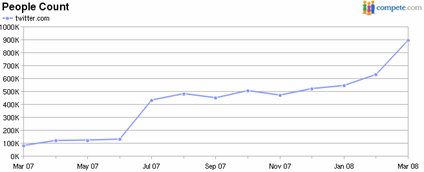
Which made me check out the visitor stats for Twitter on compete.com:

Look at that sharp rise in March 2008. The Twitter train just keeps on rollin’.

*****

See this item on FriendFeed: http://friendfeed.com/e/a2054173-1d1f-cebf-1a95-a578f2479ce8

Facebook Fatigue? NO. March 08 Visitors Back Up

Last week, I posted a stat on Facebook’s February 2008 visitors, which were down from January. The post asked whether it was a trend, or seasonality.

Facebook’s March 2008 numbers are in, from compete.com. And they’re up. So it was seasonality. The chart below shows a rebound from February.

The same kind of rebound between February and March was seen in 2007. So clearly there’s seasonality to their business.

The fatigue felt by prominent bloggers Robert Scoble and Guy Kawasaki is real. But clearly a lot of folks are enjoying Facebook. Perhaps this is the transition of Facebook from early adopters to mainstream.

Facebook Fatigue Watch: U.S. Feb 08 Down, But Is It a Trend?

Facebook’s number of visitors fell again in February 2008, according to compete.com. This follows a decline in January.

facebook-visitor-stats-feb-08.png

TechCrunch’s February 22 post, “Facebook Fatigue? Visitors Level Off In the U.S.” noted the January 2008 drop in visitors. It spawned a lot of discussion along two broad lines:

From where I sit, Facebook is taking a lot of positive steps to improve the user experience. More controls are being put on Facebook apps. Users can easily clean up their apps. There will be other moves.

I still think there is going to be natural attrition as well. The whole media-fueled rush to join Facebook was a boon to the company in the latter half of the year. But a lot of people who joined were there to experiment with it and see what all the hub bub was about. It’s not surprising that many of these folks are disengaging. It’s a natural market phenomenon.

As for the seasonality, it is entirely possible. The graphic below is from comScore, courtesy of the TechCrunch post. Notice how Jan 07 and Feb 07 both were lower, just like this year. One big difference – Facebook’s growth was so gangbusters in 2007 that you expected it to go on for quite a while. The drop so far in 2008 feels like the momentum stopped.

What do you think?  Trend or seasonal effect?

What Makes the Different Social Networks Tick?

There are two “full-service” social networks that I predominantly use: Facebook and LinkedIn. I belong to a Ning group as well, but don’t often check in there. I avoid MySpace the way I’d avoid a hipster rave…it’s just not me.

Over time, I’ve either read things about social networks or made my own assumptions about them:

Aside from this horse race aspect, there’s also the issue of what you want to get from a social network. This is an important consideration. Josh Catone at ReadWriteWeb has a post that asks, Should Employers Use Social Network Profiles in the Hiring Process? It’s a really good question. And I think one that is probably best answered this way: assume they will.

With these perspectives as background, I wanted to map several social networks to understand them a little more. Not so much the technical ins-and-outs (APIs, open social, openID, etc.). More in the sense of why people use the different networks.

I picked four: Facebook, MySpace, LinkedIn and Ning. They are all quite distinct in their approach and personality. The chart below is my map of the social networks’ strengths. Across the top, I’ve put six different types of social connections. The boxes below each column represent the relative strength of each network for that social interaction.

Social Networks Chart png

Here’s my breakdown of the four social networks.

Facebook

More than any other social network, Facebook wants to be The Social Utility. Like electricity or water, you just plug into Facebook, and it’s the place you go for all of your social interactions.

Facebook’s Ivy League-inspired ethos is a good one for being a wider destination of all your social interactions. Clean interfaces, heavy alumni basis and a relatively safe feel to it are key to its wide appeal. It works well for keeping up with friends, social acquaintances and friends from the past.

I think there’s a fundamental decision you have to make with Facebook. Do you intend to use it to keep up with people to whom you really have a connection? Or do you see it as essentially a communication venue?

I use it only for people with whom I have a relationship in the offline world. This is important for me. I use the Notes functionality to blog about my kids. Lord knows I don’t want everyone out on the Web to read those. So I keep my Facebook network quite limited. Others, like Robert Scoble and his 5,000 Facebook “friends”, seem less interested in the interaction and more interested in the one-way communication.

What makes Facebook great for friends is what makes it not good for business in my mind. There’s the personal and goofy stuff you do on Facebook. Blog about your kids, talk politics, post party pix, family pix, throw sheep, etc. I don’t think that stuff is what you want your business contacts to see.

Facebook has designs on moving into the business networking space. The recently introduced ability to create your own groups and use those groups for distributing updates helps this cause. But it seems like a lot of work to keep all these connections categorized and used correctly.

Facebook’s best social interaction: core lifestream stuff with people you’ve known for years.

MySpace

I remember the glowing, pre-Facebook stories about MySpace. Founded by musicians, it had hipster cred. Kids loved it. And the profiles can be customized a lot in terms of look and layout. True personalization.

What did all that give us? Tila Tequila.

OK, that was a cheap shot. But MySpace has become an impenetrable thicket of overdone profiles with…uh…interesting pix and teen age language. I surfed around over there, and I’m a stranger in a strange land.

Which begs a question. In the chart above, Facebook and MySpace share strengths in several social interactions. So don’t they compete? I’ll have to say not really. The demographics of the two networks are quite different.

If Facebook is Harvard, MySpace is the crowded hookup bar.

I haven’t heard MySpace tabbed as a competitor in the business networking space. Yeah, it’s a pretty safe bet that’s not gonna happen.

But I do want note the large number of specialized groups on MySpace. That’s a really nice aspect of the social network. Meet like-minded folks to discuss topics of interest.

MySpace’s best social interaction: sharing good times and opinions with friends, fellow travelers and hookups.

LinkedIn

LinkedIn is a dry, utilitarian social network. It feels slow, and you don’t get many interesting updates from your network. It’s full of business types. It includes business news on the home page. It’s kinda boring…

And it’s incredibly valuable.

As you get older and develop of a bunch of professional contacts, LinkedIn’s value becomes more apparent. I love to see when my former colleagues at Pay By Touch land new jobs. You can find people you’d like to meet, and work your connections via the “six degrees of separation” functionality of LinkedIn. I don’t have to worry about maintain emails for all my old contacts – I just fire messages through the platform. Employers use the network to find prospective employees. Job candidates can do research on the current and former employees of a company to which they’re applying.

I don’t look to LinkedIn to stay up-to-date on the lifestream events of my friends. I have no idea what my old friends from the past are up to via LinkedIn. The groups based on shared interests are only beginning on LinkedIn. I question how active they’ll really be. In professional interactions, people probably will have their “professional guard” up at all times.

LinkedIn’s best social interaction: reaching out to your network to prospect for a new job or employee.

Ning

Ning is a platform chock full of individual networks. Lots of them. Ning lets people create their own private networks, with much more control than what the other big networks offer.

This makes Ning an ideal place to set up social networks that revolve around a specific area of interest. On the Ning home page right now, featured networks include:

Ning works best for topics with members who are passionate about them. Hobbies, pastimes, specialized professions, politics. This is because these networks have a limited scope. Whereas Facebook and MySpace offer updates on a variety of activities for members, a Ning network is wholly dependent on its narrow scope of interest. Better have a lot of energy around that topic!

Arguably, a Facebook or MySpace group page can serve the function of Ning reasonably well. And specialized industry/hobby sites with good community boards are competition for Ning.

Ning’s best social interaction: discussion with people we’ve met online who ‘get’ our passion.

I’m @bhc3 on Twitter.


Will Enterprise 2.0 Increase Web 2.0 Adoption?

On ReadWriteWeb, Josh Catone asks Is Facebook for Business Really Coming? The post is a good breakdown on how Facebook is growing in terms being useful for business. It touches on areas such as employees networking on Facebook, concerns about security around private content and groups, and inroad against LinkedIn.

The post is a good reference point for thinking about the effects of Web 2.0 in the enterprise. I’ve been out at the Gartner portals conference the past few days. Plenty of good analyst presentations and vendor updates. Expect to see more tagging, implicit activity integration, blogs, wikis, mashups, social networks, etc. Coming to a company near you!

As I listened to the presentations and talked with companies at our vendor booth, I came away with a strong impression that companies are looking at implementing Web 2.0 inside the enterprise. Yes, there are business cases to be built, but more companies are bringing Web 2.0 inside the firewall.

Assuming increased Web 2.0 usage inside companies, what are the outcomes? Of course, there are business improvements that will occur.

But, I think there’s another outcome from this increase. Web 2.0 tools will become more mainstream as employees are introduced to them in the enterprise.

Now, I want to make two points with regard to that statement. One is that “mainstream” is a relative term. In the U.S., there are 211 million Internet users. So one definition of mainstream could be say…50 million users. In the one quarter range. The other point is that plenty of great web sites can/will go mainstream without enterprise adoption. Nice thing about this Web, eh?

OK…with that out of the way…

This idea that companies lead the way for consumer adoption of technologies is not without precedent. Apple had the better PCs in the 1980s and 90s, but Microsoft’s operating system became the standard for the consumer market (Compaq, Dell, IBM). Why? Microsoft became the corporate standard, and employees bought the same technology when they got computers for the home.

As companies adopt Web 2.0 technologies, employee adoption is key to maximizing their benefit. As employees adopt the Web 2.0 technologies at the office, they become more familiar with them at home.

Let’s look at tagging. Del.icio.us has 3 million users. An impressive number, but only fraction of the 211 million Internet users. Many enterprise software companies are offering companies social tagging and bookmarking solutions. What happens once tagging becomes a regular part of the application stack inside the enterprise? People become comfortable with it. They ‘get’ why tagging has value (easy personal classification system, basis for discovering new content). They tag content inside their own companies. They click on tag clouds. They then come home, and want the same tagging experience.

How about RSS? RSS is a terrific way to easily stay up to date on new website content. But how many of those 211 million Internet users actually have an RSS reader of some type? Google Reader, FeedBurner, Firefox subscriptions, etc. Not that many yet. But RSS is going to be more pervasive in companies. Heck, you can even add it to Microsoft Outlook. What happens when people get used to staying updated via RSS feeds at work? They ‘get’ it. And when they get home, they’re stuck with email and their bookmarked websites. Until they realize they can enjoy the benefits of RSS on their computers.

You’re also going to see social networking introduced in the enterprise. Big as Facebook and MySpace are, the majority of Internet users do not have accounts on these services. Once employees are automatically enrolled into their companies’ social networks, they’ll start playing with them and begin to ‘get’ the value if being connected in this way. Maybe they had held off on social networks before (that’s for the kids). But after their work experience, what happens when they get home and want to keep up in a similar fashion with family and friends?

Companies need to be on top of the technology trends to stay competitive. This happens regardless of whether employees are itching for the change (how many employees were demanding groupware?). As companies roll out Enterprise 2.0, how long will it be before employee adoption makes Web 2.0 applications mainstream?