Microsoft Is Getting Much More from Its Investment in Facebook

When Microsoft invested $240 million in Facebook at a $15 billion valuation, the general reaction was one of disbelief. The valuation is too high to justify. But some people at the time felt like the dollar amount was well within the comfort zone of a giant like Microsoft. Here’s how commenter Prashant put it on TechCrunch:

I don’t think that MSFT expects to make money on the $250MM at a $15B valuation. Internally for them it is a $250MM investment to get an exclusive advertisement deal over the next 4 years. The 2% stake is only icing on the cake. Had they announced that they have given $250MM to Facebook for a 4 year exclusive ad deal, no one would have flinched, this is cheaper than the Google/MySpace deal.

Over the past few days, I’ve read a couple other blog posts that make me think Microsoft may be getting much more from its investment. Here’s a quick list of what what Microsoft seems to be getting:

  1. Exclusivity on a huge number of page views, and experience with social context advertising
  2. Insight into an emerging competitor to its operating system and productivity apps hegemony
  3. Model for bringing social networking into the enterprise

Let’s look at #2 and #3.

Operating System and Productivity Apps

Dan Kimerling wrote a great piece on TechCrunch about how Generation Y looks to the new wave of social media apps for functionality previously provided by Microsoft’s desktop and web offerings. As Dan notes:

Facebook succeeds because it is the killer web application for communications and personal information management

These are in-the-flow tools. Facebook users don’t leave Facebook, open email and send a separate message. They do it all, right there. The level of functionality is just right for their usage.

The original Microsoft email and productivity apps were pretty simple, but they did just what people needed, and with skillful marketing tie-ups, Microsoft became the standard for millions of us. Over time, Microsoft has added new features to each release, because that’s how they grew their revenues. You had to get the latest. But what happened was we got to feature bloat.

Via Kathy Sierra, Creating Passionate Users Blog, 2005

Via Kathy Sierra, Creating Passionate Users Blog, 2005

I think Kathy Sierra’s graphic is spot-on for general mainstream users. Personally, I probably use only 5% of the functionality available with the applications.

I’ve talked previously about the Innovator’s Dilemma here. As market incumbents grow, they tend to move up-market in terms of functionality in their offerings. What this does is open the door for competitors with new functions that are simpler to use. These new competitors target a niche, and grow slowly upward from there.

Facebook’s niche is still heavily Gen Y. But they’re gaining a foothold. Microsoft’s investment gives them a ringside seat for what’s happening there.

Social Networking Inside the Enterprise

I was reading a blog post by Doug Cornelius where he reported out notes from a session at the Real World SharePoint Experiences conference. A Microsoft Solution Specialist was describing the roadmap for SharePoint. If you don’t know, SharePoint is Microsoft’s enterprise collaboration software, where teams can build out individual sites to shhare and work on documents and to communicate. Each employee has a MySite, which includes their corporate directory information as well as the the list of groups and documents that are theirs.

Here’s a quote from Doug’s post:

Social networking. Mysite will be the hub of the social network. There will likely be Knowledge Network integration. They are looking to take some lessons from their investment in Facebook.

The Enterprise 2.0 space is hot, and social networking is a big focus for companies and vendors. Through its investment in Facebook, Microsoft can learn a lot of what drives interactions, how people connect and watch the mistakes the young company makes. As Dave Ferguson put it:

Good judgment comes from experience. Experience comes from bad judgment. The corollary is that the bad judgment doesn’t have to be yours.

Microsoft continues to evolve its SharePoint offering, and I look forward to SuperPoking my colleagues one day.

Wrapping Up

At first, the only purpose for the Facebook investment appeared to be advertising related. I’m sure that’s still primary, because of the huge dollars involved.

But Microsoft is also gaining an information advantage for the new wave of social computing that is finding its way into both consumer and business experiences. Given the vast reach of the company’s product lines, that’s pretty valuable as well.

*****

See this post on FriendFeed: http://friendfeed.com/search?q=%22Microsoft+Is+Getting+Much+More+from+Its+Investment+in+Facebook%22&who=everyone
Yammer Gets Bronx Cheers from the Blogosphere. Why?

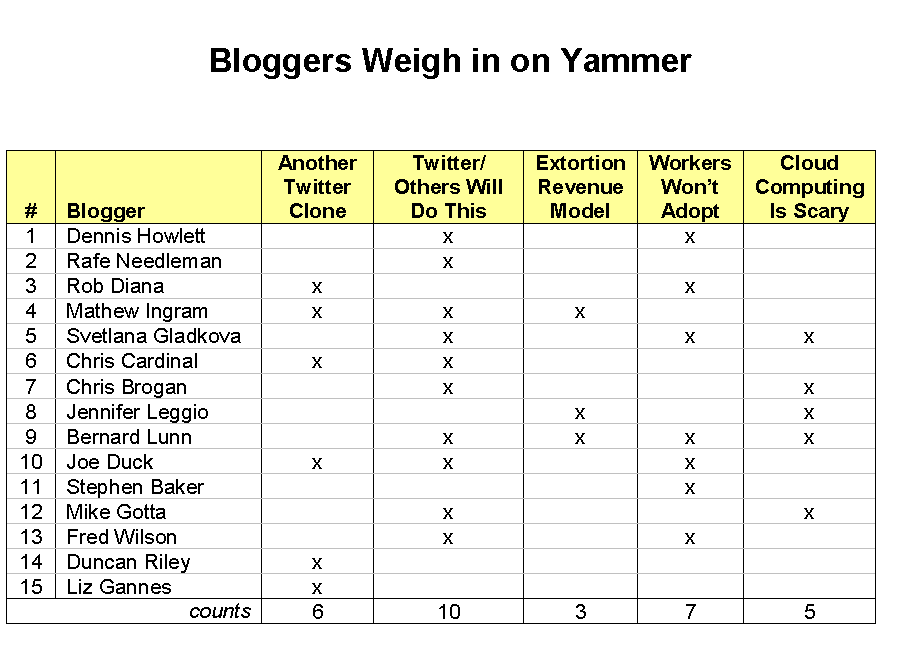
Yammer, as much of the free world seems to now know, won “best of show” at TechCrunch50. Yammer is an enterprise 2.0 company. The blogosphere had a fairly negative opinion about this. I read a number of these posts, and the table below outlines the reasons Yammer was viewed negatively:

Links to source posts: Dennis Howlett, Rafe Needleman, Rob Diana, Mathew Ingram, Svetlana Gladkova, Chris Cardinal, Chris Brogan, Jennifer Leggio, Bernard Lunn, Joe Duck, Stephen Baker, Mike Gotta, Fred Wilson, Duncan Riley, Liz Gannes

It’s a diverse collection of bloggers, and they each bring different perspectives. But there was enough commonality that I bucketed the reasons into the five groups you see in the table.

The reactions surprised me a bit – although there were positive reactions too. Let’s break down these five buckets.

Another Twitter Clone

Understandable reaction. We’ve seen Plurk, Identi.ca, Rejaw, etc. So I get the weary “Yet Another Twitter Clone” reaction.

Key difference here is the market Yammer is pursuing: enterprise. That makes all the difference in the world.

  • For Identi.ca to succeed, people would have to stop using Twitter (see Louis Gray’s post for analytical back-up to this point)
  • For Yammer to succeed, the more people use Twitter, the better.

Twitter ain’t enterprise, and I’d be surprised it gets there anytime soon. But using Twitter makes people understand the value of microblogging, which in turn helps Yammer.

Twitter/Others Will Do This

Given Twitter’s problems with keeping the service stable, I’d be shocked if they had also been putting in cycles figuring out how to go after the corporate market.

The other key difference is this. Enterprise is a different world than consumer. Probably one of the better explanations of the differences was by Mike Gotta, in discussing microblogging inside the enterprise:

“Within the enterprise, it is highly probable that IT organizations will classify these tools as messaging platforms (I would BTW). As a messaging platform, these tools would have to support security, logging, audit and archival functions to satisfy regulatory, compliance and records management demands.”

To succeed in the enterprise, you really need to focus on the enterprise. Twitter is having a field day in its growth in the consumer world. Wachovia just added their Twitter account to the website Contact Us page. Keith Olbermann is now on Twitter. Twitter should really focus on the consumer market, and own that.

Yammer is more likely to bump up against SAP’s ESME and Oracle’s OraTweet.

Extortion Revenue Model

The extortion is based on the fact that Yammer is free for sign-up and use. But if a company wants to control it, access to the administrative functions costs money. So companies will feel compelled to pay in order to manage the goings-on inside Yammer.

I’ll admit it’s a pretty creative enterprise pricing model. It seems to address two issues that bedevil enterprise software vendors:

  • How do I get a company to try my software
  • How do I prove employees will use it and get value from it

Companies don’t pay until they’ve seen employees use it and get value from it. Not bad, and it really wouldn’t be that hard for a CIO to tell employees to stop using Yammer (and block the site).

It is sneaky, but it’s also a clever way to address the adoption and value proposition issues that enterprise software vendors will always face. Atlassian Confluence achieved a solid share of the wiki market via viral adoption. Atlassian doesn’t have sales people – it’s all word of mouth.

Workers Won’t Adopt

This is where Yammer faces the toughest road. Getting people to microblog. Twitter is available to the hundreds of millions of people around the globe who might be interested. And it’s gotten a very small percentage of them.

Inside the enterprise, you need a much higher adoption rate. People already on Twitter are natural adopters, but a lot of employees will still have the “why would I do that?” reaction.

The “sell” has to compare Yammer to existing communication modes:

  • Email
  • Instant messaging
  • Forums

Note that relative to Twitter, Yammer has immediate context and built-in users. Context comes because the internal messages will generally center around work that colleagues have a stake in. In other words, they care more about each Yammer message than they do about individual tweets out in the wild.

The other thing is that managers at the departmental level can join and start using Yammer. On Twitter, if you don’t follow an A-Lister…so be it. On Yammer, if you don’t follow your boss…you’re going to miss something.

Cloud Computing Is Scary

This is an ongoing issue for the entire cloud computing/web apps world. Amazon S3 and Gmail’s recent outages highlight the issue.

Salesforce.com experienced outages back in late 2005 and early 2006. They were a blow to the software-as-a-service sector, but the company appears to have righted the ship since then.

Salesforce.com has a market cap of $6.9 billion. Yammer doesn’t.

But Yammer doesn’t have the database-of-record mission that Salesforce.com does, so the threshold for Yammer is lower. Still, ideally for Yammer, people will message about critical issues for their companies, not just what they’re having for lunch. So Yammer’s scalability, security and reliability will be important.

Cloud computing still has a sell-job of its own, but I like the way Anshu Sharma put it:

“No one (at least not me) is suggesting that on-premise software will disappear – its just that growth in enterprise software will come from SaaS and not on-premise (which is growing at about 4%). Venture capitalists like Emergence Capital and Humbold Winblad are voting with their dollars!”

A lot of action is around SaaS, it’s a question of how long the adoption curve will be. Yammer is counting on this one.

Gartner’s Hype Cycle

Gartner puts out updates on something it calls the Hype Cycle for Emerging Technologies. The hype cycle tracks the market views of various technologies, which go through predictable cycles:

  • Technology Trigger
  • Peak of Inflated Expectations
  • Trough of Disillusionment
  • Slope of Enlightenment
  • Plateau of Productivity

In July 2008, Gartner released its latest view regarding the hype cycle. This one included both microblogging and cloud computing, Yammer’s model:

Courtesy marketingfacts on Flickr

Courtesy marketingfacts on Flickr

Neither microblogging nor cloud computing is anywhere near mainstream uptake. Gartner pegs that at a 2 to 5 year horizon.

The companies that are in now, though, will be best positioned to figure out what drives the Plateau of Productivity. It takes time to learn a market, get some positive customer stories and gain a wider customer base.

I’ll be watching Yammer.

I’m @bhc3 on Twitter.

Yelp Is Putting Zagat into the “Innovator’s Dilemma” Headlock

In The Innovator’s Dilemma, author Clayton Christensen describes how new technologies emerge to take over markets. Initially, companies roll out products that serve the low-end of the market. They offer something cheaper and less functional than the product that currently dominates a market.

After establishing a toehold in a niche, a company expands the capabilities of its product until its features start to “bump up” against those of the incumbent vendors. The incumbents, the original “innovators”, find themselves fighting at the lower margin end of their business. Tired of spending resources to protect low margin sales, they take themselves further up the functionality ladder, where they can charge a premium.

Eventually, they run out of room at the top of the market. And the scrappy, less functional competitor has taken over the remaining market. This is shown graphically below:

In the recent New York Times article, How Many Reviewers Should Be in the Kitchen, Randall Stross looks at how Yelp is eating away at Zagat’s business model. Zagat publishes the very successful Zagat Guides. Zagat’s reviewers give the low-down on restaurants in cities around the world: price, quality, service.

I remember from my banking days that these were hit. And they cost money as well. Zagat has done well charging for their guides.

Yelp is the Web 2.0 site where everyday people rate their experiences with all sorts of services, restaurants included. Typical of these user-generated content sites, the quality of Yelp reviews was uneven early on. But it was a quick way to see what someone thought of a place before you went.

Well Yelp has gotten bigger and better. The site now has an army of reviewers. And power users with a flair for good reviews earn Yelp Elite status (my brother-in-law is one of them).

Yelp started out pretty low-end, as most Web 2.0 companies do. But it appears that Yelp is now migrating upmarket in terms of quality. It’s starting to bump up against market leader Zagat.

Here’s how Stross describes it in the New York Times:

Fortunately, the sites that welcome customer reviews have evolved significantly. One of the best, Yelp, has replaced the cult of the anonymous amateur with a design that highlights the judgments of the exceptional few. These dedicated reviewers produce work that, in quantity and quality, increasingly approaches that of their professional forebears, and they are willing to divulge personal information about themselves.

Because of Zagat’s 30-year history of subscriptions, the company’s mindset is one of actually making money via subscriptions, and that has served it well. The reluctance to give up something that’s generating real sales with real profits is understandable, but risks Zagat losing market share.

I don’t have a crystal ball, but there’s enough history where companies that you might have said, “Oh, they’ll never overtake so-an-so” end up doing just that. It’s not an overnight thing, it takes years. But it’s a real phenomenon.

Michelin Guides next?

*****

See this post on FriendFeed: http://friendfeed.com/search?q=%22Yelp+Is+Putting+Zagat+into+the+%E2%80%9CInnovator%E2%80%99s+Dilemma%E2%80%9D+Headlock%22

How Enterprise 2.0 Fosters Innovation: Stop Groupthink

I’ve had a chance to read some interesting research about innovation. In this case, whether more quality ideas emerge…

  • When people are in group sessions; or
  • Thinking independently

The background of this research ties into a well-known corporate activity: group meetings. I imagine most of us go through the ritual team meetings. Team meetings are good for a lot of things, but innovation may not be their highest and best use.

Turns out, research says that companies would be better off if employees had a way of coming up with ideas on their own, not in group meetings.

Here are three separate findings:

Via Marc Andreessen’s blog, the findings of researchers as related by Frans Johansson in The Medici Effect:

Via MSNBC, the findings as reported in the Journal of Consumer Research.

Via MIT Sloan Management Review, research published by INSEAD Business School

These observations about brainstorming ring true to me. I’ve been in enough meetings to know that strong personalities and prior relationships can hold sway over a group. The quote above by the Indiana University associate professor describes a dynamic I’ve seen time and again. An idea suggested early in the session gets traction, and becomes the focal point of the brainstorming. At some point, groupthink takes over. Maybe it’s exhaustion, maybe it’s an inability to focus on the other ideas anymore.

Yes, good ideas can emerge. But often, the whole exercise feels forced, and in my personal experience, employees don’t expect much from these meetings. Particularly if they’re run by outside consultants.

It Turns Out Group Brainstorming Does Have Its Attractions

The INSEAD paper referenced above does have some good news about group meetings. The paper studied two types of brainstorming groups:

  1. The traditional model, assembling a group of people.
  2. The other group took a “hybrid” approach, working on ideas by themselves before coming together to share their thinking.

The quote I selected above is from the research. But the study also has this to say about the two types of brainstorming:

Which technique yielded the best ideas? Strictly speaking, the traditional brainstorming groups consistently came up with the very best idea — and the very worst one, too. In other words, the quality of their results varied much more than those that came out of the hybrid groups that combined individual and group idea generation. However, the hybrid groups produced more ideas that were, on average, of higher quality. Nonetheless “for the very best idea, you need to have a pure brainstorming group,” notes Girotra. “Random interactions are likely to produce better-quality ideas.”

A few thoughts from that quote. One, the best idea can emerge from the group brainstorming, but I suspect it takes a truly motivated group. People need to come to meetings energized, ready to participate in a rapid-fire exchange of ideas and counter-arguments. In my experience, most meetings aren’t like that.

Also, how does that research that both the best and worst ideas emerge from group brainstorming play out there? Who doesn’t want the best ideas to emerge, but are you ready to put up with the worst ones too? Is there an argument for maintaining a larger number of ideas that are consistently above average?

Why can’t we get the best of both worlds? I want a higher quantity of good ideas, and I want the best ideas to emerge. While avoiding the worst ideas, if possible.

Enterprise 2.0: Hybrid Between Individualism and Group Dynamics

The graphic below describes the way Enterprise 2.0 captures the advantages of both brainstorming styles, group and hybrid:

Source Ideas: In the model above, the bottom level speaks to the core driver of Web 2.0: user-generated content. In this case, employee-generated ideas. Applying the familiar design and functionality of the consumer web (e.g. Twitter, Flickr, FriendFeed, WordPress, etc.) allows the easy creation of ideas.

Filter Ideas: Something I’ve learned by participating in social media is that your peers are amazing filters. Find a group of people with common interests – but with different opinions – and you’d be amazed at how the most useful stuff floats to the top. Happens in blogging, photos, videos, tweets etc.

Execute Ideas: After all this idea creation and filtering is done, the ideas need to be executed. Here’s where the group dynamic becomes a huge plus. Most ideas in a corporate setting will touch a number of areas, and the group makes it happen.

The key to getting the best of both worlds – more ideas of better quality, identification of the top ideas – is to create a culture where ideas are rapidly created and evaluated, while also letting advocates gestate their ideas to fix areas of weakness.

The ‘Source Ideas’ part of the model speaks to the best of brainstorming as researchers have found, in the above quotes. In my own experience, it’s hard to find those channels for new ideas, either fully baked or based on a hunch. You’d typically have to email someone, or call a meeting with several folks. Coming up with new ideas is challenging enough…you then have to go through workplace Olympics to see an idea get discussed and considered.

‘Filter Ideas’ gets to the heart of what makes group brainstorming powerful, when it works. The rapid creation and analysis of ideas helps everyone. Different points of view, people seeing unique opportunities with an idea or recognizing weaknesses…all are vital to the corporate innovation process. Currently, this can only happen in a group setting, but the group brainstorming dynamics have to be “right”.

Enterprise 2.0 has this figured out. Ideas are easily created and shared. Proponents and opponents can develop analyses of ideas. Simple commenting is very powerful, while longer form blogging can lay down foundational elements. Proposed ideas and discussions live longer than the one hour everyone is together in a conference room.

I know this, because I see it everyday in places like FriendFeed, blogs and Twitter. The diverse opinions, knowledge, creativity and world views result in some really good ideas and perspectives.

I’m not prescribing the particular technology to capture the best of individual and group brainstorming. There are different ways to approach that. What matters is letting the employees try this out for themselves.

Groupthink has its place. A unified group taking on the challenges of the market is vital. But groupthink should kick in after the innovation processes have occurred. First, a healthy scrum of ideas, ultimately filtered to the ones that a company will execute. Then everyone working together with a common sense of purpose.

A utopian vision? Perhaps. But like all stretch goals…if you get halfway to them, you’ve accomplished a lot.

*****

If you want an easy way to stay on top of Enterprise 2.0, I invite you to join the Enterprise 2.0 Room on FriendFeed. The room takes feeds for Enterprise 2.0-related items on Twitter, Del.icio.us and SlideShare. To see this room, click here: http://friendfeed.com/rooms/enterprise-2-0

*****

See this post on FriendFeed: http://friendfeed.com/search?q=%22How+Enterprise+2.0+Fosters+Innovation%3A+Stop+Groupthink%22

How Would Social Media Help You in Your Job?

I’m having a ball with social media out in the consumer web. Blogging, FriendFeed, Twitter, Facebook. I’m learning so much about technology, new companies and people’s attitudes regarding Web 2.0. Along the way, some collaboration and a new job actually happened out of all this fun.

Now why can’t we see some of these same effects in the place where most of us spend a third of our day? We’re seeing live implementations of social media inside organizations (aka Enterprise 2.0). It’s a good sign.

I’m now in a job where I’m thinking about this a lot. And I figured I’d start with myself. Where would social media have made a difference in my two previous Big Corporate jobs:

Both companies were examples of today’s modern company, with a heavy information orientation. It’s been years since I worked at either, but here is how social media could have helped me in my jobs.

May Department Stores

The buying office of a retailer is responsible for picking the merchandise you see on the floor. Buyers also plan and execute promotions, set prices and ensure optimum amount of inventory on the floor and in the warehouse. We also had to communicate with the department managers of dozens of stores.

Here are the social media that would have helped me (if we had the Web back in 1990-1994):

  • Twitter: Yup, I would have loved Twitter. An easy way to fire off updates out to the field of department managers. And they would have sent back news of things they were seeing. Would have been a huge help during the crazy Christmas season.
  • Blog: I would have blogged about the weekly promotions. There’s a fair amount of work that went into them (promo prices, signage, focus of the ads), and documenting all that would have been useful. New products that we bought would have been good to discuss as well.
  • Bookmarking and notetaking: Assuming we had the world wide web back then, I would have bookmarked and noted a number of things for the job: competitor ads and pricing, product promotions I liked, new products I’d seen elsewhere.

Bank of America

At BofA, my group raised debt for corporations. Deals could run anywhere from $25 million to $6 billion. It was an information-intensive job.

The work consisted of three primary activities: (1) win the deal; (2) sell the deal; (3) close the deal via documentation. You had to stay on top of comparable deals, industry trends, capital market trends and general market chatter. Our group was divided into Structurers (me), who worked with clients to win and structure deals; and Distribution, who sold the deal to the market. Distribution always had the best information.

Social media I would have wanted:

  • Twitter: Again! I really would have wanted to see the ongoing chatter of the Distribution guys. They picked up all sorts of incredibly valuable market intelligence during the day. They used to IM. Now I’d want them to tweet.
  • Wiki: Every deal should have had a wiki space, with its “win the mandate” phase, its “sell it to the market” phase and the documentation phase. Wikis would have been good for handling the whole deal cycle.
  • Feed Reader: There were market data publications to which BofA subscribed. Getting a feed of deal information would have been a huge help. We were chasing information down in paper publications.
  • Bookmarking and notetaking: When deal, market or industry news came through, I needed a place to save it. I was always going back to find stuff I’d seen earlier. Bookmarking would have helped a lot. Note taking too – capture some information or thoughts, tag it and come back to it later.
  • Blog: My group wouldn’t have had much use for a blog amongst ourselves. But a blog that updated the rest of the bank as to what was happening in our particular capital market (syndicated loans) would have been perfect. We had other groups asking us often about market conditions.

I’d Love to Hear About You

Maybe you’re already using social media inside your company. Or perhaps you’ve been thinking, “my company really needs…”

If you’ve got any ideas to share, I’d love to hear them.

*****

If you want an easy way to stay on top of Enterprise 2.0, I invite you to join the Enterprise 2.0 Room on FriendFeed. The room takes feeds for Enterprise 2.0-related items on Twitter, Del.icio.us and SlideShare. To see this room, click here: http://friendfeed.com/rooms/enterprise-2-0

*****

See this post on FriendFeed: http://friendfeed.com/search?q=%22How+Would+Social+Media+Help+You+in+Your+Job%3F%22&public=1

I’ve Joined Connectbeam, and Social Media Got Me the Job

On Wednesday August 13, I start my new job as Senior Product Manager for Connectbeam. Connectbeam provides social bookmarking and networking to the enterprise. The goal is to foster better information management and discovery, and to connect colleagues around projects and common interests.

Going a bit further, here is a note from privately-held Connectbeam’s about page:

Connectbeam’s architecture and core application (Spotlight) were designed to help people in any role, across the enterprise, connect with both the growing pool of information and colleagues with the expertise and experience to help them get their jobs done more intelligently and more quickly. We enable this by aggregating the social metadata that is generated naturally by using the web into a single repository that everyone in the company can access and use.

Current customers include: Procter & Gamble, CSC, Bristol-Myers Squibb, Honeywell, 3M, Intel, Pfizer and Booz Allen Hamilton.

Why Connectbeam?

The problem Connectbeam is tackling greatly interests me. How to manage information to make individuals smarter, help people find information and determine the ways in which common interests establish and build relationships. There are many posts on this blog along those lines. Here are six of them:

  1. FriendFeed ‘Likes’ Compatibility Index
  2. Hey Yahoo! Forget MSFT, GOOG. Change the Search Rules.
  3. Who Is Your Information Filter?
  4. Knowledge & Innovation: The Journey Is as Valuable as the Destination
  5. Tag Recommendations for Content: Ready to Filter Noise?
  6. Social Media Consumption: You Want Signal or Discovery?

I also like Connectbeam’s delivery model. I am a fan of cloud computing, and in my experiences at eFinance and Pay By Touch, customers got comfortable. But I also ran into companies that only wanted applications behind their firewall, which is what we sold at BEA Systems. Security, control and reliability are still important, and recent outages at Amazon S3 and Gmail highlight those concerns. Connectbeam runs as an appliance behind companies’ firewalls.

Connectbeam delivers its model as an integration with existing search engines and other applications. For instance, Connectbeam now has an integration with Microsoft’s SharePoint, the most pervasive collaboration software out there. The Microsoft SharePoint Senior Technical PM even tweeted about it.

I’m a big believer in the ability of enterprises to improve the ways that information is created, disseminated and managed by employees. Those that get this right will be better-positioned in our information-centric economy.

FriendFeed Has Opened My Eyes

I joined BEA Systems to do product marketing for enterprise 2.0. Prior to that, I had done a little tweeting and had a Facebook profile. But not a whole lot of social media. I started blogging in February to eat my own dog food when I was marketing web 2.0 to companies. I needed to immerse myself in the world to really understand it.

Well, blogging has become quite important for me. FriendFeed has become just as important.

FriendFeed opened my eyes to the possibilities of knowledge as the basis of relationships. The ways in which content from a variety of sources is a powerful, addictive basis for learning, conversations and collaboration. How activity streams are compelling reads. I’ve been active on FriendFeed since March, and it shocks me how much I know about web 2.0 and technology in general versus last year. I’ve still got much to learn, and FriendFeed will continue to be a good source for that.

So why can’t companies get better around that too? Having eaten my own dog food on FriendFeed, I’m ready to work with employees and companies to improve the ways in which information is created, tracked and shared.

How Social Media Got Me the Job

You’ve probably seen more than a few posts saying that today’s resume is your Google search results. Your social network sites, content, updates, what others say about you…all of it is searchable.

Like me, Connectbeam CEO Puneet Gupta subscribes to Google Alerts for “enterprise 2.0”. Well one of my blog posts was listed in an alert. It caught Puneet’s attention, so he read the blog a bit more. Liking what he saw, he then investigated my name out on the web. Among the sites he found was one where I was a recommended blogger to follow (thanks Daryl, Franklin, Louis, Mark, Mike, Rob, Steven). Those recommendations were in part made due to the wonderful effects FriendFeed has for bloggers.

It didn’t hurt that I had been involved with enterprise 2.0 at BEA Systems. So after doing some due diligence, he left this comment on my blog:

Hutch:
Would love to connect with you and discuss some ideas.

I reached out to him, did some interviews, and the rest is history.

Looking Ahead

The new job will give me a more structured basis for looking at the ways in which information is managed. I plan to look more deeply at some of the consumer social bookmarking sites.I’m a product manager for Connectbeam, but a lot of my job will involve product marketing too.

I expect working in this area will influence my blogging subjects some. But I’ll blog about other fun stuff along the way as well.

Gotta go – my commute is from San Francisco to Mountain View. Need to battle the 101 traffic.

*****

If you want an easy way to stay on top of Enterprise 2.0, I invite you to join the Enterprise 2.0 Room on FriendFeed. The room takes feeds for Enterprise 2.0-related items on Twitter, Del.icio.us and SlideShare. To see this room, click here: http://friendfeed.com/rooms/enterprise-2-0

*****

See this post on FriendFeed: http://friendfeed.com/search?q=%22I%E2%80%99ve+Joined+Connectbeam%2C+and+Social+Media+Got+Me+the+Job%22&public=1

Cuil and Business Models: Complement, Replace or Create?

Cuil went live Monday. The new search engine promises dramatically better search results:

Rather than rely on superficial popularity metrics, Cuil searches for and ranks pages based on their content and relevance. When we find a page with your keywords, we stay on that page and analyze the rest of its content, its concepts, their inter-relationships and the page’s coherency.

Cuil went live with an incredibly high level of publicity. Alas, the promise of the company’s press release has not been met initially:

So Cuil has its work cut out.  And Cuil is running into the classic 9x problem anyway. As Harvard professor John Gourville explains it, new products need to be nine times better than the product they replace. Two parts to that nine times rationale:

  1. Risk aversion: the market will overvalue the incumbent product, with all its warts and limitations, because the benefits are certain and entrenched
  2. Uncertainty: the described benefits of the new product may not be realized

Three Philosophies to Building Products

I lack any build-your-own-company experience, so my observations are those of an outsider looking in. From what I see, companies build products that do one of the following:

Each product strategy entails its own risks and rewards.

Complement Strategy

In the Complement strategy, companies plug into an installed based and existing ecosystem. They see an opportunity to improve the functionality of the existing product.

The nice thing with the Complement Strategy is that there is a defined market. The incumbent provider has done the hard work of creating it. And the way customers use the incumbent product is well-known, so creating an experience consistent with that makes the new company’s job easier.

The Complement Strategy company ties its fortunes to the incumbent’s installed base and future product roadmap.  A nice exit strategy is to be acquired by the incumbent. There is the risk that the incumbent company will just add the feature on their own to their product.

One good example was Summize. Summize built a very nice search application in support of Twitter. Summize didn’t ask you to use it for micro-blogging. It worked on top of Twitter, making up for a limitation in twitter: search.

9 times better impact: Companies that pursue the Complement Strategy buys themselves a much easier time of it. The issue of risk aversion is put to bed because customers are not asked to give up their existing products.

Replace Strategy

The company that pursues the Replace Strategy aims to dislodge the incumbent. This is a tough thing to do. Customers know what they value in the existing product. They know how to work around the limitations of the products. They built their own processes around the product.

That’s going to be tough to disrupt. But the rewards are terrific. Typically, the incumbent has a large market size. The customers’ use cases are well-developed, and the shortcomings of the existing product are easy to identify.

Still, it takes ripping out a lot of entrenched processes and mindset to replace.

The iPhone is a good example of a product successfully employing the Replace Strategy. Not that it has actually replaced the bast majority of existing mobile phones yet. But it has gotten vital traction in the mobile market and is carving out its share.

9 times better impact. This strategy is the one that runs hardest into the issue of a product needing to be nine times better than what it replaces. Customers are going to overvalue what they have, and the completeness and reliability of the replacement product will be questioned.

Create Strategy

The Create Strategy is a storied one in the world of entrepreneurship. To create a whole new category of usage. Companies that pursue this are riding the visionary edge. Fun place to be.

The landscape is littered with companies that have tried this approach. That’s the big risk with this approach. It takes a lot of experimentation to find the new products that resonate with the market and really change people’s experience.

If a company hits on success in creating a new category, it will enjoy first mover advantages. These are important as Replace Strategy competitors inevitably crop up.

Twitter is an example of this. Twitter is the leader in the micro-blogging/social messaging movement. Other companies are trying to move into the space (Jaiku, Pownce, Plurk, Identi.ca), but Twitter continues to enjoy a dominant position.

9 times better impact. This strategy has an easier time relative to the nine times better requirement. The Create Strategy does have replacement aspects, but they’re often more time replacement issues. Using Twitter as an example, Twitterers were likely replacing some of their activity on email, instant messenger and social networks. But they really weren’t replacing those. Twitter stands on its own merits, not in comparison to other apps.

Diigo: A Hybrid Case

Diigo is a new bookmark and tagging service. Ultimately, Diigo would like to replace Del.icio.us as users’ go-to site for bookmarking (Replace Strategy). But Diigo is being sm,art about it. They have made it easy for sites bookmarked in Diigo to be exported over to Del.icio.us at the same time. So by bookmarking in Diigo, users are suimultaneous bookmarking in Del.icio.us. In this way, Diigo is also pursuing the Complement Strategy. This allows users to get comfortable with Diigo while not losing their existing investment in Del.icio.us.

Cuil: The Challenge of the Replace Strategy

Google Search has en established brand. It has a huge share of mind. People have Google Toolbars. Google Search is a popular add-on to the Firtefox browser. Google Search powers myriad corporate websites.

Louis Gray has a nice post describing the challenge start-ups face when they take on incumbents. Often they start out with dreams of becoming the next big thing, but may have to settle for niche market positions.

Cuil’s initial approach is one of being better than Google Search. Not carving out a particular niche. But based on the initial feedback, Cuil has not come anywhere near being nine times better than Google Search. Cuil is not trying to create a new category. It is not trying to complement existing search. It is firmly in the Replace Strategy mode. Here are its options:

  • Completely replace Google Search: continue to compete against Google for more content that is searched and superior relevance.
  • Replace Google Search for a niche segment: be better than Google at just one thing. But really be nine times better.

Might there be a hybrid strategy for Cuil? You get your Google search results, but get to see what Cuil found? Perhaps like dogpile.com. Not sure how that would work though. And it really doesn’t address the entrenched ecosystem that Google has.

Choose Your Strategy with Care

Dave Winer makes a nice point when it comes to competing against an incumbent like google:

Google is a thriving coral reef, and one doesn’t just show up one day with an idea and compete with an ecosystem.

I don’t know if the Replace Strategy or the Create Strategy is harder. Both have their challenges. It seems Complement Strategy is the easiest, but probably has the lowest market potential.

What do you think? Did I miss any other product market strategies?

*****

See this post on FriendFeed: http://friendfeed.com/search?q=%22Cuil+and+Business+Models%3A+Complement%2C+Replace+or+Create%3F%22&public=1

Unclear on the Concept: People Complaining about Comcast Monitoring Social Media

The New York Times has an article today about Comcast using social media to respond to customer complaints. Comcast is definitely at the forefront of this move to engage customers out in the wild. Comcast’s efforts have previously been documented on ReadWriteWeb. New York Times coverage helps move the concept, and Twitter, closer to mainstream adoption.

What caught my eye in the NYT article is that some people are concerned about Comcast doing this. They feel like Comcast is acting like Big Brother. According to the article, 20 year-old Brandon Dilbeck blogged about his dislike of ads on Comcast’s programming guide. A Comcast representative found the post (Google blog alert perhaps?), and responded to him via email.

Hey dude! Your blog had some impact! Isn’t that cool?

Well, no. The blogger apparently thought it was weird:

Mr. Dilbeck found it all a bit creepy. “The rest of his e-mail may as well have read, ‘Big Brother is watching you,’ ” he said.

Here’s what I don’t get. Blogs are publicly available. Anyone can find a blog and comment on it. Sometimes, your blog posts result in actions you wouldn’t have expected. This is the power of Web 2.0.

If you’re going to write publicly, how on earth can you be concerned about Big Brother? Sure, if Comcast had monitored his email or phone conversations, that’d be Big Brother (and illegal).

But to air your concerns publicly and have someone from the company read it? If you’re concerned someone would actually read your post, then don’t blog. I’m actually surprised this 20 year old was concerned. The Gen Y folks are supposed to be pretty open about everything in their lives. Maybe Mel McBride is right when she made this comment on FriendFeed with regard to Facebook:

I’m just getting tired of dopes buying into the surveillance of their personal history, daily activities and personal associations as a “convenience” – wake up people.

Social media: If you write it, do it or video it, people can find it. That’s the great opportunity for all of us.

*****

See this post on FriendFeed: http://friendfeed.com/search?q=%22Unclear+on+the+Concept%3A+People+Complaining+about+Comcast+Monitoring+Social+Media%22&public=1

Using FriendFeed for E-Commerce

The secret sauce of FriendFeed is the development of a trusted network of referrals and commentary by users. People add users to and prune users from their subscriptions based on how well interests align. Once you subscribe to someone, you develop a good feel for their interests and perspectives over time.

This process lowers the barrier to accepting information from someone, as you learn to trust him or her.

In other words, fertile ground for e-commerce.

Seth Godin had a nice post a few months back, The truth about word of mouth. Here’s a quote from that post:

The truth about word of mouth. It’s hard. Sure, it’s hard for you. Your brand doesn’t get as much as you like. But that’s not what I mean. It’s hard for the consumer. A few people like to blab and babble. Most people don’t. They lay low, because they’re afraid or shy or just not used to talking about brands and products or experiences.

Getting people to talk about products they buy is the tough. Yet that kind if information is exactly what most of us are looking for. According to the Keller Fay Group, 80% of us trust recommendations from family, friends and influential persons over all other forms of advertising and marketing.

Think about your own buying decisions. Don’t you love it when you can get a solid recommendation on a product from someone you trust?

This got me wondering…does FriendFeed have an opportunity in the e-commerce space? Not as a direct seller of goods. But as a trusted referral network. With some added features, there’s a nice revenue opportunity riding the rails of the affiliate marketing world. And users would get better info on products.

But first let’s look at a previous effort here, Facebook’s Beacon.

Facebook Beacon: Misfiring on Three Counts

Facebook rolled out Beacon last fall. The idea is that you can broadcast your purchases from online retailers back into the Facebook newsfeed of your friends.

Well, Beacon was excoriated. Two reasons for this:

  1. Beacon’s user control and notification process were terrible
  2. People weren’t sharing a lot of external activity into Facebook, making it seem weird to have that suddenly occur

A third problem with Beacon, even for people that wanted to share product information, was that the product information passed through the newsfeed pretty quickly. If you happened to be interested in the product at that moment, great. But if you were in the market for a given product later, you couldn’t search for information about what your friends bought.

FriendFeed: All About Sharing External Things You Like

FriendFeed’s whole vibe is different from that of Facebook. You’re supposed to bring your outside interests into the site. Commentary and opinion is the order of the day. Interactions revolve around those interests, and accompanying commentary and opinion.

Why not extend that mentality to products that people buy? We already see things with a product orientation coming through FriendFeed:

  • Books: Book recommendations come through via Goodreads. For instance, Here’s a discussion around the book Spook Country. Users will also directly post recommendations, such as this one for Community: the Structure of Belonging.
  • Music: People stream in their Last.fm and Pandora music selections. What a Wonderful World by Louis Armstrong got a nice discussion going.
  • Movies: We see people’s movie tastes through NetFlix on FriendFeed. Here’s some discussion around the movie Hancock, with Will Smith.
  • Amazon: Amazon wishlists tell the world the things a user wants. Often these are books, music and movies. But a lot of interesting other products come through as well. Here’s a discussion around the Nikon D300 camera.

People are already sharing product-related stuff on FriendFeed. Which has incredibly high potential. Here’s what I mean…

Push vs. Pull Marketing

Louis Gray asked this question recently on FriendFeed:

I’ve seen a lot of stories lately around behavioral targeted advertising, and privacy. But in theory, wouldn’t you rather see more relevant ads? Isn’t this a good thing?

Many of the responses were suspicious of the tracking or didn’t think ads could ever be that relevant. Here are a few responses:

Jill O’Neill: “No. If I need to buy something, I’ll track it down on my own.”

Dobromir Hadzhiev: “I’m with @Jill, nothing beats the research, ads are and always will be annoying.”

Amanda Chapel: “Some of this stuff would make Joe Goebbels blush.”

Bwana McCall: “In my 16 some odd years on the internet, I have to yet to see an ad that I wanted to click on.”

A lot of good opinions, and they bolster the argument that making trusted product recommendations available when someone wants them (“pull marketing”) has advantages over running ads (“push marketing”).

This is why I think sites like FriendFeed, and even Facebook, have enormous potential in the world of e-commerce. They can become the source for getting recommendations and asking questions about products.

What Would FriendFeed Need to Make a Play in E-Commerce?

Say you’re an  expecting first-time parent. You want to buy a crib. Right now, that’d be a little daunting on FriendFeed. Here’s a search for the word ‘crib’. Lots of stuff there, but it’d be tough to use that for making a purchase decision.

Here are some things that would help users find products that their friends have purchased on FriendFeed:

  • An ‘Add to FriendFeed’ button at the checkout of e-tailer sites
  • A special designation of these streams from e-tailers as ‘PRODUCT’
  • The ability for users to hide all feeds with the designation ‘PRODUCT’
  • A tab on FriendFeed set up specifically for all feeds designated ‘PRODUCT’
  • Search of all ‘PRODUCT’ feeds
  • The ability to click a link on the product name, and be taken directly to that product on the e-tailer’s website

Once a user lands on the e-tailer’s site from FriendFeed, FriendFeed gets a cut of any purchases by that user, a la standard affiliate marketing agreements.

Users would get a much better way to find products they want. Just like the blog posts and articles that stream through, each person would likely specialize in product categories that fit their interests and knowledge. You would come to trust the recommendations of different users for different product categories. You’d have the person who knows cameras. Who knows home decor. Home entertainment systems. Running gear. Toddlers’ toys. Womens’ shoes. Flowers. Etc…

What do you think? Would you use such a system? I would.

*****

See this post on FriendFeed: http://friendfeed.com/search?q=%22Using+FriendFeed+for+E-Commerce%22&public=1

Good Move = Kleiner Perkins Drops Web 2.0, Goes After Alt Energy

I just read a nice piece in Fortune, Kleiner Bets the Farm. The article describes Kleiner’s big move into alternative energy. And this move comes at the expense of investments in new Web 2.0 companies.

Kleiner’s halting investments in Web 2.0 generated quite a discussion last November. Tom Foremsky reported the firm’s change of heart to kick off the discussion. In that article, he wrote this:

The firm is one of the trend setters in Silicon Valley, with a long string of massively successful investments over several decades. And Silicon Valley VC firms always invest in trends, rather than companies.

Which is what makes Kleiner Perkins’ new investment focus so interesting. And a good direction.

$4.00 Per Gallon = Better Green Tech ROI

Now that filling up your car requires $50, $60, $70 or more, consumers are much more interested in changing energy habits. And businesses are going to be whacked hard as well, with the costs inevitably costing us more money everywhere. Yeah, we’re ready for some changes.

I’m no expert in the field, but a common problem with generating alternative sources of energy is the high cost of production. But now with oil prices going through the roof, those alternative sources of energy suddenly look better.

Here’s one example: hydrogen fuel-powered cars. Hydrogen is a clean, abundant source of energy. But it’s not yet commercially viable. In 2003, gubernatorial candidate Arnold Schwarzenegger proposed a plan to foster the production and adoption of hydrogen powered cars. President Bush echoed this idea in a 2006 Earth Day speech:

It (hydrogen) has the potential — a vast potential to dramatically cut our dependence on foreign oil.

Good news, right? Well, the reality has not yet met the aspirations. First, there’s the cost of hydrogen fuel. Research Capital analyst Jon Hykawy had this to say about hydrogen-powered cars:

In my view, the hydrogen car was never alive. The problem was never could you build a fuel cell that would consume hydrogen, produce electricity, and fit in a car. The problem was always, can you make hydrogen fuel at a price point that makes any sense to anybody. And the answer to that to date has been no.

And this year, Govern Schwarzenegger had to retreat from his ambitious hydrogen and electric car  goals.

Which leaves us with $4 gas.

At some point, oil prices will cross over the economic threshold for other energy sources to become economically viable. Waiting until then will be bad, because commercial development of these alternatives will take several years. We need to get our collective asses moving to drop our dependence on oil. We need new investment dollars flowing into that sector now.

Web 2.0: Feature or Business?

We’re several years deep into the Web 2.0 revolution. Allen Stern at CenterNetworks asked How Many Web 2.0 Services Have Gone Mainstream? The answer? Not many. How many have had an IPO?

That’s not to say that Web 2.0 is going away. Anything but. What does seem to be happening is that Web 2.0 is being integrated into the traditional big software and Internet players. I did product marketing for BEA Systems’ Enterprise 2.0 apps. Not some small company, but a big name Web company adding Web 2.0 to its existing portal platform.

There will be Web 2.0 businesses that succeed. Most seem to be acquisition bait. Some will break through in a public offering.

The low cost of entry to create Web 2.0 businesses has democratized company creation. If you want to be snarky, you might say that just means a bunch of crappy apps have been created. This is true. But from a capitalist point of view, all that creativity is healthy because some good companies come out of all that.

Web 2.0 companies have become easier to create, and funding has generally not been a problem.

As Kleiner Perkins Goes, So Goes Venture Capital?

Going back to Tom Foremsky’s quote, is Kleiner Perkins the first of what will be several firms to change focus to alternative energy? My impression is that alternative energy is at the stage of two guys hacking together a computer in their garage. Some interesting experimentation, but clearly there’s a need to ramp things up dramatically, with attention, experimentation and financing.

Go Kleiner Perkins. And I hope other VC firms are following suit. And don’t worry. Web 2.0 will be fine.

*****

See this post on FriendFeed: http://friendfeed.com/search?q=%22Good+Move+%3D+Kleiner+Perkins+Drops+Web+2.0%2C+Goes+After+Alt+Energy%22&public=1

Email’s Changing Role in Social Media: Digital Archive, Centralized Identity

Alex Iskold wrote a great post recently, Is Email in Danger? This quote lays out the premise of the post:

From the 20th century mail was a fundamental form of communication. The invention of electronic mail (email) changed two things. It became cheap to send mail, and delivery was instant. Email became favored for both corporate and personal communication. But email faces increasing competition. Chat, text messages, Twitter, social networks and even lifestreaming tools are chipping away at email usage.

When it comes to email, there are some parallels to what happened to snail mail with the spread of the Internet and email. The biggest thing is this:

Snail mail found an unexpected opportunity for growth with the rise of the Web.

Email will lose out on some of its uses, but there are some interesting possibilities that will emerge.

The Disruption of Snail Mail

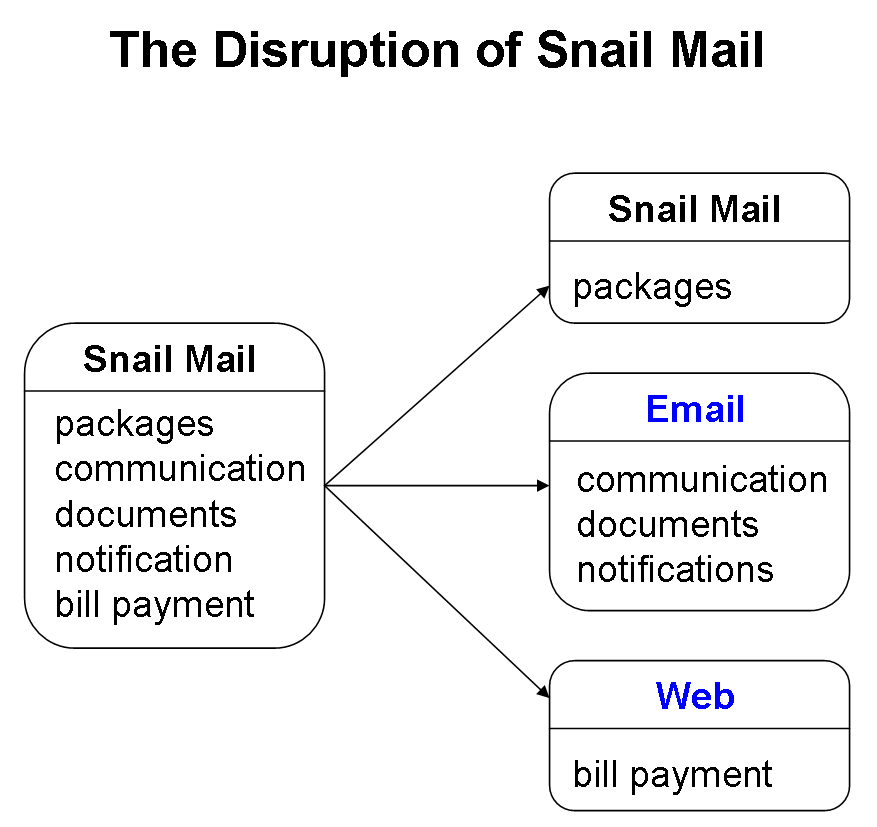
The diagram below depicts the disruption that occurred to snail mail.

I’ve kept the disruption focused on the effects of the Internet. In other words, no fax machine or FedEx in here.

Back in the day, the mail system was the way you got a variety of important communications to other people. Our grandparents wrote letters. L.L. Bean mailed us the stuff we ordered via their catalogs. All our bills came through the mail. We were notified of things like jury service.

With the arrival of the Net, a good portion of snail mail’s portfolio was assumed by other technologies. And it’s had an effect. Here’s a quote from a 2001 General Accounting Office report on the future of the U.S. Postal Service:

Although it is difficult to predict the timing and magnitude of further mail volume diversion to electronic alternatives and the potential financial consequence, the Service’s baseline forecast calls for total First-Class Mail volume to decline at an average annual rate of 3.6 percent from fiscal years 2004 through 2008.

Pretty bad, eh? Electronic alternatives were evaporating the revenues of the post office.

But something else was out there which would help offset these losses in first-class mail: e-commerce. With the growth of the Internet, people got more comfortable shopping online instead of going to their local mall.

Those packages had to get to shoppers somehow. That’s where the U.S. Post Office shined. It already had the infrastructure to get things from a centralized place to multiple individual residences. What got disrupted were the trucking companies who moved merchandise from manufacturers to retailers.

Sure enough, the U.S. Postal Service saw a rebound thanks to online purchases, according to Web Designs Now:

In 2005, revenue from first-class mail like cards and letters, which still made up more than half the Postal Service’s total sales of $66.6 billion, dropped nearly 1% from 2004. But revenue from packages helped make up for much of that drop, rising 2.8%, to $8.6 billion, last year, as it handled nearly three billion packages.

And the dark mood at the U.S. Postal Service headquarters brightened quite a bit:

“Six years ago, people were pointing at the Web as the doom and gloom of the Postal Service, and in essence what we’ve found is the Web has ended up being the channel that drives business for us,” said James Cochrane, manager of package services at the Postal Service.

There is a lesson here for email.

The Disruption of Email

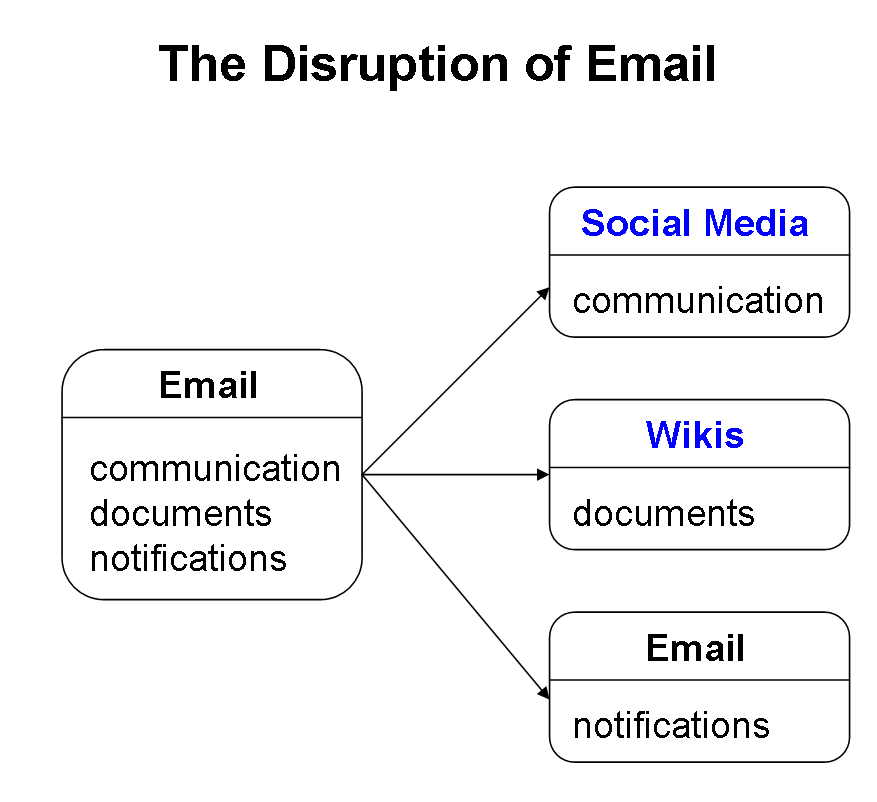
Email is undergoing its own disruption:

Again, similar to the previous diagram, I’m focusing on the web here. No mobile texting as an email disruptor, even though it is.

As Alex outlined in his post, the easy messaging of social media is supplanting the email messages that used to be sent. I haven’t seen any surveys that show the decline in person-to-person communications because of email. But my own experience reflects the migration of communications to the various social media.

  • LinkedIn messages
  • Facebook messages
  • Twitter
  • FriendFeed comments

As Zoli Erdos pointed out in his blog post Email is Not in Danger, Thank You, wikis are growing as the basis for sharing documents. They provide better capabilities than does email: wider visibility, versioning and searchability.

But it’s in notifications where email’s future is bright. Many of us are members of social media sites. As we go through our day, it’s hard to stay on top of activity in each one: new messages, new subscribers, new friend requests, etc.

Where is the central clearinghouse of my multiple social media identities? Email.

Email is the permanent record of what’s happening across various sites. This is actually a very valuable position in which to be. Here are two examples where email helped me:

  • After I wrote a post about nudity on FriendFeed, I lost some FriendFeed subscribers. I know this because my number of followers went down. There was one person in particular I wanted to check. This person wasn’t on my list of followers, and I thought, “maybe wasn’t subscribed to me in the first place?” Checked email, and I did indeed have a follow notification from this person a few weeks earlier. So I knew I’d been dropped.
  • I inadvertently deleted a comment to this blog. On wordpress.com, once deleted, the comment is not recoverable. I was in a bind. But then I realized I get whole copies of comments to this blog emailed to me. So I went to Gmail and found the comment notification. I was able to add the comment back by copying it from my email.

As snail mail had to adjust to the rise of email, so too will email adjust to the rise of social media:

As the number of social media sites and participation in them expands, email will find new growth and value in being the centralized notifications location.

Email = Centralized Identity Management

Much has been written about email being the ultimate social network. The basis for this is your address book and the emails you trade with others. But might there be another opportunity for email?

If email has all these subscription and message notifications, doesn’t it potentially have a role in helping you manage your centralized identity? Gmail could map out my connections across various sites. Find those that are common across the sites. Gauge the level of interaction with others.

Even add APIs from the various sites and let me send out communications from email. Suddenly, email’s back in the communication game as well.

I’m just scratching the surface of what might be possible here.

What Do You Think?

Email’s primary role as a communication medium is diminishing. Many of us are enjoying the easy, contextual basis of communicating via the various social media sites.

But like snail mail before it, email has interesting possibilities for what it will do for us in the future.

What do you think?

*****

See this post on FriendFeed: http://friendfeed.com/search?q=%22Email%E2%80%99s+Changing+Role+in+Social+Media%3A+Digital+Archive%2C+Centralized+Identity%22&public=1

Do FriendFeed Comments Hurt Bloggers’ Ad Revenue?

Allen Stern at CenterNetworks recently wrote a post arguing that FriendFeed was hurting bloggers by taking away page views. I’d paraphrase his position as this:

Once people comment on the actual blog post, they tend to return many times to see the comments that follow theirs.

I mean, they reload the blog post…MANY, MANY times…

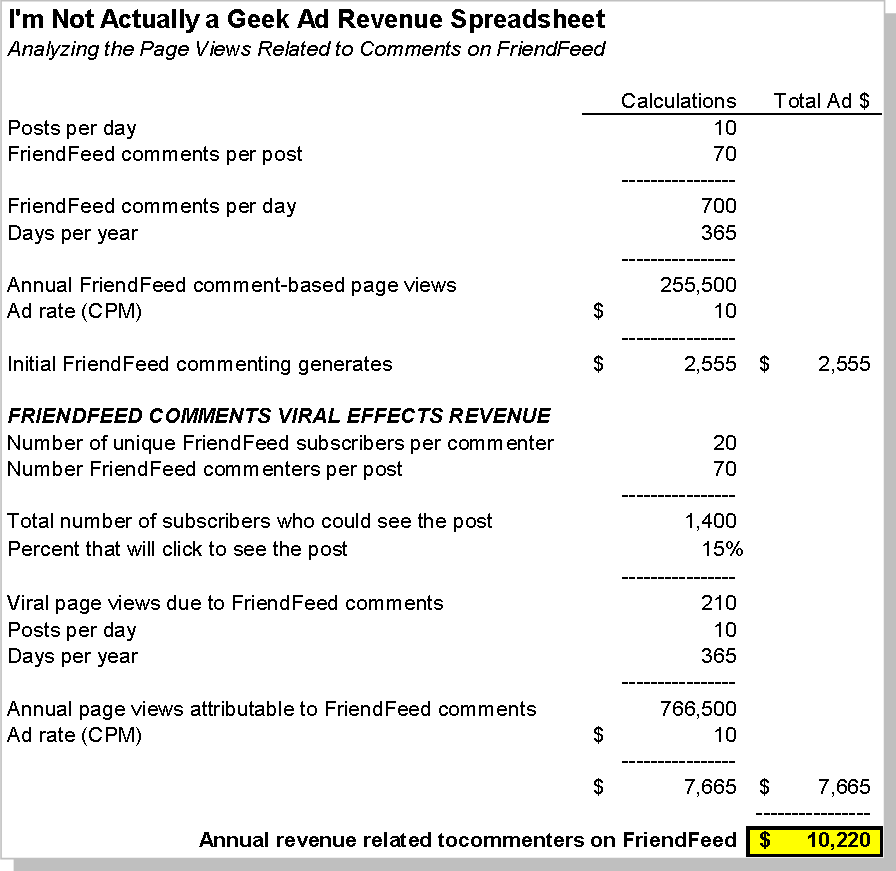
The numbers sounded aggressive to me, so I wanted to give some consideration to Allen’s calculations. I also created a separate spreadsheet that estimates the ad revenue generated from comments on FriendFeed. The tables are presented below.

One note. Allen’s CenterNetworks worksheet for blog-based comments shows ad revenue that crushes the revenue I show for FriendFeed-based comment ad revenue. But here’s the catch – there’s an uber-aggressive assumption about repeat visitors to blogs in Allen’s calculations. Right-size that assumption, and I think FriendFeed ends up looking better.

If you leave this post with one thought, it’s this:

FriendFeed will help the vast majority of ad-based blogs to increase their revenue by driving higher page views.

OK, on to the calculations.

CenterNetworks Blog Comment Ad Revenues

Allen wrote most the calculations below in his blog post. I did have to make some assumptions to hit the $100,000 annual revenue level he associated to commenter page views.

As Allen says in explaining the $100,000 in comment-related revenue:

Last step in the equation – how many people visiting the blog will reload the page a number of times to view and/or interact with the comments – on sites with major trollage, this number can be astronomical. Using our numbers above, I estimate that this could be a minimum of $25,000-75,000 per year. Again this is most likely a bare minimum and for large blogs with controversial content, this dollar figure could be way higher.

At the end of the day, a large blog could easily be generating more than $100,000 a year in commenting revenue alone.

Allen does say the number of reloads is astronomical. As the table above shows, to hit his $100,000 in comment-related revenue, commenters must hit reload 39 times. For all 10 posts. Every day. All year long. All commenters.

And presumably they’re doing this for all the big blogs: TechCrunch, BoingBoing, ReadWriteWeb, Mashable, Engadget, Gizmodo, Huffington Post…and do these blogs actually average 70 comments per post?

Anyway, I’m sure there are those who actually refresh 39 times per post on all these blogs. But are there enough to generate $100,000?

FriendFeed Comment Ad Revenues

The crux of my analysis is not page views driven by reloads. It’s based on unique visitors clicking to the blog because of the viral attention features of FriendFeed. Specifically the tendency of comments to bounce a blog post to the top of people’s FriendFeed. Comments in general will advertise the content, and comments by someone you trust will increase the odds of clicking.

As you see, I set the revenue as 10% of what Allen has in his, but I’d argue it’s based on a more realistic assumption about page views. Remember this spreadsheet focuses only on the comments effects, not the Likes or the multiple times a blog post shows up in FriendFeed: Google Reader Shares, bookmarks, Stumbles, etc.

A problem with my spreadsheet is that I carry over the aggressive assumption about comments (70 per FriendFeed entry). But I want to make the comparison to Allen’s spreadsheet apples-to-apples.

Analyzing TechCrunch’s Comment Activity

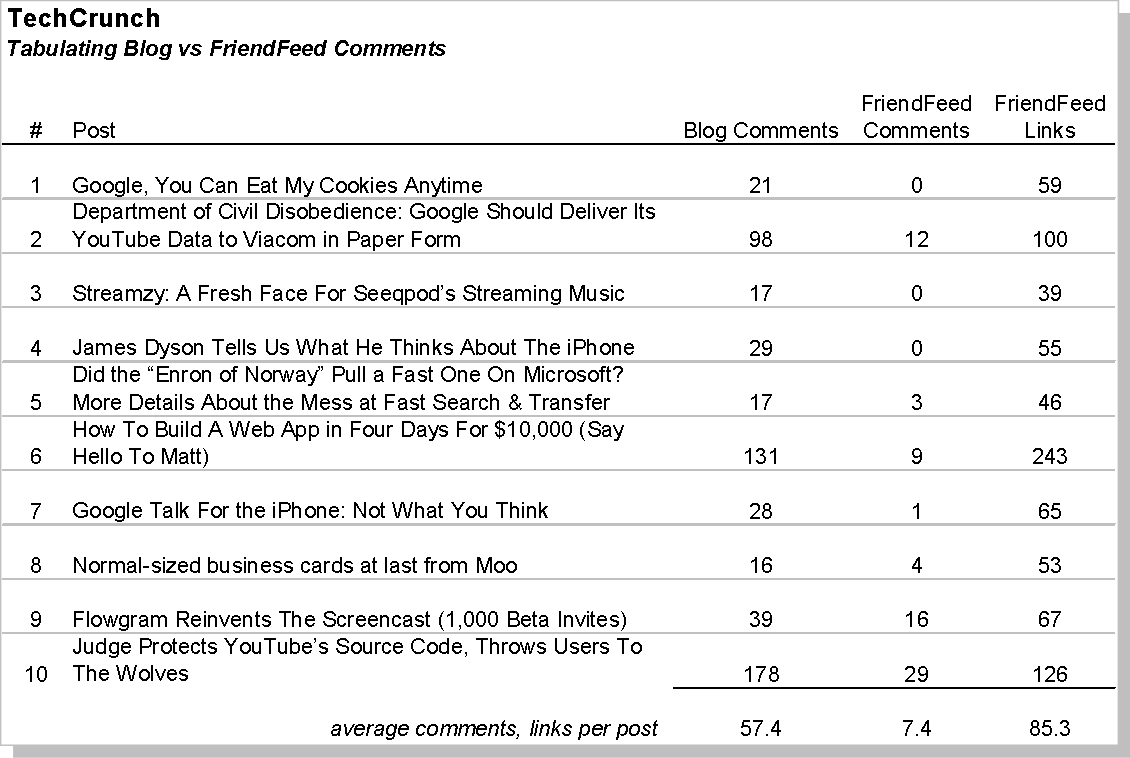
To get a sense of FriendFeed’s impact thus far, I looked at ten TechCrunch posts from the July 3 period. I counted the number of comments the posts received directly on TechCrunch, and how many they received on FriendFeed. For FriendFeed, I found all instances of the link – TechCrunch’s RSS feed, Google Reader shares, del.icio.us bookmarks, Stumbles, etc.

I excluded notes included with Google Reader shares or del.icio.us bookmarks from the FriendFeed comment count.

Looking at the table a couple things stand out:

  • FriendFeed does not appear to have stolen too many comments from TechCrunch
  • FriendFeeders have put the link out into their individual networks an average of 85 times – that’s the kind of visibility most blogs would kill for

I want to call your attention to post #10 in the above table, “Judge Protects YouTube’s Source Code”. 29 comments on FriendFeed. 14 of those comments came on a direct post of the TechCrunch article by Jason Calacanis. Jason has 29,000 followers on Twitter, and many of those have come over to FriendFeed. So when posts a question, he can get a lot of comments. But more importantly, the people commenting on his post are in all likelihood doing it because it’s Jason Calacanis.

My guess is that most of those commenting would not comment on the TechCrunch post. They’re more interested in what Jason is discussing.

Some Conclusions

I’m sure Allen is right about the TechCrunch “regulars” who post and reload multiple times. I’ve seen the reload behavior in myself when it comes to FriendFeed. However, I suspect his estimated number of reloads is way overstated. If you were to look at the 70 commenters in his scenario, you’d be lucky to get an average reload of 3 times, not 39 times. Sure, some commenters will hit double digits in their reloads. But many commenters won’t return at all.

The other consideration is that FriendFeed will take away some of those diehard reloaders. But I’d be willing to bet most of the die-hards will stay on the blog itself. Why? These guys’ relationship is with the blog and if you’re really reloading 39 times, you won’t stop commenting on the blog itself. I’ll bet there are a bunch of TechCrunch-heads who know one another via posting there. The TechCrunch site is their social network.

For most blogs that don’t generate 70 comments per post, the viral attention features of FriendFeed hold greater benefit than comments on the blog itself. Look at the ratio of FriendFeed links-to-comments for TechCrunch:

11.5 times more links for a post than comments (85.3/7.4)

As a blogger, I’ll take that trade-off. All those links are added visibility. FriendFeed is just as much about discovery as it is about conversations. That shouldn’t be overlooked.

Even Allen’s post about this was visible 24 separate times on FriendFeed.

Finally, in an interesting development, check out how ReadWriteWeb is integrating FriendFeed comments into each blog post. That’s one of the top 11 blogs worldwide embracing FriendFeed comments.

*****

See this post on FriendFeed: http://friendfeed.com/search?q=%22Do+FriendFeed+Comments+Hurt+Bloggers%E2%80%99+Ad+Revenue%3F%22&public=1