Subscribe or Not? Toluu Just Got Better at Helping You Decide

A couple months ago, I had a chance to review Toluu, the blog recommendation site. The site is great, and has gotten really good uptake. In that review, I did write this:

I’d like to get a little more info about some of these blogs in a summary fashion, without having to click each one.

Well, Caleb Elston and team have delivered some nice new features that do just that. Here’s what is new at Toluu:

  • View the most popular posts from a blog
  • Who else has subscribed to the blog within the Toluu world
  • What other blogs those same subscribers have subscribed to recently
  • Posts now have datestamps
  • The contact page loads 5 times faster

The new features providing context around a blog are particularly interesting for me. Let’s look at those.

Toluu Before and After

Here’s a screen shot of the page for a blog before the updates. The most recent post for the blog is shown, without any date information.

Next, the same screen with the updates. Below, you’ll see new tabs for the blog: Recent, Popular, Subscribers. Also, note that the post for the blog now has timestamp information (“Yesterday”).


With the addition of the tabs, you now have quick access to more information about the blog.

Popular Posts = Better Insight into the Blog’s Best Stuff

As you’re checking out whether to subscribe to the blog, you click on the Popular link. This is pretty nice. The blog’s most popular recent posts are shown. At a glance, the user can see if the blogger’s top stuff is interesting. A good way to gauge what animates the blog.


According to Toluu founder Caleb Elston, the determination of what’s popular for a blog is “a combination of our own data mixed in with some data from AidRSS and soon a few more sources.”

The list shown for this blog is a pretty good indicator of popularity.

Subscribers = Who Else Likes this Blog?

This feature is really cool on a couple fronts. As a user deciding whether to subscribe to a blog or not, the list of subscribers provides a reference of sorts. Who feels like there’s enough “there” to warrant a subscription?


You can see what other blogs the subscribers have added as well. For example, I see that Corvida added Blogsessive. I checked it out, and decided to add it myself. A really nice way to leverage the filters of others in finding blogs you may like.

In fact, in terms of human filtering, you now have three ways in Toluu to handle that:

  • The algorithm-based matches to others
  • Your selected contacts’ additions to their feeds
  • What are the other feeds of people who subscribe to your blog

As a blogger, I also find this feature very nice. You may know your number of subscribers, but do you know who they are? Well, with Toluu, it’s pretty easy to see who some of them are.

Nice Job

These changes are a great step forward in helping you decide which blogs warrant your subscription. Better sense of the blog’s content. Better sense of the crowd that likes a particular blog.

My wishlist still includes better macro, summary recommendations for blogs. But all in due time. Hats off to Caleb and team for adding these excellent features.

Also – I invite you to check out my Toluu page: toluu.com/bhc3 If want an invite, just leave me a comment.

*****

See this item on FriendFeed: http://friendfeed.com/search?q=%22Subscribe+or+Not%3F+Toluu+Just+Got+Better+at+Helping+You+Decide%22&public=1

Will Brands Figure Out FriendFeed?

No one wants a relationship with their mustard.

NeoAtOgilvy COO Greg Smith, via Kara Swisher at Boomtown

Two posts caught my attention. Kara Swisher has a nice post titled Social Ads Not Cutting the Mustard? In the post, she breaks down the issues that brands have in being part of the social media world. And Jeremiah Owyang hypothesizes about How Brands Will Use FriendFeed.

The two pieces do a good job of highlighting the challenge of social media for companies. Social media is authentic, it emerges from everyday people, it’s governed by its own community rules, it’s random and it’s an ongoing conversation. How do profit-oriented companies requiring measurable results and consistent formats deal with this?

The general thrust of companies’ social media efforts is to create enthusiasts who will turn around and do viral marketing on behalf of the company. Word of mouth (WOM) marketing. It is a big deal, and it would be wrong to suggest it doesn’t exist. It’s quite powerful when it happens.

But a problem with most WOM marketing is that it’s too dependent on big hits that catch the imagination of people. The fantastic YouTube video. The funny widget for Facebook and MySpace. The imaginative web page.

Those types of mega-hits are incredibly important, and are a requirement for every marketer’s toolkit. The problem is when a company’s social media strategy only relies on the big hits.

Jeremiah talks about how companies should engage users on FriendFeed:

The one caveat is that brands will need to be part of the discussion that happens among these social tools, as what’s really important is the people that are talking, debating, and discussing what your company is announcing. For those that get it wrong, no one will subscribe, no one will talk about it, no one will ‘like’ it and spread it to their network. So be active in the comments, conversations, and an open manner.

He lays out a good philosophy that companies should follow. Don’t simply rely on the big hits. Get out there and engage people. Become part of the community.

I’m wondering what exactly does a company’s participation on FriendFeed look like? Jeremiah points to Ford Motors as a company with one version of social media press releases. So how would Ford use FriendFeed?

To Do’s for Brands on FriendFeed

Create a Ford Motors room: Every company should have a destinaiton on FriendFeed. As an individual, my presence on FriendFeed is defined by subscribing – both by me and to me. A company should have a more permanent home than just being in a list of subscribers.

Find your initial audience: The everyone search is a good start. Start with people who are talking about your company, good or bad. Search on ‘mustang‘. Search on ‘F150‘. Search on ‘Ford Verve‘. Subscribe to these people.

Like and Comment: If Ford comes across someone’s interesting content, throw a Like their way. Jump in with some comments. Here are a couple examples.

First, there’s this Tweet:

Going to test drive F150 tonight. We must be crazy. Prius won’t pull horse trailer though.

Great opportunity for Ford here. In this case, someone from Ford could add a comment like, “Yeah, we made the F150 pretty powerful for those big jobs. I can get you set up with a special visit at your local dealership if you want.”

I’d also avoid laying the smack down on the Prius, tempting as it is for Ford. Criticism based purely on a profit motive is a fast way to undermine authenticity.

Next, here are some Flickr pictures of a ’67 Mustang:

Ford occupies a unique place in Americana, and this picture taps into that. Ford would definitely want to Like these Flckr photos. Add a comment too: “Those 67’s were classic cars. Takes you back to a different time, doesn’t it? We have several of them here in the Ford museum. One thing we’re realizing here is that people still love that style, and look for the new 2009 model to reflect a lot of what made that car great.”

See? Ford has engaged a person. The interaction caused the pictures to pop into others’ streams. And Ford got to plant a seed for what’s coming out later in the year.

Engage on topics that fall outside pure product: Establish a presence beyond just talking about specific products. It will help the company’s social media ‘cred’, and make it more interesting for people to follow. The downside? Your critics will find you, and you can get stuck in a nasty throwdown. So choose your topics carefully. Rising gas prices are a recurring topic on FriendFeed and other social media. A lot of people would want to know what Ford is doing in terms of gas-powered fuel efficiency, as well as in gas alternatives, such a hybrids.

This is a chance for Ford to blow it, or to shine.

Here’s what blowing it looks like: “We continue to believe that California’s efforts to enact higher gas mileage requirements are wrong.” Say that, and you’re just itching for a fight. People will no longer focus on Ford the car company. They’ll focus on Ford the antagonist.

Here’s what shining on FriendFeed looks like. “We see the market segmented into those for whom gas mileage is important, and those for whom capacity and power are important. And our view is that the fuel efficiency segment is growing fast, and we are responding to that.”

Stick with it: This type on engagement is a long term play, with benefits that will be realized over years rather than a quarter. There will be direct benefits as consumers learn more about companies. And companies will get a lot of publicity for their efforts until it becomes mainstream and everyone is doing it.

Final Thoughts

I’m no brand expert, but these are my thoughts on how companies could use FriendFeed, and other social media as well. Done right, this type of marketing could emerge as an important part of  companies’ engagement with the market.

What do you think?

*****

See this item on FriendFeed: http://friendfeed.com/search?q=%22will+brands+figure+out+friendfeed%22&public=1

Nick Carr: Google Making Us Stupid? How About Smarter?

The media or other technologies we use in learning the craft of reading play an important part in shaping the neural circuits inside our brains.

Nick Carr, “Is Google Making Us Stupid?”, The Atlantic, July/August 2008

Nick Carr has a really interesting piece in the current issue of The Atlantic (CNET coverage here). The premise of the article is that use of the web is possibly rewiring our modes of thinking. We’ve become much more adept at the light skimming of content than the deeper understanding of long thought pieces. If that’s the case, what does that mean mean for intellectual progress in the future?

The article is full of historical references (e.g. how Friedrich Nietzsche’s writing changed when he went to the typewriter) and scientific studies (e.g. the plasticity of the human brain enables us to adapt to new learning modes).

One area that Nick doesn’t talk about much is apophenia, which Maki on FriendFeed first alerted me to. According to Wikipedia:

Apophenia is the experience of seeing patterns or connections in random or meaningless data. The term was coined in 1958 by Klaus Conrad, who defined it as the “unmotivated seeing of connections” accompanied by a “specific experience of an abnormal meaningfulness”.

Robert Scoble employs apophenia as part of his profession. In one of his posts, he says: “I like the noise. Why? Because I can see patterns before anyone else.”

In this way, the larger consumption of data in lightweight chunks can be thought to bring a new kind of intelligence to people. Your subconscious is collecting a series of signals along the way. At some point, all of this information lurking just below your accessible thought pops up, and you’re suddenly aware of an emerging dynamic.

I really like this idea. And it fits with how we pick up information ourselves in the physical world. You don’t stop and ask people what they’re talking about on the street. But you may pick something up as you listen in to their conversations. You may not read the planning commission report, but you see how development is progressing in your town based on the construction you see.

I’ll contrast apophenia with traditional learning, in which a person can go deep with the thinking of a few selected masters in a field. But I draw this contrast not to dismiss traditional learning. Not at all. Understanding things based on a deeper reading of learned intellectuals and practitioners is a vital part of learning.

I hope Nick is wrong about losing our ability to sit through a longer piece. I haven’t lost that – I read his article twice this weekend.

If we can add a new mode of learning via apophenia to our traditional forms of undersatnding concepts, we’re all going to be smarter in the long run.

*****

See this item on FriendFeed: http://friendfeed.com/search?q=%22Nick+Carr%3A+Google+Making+Us+Stupid%3F+How+About+Smarter%3F%22&public=1

Three Big Questions Facing FriendFeed

I write about FriendFeed. A lot. Someone told me they wondered if I was employed there. Nope, just really enjoying the service.

Then I see a couple of bigger names in the online world, Robert Seidman and Steve Rubel, expressing their view that FriendFeed feels like it’s going to be the next big thing.

And I realize I’m not the only one with great enthusiasm. It’s growing.

As FriendFeed continues to acquire new users, innovate and roll out new features, it’s inevitable that some big decisions will need to be made. I want to discuss three of them here. Shall we?

1. How Will FriendFeed Balance Signal, Discovery and Noise?

This question really hits on two fundamental elements of the social media experience:

  • Distribution of information
  • Consumption of information

Managing information is a BIG deal. It’s hard to get the balance right – when do users really need a piece of info, when are they in the mood for a bit of discovery and at what point do they tune out because of information overload?

Google’s success was in recognizing the need for better information access, a process they continue to refine and improve. The thing with Google is that you search when you have a defined need. User intent is known. It’s what makes Google’s advertising so successful.

FriendFeed has a bigger challenge. Intentions vary by person. By hour. There’s time the river of content needs to deliver a hard dose of signal. Other times, you need a break from some work you’re doing, and you want a bit of discovery. But above all, please recognize what I consider to be noise!

So FriendFeed has to figure out the user intention, a burden that Google doesn’t have.

They’re off to a great start with these:

  • You choose the people to whom you subscribe, providing the first cut on topics you’ll see
  • Excellent Hide function
  • Rooms to isolate discussions around topics
  • Ability to view top content by likes, comments and other signals

This will be an ongoing war for FriendFeed, particularly as the service grows beyond its information junkie user base.

2. How Much of a Social Network Does FriendFeed Want to Be?

FriendFeed states their mission as follows:

FriendFeed enables you to keep up-to-date on the web pages, photos, videos and music that your friends and family are sharing. It offers a unique way to discover and discuss information among friends.

A simple goal. And yet, early users of FriendFeed are finding the social network aspects of FriendFeed to be compelling. I personally have established a completely different network of people on FriendFeed from what I have on Facebook or LinkedIn. I didn’t just port over my friends from those services, I established new connections.

When I was training for my first marathon back in 2003, I regularly participated over on Runner’s World message board. A group of us were running the California International Marathon in Sacramento, and an online bond formed. We conversed on the message board, and decided to meet up in Sacramento. How’d we do it? One guy posted his disguised email address, and we all emailed him. We then did the email thing to coordinate.

FriendFeed is above that level of social networking right now, but not by a whole lot.

FriendFeed has the potential to be a very powerful social network, one rivaling Facebook and LinkedIn. Why? Facebook is your network from school. LinkedIn is your network from work. FriendFeed is your network based on stuff that interests you. That’s what makes it so powerful.

Remember the interest in felix’s FriendFeed Likes Compatibility Calculator? People were really curious about who they match up with based on shared interests.

A few things come to mind as “best of” elements of social networks:

  • Direct messaging (Facebook, LinkedIn, Twitter all provide this)
  • Profile page – express yourself, complements your content, Likes and Comments
  • Status – for those times when you’re just not around or you need to get personal

Want to take it further? I can see FriendFeed becoming a more robust professional network than LinkedIn. You like all those comments and content? Maybe you’d look at that person as a potential hire. How about calendaring? Coordinate events, and it’d be a real nice complement to the Rooms.

How far does FriendFeed want to go in social networking?

3. How Will FriendFeed Make Money?

Ah, the money question. It’s inevitable and ultimately must be addressed to justify the venture capital.

I can see two possibilities for making money at this very early stage in the company’s history:

  • Advertising (duh…)
  • Business uses

Social media advertising has potential, but is not without its issues.

FriendFeed has a a few things to address and going for it when it comes to advertising. Users’ affection for the Refresh function means a lot of page views, but how much time will they spend on the ads. There’s a field of white space off the right, so real estate for ads won’t be a problem.

But FriendFeed does have two good weapons in its arsenal when it comes to advertising:

  1. A search function with a ton of potential (and search is the killer advertising feature)
  2. A mountain of data about what users’ interests are

As for business uses, my first thought when I saw the Rooms feature was that it could be a great thing for companies to use. Employees can trade thoughts on ideas and projects via Rooms. In fact, that’s how the FriendFeed guys use Rooms:

It started when we wanted a better way to share feature ideas and product plans with each other here at FriendFeed

I can also see media companies adding Rooms functionality to their sites. A much richer way to let readers discuss content than the current commenting systems.

Final Thoughts

I’ve written plenty about FriendFeed, and I’ll probably write more in the future. Partly because it’s such a compelling site for me. As a full participant, I can see a lot of stuff going on. And it doesn’t hurt that the site is getting hot in the blogosphere.

But there’s something deeper here as well. In FriendFeed, you can see some of the bigger issues that all social media have to deal with. For instance, I’d written a series of posts about the noise issue on FriendFeed. My most recent post stepped away from being FriendFeed-specific, and took a look at the broader issue of signal vs discovery in social media. Marshall Kirkpatrick of ReadWriteWeb took it a step further with a great post Why Online “Noise” Is Good for You, pulling in scientific studies on the value of noise and discovery.

FriendFeed is tackling some meaty issues, as described above. Since they’ve got traction, a talented team, an innovative spirit and an attentive audience, their efforts to address the big questions will be a terrific study of the larger social media realm.

*****

See this item on FriendFeed: http://friendfeed.com/search?q=%22three+big+questions+facing+friendfeed%22&public=1

Weekly Recap 060608: Ferris Bueller Was Right

The week that was…

*****

“Life moves pretty fast. If you don’t stop and look around once in a while, you could miss it.”

Ferris Beuller, Ferris Bueller’s Day Off

Consider that line in the context of the recurring demand for more signal

*****

FriendFeed rolled out a new feature to let you see the content that has risen above the noise…Personalized recommendations let you see the stuff that has the most likes and comments, but only for content provided by your network…actually, upon closer inspection, there’s one other component to the ranking…from the blog post: “based on your friends’ comments and ‘likes’ and other signals”…other signals?…hmmm…wonder what those are…

It’s a very cool feature, with some real potential…early benefit seems to be finding the good stuff missed during extended time away from FriendFeed (like more than 2 hours)…it also gives you a personal meme as well…

Robert Seidman has a good post describing potential pitfalls…

What winds up happening is that people are finding “best of” items so easily that they naturally are and adding more “likes” and comments to them which causes them to jump to the top of my regular FriendFeed stream (even outside of “show best of”). I don’t love this.

I noticed this too…older posts with lots of likes/comments suddenly were showing up in my stream again…because people using the “best of” feature were liking and commenting…let’s see how the dust settles once people get used to it…

*****

Robert Scoble, on the value of noise

If you don’t have noise, how can you tell what is signal?

Stop and think about that for a little while…

*****

I’ve been harping on the noise and filter issue for a while…I was really stoked to see ReadWriteWeb’s Marshall Kirkpatrick pick up the issue with a beautiful blog post Why Online “Noise” is Good For You…a few good points Marshall brings up…

  • Scanning quickly over large quantities of roughly relevant information can turn up invaluable resources, opportunities, context and contacts.
  • The ability to recall passively collected information that was gathered purposelessly in the past and put it to use in the future is a particularly powerful form of intelligence.
  • Some people worry that being exposed to too much information will lead to not remembering very much of it. Scientists say that’s not necessarily the case, though.

There’s a lot more there, you’ll kick yourself later if you don’t read it…

*****

Plurkkarma“…gonna wait on this one…

*****

Had a chance to visit the FriendFeed office this week during their open house…if you’ve seen Robert Scoble’s Qik video, you’ve got a good sense of their office space…big, spacious, plenty of room to grow…they actually share the space with another company…

Paul, Bret, Kevin, Casey, Ross, Dan, Ana (bios here) were all just as nice as can be…I’ve actually never gone to one of these start-up open houses before, is this some sort of Valley tradition?…one thing I got from talking with Paul was his interest in the distribution and consumption of information, which is what FriendFeed is all about…

Got to meet a few folks I’ve seen online…Ginger Makela, Adam Lasnik, Adam KazwellLouis Gray was there, and he had this awesome shirt that has his blog graphic on it…it actually made it easier to identify him if you’ve never met him before…as Chris Brogan’s been writing, you need to establish your online brand (even in offline meetings)…

*****

See this item on FriendFeed: http://friendfeed.com/search?q=%22Weekly+Recap+060608+Ferris+Bueller+Was+Right%22&public=1

Social Media Consumption: You Want Signal or Discovery?

In yesterday’s post A Definition of Noise, I talked about two types of social media consumers. Those who have a strong desire to receive only signal (signalists) and those who are looking for stuff outside their own interests (discoverers).

I thought it would be interesting to explore this a little further. Shall we break it down a little more?

Where are you on this table?

*****

See this item on FriendFeed: http://friendfeed.com/search?q=%22social+media+consumption+you+want+signal+or+discovery%22&public=1

A Definition of Noise

FriendFeed co-founder Bret Taylor has a nice interview with CNET’s Dan Farber today. In the interview, Bret mentions that FriendFeed will be introducing ranking algorithms soon. These will create your own personalized FeedMeme.  Which is going to be interesting. Dan Farber then asks whether user controls over content will be rolled soon. Bret answers ‘no’.

In the discussion around this link to the interview, Kingsley Joseph comments:

great interview. Bret’s got it right – ranking algorithms, not filtering is the key to noise processing

This was an interesting comment. I think of noise as a very personal thing. And the ability to define your own take for what constitutes noise makes sense to me. But Kingsley has a different point of view.

So I wondered…are we talking about the same thing. What exactly is noise?

A Definition of Noise

The diagram below is my definition of noise.

Signal is all about the stuff you actually want. For some, it’s a steady stream of social media entries. For others, it may be a steady stream of parenting items. Or baseball discussions.

Discovery is the middle ground. It’s things you weren’t looking for, but find interesting. Maybe Flickr Favorited pictures. An interesting tidbit from the world of science. An Inquisitr celebrity update.

Noise is the stuff you just don’t have the patience to put up with. It’s not anything you’re seeking, it’s annoying you that it’s even on your screen.

In this definition, there’s a fine line between discovery and noise. I’m argue that its the quantity of entries that determine whether something is noise or not. A few items creeping into your FriendFeed is probably all right for all but the hard core signalists. At some point though, when the volume of stuff you’re not seeking crosses a threshold, the entries become noise. You’re not getting enough of the stuff you’re seeking.

Everyone has their own threshold for discovery versus noise. This is the personalization required for noise control. Alexander van Elsas touches on this issue in a recent post:

It’s the noise problem (Try a search on “noise” here for example). How can we find the things that are really important from that huge pile of information floating around. That is partially why we have aggregation and filtering services. Each of them, using one algorithm or another, tries to compile a tiny subset of the universe and present that to its users. The question that remains is whether or not the right tiny space is presented.

Alexander strikes me as being closer to the signalist end of the information spectrum.

FriendFeed Rooms + Ranking Algorithm > Filters?

This brings me back to Kingsley’s point of view that ranking algorithms are optimal for noise control. Ranking algorithms are absolutely terrific. I love them. They provide a lot of benefits in a number of areas (e.g. Google Search).

I’m should also note FriendFeed’s Rooms as the other initiative for isolating topics and controlling noise.

Are they enough to control the noise? It’s hard to say yet. For Rooms to be effective, members are going to need to use them pretty frequently. That can happen over time, but it’s still dependent on the broadcasting member using them. There won’t be 100% compliance because:

  • I can’t perfectly predict what my subscribers will think is noise
  • Likes and Comments on something outside my usual programming put entries into my subscribers’ streams

The ranking algorithms will be interesting. Looking forward to seeing what gets rolled out. Knowing the FriendFeed gang, it’ll be good.

The difficult part is finding the middle ground between the hard core signalists and the discoverers, who like a fair amount of entries outside the stuff they seek. Neither group wants noise, but the threshold for the number of unseeked items varies greatly. My tolerance is pretty high, so I guess you’d call me a discoverer.

Balancing the desires of the signalists and the discoverers, and the varying thresholds of individuals will be the challenge. Let’s see what the ranking algorithms do.

I’m @bhc3 on Twitter.

Fostering Innovation: Lots of Little Fires or One Inferno?

An area that I find really interesting is role that social media can play in improving innovation. Before the advent of social media applications, innovation needed two primary drivers:

  1. Someone with the passion and time to see it through
  2. The luck that someone’s offline social sphere picked up on an idea and helped spread it

Today, innovation can occur much more easily than before, courtesy of social media. An idea can be disseminated and discussed far beyond (i) the originating person’s social sphere; and (ii) their level of energy to pursue it.

Which brings me back to the ongoing discussion about distributed conversations. Is innovation the product of lots of little conversational fires or one raging talk inferno? The answer is ‘both’, but I think people have undervalued the potential in lots of little fires.

The Myth of the Iconic Genius

Recently, Malcolm Gladwell wrote a great article for The New Yorker, In the Air – Who says big ideas are rare? The piece examines the history of innovation, with Alexander Graham Bell’s role in inventing the telephone as a case study. Turns out Bell wasn’t the only one working on the telephone. Elisha Gray also had a working telephone at the same time. As Gladwell describes it, this is but one example of what science historians call “multiples” – cases of simultaneous invention by completely independent persons. It happened in calculus, evolution, decimal fractions, and many, many other fields.

After discussing the findings of two researchers, Gladwell puts context to the common occurrence of “multiples” in history:

For Ogburn and Thomas, the sheer number of multiples could mean only one thing: scientific discoveries must, in some sense, be inevitable. They must be in the air, products of the intellectual climate of a specific time and place.

In other words, it’s a fallacy to think that innovation only channels through one singular genius. Which brings us back to this idea that distributed conversations are a bad thing.

The Value of Lots of Little Fires

Lets use innovation inside the enterprise as an example. An employee comes up with an idea. Not a perfect idea, perhaps not a fully formed idea. But an idea that’s got some shine to it. I hope that sounds plausible to you if you work inside a corporation. It rings true to me.

Assume the company has a good platform for this employee to propagate it. She blogs the idea on some internal web application. Other people pick up on the idea. Now stop here for second.

If her idea is to gain traction, what makes the most sense? Employees from other departments, divisions, countries all interacting with this person they don’t know? Or employees thinking through the idea with their own social circle?

I argue that employees should be free to discuss the idea how they want and with whom they want. Why? It goes back to the observation of Ogburn and Thomas – invention is often the product of current broader thinking and prior discoveries. Inside a company, this likely means an emerging issue or opportunity that employees are starting to sense.

Little fires become big fires because they burn areas that are dry and ready to ignite. In the same way, letting employees hold their own conversations is a great way to find those patches of dry tinder that are ready for your idea. Some conversations will snuff out due to lack of good kindling. But other conversations will grow as the sparks from the originating fire find lots of wood to burn.

And that’s the importance of distributed conversations. You never know from where the energy and support for your idea is going to come.

Don’t Underestimate the Value and Motivations of People

So little conversational fires are important for building a buzz inside your company. What else do they do?

  • Provide different perspectives from outside your sphere
  • Motivate employees to care about your idea

In our company example, lets say the originator of the idea is in Field Operations. She knows the customers well and has a good sense of what they’re feeling. So she writes up her idea in a blog post.

But her idea would affect a lot of different groups: product, operations, development, finance, marketing, sales, etc. Each of these departments will have a unique understanding of the idea’s requirements. Would you force all of these different perspectives through that one blog? Of course not.

Stepping outside the employee motif for a second, I think it’s important to understand that people have different experiences, interests and talents. And they have their existing peers with whom they talk. When it comes to discussing a newly presented idea, it’s unnatural to force them to abandon these existing connections and prior conversations. If that means the originating author has to chase down the conversation, so be it.

Stepping back into the employee motif, the other value of little fires is the motivational aspect. If you want an idea to take hold, you have to relinquish some control of it. If you don’t don’t, you’re going to run right into a wall of indifference.

This sounds bad to say – aren’t employees only interested in the greater company good? Maybe. But lets not make that the only basis for the success of an idea. Acknowledge that people work hard and have ambitions. The little fires of distributed conversations give them ownership of the idea within their particular social sphere. They can point out the flaws, come up with improvements and relate the idea to previous thinking.

Forcing everyone back through the originating blog post loses this dynamic, and you’ve just killed the personal motivation of some people to participate.

But Isn’t This All Messy?

Yes. It is.

Proper recognition for the idea will be an issue. Going back to Malcolm Gladwell’s article, he lists a number of people who came up with an idea at the same time as more famous inventors and discoverers. But they didn’t become household names (e.g. Elisha Gray).

Also, as different groups work through an idea, fiefdoms might emerge. Different groups laying claim to having the best vision and plan for the idea. Who’s right and who should drive it forward?

But here’s the good news – the idea got traction. Senior managers are well-paid to figure out the other issues (I’ll pause here for your Dilbert snicker…).

Now if the company’s blogging software is any good, the original author of the idea will be recognized. And more than likely, our heroine was involved in several of the distributed conversations that occurred. She is not divorced from the whole innovation process.

Final Thoughts

Distributed conversations are an important component of gaining traction for innovative ideas. They enable a greater percentage of ideas to come to fruition than in traditional company settings where dialogue is limited to your own social sphere.

I’ve used life inside the enterprise to describe why distributed conversations have value. I think a lot of the same motivations apply out on the world wide web as well. If you’re a blogger and you think you’ve got a good idea or insight, recognize that you most likely were not the only person thinking that way. So don’t be too bothered when little conversational fires start elsewhere – your spark landed in some dry tinder.

Grab some marshmallows and join the fun.

*****

See this item on FriendFeed: http://friendfeed.com/search?q=%22Fostering+Innovation%3A+Lots+of+Little+Fires+or+One+Inferno%3F%22&public=1

Filtering FriendFeed – How Crowdsourcing Can Solve This

It would be nice to have filters on FriendFeed. For instance, it would be nice to be able to hide any post containing the word “Obama” without having to hide someone’s other stuff. Or the ability to hide any entry containing the word “ubuntu”, etc.

Thomas Hawk, FriendFeed direct post, May 1, 2008

The need for filters on FriendFeed is a recurring topic. Click here to see the numerous entries that contain the words ‘friendfeed’ and ‘filters’. Louis Gray notes the need for this in a recent post.

I want present an idea for filters that has two pieces:

  • Category filters
  • Keyword filters

The two pieces are interrelated, and crowdsourcing will be used to build out the category filters.

Let’s get to it, shall we?

Category Filters

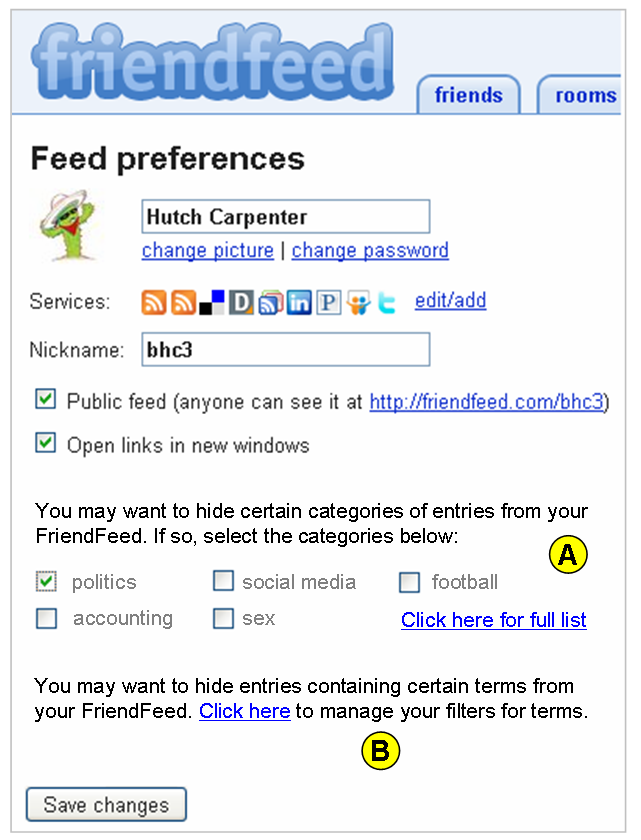
FriendFeed already has a “Feed Preferences” page for each member. Here is where you can manage your category and keyword filters. The graphic below is mockup of this:

A. Category Filters

Various categories will be displayed, along with a link to the full list of categories. In the example, above, I say that I’d like to filter out all FriendFeed entries that relate to politics.

The value of category filtering is that it prevents you from having to manage every keyword that might relate to a category. In a recent post, I noted Dave Winer’s 38 different politics-related terms. For instance, he used the terms: Hillary, HRC, Clinton, Edwards, Obama, Rove, etc. Having the ability to automatically filter those out without having to set up keyword hides over and over would be a great benefit to many members. Particularly as FriendFeed gains traction with a flood of new members.

Now how would FriendFeed know that Hillary, Obama, HRC, etc. are part of the politics category? Keep reading.

B. Keyword Filters

Members will need the ability to see what words they have hidden. They can un-hide keywords, or add new keywords to hide directly on the Feed Preferences UI.

Keyword-Based Hides

FriendFeed currently supports hiding specific entries, plus entries from specific members and services. For instance, you can hide all Twitter updates. What is lacking is the ability to filter out entries with specific terms in them.

For instance, shown below are three tweets from Dave Winer regarding politics:

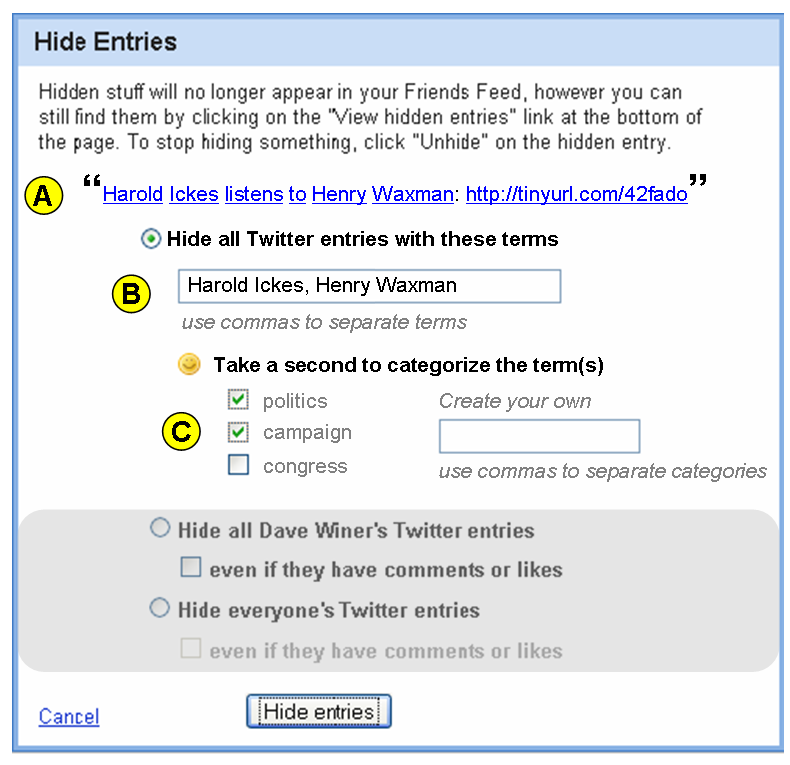
What I’d like to do is apply the Hide function to anything with ‘Harold Ickes’ or ‘Henry Waxman’. This is a mock up of that screen below:

A. Full Text of Entry Displays

The full text of the entry appears. Each word of the entry includes a link. The links are easy ways for members to populate the ‘hide terms’ input box.

B. Hide Terms Input Box

Commas separate each term.

C. Categorize the Terms to Be Hidden

As the member hides the terms, they will be asked to apply a category. The most popular categories previously applied to the keywords will be displayed. Or the member can type a category into the input box, and FriendFeed will auto-suggest different categories with each character entered.

Why do this? This is the basis of the crowdsourced solution.

Let the People Decide

People will have a much better handle on the categories that apply to a keyword than will a heavy-duty algorithm. Such human filtering is the basis of tagging.

Two elements are relevant here:

  • The need to prevent bad categories being assigned to keywords
  • The motivation to do this categorizing

Use Bayesian Stats to Prevent Bad Categories

Here’s the issue you want to avoid. Some prankster assigns the football category to the term “Paris Hilton” while hiding all entries containing her name. Suddenly, members who are filtering out football entries stop seeing their Paris Hilton updates (yes I know, horrors…).

Enter Bayesian statistics. Carl Bialik, a columnist for the Wall Street Journal, has a great column on the use of Bayesian stats for online ratings. The gist of this approach is that all items in a rating system are born with identical ratings. Their ratings only change as people vote, and it takes a sufficient number of votes to really move the rating of an item. Here’s an example of this from the WSJ column:

For instance, as noted in the column, IMDB.com doesn’t use straight averages to list the top 250 movies of all time, as voted on by its users. Instead, each movie starts out with 1,300 votes and a ranking of 6.7, which is the site’s average. That helps smooth the effects of a few intense votes; it takes a lot of votes to budge the IMDB meter up or down from 6.7

That same approach would be applied inside FriendFeed. It would take a large number of people putting a keyword into the same category before the keyword actually became “part” of that category.

Once a keyword graduates to a category, any users filtering that category won’t see entries with those keywords.

Motivation

Why would anyone bother to categorize the keywords they hide? One answer – not everyone will. But there are two drivers of members doing some keyword categorization.

First, members need to recognize that they are contributing to a system from which they are likely benefiting. If you filter any category, you will be benefiting from the work of others’ who have categorized keywords.

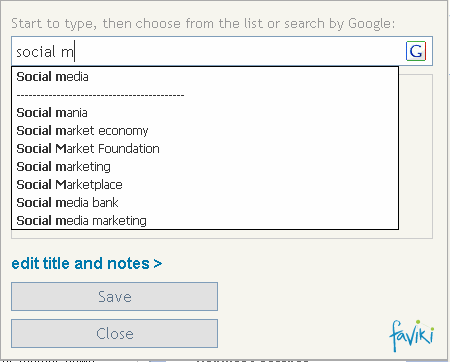
Second, the categorization experience has to be simple and fast. You’ve got the member right there, motivated to hide a term. Make it easy for them to channel that motivation into a simple categorization. The most popular previous categories are displayed, making it easy check them. And the auto-suggest feature can be done fairly quickly. I like how Faviki is doing it:

Faviki draws from thousands of different Wikipedia entries for this list.

Final Thoughts

One thing to consider here is that every entry coming into FriendFeed would need to be filtered for keywords. Serious processing power will be required. Fortunately, the FriendFeed guys have firsthand experience with high volumes of real-time queries for keywords at Google.

With regard to this proposal, I haven’t (yet) seen anything on the market that will provide the category tags that would help filter FriendFeed. Since it’s the members who are most in tune with what they want to filter, their common sense and motivation should be leveraged.

As FriendFeed grows, imagine new members easily managing the flow of information by simply filtering the politics category rather than having to set up an extensive list of new keywords. It would make the experience that much better for everyone.

*****

See this item on FriendFeed: http://friendfeed.com/search?q=%22Filtering+FriendFeed+-+How+Crowdsourcing+Can+Solve+This%22&public=1

Weekly Recap 053008: ‘No Comment’

The week that was…

*****

Good discussion this week about comments…first, there was the latest installment of this issue: comment dispersion away from the originating blog…Fred Wilson at A VC weighed in: Jackson instigated the conversation with that post. His reward is the comments it generates…interestingly, bloggers with big established audiences agreed with him…Chris Brogan wrote this on Fred’s blog: One part of the currency I crave from doing a blog is that conversation, especially on my blog, where I spend lots of effort building the posts to be conversation starters, not just fully formed ideas…Mathew Ingram wrote a concurring blog post Bloggers get “paid” with comments

Which made me wonder, do you think there’s a divide between larger established bloggers and smaller, newer bloggers on this issue of distributed conversations?

*****

Next up on the comment discussions…who actually owns the comments?…there was a controversy early in the week where Rob La Gesse was irritated at the comments that were occurring on FriendFeed about his blog post…so he pulled his blog RSS from FriendFeed, which eradicated that post and all its comments from the FriendFeed UI…this raised the question of who owns the comments, and whether FriendFeed should do a better job of keeping records…Mathew Ingram reached out to FriendFeed co-founder Paul Buchheit, who noted the bias is toward blogger control of their feeds and that they will look at ways to solve to better retain comments…

Later, Daniel Ha of Disqus wrote a post called A Commenter’s Rights…kind of a Bill of Rights for those who leave comments on blogs…one Right that I liked: ‘The ability to edit and remove their comments’…too many blogs don’t allow that, including wordpress.com…

We’ll close this out with a quote from my favorite cranky blogger Steven Hodson: This whole discussion about comments is becoming borderline stupid

*****

FriendFeed is growing, and not surprisingly, it’s getting its share of…um…interesting personalities…click this link which takes you to a search for “tweets totally f%(#ed twitter”…you’ll understand what I mean…

*****

Hats off to a couple of developers this week…I wrote a post titled FriendFeed ‘Likes’ Compatibility Index…I manually pulled together some stats to see which other FriendFeeders had the same Likes as me…well Yuvi wrote a script that he could run from his computer for any FriendFeed handle he entered…a bunch of us wanted our stats manually calculated, and he obliged…he blogged about it, and hit Techmeme…very nice Yuvi…

Then another developer, felix, created a UI where anyone could enter their FriendFeed handle to see the people who shared Likes the most…and then felix thought, “I’m going to turn this one up to 11″…he made pie charts out of the results, which have become a big hit on FriendFeed…FriendFeed co-founder Bret Taylor gave his thumbs up on felix’s blog, “Very cool!“…very nice work felix…

BTW, we’re all one playing for second place to Shey in the Likes department…

*****

Jeremiah Owyang apparently has an interesting post on FriendFeed that he’s writing for Saturday 5/31/08…Robert Scoble talked with Jeremiah, and gave this update:

I just talked with Jeremiah. He says FriendFeed will turn on a new functionality that Jeremiah is calling “MiniMeme.” He wouldn’t give me more details, but I am intrigued.

So check your RSS reader for Jeremiah’s post, and maybe we’ll be talking about that here next week….

*****

See this item on FriendFeed: http://friendfeed.com/search?q=%22Weekly+Recap+053008%3A+%E2%80%98No+Comment%E2%80%99%22&public=1

FriendFeed ‘Likes’ Index: Case Study in Value of Distributed Conversations

By keeping comments distributed, or decentralized, more than one discussion is able to take place. New ideas are likely to be heard since readers often start with a blank slate and are more likely to participate.

Shey Smith, introspective snapshots, The Case For Distributed Conversations

Today, a great example of the value of distributed conversations took place. What started as a blog post here ended up with three different developers coming up with innovative new scripts that FriendFeeders were digging. And it all happened because of distributed conversations, not despite them.

The very smart and in-tune Fred Wilson wrote a piece yesterday decrying the distribution of conversations all over the Web, including on FriendFeed. Mathew Ingram followed up with a concurring blog post. I understand where they’re coming from, but I think they overlook the value of distributed conversations.

What I’d like to do is briefly describe the action today, and then point out how distributed conversations made innovation possible today.

FriendFeed ‘Likes’ Index Calculators

Wednesday night, I posted a piece titled FriendFeed ‘Likes’ Compatibility Index. The post reported some number crunching I did to figure out who most often Liked the same things that I do. The idea was to see what other FriendFeeders shared the same interests. At the end of the post, I made a request for someone to automate the analysis.

From this post, two separate conversations emerged. The RSS feed for the blog post hit FriendFeed (Original Post). And Louis Gray shared it on Google Reader (Shared Post), which started a second conversation.

What happened? There were three different places where conversations were happening: on this blog and on two different items in FriendFeed. And it resulted in three separate developers coming up with solutions.

Yuvi

Yuvi, a 17-year old wunderkind who does amazing stats analysis, was interested in automating this analysis. He posted the same comment on all three locations: “I could automate this…if friendfeed fixed this bug.” Yuvi was concerned about a bug in FriendFeed that won’t allow you to go more than 11 pages back in your history.

His comment generated responses in FriendFeed on both the Original Post and on the Shared Post.

Original Post:

  • Phil Glockner: “Yuvi, does that bug exist when doing queries against the API?”
  • Yuvi: “Yes, it exists in the API too.”

Shared Post:

  • Shey: Yuvi, could you automate it up to page 11?
  • Hutch: Does the limit of going back beyond page 11 risk the script failing? Or does it limit the data collected?
  • Yuvi: @Hutch: Limits data collected.
  • Yuvi:@Shey: Well, I could… But, it’ll be of limited use, no?
  • Bwana: I say do it now so when they do fix it, it’ll be ready, plus there seems to be an interest
  • Shey: @Yuvi Limited yes, but I think 11 pages of data is of some use for analysis of recent data
  • Cyndy: Yuvi, I’m not sure it’s a bug. I think it’s a limit that they have set. Since the variable is passed in the URL, if you try to go past that number of posts manually, it still won’t go. Could be that they are only pulling from cache?
  • Yuvi: @Cyndy: Well, they’ve been mum on this – so I don’t really know. But, if even *I* can’t access my old stuff, isn’t that wrong on at least “some” level?
  • Benjamin Golub: I don’t think it’s a bug either. I feel that there DB sharding might be setup such that it is very very quick to pull recent data.
  • Bwana: Well if there is a limit imposed, pages after 11 shouldn’t even be shown. It’s a bug of some kind either way.
  • Yuvi: @Benjamin: Yep, agree on that, but there should be ‘some’ way to get the older data out, no?
  • Yuvi: Just repeating – the API has the same limit in place. Script ready anyway – First Target – LouisGray 😉

So in that sequence, you see that fragmented conversation, away from the blog post itself, resulted in Yuvi creating a script to determine who shares your Likes.

And Yuvi blogged about it, linking to my blog post and even mentioning me by name. Everything a blogger could want.

Do you see what I mean Fred and Mathew?

Ole Begemann

On Louis’s Shared Post, a second developer Ole Begemann weighed in:

  • Ole Begemann: I’ve written a Python script that does this, too (for practice). Interestingly, Phil is no. 12 on my list of Louis Gray’s most compatible likers. If there’s interest, I’ll try to wrap it up on a web page (it’s command line at the moment) and publish it.
  • Hutch: @Ole – Yeah, I’d like to have a page where you could see these results.
  • Ole Begemann: I’ll get around to it Hutch. It might take me a few days. It’s my first try as a Python programmer. 😉

A second developer came up with a script for this. Again, via conversations that happened entirely away from the originating blog.

felix

Finally, back on my Original Post in FriendFeed, a developer named felix added this comment:

“I just created a little javascript to go and grab the last 30 likes of anyone and do a basic calculation. Have a couple more features I want to add, but no more time today – what do y’all think? http://is.gd/nLc

That link goes to a blog post, where Ole links back to my original blog post. Again, as a blogger who wrote something I thought might be interesting, this is all really good stuff.

None of it occurred on my blog. And it doesn’t bother me in the least! in fact, check out felix’s blog post. You’ll see that he, Yuvi and Ole are having a conversation about FriendFeed API limits.

Why the Distribution of the Conversation Made a Difference

Three points to make here.

1. Go where the conversations are

If I’d been hung up on forcing everyone back to my blog for comments, this likely would not have been as successful as it turned out. FriendFeed offers a dead simple commenting function that makes it incredibly easy to comment. People find it easy to interact around content, rather than everyone having to travel from blog to blog to hold conversations.

Some blogger removed his RSS from FriendFeed recently, because he didn’t like all the FriendFeed comments along with it. Really? I remember the story, but can’t find the link to his blog. Seriously.

2. Connect to people outside your blog subscriber base

Digg, StumbleUpon, FriendFeed…all of these give exposure to your blog outside of those who subscribe to it or bookmark it. And when conversations about your blog occur on these venues, you’re getting vital exposure.

Make no mistake about this. A Like or a Digg or a Stumble is great. But if you really want to attract people to your blog post, comments are king. They tell people that the post is interesting, and that they better go read to get in on the discussion.

Louis Gray has a bigger, and different, community than I do. So his share of the post on Google Reader, and the subsequent conversation, attracted people who might never have bothered with my post.

felix, who developed the really cool app where you can see who shares your Likes, does not subscribe to me in FriendFeed, nor does he subscribe to my blog. I looked at his subscriptions, and we do have a number of FriendFeeders in common including Louis. I presume that’s how he found his way to the conversation about the blog post. Would he have been attracted to the blog without the conversation going on inside FriendFeed? Unlikely.

Embrace distributed conversations. They are free advertising for your blog.

3. Use the everyone search feature

Have people figured out this one yet? On FriendFeed, you can run a search for your blog post title in the ‘everyone’ tab. It can be a little hectic, but also fascinating. Click here for the everyone search for the FriendFeed ‘Likes’ Compatibility Index post.

Note that not only will you see all the different instances of my original blog post. You’ll see Yuvi’s post as well as Thomas Hawk’s post on the subject. I like seeing comments on those related posts as well.

As a blogger, I get a lot of value out of seeing who liked the blog post, and all the conversations among the different tribes. They help me improve.

Final Thoughts

Would that blog post have resulted in three separate scripts being developed if conversations only happened on the blog? No. At least not for me. If you’ve got a huge subscriber base like Fred Wilson or Mathew Ingram, it might.

But if you’re small fry, the distribution of conversations provides enormous value. Now let me go see who shares my Likes on FriendFeed…

*****

See this item on FriendFeed: http://friendfeed.com/search?q=%22FriendFeed+%E2%80%98Likes%E2%80%99+Index%3A+Case+Study+in+Value+of+Distributed+Conversations%22&public=1

FriendFeed ‘Likes’ Compatibility Index

A favorite feature of FriendFeed is the Like. You get to indicate your interest in an item with a simple click of the Like button.

The act of applying a Like does two things:

  • Provides feedback to the content creator
  • Reveals what your interests are

It’s that second point that is interesting. Amazon.com matches you to other shoppers based on what you buy in order to provide recommendations. Toluu matches you with others based on common RSS feeds. Diigo matches you based on common bookmarks and tags.

How about matching people based on common FriendFeed Likes? Call it the FriendFeed Likes Compatibility Index.

Curious about this, I went to my Likes tab on FriendFeed. I went back to my 50 most recent Likes, and tallied the number of Likes by others. By doing this, I figured I’d see with whom I had the most in common.

The top 29 people are shown below – I put the cutoff at having 4 Likes in common. Some of these folks I know, others I really haven’t interacted with yet.

Here are my top matches in FriendFeed:

  1. Atul Arora (13 likes in common)
  2. Louis Gray (13)
  3. Mitchell Tsai (11)
  4. Shey (11)
  5. Robert Scoble (10)
  6. Thomas Hawk (9)
  7. Julian Baldwin ( 8 )
  8. Jason Kaneshiro ( 8 )
  9. Mark Trapp (7)
  10. Charlie Anzman (6)
  11. Mark Dykeman (6)
  12. Bearded Dave (5)
  13. Bwana McCall (5)
  14. Mack D. Male (5)
  15. Mike Fruchter (5)
  16. Phil Glockner (5)
  17. Alejandro S. (4)
  18. Andrew Badera (4)
  19. Anthony Farrior (4)
  20. Dobromir Hadzhiev (4)
  21. edythe (4)
  22. Kenichi Matsumoto (4)
  23. Marco (4)
  24. Nikpay (4)
  25. Rob Diana (4)
  26. Ruth Ferguson (4)
  27. Shawn L Morrissey (4)
  28. Susan Beebe (4)
  29. Timothy Neilen (4)

One small observation – I’m not in sync with a lot of women, am I? What’s up there? FriendFeed Is from Mars, Twitter Is from Venus?

Now what I need to do is to subscribe to those on this list that I haven’t yet. Also of note – there were 241 different people with whom I shared a Like in this analysis. Really great how FriendFeed lets you come into contact with a wide range of people.

Would be cool if a script could automate the FriendFeed Likes Compatibility Index…

*****

See this item on FriendFeed: http://friendfeed.com/search?q=%22FriendFeed+%27Likes%27+Compatibility+Index%22&public=1